
When you are shopping for a dishwasher on a limited budget, Amana vs Frigidaire is one of the comparisons worth making. Both brands offer 24-inch built-in dishwashers at relatively accessible prices, and both have models designed for households that want basic cleaning performance without paying several hundred dollars extra for premium features.
The difficulty is that “budget dishwasher” does not simply mean the dishwasher with the lowest purchase price. A genuinely good budget dishwasher needs to balance its initial cost with cleaning performance, water and energy consumption, drying, noise, capacity, rack design, filtration, reliability, warranty coverage, installation requirements, and the cost of living with the appliance for several years.
Current retail listings show why the comparison is complicated. A current Amana ADFS2524RS has been listed around $349 in the U.S., while Frigidaire currently lists several budget models, including the FDPC4221AS around $329, FFCD2413US around $359, and FDPC4314AS around $399. Retail prices are promotional and can change by retailer, location, color, and time of purchase.
The important question, therefore, is not simply “Is Amana cheaper than Frigidaire?” It is “Which brand gives a budget buyer the combination of features and performance that matters most for the money?”
This detailed comparison examines that question for buyers in the United States and Canada, while also explaining what UK buyers should consider when comparing equivalent models because model availability and efficiency labeling differ between North America and the UK.
Amana vs Frigidaire Budget Dishwasher: Quick Comparison
| Category | Amana ADFS2524RS | Frigidaire FFCD2413US | Frigidaire FDPC4314AS | Frigidaire FDPC4221AS |
|---|---|---|---|---|
| Approx. current U.S. price | $349 | $359 | $399 | $329 |
| Width | 24 in. | 24 in. | 24 in. | 24 in. |
| Capacity | 12 place settings | 12 place settings | 12 place settings | 12 place settings |
| ENERGY STAR | Yes | Yes | Yes | No |
| Water use | 3.2 gal/cycle | 3.2 gal/cycle | 3.2 gal/cycle | 5 gal/cycle |
| Annual energy | 240 kWh | 240 kWh | 240 kWh | 270 kWh |
| Soil sensor | No | Yes | Yes | No |
| Tub | Plastic | Plastic | Plastic | Plastic |
| Drying | Heated | Heated | Heated | Heated/no-heat option |
| Controls | Front | Top | Front | Front |
| Noise | 59 dBA | 55 dBA | varies by configuration | 62 dBA |
| Main strength | Simple, efficient design | Features + efficiency | Features + sensing | Low purchase price |
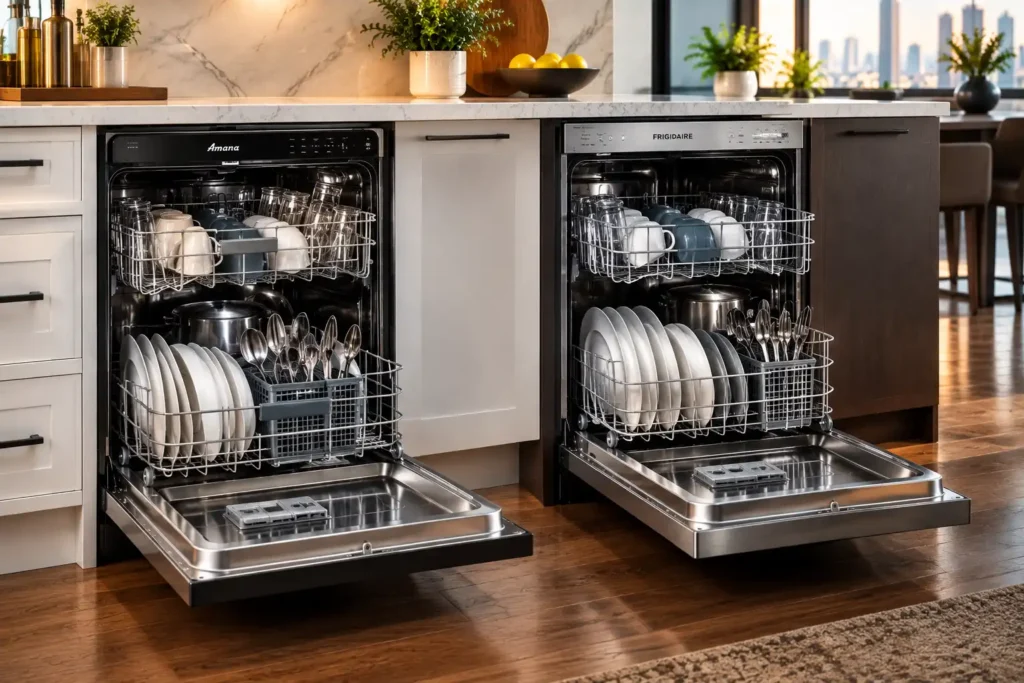
The most important observation is that the lowest-priced Frigidaire model is not necessarily the most efficient model. The FDPC4221AS can be less expensive to purchase, but it is not ENERGY STAR certified and is listed at 5 gallons of water per cycle in the Canadian specification. Meanwhile, the FFCD2413US and FDPC4314AS are ENERGY STAR certified at 3.2 gallons per cycle.
That distinction is critical for budget buyers because the cheapest dishwasher at checkout is not necessarily the cheapest dishwasher to own.
What Makes a Dishwasher a Good Budget Buy?
A budget dishwasher should not be evaluated solely by sticker price.
The purchase price is only one part of the total ownership cost. A dishwasher that costs $30 or $50 less initially but uses substantially more water and electricity over thousands of cycles may not provide the lowest long-term cost.
Likewise, a machine with an inexpensive purchase price but poor cleaning performance may require pre-rinsing, additional cycles, or manual washing. Those behaviors increase the real cost of ownership.
For this reason, an efficient budget dishwasher should ideally combine a reasonable purchase price with low resource consumption, adequate cleaning performance, acceptable noise, useful rack capacity, and reasonable reliability. Current efficiency criteria for standard-size dishwashers allow up to 3.2 gallons of water per cycle for ENERGY STAR qualification, while the federal standard is higher.
This is where Amana and Frigidaire become particularly interesting.
Current Amana Budget Dishwasher
The Amana ADFS2524RS is a useful example of the brand’s budget-oriented approach.
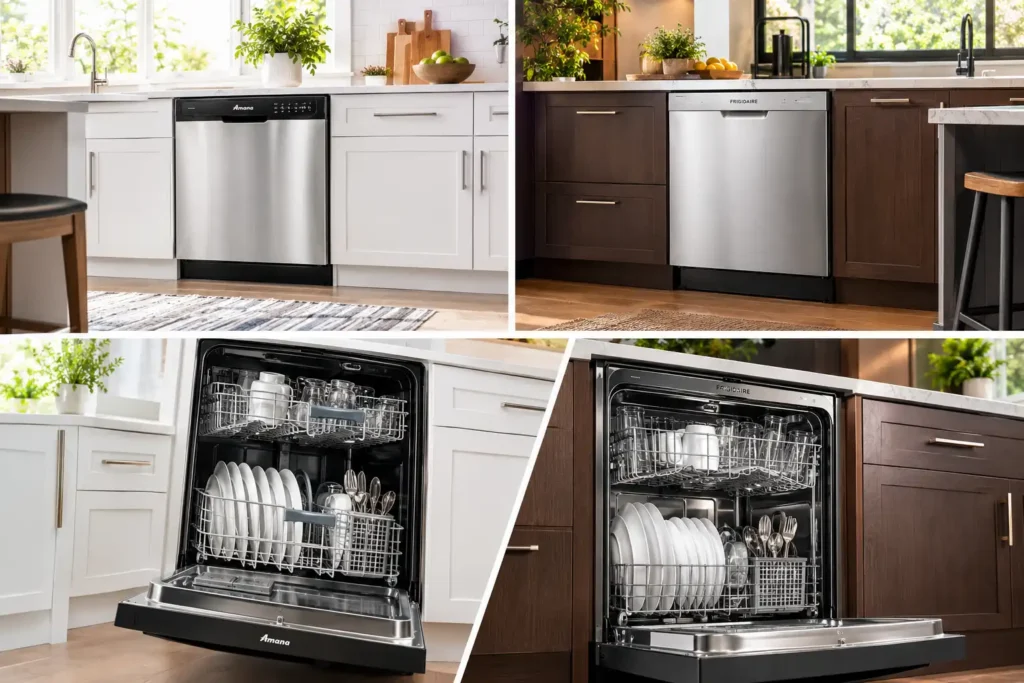
It is a 24-inch built-in dishwasher with a 12-place-setting capacity, three main cycles, front controls, a plastic tub, heated drying, a quick-wash cycle, and a triple-filter wash system. It is rated at 59 dBA.
The model is also ENERGY STAR certified and has a published water-use figure of 3.2 gallons per cycle and annual energy consumption of 240 kWh under the standardized test methodology.
That combination is significant for a budget dishwasher.
Amana has not attempted to load the machine with every premium feature available in the industry. Instead, the ADFS2524RS focuses on fundamental dishwasher functions: cleaning, filtration, drying, basic cycle choices, reasonable capacity, and efficiency.
For buyers who do not need Wi-Fi connectivity, multiple specialty programs, a third rack, advanced rack adjustment, or premium stainless-steel construction, this straightforward design can make sense.
Amana’s Biggest Budget Advantage: Simplicity
One of the most important reasons to consider Amana in the budget category is simplicity.
The ADFS2524RS provides three main cycles: Heavy, Normal, and Quick Wash. It also provides heated dry and a high-temperature wash option.
This is enough for many households.
A typical family may use Normal for everyday dishes, Heavy for pots and pans, and Quick Wash for lighter loads. There is no requirement for a complicated collection of specialty programs if those three basic options cover the household’s needs.
Simple controls can also be useful for households where multiple people use the dishwasher.
The trade-off is that buyers who want sophisticated customization will find fewer options.
Amana’s Triple Filter Wash System
Filtration is particularly important in an inexpensive dishwasher because effective filtration contributes to the machine’s ability to reuse wash water and keep food particles from being redeposited on dishes.
The ADFS2524RS uses a triple-filter wash system designed to capture food soils during the wash process. The manufacturer specifically describes the system as helping users avoid extensive pre-rinsing.
This is useful because unnecessary pre-rinsing can undermine the water savings of an efficient dishwasher.
Current efficiency guidance recommends scraping dishes rather than extensively rinsing them before loading. Modern filtration and wash systems are designed to handle food particles without requiring the user to wash dishes twice.
For a budget dishwasher, this is an important practical feature.
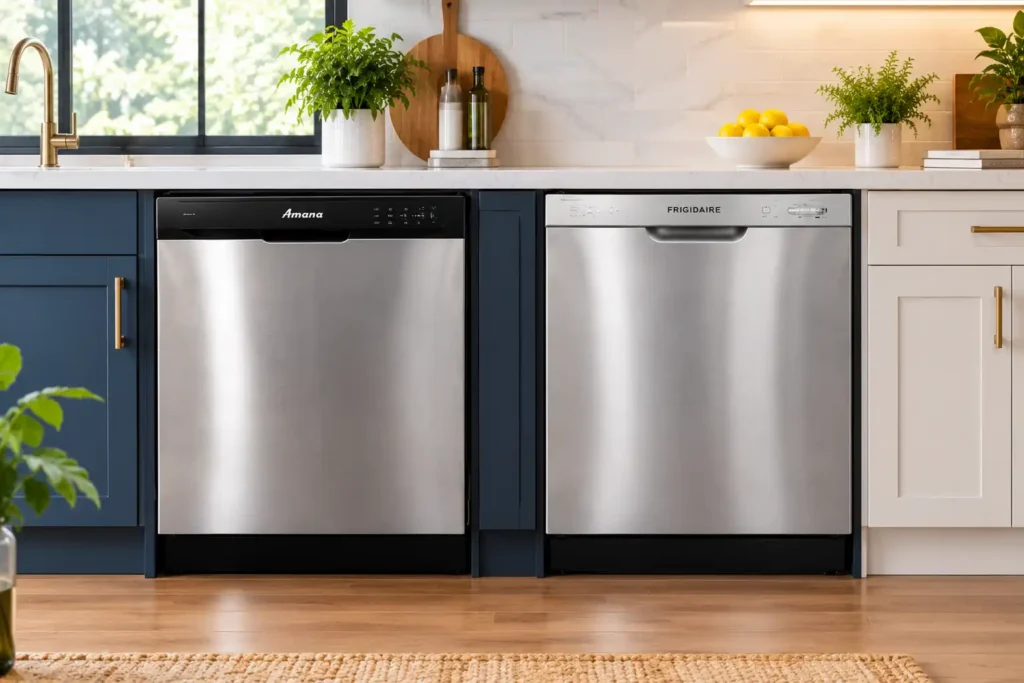
Amana Cleaning Performance
Budget pricing does not automatically mean poor cleaning performance.
Independent laboratory testing of the related Amana ADB1500ADS found excellent performance on heavily soiled dishes and excellent energy-use performance in that test. Another tested Amana ADB1400AGW performed very well on heavily soiled dishes and also received an excellent energy-use result.
However, these are different models from the current ADFS2524RS.
That distinction matters.
Test results for one model should not automatically be treated as proof that every dishwasher from the same brand performs identically. Dishwasher cleaning performance varies with spray-arm design, racks, filtration, wash programming, detergent, soil sensing, and other model-specific characteristics.
Still, the available independent testing provides evidence that Amana’s lower-cost dishwasher designs are capable of strong cleaning performance in some tested models.
Amana’s Limitations as a Budget Dishwasher
The main limitation is not that the Amana lacks basic cleaning functions.
Rather, it is that the model is relatively simple compared with some similarly priced Frigidaire alternatives.
The ADFS2524R family is listed without soil-sensing capability. It uses a plastic tub, front controls, two racks, and a relatively limited selection of cycles.
It also operates at 59 dBA.
That is not unusually loud for a budget dishwasher, but buyers who have an open-plan kitchen or frequently run the dishwasher while watching television may prefer something quieter.
A premium dishwasher can cost considerably more to obtain lower sound levels and more sophisticated rack systems.
Frigidaire’s Budget Dishwasher Range
Frigidaire approaches the budget segment differently.
Instead of concentrating on one simple budget configuration, it currently offers several models in the lower price range.
Current listings include the FDPC4221AS around $329, FFCD2413US around $359, FDPC4314AS around $399, and FDPH4316AS around $399, although actual prices change with promotions and location.
This creates a major advantage for consumers: more choice.
A buyer can select a lower-cost model and accept fewer efficiency features, or spend a little more and obtain ENERGY STAR certification and soil sensing.
That makes Frigidaire’s budget range broader than simply “one cheap dishwasher.”
Frigidaire FFCD2413US
The FFCD2413US is one of the most important models to consider when evaluating Frigidaire against Amana.
It is a 24-inch standard dishwasher with a 12-place-setting capacity, plastic tub, top controls, heated drying, and soil sensing. It is ENERGY STAR certified and rated at 3.2 gallons per cycle and 240 kWh per year.
That puts it remarkably close to the Amana ADFS2524RS on the basic efficiency specifications.
Both have:
- 12-place capacity
- 3.2-gallon water use
- 240 kWh annual energy use
- Plastic tubs
- Heated drying
- ENERGY STAR certification
The most notable specification difference is that the Frigidaire has soil sensing while the cited Amana model does not.
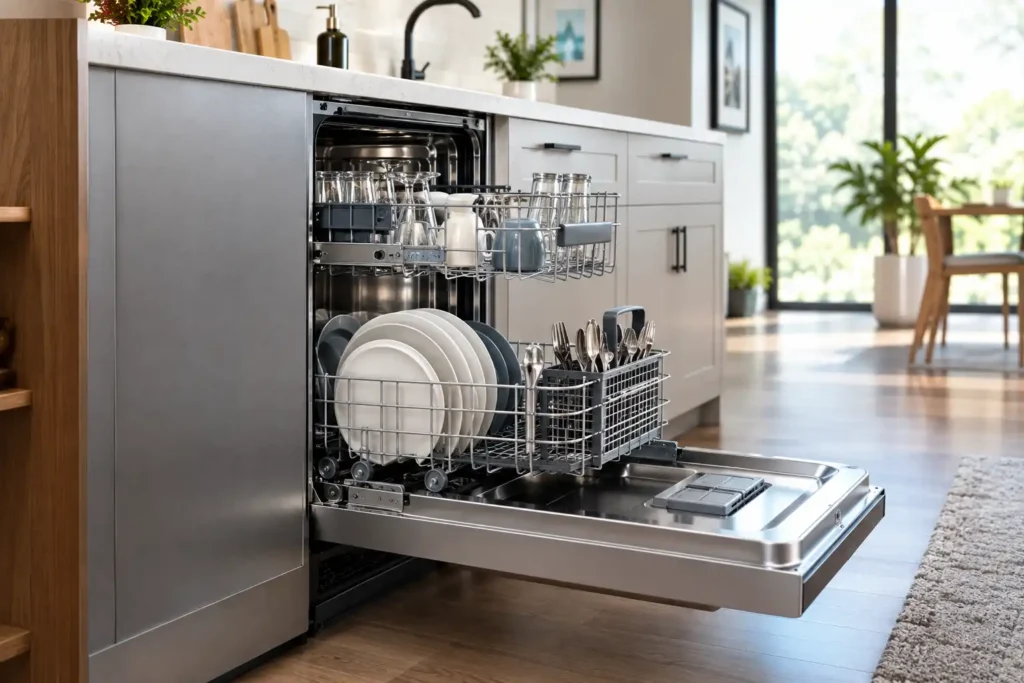
Frigidaire FFCD2413US Cleaning Performance
Independent testing of the FFCD2413US found very good washing performance on heavily soiled dishes. Its energy-use performance was rated good, while its noise performance was also rated good in that testing. Cycle time was judged poor under the demanding test conditions.
Again, this is model-specific testing rather than a statement about every Frigidaire dishwasher.
But it provides useful evidence for someone considering a budget Frigidaire.
The model is not simply a low-cost appliance with no performance data. It has been independently tested against heavily soiled loads, and the results indicate strong basic cleaning capability.
Frigidaire FDPC4314AS
If the budget allows approximately $40–$50 more than a basic Amana, the FDPC4314AS deserves attention.
Current retail listings place it around $399, although promotional pricing can change.
Its efficiency specifications are particularly attractive.
The model is ENERGY STAR certified, rated at 3.2 gallons per cycle, 240 kWh per year, and 12 place settings. It also includes soil-sensing capability.
This gives it a stronger feature set than a basic budget dishwasher while keeping it substantially below many premium models.
For consumers who can stretch the budget somewhat beyond the lowest price, this kind of model can be more interesting than simply buying the cheapest available dishwasher.
Frigidaire FDPC4221AS: The Cheapest Option
The FDPC4221AS demonstrates why purchase price and ownership cost must be considered separately.
Current retail listings have shown this model around $329, making it one of the least expensive 24-inch Frigidaire dishwashers in the current range.
It has a 12-place-setting capacity, five-level wash system, plastic tub, removable filter, hard-food filtration, heated drying, and a 62 dBA sound rating.
However, this model is not ENERGY STAR certified.
Its published Canadian specifications list 5 gallons of water consumption and 270 kWh of annual energy use.
That creates an important budget-shopping lesson.
If your only goal is the lowest upfront price, this model can be attractive.
If your goal is the lowest combination of purchase price and long-term utility consumption, an ENERGY STAR-certified model costing only a little more may make more sense.
Amana vs Frigidaire: Purchase Price
At current U.S. retail pricing, the budget comparison looks roughly like this:
| Model | Approximate current price |
|---|---|
| Frigidaire FDPC4221AS | $329 |
| Amana ADFS2524RS | $349 |
| Frigidaire FFCD2413US | $359 |
| Frigidaire FDPC4314AS | $399 |
| Frigidaire FDPH4316AS | $399 |
These are current examples rather than guaranteed prices. Promotions can change rapidly, and prices can vary by retailer, region, finish, installation package, and availability.
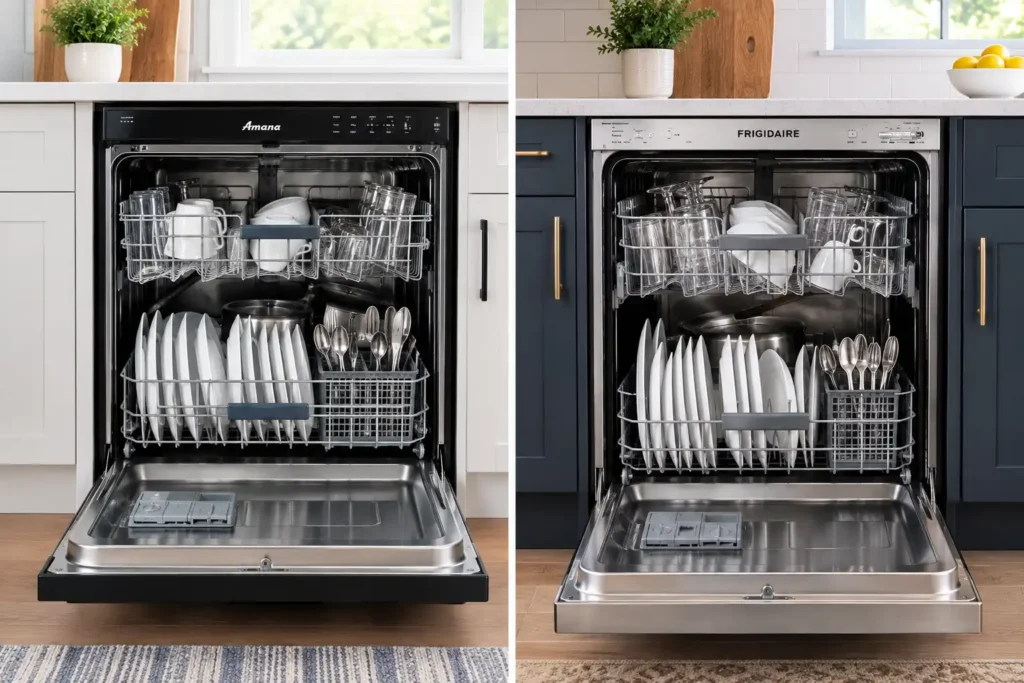
The difference between the least expensive and most expensive models in this small comparison is only about $70.
That is important.
For a dishwasher expected to remain in a kitchen for many years, spending an additional $30–$70 for improved efficiency or features may be reasonable if those features will actually be used.
Amana vs Frigidaire: Cleaning Performance
Cleaning performance should be one of the highest priorities when choosing a budget dishwasher.
A cheap dishwasher that leaves food residue on plates is not really a good value.
Independent testing shows that both brands have produced models with strong washing performance. The tested Amana ADB1500ADS performed excellently on heavily soiled dishes, while the Amana ADB1400AGW performed very well. The Frigidaire FFCD2413US also performed very well on heavily soiled dishes.
The important caveat is model specificity.
The ADFS2524RS is not the same machine as the ADB1500ADS, and the FFCD2413US is not identical to every other Frigidaire model.
Therefore, the safest conclusion is that both brands have demonstrated the ability to produce budget and mid-range machines with good cleaning performance, but individual models should be examined before purchase.
Amana vs Frigidaire: Drying Performance
Drying is another area where budget shoppers should look beyond price.
Both brands offer budget models with heated drying.
The Amana ADFS2524RS uses heated drying and also has a vented drying system. Its water-repellent silverware basket is designed to help reduce retained moisture on utensils.
The Frigidaire budget models also offer heated drying, while some models provide energy-saving no-heat drying options.
The FDPC4221AS, for example, includes an Energy Saver Dry option that reduces energy use by using no heat during drying.
The choice therefore depends on whether the buyer prioritizes faster, more complete drying or lower energy consumption.
Amana vs Frigidaire: Noise
Noise can make a surprising difference in daily satisfaction.
The current Amana ADFS2524RS is rated at 59 dBA.
The Frigidaire FFCD2413US is listed around 55 dBA in current retail specifications, while the FDPC4221AS is rated at 62 dBA.
This demonstrates why comparing brands rather than models is problematic.
One Frigidaire budget dishwasher can be noticeably quieter than an Amana model, while another Frigidaire model can be louder.
For open-plan kitchens, prioritize the exact model’s sound rating.
Amana vs Frigidaire: Water Efficiency
This category produces one of the clearest comparisons.
The Amana ADFS2524RS is rated at 3.2 gallons per cycle and 240 kWh annually.
The Frigidaire FFCD2413US and FDPC4314AS are also rated at 3.2 gallons per cycle and 240 kWh annually.
Therefore, the Amana does not have a meaningful water-efficiency advantage over these Frigidaire models.
All three are at the current ENERGY STAR threshold for standard-size dishwashers.
The FDPC4221AS is different, with a
published 5-gallon water-use figure and no ENERGY STAR certification.
For buyers who intend to keep their dishwasher for many years, this distinction can matter more than a
small difference in purchase price.

Why ENERGY STAR Matters for Budget Buyers
Efficiency certification is especially valuable when shopping on a budget because it provides a standardized performance benchmark.
Current criteria for a standard-size certified dishwasher are no more than 240 kWh per year and no more than 3.2 gallons per cycle.
That does not mean every ENERGY STAR dishwasher is identical.
But it does establish a useful minimum efficiency threshold.
Government lifecycle-cost analysis illustrates the difference between a 3.2-gallon dishwasher and a less-efficient 5-gallon model. At the standardized assumption of 215 cycles per year, 3.2 gallons corresponds to about 688 gallons of annual water use, while 5 gallons corresponds to about 1,075 gallons.
That is approximately 387 gallons of water difference per year under the standardized assumptions.
Is Amana More Reliable Than Frigidaire?
Reliability is difficult to answer with a simple brand statement.
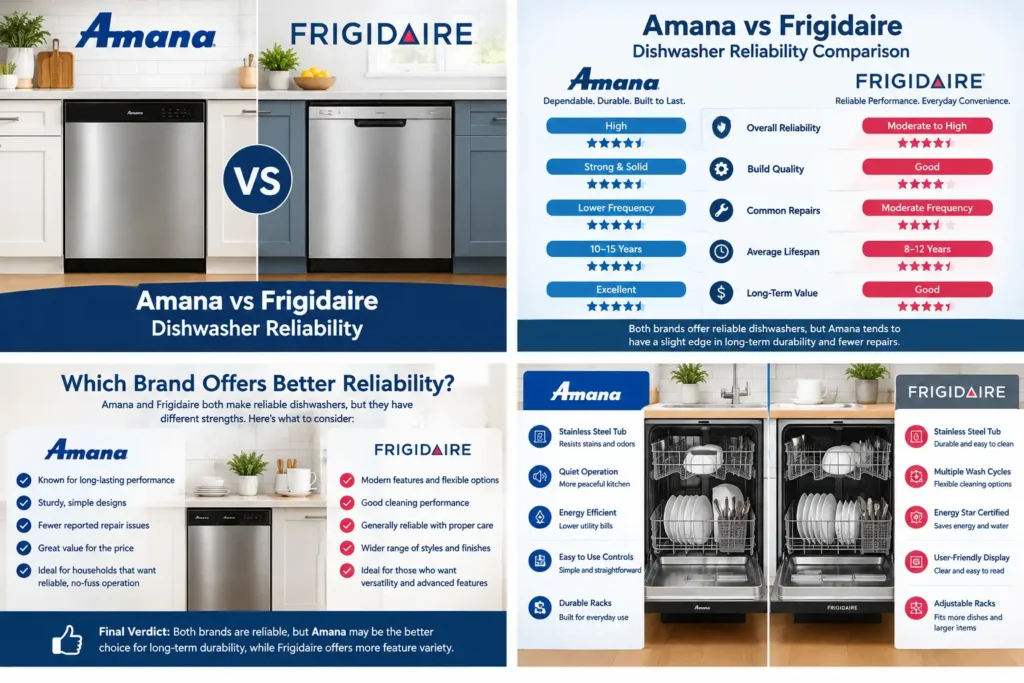
Large-scale reliability research evaluates thousands of owners and uses statistical methods to estimate the likelihood of a dishwasher experiencing a problem within a defined ownership period. Current data show measurable differences among dishwasher brands, but individual model reliability can still vary.
One current reliability dataset places Frigidaire above Amana in predicted dishwasher reliability, although this should not be interpreted as a guarantee for a specific model or as a prediction of what will happen to an individual owner’s machine.
For a budget buyer, this is useful information but should not be the only factor.
Warranty, local repair availability, parts availability, installation quality, and how heavily the dishwasher is used can all affect the practical ownership experience.
Amana vs Frigidaire: Ease of Use
Amana’s simplicity can be a genuine advantage.
The ADFS2524RS has three main cycles, front controls, cycle-status lights, and straightforward options.
Frigidaire offers a wider selection across its budget range.
Some models have top controls, soil sensing, additional cycles, and different rack and filtration configurations.
This means the choice comes down to the user’s preferences.
Someone who wants a straightforward appliance with few decisions may prefer the Amana design.
Someone who wants more automated control and model choices may find Frigidaire more attractive.
Amana vs Frigidaire for a Small Family
For a small family, a 12-place-setting dishwasher is generally sufficient for normal household use.
The Amana ADFS2524RS provides 12-place capacity. The comparable Frigidaire models discussed here also provide 12-place capacity.
The more important question is how often the machine will be run.
If a household runs one full load every day, efficiency can become more important.
If it runs the dishwasher only two or three times per week, the purchase-price difference may matter more than a small difference in annual resource consumption.
Amana vs Frigidaire for a Large Family
Large families generally benefit from efficient 24-inch machines with flexible loading and good cleaning performance.
Although the budget models considered here all provide around 12-place capacity, buyers with very large dish loads should carefully examine rack configuration.
A dishwasher with better rack flexibility can sometimes be more useful than one with a longer list of wash cycles because it allows more dishes to be loaded correctly.
Poor loading can reduce cleaning performance regardless of brand.
Therefore, families should examine the rack design in person whenever possible.
Amana vs Frigidaire for Apartments
Apartment buyers should pay particular attention to:
- Noise
- Width
- Installation clearance
- Water consumption
- Cycle duration
- Drying
- Front versus top controls
The 24-inch models discussed here are designed for standard built-in installations.
The Amana ADFS2524RS is approximately 23.9 inches wide and 24.5–25.3 inches deep depending on the measurement reference.
Frigidaire’s common 24-inch models similarly require careful measurement of the cabinet opening before purchase.
Never assume that “24-inch dishwasher” means every model has identical installation dimensions.
Amana vs Frigidaire for Hard Water
Hard water can affect dishwasher performance regardless of brand.
Mineral deposits can create spots and filming on glasses, silverware, and dishwasher components.
A budget dishwasher can still perform well in hard-water areas, but detergent choice, rinse aid, water temperature, and maintenance become particularly important.
If the household has very hard water, buyers should also consider whether the particular dishwasher provides appropriate filtration and whether the manufacturer recommends a particular maintenance procedure.
The dishwasher brand alone does not solve hard-water problems.
Amana vs Frigidaire for Pots and Pans
Pots and pans are a useful test of budget dishwasher capability.
Heavily soiled cookware requires more cleaning power than lightly used plates.
Independent testing of multiple Amana and Frigidaire models has shown good or very good performance on heavily soiled dishes, although results vary by model.
The best approach is to use the appropriate heavy cycle for baked-on food rather than expecting a normal or quick cycle to perform the same task.
This can also reduce the temptation to pre-wash everything by hand.
Amana vs Frigidaire: Plastic Tub
The inexpensive models discussed in this comparison generally use plastic tubs.
A plastic tub is not automatically a sign of poor cleaning performance.
The tub material can influence heat retention, noise characteristics, drying behavior, and perceived interior quality, but cleaning performance depends on many other components.
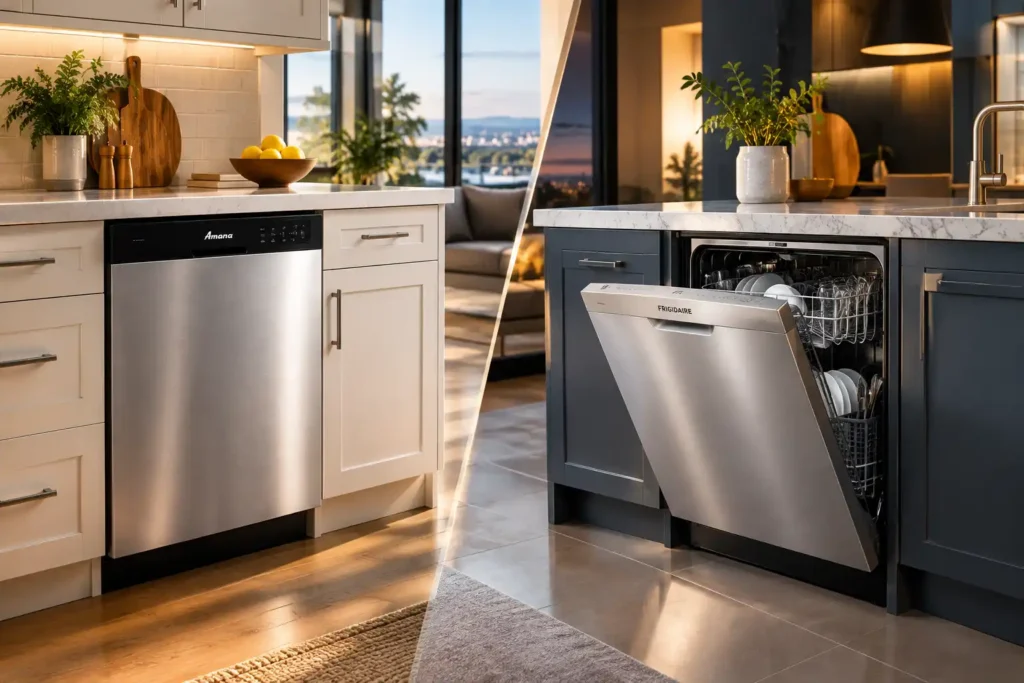
Both the Amana ADFS2524R family and several budget Frigidaire models use plastic interiors.
A buyer on a strict budget may therefore be better served by choosing a well-designed plastic-tub dishwasher with strong efficiency and cleaning performance than by spending substantially more simply to obtain a stainless-steel tub.
Amana vs Frigidaire: Warranty Considerations
Budget appliances should always be evaluated with warranty terms in mind.
A lower purchase price can become less attractive if a major component fails shortly after the warranty expires.
The current Amana model information lists a one-year warranty, while comparable budget Frigidaire models also commonly carry one-year limited warranty coverage.
Buyers should check the exact warranty documentation for the model and country because coverage can differ by market.
Installation quality is also important.
A dishwasher that is incorrectly leveled or connected can experience leaks, drainage problems, or door issues regardless of brand.
Amana vs Frigidaire: Parts and Service
Before buying a budget dishwasher, it is sensible to investigate local service availability.
This is especially important in smaller communities.
A dishwasher may be inexpensive to purchase, but if a service technician must travel a long distance or a replacement component is difficult to obtain, the total ownership experience can be less convenient.
Both brands have established North American appliance operations and parts/support infrastructure, but local availability should still be checked.
Canadian buyers should also confirm that the exact model is sold and supported in Canada rather than assuming that a U.S. model has identical support.
What About UK Buyers?
The Amana and Frigidaire models discussed in this article are primarily North American products.
That means UK buyers should not simply import a U.S. comparison based on price and assume the same purchasing conditions apply.
UK dishwashers use different energy-label conventions, electrical requirements, dimensions, and market-specific product ranges.
The UK energy label provides information such as eco-program water consumption in litres per cycle, energy consumption per 100 cycles, capacity, program duration, and noise.
Therefore, a UK consumer researching “Amana vs Frigidaire” should first confirm whether the exact model is officially available for the UK market.
If it is not, the more useful comparison is between equivalent budget models available under the UK’s electrical and appliance regulations.
What About Canadian Buyers?
Canada is particularly relevant because many of the current Amana and Frigidaire models are explicitly listed for both the United States and Canada.
The Amana ADFS2524R family, for example, is listed in the efficiency database for both markets.
The Frigidaire FFCD2413 family and FDPC4314 family are similarly listed for the United States and Canada.
Canadian buyers should still verify the Canadian product page and EnerGuide information for the exact model because specifications can differ between U.S. and Canadian versions.
Canada also emphasizes the benefits of efficient dishwasher operation, including running full loads and avoiding unnecessary pre-rinsing.
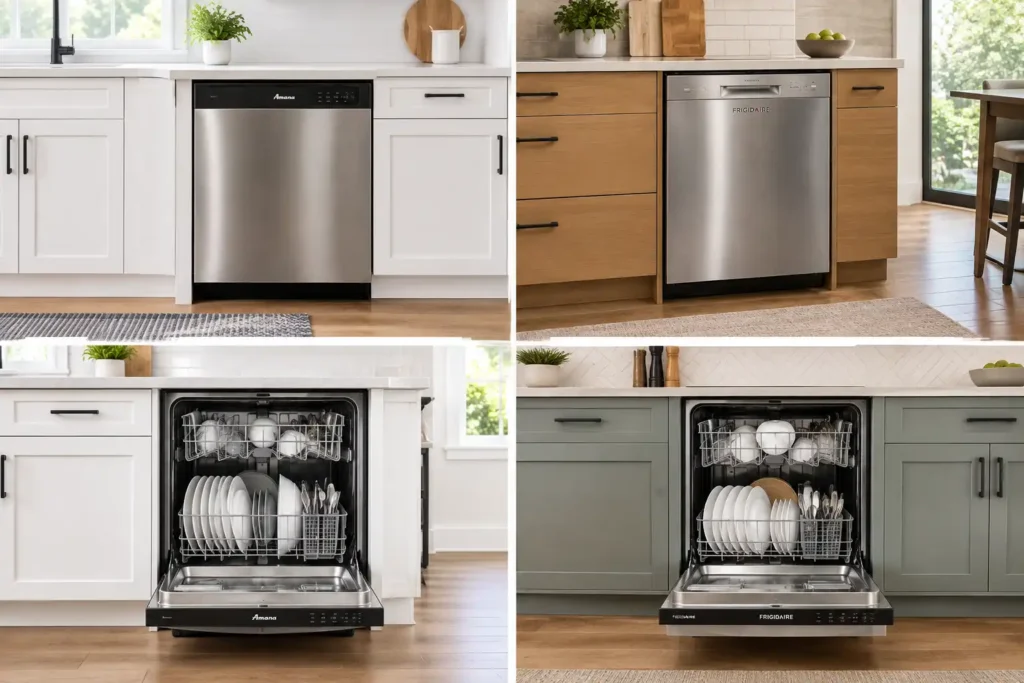
Is the Cheapest Frigidaire Better Than Amana?
Not automatically.
The Frigidaire FDPC4221AS can be cheaper than the Amana ADFS2524RS based on current retail listings.
But it uses substantially more water according to its Canadian specifications and does not carry ENERGY STAR certification.
The Amana costs more in the current examples but provides 3.2-gallon water consumption and ENERGY STAR certification.
Therefore, if the price difference is only around $20, a buyer should consider whether the lower resource consumption is worth more than the initial savings.
For someone buying strictly on the lowest possible upfront price, the cheaper Frigidaire remains relevant.
For someone considering total ownership cost, the efficiency difference deserves serious attention.
Is Amana Better Than Frigidaire for a Tight Budget?
Amana can be particularly attractive when simplicity is a priority.
The ADFS2524RS offers:
- 12-place capacity
- 3.2 gallons per cycle
- ENERGY STAR certification
- Heated drying
- Triple filtration
- Quick Wash
- Heavy and Normal cycles
- 59 dBA operation
- Basic front controls
It avoids many premium features while retaining the fundamental functions required by most households.
For someone who wants a straightforward dishwasher rather than a feature-heavy appliance, that simplicity can be valuable.
Is Frigidaire Better for Features on a Budget?
Frigidaire generally offers more choice within the budget segment.
The current lineup includes multiple sub-$500 models, including options with soil sensing, different control layouts, different sound levels, and different efficiency specifications.
This means buyers can tailor their purchase more closely to their priorities.
For example:
Lowest initial price: FDPC4221AS
Budget + ENERGY STAR: FFCD2413US
Budget + soil sensing + ENERGY STAR: FDPC4314AS
That flexibility is one of Frigidaire’s strongest advantages in this comparison.
Which Should You Buy Under $350?
If the actual selling prices are approximately $329 for the Frigidaire FDPC4221AS and $349 for the Amana ADFS2524RS, the comparison becomes interesting.
The Frigidaire saves about $20 initially.
The Amana provides ENERGY STAR certification and a 3.2-gallon-per-cycle rating compared with the Frigidaire’s 5-gallon figure in the Canadian specification.
For a dishwasher expected to run frequently for many years, the additional upfront $20 may be small relative to the potential difference in water and energy use.
However, households with very low dishwasher usage may place more value on the initial purchase price.
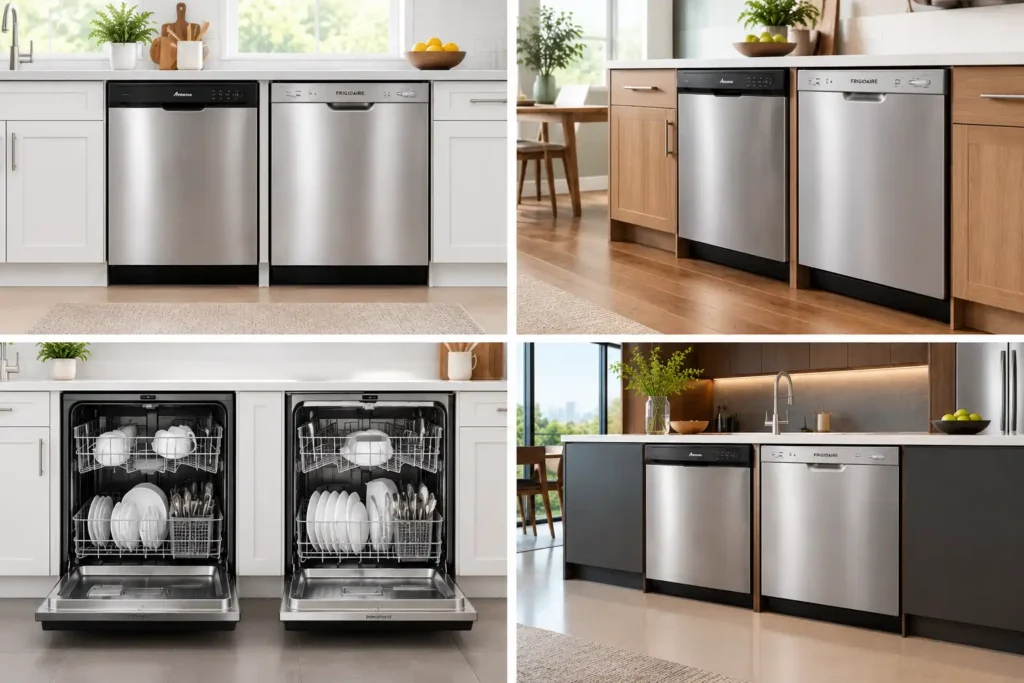
Which Should You Buy Around $350–$400?
This is where Frigidaire becomes particularly competitive.
The FFCD2413US is currently listed around $359 and is ENERGY STAR certified at 3.2 gallons per cycle.
The Amana ADFS2524RS is around $349 in the current retail snapshot and provides similar efficiency specifications.
The FDPC4314AS is around $399 and adds soil sensing while retaining the 3.2-gallon and 240-kWh efficiency specifications.
Therefore, the $350–$400 category provides substantially more choice.
Best Budget Dishwasher for Water Efficiency
If water efficiency is your primary concern, compare ENERGY STAR-certified models with a 3.2-gallon-per-cycle rating.
The Amana ADFS2524RS meets that benchmark.
The Frigidaire FFCD2413US meets it.
The Frigidaire FDPC4314AS also meets it.
The difference is therefore not really between Amana and Frigidaire.
It is between specific models.
That is an important distinction for anyone writing or researching budget dishwasher comparisons.
Best Budget Dishwasher for Simplicity
Amana has an advantage if simplicity is the priority.
The ADFS2524RS has three primary cycles and a relatively straightforward control system.
There is less emphasis on advanced automation.
For users who simply want to load dishes, select Normal, Heavy, or Quick Wash, and start the dishwasher, this approach can be appealing.
Best Budget Dishwasher for Features
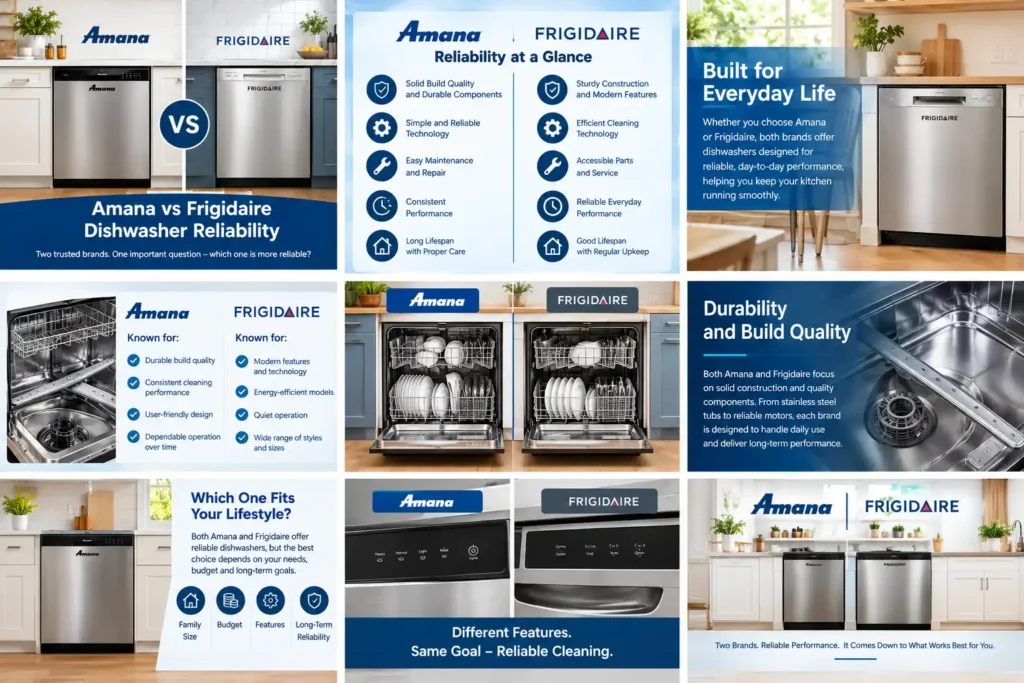
Frigidaire offers the broader feature selection.
Its budget range includes models with soil sensing, different control arrangements, different sound levels, and multiple efficiency levels.
This means consumers can choose according to their priorities rather than being locked into a single budget configuration.
Best Budget Dishwasher for a Frequent-Use Household
If the dishwasher will be used frequently, efficiency deserves significant weight.
A household running a dishwasher several times per week can accumulate thousands of cycles over the appliance’s lifetime.
A 3.2-gallon model and a 5-gallon model can therefore have a meaningful difference in cumulative water consumption.
The standardized annual calculation is 688 gallons for a 3.2-gallon dishwasher at 215 cycles per year, compared with 1,075 gallons for a 5-gallon dishwasher.
That is a difference of approximately 387 gallons per year under the standardized assumptions.
Best Budget Dishwasher for Occasional Use
If the dishwasher is used only occasionally, purchase price may carry greater importance.
For example, someone living alone who runs the dishwasher once or twice a week may not accumulate enough cycles for a relatively small efficiency difference to dominate the purchase decision.
However, efficiency still matters because an efficient dishwasher generally reduces water and energy use whenever it operates.
How to Get the Best Value From Either Brand
Regardless of whether you choose Amana or Frigidaire, operating habits matter.
Run full loads
A full dishwasher makes better use of the water and energy consumed by each cycle.
Avoid unnecessary pre-rinsing
Scrape food from dishes instead of thoroughly rinsing them under running water.
Choose the appropriate cycle
Do not automatically select Heavy for ordinary dishes.
Use Quick Wash appropriately
Quick cycles are intended for particular load conditions and are not automatically the lowest-water option.
Maintain the filter
A dirty or poorly maintained filter can interfere with cleaning performance.
Use rinse aid when appropriate
Rinse aid can improve drying and reduce spotting, especially in hard-water areas.
Load correctly
Spray arms need access to the dishes. Overloading can cause poor cleaning and force another cycle.
These practices are consistent with current efficiency guidance.
Amana vs Frigidaire: Long-Term Value
Long-term value depends on more than the purchase price.
Consider this simplified example.
Suppose:
- Dishwasher A costs $349
- Dishwasher B costs $329
At checkout, Dishwasher B saves $20.
But suppose Dishwasher A uses 3.2 gallons per cycle while Dishwasher B uses 5 gallons.
At 215 cycles per year:
Dishwasher A:
688 gallons/year
Dishwasher B:
1,075 gallons/year
Difference:
387 gallons/year
Over five years, that becomes approximately:
1,935 gallons
This does not automatically mean the more efficient dishwasher will save exactly a particular dollar amount because local water, sewer, electricity, and usage rates differ.
But it demonstrates why purchase price should not be the only measurement of budget value.
What Consumer Reviews Can and Cannot Tell You
Customer reviews are useful for identifying recurring practical issues.
They can reveal experiences with:
- Installation
- Door operation
- Rack loading
- Noise
- Drying
- Cleaning
- Controls
- Service
- Leaks
- Long-term ownership
But individual reviews should not be treated as controlled laboratory tests.
A dishwasher review may be affected by detergent, water hardness, loading technique, installation, expectations, and individual household conditions.
Independent testing is more useful for comparing controlled cleaning, energy, noise, and other performance characteristics, while owner surveys can provide information about reliability and satisfaction across larger populations.
The strongest buying decision combines both types of evidence.
Final Verdict: Amana or Frigidaire for a Budget Dishwasher?
The answer depends on what “budget” means to you.
If budget means the lowest possible purchase price, Frigidaire currently has an advantage because it offers models around the low-$300 range, including the FDPC4221AS.
If budget means low purchase price plus efficient operation, the comparison becomes much closer.
The Amana ADFS2524RS is currently around the mid-$300 range and combines a relatively simple design with ENERGY STAR certification, 3.2-gallon water consumption, 240 kWh annual energy use, 12-place capacity, heated drying, and triple filtration.
Frigidaire has several comparable choices.
The FFCD2413US provides 3.2-gallon water consumption, 240 kWh annual energy use, 12-place capacity, heated drying, and soil sensing.
The FDPC4314AS adds soil sensing while maintaining the same 3.2-gallon and 240-kWh efficiency specifications.
The FDPC4221AS is cheaper but sacrifices efficiency certification and uses more water according to its published Canadian specifications.
So the most useful way to think about this comparison is:
Amana = simple, efficient, straightforward budget appliance.
Frigidaire = broader budget range with more choices and more feature variation.
For someone who wants a simple dishwasher and does not need numerous features, Amana’s current budget model is highly competitive.
For someone who wants to compare several configurations and potentially obtain soil sensing, quieter operation, or different control arrangements without moving into premium pricing, Frigidaire offers more options.
The key is to compare the exact model and current selling price, not simply the brand name.
Frequently Asked Questions
1. Is Amana or Frigidaire better for a budget dishwasher?
Both offer credible budget choices. Amana’s current ADFS2524RS emphasizes simple operation and efficiency, while Frigidaire offers a wider selection of budget models with different feature and efficiency combinations.
2. What is the cheapest Amana dishwasher?
Current retail listings show the Amana ADFS2524RS around $349 in the United States, although prices vary by retailer and promotion.
3. What is the cheapest Frigidaire dishwasher?
Current listings include the FDPC4221AS around $329, although actual prices change frequently.
4. Is the cheapest Frigidaire better than Amana?
Not necessarily. The lower-priced Frigidaire FDPC4221AS is not ENERGY STAR certified and is listed at 5 gallons of water per cycle in Canadian specifications, while the Amana ADFS2524RS is ENERGY STAR certified and uses 3.2 gallons per cycle.
5. Which brand has better water efficiency?
There is no universal brand winner. Specific models from both brands use 3.2 gallons per cycle and meet current ENERGY STAR criteria.
6. Is Amana ADFS2524RS ENERGY STAR certified?
Yes. The ADFS2524R family is ENERGY STAR certified with a 3.2-gallon-per-cycle water rating and 240 kWh annual energy use.
7. Is Frigidaire FFCD2413US ENERGY STAR certified?
Yes. It is listed at 3.2 gallons per cycle and 240 kWh per year and is ENERGY STAR certified.
8. Does Frigidaire have a budget dishwasher with soil sensing?
Yes. The FFCD2413US and FDPC4314AS are examples of Frigidaire models with soil-sensing capability.
9. Does the Amana ADFS2524RS have a soil sensor?
The efficiency specification for the ADFS2524R family lists soil-sensing capability as no.
10. Which is quieter, Amana or Frigidaire?
It depends on the model. The Amana ADFS2524RS is rated at 59 dBA, while some Frigidaire budget models are rated lower and others higher.
11. Does Amana have a stainless-steel tub?
The ADFS2524R family discussed here uses a plastic tub.
12. Does Frigidaire have plastic-tub budget dishwashers?
Yes. Several current budget models use plastic tubs, including the FFCD2413US and FDPC4314AS.
13. Which has better drying, Amana or Frigidaire?
Both offer heated-drying options in relevant budget models. Actual drying performance depends on the exact model, rinse aid, load configuration, cycle, and selected drying option.
14. Is a $300 dishwasher worth buying?
It can be, provided the model offers adequate cleaning, reasonable efficiency, appropriate capacity, and acceptable warranty/service support. A very low purchase price should not be the only consideration.
15. Should I buy an ENERGY STAR dishwasher on a budget?
It is worth considering. Current efficiency criteria for standard-size ENERGY STAR dishwashers limit water consumption to 3.2 gallons per cycle and annual energy consumption to 240 kWh.
16. How much water can an efficient dishwasher save?
Under standardized assumptions, a 3.2-gallon dishwasher uses about 688 gallons annually at 215 cycles, compared with 1,075 gallons for a 5-gallon model.
17. Is Frigidaire reliable enough for a budget dishwasher?
Reliability varies by model. Large owner-survey datasets provide brand-level reliability estimates, but those figures should not be treated as guarantees for individual appliances.
18. Is Amana reliable enough for a budget dishwasher?
Amana has models that have performed well in independent testing, but reliability should be evaluated using the exact model, warranty, service availability, and current owner data rather than brand reputation alone.
19. Which is better for a small family?
Either can work. A 12-place-setting model such as the Amana ADFS2524RS or comparable Frigidaire models is suitable for many small-to-medium households.
20. Which is better for a large family?
Look beyond brand and focus on capacity, rack design, cleaning performance, cycle options, and efficiency. A 12-place dishwasher can be adequate for many families, but larger households should pay particular attention to how efficiently the racks accommodate their cookware and dishes.
21. Should I buy Amana or Frigidaire for hard water?
Neither brand automatically solves hard-water problems. Focus on filtration, detergent compatibility, rinse aid, maintenance requirements, and the water conditions in your home.
22. Is Frigidaire worth paying more for?
It can be when the additional cost buys a feature you will actually use, such as soil sensing, improved noise performance, or better efficiency. The value depends on the exact models being compared.
23. Is Amana worth buying instead of Frigidaire?
Amana can make sense for buyers who value a straightforward dishwasher with good efficiency and fewer complicated features. The ADFS2524RS provides 3.2-gallon water consumption, ENERGY STAR certification, 12-place capacity, triple filtration, and heated drying.
24. What should I look for in a $350 dishwasher?
Prioritize cleaning performance, water consumption, ENERGY STAR certification, capacity, noise, drying, filter design, rack usability, warranty, and local service availability.
25. What should I avoid in a cheap dishwasher?
Avoid choosing solely on the lowest price. Be cautious about models with high water consumption, poor rack flexibility, excessive noise, limited service availability, or features that do not match your household’s needs.
26. Does a cheap dishwasher use more water?
Not necessarily. The Amana ADFS2524RS and several Frigidaire models in the $350–$400 range use only 3.2 gallons per cycle.
27. Does Frigidaire make ENERGY STAR budget dishwashers?
Yes. Current Frigidaire models such as the FFCD2413US and FDPC4314AS are ENERGY STAR certified.
28. Does Amana have a quick wash cycle?
Yes. The ADFS2524RS includes a Quick Wash cycle.
29. Which is better for an apartment?
Look for a dishwasher with a suitable sound rating, correct dimensions, efficient water use, and appropriate installation requirements. The exact model is more important than the brand.
30. Which is the best budget dishwasher: Amana or Frigidaire?
There is no single answer independent of price and priorities. Amana’s current budget offering emphasizes simplicity and efficiency, while Frigidaire offers a broader range of budget configurations. The most useful comparison is between specific models at the prices available when you are ready to buy.
Final Buying Checklist
Before purchasing an Amana or Frigidaire budget dishwasher, check these points:
Price
Compare the actual sale price rather than the manufacturer’s suggested retail price.
Water consumption
Look for the gallons-per-cycle or litres-per-cycle figure.
ENERGY STAR
If water and energy savings matter, certification is an important benchmark.
Annual energy use
Compare the annual kWh figure rather than relying only on the purchase price.
Noise
For open kitchens, pay close attention to dBA.
Capacity
A 12-place-setting dishwasher is common in this price category.
Rack design
Make sure plates, bowls, glasses, pots, and pans fit comfortably.
Filtration
Good filtration supports effective cleaning and water reuse.
Soil sensing
This can be useful when load soil levels vary.
Drying
Check whether the dishwasher provides heated drying, air drying, or both.
Warranty
Check the exact warranty for the country where the dishwasher will be purchased.
Service
Confirm that replacement parts and authorized service are available locally.
Installation
Measure the cabinet opening carefully before ordering.
Total ownership cost
Consider water, electricity, detergent, rinse aid, repairs, and expected lifespan.
Conclusion
The Amana vs Frigidaire budget dishwasher comparison is not simply a matter of choosing whichever brand has the lowest advertised price.
Amana’s current ADFS2524RS is a straightforward, efficient 24-inch dishwasher that combines a 12-place capacity, 3.2-gallon water consumption, 240 kWh annual energy use, triple filtration, heated drying, and ENERGY STAR certification. Its relatively simple configuration makes it particularly suitable for buyers who want the fundamentals without paying for numerous premium features.
Frigidaire offers a wider selection. Its FFCD2413US and FDPC4314AS models provide 3.2-gallon water consumption, 240 kWh annual energy use, ENERGY STAR certification, and soil sensing, while the FDPC4221AS provides a lower purchase-price entry point but uses more water and does not carry ENERGY STAR certification.
That makes Frigidaire particularly interesting for buyers who want to select among several budget configurations.
Amana, meanwhile, makes a strong case for the buyer who values simplicity, efficient operation, basic cleaning functions, and a relatively straightforward appliance.
For U.S. and Canadian shoppers, the strongest comparison is therefore Amana ADFS2524RS vs Frigidaire FFCD2413US or FDPC4314AS, rather than simply “Amana vs Frigidaire.” For UK shoppers, the exact North American models should not be assumed to be available or electrically suitable; equivalent UK-market models should be compared using their local efficiency labels.
Most importantly, don’t judge a budget dishwasher only by its purchase price. A $20–$50 difference at checkout can be much less important over the life of the appliance than differences in water consumption, energy use, cleaning performance, noise, drying, reliability, and service.
For a buyer who wants a simple and efficient budget dishwasher, Amana’s current offering is highly competitive.
For a buyer who wants more budget configurations and additional features, Frigidaire provides a broader selection.
The final choice should come down to the exact model, current selling price, household usage, efficiency rating, installation requirements, and the features you will actually use.