
When buying a dishwasher, the purchase price is only part of the decision. A dishwasher may look inexpensive at the time of purchase, but if it requires repeated repairs or replacement after only a few years, the original savings can disappear quickly. This is why Amana vs Frigidaire dishwasher lifespan is an important comparison for homeowners, renters, landlords, and anyone trying to choose a dependable appliance.
Amana and Frigidaire both sell dishwashers across the budget and mid-range segments. Neither brand, however, can accurately promise that every dishwasher will last a specific number of years. Dishwasher longevity depends on the particular model, how frequently it is used, water quality, installation, maintenance, detergent, loading practices, component quality, and whether repairs are performed when smaller problems first appear. Large-scale reliability research also shows that reliability varies among brands and individual models, which makes a simple brand-wide lifespan number misleading.
Federal appliance-lifetime research provides a useful broader benchmark. Government analysis estimated an average dishwasher lifetime of approximately 15.2 years based on appliance age and survival data. This is a statistical estimate for the dishwasher category, not a guarantee that an individual Amana or Frigidaire dishwasher will operate for 15 years without repairs.
At the same time, current owner-survey research evaluates reliability differently. The latest large survey covered approximately 77,000 dishwashers purchased between 2015 and 2025 and examined the likelihood of experiencing a problem by the fifth year. The survey found that approximately 21% of the dishwashers represented had broken down or stopped working as well as they should, with cleaning, drying, and draining problems among the most frequently reported issues.
This distinction is extremely important. Lifespan and reliability are related, but they are not the same thing. A dishwasher may experience a pump, heater, drain, or control problem during its life and still remain in service after the component is repaired. Conversely, a dishwasher may be replaced early because the cost of repairing it is no longer considered worthwhile even though some of its components remain functional.
So, when comparing Amana and Frigidaire, the better question is not simply “Which dishwasher lasts longer?” Instead, the comparison should consider expected service life, five-year reliability, repairability, maintenance requirements, component failures, warranty coverage, and the cost of keeping the dishwasher operating over time.

Amana vs Frigidaire Dishwasher Lifespan at a Glance
| Lifespan factor | Amana | Frigidaire |
|---|---|---|
| General dishwasher lifespan benchmark | Around 15 years as a category-level statistical estimate | Around 15 years as a category-level statistical estimate |
| Manufacturer guaranteed lifespan | No fixed lifespan guarantee | No fixed lifespan guarantee |
| Typical basic warranty | Generally 1 year | Generally 1 year |
| Current reliability data | Brand-level five-year reliability data available | Brand-level five-year reliability data available |
| Budget models available | Yes | Yes |
| Plastic-tub models available | Yes | Yes |
| Replacement parts/support | Available | Available |
| Maintenance required | Yes | Yes |
| Filter maintenance | Important | Important |
| Lifespan strongly affected by usage | Yes | Yes |
| Lifespan strongly affected by installation | Yes | Yes |
| Lifespan strongly affected by water quality | Yes | Yes |
The most important point is that neither brand should be assigned a fixed “10-year” or “15-year” lifespan as if every machine will reach that age. The federal 15.2-year estimate describes the dishwasher category as a whole, while brand reliability research focuses on the probability of problems during the first five years.
What Is the Average Lifespan of a Dishwasher?
The commonly repeated idea that every dishwasher lasts exactly seven, ten, or twelve years is too simplistic.
Government analysis of dishwasher survival data produced an estimated average lifetime of approximately 15.2 years. The analysis used appliance shipment information and household appliance-age data to develop a statistical lifetime distribution.
That figure should not be interpreted as a manufacturer’s promise.
An average is created from a distribution of appliances. Some dishwashers will fail earlier, some will remain in service considerably longer, and many will require repairs during their service life.
The same research used a statistical survival model rather than assuming that every dishwasher reaches the average age. The model included a minimum and maximum range and an increasing failure rate as appliances became older.
Therefore, a homeowner should think about dishwasher lifespan in terms of probability and ownership economics, rather than an exact expiration date.
How Long Can an Amana Dishwasher Last?
An Amana dishwasher can potentially remain in service for many years, but the company does not provide a universal lifespan guarantee applying to every dishwasher.
Current manufacturer support information explains that Amana appliances are generally covered by limited warranty protection and that the exact warranty depends on the appliance type and model. The typical appliance warranty is around one year, but consumers should check the documentation for their specific dishwasher.
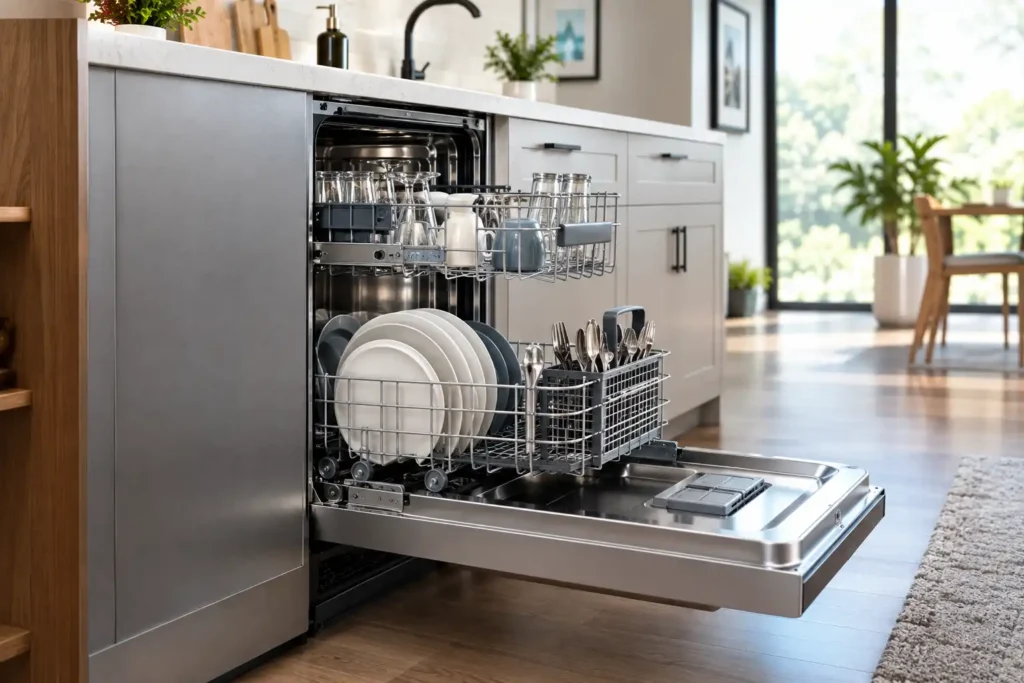
A one-year warranty should not be interpreted as meaning the dishwasher is designed to last only one year.
Warranty duration and expected service life are completely different concepts.
A manufacturer warranty primarily establishes the period during which specified defects or failures may be covered under the warranty terms. A dishwasher can remain functional for many years after the warranty expires.
The eventual lifespan depends on mechanical wear, electrical components, water exposure, maintenance, operating frequency, and repair decisions.
How Long Can a Frigidaire Dishwasher Last?
Frigidaire similarly does not provide a universal number of years that every dishwasher is guaranteed to operate.
Current Frigidaire product-support information for dishwasher models commonly lists a one-year manufacturer’s warranty, including one year for labor and parts on the example model shown in current support documentation.
Again, this is warranty coverage rather than expected lifespan.
A dishwasher can remain operational for many years after its warranty expires. However, the probability of requiring repairs generally increases as an appliance ages because components experience repeated heating, cooling, vibration, water exposure, chemical exposure, and mechanical movement.
Consequently, a dishwasher that reaches five years without a major problem is not necessarily near the end of its life, while a dishwasher that experiences a major failure at year six may still be economically repairable.
Amana vs Frigidaire: Which Has the Longer Lifespan?
There is no scientifically defensible universal answer that every Amana dishwasher will outlast every Frigidaire dishwasher, or vice versa.
Current large-scale reliability research does provide a useful comparison. In the latest reliability data, Frigidaire received a higher predicted reliability score than Amana: Frigidaire was listed at 65 and Amana at 58 on a 100-point scale. These scores represent predicted reliability through the first five years, rather than an estimate of total lifespan.
This is important because a five-year reliability score is not the same as a 10- or 15-year lifespan measurement.
It tells consumers something about the likelihood of experiencing a problem during the early ownership period, but it does not establish that one brand will necessarily remain functional longer at year 10, year 12, or year 15.
Model-level differences also matter.
A budget dishwasher from one brand can use different pumps, controls, filtration systems, racks, heaters, motors, and electronics than another dishwasher from the same brand.
For this reason, brand reliability data should be treated as one part of the purchasing decision rather than a prediction for an individual dishwasher.
What Does the Five-Year Reliability Data Actually Mean?
The latest large reliability survey is particularly useful because it includes approximately 77,000 dishwashers purchased between 2015 and 2025 across 27 brands.
The reliability measurement estimates the likelihood that a newly purchased dishwasher will experience a problem by the end of its fifth year, while accounting for factors such as usage and service-contract status.
Approximately 21% of the dishwashers in the survey were reported as having broken down or stopped working as well as they should.
The most common problems included:
- Cleaning performance
- Drying performance
- Drainage
- General operating problems
Cleaning problems accounted for approximately 9%, while drying and draining problems each accounted for approximately 7%.
This information is useful for understanding what owners actually experience.
However, a reported problem does not automatically mean the dishwasher was permanently discarded.
A dishwasher that stops draining may need a filter cleaning, drain-hose correction, pump repair, or replacement component. If repaired successfully, the dishwasher can potentially continue operating for years.
Reliability vs Lifespan: Why the Difference Matters
Suppose an Amana dishwasher develops a drain-pump problem after six years.
If the pump can be replaced economically, the dishwasher’s service life may continue.
Now suppose another dishwasher develops a major control-board failure after eight years and the replacement part plus labor costs almost as much as a new dishwasher.
The owner may decide to replace the machine.
In both situations, the dishwasher technically experienced a component failure, but the final lifespan depended partly on the economics of repair.
This is why appliance lifespan is influenced not only by engineering but also by repair cost, parts availability, labor rates, and consumer expectations.
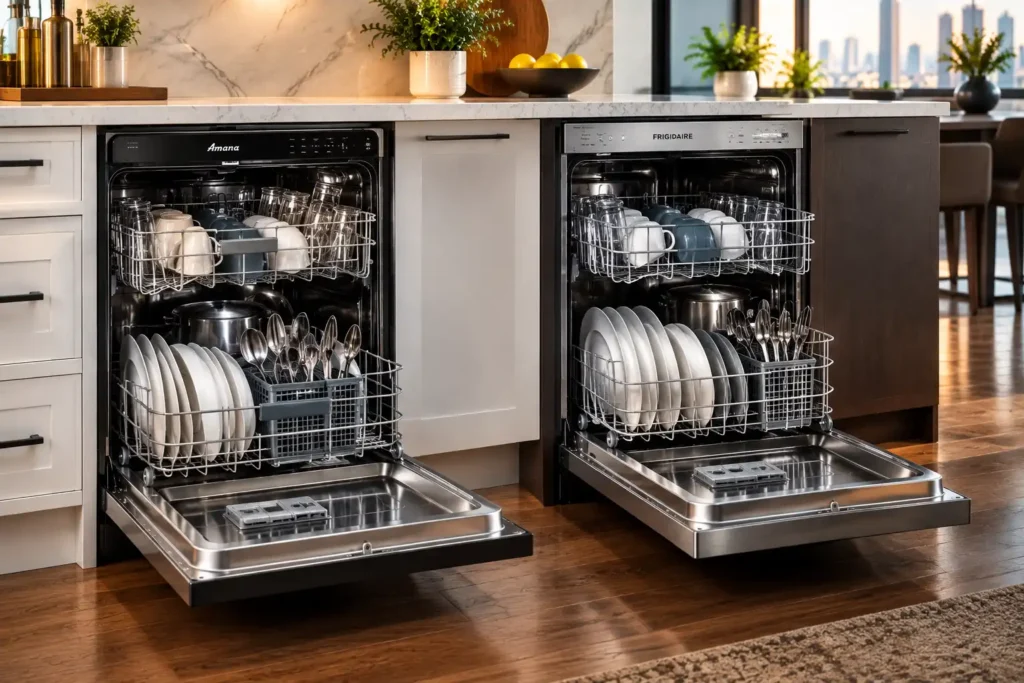
Amana Dishwasher Lifespan and Model Differences
One of the biggest mistakes when discussing Amana lifespan is treating every model as identical.
Amana has produced different dishwasher generations with different filtration systems, racks, control boards, pumps, tubs, heating elements, and cycle designs.
For example, independent testing of the Amana ADB1400AGW evaluated washing, energy consumption, noise, cycle time, and ease of use. The model uses a plastic interior and does not have a self-cleaning filter.
A different Amana dishwasher may have different specifications.
Therefore, someone researching the lifespan of a particular Amana model should investigate the exact model number rather than relying only on the Amana brand name.
This becomes particularly important when buying an older used dishwasher.
Frigidaire Dishwasher Lifespan and Model Differences
The same principle applies to Frigidaire.
The company sells different dishwasher platforms with different filtration arrangements, racks, controls, tubs, motors, drying systems, and cycle options.
For example, independent information for the Frigidaire FFCD2413US identifies a plastic interior and self-cleaning filter. Other Frigidaire models have different specifications.
Therefore, a Frigidaire dishwasher that has a different pump, filter, control system, or tub configuration cannot automatically be expected to have exactly the same lifespan.
When comparing two specific models, model-level evidence is more useful than a general brand reputation.
Does a Plastic Tub Reduce Dishwasher Lifespan?
A plastic tub does not automatically mean a dishwasher will have a short lifespan.
Plastic interiors are widely used in budget and mid-range dishwashers.
Tub material can affect heat retention, drying characteristics, noise, appearance, and resistance to certain forms of wear, but it is not the only factor controlling lifespan.
The pump, motor, seals, heater, control board, drain system, spray arms, racks, and installation can all influence how long the dishwasher remains usable.
Consequently, consumers should not assume that a plastic-tub Amana or Frigidaire dishwasher will automatically fail sooner than a stainless-steel dishwasher.
Does Stainless Steel Make a Dishwasher Last Longer?
Not necessarily.
A stainless-steel interior can provide advantages in terms of appearance, heat retention, and certain durability characteristics, but the interior tub is only one part of the appliance.
A dishwasher could have a stainless-steel interior and still experience a pump or electronic-control failure.
Conversely, a plastic-tub dishwasher can continue operating for many years if its mechanical and electrical components remain functional and the appliance is properly maintained.
Therefore, tub material should be considered as part of the overall construction rather than treated as a direct lifespan guarantee.
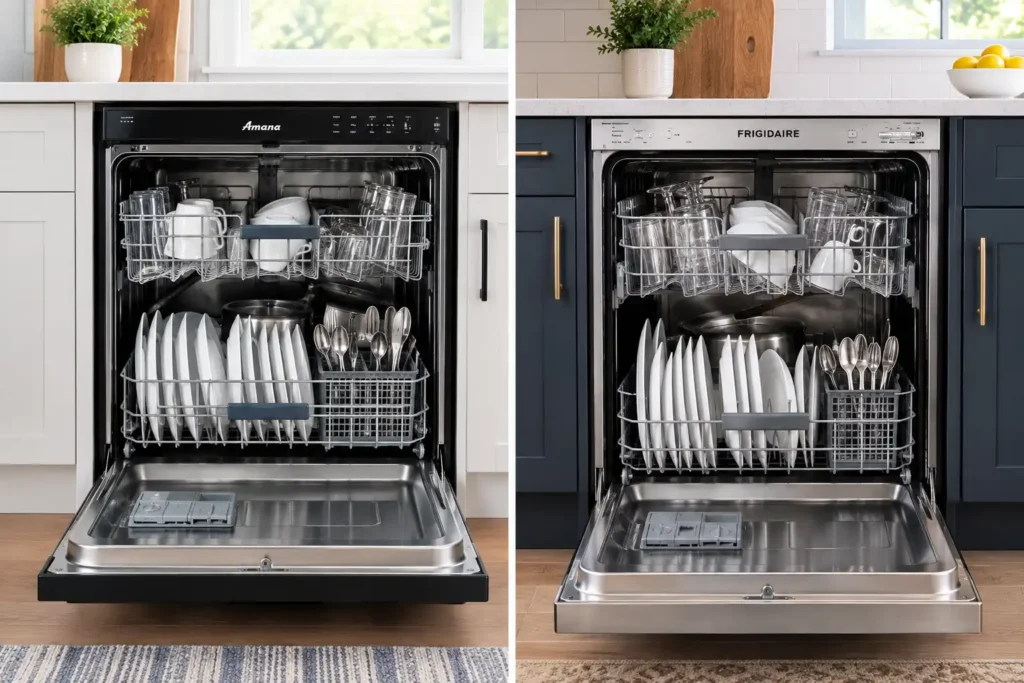
The Components That Usually Determine Dishwasher Lifespan
Several components have an especially important role in long-term dishwasher operation.
1. Circulation Pump
The circulation pump moves wash water through the spray system.
A failing pump can cause weak spray pressure, poor cleaning, unusual sounds, or failure to circulate water properly.
Because the pump is used repeatedly, it experiences mechanical wear throughout the dishwasher’s life.
2. Drain Pump
The drain pump removes wastewater from the dishwasher.
Drainage problems can also be caused by clogged filters, hoses, air gaps, garbage-disposal connections, or installation problems.
Frigidaire’s support information specifically identifies filter, glass-trap, and drainage maintenance as important when a dishwasher does not drain correctly.
Therefore, a dishwasher that appears to have a failing drain system may sometimes have a relatively simple blockage rather than a failed pump.
3. Heating Element
The heating system raises water temperature and can assist drying.
Repeated heating cycles place thermal stress on components.
A heating problem may result in poor cleaning, poor drying, or a dishwasher that takes unusually long to complete a cycle.
4. Control Board
Electronic controls are increasingly important in modern dishwashers.
The control board coordinates valves, pumps, heating, sensors, timing, and other functions.
Electronic failure can sometimes be expensive because the component itself can be costly and diagnosis requires service expertise.
5. Door Gasket and Seals
Door seals prevent water from escaping from the tub.
Over time, rubber and elastomer components can deteriorate.
A worn gasket can create leaks even when the dishwasher’s major mechanical components are still working correctly.
6. Water Inlet Valve
The inlet valve controls water entering the dishwasher.
A defective valve can cause insufficient filling or prevent the dishwasher from filling at all.
7. Spray Arms
Spray arms generally are not among the most expensive dishwasher components, but blocked spray holes can seriously affect cleaning.
Food particles and mineral deposits can restrict water flow.
Maintenance Can Make a Major Difference to Lifespan
Regular maintenance is one of the most practical ways to protect dishwasher longevity.
The manufacturer guidance for Amana specifically states that maintaining a clean filter is important for performance and longevity. It recommends regular inspection and cleaning, with more frequent cleaning for heavily used machines.
The guidance also notes that hard-water calcium deposits may require additional cleaning attention.
This matters because a dishwasher’s filtration system is exposed to food particles and debris every time the appliance operates.
A neglected filter can restrict water flow, interfere with cleaning, contribute to odors, and potentially increase strain on the wash system.
How Often Should an Amana Dishwasher Filter Be Cleaned?
Current maintenance guidance recommends cleaning the filter approximately once a month under frequent use, with more frequent cleaning potentially appropriate for households that run the dishwasher every day or have large families.
The exact requirement can vary by model.
Some Amana models have different filtration designs, so the owner’s manual should take precedence.
The important principle is simple:
Do not treat the dishwasher filter as a “set it and forget it” component.
Regular inspection and cleaning can help preserve wash performance and reduce the possibility of blockages.

How Often Should a Frigidaire Dishwasher Filter Be Cleaned?
Frigidaire’s current support guidance also provides cleaning procedures for dishwasher filters and glass traps.
The guidance recommends removing accumulated debris, rinsing filters under running water, and cleaning the fine and coarse filtration components as applicable to the dishwasher design.
Frigidaire also identifies clogged filters and spray arms as potential causes of poor cleaning performance.
Again, the exact schedule should follow the owner’s manual.
A household that runs a dishwasher several times a week may need more frequent inspection than someone who runs it once a week.
Hard Water and Dishwasher Lifespan
Water quality can significantly affect appliance maintenance.
Hard water contains dissolved minerals that can accumulate on internal and external surfaces.
Over time, mineral deposits can affect spray holes, filters, heating surfaces, valves, and other components.
Amana’s filter-maintenance guidance specifically mentions calcium deposits associated with hard water and notes that additional cleaning may be necessary.
For households in hard-water regions, regular cleaning and appropriate detergent/rinse-aid practices can therefore be particularly important.
Can Hard Water Shorten an Amana Dishwasher’s Life?
It can contribute to maintenance problems if deposits are allowed to accumulate.
Hard water does not mean an Amana dishwasher will automatically have a short lifespan.
Instead, the risk comes from failing to manage the mineral deposits.
A dishwasher operating in hard water may require more frequent filter, spray-arm, and interior cleaning.
The same principle applies to Frigidaire.
Can Hard Water Shorten a Frigidaire Dishwasher’s Life?
Potentially, if mineral buildup is severe and maintenance is neglected.
Frigidaire’s maintenance documentation specifically recognizes the importance of cleaning filtration components and addressing debris that can interfere with dishwasher operation.
For hard-water households, maintenance should therefore be considered part of normal appliance ownership rather than an optional activity.

Does Dishwasher Usage Frequency Affect Lifespan?
Yes.
A dishwasher that runs once or twice a week experiences fewer operating cycles than one that runs twice every day.
Every cycle involves:
- Water filling
- Pump operation
- Spray-arm movement
- Drainage
- Heating
- Cooling
- Door and seal exposure
- Electronic control operation
Over many years, those repeated cycles accumulate.
This does not mean a frequently used dishwasher will necessarily fail early. Modern appliances are designed for repeated use.
But usage frequency is one of the variables that should be considered when comparing two ownership situations.
A Dishwasher Used Once a Week vs Every Day
Consider two households.
Household A
The dishwasher runs twice per week.
That is approximately:
104 cycles per year
Household B
The dishwasher runs every day.
That is approximately:
365 cycles per year
Over five years:
Household A:
520 cycles
Household B:
1,825 cycles
The second dishwasher experiences more than three times as many cycles.
Therefore, when someone says, “My dishwasher lasted 12 years,” that statement does not provide enough information to compare it directly with another household’s dishwasher that lasted eight years.
Usage intensity matters.
Does Overloading Shorten Dishwasher Lifespan?
Overloading can contribute to problems indirectly.
If dishes block spray arms, the machine may not clean properly.
Users may then repeatedly run cycles, increase detergent, manually scrub dishes, or use more intensive programs.
Overloading can also interfere with racks and potentially damage components if heavy cookware is placed incorrectly.
Manufacturer guidance emphasizes proper loading because loading affects cleaning performance. Frigidaire specifically notes that improperly loaded dishes can result in poor cleaning.
Proper loading therefore supports both performance and efficient operation.
Does Pre-Rinsing Affect Dishwasher Lifespan?
Extensive pre-rinsing is generally unnecessary with modern dishwashers designed to handle food soils.
The more important concern is that excessive pre-rinsing wastes water and can change how the dishwasher’s sensors and cleaning system respond to the load.
Properly designed filters are intended to capture food particles.
Amana’s filter guidance explains that the filtration system prevents food particles from being recirculated onto dishes and helps maintain performance.
Rather than thoroughly washing dishes before putting them into the dishwasher, users should normally scrape off large food particles and load the dishes correctly.

Does Detergent Affect Dishwasher Lifespan?
Yes, detergent practices matter.
Using too much detergent can leave residue and may contribute to deposits.
Using too little detergent can result in poor cleaning and soil accumulation.
Frigidaire’s current support information recommends following detergent instructions and not exceeding recommended amounts. It also notes that detergent left in the dispenser can indicate an obstruction.
The appropriate detergent amount depends on the dishwasher, detergent formulation, water hardness, soil level, and manufacturer’s recommendations.
Does Rinse Aid Help a Dishwasher Last Longer?
Rinse aid is primarily intended to improve rinsing and drying performance rather than directly extend mechanical lifespan.
However, improved water drainage and reduced mineral spotting can help maintain the interior and dishware.
Rinse aid should therefore be considered a performance and maintenance aid rather than a guaranteed lifespan-extending product.
Amana vs Frigidaire Lifespan: Repairability
Repairability is one of the most important factors in practical lifespan.
A dishwasher that can be repaired economically may remain useful for several additional years.
Both Amana and Frigidaire provide product-support systems, manuals, troubleshooting information, replacement parts, and service resources for their dishwashers.
This matters because a dishwasher does not necessarily need to be discarded when a component fails.
If a pump, valve, gasket, rack component, or other replaceable part fails, repair may be possible.
The economics depend on the appliance’s age, repair cost, part availability, and the price of a comparable new dishwasher.
When Is a Dishwasher Repair Worth It?
A repair can make sense when:
- The dishwasher is relatively young.
- The failure is limited to one replaceable component.
- Replacement parts are readily available.
- The repair cost is relatively low.
- The dishwasher otherwise performs well.
- The appliance has good efficiency.
- There are no signs of corrosion or repeated failures.
For example, replacing a gasket or clearing a blockage can be very different financially from replacing an electronic control board.

When Is Dishwasher Replacement More Sensible?
Replacement may make more sense when:
- Multiple major components have failed.
- Repair costs are high.
- The dishwasher has repeated breakdowns.
- Water or energy consumption is substantially higher than current models.
- The tub or major structural components are damaged.
- Parts are difficult to obtain.
- The dishwasher has become unreliable.
- A major repair approaches the price of a replacement machine.
The correct decision depends on the specific situation rather than a universal age threshold.
Is a 10-Year-Old Amana Dishwasher Too Old?
Not necessarily.
A 10-year-old dishwasher can still be useful if it cleans properly, drains correctly, does not leak, and can be economically repaired when necessary.
The federal statistical lifetime estimate of approximately 15.2 years demonstrates why it would be inappropriate to assume that every dishwasher should be discarded at 10 years.
However, age does increase the probability that components will eventually require attention.
A 10-year-old dishwasher should therefore be evaluated based on condition rather than age alone.
Is a 10-Year-Old Frigidaire Dishwasher Too Old?
Again, not necessarily.
A well-maintained Frigidaire dishwasher can remain useful beyond 10 years.
The decision should consider its current condition, repair history, cleaning quality, noise, leaks, efficiency, and availability of replacement parts.
The age alone does not determine whether the dishwasher is still economically worthwhile.
Is a 15-Year-Old Dishwasher Worth Repairing?
This is where the economic calculation becomes more important.
At approximately 15 years, the appliance is approaching the federal category-level average lifetime estimate of 15.2 years.
That does not mean it must fail at 15 years.
It means the owner should consider whether a major repair is justified given the appliance’s age.
If the repair is inexpensive and the dishwasher is otherwise excellent, repairing it can still be reasonable.
If a major pump, heater, and electronic control all need replacement, purchasing a new efficient dishwasher may make more financial sense.
Amana vs Frigidaire: Lifespan and Cost of Ownership
Lifespan should always be considered together with operating costs.
The Department of Energy’s purchasing analysis estimates that an ENERGY STAR dishwasher using 3.2 gallons per cycle consumes approximately 688 gallons of water per year under the standardized 215-cycle assumption. A less-efficient 5-gallon model consumes about 1,075 gallons per year.

The same analysis estimated lower annual energy consumption for efficient models and calculated lifetime utility savings based on an assumed 15.2-year product life.
This demonstrates why a dishwasher that costs slightly more to purchase can potentially have a lower total ownership cost.
Does a Longer Lifespan Always Mean Better Value?
No.
Suppose an older dishwasher lasts 16 years but consumes considerably more water and electricity than a newer efficient dishwasher.
Another dishwasher may last 12 years while using significantly fewer resources and requiring fewer repairs.
The second appliance could potentially provide a competitive overall ownership cost despite having a shorter nominal service period.
Therefore, dishwasher value should be considered across:
- Purchase price
- Installation
- Energy consumption
- Water consumption
- Detergent
- Maintenance
- Repairs
- Replacement parts
- Service costs
- Useful service life
Amana vs Frigidaire: Lifespan in the USA
For U.S. consumers, current reliability and efficiency information provide the most directly applicable comparison.
The latest reliability survey places Frigidaire’s predicted five-year reliability score above Amana’s, while both brands have models that have undergone independent performance testing.
However, this should not be interpreted as proof that every Frigidaire will outlive every Amana.
U.S. buyers should investigate the exact model, current price, warranty, local repair network, and efficiency information.
Amana vs Frigidaire: Lifespan in Canada
Canadian buyers should pay attention to the exact Canadian model number.
Specifications can differ between U.S. and Canadian versions.
Canadian efficiency labeling provides standardized information that allows consumers to compare appliance energy performance. Dishwashers are among the appliances covered by the Canadian labeling system.

Canadian buyers should also consider:
- Water hardness
- Local electricity costs
- Water and sewer charges
- Availability of service technicians
- Parts availability
- Warranty terms
- Winter installation considerations
These factors can affect the practical ownership cost and lifespan experience.
Amana vs Frigidaire: Lifespan in the UK
UK buyers need to be more cautious about applying North American model comparisons.
Dishwasher models sold in the United States and Canada are not necessarily identical to models sold in the United Kingdom.
Electrical requirements, product configurations, dimensions, labeling, and market availability can differ.
UK consumers should therefore identify the exact UK-market model before relying on North American reliability or specification information.
The general lifespan principles remain applicable, but the exact model and support arrangements should be verified for the UK market.
How to Make an Amana Dishwasher Last Longer
If you own or are considering an Amana dishwasher, the following practices can help maintain it:
Clean the filter regularly
Amana specifically recommends regular filter cleaning and notes that frequent-use households may require more frequent maintenance.
Keep spray arms clear
Blocked spray holes can reduce cleaning performance.
Scrape large food particles
Avoid putting large amounts of food waste into the filtration system.
Use appropriate detergent
Follow the model and detergent instructions.
Use rinse aid when appropriate
This can improve drying and reduce spotting.
Avoid overloading
Give spray arms adequate access to the dishes.
Check for leaks
Address small leaks quickly rather than allowing water to damage surrounding components.
Maintain the door seal
Inspect the gasket for cracks, deformation, or accumulated debris.
Use the correct cycle
Avoid forcing a Quick cycle to handle extremely dirty cookware.
Address problems early
A small drainage or filling problem can sometimes be corrected before it develops into a more expensive failure.

How to Make a Frigidaire Dishwasher Last Longer
The same general maintenance principles apply to Frigidaire.
Clean filters and glass traps
Frigidaire provides specific guidance for cleaning filtration components and glass traps.
Keep spray arms clear
Debris can interfere with water distribution.
Load correctly
Improper loading can result in poor cleaning.
Use appropriate detergent quantities
Do not exceed recommended amounts.
Check drainage
Poor drainage can be caused by filters, hoses, air gaps, or other obstructions.
Maintain the door gasket
A damaged seal can result in water leakage.
Avoid unnecessary intensive cycles
Use the appropriate cycle for the soil level.
Respond to unusual noises
A new grinding, humming, or rattling sound can indicate a developing mechanical issue.
Early Warning Signs That an Amana Dishwasher May Be Aging
Watch for:
- Increasingly poor cleaning
- Water remaining in the tub
- Longer-than-normal cycles
- Unusual pump noise
- Grinding sounds
- Inconsistent water filling
- Poor drying
- Leaking around the door
- Cracked racks
- Persistent odors
- Repeated fault conditions
- Heating problems
One symptom does not necessarily mean the dishwasher is nearing the end of its life.
For example, poor cleaning can result from a dirty filter or blocked spray arms rather than a failing pump.
Amana’s maintenance information specifically identifies dirty filters as a potential cause of declining cleaning performance.
Early Warning Signs That a Frigidaire Dishwasher May Be Aging
Potential warning signs include:
- Poor cleaning
- Poor drying
- Failure to drain
- Unusual noises
- Water leaks
- Persistent odors
- Incomplete filling
- Heating problems
- Repeated error conditions
- Damaged racks
- Increasing cycle times
Frigidaire’s support information specifically notes that blocked filters, glass traps, and spray arms can contribute to poor cleaning and drainage problems.
Therefore, owners should diagnose simple maintenance problems before assuming that a major component has failed.
Does Noise Increase as a Dishwasher Gets Older?
It can.
Mechanical components such as pumps and motors may develop increased noise as they wear.
However, noise can also come from:
- Loose dishes
- Spray arms contacting cookware
- Debris
- Installation issues
- Pump obstruction
- Improper leveling
A sudden change in noise is more informative than the absolute noise level of an older machine.
If a dishwasher that has operated quietly for years suddenly develops a grinding or rattling sound, it is worth investigating.
Does Dishwasher Lifespan Depend on Installation?
Yes.
Correct installation is extremely important.
The dishwasher must be properly leveled, connected to the water supply, connected to drainage, and secured according to manufacturer instructions.
Incorrect drainage installation can contribute to drainage problems.
Improper leveling can affect door operation and water management.
Poorly installed connections can create leaks.
This is one reason a high-quality dishwasher can still have a poor ownership experience if it is incorrectly installed.
Can a Dishwasher Last 20 Years?
It is possible for individual dishwashers to remain in service for 20 years, but 20 years should not be treated as a normal guaranteed lifespan.
The federal statistical analysis estimates an average dishwasher lifetime of about 15.2 years.
Some appliances will fall below the average.
Some will exceed it.
A 20-year-old dishwasher should therefore be evaluated based on condition, repair history, efficiency, and safety rather than assuming it must be replaced simply because it has reached a certain age.
Can an Amana Dishwasher Last 15 Years?
It is possible.
The category-level federal average of approximately 15.2 years shows that dishwashers can remain in service for long periods.
But there is no basis for promising that a particular Amana model will definitely last 15 years.
Maintenance, usage, water quality, installation, component quality, and repairs all affect the outcome.
Can a Frigidaire Dishwasher Last 15 Years?
It is also possible.
A Frigidaire dishwasher that is well maintained and economically repaired may remain in service for many years.
The brand’s current five-year reliability data provides useful information about early ownership reliability but does not establish a maximum lifespan.
Is Amana or Frigidaire Better for Long-Term Ownership?
For long-term ownership, several factors should be evaluated together.
Current five-year reliability data gives Frigidaire a higher predicted reliability score than Amana in the cited large-scale survey.
At the same time, Amana has models that have performed strongly in independent cleaning and energy tests.
Therefore, long-term ownership should not be reduced to a single brand ranking.
A buyer should examine the exact dishwasher model and consider:
- Five-year reliability evidence
- Cleaning performance
- Energy and water consumption
- Warranty
- Parts availability
- Local service
- Filter design
- Pump and motor configuration
- Tub construction
- Purchase price
- Expected repair costs
- Household usage frequency
Amana vs Frigidaire Lifespan: What About Budget Models?
Budget models deserve particular attention because their purchase price is lower, but their component configuration may also be simpler.
That does not automatically mean a budget dishwasher has a short lifespan.
A relatively simple appliance can potentially be easier to maintain because it has fewer electronic features.
On the other hand, less expensive models may use simpler racks, plastic tubs, fewer sensors, and different filtration or sound-insulation arrangements.
The buyer should therefore compare the exact model rather than assuming that a more expensive dishwasher automatically lasts longer.
Does More Technology Reduce Dishwasher Lifespan?
Not necessarily.
Additional sensors and electronic controls create more components, but modern electronics can also improve efficiency and control.
A soil sensor, for example, can adapt the cleaning process to the load.
However, additional electronic components can also introduce additional potential failure points.
This is why buyers should not choose between “simple” and “advanced” technology solely on the assumption that one will automatically last longer.
The better question is whether the features provide enough practical value to justify their cost and potential repair complexity.
Should You Buy an Extended Warranty?
An extended warranty should be evaluated financially rather than automatically purchased.
Consider:
- Warranty price
- Coverage period
- Covered components
- Deductibles
- Service fees
- Exclusions
- Replacement policy
- Repair limits
- Dishwasher purchase price
The standard manufacturer’s warranty on many dishwasher models is around one year, so extended coverage can provide additional protection beyond that period.
However, whether it represents good value depends on the price and terms of the particular plan.
Does Regular Cleaning Really Extend Dishwasher Life?
Regular cleaning is not a guarantee of longer life, but it can help preserve performance and reduce avoidable problems.
Amana explicitly connects filter maintenance with appliance performance and longevity.
Frigidaire likewise recommends maintaining filters and glass traps and cleaning components when performance or drainage problems occur.
This means maintenance is not merely cosmetic.
It is part of normal dishwasher ownership.
Amana vs Frigidaire Dishwasher Lifespan: Overall Assessment
The available evidence supports several important conclusions.
First, there is no fixed Amana or Frigidaire lifespan that applies to every model.
Second, government analysis places the statistical average lifetime for dishwashers at approximately 15.2 years, but this is a category-level estimate rather than a guarantee.
Third, current large-scale reliability research measures reliability through the first five years and found a higher predicted reliability score for Frigidaire than Amana in the cited dataset. Frigidaire scored 65 compared with Amana’s 58 on the survey’s 100-point predicted reliability scale.
Fourth, this five-year reliability difference should not be translated directly into a claim that Frigidaire dishwashers will last a certain number of years longer than Amana dishwashers.
Fifth, maintenance matters. Filter cleaning, correct loading, proper detergent use, drainage maintenance, and prompt attention to developing problems can all help preserve dishwasher performance.
Finally, the best way to evaluate lifespan is to look at the exact model, not just the brand.
Frequently Asked Questions
1. How long does an Amana dishwasher last?
There is no fixed guaranteed lifespan. Government dishwasher-lifetime research estimates an average category lifespan of approximately 15.2 years, but individual Amana dishwashers can fail earlier or remain operational longer.
2. How long does a Frigidaire dishwasher last?
There is no universal guaranteed lifespan. A well-maintained Frigidaire dishwasher can remain operational for many years, while individual machines can require repairs earlier.
3. Is Amana more reliable than Frigidaire?
Current large-scale reliability data cited here gives Frigidaire a higher predicted five-year reliability score than Amana. However, this does not establish that every Frigidaire dishwasher will outlast every Amana dishwasher.
4. Is Frigidaire more reliable than Amana?
The cited five-year reliability survey reports a higher predicted reliability score for Frigidaire than Amana. The score measures the likelihood of experiencing a problem by the fifth year, not total lifespan.
5. Can an Amana dishwasher last 10 years?
Yes. A properly maintained Amana dishwasher can remain in service for 10 years or longer. However, no particular lifespan can be guaranteed.
6. Can a Frigidaire dishwasher last 10 years?
Yes. A Frigidaire dishwasher can remain operational for 10 years or longer, depending on model, usage, maintenance, installation, and repair history.
7. Can an Amana dishwasher last 15 years?
It is possible. The overall dishwasher category has an estimated average lifetime of approximately 15.2 years, but that figure should not be interpreted as an Amana-specific guarantee.
8. Can a Frigidaire dishwasher last 15 years?
It is possible. Individual appliances can exceed or fall below the category-level average lifespan.
9. Can a dishwasher last 20 years?
Some individual dishwashers can remain in service for 20 years, but 20 years should not be considered a guaranteed or universal lifespan.
10. What is the average dishwasher lifespan?
Government analysis estimates an average dishwasher lifetime of approximately 15.2 years.
11. Does a one-year warranty mean the dishwasher lasts only one year?
No. Warranty length and expected service life are different. A warranty specifies the period during which certain failures may be covered under the warranty terms.
12. What usually fails first in a dishwasher?
Potential failure points include pumps, heating components, inlet valves, door seals, drainage components, and electronic controls. Some apparent failures are actually caused by clogged filters, spray arms, or drainage pathways.
13. Does cleaning the filter extend dishwasher life?
Regular filter maintenance helps maintain cleaning performance and can help prevent avoidable blockages. Manufacturer guidance specifically emphasizes filter maintenance.
14. How often should I clean an Amana dishwasher filter?
Current guidance generally recommends monthly cleaning under frequent use, with more frequent cleaning potentially appropriate for daily-use households. Always follow the instructions for the exact model.
15. How often should I clean a Frigidaire dishwasher filter?
The appropriate interval depends on the model and usage. Frigidaire provides specific instructions for cleaning filter and glass-trap components and recommends keeping these areas free of accumulated debris.
16. Does hard water reduce dishwasher lifespan?
Hard water can contribute to mineral buildup and may increase maintenance requirements. Regular cleaning and appropriate detergent and rinse-aid practices can help manage these effects.
17. Does a stainless-steel tub last longer than a plastic tub?
Not necessarily. Tub material is only one factor. Pumps, motors, seals, heating components, electronics, installation, and maintenance can have major effects on lifespan.
18. Is a 10-year-old Amana dishwasher worth repairing?
It can be. Consider the repair cost, overall condition, efficiency, repair history, and availability of replacement parts rather than age alone.
19. Is a 10-year-old Frigidaire dishwasher worth repairing?
It can be, particularly if the required repair is inexpensive and the rest of the appliance is in good condition.
20. When should I replace an Amana dishwasher?
Replacement becomes more attractive when the machine has repeated major failures, extensive corrosion, expensive repairs, poor efficiency, or parts that are difficult to obtain.
21. When should I replace a Frigidaire dishwasher?
The same considerations apply: repair cost, age, efficiency, repeated failures, parts availability, and overall condition.
22. Does using the dishwasher every day shorten its life?
More frequent use means more operating cycles, but modern dishwashers are designed for repeated operation. Maintenance and proper use remain important.
23. Does overloading shorten dishwasher life?
Overloading can interfere with cleaning and water circulation and can contribute to poor performance. Correct loading is recommended for reliable operation.
24. Does using too much detergent damage a dishwasher?
Excess detergent can create residue and cleaning problems. Follow the detergent and dishwasher manufacturer’s recommendations.
25. Does Frigidaire have replacement parts?
Current support resources provide access to genuine replacement parts and certified service resources for supported models.
26. Does Amana have replacement parts?
Current support resources provide model-specific manuals, warranty information, and product-support resources, including information used to identify appropriate parts and service.
27. Which brand is better for long-term ownership?
There is no universal answer based solely on brand. Current five-year reliability data favors Frigidaire over Amana in the cited survey, while individual model performance and ownership conditions can differ significantly.
28. Does a more expensive dishwasher always last longer?
No. Purchase price does not guarantee lifespan. More expensive models may provide additional features, materials, quieter operation, or different construction, but individual component reliability still matters.
29. Is a budget Amana dishwasher worth buying?
It can be, particularly for buyers who want straightforward operation and are willing to maintain the dishwasher properly. The exact model should be evaluated before purchase.
30. Is a budget Frigidaire dishwasher worth buying?
It can be. Frigidaire offers multiple dishwasher configurations, and the exact model should be evaluated for reliability, efficiency, cleaning performance, noise, warranty, and service support.
Amana vs Frigidaire Dishwasher Lifespan: Final Conclusion
The question of Amana vs Frigidaire dishwasher lifespan does not have a simple “this brand lasts X years” answer.
The strongest available category-level evidence estimates the average dishwasher lifetime at approximately 15.2 years. That figure provides useful context but is not a promise for either brand or any particular model.
The latest large-scale reliability research provides a different type of evidence. It examines the likelihood of problems during the first five years and, in the cited dataset, gives Frigidaire a higher predicted reliability score than Amana.
That information is useful, but it should not be converted into a prediction that one brand will necessarily last several years longer.
For a buyer deciding between the two, the exact dishwasher model matters considerably.
Look at the model’s construction, filtration, pump system, controls, heating system, rack design, warranty, efficiency, service availability, and repair-part availability.
Then consider how the dishwasher will actually be used.
A household running one cycle every few days places a very different operating load on a dishwasher than a large family running two or three cycles every day.
Maintenance is equally important. Keeping filters and spray components clean, maintaining proper drainage, using appropriate detergent, loading correctly, managing hard-water deposits, and addressing small problems early can help preserve dishwasher performance and potentially prevent avoidable failures.
For USA buyers, current five-year reliability data provides a useful starting point, while efficiency and lifecycle costs provide additional context.
For Canadian buyers, the same reliability principles apply, but the exact Canadian model, efficiency label, water conditions, warranty, and service network should be checked.
For UK buyers, North American model numbers should not automatically be assumed to represent UK-market products. The exact UK model and local warranty/service arrangements should be verified.
Ultimately, an Amana or Frigidaire dishwasher should be viewed as a long-term appliance rather than a product with a predetermined expiration date.
A well-maintained dishwasher can potentially remain useful for many years beyond its warranty period. The most important factors are model selection, maintenance, usage intensity, installation quality, water conditions, repair economics, and the availability of parts and service.
That is why the most accurate conclusion is not that Amana or Frigidaire has a guaranteed longer lifespan. Instead, current evidence suggests that Frigidaire has the stronger five-year predicted reliability result in the cited survey, while both brands can produce dishwashers capable of long service, and individual model selection and maintenance remain critical to actual lifespan.