
When comparing Amana vs Frigidaire dishwashers, water consumption is an important factor that is sometimes overlooked. Many buyers focus on cleaning performance, drying, noise, racks, reliability, and price, but the amount of water a dishwasher uses during every cycle can also affect household utility costs and long-term resource consumption. Modern dishwashers are designed to reuse and filter wash water rather than continuously use fresh water, which allows them to clean a full load with considerably less water than many people expect.
The important point, however, is that water usage is primarily a model-specific characteristic rather than a simple brand characteristic. Two dishwashers carrying the same brand name can use different amounts of water depending on their design, cycle selection, capacity, sensors, filtration system, and efficiency certification. Current representative standard-size Amana and Frigidaire models provide a useful example: both can be rated at approximately 3.2 gallons of water per cycle under the standardized efficiency test.
That means a simple statement such as “Amana uses less water than Frigidaire” or “Frigidaire uses less water than Amana” would be misleading without identifying the exact models. For buyers comparing the two brands, the better approach is to examine the water-use figure for the specific dishwasher, understand which cycle produced that rating, and then consider how the dishwasher will actually be used at home.
This detailed comparison explains Amana vs Frigidaire dishwasher water usage, gallons per cycle, liters per cycle, annual water consumption, normal versus heavy cycles, water-saving technologies, soil sensing, filtration, cycle selection, hard-water considerations, handwashing comparisons, and the differences between U.S., Canadian, and UK efficiency labeling.
Amana vs Frigidaire Dishwasher Water Usage at a Glance
For a straightforward comparison, two current standard-size models provide useful reference points.
| Water-use factor | Amana | Frigidaire |
|---|---|---|
| Representative standard model | ADFS2524R** | FFCD2413**** |
| Rated water consumption | 3.2 gallons/cycle | 3.2 gallons/cycle |
| Approximate liters/cycle | 12.1 L | 12.1 L |
| U.S. federal maximum for standard dishwasher | 5.0 gallons/cycle | 5.0 gallons/cycle |
| ENERGY STAR threshold | 3.2 gallons/cycle | 3.2 gallons/cycle |
| Standard capacity | 12 place settings | 12 place settings |
| Annual energy-use figure | 240 kWh/year | 240 kWh/year |
| Soil sensing | No | Yes |
| Market availability listed | U.S. and Canada | U.S. and Canada |
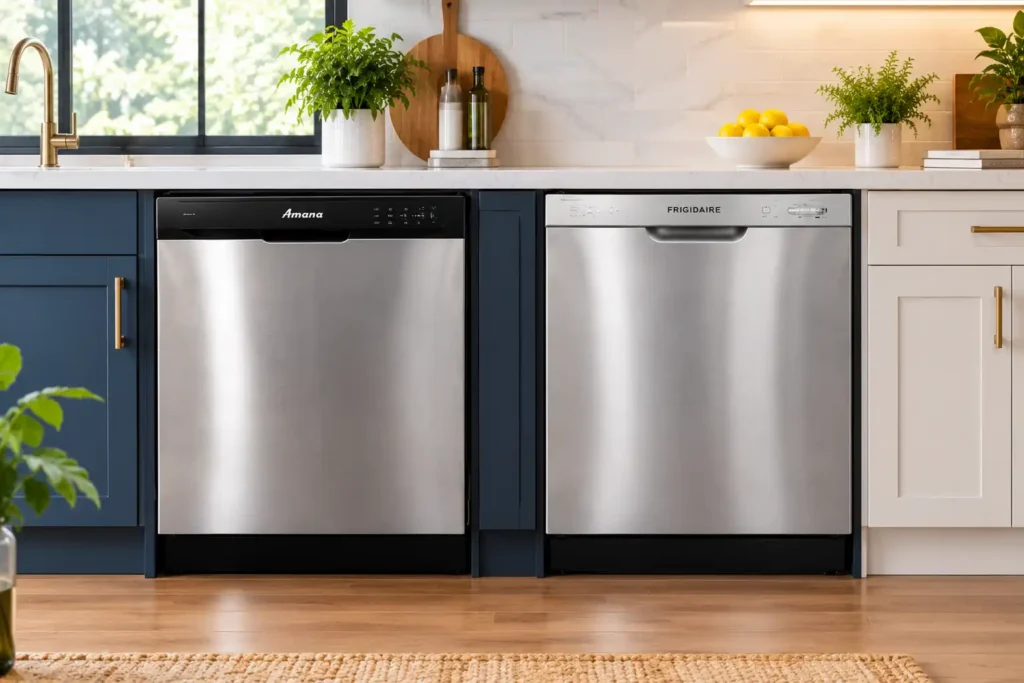
The current Amana ADFS2524R series and Frigidaire FFCD2413 series are both listed at 3.2 gallons per cycle, meaning their standardized water-consumption figures are essentially identical. Both are also 36% below the 5.0-gallon federal maximum for standard residential dishwashers.
Therefore, if water consumption alone is the deciding factor between these particular models, there is no meaningful water-use advantage based on the rated gallons-per-cycle figure. The differences become more interesting when you examine cycle selection, sensing technology, filtration, and how much water may be used during different programs.
What Does Dishwasher Water Usage Actually Mean?
Dishwasher water consumption is normally expressed as gallons per cycle in the United States and Canada and commonly as litres per cycle in Canada and the United Kingdom.
A water-use figure such as 3.2 gallons per cycle does not necessarily mean that every program in the dishwasher will use exactly 3.2 gallons. It represents consumption under a standardized test procedure designed to allow consumers to compare similar machines. Actual consumption can vary according to the settings selected and the conditions under which the machine operates.
For example, a dishwasher may have a normal cycle that forms the basis of its efficiency rating, while a heavy-duty cycle may use additional water to deal with baked-on food. A quick cycle can also behave differently because its objective is to complete cleaning more rapidly rather than necessarily minimize water consumption.
This distinction is particularly important when comparing Amana and Frigidaire. Looking only at the headline water-use number can make two machines appear identical even though their individual programs may behave differently.
Amana Dishwasher Water Usage
Current standard-size Amana dishwashers can achieve very low water consumption. A current ADFS2524R-series dishwasher is listed at 3.2 gallons per cycle, equivalent to approximately 12.1 litres per cycle. It is a 12-place-setting standard dishwasher and is listed at 240 kWh of annual energy use under the standardized test methodology.
The 3.2-gallon figure is important because it places the model at the current U.S. efficiency threshold for ENERGY STAR qualification for standard residential dishwashers. The current qualification limit for a standard dishwasher is no more than 3.2 gallons per cycle.
This means a modern Amana dishwasher does not need to use large amounts of water to clean a full load. Instead, the dishwasher uses a combination of controlled water delivery, spray pressure, filtration, detergent chemistry, temperature, and circulation to repeatedly expose dishes to cleaning water.
The result is that the water inside the machine is not simply used once and immediately discarded. The dishwasher’s wash system is designed around controlled circulation and reuse before dirty water is drained and replaced with cleaner water for later stages.
Frigidaire Dishwasher Water Usage
Frigidaire also has standard-size models with very low water consumption. The current FFCD2413 series, for example, is listed at 3.2 gallons per cycle, with a 12-place-setting capacity. Its standardized annual energy figure is 240 kWh, and the model is listed as using 36% less water than the applicable 5.0-gallon federal standard.
This puts the representative Frigidaire model at exactly the same headline water-consumption level as the current Amana model discussed above.
The manufacturer’s support information also describes typical dishwasher water consumption as approximately 3–4 gallons per cycle, although the exact amount depends on the particular dishwasher and operating conditions.
Therefore, Frigidaire cannot reasonably be characterized as a high-water-use dishwasher brand based on current standard models. Modern Frigidaire machines are designed to operate within contemporary efficiency requirements, and many current models carry efficiency certification.
Amana vs Frigidaire: Which Uses Less Water?
For the representative current models examined here, neither has a water-use advantage.
Both are rated at 3.2 gallons per cycle.
That equals approximately:
- 3.2 U.S. gallons
- 12.1 litres
- 0.85 gallons per place setting for a 12-place-setting machine
- approximately 688 gallons per year at 215 cycles
- approximately 2,604 litres per year at 215 cycles
The annual calculation is based on the standardized assumption of 215 cycles per year used in the U.S. dishwasher efficiency methodology.
This is one of the most important conclusions in an Amana vs Frigidaire water-use comparison: the exact model matters more than the logo on the front of the dishwasher.
If an Amana model is rated at 3.2 gallons and a Frigidaire model is rated at 3.2 gallons, choosing one over the other will not materially change water consumption solely because of the brand.
How Much Water Does a Dishwasher Use Per Cycle?
A modern efficient standard dishwasher can use roughly 3.2 gallons per standardized cycle.
Three-point-two gallons is approximately 12.1 litres.
For comparison, the current U.S. federal maximum water-use standard for a standard residential dishwasher is 5.0 gallons per cycle, or about 18.9 litres. A dishwasher using 3.2 gallons therefore uses approximately 36% less water than that maximum.
However, it is important not to interpret 3.2 gallons as a guarantee that every cycle will always use exactly 3.2 gallons. The efficiency test provides a standardized comparison figure, while actual use can change according to cycle and options.
This explains why an owner’s experience can sometimes differ from the number printed on the product information.
Amana Normal Cycle vs Heavy Cycle Water Usage
The difference between rated consumption and actual program consumption can be seen particularly clearly in Amana’s published cycle information.
A published Amana dishwasher cycle guide lists approximately 3.01 gallons (11.38 litres) for its normal cycle, approximately 7.47 gallons (28.28 litres) for its heavy cycle, and approximately 5.80 gallons (21.94 litres) for its quick cycle on the models covered by that guide.
This demonstrates why consumers should not assume that every program uses the same amount of water.
The normal program is designed for typical everyday loads and can use relatively little water. The heavy program is designed for difficult loads containing baked-on food, pots, pans, casseroles, and other heavily soiled items. It can therefore require substantially more water.
The quick program can also use more water than the normal program. This may seem counterintuitive, but a short cycle does not necessarily mean a low-water cycle. The dishwasher has less time to perform its cleaning process, so the program may use additional water or different spray patterns to achieve its objective.
Does Frigidaire Use More Water on Heavy Cycles?
Frigidaire’s published guidance similarly emphasizes that actual water consumption depends on the dishwasher and cycle being used. Its support information describes typical use in the range of approximately 3–4 gallons per cycle and notes that the dishwasher’s limited water volume makes the temperature of the incoming water important to cleaning performance.
The important takeaway is that the rated 3.2-gallon number should not be interpreted as the maximum amount of water that every program can use.
Heavy-duty programs, sanitation options, additional rinses, and other specialized functions can alter the amount of water and energy consumed.
For a fair comparison, therefore, consumers should compare the normal or standardized water-use figures between equivalent models and then separately consider whether they regularly use heavy, quick, sanitize, or other specialized cycles.
Why Does the Dishwasher Need So Little Water?
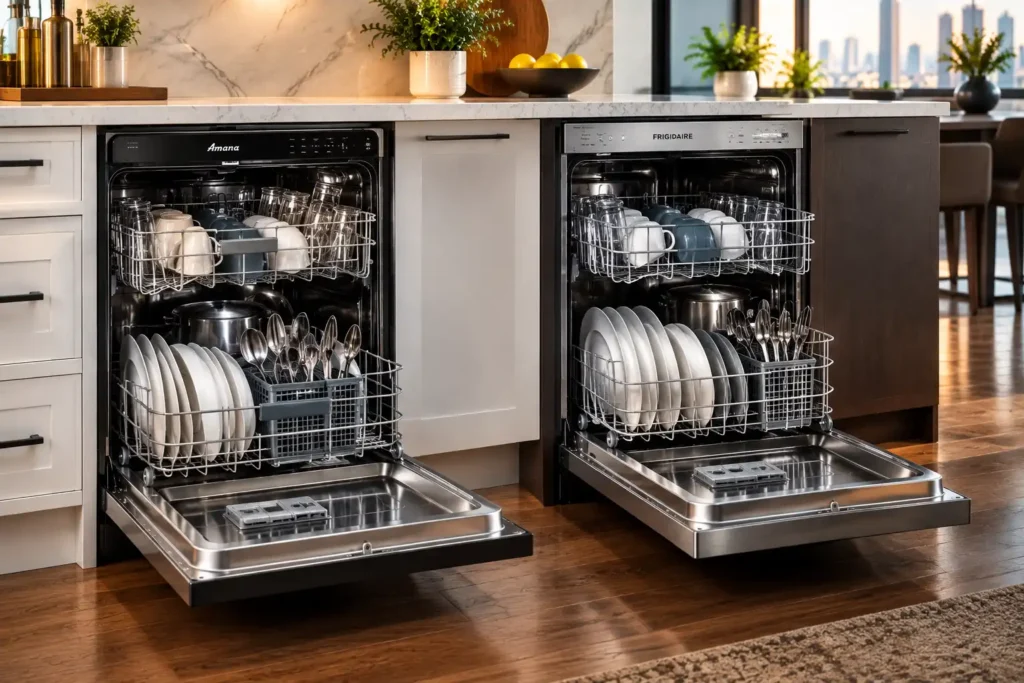
A dishwasher does not fill its entire tub with fresh water.
Instead, the machine typically introduces a controlled amount of water, mixes it with detergent, and circulates it through spray arms. The water is directed toward dishes under pressure. After the wash stage, some of the water is drained and later stages can introduce cleaner water.
Modern filtration systems also help remove food particles from the circulating water. Efficiency programs use technologies such as improved filtration, spray systems, rack design, and soil sensing to achieve cleaning with relatively little water.
This is one reason a dishwasher can clean an entire load using only a few gallons of water.
Soil Sensors and Water Consumption
Soil sensing can be an important factor in water efficiency.
A soil-sensing dishwasher can monitor conditions during the cycle and adjust aspects of the program according to how dirty the load is. The objective is to avoid unnecessarily running a more intensive cycle when the dishes do not require it.
This creates an interesting distinction between the representative Amana and Frigidaire models.
The current Amana ADFS2524R series is listed without soil-sensing capability, while the Frigidaire FFCD2413 series is listed with soil sensing.
That does not mean the Frigidaire automatically uses less water per cycle. Both models are rated at 3.2 gallons.
Instead, soil sensing can provide an additional mechanism for adapting operation to the load. Its potential advantage is particularly relevant when loads vary significantly in soil level.
Does a Soil Sensor Always Save Water?
No.
A soil sensor should not be interpreted as an automatic guarantee of lower water consumption under every circumstance.
If the dishwasher detects a heavily soiled load, it may determine that additional cleaning is necessary. The machine can therefore run a more intensive program rather than reducing water use.
The benefit of sensing technology is its ability to make cycle decisions based on conditions rather than blindly applying the same process to every load.
For a household that usually runs lightly soiled dishes, this may provide an opportunity to avoid unnecessary intensive cleaning. For a household that regularly washes heavily soiled cookware, the machine may still require more resources to achieve the desired result.
Filtration and Water Reuse
Filtration is another important part of dishwasher water efficiency.
Rather than allowing food particles to remain in the circulating water, modern filtration systems help capture soils and particles. This permits water to be circulated through the cleaning system without continually replacing the entire volume with fresh water.
Efficient water filtration is specifically identified as one of the technologies that can help modern dishwashers reduce water consumption while maintaining cleaning performance.
The practical lesson is that water efficiency is not achieved through one feature alone.
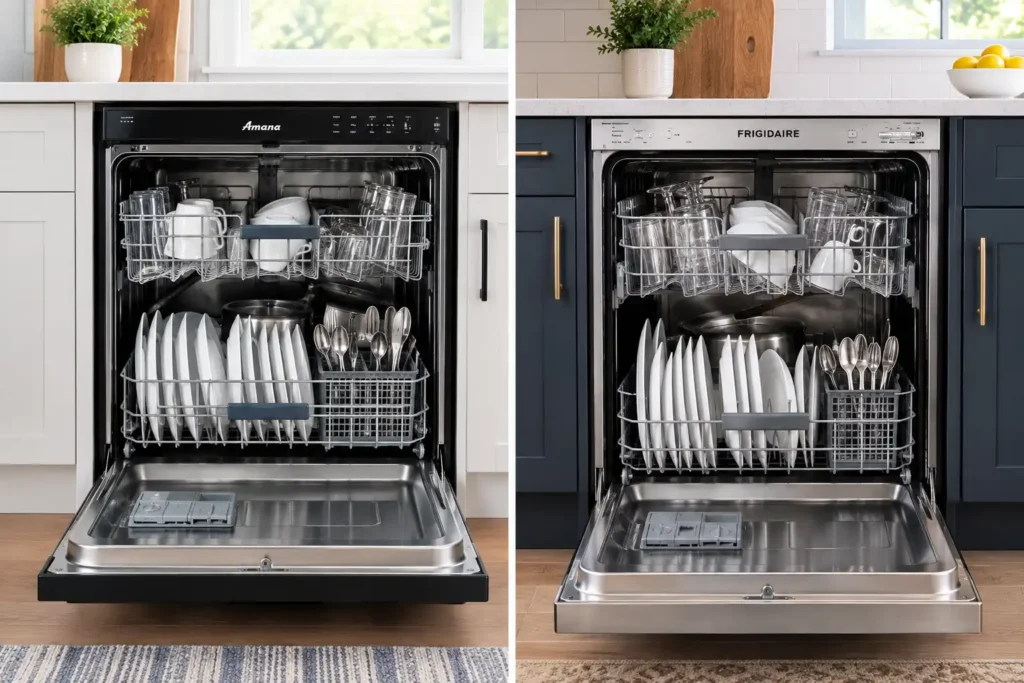
It comes from the interaction of:
- Water filtration
- Spray-arm design
- Water pressure
- Detergent chemistry
- Water temperature
- Soil sensing
- Rack design
- Cycle programming
- Controlled filling and draining
This is why two dishwashers with similar gallon-per-cycle ratings can still have different operating characteristics.
Amana vs Frigidaire Water Usage for Everyday Loads
For everyday dishes such as plates, bowls, cups, glasses, and normal cookware, the normal cycle is generally the most relevant comparison.
The standardized water-use figures for the current representative Amana and Frigidaire models are both 3.2 gallons. Therefore, if both machines are run under comparable normal conditions, there is no meaningful brand-level difference in their rated water consumption.
The bigger difference can come from how the household uses the machine.
Someone who runs a dishwasher every day using normal cycles may consume substantially less water than someone who frequently chooses heavy or intensive cycles.
Likewise, a person who runs half-empty loads twice per day may consume more water annually than someone who waits and runs one properly loaded dishwasher cycle each day.
Full Loads vs Partial Loads
One of the simplest ways to reduce dishwasher water consumption is to operate the dishwasher with reasonably full loads rather than repeatedly running partially loaded cycles.
The reason is straightforward: a dishwasher generally uses a programmed amount of water for its cycle rather than adjusting water consumption proportionally to the number of plates inside it.
Running a machine with six plates does not necessarily require half the water of running it with twelve place settings.
Canadian efficiency guidance specifically recommends running full loads when possible and points out that modern efficient dishwashers can use less water than running a faucet continuously while washing dishes.
This principle applies equally to Amana and Frigidaire.
Amana vs Frigidaire Water Usage When Washing Pots and Pans
Heavy cookware can change the water-consumption equation.
Pots and pans with dried or baked-on food often require more intensive cleaning. A heavy cycle may increase water consumption because the dishwasher needs additional cleaning action.
Amana’s published cycle data demonstrates this clearly: the heavy cycle in the documented dishwasher guide uses considerably more water than the normal cycle.
This does not necessarily mean that using a heavy cycle is wasteful. If a normal cycle cannot clean the dishes, running an inadequate cycle and then washing the dishes again can consume additional water and energy.
The goal should therefore be to select the lowest-intensity cycle that reliably cleans the load, rather than automatically choosing the program with the lowest theoretical water consumption.

Quick Wash and Water Consumption
Many consumers assume that a quick cycle must be the most water-efficient cycle because it finishes sooner.
That assumption is not always correct.
Amana’s published cycle information shows a quick program using approximately 5.80 gallons compared with approximately 3.01 gallons for the normal cycle on the covered models.
The reason is that time and water are different efficiency variables.
A program designed to finish quickly may compensate for reduced time through increased water use, altered spray patterns, temperature, or other changes in the cleaning process.
Therefore, consumers interested specifically in saving water should not automatically choose Quick Wash simply because the cycle duration is shorter.
Does Running a Dishwasher Save More Water Than Handwashing?
For many normal household situations, a modern efficient dishwasher can use substantially less water than washing the same quantity of dishes by hand under a continuously running faucet.
Canadian efficiency guidance notes that an efficient dishwasher can use less than 15 litres per cycle, while a running faucet can use up to 15 litres every two minutes.
That comparison illustrates why dishwasher water efficiency has improved substantially over the years.
If a person allows water to run continuously while washing and rinsing a large number of dishes, the faucet can consume water rapidly. A dishwasher instead controls the amount of water entering the machine and recirculates water during portions of the cleaning process.
This makes the dishwasher particularly useful for households that regularly clean large loads.
Annual Water Consumption: Amana vs Frigidaire
Using the standardized 215-cycle annual assumption, a dishwasher rated at 3.2 gallons per cycle would theoretically consume:
3.2 × 215 = 688 gallons per year
That is approximately:
2,604 litres per year
This calculation provides a useful baseline for comparing models.
For both the representative Amana and Frigidaire models discussed here, the rated water consumption is 3.2 gallons per cycle, so their standardized annual water consumption is effectively the same.
However, real household consumption can be higher or lower depending on how often the dishwasher is operated and which cycles are selected.
What If You Run the Dishwasher Every Day?
A household running one 3.2-gallon cycle every day would use approximately:
3.2 × 365 = 1,168 gallons per year
That equals approximately:
4,421 litres per year
This is higher than the standardized annual estimate because the efficiency calculation assumes 215 cycles per year rather than 365.
A household running one cycle every day therefore should not use the 688-gallon figure as its personal annual consumption estimate.
The same calculation applies to both brands if their selected models have identical water-use ratings.
What If You Run Two Cycles Every Day?
A household running two cycles every day at 3.2 gallons per cycle would consume approximately:
6.4 gallons per day
Over 365 days:
2,336 gallons per year
That is approximately:
8,840 litres per year
This demonstrates why household usage patterns can have a greater impact on annual water consumption than small differences between dishwasher models.
For a family that frequently runs multiple loads each day, choosing a machine with a low per-cycle water rating can become particularly important.

U.S. Water Efficiency Standards
In the United States, current standard residential dishwashers must meet a federal water-consumption limit of 5.0 gallons per cycle. The current efficiency certification threshold for a standard dishwasher is 3.2 gallons per cycle or less.
This creates an important distinction.
A dishwasher using 4.5 gallons per cycle may comply with the federal standard but consume substantially more water than a 3.2-gallon model.
Therefore, simply seeing that a dishwasher meets legal requirements is not enough for a consumer who wants to minimize water consumption.
The product’s actual rated water-use figure is more informative.
Canadian Dishwasher Water Consumption
Canadian buyers should pay attention to litres per cycle because Canadian regulatory information expresses dishwasher water consumption in litres.
The Canadian maximum water consumption for a standard dishwasher is 18.93 litres per cycle, which corresponds closely to the U.S. 5.0-gallon standard.
A dishwasher using 3.2 U.S. gallons consumes approximately 12.1 litres per cycle, meaning the representative Amana and Frigidaire models discussed above are well below the Canadian maximum.
Canadian efficiency information also emphasizes technologies such as soil sensors, improved filtration, efficient spray systems, and rack designs as mechanisms that can reduce water use while maintaining cleaning performance.
UK Dishwasher Water Usage
The UK market uses a somewhat different labeling approach.
UK dishwasher energy labels include an eco-program water consumption figure in litres per cycle, along with energy consumption per 100 cycles, capacity, program duration, noise emissions, and the appliance’s energy-efficiency class.
This is important for anyone in the UK researching Amana vs Frigidaire because the American gallon-per-cycle figures should not simply be copied into a UK buying comparison without considering the labeling system and the exact model available in the UK market.
Amana and Frigidaire availability also differs by market, so UK shoppers should verify that a specific model is actually sold and certified for the UK before comparing it directly with European-market dishwashers.
The underlying principle remains the same: compare the litres of water used per standardized eco cycle, not merely the brand.
Converting Amana and Frigidaire Water Use Into Litres
For readers outside the United States, the 3.2-gallon figure can be converted to approximately 12.1 litres.
Useful conversions include:
| Gallons per cycle | Approximate litres per cycle |
|---|---|
| 2.0 | 7.6 L |
| 2.5 | 9.5 L |
| 3.0 | 11.4 L |
| 3.2 | 12.1 L |
| 3.5 | 13.2 L |
| 4.0 | 15.1 L |
| 5.0 | 18.9 L |
| 5.8 | 22.0 L |
| 7.47 | 28.3 L |
These conversions are useful when comparing U.S. product information with Canadian or UK specifications.

Does Water Temperature Affect Water Consumption?
Water temperature primarily affects energy consumption rather than the basic volume of water entering the dishwasher, but the two are closely related in practical operation.
Frigidaire’s guidance recommends that incoming household water be at least 120°F for good cleaning performance and notes that allowing hot water to reach the faucet before starting the dishwasher can help the machine begin with sufficiently hot water.
The dishwasher uses energy to heat water as necessary. Efficient cleaning therefore depends on balancing water volume, temperature, detergent, spray pressure, and cycle duration.
Using more water is not automatically a substitute for proper water temperature, and using less water is not automatically more efficient if the result is poor cleaning that requires rewashing.
Hard Water and Dishwasher Water Usage
Hard water presents another important consideration for households in areas with high mineral content.
Hard water can contribute to mineral deposits and spotting on dishes and dishwasher components. When the dishwasher is operating with mineral-heavy water, proper detergent dosing and appropriate rinse-aid use can become especially important.
Water efficiency should therefore not be considered in isolation from cleaning performance.
A dishwasher that uses slightly less water but repeatedly leaves mineral deposits or food residue may require additional cleaning, rewashing, or manual intervention. In practical terms, the most efficient dishwasher is one that achieves the required cleaning result with the least unnecessary water and energy.
Does Using Rinse Aid Increase Water Usage?
Rinse aid is not generally a reason to expect a major increase in dishwasher water consumption.
Its primary purpose is to improve the way water drains from dish surfaces and reduce spotting and filming during the final stages of the cycle.
Modern dishwashers can therefore use rinse aid as part of an overall strategy for improving drying and rinsing performance without requiring the dishwasher to use dramatically more water.
For users in hard-water areas, rinse aid can be particularly useful because it can help reduce visible water spots.
Water Efficiency and Cleaning Performance
There is an important balance between using less water and maintaining effective cleaning.
A dishwasher cannot simply reduce water consumption indefinitely and still provide the same performance.
Effective cleaning requires enough water to:
- Dissolve detergent
- Carry detergent to the dishes
- Remove food particles
- Maintain spray pressure
- Rinse dishes
- Transport soil to the filtration system
- Complete the final rinse
Modern dishwasher engineering attempts to optimize those variables rather than simply minimizing the amount of water used.
This is why contemporary efficiency standards focus on both water and energy performance rather than treating water consumption as the only measure of a dishwasher’s quality.

Amana vs Frigidaire Water Usage for Families
For a family producing a large number of dishes every day, water efficiency can become more significant.
Suppose a family runs one dishwasher cycle every day. At 3.2 gallons per cycle, the machine would theoretically consume approximately 1,168 gallons per year.
If another dishwasher consumed 5 gallons per cycle, the same household would use approximately 1,825 gallons per year.
The difference would be about:
657 gallons per year
This illustrates why choosing a low-water dishwasher can matter even when the difference per individual cycle seems small.
Amana vs Frigidaire Water Usage for Apartments
Apartment residents may also benefit from a low-water dishwasher because water consumption can be relevant where utility costs are metered separately or included within building operating costs.
The low water use of modern dishwashers also makes them suitable for households where water conservation is an important priority.
For an apartment with limited household occupancy, however, the number of cycles per week may be more important than small differences in per-cycle consumption.
If two models both use 3.2 gallons per standardized cycle, there is little reason to expect a meaningful water bill difference based solely on the dishwasher brand.
Is a 3.2-Gallon Dishwasher Water Efficient?
Yes.
A standard dishwasher rated at 3.2 gallons per cycle is operating at the current U.S. efficiency threshold for ENERGY STAR qualification. It is also significantly below the 5.0-gallon federal maximum for standard residential dishwashers.
The same 3.2-gallon figure is approximately 12.1 litres, making it relatively low when compared with the maximum permitted consumption in the U.S. and Canada.
Therefore, both the representative Amana and Frigidaire models examined in this comparison qualify as low-water-use machines by current U.S. standards.
What Matters More Than the Brand Name?
When water consumption is the primary concern, consumers should compare these specifications:
- Water consumption per cycle
- Eco or normal cycle consumption
- Capacity
- Annual water consumption
- Soil-sensing capability
- Filtration system
- Available cycle options
- Heavy-cycle water consumption
- Quick-cycle water consumption
- Whether the model is independently efficiency certified
- Local water and sewer costs
- Expected number of cycles per week
This approach is much more reliable than simply asking whether Amana or Frigidaire is the more water-efficient brand.

How to Reduce Water Usage With an Amana Dishwasher
If you already own an Amana dishwasher, several operating habits can reduce unnecessary water consumption.
Run full loads
Avoid repeatedly running small loads when dishes can safely wait for a fuller load.
Use the normal cycle for ordinary dishes
Do not automatically choose heavy cleaning for lightly or normally soiled dishes.
Avoid unnecessary pre-rinsing
Scrape large pieces of food into the waste or compost stream instead of standing at the sink and rinsing every dish.
Use heavy cycles when they are actually needed
Heavy programs can use significantly more water on some models.
Avoid assuming Quick Wash saves water
A shorter program may use more water than the normal cycle.
Maintain the filtration system
A properly maintained filtration system supports effective water circulation and cleaning.
These principles are consistent with modern dishwasher efficiency guidance.
How to Reduce Water Usage With a Frigidaire Dishwasher
The same basic principles apply to Frigidaire.
Run reasonably full loads, choose the appropriate cycle, avoid unnecessary manual rinsing, and use the dishwasher’s normal program for ordinary loads when appropriate.
Where a Frigidaire model has soil-sensing capability, allowing the dishwasher to use that feature can help the machine adapt its operation to the soil level rather than always applying the same intensive process.
However, consumers should still consult the specific model’s owner’s documentation because cycle behavior varies between models.
Amana vs Frigidaire: Which Is Better for Water Conservation?
If the comparison is limited strictly to the representative current models examined in this article, the answer is essentially a tie.
The Amana ADFS2524R series is rated at 3.2 gallons per cycle.
The Frigidaire FFCD2413 series is also rated at 3.2 gallons per cycle.
Both are 12-place-setting standard dishwashers and both are listed at 240 kWh annual energy use under the applicable standardized test.
Therefore, the water-use specification itself does not provide a meaningful reason to choose one brand over the other.
The more useful distinction is that the Frigidaire representative model includes soil sensing, while the cited Amana model does not. That difference may affect how the machines adapt to different loads, but it does not change their published 3.2-gallon water-use rating.
Is Lower Water Usage Always Better?
Not necessarily.
The goal is not simply to find the dishwasher that uses the absolute smallest quantity of water.
The goal is to find a dishwasher that provides effective cleaning using an efficient amount of water.
For example, a machine that uses very little water but cannot adequately remove baked-on food may force the user to run another cycle or wash dishes by hand. That can eliminate the theoretical water savings.
Modern efficiency programs therefore consider standardized performance and efficiency together rather than assuming that lower water consumption alone represents better appliance performance.

Water Consumption vs Energy Consumption
Water and energy are connected because most dishwasher water is heated.
A machine may use a small amount of water but still consume considerable energy if it heats that water to a high temperature and uses heated drying.
Conversely, reducing water can reduce the amount of water that needs to be heated, potentially reducing energy requirements.
This is why efficiency labels provide both energy and water information.
The current U.S. efficiency methodology uses standardized assumptions and test procedures to calculate annual energy consumption while measuring water consumption per cycle.
Why the EnergyGuide Number Is Also Important
Consumers in the United States should look beyond gallons per cycle and check the EnergyGuide information associated with the specific model.
The annual energy figure provides a standardized way to compare expected energy use under the testing assumptions.
For the current Amana and Frigidaire examples examined here, the listed annual energy figure is 240 kWh, while both have a 3.2-gallon water-use figure.
This reinforces the conclusion that these particular models are closely matched from a standardized efficiency perspective.
What About Older Amana and Frigidaire Dishwashers?
Older models can have substantially different water-use figures.
Dishwasher efficiency standards have changed over time, and manufacturers have introduced progressively more efficient machines.
Historical product data illustrates that earlier models could have water-use figures different from today’s 3.2-gallon level.
Therefore, someone comparing a ten-year-old Amana dishwasher with a current Frigidaire dishwasher should not assume that the current brand-level figures apply to the older machine.
The model number and production era matter.
This is especially important when researching replacement decisions.
Should You Replace an Older Dishwasher to Save Water?
It depends on the existing dishwasher’s condition, water consumption, usage frequency, and replacement cost.
If an older dishwasher consumes substantially more water per cycle and is used frequently, replacing it with a modern efficient model may reduce water consumption over time.
However, the financial benefit depends on local water, sewer, electricity, and heating costs as well as the purchase price of the new appliance.
The U.S. Department of Energy’s efficiency analysis demonstrates that water and energy savings can contribute to lifecycle cost reductions when efficient dishwashers replace less efficient machines.
A replacement decision should therefore consider both utility savings and the total cost of purchasing and installing the new dishwasher.

Amana vs Frigidaire Dishwasher Water Usage: Final Comparison
The water-consumption comparison between Amana and Frigidaire is more balanced than a simple brand-versus-brand argument suggests.
A current standard Amana ADFS2524R-series dishwasher is listed at 3.2 gallons per cycle, while the current Frigidaire FFCD2413 series is also listed at 3.2 gallons per cycle. Both therefore sit at the current 3.2-gallon efficiency threshold and substantially below the 5.0-gallon U.S. federal maximum for standard dishwashers.
The representative Amana model does not list soil sensing, while the representative Frigidaire model does. This may create differences in how the machines respond to varying soil conditions, but it does not create a difference in their published standardized water-use figure.
Amana’s published cycle information also illustrates that actual water consumption can differ significantly by program. A normal cycle can use around 3 gallons on certain models, while heavy and quick programs can consume substantially more.
Therefore, consumers should avoid choosing a dishwasher based solely on the brand name. Instead, compare the exact models and examine the normal or eco water-use figure, annual consumption, cycle options, soil sensing, capacity, and efficiency certification.
For USA buyers, 3.2 gallons per cycle is a particularly useful benchmark. For Canadian buyers, the equivalent figure is approximately 12.1 litres per cycle. UK buyers should compare the eco-program water-consumption figure shown in litres on the applicable product information and verify that the exact model is intended for the UK market.
Overall, the current evidence indicates that Amana and Frigidaire can both offer very low-water-use dishwashers, and the exact model is more important than the brand when water conservation is the priority.
Frequently Asked Questions
1. Does Amana or Frigidaire use less water?
For the representative current models examined here, neither uses less water. Both the Amana ADFS2524R series and Frigidaire FFCD2413 series are rated at 3.2 gallons per cycle.
2. How many gallons of water does an Amana dishwasher use?
A current standard Amana ADFS2524R-series model is rated at 3.2 gallons per cycle under the standardized efficiency test. Actual consumption can vary by cycle and options.
3. How many gallons does a Frigidaire dishwasher use?
A current Frigidaire FFCD2413-series model is rated at 3.2 gallons per cycle. Manufacturer guidance also describes typical dishwasher consumption as approximately 3–4 gallons per cycle, depending on the model and operating conditions.
4. Is 3.2 gallons per dishwasher cycle good?
Yes. For a standard residential dishwasher, 3.2 gallons per cycle is the current U.S. threshold for the major efficiency certification and is 36% below the 5.0-gallon federal maximum.
5. How many litres is 3.2 gallons?
Three-point-two U.S. gallons is approximately 12.1 litres.
6. Does a heavy dishwasher cycle use more water?
It can. Published Amana cycle information shows that a heavy program on certain models can use substantially more water than the normal program.
7. Does Quick Wash use less water?
Not necessarily. A quick program can use more water than a normal program because it is designed to complete cleaning in a shorter period. Published Amana cycle information provides an example where the quick cycle uses more water than normal.
8. Does soil sensing reduce dishwasher water usage?
Soil sensing can allow a dishwasher to adjust operation according to the soil level, potentially avoiding unnecessary intensive operation. It does not guarantee that every cycle will use less water.
9. Does the Frigidaire FFCD2413 use less water than the Amana ADFS2524R?
No significant difference appears in their published water-use ratings. Both are listed at 3.2 gallons per cycle.
10. Does running a full dishwasher save water?
Generally, yes. Using the dishwasher for reasonably full loads makes better use of the water consumed by each cycle. Canadian efficiency guidance specifically recommends running full loads when possible.
11. Is dishwasher water usage lower than handwashing?
A modern efficient dishwasher can use less water than handwashing a comparable load when handwashing involves a continuously running faucet.
12. Does pre-rinsing dishes waste water?
Yes, unnecessary faucet rinsing can add water consumption before the dishwasher even begins its cycle. Scraping large food particles from dishes rather than extensively rinsing them can reduce unnecessary water use.
13. Does water usage affect electricity consumption?
It can, because dishwasher water generally needs to be heated. Less water can mean less water requiring heating, although the overall energy consumption also depends on temperature, cycle duration, drying method, and other factors.
14. Is an ENERGY STAR dishwasher always using exactly 3.2 gallons?
No. The 3.2-gallon figure is a standardized water-consumption criterion for standard-size dishwashers. Individual cycles and settings can consume different amounts of water.
15. Does Amana have water-saving dishwashers?
Yes. Current Amana standard-size models include models rated at 3.2 gallons per cycle, demonstrating that the brand offers dishwashers meeting current high water-efficiency requirements.
16. Does Frigidaire have water-saving dishwashers?
Yes. Current Frigidaire models include standard dishwashers rated at 3.2 gallons per cycle and multiple current models carrying efficiency certification.
17. Which is better for water conservation: Amana or Frigidaire?
There is no universal brand-level answer. Current representative models from both brands can have the same 3.2-gallon-per-cycle rating. The exact model, cycle, options, and household usage pattern are more important than the brand name.
18. How much water does a dishwasher use per year?
At the standardized assumption of 215 cycles per year, a dishwasher using 3.2 gallons per cycle consumes approximately 688 gallons annually, or about 2,604 litres.
19. How much water does a dishwasher use if run every day?
At 3.2 gallons per cycle, one cycle every day would consume approximately 1,168 gallons per year, or about 4,421 litres.
20. What should I check when comparing Amana and Frigidaire water usage?
Compare the exact model’s gallons or litres per cycle, annual energy and water information, normal or eco cycle, capacity, soil sensing, heavy-cycle consumption, quick-cycle consumption, and efficiency certification. This provides a much more meaningful comparison than comparing brand names alone.
Key Takeaways
- Current representative Amana and Frigidaire standard dishwashers can both use 3.2 gallons per cycle.
- 3.2 gallons equals approximately 12.1 litres.
- Both are substantially below the 5.0-gallon U.S. federal maximum for standard residential dishwashers.
- At 215 cycles per year, 3.2 gallons per cycle equals approximately 688 gallons annually.
- Actual water consumption varies with the selected cycle and options.
- Heavy cycles can use considerably more water than normal cycles.
- Quick cycles do not necessarily save water.
- Frigidaire’s representative model examined here includes soil sensing, while the cited Amana model does not.
- Running full loads is an important way to maximize water efficiency.
- Avoiding unnecessary pre-rinsing can save additional household water.
- For Canada, compare water consumption in litres per cycle.
- For the UK, use the eco-program water-consumption figure in litres on the applicable product information.
- The exact dishwasher model is more important than the brand when comparing water consumption.
- For the current representative models examined, Amana and Frigidaire are effectively tied on rated water consumption at 3.2 gallons per cycle.
- Water efficiency should be evaluated together with cleaning performance, cycle selection, energy consumption, capacity, and long-term operating habits.