
When shoppers search for Amana vs Frigidaire dishwasher reviews, they are usually looking for more than a simple list of features. They want to know whether these dishwashers actually clean well, how reliable they are, whether they dry dishes properly, how noisy they are, what owners experience over time, and whether the price represents good value.
The comparison is particularly interesting because Amana and Frigidaire both compete in the mainstream dishwasher market, including relatively affordable models. Neither brand represents a single uniform dishwasher design, however. Each manufacturer sells different models with different wash systems, racks, filters, drying systems, controls, sensors, tub materials and efficiency specifications. Independent testing therefore needs to be interpreted at the model level rather than assuming that every dishwasher carrying the same brand name performs identically.
Recent independent testing provides evidence that both brands have produced dishwashers with strong cleaning performance. For example, the Amana ADB1500ADS achieved an excellent result in a heavily soiled dishwashing test, while several Frigidaire models, including the FDSP4401AS, have also achieved excellent washing results. Other models from both brands have produced very good results.
Reliability is a separate issue. A dishwasher can clean exceptionally well in a laboratory and still have a different long-term ownership experience. Conversely, a dishwasher with a simpler feature set can provide satisfactory service for years. Recent owner-survey research covering tens of thousands of dishwashers shows why reliability needs to be considered independently from washing performance.
This detailed Amana vs Frigidaire dishwasher review examines the two brands across the factors that matter most to homeowners in the USA, Canada and UK, while emphasizing that the exact model number should always be checked before purchasing.

Amana vs Frigidaire Dishwasher Reviews at a Glance
| Category | Amana | Frigidaire |
|---|---|---|
| Product positioning | Value-oriented mainstream appliances | Mainstream value and mid-range appliances |
| Independent testing | Multiple models tested | Multiple models tested |
| Washing performance | Several models rated very good or excellent | Several models rated very good or excellent |
| Reliability | Model and survey dependent | Model and survey dependent |
| Drying | Varies substantially by model | Varies substantially by model |
| Noise | Model dependent | Model dependent |
| Soil sensors | Available on selected models | Available on selected models |
| Adjustable racks | Model dependent | More common on feature-rich models |
| Self-cleaning filter | Model dependent | Available on selected models |
| Tub material | Plastic common on value models | Plastic and stainless-steel models |
| Energy efficiency | Efficient models available | Efficient models available |
| Warranty | Usually model dependent; many mainstream models offer one year | Usually model dependent; many mainstream models offer one year |
| Best comparison approach | Exact model-to-model comparison | Exact model-to-model comparison |
This table is a general guide rather than a brand ranking. The testing evidence shows substantial differences between individual models within both product families.
How to Read Dishwasher Reviews Properly
A dishwasher review should not be based on one characteristic.
Cleaning performance tells you how well a machine removes food residue. Drying tells you how effectively it removes moisture from dishes. Noise tells you how noticeable the machine is while operating. Reliability attempts to estimate the likelihood of problems over time. Ease of use considers loading, controls and convenience features.
Independent dishwasher testing evaluates these categories separately. The testing methodology includes washing heavily soiled dishes, energy use, noise and cycle time, while owner surveys contribute information about reliability and satisfaction.
This distinction matters when comparing Amana and Frigidaire because a model can perform very well in one category while being average in another. For example, one Amana model achieved excellent washing and energy results but had a mediocre noise result, while a Frigidaire model achieved excellent washing but mediocre energy performance.
Therefore, the phrase “best dishwasher” is not very useful without knowing what the buyer values.
Amana Dishwasher Reviews
Amana’s dishwasher range has traditionally emphasized relatively straightforward appliances and value-oriented pricing. Its models tend to concentrate on essential dishwasher functions rather than providing every premium feature found in more expensive appliances.
That does not mean Amana dishwashers necessarily have weak washing performance. Independent testing of the Amana ADB1500ADS produced an excellent result in a heavily soiled dishwashing test. The same model also produced an excellent result in a test combining water and energy use.
The Amana ADB1400AGW also produced a very good washing result when tested with heavily soiled dishes. It received an excellent energy-use result under the same testing programme.
The older Amana ADB1100AWW similarly achieved a very good result for heavily soiled dishwashing.
These results demonstrate that a relatively straightforward dishwasher can still deliver strong cleaning performance. However, the results should not be interpreted as proof that every current Amana dishwasher will achieve exactly the same performance.
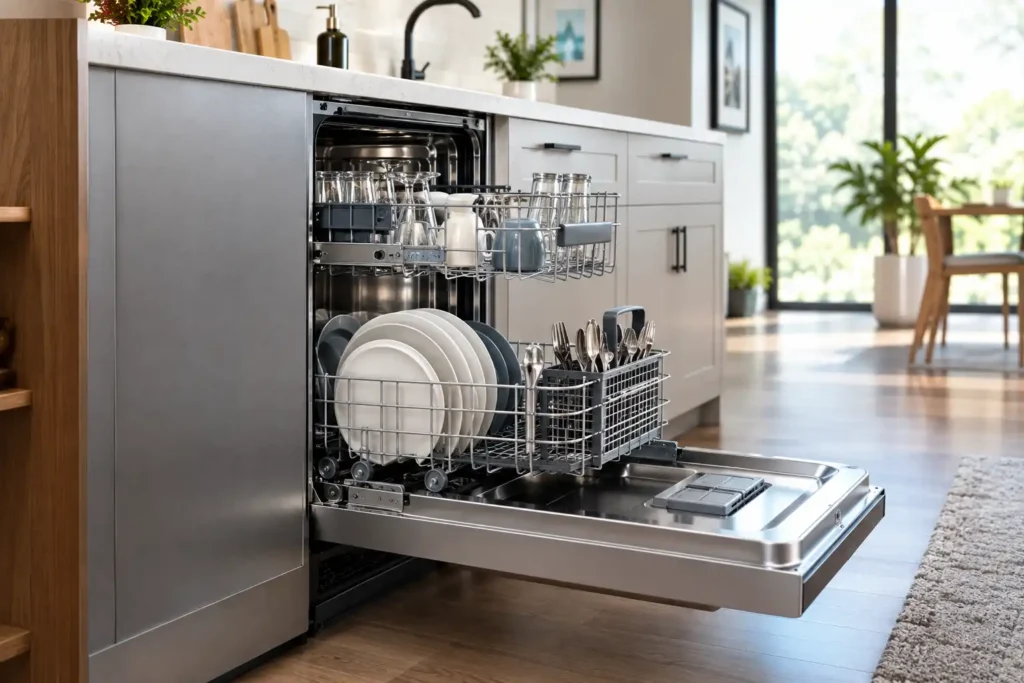
Current Amana Dishwasher Design
Current Amana models show that the brand has also incorporated more modern technologies.
The ADFS2524RB, for example, uses a sensor that monitors conditions during the cycle and automatically adjusts settings. It also carries Energy Star certification and uses front-mounted controls.
This is important because older Amana reviews should not automatically be applied to newer Amana models. Dishwasher technology changes as manufacturers introduce new wash systems, electronic controls, racks and sensors.
When reading an older Amana review, check whether the exact model is still sold and whether the current replacement has the same components.
Frigidaire Dishwasher Reviews
Frigidaire has a broader range of dishwasher configurations, from basic models to machines with additional sensors, adjustable racks, enhanced filtration and more advanced controls.
Independent testing demonstrates strong cleaning performance from multiple Frigidaire models.
The FDSP4401AS achieved an excellent result in a heavily soiled washing test and a very good result for energy use.
The FDPH4316AS is another current-generation example. It includes a soil-sensing system that monitors conditions during the cycle and adjusts settings.
The older FGID2468UF also achieved an excellent heavily soiled washing result and a very good noise result, although its energy-use result was mediocre and its cycle-time result was poor under the test conditions.
This is a useful illustration of why Frigidaire reviews should be examined model by model. Strong washing performance does not automatically mean that every other characteristic will also receive a strong result.
Amana vs Frigidaire Washing Performance
Washing performance is probably the most important category for most dishwasher buyers.
A dishwasher exists primarily to remove food residue from plates, glasses, cookware and utensils without requiring manual scrubbing.
Independent laboratory testing uses heavily soiled dishes specifically to distinguish basic cleaning ability from performance under more demanding conditions. The testing also evaluates lower- and upper-rack performance separately because water distribution can differ between the two areas.
Amana has produced strong results in this area. The ADB1500ADS achieved an excellent washing result, while the ADB1400AGW and ADB1100AWW achieved very good results.
Frigidaire has also produced several strong performers, including the FDSP4401AS, which achieved an excellent result, and the FDPH4316AS, which achieved a very good result.
The available evidence therefore shows strong washing capability across both brands rather than a simple brand-wide difference.
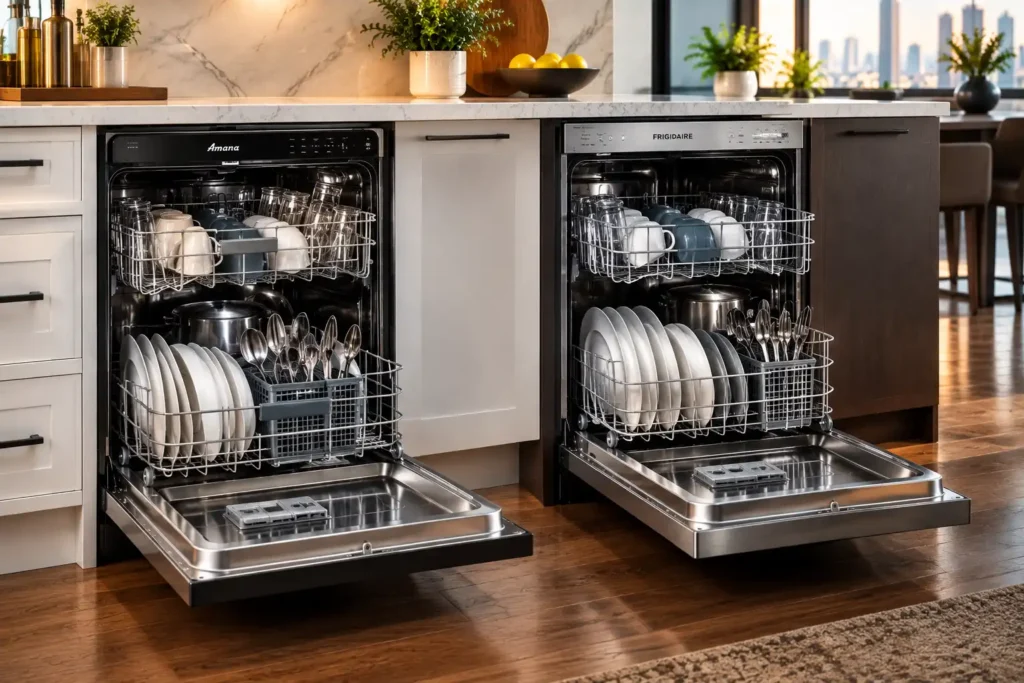
Washing Heavily Soiled Dishes
Heavily soiled dishes are particularly important because they can reveal weaknesses that ordinary loads do not expose.
Dried pasta sauce, baked cheese, grease, oatmeal, egg residue and other stubborn food deposits require a combination of water pressure, temperature, detergent, mechanical action and sufficient cycle time.
The ADB1500ADS demonstrated excellent performance under this type of testing.
Frigidaire’s FDSP4401AS also demonstrated excellent heavily soiled washing performance.
The practical lesson is that consumers should not assume that a less expensive dishwasher automatically performs poorly on difficult food residue.
Upper-Rack and Lower-Rack Cleaning
A dishwasher does not clean every position in the tub identically.
The lower rack is generally exposed to stronger or more direct spray patterns and is commonly used for plates, pans and larger cookware. The upper rack is designed for glasses, cups, bowls and smaller objects.
Independent testing therefore considers lower- and upper-rack washing separately.
This is especially important for people who frequently fill their dishwasher to capacity. A machine can perform very well when lightly loaded but produce less consistent results when dishes block water from reaching neighboring surfaces.
Amana vs Frigidaire Soil Sensors
Soil sensors have become common in modern dishwashers.
The purpose of a sensor is to monitor conditions during the wash and adjust aspects of the cycle according to the detected soil level.
The current Amana ADFS2524RB has a sensor that monitors conditions and adjusts settings for cleaning.
The Frigidaire FDPH4316AS similarly has a sensor system that monitors conditions during the cycle and automatically adjusts settings.
Sensors can improve efficiency and help the dishwasher adapt to different loads, but they do not eliminate the importance of proper loading, detergent, filtration and spray coverage.
A sensor cannot make water pass through a plate that is blocking another plate.
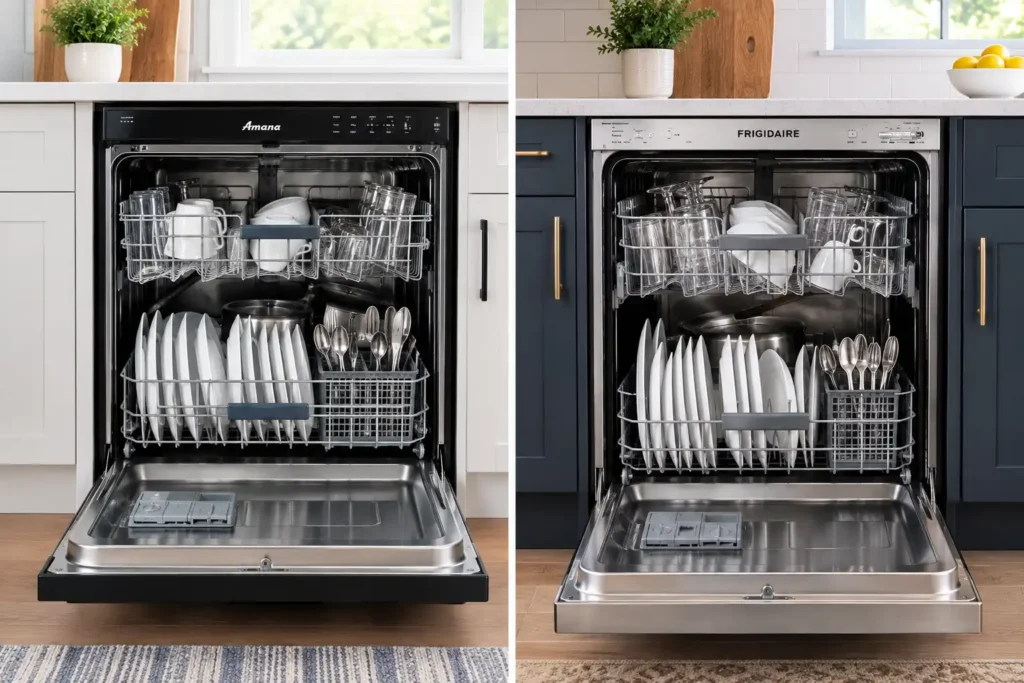
Amana vs Frigidaire Rack Design
Rack design is sometimes overlooked in dishwasher reviews.
A dishwasher’s physical capacity is not simply the number of place settings printed on the specification sheet. The practical capacity depends on how easily dishes can be positioned and how much usable space exists around cookware.
Some Amana models have relatively basic rack systems. The ADB1400AGW, for example, is listed without an adjustable upper rack or adjustable tines.
Some Frigidaire models offer more flexible loading. The FGID2468UF includes an adjustable upper rack and adjustable tines.
This does not automatically make one dishwasher a better cleaner. It can, however, make it easier to arrange dishes so that water can reach more surfaces.
Filtration and Cleaning
Filtration is essential because food particles removed from dishes enter the dishwasher’s water system.
A filtration system helps prevent those particles from repeatedly circulating onto dishes.
The filtration arrangement varies between models.
Some Amana models use manually cleaned filters. The ADB1400AGW, for example, is listed with a manually cleaned filter.
Frigidaire offers models with self-cleaning filtration. The FFCD2418US, for example, is listed with a self-cleaning filter.
A self-cleaning filter can reduce maintenance, but it should not automatically be interpreted as evidence of superior cleaning. Actual washing performance depends on the entire wash system.
Amana vs Frigidaire Drying Reviews
Drying is one of the most important differences between dishwasher models.
A dishwasher can remove food extremely well and still leave plastic containers wet.
Drying performance depends on heating, airflow, condensation, tub material, rinse aid and programme design.
Independent testing evaluates drying separately from washing. This means that a dishwasher with a strong washing result cannot automatically be assumed to have an equally strong drying result.
Consumers who regularly wash plastic containers should pay particular attention to drying technology.

Plastic Tub vs Stainless-Steel Tub
Both brands offer models with plastic interiors, while some Frigidaire models also offer stainless-steel interiors.
The Amana ADFS2524RB uses a plastic interior.
The Frigidaire FFCD2413US also uses a plastic interior.
Stainless steel can provide certain thermal and construction characteristics, but tub material should not be used as a substitute for actual performance testing.
A plastic-tub dishwasher can clean very effectively.
Amana vs Frigidaire Noise Reviews
Noise is particularly important in open-plan homes.
If the dishwasher is installed next to a living room, dining area, bedroom or home office, operating noise can affect everyday comfort.
Independent testing combines sound measurements and listener judgments rather than relying only on the manufacturer’s published decibel number.
The Amana ADB1500ADS received a mediocre noise result in independent testing, while the ADB1400AGW received a fair result.
By comparison, the Frigidaire FGID2468UF received a very good noise result, and the FDPH4316AS also has very good reported noise performance.
These findings apply to the specific tested models rather than every dishwasher sold under each brand.
Amana vs Frigidaire Energy Efficiency
Energy efficiency is increasingly important because dishwasher operating costs accumulate over many years.
A dishwasher uses electricity to operate pumps, controls and heating systems. Water heating can represent a significant part of dishwasher energy consumption.
Independent testing combines water and energy use when evaluating dishwasher energy performance.
The Amana ADB1500ADS achieved an excellent energy-use result in independent testing. The ADB1400AGW also achieved an excellent result.
Frigidaire results vary. The FDSP4401AS achieved a very good energy result, while the older FGID2468UF was rated mediocre in this category.
This again demonstrates why an individual model should be examined instead of assuming that every dishwasher from either brand consumes the same amount of energy.

Amana vs Frigidaire Cycle Time
Cycle duration is an important part of the ownership experience.
Modern dishwashers can have long cycles because they use lower water volumes and carefully controlled temperatures and spray patterns.
The Amana ADB1400AGW received a poor cycle-time assessment under the specified test conditions. The ADB1500ADS received a fair cycle-time result.
The Frigidaire FGID2468UF also received a poor cycle-time assessment despite achieving excellent washing performance.
This is a useful reminder that a longer cycle does not necessarily mean inferior cleaning.
Amana vs Frigidaire Reliability Reviews
Reliability is one of the areas where consumers should be particularly careful with online reviews.
Individual customer reviews can be useful for identifying recurring complaints, but they are not equivalent to a statistically designed owner survey.
Large-scale reliability studies use information from many owners and attempt to estimate the probability of a dishwasher developing a problem over a specified period.
Recent research used approximately 77,000 dishwashers across 27 brands, with purchases made between 2015 and 2025.
The methodology estimates the probability of a newly purchased dishwasher developing a problem by the end of its fifth year, while adjusting for factors including usage and service-contract status.
This is much more useful than taking a handful of online complaints and concluding that an entire brand is unreliable.
What Owners Commonly Report
Recent owner-survey research identifies cleaning problems, drying problems and draining problems among the more common dishwasher complaints.
In the latest published survey discussion, around 21 percent of dishwashers in the surveyed population had broken down or stopped working as they should, while approximately 9 percent had reported cleaning problems, 7 percent drying problems and 7 percent drainage problems.
These numbers should not be interpreted as the failure rate of every Amana or Frigidaire dishwasher.
They demonstrate instead why cleaning, drying and drainage are important components of long-term dishwasher ownership.

Amana vs Frigidaire Owner Satisfaction
Owner satisfaction is different from reliability.
A dishwasher might operate without a major failure but still disappoint the owner because it is noisy, takes too long, leaves plastic wet or is difficult to load.
Conversely, a relatively simple dishwasher can satisfy an owner because it consistently performs the basic job.
Independent owner surveys therefore consider owner satisfaction separately from predicted reliability.
This distinction is particularly important for Amana and Frigidaire because their product ranges include both straightforward value-oriented models and more feature-rich designs.
Amana vs Frigidaire Ease of Use
Ease of use includes controls, rack flexibility, loading convenience and maintenance requirements.
The Amana ADB1400AGW has a relatively basic configuration, including no adjustable upper rack, no adjustable tines and no self-cleaning filter.
Some Frigidaire models provide more flexibility. The FGID2468UF, for example, has an adjustable upper rack, adjustable tines, ample flatware slots, a remaining-time display and a self-cleaning filter.
For a household that loads the dishwasher differently every day, these seemingly minor features can have a meaningful practical effect.
Amana vs Frigidaire for Families
Families often run their dishwasher frequently.
For these households, capacity and loading flexibility can be more important than decorative finishes.
If the dishwasher is used every day, an adjustable rack or better utensil organization can save time repeatedly.
Families should also consider cycle duration. A dishwasher that takes a long time may be perfectly acceptable for overnight operation but less convenient for households that need multiple loads during the day.

Amana vs Frigidaire for Apartments
Apartment residents may place greater importance on noise.
A dishwasher that operates beside a living room can be more noticeable than one installed in a separate kitchen.
The tested differences between individual models demonstrate why sound performance should be checked before purchasing rather than assumed from the brand name.
Apartment buyers should also confirm installation dimensions and water, drain and electrical requirements.
Amana vs Frigidaire for Hard Water
Hard water can affect dishwasher performance regardless of brand.
Mineral deposits can accumulate on components and dishes, and poor water conditions can make glasses appear cloudy.
Consumers in hard-water regions should follow the manufacturer’s recommendations concerning detergent, rinse aid and maintenance.
A dishwasher that performs extremely well under laboratory conditions can still produce disappointing household results if water quality and maintenance are ignored.
Amana vs Frigidaire for Pots and Pans
Large cookware requires sufficient rack clearance and good spray coverage.
A large pan positioned incorrectly can block water from reaching other dishes.
For households that wash pots and pans regularly, the physical rack layout may be as important as the dishwasher’s headline cleaning rating.
An adjustable rack can provide additional loading flexibility, while a simple fixed-rack design may require more careful arrangement.

Amana vs Frigidaire for Plastic Containers
Plastic containers are one of the most difficult dishwasher items to dry.
Plastic does not retain heat in the same way as glass or metal, so water can remain on the surface after the cycle ends.
Consumers who wash many plastic containers should examine the drying system rather than choosing solely based on washing performance.
Amana vs Frigidaire for Glasses
Glasses are generally placed on the upper rack.
The key issue is whether water can reach the inside surfaces while the glass remains properly positioned.
Overloading can create shadowed areas where spray cannot reach.
For this reason, upper-rack washing performance and rack flexibility deserve attention in addition to the overall washing score.
Amana vs Frigidaire for Everyday Dishes
For ordinary dishes containing food residue from breakfast, lunch and dinner, both brands offer models capable of effective cleaning.
The more difficult differences become apparent when users demand consistent performance with baked-on food, large cookware, tightly packed racks or heavily soiled loads.
This is why independent testing of heavily soiled dishes is especially valuable.
What Makes a Good Dishwasher Review?
A useful dishwasher review should answer at least ten questions:
- Does it clean heavily soiled dishes?
- Does it clean the upper rack effectively?
- Does it clean the lower rack effectively?
- Does it dry dishes properly?
- Is it quiet enough for the kitchen?
- Is it energy efficient?
- Is it easy to load?
- Is filtration easy to maintain?
- Does it have a reasonable reliability history?
- Is its price appropriate for the feature set?
Looking at only one of these factors can create a misleading picture.

Why Some Online Amana and Frigidaire Reviews Conflict
Consumers may notice that one owner gives an Amana dishwasher five stars while another gives the same brand one star.
The same thing happens with Frigidaire.
There are several reasons.
Different models can share a brand name but have completely different wash systems.
Different households have different water quality.
Different users load dishes differently.
Some consumers use heavy cycles while others use quick cycles.
Some owners maintain filters regularly while others do not.
Installation quality can also differ.
Consequently, an individual review can describe a real experience without representing the average performance of the entire product family.
Professional Testing vs Customer Reviews
Professional testing and customer reviews answer different questions.
Laboratory testing attempts to create standardized conditions so models can be compared.
Customer reviews provide information about real-world ownership, including installation experiences, noise impressions, reliability problems and customer-service experiences.
Neither source should automatically replace the other.
A strong purchasing process combines controlled testing with large-scale owner information and model specifications.
USA Buying Considerations
U.S. consumers should verify the exact model number and compare its published energy information, capacity, sound level, features and warranty.
Energy certification can provide another standardized efficiency reference.
However, energy efficiency should not be confused with cleaning performance.
A dishwasher can be extremely efficient while another model may provide a different balance between energy, water, cycle time and cleaning.
Canada Buying Considerations
Canadian consumers should verify the Canadian-market model rather than assuming that a U.S. model with a similar name has identical specifications.
Canadian dishwasher regulations establish requirements relating to energy and water consumption, while product labeling provides standardized information for consumers.
This makes the model-specific label especially useful when comparing two appliances sold in Canada.
UK Buying Considerations
UK consumers should pay close attention to the exact UK-market model and its energy label.
UK dishwasher regulations include requirements for an eco programme and establish energy-efficiency and cleaning-performance requirements.
Energy information is provided through the applicable UK labeling framework.
A dishwasher model marketed in another country may therefore not have identical programme settings or efficiency characteristics.

Amana vs Frigidaire Price and Value
Price should be considered together with features and performance.
A cheaper dishwasher may provide excellent basic washing while offering fewer convenience features.
A more expensive dishwasher may provide better rack flexibility, quieter operation, enhanced filtration or improved drying.
But paying more does not automatically guarantee greater reliability.
Recent reliability research specifically demonstrates that higher-priced appliances are not universally more reliable than lower-priced alternatives.
For this reason, value should be evaluated by looking at what the buyer receives for the additional money.
Amana vs Frigidaire Warranty
Warranty coverage is another important part of a review.
The Amana ADFS2524RB, for example, is listed with a one-year warranty.
The Frigidaire FDPH4316AS is also listed with one-year warranty coverage.
Exact terms can vary by model and market, so buyers should review the warranty for the precise dishwasher they intend to purchase.
Warranty length should not be confused with reliability.
A warranty tells you what the manufacturer agrees to cover under defined conditions; reliability research attempts to estimate how frequently problems occur.
What About Replacement Parts and Service?
Long-term ownership depends partly on service availability.
A dishwasher may be relatively inexpensive to purchase but frustrating to own if qualified technicians are difficult to find or parts take a long time to obtain.
This is particularly important outside major metropolitan areas.
Before buying either brand, consumers should check whether authorized service is available locally and whether common replacement components are readily obtainable.
Are Amana Dishwashers Good?
The available evidence shows that Amana has produced dishwashers capable of strong cleaning performance.
The ADB1500ADS achieved excellent washing and energy-use results in independent testing, while the ADB1400AGW achieved very good washing and excellent energy-use results.
The brand’s current models also include modern features such as soil sensing on selected models.
The main consideration is that Amana’s feature sets vary substantially between models.
Are Frigidaire Dishwashers Good?
Frigidaire has also produced several models with strong independent-test results.
The FDSP4401AS achieved excellent washing performance and very good energy performance, while the FDPH4316AS achieved very good washing, energy and noise results.
Some Frigidaire models also provide additional loading and filtration features.
Again, however, the brand should not be treated as one single dishwasher design.
Amana vs Frigidaire: What Should You Compare?
When comparing two specific models, use this checklist:
| Factor | What to check |
|---|---|
| Washing | Heavily soiled performance |
| Upper rack | Cleaning and water coverage |
| Lower rack | Cleaning of plates and cookware |
| Drying | Plastic and glass drying |
| Noise | Laboratory sound result |
| Reliability | Predicted reliability information |
| Satisfaction | Owner survey information |
| Filter | Manual or self-cleaning |
| Rack | Adjustable or fixed |
| Sensor | Soil sensing |
| Tub | Plastic or stainless steel |
| Cycle time | Normal and heavy cycles |
| Energy | Annual consumption |
| Water | Water per cycle |
| Warranty | Parts and labor coverage |
| Service | Local technician availability |
| Price | Current purchase price |
Frequently Asked Questions
Is Amana or Frigidaire better according to reviews?
Reviews show strong performance from specific models of both brands. Amana has models with very good and excellent washing results, while Frigidaire also has multiple models with very good and excellent results. The evidence is therefore best interpreted by comparing exact model numbers.
Which brand has better dishwasher cleaning?
There is no sound basis for assigning one universal brand-wide cleaning result. Individual Amana and Frigidaire models have both achieved strong heavily soiled washing results in independent testing.
Are Amana dishwashers reliable?
Reliability depends on the model and ownership conditions. Large-scale owner surveys provide brand-level reliability estimates, while individual models can have different designs and histories.
Are Frigidaire dishwashers reliable?
Frigidaire’s reliability should be assessed using current owner-survey data and the exact model under consideration. Reliability is separate from laboratory cleaning performance.
Which brand has quieter dishwashers?
Noise varies by model. Some tested Frigidaire models have received very good noise results, while some tested Amana models have received fair or mediocre results. This should not be generalized to every model.
Which brand dries dishes better?
Drying varies by model and drying system. Buyers should examine the individual model’s drying technology and independent drying result rather than relying on the brand name.
Which brand is better for hard water?
Neither brand is automatically superior for every hard-water installation. Water hardness, detergent, rinse aid, filter maintenance and machine design all influence performance.
Which is better for large families?
Look for a model with flexible racks, good usable capacity, strong filtration and appropriate drying. The number of advertised place settings alone does not determine how easy the dishwasher is to load.
Are Amana dishwashers good for baked-on food?
Some models are. The ADB1500ADS, for example, achieved an excellent result in a heavily soiled washing test.
Are Frigidaire dishwashers good for baked-on food?
Several models have performed strongly. The FDSP4401AS achieved an excellent result in heavily soiled dishwashing tests.
Does a soil sensor make a dishwasher better?
A soil sensor can help the machine adjust its operation according to detected conditions, but it does not independently determine overall cleaning performance.
Is a stainless-steel tub better than plastic?
Stainless steel can offer certain thermal and construction advantages, but tub material alone does not determine cleaning or reliability.
Does a self-cleaning filter mean better washing?
Not necessarily. A self-cleaning filter can reduce manual maintenance, but washing performance depends on the entire dishwasher system.
Why do some Amana reviews say the dishwasher is excellent while others are negative?
Different Amana models have different designs, and owners use dishwashers under different conditions. Online reviews can therefore vary considerably without necessarily contradicting one another.
Why do Frigidaire dishwasher reviews vary so much?
Frigidaire sells multiple dishwasher platforms with different wash systems, rack designs, filters and feature packages. Model differences can produce substantially different ownership experiences.
Does Consumer Reports test both Amana and Frigidaire?
Yes. Its dishwasher testing database includes models from both brands, and individual model pages provide laboratory and owner-survey information where available.
Does Consumer Reports reliability mean a dishwasher will definitely last five years?
No. Predicted reliability is a statistical estimate based on owner-survey data. It is not a guarantee for an individual dishwasher.
Is the cheapest Amana or Frigidaire dishwasher the best value?
Not necessarily. Value depends on washing, drying, noise, reliability, features, operating costs, warranty and purchase price.
Which should I buy: Amana or Frigidaire?
The most useful approach is to compare the exact two models you are considering. Check washing performance, drying, noise, reliability information, rack design, filtration, energy use, warranty and current price rather than choosing solely by brand.
Final Review: Amana vs Frigidaire Dishwasher
The available evidence paints a more nuanced picture than a simple “Amana versus Frigidaire” brand comparison.
Amana has produced several dishwashers with strong independent washing results. The ADB1500ADS achieved excellent heavily soiled washing performance, while the ADB1400AGW and ADB1100AWW achieved very good results.
Frigidaire has also produced multiple strong-performing dishwashers. The FDSP4401AS achieved excellent heavily soiled washing performance, while the FDPH4316AS and other models achieved very good results.
The largest lesson from the reviews is that brand reputation alone is not enough to predict dishwasher performance.
An Amana dishwasher with a strong wash system may outperform a more expensive Frigidaire model in cleaning, while a feature-rich Frigidaire may provide greater rack flexibility, quieter operation or more convenient filtration than a basic Amana model.
Reliability also needs to be considered independently. Large-scale owner research provides useful statistical information, but it cannot guarantee how a particular dishwasher will perform in an individual home.
For buyers in the USA, Canada and UK, the best approach is to identify the exact model available in the local market and compare its washing, drying, noise, energy consumption, water use, rack design, filtration, warranty and reliability information.
The most meaningful comparison is therefore not simply:
Amana vs Frigidaire.
It is:
Amana Model A vs Frigidaire Model B — based on independently tested performance and the features that matter to your household.
That model-specific approach gives consumers a much more accurate picture of what they can realistically expect from either dishwasher over years of everyday use.