
When choosing a dishwasher, cleaning performance, price, capacity, reliability, and energy efficiency usually receive most of the attention. However, dishwasher noise level can be just as important, particularly in an open-plan kitchen, apartment, condominium, small home, or kitchen located close to a bedroom or living room.
The comparison between Amana vs Frigidaire dishwasher noise level is especially interesting because the two brands offer dishwashers across substantially different sound ranges. Some Amana models are rated around the mid-50-decibel range, while current Frigidaire models can range from considerably louder basic machines to very quiet premium models rated in the low 40s. Manufacturer specifications therefore show that there is no single noise level for either brand.
For example, a current Amana dishwasher with SoilSense and SofSound Technology is rated at 55 dBA, while another current Amana model is rated at 59 dBA. By comparison, Frigidaire currently offers models rated at 42 dBA, 45 dBA, 49 dBA, and 52 dBA, while some more basic models are rated considerably higher.
That difference can be important in everyday use. A dishwasher rated at 42 dBA is designed for a substantially quieter operating experience than one rated at 59 dBA. However, consumers should not compare numbers without understanding how dishwasher sound ratings are measured, because installation, kitchen acoustics, cabinetry, flooring, loading, plumbing, and the particular wash cycle can all affect what you actually hear.
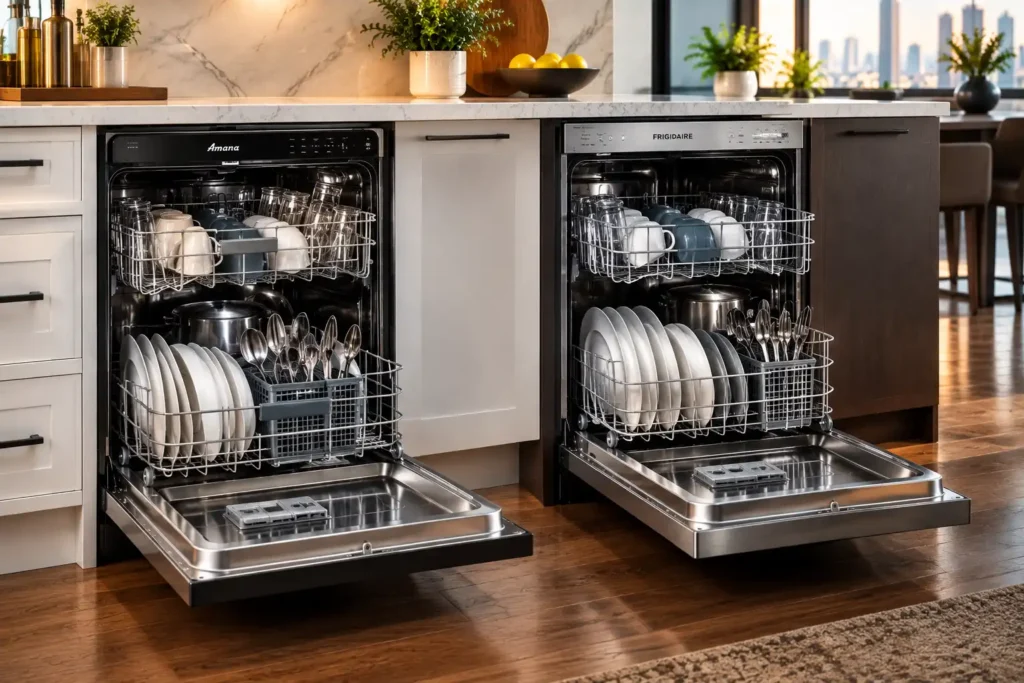
This guide explains the differences in detail and examines Amana and Frigidaire dishwasher noise levels for homes in the United States, Canada, and the United Kingdom.
Amana vs Frigidaire Dishwasher Noise Level at a Glance
| Factor | Amana | Frigidaire |
|---|---|---|
| Typical examples examined | 55–59 dBA | Approximately 42–62 dBA depending on model |
| Quietest example researched | 55 dBA | 42 dBA |
| Mid-range examples | 55–59 dBA | 45–52 dBA |
| Basic/louder example | 59 dBA | 62 dBA |
| Quiet premium options | Limited in current examples | Several low-noise options |
| Sound-reduction technology | SofSound Technology on applicable models | Insulation and quiet-operation designs on applicable models |
| Sound varies by model | Yes | Yes |
| Installation affects perceived noise | Yes | Yes |
| Suitable for open-plan kitchen | Depends heavily on model | Low-dBA models are particularly suitable |
| Best approach | Compare exact model dBA | Compare exact model dBA |
The table demonstrates an important point: brand-level comparisons can be misleading. The exact model number is much more important than simply choosing Amana or Frigidaire.
A 55 dBA Amana and a 42 dBA Frigidaire are separated by 13 dB. That is a meaningful difference in sound level, not a tiny specification variation.
What Does dBA Mean on a Dishwasher?
Dishwasher manufacturers normally express sound levels using dBA, or A-weighted decibels.
The decibel scale is logarithmic rather than linear. This means that a difference of several decibels can represent a significant change in acoustic level. Consequently, shoppers should not assume that a dishwasher rated at 50 dBA is only slightly quieter than one rated at 55 dBA.
The “A” in dBA refers to A-weighting, a method of adjusting measurements to approximate the sensitivity of human hearing across different frequencies.

Dishwasher manufacturers use standardized test procedures to measure airborne acoustic noise. The international standard specifically covering household dishwashers is IEC 60704-2-3. The current 2025 edition applies to household electric dishwashers and establishes the particular test requirements used with the broader household-appliance acoustic-noise measurement standard.
This is important because manufacturers are not simply standing beside a running dishwasher with an ordinary consumer sound meter and choosing a number.
The standardized approach makes published noise specifications more useful for comparing appliances.
Why Dishwasher Noise Ratings Matter
Noise is particularly important because dishwashers often run while people are doing other activities.
A kitchen may be connected directly to:
- A family room
- Dining room
- Living room
- Home office
- Bedroom
- Hallway
- Apartment living space
In an enclosed utility room, a dishwasher that produces noticeable washing sounds may not be particularly troublesome. In an open-plan kitchen, the same dishwasher can be much more noticeable.
Noise can also matter when the dishwasher is programmed to run during the evening or overnight.
A quieter dishwasher makes it easier to watch television, have a conversation, work, read, or sleep while the appliance is operating.
This is one reason manufacturers increasingly promote low-dBA dishwashers as a major feature.
Amana Dishwasher Noise Levels
Amana’s current dishwasher lineup demonstrates why the exact model number matters.
The Amana ADB1500ADS is rated at 55 dBA and uses SofSound Technology II. The manufacturer describes this sound-reduction system as helping reduce dishwasher noise while the appliance is operating. Its specification sheet states that the sound rating is measured according to IEC standards.
Another current Amana model, the ADFS2524 series, is rated at 59 dBA. Its manufacturer description specifically states that the dishwasher operates at a 59 dBA sound rating.
This means that even within the Amana brand, shoppers should not assume that every dishwasher operates at the same noise level.
The difference between 55 dBA and 59 dBA may look small on paper, but it can be noticeable in a quiet kitchen.
The 55 dBA model is therefore a more appropriate reference when discussing Amana’s quieter offerings, while the 59 dBA models demonstrate that some Amana dishwashers remain more audible during operation.
Amana SofSound Technology
Amana uses the term SofSound Technology for sound-reduction features on applicable dishwasher models.
The purpose is straightforward: reduce the amount of dishwasher operating noise that reaches the surrounding kitchen.
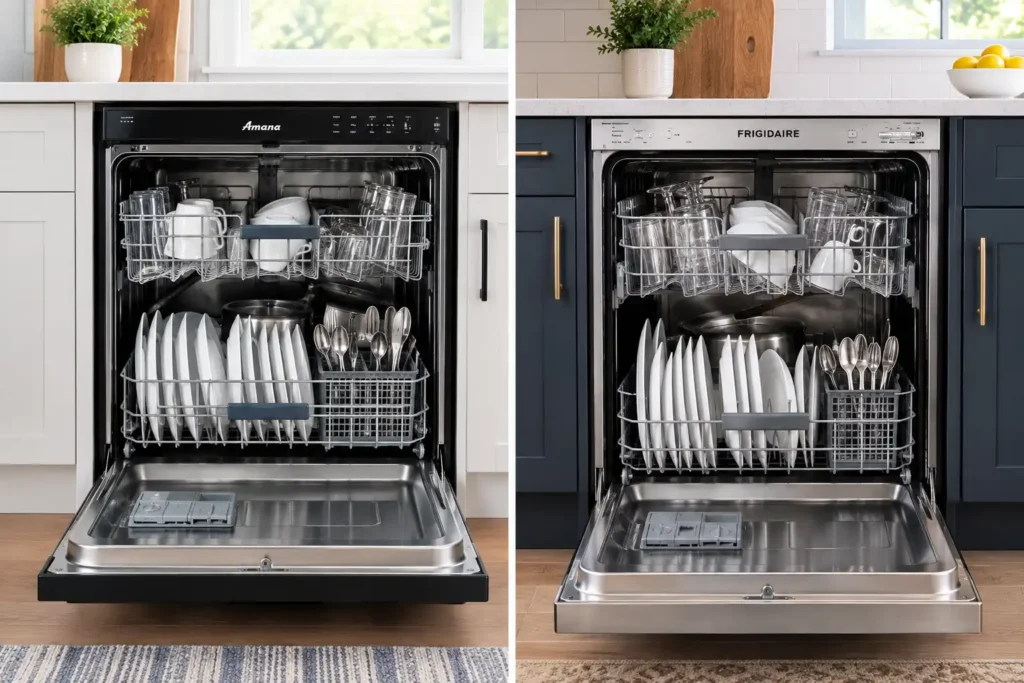
A dishwasher generates sound from several sources:
- Circulation pump
- Drain pump
- Water entering the appliance
- Water striking dishes and tub surfaces
- Spray arms
- Motor operation
- Valves
- Drainage
- Detergent dispenser
- Internal vibration
Insulation and cabinet construction can reduce the transmission of some of this noise.
However, sound-reduction technology does not mean a dishwasher becomes completely silent.
Even a well-insulated dishwasher still has moving pumps, flowing water, valves, spray arms, and drainage activity.
Amana itself explains that different operating noises are normal during a dishwasher cycle, including water movement, humming, swishing, clicking, and other sounds.
Therefore, the published dBA number should be considered an overall acoustic specification rather than a promise that the appliance will produce no noticeable sound.
Frigidaire Dishwasher Noise Levels
Frigidaire’s current lineup demonstrates a considerably wider range of noise ratings.
A current Frigidaire Gallery dishwasher, model GDPH4525AF, is advertised at 42 dBA in its quietest cycle. The same model’s documentation specifies a 45 dBA normal cycle and a 42 dBA Quiet and Gentle cycle.
Another Frigidaire Gallery model, the GDSH4735AF, is rated at 45 dBA and uses additional insulation intended to keep dishwasher noise contained.
The FDSH4502BF is rated at 49 dBA and is marketed as a very quiet dishwasher.
Another Frigidaire model, the GDPP4515AF, is rated at 52 dBA.
At the other end of the range, the FDPC4221 series is rated at 62 dBA.
This wide range makes one thing particularly clear:
You cannot accurately describe Frigidaire dishwashers as simply “quiet” or “loud.”
There are very quiet Frigidaire models and considerably louder models.
Why Frigidaire Has Such a Wide Noise Range
Different Frigidaire dishwasher families target different price points and performance levels.
A basic dishwasher may use less extensive acoustic insulation, a different motor configuration, simpler cabinet construction, or a less sophisticated sound-control system.
Premium models can incorporate more extensive insulation and other design features intended to reduce airborne and structural noise.
For example, the 42 dBA Frigidaire Gallery model is explicitly described as having additional insulation for quiet operation.
This illustrates an important purchasing principle:
A quieter dishwasher often requires additional engineering and insulation.
That does not mean a louder dishwasher is defective or poorly designed. It simply means the manufacturer has made different design choices concerning sound, features, cost, and construction.

Amana vs Frigidaire: Direct Noise Comparison
If we compare representative models, the difference becomes easier to understand.
| Model example | Published sound rating |
|---|---|
| Amana ADB1500ADS | 55 dBA |
| Amana ADFS2524 series | 59 dBA |
| Frigidaire Gallery GDPH4525AF | 42 dBA quiet cycle / 45 dBA normal |
| Frigidaire Gallery GDSH4735AF | 45 dBA |
| Frigidaire FDSH4502BF | 49 dBA |
| Frigidaire Gallery GDPP4515AF | 52 dBA |
| Frigidaire FDPC4221 series | 62 dBA |
These are manufacturer-published figures for specific models and should not be interpreted as permanent brand-wide specifications.
The comparison nevertheless illustrates a clear product-range difference.
The quietest Frigidaire model examined here is 13 dB lower than the 55 dBA Amana model and 17 dB lower than the 59 dBA Amana model.
At the same time, a 62 dBA Frigidaire model is louder than both Amana examples.
Therefore, the correct conclusion is not simply “Frigidaire is quiet” or “Amana is loud.”
The more accurate conclusion is:
Frigidaire currently offers a broader selection of very-low-noise dishwasher models, while Amana’s examples examined here are generally in the mid-to-upper-50-dBA range.
Is 42 dBA Really Much Quieter Than 55 dBA?
Yes, the difference is significant.
Because decibels are logarithmic, a 13 dB reduction represents a substantial decrease in sound pressure level.
However, human perception of loudness does not follow a simple one-to-one relationship with the numerical dBA value.
This is why comparing dishwasher specifications by looking only at the numerical difference can sometimes be confusing.
A 42 dBA dishwasher can sound dramatically less intrusive than a 55 dBA dishwasher in a quiet room.
This is particularly important during:
- Television viewing
- Family conversations
- Remote work
- Studying
- Reading
- Sleeping
- Evening meals
A dishwasher rated in the low 40s is generally designed for environments where low operating noise is a priority.
What Does 50 dBA Mean for a Dishwasher?
Around 50 dBA is often a useful middle ground.
A dishwasher at approximately 50 dBA can generally be much less intrusive than a conventional louder machine, while it may not be as acoustically unobtrusive as models in the low 40s.
Frigidaire’s 49 dBA model provides an example of this category.
For many kitchens, a 49–52 dBA dishwasher can represent a practical compromise between purchase cost, performance, and quiet operation.
However, individual sensitivity varies.
Someone living in a small studio apartment may prefer a dishwasher below 45 dBA, while someone with a separate kitchen may have little reason to pay extra for ultra-quiet operation.
What Does 55 dBA Mean?
A 55 dBA dishwasher is not necessarily “loud.”
It is simply louder than a dishwasher designed around the low-40-dBA range.
The Amana ADB1500ADS, for example, is rated at 55 dBA and specifically uses SofSound Technology II.
For many conventional kitchens, this may be acceptable.
However, if the dishwasher is installed directly beside a living area, a 55 dBA machine can be more noticeable than a 42–45 dBA model.
This becomes particularly relevant in modern open-concept homes where there may be little physical separation between kitchen and living spaces.
What Does 59–62 dBA Mean?
A dishwasher in the upper-50s or low-60s can be noticeably more audible.
The current Amana ADFS2524 series is rated at 59 dBA, while the Frigidaire FDPC4221 series is rated at 62 dBA.
These models can still be completely functional and suitable for many homes.
However, shoppers specifically searching for an ultra-quiet dishwasher should pay attention to the model’s published sound rating.
A 59 or 62 dBA machine should not be confused with a premium dishwasher advertised around 42–45 dBA.
Why a Dishwasher Can Sound Louder Than Its Published Rating
The published sound rating is based on standardized testing, but your kitchen is not a laboratory.
Your actual experience can be affected by:
- Cabinet construction
- Flooring
- Countertop material
- Wall construction
- Dishwasher installation
- Appliance leveling
- Door alignment
- Plumbing connections
- Drain-hose routing
- Nearby cabinets
- Empty versus full loads
- Type of dishes being washed
- Wash cycle
- Water pressure
- Resonance from surrounding structures
A dishwasher installed incorrectly can transmit more vibration than the same model installed correctly.
For this reason, the published rating should be viewed as a standardized comparison point rather than an exact prediction of the sound you will hear from every location.

Installation Can Affect Dishwasher Noise
Installation is one of the most overlooked factors in dishwasher noise.
The dishwasher should be properly leveled and secured according to the installation instructions.
If the appliance is not properly secured, vibration can be transferred to the surrounding cabinets.
A loose dishwasher may therefore sound louder than expected.
The same thing can happen if the machine is touching surrounding cabinetry in a way that allows vibration to transfer directly into the kitchen structure.
Correct installation helps ensure that the dishwasher operates closer to the acoustic characteristics intended by its manufacturer.
Cabinetry and Countertops Matter
Built-in dishwashers sit between kitchen cabinets.
This arrangement can either help or hurt perceived noise.
Cabinetry may absorb or block some airborne sound, but it can also transmit mechanical vibration.
If the dishwasher is tightly contacting surrounding structures, vibration from the pump or motor can travel into the cabinet framework.
Countertops can also act as structural surfaces that transmit vibration.
This is why two homes can have noticeably different experiences with the same dishwasher model.
The Type of Noise Matters
Not every dishwasher noise is equally annoying.
A continuous low hum may become background noise after a few minutes.
A sharp clicking, buzzing, rattling, or intermittent vibration can attract much more attention even when the average measured sound level is relatively low.
Dishwasher operation naturally includes different sounds.
Amana identifies normal sounds such as rushing water, humming, swishing, clicking, and brief gurgling during normal operation.
Frigidaire similarly identifies several normal dishwasher noises, including water-valve hissing, wash-pump humming, drain-pump humming, detergent-dispenser clunking, spray-arm sounds, and water whooshing.
Consequently, a low-dBA dishwasher can still make sounds that are noticeable.

Amana vs Frigidaire: Pump Noise
The wash pump is one of the main sources of dishwasher noise.
During washing, the pump circulates water through the spray system.
This produces a combination of:
- Motor noise
- Pump vibration
- Water movement
- Spray-arm noise
- Water striking dishes
Frigidaire’s official noise guide specifically identifies the wash pump as a source of humming during operation.
Amana likewise identifies humming and water-related noises as normal operating sounds.
The sound rating therefore reflects the combined acoustic output of the appliance rather than a single motor measurement.
Amana vs Frigidaire: Drain Pump Noise
The drain pump can produce a different sound from the circulation pump.
When the dishwasher drains, the pump moves water from the appliance into the household drainage system.
Frigidaire explains that drain-pump noise can be relatively steady at first and then change as the water is pumped out.
This is important because someone may hear a dishwasher become temporarily louder during drainage and assume there is a fault.
A change in sound during different stages of a dishwasher cycle is not automatically evidence of a problem.
Spray Arm Noise
Spray arms are another normal source of dishwasher sound.
Water is forced through small openings in the spray arms, causing them to rotate and distribute water throughout the tub.
Frigidaire’s noise guidance notes that spray-arm movement can produce a whooshing sound and that the sound can change as the spray arms alternate.
Objects that interfere with the spray arms can create additional noise.
For example, a tall utensil, plate, pan, or other item may physically contact the spray arm.
Therefore, proper loading is also part of noise management.
Why Proper Loading Can Reduce Noise
A poorly loaded dishwasher can produce unnecessary rattling.
Glassware, plates, pans, utensils, and other objects can move when exposed to high-pressure water.
If items are positioned incorrectly, they may strike one another.
This creates rattling that is unrelated to the dishwasher’s published dBA rating.

The solution is usually straightforward:
- Secure lightweight items.
- Avoid placing objects where spray arms can contact them.
- Keep glasses properly positioned.
- Avoid overloading.
- Follow the manufacturer’s loading instructions.
This can make the dishwasher sound quieter without changing the appliance itself.
Amana vs Frigidaire for Open-Plan Kitchens
Open-plan kitchens create a particularly strong case for paying attention to dishwasher noise.
In a traditional kitchen separated by a wall or door, dishwasher noise may be partially contained.
In an open-plan layout, the dishwasher may be only a few metres from the sofa or dining table.
A low-dBA model therefore becomes much more attractive.
For this type of installation, a Frigidaire model rated around 42–45 dBA provides a significantly quieter published specification than the 55–59 dBA Amana examples examined above.
However, this does not mean every Frigidaire model is appropriate.
A 62 dBA Frigidaire model would have a very different acoustic profile.
The model number remains essential.
Amana vs Frigidaire for Apartments and Condos
Noise can be even more important in apartments and condominiums.
In a detached home, there may be considerable separation between the dishwasher and bedrooms.
In an apartment, the kitchen may be close to sleeping areas, neighboring walls, or shared living spaces.
Low-frequency vibration can also travel through floors and cabinetry.
For apartment living, shoppers should therefore pay particular attention to:
- Published dBA rating
- Vibration
- Installation quality
- Flooring
- Cabinet contact
- Operating schedule
A low-dBA model may be worth considering even if the purchase price is somewhat higher.
Amana vs Frigidaire for Nighttime Dishwashing
Many households prefer to run their dishwasher overnight.
This can reduce daytime noise concerns and may allow dishes to be clean by morning.
However, overnight operation makes acoustic performance particularly important when bedrooms are nearby.
A dishwasher operating around 42–45 dBA is less likely to be intrusive than one rated around 55–62 dBA.
This does not guarantee that the quieter machine will be inaudible, but the lower specification provides a meaningful starting point.
Does Stainless Steel Make a Dishwasher Quieter?
A stainless-steel interior can contribute to the overall construction and acoustic behavior of a dishwasher, but it would be inaccurate to say that stainless steel automatically makes a dishwasher quiet.
Noise depends on the complete design.
Important factors include:
- Insulation
- Motor design
- Pump design
- Cabinet construction
- Tub construction
- Door construction
- Mounting
- Vibration control
- Water flow
- Sound insulation
A plastic-tub dishwasher can have a lower published dBA rating than another dishwasher with a stainless-steel tub.
Therefore, always check the actual sound rating rather than using tub material as a substitute for a noise specification.
Does More Insulation Always Mean Better?
More acoustic insulation can help reduce noise transmission, but quiet operation involves more than simply adding insulation.
Manufacturers need to control vibration, pump noise, water noise, and structural transmission.
The Frigidaire 42 dBA model, for example, specifically identifies extra insulation as part of its quiet design.
Amana’s SofSound approach similarly addresses noise reduction.
The important distinction is that these technologies are part of a complete engineering system.
Noise and Dishwasher Energy Efficiency
Noise and energy efficiency are separate characteristics.
A quiet dishwasher is not automatically more energy efficient.
Likewise, an energy-efficient dishwasher is not necessarily quieter.
For example, the Frigidaire 42 dBA model examined here is ENERGY STAR certified and lists annual energy use of 240 kWh.
Some Amana models are also ENERGY STAR certified.
Consumers should therefore evaluate energy consumption and sound level separately.
If both matter, look for a model that satisfies both requirements.
Dishwasher Noise Standards in the United States and Canada
The United States and Canada use product specifications and certification systems that allow consumers to compare appliance characteristics.
Manufacturers publish sound ratings for specific models, while appliance testing follows standardized procedures.
For Canadian shoppers, current product documentation can include sound-level specifications alongside other technical information. For example, the Canadian specification sheet for the Frigidaire GDPH4525AF lists a 42 dBA sound level.
This is particularly useful because the same model can be documented for the Canadian market rather than relying on an unofficial third-party specification.
Dishwasher Noise Information in the UK
UK consumers should pay close attention to the official product information associated with the exact model.
Dishwasher energy labeling in the UK includes an airborne acoustic noise-emission value in dB(A) and a corresponding noise-emission class. The official UK labeling system specifies that dishwasher noise emissions are expressed in dB(A) relative to 1 pW.
This makes noise a formal product characteristic rather than merely a marketing description.
However, Amana and Frigidaire product availability differs substantially between North American and UK markets.
A dishwasher purchased in the UK should therefore be evaluated using the specifications and labeling of the actual UK-market model, rather than assuming that a North American model number has identical specifications.
Why UK, US, and Canadian Buyers Should Check the Exact Model
The same brand can sell different dishwasher models in different countries.
Differences can include:
- Voltage
- Frequency
- Dimensions
- Capacity
- Noise rating
- Energy label
- Water consumption
- Controls
- Wash cycles
- Drying systems
- Warranty
- Parts availability
- Service network
Consequently, a noise comparison based on one North American model should not automatically be applied to every model sold under the same brand in the UK.
This is especially important when importing appliances.

Does Dishwasher Age Affect Noise?
It can.
A dishwasher that was quiet when new may become noisier over time.
Potential reasons include:
- Pump wear
- Bearing wear
- Debris
- Loose components
- Spray-arm damage
- Worn seals
- Installation movement
- Cabinet contact
- Drain-pump problems
- Motor problems
A gradual increase in noise should therefore not automatically be blamed on the dishwasher’s original dBA rating.
If an appliance suddenly develops a new grinding, rattling, squealing, or unusually loud vibration, troubleshooting may be appropriate.
Normal Versus Abnormal Dishwasher Noise
Normal sounds can include:
- Gentle humming
- Water rushing
- Water spraying
- Swishing
- Clicking
- Valve sounds
- Drain-pump sounds
- Detergent-dispenser sounds
- Spray-arm movement
Both manufacturers provide information explaining that several of these sounds can occur during normal dishwasher operation.
Potentially abnormal sounds include:
- Grinding
- Screeching
- Repeated hard knocking
- Persistent metallic scraping
- Sudden loud vibration
- New rattling that was not previously present
- Strong cabinet vibration
- Motor sounds that progressively worsen
The appropriate response depends on the specific sound and model.
How to Make an Amana Dishwasher Quieter
If you already own an Amana dishwasher, several practical steps may help reduce perceived noise.
1. Check leveling
An improperly leveled dishwasher can vibrate.
2. Check mounting
The dishwasher should be properly secured according to the installation instructions.
3. Inspect loading
Make sure dishes and utensils are not touching spray arms or rattling against each other.
4. Clean the filter
A dirty filter can contribute to abnormal operation and poor water circulation.
5. Check the spray arms
Make sure they can rotate freely.
6. Investigate new noises
If the sound has changed significantly, determine whether a pump, valve, or other component may require attention.
7. Check surrounding cabinetry
Make sure excessive vibration is not being transferred into cabinets.
These measures cannot turn a 59 dBA dishwasher into a 42 dBA dishwasher, but they can help the appliance operate normally and reduce unnecessary vibration.
How to Make a Frigidaire Dishwasher Quieter
The same principles apply to Frigidaire.
Check:
- Dishwasher leveling
- Mounting
- Cabinet contact
- Spray-arm clearance
- Loading
- Filters
- Drain system
- Pump sounds
- Water-inlet sounds
Frigidaire’s official noise guidance identifies specific operating noises associated with water valves, wash pumps, drain pumps, detergent dispensers, ball valves, and spray arms.
This information can help determine whether a noise is simply part of normal operation or deserves further investigation.
Is a 42 dBA Dishwasher Worth Paying More For?
That depends on your kitchen and priorities.
A 42 dBA dishwasher can be particularly useful when:
- The kitchen is open-plan.
- The dishwasher is beside the living room.
- You work from home.
- You frequently run the dishwasher at night.
- Bedrooms are close to the kitchen.
- You are sensitive to appliance noise.
- You want the dishwasher to blend into the background.
If none of these factors matter, paying substantially more for a very low dBA rating may provide less practical benefit.
Is a 55 dBA Dishwasher Too Loud?
Not necessarily.
A 55 dBA dishwasher is not inherently unsuitable.
The Amana ADB1500ADS is rated at 55 dBA and includes a dedicated sound-reduction system.
For a kitchen separated from the living area, this may be perfectly acceptable.
The question is not whether 55 dBA is objectively “too loud.”
The more useful question is whether 55 dBA is quiet enough for your particular home.
Is a 59 dBA Dishwasher Too Loud for an Apartment?
It may be more noticeable in an apartment, especially if the kitchen is close to a bedroom or living area.
The current Amana ADFS2524 series is rated at 59 dBA.
Someone who is highly sensitive to appliance noise may prefer a lower-rated model.
However, actual perceived noise will depend on the building, cabinetry, floor construction, installation, and when the appliance is operated.
Amana vs Frigidaire Dishwasher Noise Level: Which Range Should You Look For?
A useful practical way to think about dishwasher sound ratings is:
Around 40–44 dBA
Very quiet category.
These models are particularly attractive for open-plan kitchens, apartments, bedrooms near kitchens, and nighttime operation.
Around 45–49 dBA
Quiet category.
This is often a strong balance between low noise and cost.
Around 50–54 dBA
Moderately quiet.
Suitable for many conventional kitchens.
Around 55–59 dBA
Noticeable operation.
May be acceptable in kitchens with some separation from living spaces.
60+ dBA
More audible.
Best considered when purchase price and basic functionality are more important than extremely quiet operation.
These categories are practical descriptions rather than official international classifications.
Amana vs Frigidaire Dishwasher Noise Level for Families
Families often use the kitchen throughout the day.
The dishwasher may operate while children are studying, people are talking, television is playing, or meals are being prepared.
A lower noise rating can therefore make the kitchen feel more comfortable.
However, the difference between a 42 dBA and 55 dBA dishwasher is most valuable when people are actually nearby during operation.
If the dishwasher runs while everyone is asleep and the kitchen is isolated, the benefit may be smaller.
Amana vs Frigidaire Dishwasher Noise Level for Home Offices
Remote work has made kitchen noise more relevant.
A dishwasher running behind an open-plan home office can potentially become part of the background environment.
If video calls and concentration are important, a low-dBA dishwasher may be preferable.
This is one area where a 42–45 dBA model can offer a practical advantage over a 55–59 dBA model.
Amana vs Frigidaire Dishwasher Noise Level for Small Kitchens
Small kitchens amplify the importance of sound because the dishwasher is usually close to the people using the room.
There may also be fewer walls and less physical separation between the appliance and occupants.
A low-noise model can therefore be more noticeable as a benefit.
For small homes, apartments, and condos, the exact dBA rating deserves more attention than it might in a large detached home.
How Much Does Dishwasher Loading Affect Noise?
Loading affects noise in two main ways.
First, dishes can rattle against one another.
Second, incorrectly positioned objects can interfere with spray arms.
Frigidaire specifically notes that spray-arm contact with an excessively tall item can produce a clunking sound.
Therefore, if a dishwasher suddenly becomes noisy after loading, check the dishes before assuming there is a mechanical problem.
Should You Trust the Manufacturer’s dBA Rating?
Manufacturer-published sound ratings are useful because they are based on standardized testing rather than subjective descriptions alone.
The international dishwasher noise standard provides a structured test methodology for measuring airborne acoustic noise.
However, consumers should understand what the number represents.
It is a standardized measurement, not a guarantee that every household will perceive the appliance identically.
Installation and room acoustics can change the experience.
Nevertheless, when comparing two dishwasher models, the manufacturer’s published dBA figure is one of the most useful objective specifications available.
Amana vs Frigidaire Dishwasher Noise Level: Important Buying Mistakes to Avoid
Mistake 1: Comparing brands instead of models
Always compare the exact model number.
Mistake 2: Assuming expensive means quiet
Price and noise are related in some product ranges but are not interchangeable.
Mistake 3: Ignoring the dBA specification
Marketing terms such as “quiet” or “ultra quiet” should be checked against the actual numerical specification.
Mistake 4: Ignoring installation
A poorly installed quiet dishwasher can still transmit considerable vibration.
Mistake 5: Assuming all Frigidaire models are quiet
Frigidaire offers models across a wide sound range, including a current 62 dBA example.
Mistake 6: Assuming all Amana models have the same noise level
Amana examples currently range from 55 to 59 dBA in the models examined here.
Amana vs Frigidaire Dishwasher Noise Level: Final Comparison
The available manufacturer specifications make the comparison relatively clear when looking at individual models.
Amana’s current examples include a 55 dBA dishwasher with SofSound Technology II and models rated at 59 dBA.
Frigidaire’s current lineup includes considerably quieter options, including a 42 dBA model with a 45 dBA normal cycle, a 45 dBA model, a 49 dBA model, and a 52 dBA model. At the same time, it also sells models rated around 62 dBA.
Therefore, the most accurate way to describe the comparison is:
Amana’s dishwasher noise levels in the models examined tend to fall in the mid-to-upper 50-dBA range, while Frigidaire offers a much wider selection, including several models in the low-40-dBA range as well as louder basic models.
For shoppers whose main priority is minimum operating noise, the exact Frigidaire model’s low-dBA options deserve particular attention.
For shoppers considering an Amana dishwasher, checking whether the selected model is rated around 55 dBA or closer to 59 dBA is important.
The choice should ultimately depend on the layout of the kitchen and how sensitive the household is to appliance noise.
Frequently Asked Questions
Is Amana quieter than Frigidaire?
Not across the entire product range. The Amana models examined here are rated at 55 and 59 dBA, while Frigidaire offers models ranging from the low 40s to above 60 dBA. Therefore, the exact model matters more than the brand.
What is the quietest Amana dishwasher?
Among the current Amana models researched for this comparison, the ADB1500ADS is rated at 55 dBA and uses SofSound Technology II.
What is the quietest Frigidaire dishwasher?
The Frigidaire Gallery GDPH4525AF is specified at 42 dBA on its Quiet and Gentle cycle and 45 dBA during its normal cycle.
Is 42 dBA very quiet for a dishwasher?
Yes. A 42 dBA rating represents a very low published sound level for a household dishwasher. The exact perceived noise will still depend on installation and room acoustics.
Is 55 dBA quiet enough for a dishwasher?
For many households, yes. However, it will generally be more noticeable than a dishwasher rated around 42–45 dBA.
Is 59 dBA loud for a dishwasher?
A 59 dBA dishwasher is more audible than modern low-noise models in the 40s. Whether it is too loud depends on the room layout and individual preferences.
Is a 62 dBA dishwasher loud?
Compared with current ultra-quiet models, 62 dBA is relatively audible. It may still be perfectly suitable for a separate kitchen where noise is not a major concern.
Is Frigidaire 42 dBA really quieter than Amana 55 dBA?
The published ratings indicate a substantial acoustic difference. The Frigidaire model is rated 13 dB lower than the 55 dBA Amana model.
Does dBA determine exactly how loud a dishwasher will sound?
No. dBA provides a standardized comparison measurement, but installation, cabinetry, flooring, room acoustics, loading, and cycle selection can influence perceived noise.
Can a dishwasher become louder as it gets older?
Yes. Component wear, debris, pump problems, loose components, vibration, or installation changes can result in increased noise.
Why does my dishwasher make a humming sound?
Humming can be a normal operating sound from the wash pump or drain pump. The precise cause depends on when the humming occurs and whether it represents a change from normal operation.
Why does my dishwasher make a whooshing sound?
Water moving through the spray arms can create a whooshing sound. Spray arms alternate during some dishwasher cycles, which can cause the sound to change.
Why does my dishwasher make a clicking sound?
Some clicking can be normal and may come from valves, controls, or other components operating during the cycle. The location and timing of the sound are important when determining whether it is normal.
Does stainless steel make a dishwasher quieter?
Not automatically. Noise depends on the complete design, including insulation, pumps, motors, mounting, cabinet construction, and vibration control.
Is a quiet dishwasher better for an open kitchen?
A low-dBA dishwasher can be particularly useful in an open kitchen because there is less physical separation between the appliance and living spaces.
What dishwasher noise level is best for an apartment?
A model in the low-to-mid 40 dBA range can be particularly attractive for an apartment, especially when the kitchen is close to bedrooms or shared living areas.
Should I buy a 42 dBA dishwasher instead of a 55 dBA dishwasher?
If minimizing noise is a major priority, the lower-rated model provides a substantially quieter published specification. If noise is not important, a higher-rated model may provide a better balance with price and other features.
Does dishwasher insulation reduce noise?
Yes, insulation can reduce sound transmission. Some current Frigidaire models specifically identify additional insulation as part of their quiet-operation design.
Can improper installation make a dishwasher louder?
Yes. Leveling, mounting, cabinet contact, and vibration transmission can affect the amount of sound heard in the kitchen.
Does the wash cycle affect dishwasher noise?
Yes. Different stages of a dishwasher cycle can involve different pumps, valves, spray patterns, and drainage operations. Consequently, the sound can change during the cycle.
Is dishwasher noise measured using international standards?
Yes. IEC 60704-2-3 is the international standard specifically addressing airborne acoustic noise measurement for household dishwashers. The 2025 edition replaced the earlier 2017 edition.
Does the UK energy label show dishwasher noise?
Yes. UK dishwasher energy-label information includes airborne acoustic noise emissions in dB(A) and a corresponding noise-emission class.
Are US, Canadian, and UK dishwasher noise ratings directly interchangeable?
The basic concept of dBA is comparable, but consumers should always check the actual market-specific model documentation. Product specifications, test documentation, model numbers, and labeling requirements can differ between markets.
Final Verdict on Amana vs Frigidaire Dishwasher Noise Level
When noise is the primary consideration, the individual dishwasher model matters far more than the brand name.
Amana currently has models around 55–59 dBA, with SofSound Technology appearing on applicable models.
Frigidaire has a much broader noise range. Its current products include models at 42 dBA, 45 dBA, 49 dBA, and 52 dBA, while some basic models are rated at approximately 62 dBA.
For a quiet open-plan kitchen, apartment, condo, home office, or nighttime operation, a dishwasher in the low-40-dBA range offers a substantially different acoustic experience from a dishwasher in the upper-50s or low-60s.
For a separate kitchen where dishwasher noise is not a major concern, a mid-50-dBA dishwasher may be entirely adequate.
The most important rule is simple: do not buy an Amana or Frigidaire dishwasher based only on the brand’s reputation for quietness. Check the exact model’s published dBA rating, then consider installation, cabinetry, room layout, and the way you intend to use the dishwasher.
A dishwasher’s sound rating is one of the few objective specifications that allows shoppers in the United States, Canada, and the United Kingdom to make a meaningful noise comparison before purchasing. For anyone who considers a quiet kitchen important, checking that number before buying can prevent years of unnecessary appliance noise.