
When people compare dishwashers, they often focus on cleaning performance, reliability, noise level, capacity, price, and energy consumption. Drying performance is sometimes treated as a secondary feature, but it can have a major effect on everyday satisfaction. A dishwasher that cleans plates perfectly but leaves cups, containers, silverware, and plastics covered with water can still be frustrating to use.
The comparison between Amana vs Frigidaire dishwasher drying performance is particularly interesting because both brands use several different drying approaches depending on the model. Amana offers dishwashers with heated drying, vented drying, fan-assisted drying, extended drying, and door-opening technologies on applicable models. Frigidaire similarly offers Heat Dry, Air Dry, Sahara Dry, and PowerPlus Dry on different models. The actual drying system therefore varies substantially from one dishwasher to another.
This means that it would be inaccurate to say that every Amana dishwasher dries better than every Frigidaire dishwasher, or the opposite. The specific model, drying technology, rinse-aid use, rack loading, water temperature, dish material, and cycle selected can all influence the final result.
For consumers in the United States, Canada, and the United Kingdom, understanding these differences is particularly useful because dishwasher designs and model availability can vary between markets. A dishwasher that performs very well in one category may not necessarily be the best choice for someone who frequently washes plastic food containers, stainless-steel cookware, glassware, or large numbers of cups.
This guide provides a detailed comparison of Amana and Frigidaire dishwasher drying performance, explains how their drying systems work, examines plastic and glass drying, discusses rinse aid and water temperature, and explains what shoppers should look for when choosing between the two brands.
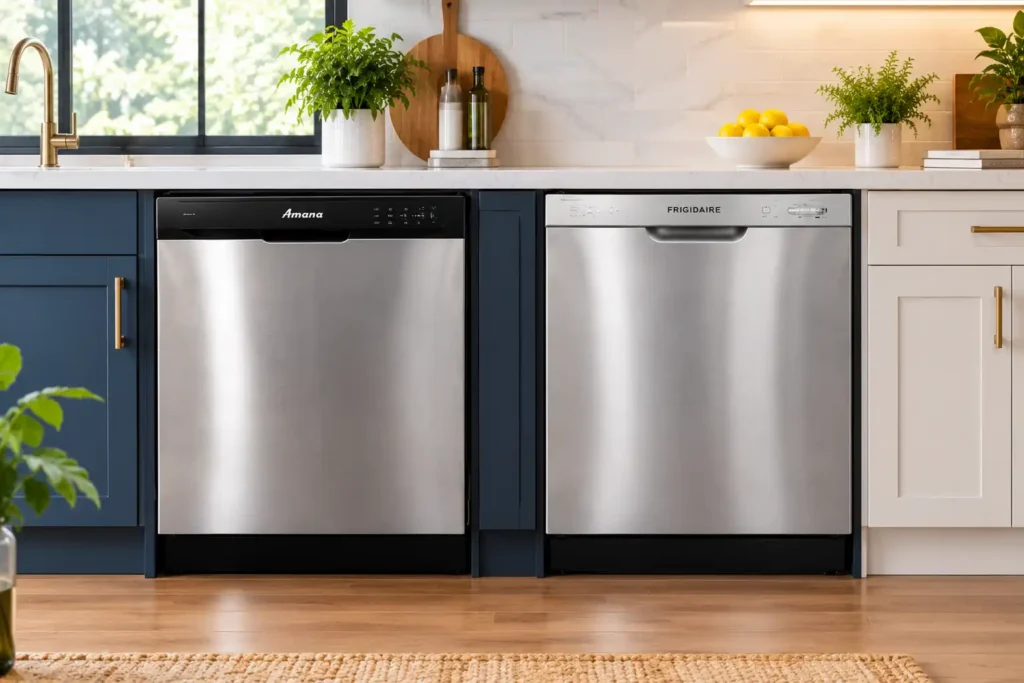
Amana vs Frigidaire Dishwasher Drying Performance at a Glance
| Drying Factor | Amana | Frigidaire |
|---|---|---|
| Heated drying | Available on many models | Available on many models |
| Fan-assisted drying | Available on selected models | Available on selected models |
| Door-opening drying | Available on selected models | Varies by model |
| Vented drying | Available on selected models | Varies by model |
| Extended drying | Available on selected models | Available on selected models |
| Air drying | Available on applicable models | Available on applicable models |
| Rinse aid recommended | Yes | Yes |
| Plastic drying | Can remain difficult | Can remain difficult |
| Concave-item drying | Can retain water | Can retain water |
| Stainless-steel drying | Generally good with appropriate cycle | Generally good with appropriate cycle |
| Best drying depends on | Exact model and cycle | Exact model and cycle |
| Advanced drying options | Model dependent | Strong options on selected models |
The most important point is that both brands offer multiple drying technologies, so the model number should always be checked before making a purchase.
Why Dishwasher Drying Performance Matters
A dishwasher’s job does not end when the washing stage finishes.
After the final rinse, water remains on the surfaces of plates, glasses, bowls, utensils, pans, and containers. The drying system has to remove that moisture or encourage it to evaporate and drain away.
Poor drying can create several practical problems:
- Wet plates must be towel-dried.
- Cups may contain pools of water.
- Plastic containers may remain covered in droplets.
- Cutlery may require wiping.
- Glassware may develop water spots.
- Concave dishes can retain water.
- The dishwasher interior can remain humid.
- Dishes may need to remain inside longer before being put away.
Both Amana and Frigidaire acknowledge that certain items, especially plastics and concave surfaces, are inherently more difficult to dry. Frigidaire specifically states that plastics, wooden items, and concave items may not dry completely, while Amana explains that plastic items and some shapes can retain moisture even when heated drying is used.
Therefore, excellent dishwasher drying should not be defined as making every object completely dry under every condition.
Instead, good drying performance means the dishwasher effectively removes moisture from the majority of dishwasher-safe items while minimizing standing water, droplets, and spotting.
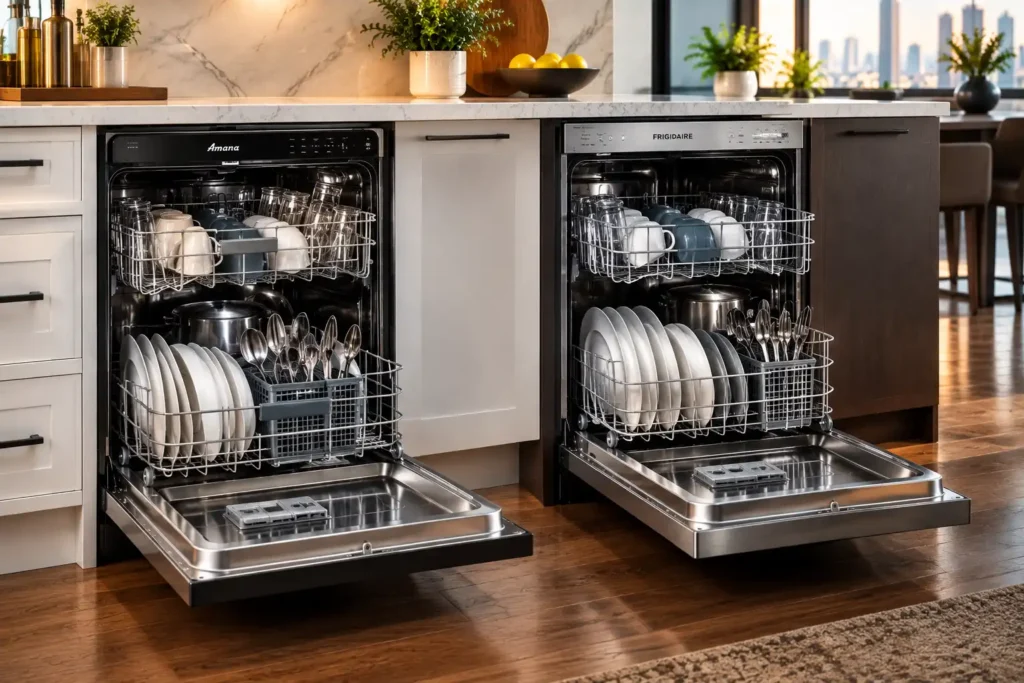
How Dishwasher Drying Works
Dishwashers use several different methods to remove water.
The traditional approach is heated drying, where a heating element raises the temperature inside the dishwasher. Warmer conditions accelerate evaporation.
Other systems use fans to move warm, humid air around the dishwasher.
Some modern dishwashers allow the door to open automatically near the end of the cycle. This lets humid air escape and allows drier surrounding air to enter.
Other systems depend primarily on condensation and natural airflow.
These technologies can also be combined.
Amana describes heated drying as using an internal heating element and, on applicable systems, airflow to accelerate evaporation. Its support documentation also describes fan-assisted drying and door-opening systems.
Frigidaire similarly offers traditional Heat Dry, Air Dry, and more advanced forced-air systems on selected models. Its Sahara Dry and PowerPlus Dry technologies combine heat with forced air.
Amana Dishwasher Drying Performance
Amana’s drying performance depends considerably on the model.
Many Amana dishwashers use a Heated Dry option. Current Amana models can also include technologies such as Vented Dry, ProDry, Extended ProDry, and Door Open Dry, depending on the specific model.
For example, an Amana dishwasher with a Heated Dry option uses an internal heater to remove excess moisture. Another current model includes Vented Dry, which releases humid air through a vent while the heating element helps evaporate water from dishes.
This approach can produce good drying results for ceramic plates, glassware, stainless-steel utensils, and many other heat-tolerant dishwasher-safe items.
However, Amana’s own guidance makes an important point: plastic items can remain wet even when the heated-dry system is working properly. The material and shape of the item influence how quickly water evaporates.
Amana Heated Dry
Heated Dry is one of the most important features to examine when comparing Amana dishwashers.
The basic concept is simple.
The dishwasher uses heat to raise the temperature of the internal environment after washing. Higher temperatures encourage water to evaporate.
Heated drying can be particularly effective for:
- Ceramic plates
- Porcelain dishes
- Stainless-steel cutlery
- Glasses
- Heat-resistant cookware
Amana specifically recommends heated drying when users want the best drying performance. Its guidance also explains that using rinse aid together with heated drying improves results.
However, heated drying does not guarantee that every item will be completely dry.
Plastic is particularly challenging because it does not retain heat in the same way as glass, ceramic, or metal.

Amana Vented Dry
Some Amana models use Vented Dry.
This system allows humid air to escape through a vent during the drying process.
The combination of heat and ventilation can help remove moisture from the dishwasher cavity.
For example, one current Amana model specifically describes Vented Dry as using an open vent to release humid air while the heating element helps evaporate water from dishes.
This approach can be useful because simply heating a closed dishwasher does not automatically guarantee efficient moisture removal.
If humid air remains trapped inside the tub, drying can slow down.
Venting provides a route for moisture to leave the dishwasher.
Amana Fan-Assisted Drying
Some Amana models use a fan together with heat.
The fan circulates warm air around the dishes and can increase evaporation.
Amana’s documentation explains that its ProDry or Heat Dry systems on applicable models combine a heating element with a fan to circulate hot air around dishes. The company also notes that a fan may continue operating after the main cycle to provide additional air movement.
This can be especially useful when moisture remains on surfaces after the final rinse.
Instead of relying exclusively on passive evaporation, moving air encourages moisture to leave the surfaces and eventually exit the dishwasher.
Amana Door Open Dry
Another approach used on selected Amana models is Door Open Dry.
At the end of the washing phase, the dishwasher automatically opens the door slightly.
This allows hot, humid air to escape and permits fresh air to circulate.
Amana explains that this system can accelerate drying by releasing humid air and allowing fresh air into the dishwasher.
This is a fundamentally different approach from simply adding more heat.
Instead of continually increasing the temperature, the dishwasher improves moisture removal by changing the air conditions inside the tub.
Frigidaire Dishwasher Drying Performance
Frigidaire has a particularly broad selection of drying technologies.
Depending on the model, consumers may encounter:
- Heat Dry
- Air Dry
- Sahara Dry
- PowerPlus Dry
- Forced-air drying
- Rinse-aid-assisted drying
The exact technology is model dependent.
Frigidaire states that its Sahara Dry system adds a forced-air system to Heat Dry, while PowerPlus Dry similarly combines forced air with heat on selected models. The company describes Sahara Dry as its most advanced drying action on applicable models.
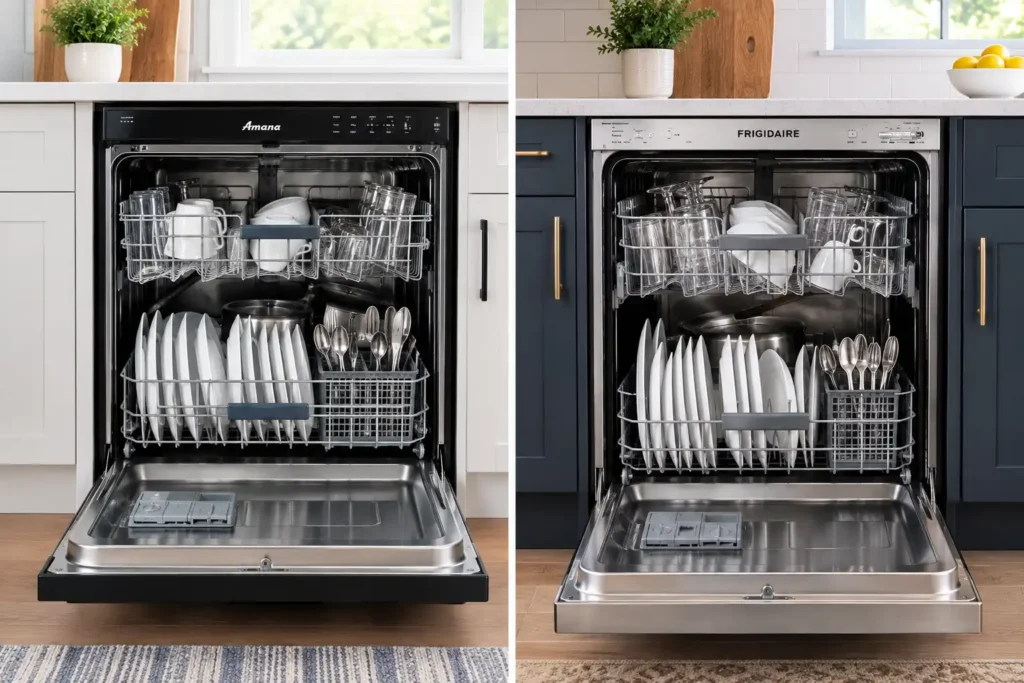
This means Frigidaire can provide substantially different drying performance depending on which product family and model a customer purchases.
A basic Frigidaire dishwasher should therefore not be compared directly with a premium Frigidaire dishwasher simply because both carry the same brand name.
Frigidaire Heat Dry
Heat Dry is the traditional drying option in the Frigidaire lineup.
The heating system raises the temperature inside the dishwasher and accelerates evaporation.
Frigidaire recommends using Heat Dry together with rinse aid for improved drying performance. The company also explains that some plastic and concave items may retain moisture even when Heat Dry is functioning normally.
This is important when evaluating drying performance.
If a Frigidaire dishwasher leaves a few plastic containers wet, that does not necessarily mean its heating system is defective.
The material itself can be responsible.
Frigidaire Sahara Dry
Sahara Dry is one of the more advanced drying technologies available on selected Frigidaire models.
It combines heat with forced air.
The purpose is to move warm air around the dishes while encouraging moisture to evaporate.
According to the manufacturer’s guidance, Sahara Dry is available on selected models and, when combined with rinse aid, provides the brand’s highest level of drying performance.
This makes the exact model particularly important in an Amana-versus-Frigidaire comparison.
A Frigidaire dishwasher equipped with Sahara Dry should not be treated as equivalent to a basic model that only offers Air Dry.
Frigidaire PowerPlus Dry
PowerPlus Dry is another drying technology available on selected models.
Like Sahara Dry, it adds forced air to a heated drying process.
The forced airflow helps move moisture away from dishes rather than relying solely on passive evaporation.
Frigidaire recommends using rinse aid with this type of drying system for the best results.
For shoppers specifically interested in strong drying performance, identifying whether the selected Frigidaire model has Sahara Dry or PowerPlus Dry can be more useful than simply looking at the brand name.
Amana vs Frigidaire: Heated Dry Comparison
Both brands offer heated drying, but the implementation varies.
Amana uses heated drying on numerous models and combines it with other technologies on selected products.
Frigidaire also uses Heat Dry widely and adds forced-air systems to certain premium models.
The basic difference is therefore not that one company “uses heat” and the other does not.
Instead, the important question is:
How does the particular model combine heat, airflow, ventilation, and moisture removal?
For example, a Frigidaire model with Sahara Dry has a different drying system from a basic Frigidaire model using Air Dry.
Similarly, an Amana model with Vented Dry or ProDry may provide a different result from an Amana model with basic Heated Dry.
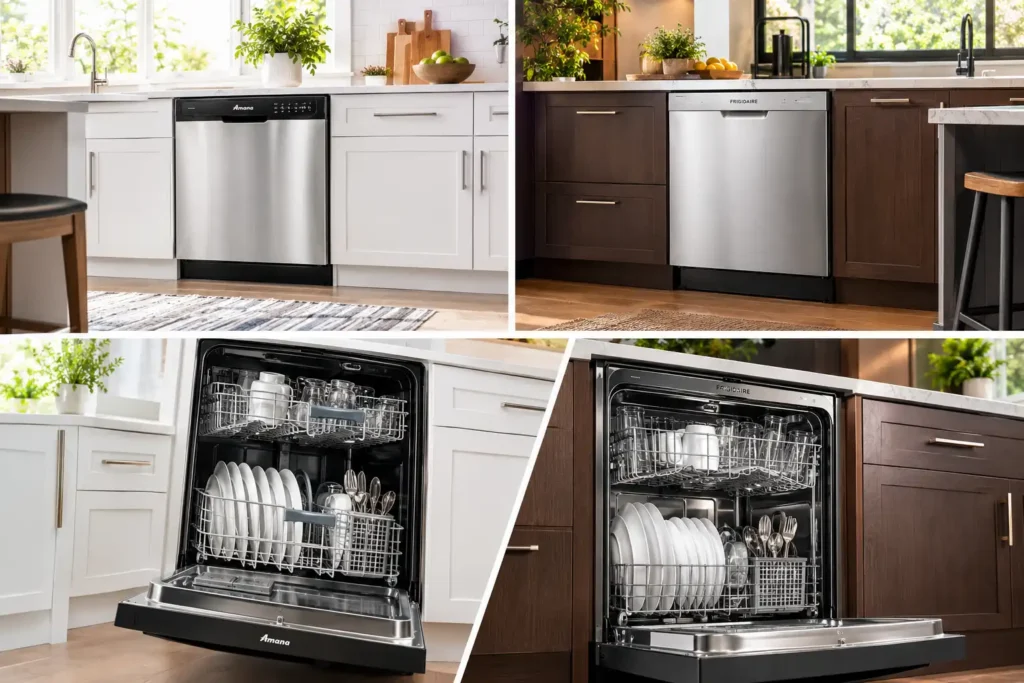
Amana vs Frigidaire: Which Is Better for Plastic?
Plastic is one of the most difficult materials for any dishwasher to dry.
Plastic generally does not hold heat as effectively as ceramic, glass, or metal.
Water droplets can therefore remain on plastic surfaces after the cycle finishes.
The shape of the container makes a difference as well.
A flat plastic plate may dry reasonably well, while a deep plastic food-storage container can retain a puddle of water.
Both manufacturers recognize this limitation. Frigidaire explicitly states that plastic products may not dry completely, while Amana similarly explains that plastic can remain wet even with heated drying.
Therefore, the best dishwasher for a household that washes large amounts of plastic should ideally have a strong drying system, good airflow, appropriate rack placement, and an effective rinse-aid system.
Even then, completely dry plastic should not be guaranteed.
Why Plastic Is So Difficult to Dry
There are several reasons.
First, plastic has relatively poor heat retention compared with materials such as glass and metal.
Second, plastic surfaces can hold droplets.
Third, containers often have recessed or concave surfaces.
Fourth, plastic containers can trap water underneath lips, handles, and edges.
Consequently, the dishwasher may finish its cycle with the plates and glasses dry while plastic containers remain wet.
This is not necessarily evidence of inferior dishwasher performance.
It is a physical limitation associated with the material and shape.
Amana vs Frigidaire for Glassware
Glassware generally dries better than plastic.
Glass can become relatively warm during the final rinse, which helps water evaporate.
Rinse aid also helps water spread into a thin film rather than remaining as individual droplets.
Amana specifically recommends rinse aid and heated drying for improved drying and reduced spotting on glassware.
Frigidaire similarly recommends rinse aid because it helps water sheet off surfaces and improves drying performance.
Therefore, both brands can provide good glassware drying when the correct cycle, rinse aid, and loading arrangement are used.
Amana vs Frigidaire for Stainless-Steel Utensils
Stainless-steel cutlery generally responds well to heated drying.
Metal heats up during the wash and rinse process, which can help residual water evaporate.
However, cutlery can still remain wet if it is packed tightly together.
If spoons are nested together, water can become trapped between them.
Amana’s drying guidance recommends appropriate silverware loading and spacing to improve results.
Therefore, good drying depends partly on how the silverware basket is loaded.
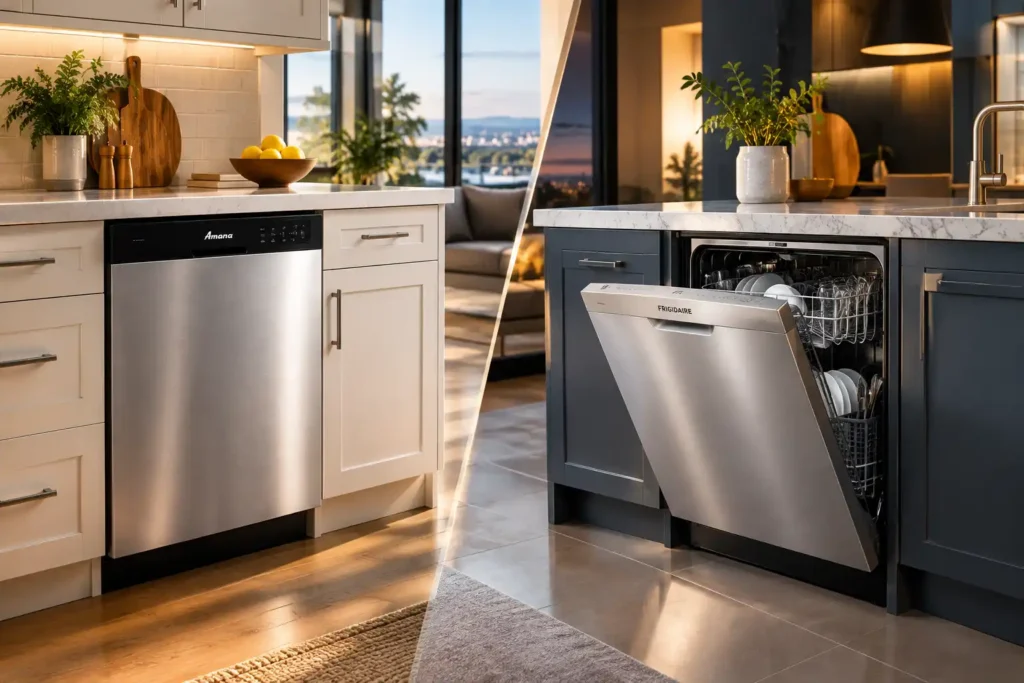
Amana vs Frigidaire for Bowls
Bowls are another challenging category.
Their curved shape can create a pocket where water remains after the cycle.
Frigidaire specifically identifies concave items such as bowls as products that may not dry completely and recommends placing them at an angle.
Amana similarly recommends positioning cups and bowls at angles so water does not pool.
This is one of the easiest ways to improve drying without changing the dishwasher.
The Importance of Rinse Aid
Rinse aid is one of the most important factors in dishwasher drying.
It does not simply add fragrance or make dishes look shiny.
Rinse aid changes the behavior of water on the surface of dishes.
It helps water spread and drain away rather than remaining as large droplets.
Amana specifically states that rinse aid optimizes drying and wash performance and helps control hard-water deposits.
Frigidaire likewise explains that rinse aid helps water sheet off dishes and improves drying performance.
This means that a dishwasher with excellent drying technology can still produce disappointing results if the rinse-aid dispenser is empty or improperly adjusted.
Can You Get Good Drying Without Rinse Aid?
You can get some drying without rinse aid, but performance may be less consistent.
Water tends to remain on surfaces more readily when surface tension is higher.
This is especially noticeable with:
- Glassware
- Stainless steel
- Plastics
- Bowls
- Cups
- Hard-water conditions
Both Amana and Frigidaire recommend rinse aid as part of achieving good drying performance.
Therefore, when comparing the two brands, testing one machine with rinse aid and another without it would not provide a fair comparison.
Hard Water and Drying Performance
Hard water can complicate dishwasher ownership.
Minerals in hard water can contribute to spotting, filming, and deposits.
Rinse aid becomes particularly important because it helps water leave surfaces more effectively.
Amana specifically notes that rinse aid can help control hard-water deposits as well as improve drying.
A household with very hard water may therefore experience poorer-looking drying results even when the dishwasher itself is operating correctly.
This is relevant in parts of the United States, Canada, and the United Kingdom where local water hardness varies substantially.
Water Temperature and Dishwasher Drying
Water temperature affects dishwasher operation.
Amana recommends a hot-water supply of at least 120°F (49°C) on applicable models for optimal wash and dry performance.
Frigidaire likewise recommends a water-heater setting of at least 120°F and suggests running the hot-water tap before starting the dishwasher so hot water reaches the appliance.
The reason is straightforward.
The final rinse contributes heat to the dishes.
If the dishes become warmer, evaporation can happen more efficiently.
Therefore, inadequate incoming water temperature can affect drying as well as washing.
Why the Final Rinse Matters
The final rinse is more than simply the last opportunity to remove detergent.
It can also influence the thermal condition of the dishes.
Hot dishes provide an environment in which remaining moisture can evaporate more readily.
This is one reason dishwasher drying performance should not be considered independently from the wash and rinse process.
A dishwasher that does not reach appropriate operating temperatures may show both cleaning and drying problems.
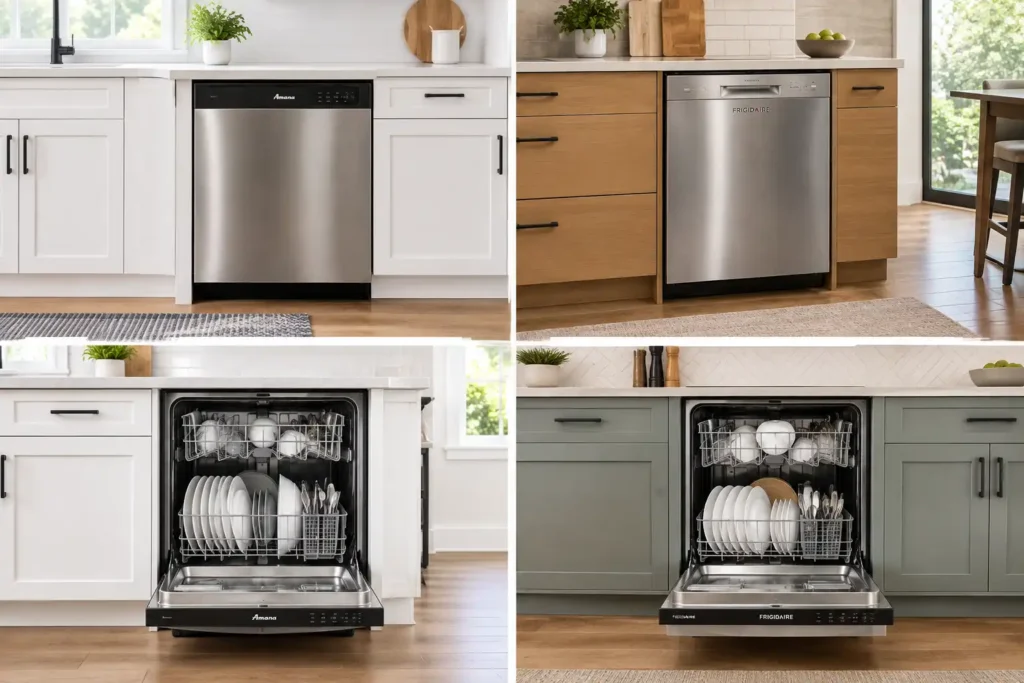
Air Dry Versus Heated Dry
Air drying uses less additional heat.
It relies primarily on airflow and ambient conditions.
This can reduce energy consumption but generally takes longer and can leave more water on dishes.
Frigidaire explains that Air Dry relies on air rather than heat and may leave some dishes incompletely dry.
Amana similarly explains that air drying can save energy but may leave more moisture, particularly on difficult-to-dry items.
Therefore, air drying can be useful when energy savings are more important than achieving the driest possible load.
Heated Dry Versus Fan-Assisted Drying
Heated drying raises the temperature.
Fan-assisted drying adds airflow.
Combining the two can provide a more active drying process.
The heat encourages evaporation while the moving air carries moisture away.
This is why advanced systems such as Frigidaire Sahara Dry and PowerPlus Dry and certain Amana fan-assisted systems can potentially outperform simple passive drying.
However, the actual performance still depends on loading, rinse aid, water temperature, and the material of the dishes.
Door-Opening Drying Versus Heated Drying
Door-opening systems take a different approach.
Rather than continually heating the dishwasher, the system allows humid air to escape.
Amana’s Door Open Dry system opens the door slightly after the wash stage, allowing hot humid air to leave and fresh air to enter.
This can be particularly useful because humid air is the enemy of efficient evaporation.
If moisture remains trapped inside a closed cabinet, drying can take longer.
Condensation Drying and European Dishwashers
European dishwasher designs often place greater emphasis on condensation-based drying.
In a condensation system, hot dishes and hot rinse water provide heat while moisture condenses on cooler surfaces within the dishwasher.
The technical principles behind condensation drying differ from traditional exposed heating-element systems.
Government technical documentation explains that condensation drying can reduce energy consumption by using hot rinse water to heat the dishes and then allowing moisture to condense on cooler surfaces rather than relying exclusively on an exposed electric heating element.
This is particularly relevant to UK readers because European-market dishwasher designs can differ from typical North American models.
A UK buyer should therefore examine the actual drying technology and energy label of the specific model rather than assuming that North American drying terminology applies identically.
Amana vs Frigidaire for Energy-Conscious Buyers
Drying technology affects energy use.
Traditional heated drying requires additional electrical energy to produce heat.
Air drying can reduce that additional energy requirement.
Condensation and other heat-recovery approaches can also reduce energy requirements.
However, energy consumption depends on the entire dishwasher cycle, not just the drying system.
The U.S. Department of Energy’s technical analysis identifies several drying approaches and notes that condensation drying can reduce the energy required for drying compared with traditional exposed heating-element systems.

Therefore, consumers should compare the complete energy specification for the model rather than assuming that a particular drying technology automatically means lower total energy use.
Amana vs Frigidaire for Spot-Free Glassware
Drying and spotting are closely connected but are not exactly the same thing.
A glass can be completely dry but still have mineral spots.
Conversely, a glass can have very little spotting while still retaining some moisture.
Rinse aid is important because it helps water leave the glass surface more evenly.
Amana recommends rinse aid and heated drying for improved glassware results.
Frigidaire similarly identifies rinse aid as an important part of optimal drying and spot reduction.
Therefore, if your primary concern is sparkling glassware, compare both drying technology and rinse-aid functionality.
Amana vs Frigidaire for Plastic Containers
For households that frequently wash food-storage containers, drying performance deserves particular attention.
Plastic containers can emerge with:
- Droplets on the exterior
- Water underneath the rim
- Moisture inside the container
- Water trapped around handles
- Wet lids
- Moisture underneath recessed surfaces
Even advanced drying technology may not eliminate all of this.
A forced-air system can help, but loading remains extremely important.
Containers should be positioned so water can drain rather than collect.
Concave surfaces should be angled where possible.
Frigidaire specifically recommends angling concave items to improve drying.
Amana similarly recommends loading plastics at an angle on the upper rack.
Why Plastic Should Usually Go on the Upper Rack
The upper rack generally provides a more suitable location for dishwasher-safe plastics.
It keeps plastic farther from the strongest heat sources and provides an arrangement that can encourage water to drain.
Amana specifically recommends placing plastic items on the upper rack and loading them at an angle.
This is useful regardless of whether the dishwasher is Amana or Frigidaire.
Amana vs Frigidaire Drying Performance in Hard-Water Areas
In hard-water regions, drying performance should be evaluated together with spotting and mineral buildup.
A dishwasher can technically dry dishes while leaving visible mineral deposits.
This can make consumers believe the dishwasher has poor drying performance when the underlying issue is water chemistry.
Rinse aid, appropriate detergent, regular filter maintenance, and proper dishwasher cleaning can help.
The exact approach should follow the dishwasher’s instructions and the household’s water conditions.

Does a Stainless-Steel Tub Improve Drying?
Stainless steel can influence drying behavior because it retains heat differently from plastic.
Amana’s drying guidance notes that stainless-steel tubs can retain heat well and that this can support evaporation.
However, stainless steel alone does not guarantee excellent drying.
The drying system, airflow, final rinse temperature, insulation, loading, and rinse aid remain important.
A dishwasher with a stainless-steel tub and weak drying system should not automatically be expected to outperform a dishwasher with a different tub construction and stronger active drying system.
Amana vs Frigidaire: Drying Time
Drying time varies by model and selected cycle.
Heated and forced-air systems may extend the overall cycle.
Extended drying options can also increase the time required.
Amana explains that some Extended Dry settings can add additional drying time to improve results.
Frigidaire likewise provides different drying modes depending on model.
Consumers should therefore compare total cycle duration as well as drying performance.
A dishwasher that leaves dishes slightly damp after a shorter cycle may be preferable to someone prioritizing speed, while another household may prefer a longer cycle that produces drier dishes.
Is Frigidaire Better Than Amana for Drying?
There is no valid brand-wide answer.
Frigidaire has some particularly advanced drying systems, including Sahara Dry and PowerPlus Dry on selected models.
Amana also provides heated, vented, fan-assisted, extended, and door-opening drying technologies on selected models.
The most useful comparison is therefore model versus model.
A Frigidaire with Sahara Dry may have a very different drying capability from an entry-level Frigidaire.
Likewise, an Amana with advanced heated, vented, or fan-assisted drying may perform differently from a basic Amana dishwasher.
Is Amana Better Than Frigidaire for Drying?
Again, there is no universal brand-level answer.
Amana has strong practical drying features on selected models, including Heated Dry, Vented Dry, ProDry, Extended ProDry, and Door Open Dry.
The quality of the result depends on which technology is present.
For example, a household that primarily washes ceramic plates and stainless-steel utensils may be very satisfied with a conventional heated-dry Amana.
Another household that washes large quantities of plastic food-storage containers may prefer a model with stronger forced-air drying.
Which Brand Is Better for Large Families?
Large families often run the dishwasher frequently and wash a mixture of materials.
A typical load may contain:
- Ceramic plates
- Glasses
- Stainless-steel utensils
- Plastic lunch containers
- Plastic storage lids
- Bowls
- Pots
- Pans
This mixed load creates a greater challenge than a dishwasher filled primarily with ceramic and glass.
For such households, the drying system should be considered carefully.
A model with heated drying plus active airflow may offer greater flexibility.
However, correct loading remains essential.

Which Brand Is Better for Plastic Food Containers?
When plastic drying is the priority, focus on the drying technology rather than the logo.
Look for:
- Heated drying
- Forced-air drying
- Fan-assisted drying
- Strong ventilation
- Door-opening drying
- Adjustable drying options
- Effective rinse-aid dispensing
Frigidaire’s Sahara Dry and PowerPlus Dry are particularly relevant because they add forced air to heated drying on selected models.
Amana’s fan-assisted and advanced drying options can also improve moisture removal on applicable models.
Even with these systems, some plastic items may remain damp.
Which Brand Is Better for Glasses?
Both can perform well.
Glass generally dries more easily than plastic, especially when:
- Rinse aid is used
- The final rinse is hot
- Glasses are angled correctly
- Heated drying is selected
- The dishwasher is not overloaded
Amana specifically recommends rinse aid and heated drying for optimal results.
Frigidaire similarly recommends rinse aid and Heat Dry or its advanced drying systems.
Which Brand Is Better for Stainless-Steel Cutlery?
Both brands can produce good results with stainless-steel cutlery.
The biggest factors are spacing and water drainage.
If forks, knives, and spoons are packed tightly together, water can become trapped.
Separating utensils and following the manufacturer’s basket-loading instructions can improve drying.
Which Brand Is Better for Bowls?
Both brands require proper positioning.
Bowls should generally be angled so that water can drain away rather than pooling inside.
Frigidaire specifically recommends placing concave items such as bowls at an angle.
Amana’s guidance similarly recommends positioning cups and other items to prevent water from pooling.
Dishwasher Loading Has a Major Effect on Drying
Even the best drying technology cannot overcome poor loading.
A common mistake is placing containers completely flat.
Water becomes trapped.
Another mistake is placing cups or bowls in positions where the opening faces upward.
Water accumulates.
Another issue is overcrowding.
If dishes are touching one another, air cannot circulate effectively.
Good loading practices include:
- Place cups and bowls at an angle.
- Keep plastic containers separated.
- Avoid nesting spoons.
- Do not overload racks.
- Keep spray arms unobstructed.
- Place plastic on the upper rack where recommended.
- Ensure water can drain from concave items.
These simple changes can sometimes improve drying more than changing detergent or increasing the drying temperature.
How to Improve Amana Dishwasher Drying
If your Amana dishwasher is leaving dishes wet, check the following.
Use rinse aid
Amana specifically recommends rinse aid for optimal drying.
Select Heated Dry
If the model provides Heated Dry, use it when maximum drying is the priority.
Try Extended Dry
Some models provide an extended drying option for additional drying time.
Use Door Open Dry where available
Opening the door allows humid air to escape.
Load plastics correctly
Place plastic items on the upper rack and angle them so water can drain.
Check water temperature
Amana recommends a hot-water supply of at least 120°F on applicable models.
How to Improve Frigidaire Dishwasher Drying
Frigidaire also provides several ways to improve drying.
Use rinse aid
Rinse aid helps water sheet from dishes.
Select Heat Dry
Heat Dry improves drying compared with Air Dry on applicable models.
Use Sahara Dry where available
This adds forced air to heated drying.
Use PowerPlus Dry where available
This also combines forced air and heat.
Angle bowls
This prevents water from pooling.
Check water temperature
Frigidaire recommends a minimum water-heater setting of 120°F and suggests running hot water at the sink before starting the dishwasher.
Common Reasons an Amana Dishwasher Does Not Dry
If an Amana dishwasher suddenly stops drying effectively, possible causes include:
- Rinse-aid dispenser is empty.
- Drying option is disabled.
- The wrong cycle is being used.
- Plastic is being placed incorrectly.
- Bowls are trapping water.
- Water temperature is insufficient.
- Heating element has a problem.
- Fan-assisted drying is not functioning correctly.
- The dishwasher is overloaded.
- The filter or internal components require maintenance.
Amana’s troubleshooting guidance specifically identifies rinse aid, drying settings, loading, water temperature, and heating-element operation as important areas to investigate.
Common Reasons a Frigidaire Dishwasher Does Not Dry
Possible causes include:
- Rinse aid is empty.
- Air Dry was selected.
- Heat Dry was not selected.
- A quick cycle was used.
- Plastic items are being washed.
- Bowls are positioned incorrectly.
- Water temperature is too low.
- Drainage or installation problems exist.
- The dishwasher is overloaded.
- The heating or drying system requires service.
Frigidaire specifically notes that quick cycles may not dry dishes completely and that plastics and concave items may naturally retain water.
Amana vs Frigidaire Drying Performance in the USA
For U.S. buyers, the most important step is to identify the exact model and read its cycle and feature specifications.
North American dishwashers commonly use heated drying, but the sophistication of the drying system varies.
Some models emphasize energy efficiency and lower heat use, while others offer more aggressive drying systems.
A U.S. consumer should compare:
- Drying technology
- Energy consumption
- Cycle duration
- Rinse-aid system
- Heated drying
- Fan-assisted drying
- Door-opening technology
- Plastic-drying capability
- Warranty
- Local service
Do not assume that every dishwasher from one brand has the same drying system.
Amana vs Frigidaire Drying Performance in Canada
Canadian buyers should also pay attention to the exact Canadian model.
Model numbers and available features can differ between Canada and the United States.
Canadian consumers should check:
- Official Canadian specifications
- Energy information
- Warranty coverage
- Installation requirements
- Available drying options
- Replacement parts
- Local service
A model available in the United States may not have exactly the same specifications as a similarly named Canadian product.
Amana vs Frigidaire Drying Performance in the UK
UK shoppers need to be particularly careful when comparing North American dishwasher information with UK-market products.
The UK uses formal appliance energy labeling that includes dishwasher noise information and other standardized product information.
Drying technology may also differ because European-market dishwashers commonly use condensation-based approaches and other efficiency-focused designs.
Consequently, a UK buyer should research the specific UK-market Amana or Frigidaire model, where available, rather than assuming that a North American product specification applies.
Are European Dishwashers Better at Drying?
Not necessarily.
European dishwashers often use different drying philosophies, particularly condensation-based systems.
These can be highly effective for glass, ceramic, and metal but may still struggle with plastic.
The underlying physics does not disappear simply because the dishwasher uses a different drying method.
Plastic can still retain droplets, and concave containers can still hold water.
Therefore, “European drying” should not automatically be interpreted as “completely dry plastics.”
Heated Dry and Energy Consumption
One trade-off of stronger drying is energy use.
Heating requires energy.
A dishwasher that uses an electric heating element to increase tub temperature generally consumes more energy during drying than a system relying exclusively on ambient air.
However, modern dishwashers can combine heating with ventilation, airflow, and other methods to improve drying efficiency.
Amana itself explains that air drying can reduce energy use but generally provides less aggressive drying than heated drying.
The right choice depends on whether the household prioritizes energy savings, speed, or dryness.
Is Better Drying Worth Higher Energy Use?
For some households, yes.
If you unload dishes immediately after every cycle, strong drying can save time because you do not need to towel-dry dishes.
If your dishwasher runs overnight and dishes remain inside until morning, aggressive drying may be less important.
If you frequently wash plastics, a stronger drying system may also reduce the amount of manual drying required.
Therefore, the value of better drying depends on how the dishwasher is used.
Amana vs Frigidaire Drying: What Should Buyers Look For?
When comparing two specific models, use this checklist.
1. Drying technology
Determine whether the machine uses:
- Heat Dry
- Fan-assisted drying
- Forced-air drying
- Vented drying
- Door-opening drying
- Condensation drying
- Air drying
2. Rinse-aid dispenser
Make sure the model supports and properly dispenses rinse aid.
3. Plastic performance
If your household uses lots of plastic containers, pay particular attention to this.
4. Cycle options
Look for dedicated drying options.
5. Extended drying
This can be useful for large or difficult loads.
6. Final rinse temperature
Hotter final rinses can help drying.
7. Rack design
Good rack positioning can be just as important as the drying technology.
8. Energy consumption
Compare the official energy specifications.
9. Cycle time
Advanced drying can add time.
10. Serviceability
If the heating element, fan, or other drying component fails, make sure replacement parts and service are available.
Amana vs Frigidaire Dishwasher Drying Performance: Overall Comparison
The two brands approach drying differently across their product ranges.
Amana provides conventional Heated Dry and also offers more advanced features on selected models, including Vented Dry, ProDry, Extended ProDry, and Door Open Dry.
Frigidaire provides Heat Dry and Air Dry, while selected models add forced-air technologies such as Sahara Dry and PowerPlus Dry.
Both brands emphasize rinse aid as an important part of achieving better drying performance.
Both acknowledge that plastic and concave items can retain water.
Both recommend appropriate loading.
Both identify adequate water temperature as important.
Consequently, neither brand can reasonably be classified as universally superior for drying without specifying the model.
Amana vs Frigidaire Dishwasher Drying Performance: Which Should You Choose?
If your household primarily washes ceramic plates, glassware, and stainless-steel cutlery, either brand can potentially provide good drying when the dishwasher has an effective heated drying system and is properly loaded.
If you frequently wash plastic food containers, pay more attention to advanced airflow and drying technologies. A model with forced-air drying may provide an advantage over a basic heated-dry system.
If you want to minimize energy consumption, compare air-dry or lower-energy drying options and the dishwasher’s overall energy rating.
If you want the driest possible dishes, prioritize:
- Heated drying
- Forced airflow
- Effective ventilation
- Rinse aid
- Proper loading
- Appropriate water temperature
- Extended drying options
If you live in a hard-water area, consider rinse-aid performance and mineral management alongside drying.
Frequently Asked Questions
Does Amana have good dishwasher drying performance?
Amana offers several drying systems, including Heated Dry, Vented Dry, and fan-assisted drying on selected models. Its manufacturer guidance recommends heated drying and rinse aid for the strongest drying results.
Does Frigidaire have good dishwasher drying performance?
Frigidaire offers several drying technologies, including Heat Dry, Air Dry, Sahara Dry, and PowerPlus Dry on selected models. The advanced forced-air systems are designed to improve drying performance.
Which dries better, Amana or Frigidaire?
There is no universal brand-level answer. The exact model and drying technology are more important than the brand name.
Which is better for plastic, Amana or Frigidaire?
A model with strong forced-air or fan-assisted drying may provide better results with plastic, but neither brand can guarantee that all plastic items will be completely dry. Plastic naturally retains moisture more readily than glass, ceramic, and metal.
Does Amana use heated drying?
Yes. Heated Dry is available on many Amana dishwasher models. The system uses an internal heater to remove excess moisture.
Does Frigidaire use heated drying?
Yes. Frigidaire offers Heat Dry on applicable models and combines it with forced air on selected Sahara Dry and PowerPlus Dry models.
Does rinse aid really improve dishwasher drying?
Yes. Both manufacturers specifically recommend rinse aid because it helps water sheet off surfaces and improves drying performance.
Why are my plastic containers still wet?
Plastic does not retain heat as effectively as materials such as glass or metal, and its surfaces can retain droplets. Concave containers can also trap water. Both brands identify plastics as particularly difficult to dry.
Why are my bowls still wet inside?
Bowls have concave surfaces where water can pool. Positioning bowls at an angle allows water to drain more effectively.
Should I use Heat Dry every time?
If maximum drying performance is the priority, Heat Dry is generally appropriate on compatible models. If saving energy is more important and you do not mind longer drying times, air drying may be suitable.
Is Air Dry better for plastic?
Air drying can be gentler and uses less additional heat, but it may leave more moisture on dishes. Plastic may still remain wet.
What is Sahara Dry?
Sahara Dry is a drying system available on selected Frigidaire models that combines heated drying with forced airflow. The manufacturer describes it as providing its highest level of drying performance on applicable models.
What is PowerPlus Dry?
PowerPlus Dry is available on selected Frigidaire models and adds forced air to the heated drying process.
What is Vented Dry on an Amana dishwasher?
Vented Dry uses an opening or vent to release humid air while the heating system helps evaporate moisture from dishes.
What is Door Open Dry?
Door Open Dry automatically opens the dishwasher door slightly after the washing phase on applicable models. This allows humid air to escape and fresh air to circulate, helping accelerate drying.
Does hot water improve drying?
Yes. Both brands identify adequate incoming water temperature as important for wash and drying performance. A minimum supply temperature of approximately 120°F (49°C) is recommended for applicable models.
Should I run the kitchen faucet before starting the dishwasher?
If the dishwasher is connected to the hot-water supply, running the nearby faucet until hot water arrives can help ensure that the dishwasher receives appropriately heated water at the beginning of the cycle. Frigidaire specifically recommends this approach.
Does stainless steel help dishwasher drying?
A stainless-steel tub can retain heat effectively and can support evaporation, but tub material alone does not determine drying performance.
Why are my dishes wet even though the heating element works?
Correct heating is only one part of drying. Rinse aid, loading, water temperature, airflow, ventilation, cycle selection, and dish material can all affect the final result.
Can a dishwasher dry completely without a heating element?
Some dishwashers use condensation, airflow, ventilation, or door-opening techniques rather than relying entirely on an exposed heating element. These approaches can provide effective drying but may behave differently with plastics and other difficult materials.
Is condensation drying good?
Condensation drying can be energy efficient and effective for many types of dishes. However, it does not guarantee completely dry plastics or eliminate the effect of loading and dish shape.
Which dishwasher drying system is best?
For maximum drying, a combination of heat, airflow, ventilation, and effective moisture removal can provide strong results. However, the best system for an individual household depends on dish materials, energy priorities, cycle time, and budget.
Is better drying worth paying more for?
It can be worthwhile if you frequently wash plastic containers, unload immediately, run the dishwasher overnight, or strongly dislike manually drying dishes. If drying performance is not important, spending more on advanced drying may provide less benefit.
Does a dishwasher’s drying performance decline over time?
It can. Problems with the heating element, fan, controls, pump, ventilation, or other components can affect drying. A sudden change in drying performance should be investigated rather than assumed to be normal aging.
Can hard water affect drying?
Hard water can contribute to mineral deposits, spotting, and filming. Rinse aid and appropriate maintenance can help manage these issues.
Why does my dishwasher leave water on the inside walls?
Some interior condensation is normal, particularly with certain drying systems. The purpose of drying is primarily to remove moisture from the dishes, and some dishwasher designs intentionally allow moisture to condense on cooler surfaces.
Should the dishwasher door be opened after the cycle?
If the model does not have an automatic door-opening system, manually opening the door after the cycle can help release humid air. Amana specifically recommends opening the door when a heated dry cycle is not used.
Final Thoughts on Amana vs Frigidaire Dishwasher Drying Performance
The drying comparison between Amana and Frigidaire is more complicated than simply declaring one brand the winner.
Amana offers several drying approaches, including Heated Dry, Vented Dry, fan-assisted drying, ProDry, Extended ProDry, and Door Open Dry on selected models.
Frigidaire also offers a broad selection, ranging from basic Air Dry and Heat Dry to more advanced forced-air technologies such as Sahara Dry and PowerPlus Dry.
Both manufacturers agree on several fundamentals: rinse aid improves drying, proper loading matters, hot water supports better results, and plastics and concave dishes are inherently more difficult to dry.
For a household that mostly washes plates, glasses, ceramic dishes, and stainless-steel cutlery, a good heated-dry dishwasher from either brand can provide satisfactory results.
For a household that frequently washes plastic food containers, reusable bottles, lunch boxes, and deep bowls, the drying technology deserves considerably more attention. Forced-air and fan-assisted systems can provide additional moisture removal, although they cannot completely eliminate the physical challenges associated with plastic and concave surfaces.
For energy-conscious households, air drying and condensation-based technologies can reduce the energy associated with traditional heated drying, but potentially at the cost of longer drying times or more residual moisture.
For buyers in the United States and Canada, the most important step is to compare the exact Amana and Frigidaire model numbers and examine the available drying options rather than making a brand-level assumption.
For buyers in the United Kingdom, the same principle applies, with additional attention to the exact UK-market model, energy labeling, drying technology, and local product specifications.
Ultimately, the strongest way to compare Amana vs Frigidaire dishwasher drying performance is to look at the exact drying technology, rinse-aid system, airflow, heating system, cycle options, rack design, energy consumption, and expected performance with the types of dishes your household actually washes.
A dishwasher is not truly a good dryer simply because its dishes look dry when the door is opened once. The better measure is whether it consistently produces the results you need—across glassware, plates, cutlery, bowls, cookware, and plastics—without requiring you to finish the job with a kitchen towel.