
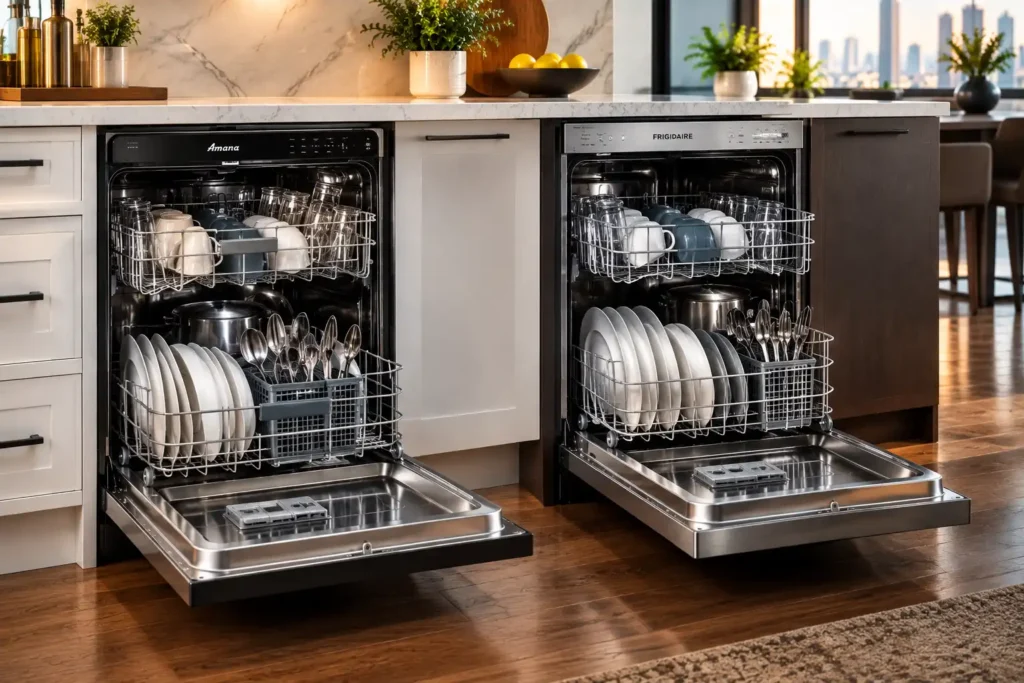
When comparing Amana vs Frigidaire dishwasher reliability, it is important to look beyond price, cleaning performance, features, and customer reviews. Reliability is really a combination of several factors: how often a dishwasher develops a problem, how complicated the machine is, the quality and availability of replacement parts, warranty coverage, service access, repairability, and how well the individual model is maintained.
Current independent reliability data provides a useful starting point. In Consumer Reports’ dishwasher reliability analysis, Frigidaire has a predicted reliability score of 65 out of 100, while Amana is at 58. Consumer Reports explains that its dishwasher reliability estimates are based on statistical modeling of member ownership experiences and predict the probability of a dishwasher developing a problem by the end of the fifth year.
A separate 2025 U.S. Appliance Reliability & Service Study measured problems per 100 appliances during the first one to three years of ownership. Frigidaire recorded 84 problems per 100 dishwashers in that study. Amana was not included in the published dishwasher brand comparison, so the study does not provide a direct Amana-versus-Frigidaire result. This distinction matters: it would be misleading to treat the absence of an Amana figure as evidence that Amana is either more or less reliable.
For shoppers, the practical conclusion is that brand name alone should not determine the purchase. Frigidaire has stronger available independent dishwasher reliability data, while Amana’s simpler product positioning and Whirlpool-family service infrastructure can make particular Amana models attractive to buyers who prioritize straightforward operation and potentially simpler ownership. The exact model, installation quality, water conditions, usage, and local service availability can ultimately have a substantial effect on ownership experience.
Amana vs Frigidaire Dishwasher Reliability at a Glance
| Reliability Factor | Amana | Frigidaire |
|---|---|---|
| Independent dishwasher reliability data | Available through Consumer Reports | Available through Consumer Reports and J.D. Power |
| Consumer Reports predicted reliability | 58/100 | 65/100 |
| J.D. Power 2025 dishwasher PP100 | Not reported in published comparison | 84 PP100 |
| Standard warranty | Generally 1 year for major appliances | Generally 1 year |
| Replacement parts support | Factory parts and model-specific support available | Genuine parts and factory service available |
| Factory service resources | Available | Available |
| Product complexity | Many models emphasize practical features | Wider range of features and configurations |
| Repair support | Amana/Whirlpool service network | Frigidaire factory-trained service |
| Canadian support | Available | Available |
| UK availability | Limited compared with North America | Model availability varies |
| Best comparison method | Individual model + service availability | Individual model + service availability |
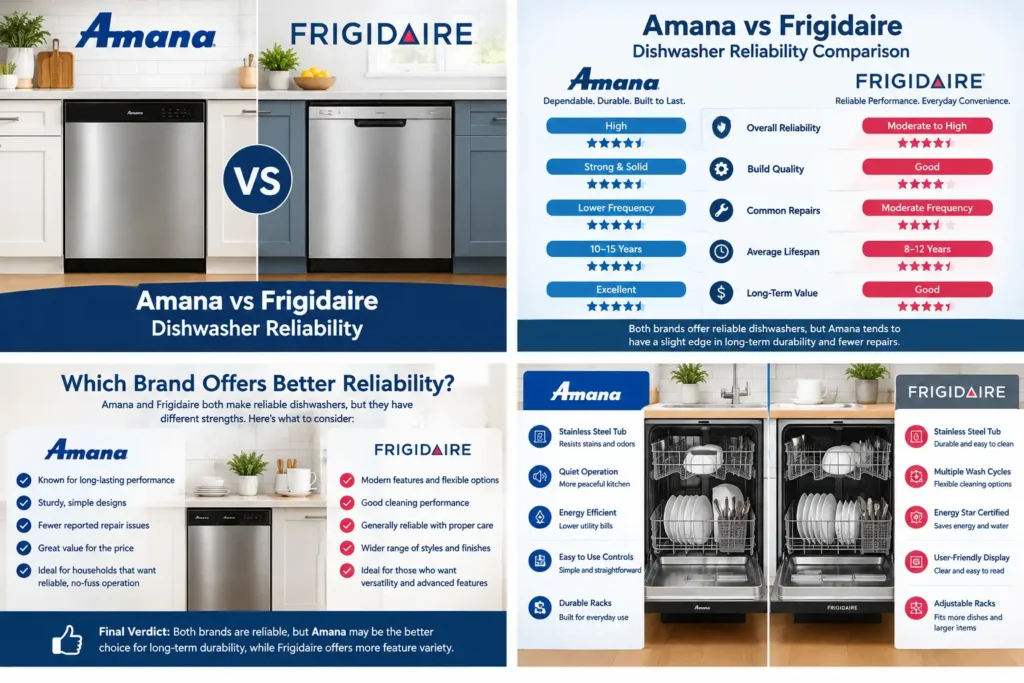
The figures above should not be interpreted as a universal prediction for every dishwasher sold under either brand. Reliability studies use different methodologies, time periods, samples, and definitions of a “problem.” Consumer Reports’ rating is a predicted five-year reliability measure, while J.D. Power’s PP100 measure concerns problems experienced during the first one to three years.
What Does Dishwasher Reliability Actually Mean?
Dishwasher reliability is often misunderstood. A dishwasher can clean extremely well when new but still be an inconvenient appliance if it develops frequent drainage, heating, filling, electronic, or drying problems.
Reliability should therefore be considered across the entire ownership period. A dependable dishwasher should consistently fill with the correct amount of water, circulate water effectively, heat water when required, drain properly, dry dishes according to its design, and continue performing these functions without repeated component failures.
Another important consideration is repairability. Even a reliable dishwasher can eventually need a replacement pump, heating component, inlet valve, control board, circulation component, rack component, gasket, or other part. A machine becomes much easier to own when replacement parts, technical documentation, troubleshooting information, and qualified technicians are available.
Amana provides owners with model-specific manuals, troubleshooting resources, parts information, and service assistance. Its support system identifies dishwashers separately and allows owners to search using model information.
Frigidaire similarly provides dishwasher-specific troubleshooting information covering subjects such as draining, filling, cleaning performance, drying, odors, detergent, filters, water leaks, error codes, and other operating issues.
This means reliability should not be reduced to a single number. How easily a problem can be diagnosed and repaired is an important part of the ownership equation.
Amana Dishwasher Reliability
Amana has traditionally positioned many of its household appliances around practical functionality rather than concentrating exclusively on premium features. Its dishwasher lineup includes features such as soil sensing, filtration systems, stainless-steel interiors on applicable models, multiple wash cycles, and integrated controls depending on the model.
The company also provides dedicated troubleshooting, manuals, replacement-parts information, registration, and service-plan resources.
From a reliability perspective, this matters because a dishwasher’s long-term ownership experience does not end when the warranty expires. Having model documentation and replacement-parts infrastructure can make later repairs easier.
Amana’s published technical documentation also demonstrates that its dishwashers are supported through formal service procedures. Technical documentation for Amana and Whirlpool 24-inch dishwashers provides service professionals with information for diagnosing malfunctions and returning appliances to operating condition.

However, Consumer Reports’ current predicted reliability figure of 58/100 for Amana dishwashers is lower than the 65/100 figure for Frigidaire. This does not mean that every Amana dishwasher will fail more often. It means the available Consumer Reports statistical estimate places the two brands at different predicted reliability levels in its dataset.
That distinction is particularly important when shopping for an inexpensive dishwasher. A relatively inexpensive appliance can still provide satisfactory ownership if the model is properly installed, maintained, and supported locally.
Frigidaire Dishwasher Reliability
Frigidaire has a broad dishwasher lineup, including compact and full-size products with different rack configurations, filtration systems, drying approaches, controls, cycle selections, and noise levels.
Its official support system provides detailed dishwasher troubleshooting information. Topics include poor cleaning, failure to drain, failure to fill, leaks, drying problems, odors, detergent issues, filters, spray arms, water-related problems, and various fault conditions.
The availability of model-specific troubleshooting information can be particularly useful once a dishwasher is several years old. Instead of automatically replacing an appliance because it is not working correctly, an owner can determine whether the issue involves a filter, drain hose, water supply, detergent, heating system, spray arm, sensor, or another component.
Frigidaire also offers factory service. Its current service information states that factory-trained technicians are available and that service vehicles can carry hundreds of genuine parts, with the company stating that this helps technicians complete many repairs during the first visit.
For warranty and post-warranty ownership, Frigidaire’s support infrastructure is therefore an important part of the reliability picture.
Consumer Reports Reliability: Amana vs Frigidaire
One of the most useful independent sources for this comparison is Consumer Reports because its reliability methodology is based on real-world ownership data rather than simply laboratory performance.
Its current dishwasher reliability information uses member responses and a statistical model to estimate the likelihood that a dishwasher will develop a problem by the end of the fifth year. The organization reports that approximately 23% of dishwashers purchased by its members since 2013 broke or stopped working as well as they should.

The current brand figures reported in its large-appliance reliability ranking place:
- Frigidaire: 65/100
- Amana: 58/100
The numbers are not percentages of machines that fail. They are reliability scores generated by Consumer Reports’ methodology.
That is an important distinction because a 65 does not mean 65% of Frigidaire dishwashers last five years, and a 58 does not mean 42% fail.
Consumer Reports also points out that the most commonly reported dishwasher problems involve cleaning and drying. This demonstrates why reliability cannot be evaluated only by looking at whether a dishwasher turns on. An appliance can continue operating while developing problems such as incomplete cleaning or inadequate drying.
What Does J.D. Power Say About Frigidaire?
The 2025 U.S. Appliance Reliability & Service Study provides another perspective.
For dishwashers, the study reported the following problems-per-100-appliances results:
- KitchenAid: 63
- Bosch: 64
- GE: 64
- Whirlpool: 76
- Segment average: 77
- Frigidaire: 84
- LG: 90
- Samsung: 91
The study covered appliances purchased within the previous one to three years.
This measurement is different from Consumer Reports’ five-year predicted reliability model. Consequently, the two datasets should not simply be combined into one score.
J.D. Power also found that connected appliances with Wi-Fi or Bluetooth experienced more reported problems on average than appliances without those connectivity features. Across the appliance categories studied, connected appliances averaged 87 problems per 100 appliances compared with 63 for appliances without connectivity.
For a dishwasher buyer, this suggests that additional electronics and connectivity should be evaluated according to whether the features are genuinely useful. More technology does not automatically mean better long-term reliability.
Why Amana and Frigidaire Reliability Numbers Can Differ
Different reliability studies measure different things.
Consumer Reports’ reliability estimate focuses on predicted problems over a longer ownership period, while J.D. Power’s 2025 study measures problems during the first one to three years. Therefore, a brand can look different depending on the methodology and ownership period.
Sample composition can also affect the results. A brand may sell numerous dishwasher models at different prices and with different technologies. A reliability number for the brand does not mean every model uses identical components.
For example, one dishwasher may have a basic control system and traditional drying, while another model from the same brand may incorporate additional sensors, electronic controls, specialized washing systems, or connectivity.
Installation can also affect reliability. Incorrect drain-hose routing, poor leveling, unsuitable electrical connections, inadequate water supply, or improper installation can cause operational problems that are not necessarily manufacturing defects.
This is why the most useful buying process is to use brand-level reliability information as a starting point, then investigate the specific model.
Amana vs Frigidaire: Motor and Pump Reliability
The circulation system is one of the most important mechanical parts of a dishwasher.
During washing, the circulation system moves water through spray arms and directs it toward dishes. A problem with the circulation pump or related components can result in poor cleaning, unusual noises, inadequate water movement, or a dishwasher that appears to run without cleaning effectively.
Both Amana and Frigidaire dishwashers use model-specific washing systems, so it would be inaccurate to claim that every Amana pump is more durable than every Frigidaire pump or vice versa.
When comparing two specific models, look at the exact replacement-parts information and service documentation. Amana provides model-specific parts resources, while Frigidaire provides genuine replacement-parts and service resources.
The key reliability question is therefore not simply “Which brand has the better motor?” It is “Which exact model uses which components, and how easily can those components be serviced in my area?”
Amana vs Frigidaire: Heating System Reliability
Heating is another important area because dishwashers commonly use heat during washing and/or drying depending on the cycle and model.
Heating problems can result in inadequate cleaning, poor drying, longer cycles, detergent-related problems, or fault conditions.
Heating also represents a significant part of dishwasher energy consumption. Department of Energy technical analysis identifies water heating as the largest component of dishwasher energy consumption.
For that reason, shoppers should not judge reliability simply by looking at whether a dishwasher has a heating element. The complete system—including sensors, controls, wiring, water temperature, and drying design—affects how the dishwasher operates.
If comparing Amana and Frigidaire, examine the exact model specifications rather than assuming the brand determines heating reliability.
Amana vs Frigidaire: Filtration and Cleaning Systems
A dishwasher’s filtration system has a direct relationship with cleaning performance and maintenance.
Amana provides models with filtration systems designed to reduce the need for pre-rinsing. Its current dishwasher information describes a Triple Filter Wash System on applicable products.
Frigidaire also provides dishwasher models with removable filters and filtered-water systems. For example, one current Canadian Frigidaire dishwasher specification lists a removable filter trap and 100% filtered water.
The important reliability issue is maintenance.
A filter that becomes heavily clogged can contribute to poor cleaning, odors, drainage problems, and reduced washing performance. Regardless of whether the dishwasher is Amana or Frigidaire, owners should follow the model’s maintenance instructions and inspect the filter regularly.
Amana vs Frigidaire: Drainage Reliability
Drainage is one of the most common dishwasher ownership concerns.
A dishwasher that does not drain correctly can leave standing water inside the tub. Potential causes include a clogged filter, blocked drain path, drain-hose installation problems, a drain pump problem, or other mechanical or electronic faults.
Frigidaire’s official dishwasher support specifically provides troubleshooting information for units that do not drain, including information related to drain hoses and other drainage concerns.
Amana likewise provides model-specific troubleshooting and service resources.
Neither brand can be considered immune to drainage problems. Installation is particularly important because the drain system has to be configured correctly for the dishwasher and the home’s plumbing.
Amana vs Frigidaire: Drying Reliability
Drying performance deserves separate attention because poor drying does not always mean the dishwasher is mechanically unreliable.
Modern dishwashers may use different drying approaches, including heated drying, condensation-based drying, ventilation, or combinations of different technologies.
A dishwasher may therefore complete its cycle normally while leaving certain plastics wet.
Consumer Reports identifies cleaning and drying among the most frequently reported dishwasher problem areas.
When comparing Amana and Frigidaire, consumers should therefore distinguish between:
- A dishwasher that is designed to leave certain items somewhat wet.
- A dishwasher whose drying system has developed a fault.
- A dishwasher that has been incorrectly loaded.
- A dishwasher operating with unsuitable rinse-aid settings or detergent practices.
These are different situations and should not all be classified as reliability failures.
Amana vs Frigidaire: Warranty Coverage
Warranty protection is another important part of reliability.
A manufacturer’s warranty does not prove that an appliance is more reliable. Instead, it determines what happens financially if a covered manufacturing defect occurs during the warranty period.

Amana’s published major-appliance warranty documentation describes a one-year limited warranty covering specified replacement parts and repair labor for covered defects, subject to its terms and conditions. The documentation also specifies U.S. and Canadian warranty-service arrangements.
Frigidaire’s Canadian warranty information lists a one-year standard limited warranty for dishwashers, with additional limited parts coverage for certain components, including stainless-steel tubs and door liners and certain racks and electronic control modules under specified conditions.
Warranty terms can differ by model, country, purchase date, and component, so buyers should always check the warranty document for the exact dishwasher they are considering.
Repair and Parts Availability
Long-term dishwasher ownership inevitably involves the possibility of repairs.
Amana provides an online parts system and identifies dishwasher replacement parts as a dedicated category. Its current parts system also indicates that factory-certified Amana parts are distributed through its parts channel.
Frigidaire similarly provides factory service and genuine replacement parts. Its service program states that factory-trained technicians perform repairs and that service vehicles can carry hundreds of parts.
For reliability-conscious shoppers, this is significant because a dishwasher that can be repaired economically may remain useful longer than one for which parts or qualified service are difficult to obtain.
Reliability in the United States
For U.S. consumers, both brands have established support infrastructures.
Amana provides U.S. customer support, manuals, troubleshooting, parts, and service resources. Frigidaire also provides model-specific support, service scheduling, warranty information, and repair resources.
The United States also has standardized federal energy-efficiency requirements for residential dishwashers. The Department of Energy has regulated residential dishwasher energy conservation standards for decades and continues to update the applicable requirements.
When buying in the United States, check the EnergyGuide information and the exact model specifications rather than assuming all Amana or all Frigidaire models have identical energy consumption.
Reliability in Canada
Canadian shoppers should pay particular attention to the exact Canadian model number.
Canada uses the EnerGuide system for appliance energy labeling, and dishwashers are among the appliances for which the EnerGuide label is mandatory. The label provides annual energy consumption and comparison information for the product class.
Canadian federal standards also establish energy and water-consumption requirements for dishwashers.
Frigidaire provides Canadian warranty information specifically for dishwashers, while Amana maintains Canadian customer support and warranty arrangements.
Because Canadian product availability can differ from the United States, consumers should not assume that a U.S. model number has an identical Canadian counterpart.
What About the UK?
The Amana-versus-Frigidaire comparison is considerably less straightforward in the United Kingdom than in the United States and Canada.
Both brands have stronger North American market visibility, and product availability, model numbers, warranty arrangements, voltage requirements, dimensions, and service networks can differ substantially by country.
A dishwasher purchased for a UK kitchen should be evaluated based on the specific UK-market model and its local support arrangements, rather than importing a North American reliability conclusion directly.
UK buyers should also pay attention to the appliance’s energy label, water consumption, installation requirements, noise level, dimensions, and availability of replacement parts and technicians.
For any imported appliance, electrical compatibility and local service support deserve particular attention.
Hard Water and Dishwasher Reliability
Water quality can affect dishwasher ownership regardless of brand.
Hard water contains higher concentrations of minerals such as calcium and magnesium. Over time, mineral deposits can accumulate on components and surfaces and may contribute to spotting, scale, reduced performance, or additional maintenance requirements.
This is especially relevant in regions with hard municipal water or private water supplies.
A reliable dishwasher still requires suitable detergent, rinse aid, cleaning, and—where appropriate—water-softening measures.
Therefore, someone living in a hard-water area should not assume that choosing Amana instead of Frigidaire, or Frigidaire instead of Amana, automatically solves water-related reliability issues.
Does a Simpler Dishwasher Last Longer?
Simplicity can be beneficial, but it should not be treated as a guarantee of longer life.
Every dishwasher contains mechanical, hydraulic, electrical, and electronic components. Even an appliance with a relatively basic control panel can have sensors, electronic controls, pumps, valves, heating components, and other internal systems.
J.D. Power’s 2025 study found higher average problem rates among appliances equipped with Wi-Fi and Bluetooth than among appliances without connectivity. The study covered multiple major appliance categories rather than only dishwashers for this specific connectivity comparison.
This does not mean that every connected dishwasher will be unreliable. It means that additional connectivity introduces additional technology into the appliance.
For shoppers primarily concerned with long-term dependability, unnecessary complexity may be worth considering alongside cleaning performance and convenience features.
Maintenance Matters More Than Many Buyers Realize
Regardless of whether you choose Amana or Frigidaire, maintenance can influence ownership experience.
Important maintenance tasks include:
- Cleaning the dishwasher filter.
- Keeping spray arms free of blocked openings.
- Checking the drain area.
- Using appropriate dishwasher detergent.
- Maintaining appropriate rinse-aid settings.
- Cleaning interior surfaces when necessary.
- Checking door seals.
- Watching for leaks.
- Following the manufacturer’s loading recommendations.
- Keeping the dishwasher level.
- Following the installation instructions.
- Addressing unusual noises or drainage problems early.
Frigidaire’s support materials specifically include guides for cleaning, filters, detergents, loading, odors, drying, drainage, filling, and leaks. Amana likewise provides troubleshooting, manuals, and service information.
A small problem that is corrected early can sometimes prevent a larger service issue.
Energy Efficiency and Reliability
Energy efficiency should not be confused with reliability, but it can affect total ownership cost.
ENERGY STAR’s current dishwasher criteria for standard-size machines specify maximum annual energy consumption of 240 kWh and maximum water consumption of 3.2 gallons per cycle under the applicable test procedure.
ENERGY STAR also reports that certified dishwashers can significantly reduce water consumption compared with older or less-efficient alternatives.

Canadian government information similarly notes that ENERGY STAR-certified dishwashers use less energy and water on average than standard models.
When comparing Amana and Frigidaire, therefore, look at the energy information for the exact model. A more efficient dishwasher may reduce operating costs even if the two machines have similar purchase prices.
Amana vs Frigidaire Dishwasher Reliability: Common Problems to Watch
Although exact problems vary by model, dishwasher owners commonly encounter several broad categories of issues.
1. Dishwasher Does Not Drain
Possible causes can include a clogged filter, blocked drain path, drain-hose problems, pump problems, or control issues.
2. Dishwasher Does Not Fill
Potential causes include water-supply problems, inlet-valve issues, float-related issues, wiring, or electronic controls.
3. Dishwasher Does Not Clean Properly
Poor cleaning can result from blocked spray arms, dirty filters, incorrect detergent use, poor loading, inadequate water temperature, circulation problems, or other mechanical issues.
4. Dishwasher Does Not Dry Properly
Drying can be affected by the selected cycle, rinse-aid use, loading, drying technology, heating components, sensors, or controls.
5. Dishwasher Makes Unusual Noises
Some noise is normal, but new grinding, rattling, humming, or unusually loud sounds can indicate a component or installation issue.
6. Water Leaks
Leaks can involve door seals, hoses, connections, pumps, tubs, or installation problems.
These categories apply to dishwashers generally and should not be interpreted as evidence that one brand necessarily suffers from all of them more frequently.
How to Choose Between an Amana and Frigidaire Dishwasher
Instead of choosing based only on the logo on the front, compare the two exact models.
Check the model number
The model number is much more useful than the brand name alone. It allows you to find the correct manual, parts, warranty information, dimensions, specifications, and service documentation.
Check the warranty
Determine exactly what is covered and for how long.
Check local repair availability
A dishwasher can be technically repairable but inconvenient to own if qualified service is difficult to find in your area.
Check parts availability
Look at pumps, valves, racks, control components, heating components, filters, seals, and other commonly replaceable components.
Check energy and water consumption
Compare the actual model specifications instead of relying on brand reputation.
Check noise level
If the kitchen is close to bedrooms, living areas, or an open-plan family room, noise can become an important ownership consideration.
Check drying technology
If you frequently wash plastic containers, drying performance may matter more than it does for someone who primarily washes glass, ceramic, and metal items.
Check installation requirements
Confirm electrical, water-supply, drainage, dimensions, and installation requirements before purchase.
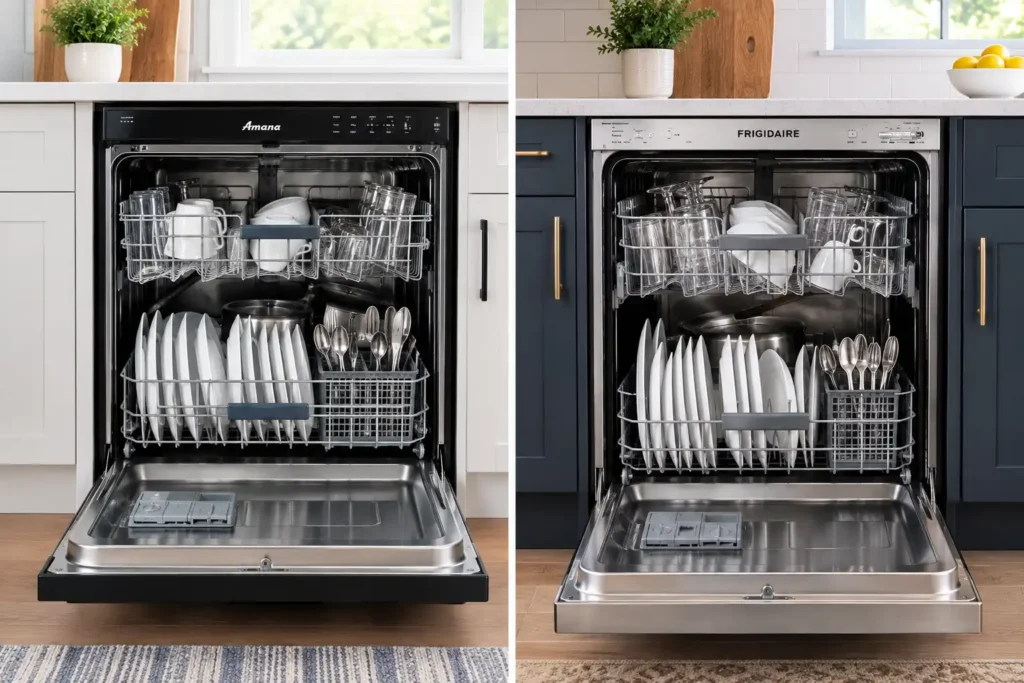
Is Amana More Reliable Than Frigidaire?
The available independent evidence does not support treating Amana as more reliable than Frigidaire across the board.
Consumer Reports’ current predicted reliability data gives Frigidaire a 65/100 score and Amana a 58/100 score.
J.D. Power’s 2025 study separately reports 84 problems per 100 Frigidaire dishwashers during the first one to three years, but does not provide a corresponding Amana dishwasher figure in its published comparison.
Because these studies measure different periods and use different methodologies, the figures should not be converted into a simple universal ranking.
The more useful takeaway is that Frigidaire has more directly available independent dishwasher reliability evidence, while Amana’s ownership case should be evaluated heavily around the exact model, service availability, price, and parts support.
Is Frigidaire More Reliable Than Amana?
The available Consumer Reports data currently places Frigidaire above Amana in predicted dishwasher reliability, but that does not establish that every Frigidaire model will outlast every Amana model.
Likewise, J.D. Power’s Frigidaire result is based on a different measurement and does not include an equivalent published Amana dishwasher result.
For consumers, this means the brand-level figures are useful for research but should be combined with model-specific information.
A Frigidaire dishwasher with an undesirable feature set or poor local service availability may not be the most practical purchase for a particular household, just as a specific Amana model may offer a suitable combination of price, simplicity, and service support.
Amana vs Frigidaire Dishwasher Reliability: Long-Term Ownership
Long-term ownership depends on more than initial reliability.
A dishwasher that lasts many years but becomes extremely expensive to repair may not be economical to keep. Conversely, a dishwasher that requires an occasional inexpensive replacement component may remain useful for a long time.
This is why repair cost, parts availability, service availability, warranty coverage, energy consumption, and purchase price should all be considered.
Amana’s parts and service ecosystem and Frigidaire’s factory-service and genuine-parts infrastructure provide mechanisms for continuing support after purchase.
Owners should also keep their model and serial information and retain the purchase documentation. These details can make warranty claims, parts searches, and service appointments easier.
Final Factors to Consider Before Buying
If reliability is your primary concern, consider these factors in this order:
- Specific model reliability information
- Warranty terms
- Local service availability
- Replacement-parts availability
- Mechanical and electronic complexity
- Water and energy consumption
- Installation requirements
- Noise level
- Cleaning performance
- Drying performance
- Purchase price
- Expected repair costs
This approach is more useful than relying on a general statement such as “Brand X always lasts longer.”
Amana vs Frigidaire Dishwasher Reliability FAQs
Is Amana a reliable dishwasher brand?
Amana has established dishwasher support, troubleshooting, parts, manuals, and service resources. However, current Consumer Reports data gives Amana a predicted dishwasher reliability score of 58/100, so its available brand-level reliability data does not place it at the same level as Frigidaire in that particular dataset.
Is Frigidaire a reliable dishwasher brand?
Frigidaire has substantial dishwasher support and service infrastructure. Consumer Reports currently gives the brand a predicted dishwasher reliability score of 65/100, while J.D. Power’s 2025 study reported 84 problems per 100 Frigidaire dishwashers during the first one to three years.
Which has fewer reported problems, Amana or Frigidaire?
The available Consumer Reports predicted reliability data shows a higher score for Frigidaire than Amana. However, the J.D. Power study does not provide a comparable Amana dishwasher figure, so the two brands cannot be directly compared using that study alone.
How long should an Amana dishwasher last?
There is no guaranteed lifespan for an individual dishwasher. Actual service life depends on model design, installation, usage, water quality, maintenance, repair history, and operating conditions.
How long should a Frigidaire dishwasher last?
Frigidaire does not guarantee a specific total lifespan for every dishwasher. Actual longevity depends on the individual model, usage, installation, maintenance, water conditions, and repairs.
Does Amana have good parts availability?
Amana provides a dedicated dishwasher parts system and model-specific owner resources. Its support system also provides manuals, troubleshooting, and service information.
Does Frigidaire provide replacement parts?
Yes. Frigidaire provides genuine replacement-parts and factory service resources, including factory-trained technicians and service arrangements.
Do Amana dishwashers have a warranty?
Amana’s published major-appliance warranty documentation provides a one-year limited warranty for covered defects, subject to the applicable terms and conditions.
Do Frigidaire dishwashers have a warranty?
Frigidaire’s Canadian warranty information lists a one-year standard limited dishwasher warranty, with additional limited parts coverage for specified components under the applicable terms.
Is a stainless-steel dishwasher more reliable?
A stainless-steel tub can provide durability and heat-retention benefits, but the presence of stainless steel does not by itself guarantee greater overall reliability. Pumps, controls, valves, heating systems, seals, racks, sensors, and installation also affect reliability.
Does hard water reduce dishwasher reliability?
Hard water can increase mineral deposits and maintenance requirements. Proper detergent, rinse-aid use, filtration maintenance, and appropriate water-softening measures can help reduce water-related problems.
Is a basic dishwasher more reliable than a smart dishwasher?
Not necessarily, but additional electronic features create additional components. J.D. Power’s 2025 research found higher average problem rates among connected appliances with Wi-Fi or Bluetooth than among appliances without those connectivity features.
Should I buy Amana or Frigidaire for a rental property?
For a rental property, consider purchase price, simplicity, warranty, parts availability, local technician availability, water and energy consumption, and the expected cost of repairs. The exact model can be more important than the brand name.
Are Amana and Frigidaire dishwashers good for hard-water areas?
Either brand can be used in a hard-water environment, provided the dishwasher is maintained correctly and the water chemistry is addressed appropriately. The appropriate approach depends on the local water hardness and the dishwasher’s instructions.
Does Frigidaire have better service support than Amana?
Both brands provide formal service and support resources. Frigidaire currently advertises factory-trained technicians and genuine parts, while Amana provides troubleshooting, manuals, parts, and authorized service resources. Actual service quality and availability can vary by location.
Which brand is easier to repair?
There is no universal answer for every model. Repairability depends on the specific dishwasher, component involved, parts availability, technician familiarity, labor cost, and access to service information.
Should I choose based on the reliability score alone?
No. Reliability scores are useful evidence, but the exact model, warranty, service network, parts availability, energy use, installation requirements, and purchase price should also be considered.
Amana vs Frigidaire Dishwasher Reliability: Bottom Line
The available evidence presents a nuanced picture.
Consumer Reports currently reports a predicted reliability score of 65/100 for Frigidaire and 58/100 for Amana, using its statistical model for the probability of a dishwasher developing a problem by the end of the fifth year.
J.D. Power’s 2025 study reported 84 problems per 100 Frigidaire dishwashers during the first one to three years, but Amana was not included in the published dishwasher comparison, so that study cannot establish a direct Amana-versus-Frigidaire result.
Both manufacturers provide owner support, troubleshooting information, parts resources, warranty programs, and service options.
For buyers in the United States and Canada, the most sensible reliability comparison is therefore not simply the two logos. Compare the exact Amana model against the exact Frigidaire model, then investigate its warranty, service availability, replacement parts, energy consumption, water usage, noise, drying system, installation requirements, and maintenance needs.
For UK buyers, model availability and local service support require additional attention because the North American product line and support infrastructure should not automatically be assumed to apply to UK-market appliances.
Ultimately, dishwasher reliability is a combination of design, components, manufacturing, installation, maintenance, serviceability, and operating conditions. Brand-level reliability data can help narrow the field, but the individual dishwasher model remains one of the most important factors in the purchase decision.