
When comparing Amana vs Frigidaire dishwashers, looking only at price, appearance, or brand reputation can leave out some of the most important differences. The two brands offer dishwashers with many of the same basic functions automatic wash cycles, heated drying, high-temperature options, filtration, adjustable racks, delay start, and energy-efficient operation but the way those features are packaged can be quite different.
Amana’s dishwasher range generally emphasizes practical cleaning functions, straightforward controls, filtration, sensor-based washing on selected models, heated or vented drying, and useful everyday cycles. Representative current models include features such as SoilSense sensing, Triple Filter Wash, 1-Hour Wash, High-Temperature Wash, Sani Rinse, Heated Dry, Vented Dry, overfill detection, and 12-place-setting capacity.
Frigidaire offers many of those fundamental functions as well, but selected models add more feature-focused wash and drying technologies. Current Frigidaire Gallery models, for example, can include DishSense sensing, OrbitClean wash systems, MaxBoost Dry, CleanBoost technology, third-level racks, adjustable racks, targeted washing, sanitize options, floor-beam indicators, and significantly quieter operating levels on some models.
That means an Amana vs Frigidaire features comparison is most useful when it examines the actual technologies rather than simply declaring one brand to have “more features.” A particular Amana model may have a feature that a particular Frigidaire model lacks, while a higher-end Frigidaire may offer technologies unavailable on a basic Amana model.
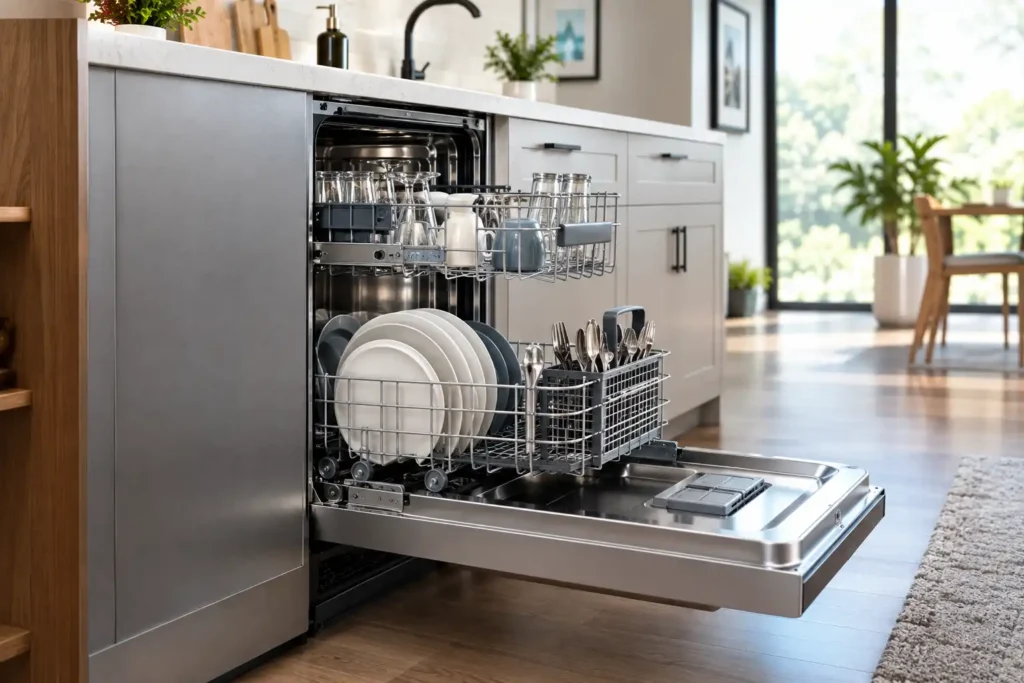
Amana vs Frigidaire Features at a Glance
| Feature | Amana | Frigidaire |
|---|---|---|
| Soil-sensing washing | Available on selected models | Available on selected models |
| Triple filtration | Available on selected models | Filtration varies by model |
| High-temperature wash | Available | Available |
| Sanitizing cycle/option | Available on selected models | Available on selected models |
| Heated drying | Available | Available |
| Fan-assisted drying | Available on selected models | Available on selected models |
| Vented drying | Available on selected models | Model dependent |
| Enhanced drying technology | Model dependent | MaxBoost Dry on selected models |
| Quick wash | Available | Available |
| 1-hour washing | Available on selected models | Available on selected models |
| Third rack | Model dependent | Available on selected higher-end models |
| Adjustable racks | Model dependent | Available on selected models |
| Targeted washing | Model dependent | Available on selected models |
| Floor status indicator | Model dependent | Available on selected models |
| Fingerprint-resistant finish | Available on selected models | Available on selected models |
| Overfill protection | Available on selected models | Model dependent |
| Delay start | Available | Available |
| ENERGY STAR models | Available | Available |
| Quiet models | Available | Available, including very quiet premium models |
| Sensor-controlled cycles | Available on selected models | Available on selected models |
| Multiple drying choices | Model dependent | Available on selected models |
| Premium rack systems | Model dependent | More common on higher-end Gallery models |
The table should not be interpreted as saying that every dishwasher from either brand contains every listed feature. Dishwasher specifications change by model, production year, configuration, and country.
1. Cleaning Technology
Cleaning technology is one of the most important areas to examine because a dishwasher’s feature list can look impressive while the actual wash system determines how water, detergent, filtration, and spray coverage work together.
Modern efficient dishwashers increasingly use sensors, filtration, specialized spray patterns, and carefully controlled water usage rather than simply increasing the amount of water used. Energy-efficiency standards also encourage manufacturers to achieve effective cleaning while controlling energy and water consumption.
Amana Cleaning Features
Selected Amana models use the Triple Filter Wash System. The system uses multiple stages of filtration to remove food particles from the wash water, helping reduce the need to pre-rinse dishes. Current models with SoilSense can also automatically detect load size and soil level and adjust the cycle accordingly.
The SoilSense system is particularly relevant for households that frequently have different types of loads. Instead of treating every load exactly the same, the dishwasher can adjust cycle behavior according to detected conditions. This can be useful when one load contains lightly soiled plates while another contains more substantial food residue.
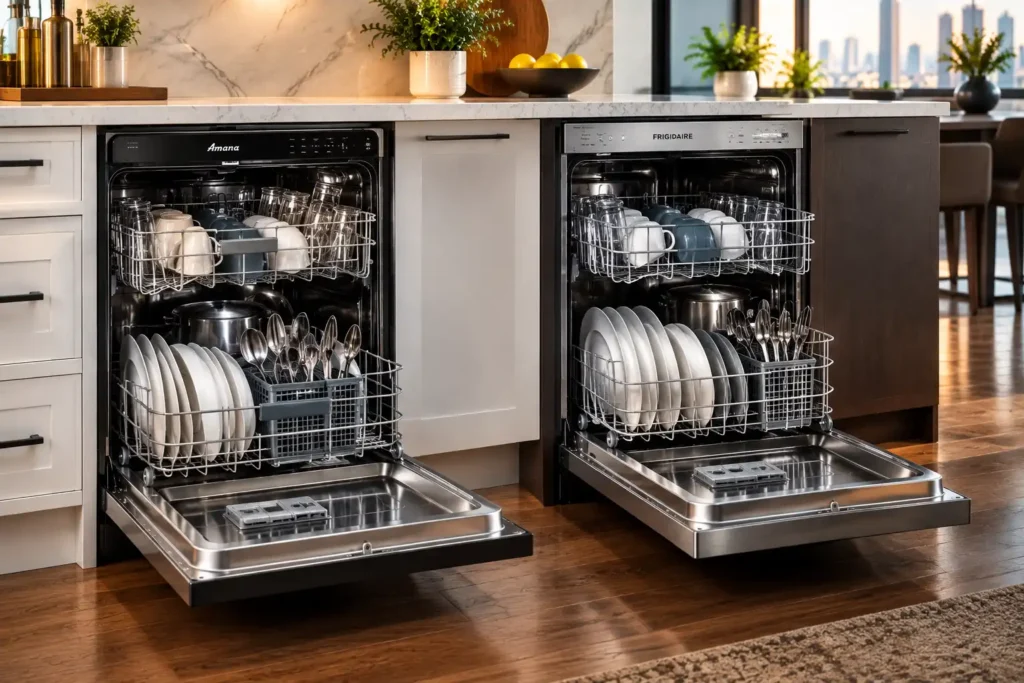
Amana also offers High-Temperature Wash on selected models. This raises wash-water temperature and can improve the dishwasher’s ability to deal with grease and food soils while also supporting drying performance.
Frigidaire Cleaning Features
Selected Frigidaire models use DishSense sensor technology. The system monitors soil conditions and adjusts cleaning performance accordingly, allowing the dishwasher to adapt to different loads instead of relying entirely on one fixed wash pattern.
Frigidaire also offers OrbitClean on selected models. Its rotating wash-arm design provides multi-directional spray patterns intended to increase coverage without simply increasing water consumption.
Higher-level Frigidaire models can also include CleanBoost technology, which premixes water and detergent before the solution reaches the dishes. The objective is to increase detergent effectiveness against difficult food residues and baked-on soils.
Cleaning feature difference
The main distinction is that Amana’s feature strategy often emphasizes filtration and automatic cycle adjustment, while selected Frigidaire models place greater emphasis on spray coverage, targeted cleaning, detergent interaction, and sensor-based adjustment.
Neither approach automatically means every model will clean better. Rack loading, spray-arm clearance, water temperature, detergent, filter maintenance, incoming water quality, and the particular cycle all influence results.
2. Soil-Sensing Technology
Sensor washing has become increasingly important because modern dishwashers are designed to avoid unnecessarily treating every load as heavily soiled.
ENERGY STAR specifically identifies soil sensors as an important dishwasher technology because they can detect whether water leaving the dishes is dirty or clean and adjust the wash process accordingly.
Amana SoilSense
Amana’s SoilSense Cycle is available on selected models. It automatically senses the size and soil level of the load and adjusts cycle time and water usage.
For a household that runs mixed loads, this can be a useful convenience feature because the user does not necessarily have to decide exactly how intensive the cycle should be.
Frigidaire DishSense
Frigidaire’s DishSense technology performs a similar basic function. It detects soil conditions and modifies cleaning performance based on the load. Selected Frigidaire models use the technology across multiple cycles, with the actual availability depending on model.
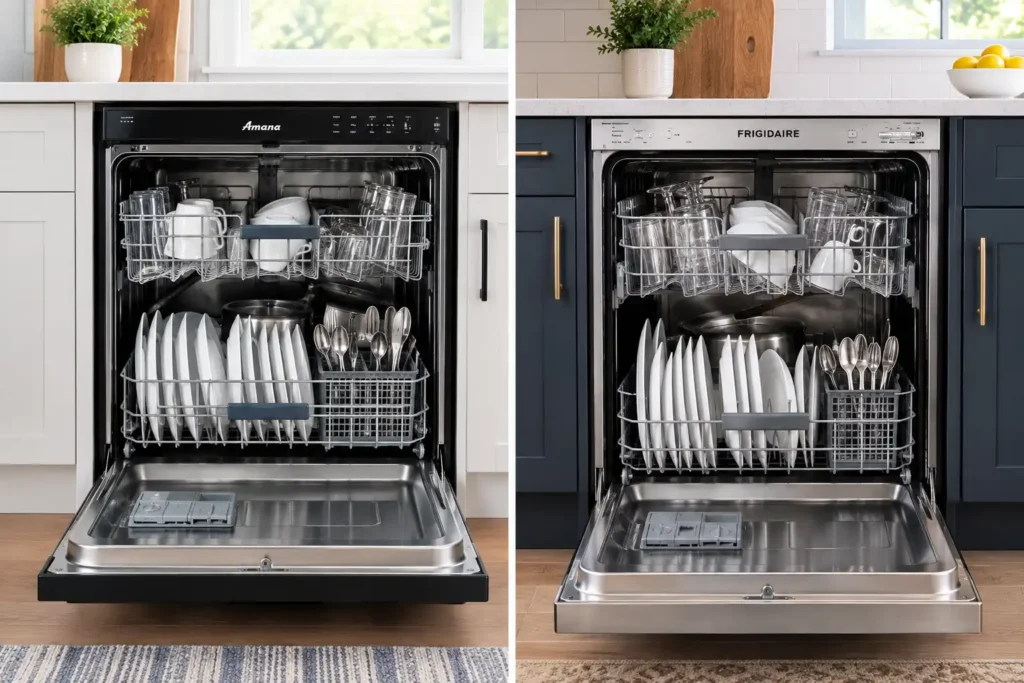
Which sensor system should you look for?
Rather than choosing purely based on the name of the technology, look at whether the particular model provides:
- soil sensing;
- automatic cycle adjustment;
- multiple cycle choices;
- energy-saving operation;
- appropriate heavy-wash capability;
- useful drying choices.
The presence of a sensor does not eliminate the importance of proper loading or detergent selection.
3. Wash Cycle Selection
Wash cycles determine how flexible the dishwasher is for different types of loads.
A dishwasher with only one or two useful cycles may be adequate for a small household, but larger families can benefit from dedicated heavy, normal, quick, sanitize, energy-saving, and delicate-load options.
Amana offers cycles such as SoilSense, 1-Hour Wash, Quick Wash, and Sani Rinse on selected models.
Frigidaire models can provide a broader selection on higher-end configurations. One current Gallery configuration lists Heavy, Normal, Quick, China Crystal, Energy Saver, Favorite, and Sanitize cycles, along with multiple drying choices.
This is an important distinction because “number of cycles” and “useful cycles” are not always the same thing. A household may benefit more from four genuinely useful cycles than from a long list of specialized programs that rarely get used.
4. Quick Wash and 1-Hour Cycles
Quick washing is useful when dishes are only lightly soiled and need to be returned to service quickly.
Amana offers Quick Wash and, on selected models, a 1-Hour Wash Cycle. The latter is intended for lighter loads that need a faster turnaround.
Frigidaire also offers quick-wash options. Certain current models feature a 34-minute Quick Wash, while other models provide different rapid-cycle configurations depending on the model.
A fast wash should not automatically be considered a replacement for a full heavy-duty cycle. Cycle duration, soil level, temperature, drying selection, and load composition all affect the final result.
5. Drying Features
Drying is an area where the feature differences between Amana and Frigidaire become particularly interesting.
A dishwasher can clean dishes effectively but still leave plastic containers, cups, bowls, and other items damp if the drying system is not designed for that type of load.
Amana Drying
Selected Amana models use Heated Dry. The internal heating element accelerates evaporation and helps remove moisture from dishes. Some models also use Vented Dry, which releases humid air while the heating element supports evaporation.
Amana’s drying options can therefore combine heat and ventilation rather than relying exclusively on passive drying.
Rinse aid also plays an important role because it helps water sheet away from surfaces rather than remaining in droplets. This can improve drying performance and reduce spotting.

Frigidaire Drying
Frigidaire offers Heat Dry on selected models, while higher-level models can add MaxBoost Dry.
MaxBoost Dry uses heat and a fan to move humid air out and bring fresh air into the dishwasher. This design is intended to improve evaporation and reduce the need to hand-dry dishes.
Some Frigidaire models provide Heat, Air, and MaxBoost drying choices, allowing the user to select different drying approaches.
Drying comparison
The practical difference is that Amana offers heated and vented drying on selected models, while Frigidaire’s higher-end models can provide more elaborate heat-and-fan drying systems and multiple drying modes.
However, the model number is more important than the brand name.
6. Third Rack and Loading Flexibility
Rack design is one of the features that can make a surprisingly large difference in everyday use.
A third rack can provide dedicated space for cutlery, cooking utensils, spatulas, knives, measuring tools, and other small objects that otherwise compete for space in the lower or upper rack.
Selected Frigidaire Gallery models offer a third-level rack, along with adjustable racks and smooth-gliding upper racks.
Amana’s current feature set varies more significantly by model. Some models emphasize conventional two-rack layouts, while buyers should check the exact specification if a third rack is important.
For households that regularly wash a large number of utensils, a third rack can be more useful than an additional specialized wash cycle.
7. Adjustable Racks
Adjustable racks are especially useful for families that frequently wash different types of cookware.
A fixed rack configuration may work well for plates and glasses but become restrictive when large pots, tall glasses, mixing bowls, or unusual cookware are introduced.
Selected Frigidaire Gallery models provide adjustable upper and lower rack configurations, including fold-down components and height adjustments.
Amana models vary by configuration, so consumers should examine the rack specifications rather than assuming that every model provides the same level of flexibility.
If you regularly wash large cookware, rack flexibility can be one of the most valuable features to prioritize.
8. Targeted Wash Zones
Targeted washing is designed to concentrate water or cleaning action toward particular areas of the dishwasher.
Selected Frigidaire Gallery models provide targeted wash zones alongside OrbitClean technology.
This can be useful when a household frequently places heavily soiled cookware in a particular section of the dishwasher.
Amana’s feature approach differs depending on the model, with filtration, sensor operation, high-temperature washing, and conventional spray-arm systems playing a more prominent role in many models.
9. Sanitizing Features
Sanitization is another feature that deserves careful attention.
Amana provides Sani Rinse on selected models. Its high-temperature approach is intended to provide a more intensive final rinse for dishes.
Selected Frigidaire models provide an NSF-certified Sanitize option designed to achieve the manufacturer’s stated sanitation performance. Current models describe the option as removing 99.9% of common household bacteria under the applicable testing conditions.
The word “sanitize” should therefore be evaluated alongside the actual certification or testing information for the model rather than treated as a generic marketing term.
For households washing baby-related items, cutting boards, heavily soiled cookware, or dishes where sanitation is particularly important, this feature may be more relevant than cosmetic features.

10. High-Temperature Wash
High-temperature washing is useful for breaking down grease and improving cleaning performance.
Selected Amana models include a High-Temperature Wash Option that increases water temperature and adds an additional rinse.
Frigidaire also offers high-temperature options on selected models. Some model documentation describes the high-temperature wash as heating the main wash to approximately 140°F (60°C), although exact operation varies by model and cycle.
The incoming water temperature also matters. If household water enters the dishwasher very cold, the machine may need additional time and energy to reach its target temperature.
11. Filtration Systems
Filtration is one of Amana’s more important feature areas.
The Triple Filter Wash System is designed to capture food particles from the wash water. This can help reduce the need for pre-rinsing and allows the dishwasher to reuse water within the wash process more effectively.
Frigidaire also uses filtration systems, although the exact configuration varies considerably by model.
Regardless of brand, a filter system works best when it is maintained correctly. A clogged or heavily contaminated filter can interfere with water circulation and cleaning performance.
12. Noise and Sound-Reduction Features
Noise matters particularly in open-plan kitchens, apartments, condos, and homes where the dishwasher operates close to living or sleeping areas.
Amana offers different sound levels depending on model. For example, one current Amana SoilSense model is rated at 55 dBA, while other configurations can have different ratings.
Frigidaire’s range also varies widely. Current Gallery models include configurations rated at 52 dBA and premium models rated around 45 dBA.
This demonstrates why brand-level noise comparisons can be misleading.
A consumer choosing between a 55-dBA Amana and a 45-dBA Frigidaire is comparing two specific machines, not two brands in their entirety.
For noise-sensitive homes, check the exact dBA specification.
13. Energy Efficiency
Energy efficiency should be evaluated using actual model data rather than simply assuming one brand is more efficient.
Current ENERGY STAR dishwasher criteria for standard-capacity models require energy use of no more than 240 kWh/year and water consumption of no more than 3.2 gallons per cycle under the program’s specified testing methodology.
ENERGY STAR also explains that dishwasher energy use includes energy required to operate the machine, heat water, and dry dishes.
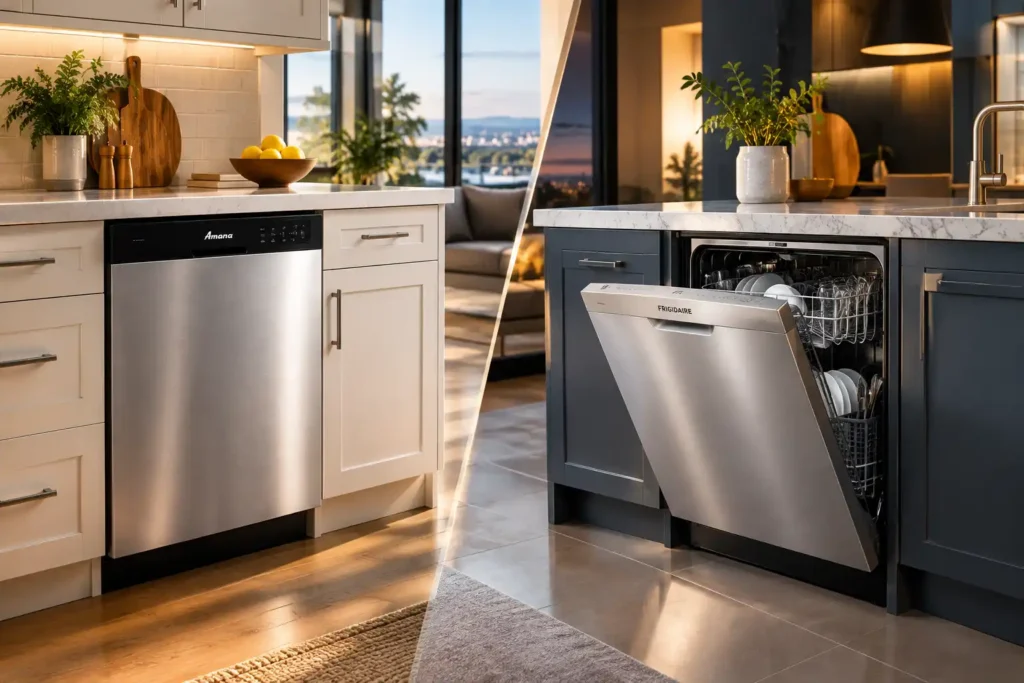
Both Amana and Frigidaire offer ENERGY STAR-certified dishwasher models. For example, current Amana models list ENERGY STAR certification, while current Frigidaire Gallery models also list ENERGY STAR certification.
Therefore, the better comparison is:
Amana model vs Frigidaire model, rather than simply Amana vs Frigidaire.
14. Water Consumption
Modern dishwashers are designed to use substantially less water than many people assume.
Water consumption is influenced by the selected cycle, soil sensing, model design, capacity, and testing methodology.
ENERGY STAR’s current U.S. criteria limit standard dishwashers to no more than 3.2 gallons per cycle for qualification, while actual consumption can vary according to cycle and model.
Canadian consumers should also pay attention to the EnerGuide information and the model’s Canadian specifications. Federal Canadian requirements include energy and water-performance information for regulated dishwashers.
This makes the water-use figure on the actual model’s energy documentation more meaningful than a general statement that one brand “uses less water.”
15. Energy-Saving Cycles
Energy-saving cycles are designed to reduce resource consumption by using lower temperatures, less water, different cycle durations, or combinations of these strategies.
Frigidaire offers Energy Saver cycles on selected models. Some configurations use Air Dry with the energy-saving cycle rather than heated drying.
Amana’s ENERGY STAR-certified models are also designed to meet applicable efficiency criteria, and their sensor and filtration technologies can support efficient operation.
The most efficient cycle is not necessarily the shortest cycle. Modern efficient dishwashers may deliberately run longer to achieve cleaning while using less water and energy.
16. Delay Start
Delay Start is a simple feature, but it can be highly practical.
Selected Amana models provide a 1–24-hour delay-start option.
Frigidaire also offers delay-start functions on selected models.
This can be useful for households that want to run the dishwasher later in the evening, after leaving the kitchen, or at another convenient time.
For apartments and open-plan homes, delayed operation can also help keep dishwasher activity separate from meal preparation or entertaining.
17. Interior Design and Tub Materials
The dishwasher interior influences durability, appearance, heat retention, drying behavior, and cleaning convenience.
Amana’s current range includes different interior configurations. One current model features a Midnight Interior and a water-repellent silverware basket, while another specification lists a plastic tub.
Frigidaire also varies by model. Some Gallery models use stainless-steel interiors, while other configurations use different tub materials.

Stainless-steel interiors are often associated with premium dishwasher construction, but the presence of stainless steel alone does not determine cleaning performance.
Consumers should evaluate the entire dishwasher rather than treating one material as a guarantee of superior performance.
18. Silverware Basket Features
Silverware storage is often overlooked when comparing dishwasher features.
Amana offers water-repellent silverware baskets on selected models. The design is intended to help water drain from the basket and improve drying of silverware.
Frigidaire models can use traditional silverware baskets or third-level racks depending on configuration. Higher-end models with third racks can provide an alternative location for flatware and utensils.
For households with large quantities of cutlery, a third rack may provide more flexibility than a conventional basket.
19. Fingerprint-Resistant Finishes
Exterior finish is primarily a convenience and appearance feature rather than a cleaning-performance technology.
Selected Amana models offer fingerprint-resistant stainless steel.
Frigidaire offers Smudge-Proof stainless-steel finishes on selected models, designed to resist fingerprints and simplify exterior cleaning.
For busy kitchens, these finishes can reduce visible smudges, although they do not eliminate the need for cleaning.
20. Controls and User Interface
Controls determine how easy it is to select cycles and options.
Amana offers front-control and top-control configurations, depending on model. Selected models have integrated consoles and electronic controls.
Frigidaire’s range includes conventional controls as well as premium capacitive-touch interfaces on selected Gallery models.
A simple control panel can be an advantage for users who prefer straightforward operation, while a more sophisticated interface may appeal to people who regularly use multiple cycles and options.

21. Floor-Beam Indicators
A floor indicator is particularly useful on quiet dishwashers.
Some Frigidaire Gallery models project an LED indicator onto the floor to communicate dishwasher status. The indicator can show when the machine is operating and when the cycle is complete.
This is useful because a quiet dishwasher may otherwise give little indication that it is running.
This type of feature is more about convenience than cleaning performance.
22. Overfill Protection
Water management and overflow protection are important safety considerations.
Selected Amana models include Overfill Detect. A float sensor detects excessive water and can interrupt the inlet fill process.
The exact protection system varies by dishwasher, so buyers should consult the technical documentation for their specific model.
Safety features should not be confused with leak-proof installation. Correct plumbing, drain routing, electrical installation, and leveling remain important regardless of brand.
23. Features for Hard Water Areas
Hard water can affect dishwasher performance through mineral deposits, spotting, filming, and scale.
This is particularly important for consumers in areas where the local water supply has elevated mineral content.
Neither Amana nor Frigidaire should automatically be considered a universal hard-water solution. The dishwasher’s filtration, rinse-aid system, detergent compatibility, water temperature, maintenance requirements, and local water characteristics all matter.
Rinse aid can help water drain more effectively from dish surfaces, while regular cleaning and appropriate detergent use can help manage mineral-related deposits.
For severe hard-water conditions, consumers should check the specific dishwasher’s recommendations rather than assuming that every model handles mineral buildup identically.
24. Drying Plastic Containers
Plastic is one of the most difficult materials for any dishwasher drying system.
Plastic tends to retain less heat than ceramic, glass, or metal, which means water evaporates more slowly from its surface.
Amana’s heated and vented drying technologies can improve drying, but plastic items may still retain droplets depending on their shape and position. Frigidaire’s MaxBoost system is specifically designed to improve moisture removal by combining heat and airflow.
If plastic drying is a high priority, compare the actual drying system rather than simply looking for the words “heated dry.”
25. Fan-Assisted Drying
Fan-assisted drying is one of the more meaningful developments in modern dishwasher design.
Instead of relying only on an exposed heating element, a fan can help move humid air out of the dishwasher and bring in drier air.
Frigidaire’s MaxBoost Dry explicitly combines heat and fan operation.
Amana also offers drying configurations involving ventilation and airflow on selected models.
The practical benefit is improved moisture removal, especially when combined with appropriate loading and rinse aid.
26. Which Brand Offers More Features?
There is no single answer that applies to every model.
If the comparison is between basic Amana and basic Frigidaire models, the feature gap may be relatively small. Both can provide the essential dishwasher functions required by most households.
When the comparison moves toward premium Frigidaire Gallery models, however, the feature list can become considerably more extensive. Examples include third-level racks, advanced rack adjustment, OrbitClean, CleanBoost, MaxBoost Dry, targeted washing, floor indicators, capacitive controls, and very low sound ratings on selected configurations.
Amana’s current models can nevertheless provide important practical technologies such as SoilSense, Triple Filter Wash, High-Temperature Wash, Sani Rinse, Heated Dry, Vented Dry, Overfill Detect, and bulk rinse-aid dispensing.
Therefore, saying that one brand “has more features” without specifying the model can be misleading.

27. Amana vs Frigidaire for Basic Everyday Use
For someone who wants a straightforward dishwasher for everyday dishes, the most important features may be:
- reliable filtration;
- normal wash;
- quick wash;
- heated drying;
- high-temperature washing;
- adequate rack space;
- rinse-aid dispensing;
- reasonable sound level;
- energy-efficient operation.
Amana models with Triple Filter Wash and SoilSense can provide a practical combination of these functions.
Frigidaire models with DishSense and OrbitClean can provide a similarly practical foundation, while some configurations add more sophisticated drying and rack systems.
28. Amana vs Frigidaire for Large Families
Large households should pay particular attention to capacity and rack flexibility rather than simply the number of wash cycles.
A 12-place-setting Amana model provides substantial capacity for a standard household dishwasher.
Frigidaire models can add third-level racks, adjustable racks, fold-down rack components, and additional loading flexibility on selected configurations.
For a family that washes numerous utensils, cooking tools, glasses, plates, and cookware every day, the rack system may have a bigger practical impact than specialized software or interface features.
29. Amana vs Frigidaire for Quiet Operation
Noise-sensitive buyers should compare dBA ratings.
Some Amana models operate around the mid-50-dBA range, while Frigidaire’s premium Gallery range includes models rated in the mid-40s dBA.
A lower dBA rating can be particularly useful in:
- open-plan kitchens;
- apartments;
- condos;
- kitchens adjacent to bedrooms;
- homes where dishes are washed during conversations;
- homes where the dishwasher runs overnight.
The exact model specification is more important than the brand.
30. Amana vs Frigidaire for Drying
If drying is your main concern, examine the actual drying architecture.
Amana offers Heated Dry and Vented Dry on selected models.
Frigidaire offers Heat Dry and, on selected models, MaxBoost Dry using heat and a fan to remove humid air and bring in fresh air.
For households that frequently wash plastics, containers, and items that retain water, enhanced airflow can be an important feature to look for.
31. Amana vs Frigidaire for Energy-Conscious Households
Energy-conscious consumers should look at:
- annual energy consumption;
- water consumption;
- ENERGY STAR certification where applicable;
- eco or energy-saving cycles;
- heated versus air drying;
- cycle frequency;
- household load size.
ENERGY STAR recommends looking at the EnergyGuide information when comparing dishwasher energy consumption rather than relying on general brand claims.
The most efficient choice can therefore be determined more accurately by comparing the actual energy and water figures of two candidate models.
32. USA Considerations
For buyers in the United States, ENERGY STAR certification and the EnergyGuide label are particularly useful comparison tools.
Current ENERGY STAR criteria for standard dishwashers limit qualified models to 240 kWh/year and 3.2 gallons per cycle under the specified test methodology.
The EnergyGuide label provides estimated annual electricity use and annual energy cost, allowing consumers to compare similarly sized appliances.
Because Amana and Frigidaire sell multiple dishwasher configurations, consumers should compare these figures model by model.
33. Canada Considerations
Canadian consumers should examine the Canadian version of the dishwasher specification rather than automatically relying on U.S. specifications.
Federal Canadian rules require regulated dishwashers to meet energy-efficiency requirements and use an EnerGuide label. The Canadian regulatory system also records information such as annual energy consumption, water use, dishwasher type and size category.
Frigidaire actively markets dishwasher models in Canada, including current Gallery configurations with features such as DishSense, OrbitClean, MaxBoost Dry, sanitize options, and ENERGY STAR certification.
Availability and specifications can differ between U.S. and Canadian models, so the exact Canadian model number should always be checked.
34. UK Considerations
The UK market requires additional care because the dishwasher models and branding available there can differ substantially from North American ranges.
UK energy information rules require applicable products to provide standardized energy information, and dishwasher energy labels include details such as efficiency class, energy consumption, water consumption, rated capacity, programme duration, and noise emissions.
UK dishwasher requirements also specify an Eco programme and define performance and efficiency requirements for household dishwashers.
Consequently, a feature comparison written around North American Amana and Frigidaire models should not be interpreted as confirmation that every one of those models is sold in the UK.
For a UK buyer, the appropriate approach is to compare the exact locally available model and its UK energy label.
35. Which Features Matter Most?
Not every feature deserves equal importance.
For most households, the most useful features are generally those that improve cleaning, drying, loading flexibility, efficiency, or everyday convenience.
A sensible feature checklist is:
High-priority features
- Soil sensing
- Effective filtration
- Heated or enhanced drying
- Adjustable racks
- Adequate capacity
- High-temperature wash
- Sanitize option when required
- Reasonable noise level
- Energy efficiency
- Appropriate water consumption
Useful convenience features
- Delay start
- Third rack
- Floor indicator
- Fingerprint-resistant finish
- Interior lighting
- Electronic controls
- Quick wash
Features that should be evaluated carefully
- Very large numbers of cycles
- Marketing-specific wash technologies
- App or connectivity features
- Cosmetic interior features
- Specialized options that you rarely use
A dishwasher does not necessarily become more useful simply because its feature list is longer.
36. What to Check Before Buying an Amana Dishwasher
Before purchasing an Amana dishwasher, check:
1. Exact model number
Features can vary substantially between Amana models.
2. Drying system
Determine whether the model uses heated, vented, fan-assisted, or another drying arrangement.
3. Filtration
Check whether the model has the Triple Filter Wash System.
4. Soil sensing
Look for SoilSense if automatic cycle adjustment is important.
5. Rack arrangement
Check whether you receive two racks or a third rack and whether the racks are adjustable.
6. Noise rating
Compare the actual dBA specification.
7. Capacity
Check place-setting capacity and usable rack dimensions.
8. Energy information
Use the appropriate local energy documentation.
9. Sanitation features
Check whether the particular model includes Sani Rinse or another high-temperature sanitation feature.
10. Installation requirements
Confirm dimensions, electrical requirements, water connection, and drain configuration before purchase.
37. What to Check Before Buying a Frigidaire Dishwasher
For Frigidaire, check:
1. DishSense availability
2. OrbitClean wash system
3. Drying system
4. MaxBoost Dry availability
5. Third-level rack
6. Adjustable racks
7. Targeted wash zones
8. CleanBoost availability
9. Sanitize option
10. Exact dBA rating
11. Energy consumption
12. Water consumption
13. Interior tub material
14. Control system
15. Local-market model number
Frigidaire’s feature differences can be particularly substantial between entry-level and Gallery models, making the exact model number essential to any meaningful comparison.
38. Amana vs Frigidaire Features: Important Model-by-Model Rule
One of the biggest mistakes consumers make is comparing brands instead of products.
For example, an Amana model with SoilSense, Triple Filter Wash, Heated Dry, High-Temperature Wash, Sani Rinse, and 12-place capacity is a very different proposition from a basic Amana configuration without those features.
Likewise, a Frigidaire Gallery model with OrbitClean, DishSense, MaxBoost Dry, CleanBoost, a third rack, adjustable racks, targeted washing, and a low dBA rating can be substantially different from a basic Frigidaire model.
This is why a proper comparison should always include the model number.
39. Amana vs Frigidaire Features Comparison: Practical Summary
The two brands overlap in many fundamental areas.
Amana commonly emphasizes:
- practical cleaning;
- filtration;
- sensor washing on selected models;
- straightforward controls;
- heated drying;
- vented drying;
- high-temperature washing;
- Sani Rinse;
- quick washing;
- 12-place capacity;
- overfill detection;
- practical everyday operation.
Frigidaire commonly emphasizes:
- sensor-controlled washing;
- multi-directional spray systems;
- enhanced drying;
- heat-and-fan drying on selected models;
- adjustable racks;
- third racks;
- targeted washing;
- specialized cleaning technologies;
- sanitize options;
- quiet premium configurations;
- floor indicators;
- more elaborate user interfaces on selected models.
This does not mean that every Frigidaire dishwasher has all of the second group or that every Amana dishwasher has all of the first group.
40. Final Thoughts on Amana vs Frigidaire Features
Amana and Frigidaire both offer dishwashers with a useful collection of modern cleaning, drying, efficiency, and convenience features. The largest differences become visible when comparing specific product tiers and individual models.
Amana’s current feature set can be attractive to consumers who want practical dishwasher technologies such as filtration, sensor washing, heated drying, vented drying, high-temperature washing, quick cycles, sanitation options, and straightforward controls.
Frigidaire’s selected Gallery models expand the feature set with technologies such as DishSense, OrbitClean, CleanBoost, MaxBoost Dry, third-level racks, adjustable racks, targeted wash zones, floor indicators, and very low sound levels on some configurations.
For that reason, the most accurate way to compare Amana vs Frigidaire is not to ask which brand has the most features overall. Instead, compare the exact two models you are considering.
Look at cleaning technology, filtration, drying method, rack configuration, capacity, noise, energy consumption, water use, sanitation options, and local-market specifications.
For U.S. buyers, EnergyGuide and ENERGY STAR information can help establish an objective baseline.
For Canadian buyers, EnerGuide and Canadian model specifications are important.
For UK buyers, the local energy label and Eco-program information should be checked because North American model availability and specifications cannot automatically be transferred to the UK market.
Ultimately, the most useful dishwasher is the one whose features match the way your household actually washes dishes. A household that prioritizes plastic drying may need a different feature combination from a household that prioritizes quiet operation, while someone with large cookware may benefit more from adjustable racks and a third rack than from additional wash programs.
Frequently Asked Questions
Is Amana or Frigidaire better for dishwasher features?
Both brands offer a range of dishwasher features, but the feature combination depends heavily on the specific model. Amana offers technologies such as SoilSense, Triple Filter Wash, Heated Dry, Vented Dry, High-Temperature Wash, and Sani Rinse on selected models. Frigidaire offers technologies such as DishSense, OrbitClean, MaxBoost Dry, CleanBoost, adjustable racks, third racks, and targeted wash zones on selected models.
Do Amana dishwashers have soil sensors?
Selected Amana dishwashers use SoilSense technology. It can sense load size and soil level and adjust cycle operation accordingly.
Do Frigidaire dishwashers have soil sensors?
Yes, selected Frigidaire dishwashers use DishSense sensor technology to adjust cleaning performance based on soil levels.
Which has better drying features, Amana or Frigidaire?
The answer depends on the exact models. Amana offers heated and vented drying on selected models, while selected Frigidaire models add MaxBoost Dry, which combines heat and fan operation to remove humid air.
Do Amana dishwashers have a heated dry option?
Yes. Heated Dry is available on selected Amana models and uses an internal heater to assist moisture removal.
Do Frigidaire dishwashers have heated drying?
Yes. Selected Frigidaire models provide Heat Dry, while some models additionally offer MaxBoost Dry or Air Dry choices.
Which brand offers a third rack?
Selected Frigidaire Gallery models include a third-level rack. Amana availability varies by model, so the exact product specification should be checked before purchasing.
Which brand has quieter dishwashers?
Both brands offer different noise levels depending on model. Amana has models around the mid-50-dBA range, while selected Frigidaire Gallery models are rated in the mid-40s dBA. The exact model’s dBA rating should therefore be compared rather than relying on the brand name.
Do Amana dishwashers have filtration systems?
Selected Amana models use the Triple Filter Wash System, which is designed to capture food particles from the wash water and reduce the need for pre-rinsing.
Do Frigidaire dishwashers have filtration?
Yes, Frigidaire dishwashers use filtration as part of their wash systems, although the exact filtration configuration varies between models.
Which brand has more wash cycles?
The answer varies by model. Some Frigidaire Gallery models offer a broad collection of cycles, while Amana models can provide multiple useful cycles such as SoilSense, 1-Hour Wash, Quick Wash, and Sani Rinse.
Which is better for large families?
Capacity and rack design should be considered more important than brand alone. Look for a dishwasher with adequate place-setting capacity, adjustable racks, fold-down rack components, and potentially a third rack. Selected Frigidaire Gallery models provide several of these loading features.
Are Amana dishwashers ENERGY STAR certified?
Selected Amana dishwashers are ENERGY STAR certified. Certification must be checked for the specific model because not every dishwasher configuration necessarily carries the same certification.
Are Frigidaire dishwashers ENERGY STAR certified?
Selected Frigidaire models are ENERGY STAR certified. Current Gallery examples list ENERGY STAR certification in their specifications.
Which brand uses less water?
It is not accurate to assign a single water-consumption figure to an entire brand. Water use depends on the model, cycle, load, sensor operation, and local-market configuration. ENERGY STAR provides model qualification criteria and recommends comparing actual product information.
Is a third rack more useful than extra wash cycles?
For many households, a third rack can provide more everyday loading flexibility because it creates additional space for utensils and small items. However, households that frequently wash heavily soiled cookware may benefit more from specialized wash options.
Does a higher number of features mean better dishwasher performance?
Not necessarily. A dishwasher with many specialized features is not automatically more effective for every household. Cleaning depends on the wash system, spray coverage, filtration, detergent, water temperature, loading, cycle selection, and maintenance.
Should I compare Amana and Frigidaire by brand or model?
Compare the exact models. Brand-level comparisons can hide substantial differences between entry-level and premium configurations.
Can I use this comparison for Canada?
Yes, the feature categories and buying principles are applicable to Canada, but the exact model specifications, availability, energy information, and model numbers should be checked against the Canadian version of the product. Canadian dishwashers are subject to federal energy-efficiency and labeling requirements.
Can I use this comparison for the UK?
The feature categories remain useful, but U.S. and Canadian model numbers should not automatically be assumed to be available in the UK. UK buyers should verify the locally available model and its energy label, Eco programme, water consumption, noise rating, and capacity.
What are the most important Amana features to compare?
Focus on Triple Filter Wash, SoilSense where available, Heated Dry, Vented Dry, High-Temperature Wash, Sani Rinse, rack configuration, capacity, sound level, energy use, and water consumption.
What are the most important Frigidaire features to compare?
Look at DishSense, OrbitClean, MaxBoost Dry, CleanBoost, rack configuration, third-level rack availability, targeted washing, sanitize options, sound level, energy use, and water consumption.
What should I check first when comparing two specific dishwashers?
Start with cleaning system, drying system, rack layout, capacity, noise rating, energy consumption, water consumption, sanitation options, and the exact model’s warranty and installation requirements. Those specifications generally provide more useful information than comparing the length of the feature lists.