
A dishwasher should produce some movement and sound while it operates. Water is being pumped through spray arms, the circulation system is running, the drain pump operates during drainage, and dishes and racks can move slightly when water strikes them. However, a dishwasher that shakes noticeably, rattles the cabinets, moves inside its opening, or produces excessive vibration deserves attention.
Excessive dishwasher vibration is often related to installation rather than a major mechanical failure. A dishwasher that is not level, is not properly secured, is touching surrounding cabinets, or has hoses contacting the cabinet can transfer vibration into the kitchen structure. Improper loading can also make normal operating sounds much louder.
The good news is that many vibration problems can be identified systematically. You do not necessarily need to replace the appliance simply because it sounds or feels unusually noisy. The first step is determining whether the vibration comes from the dishes and racks, the dishwasher cabinet, the plumbing connections, or an internal component such as a pump.
This guide explains the most common causes of dishwasher vibration, how to diagnose them, how to reduce vibration safely, and when professional service may be necessary.
What Is Normal Dishwasher Vibration?
A dishwasher is not completely silent or motionless during operation.
During the wash portion of a cycle, water is forced through spray arms at pressure. You may hear a swishing or rushing sound as the spray arms rotate. During draining, the drain pump can produce a humming sound. Water entering the appliance can create additional sounds, while the detergent dispenser may make a distinct click when it opens.
These sounds are generally part of normal operation.
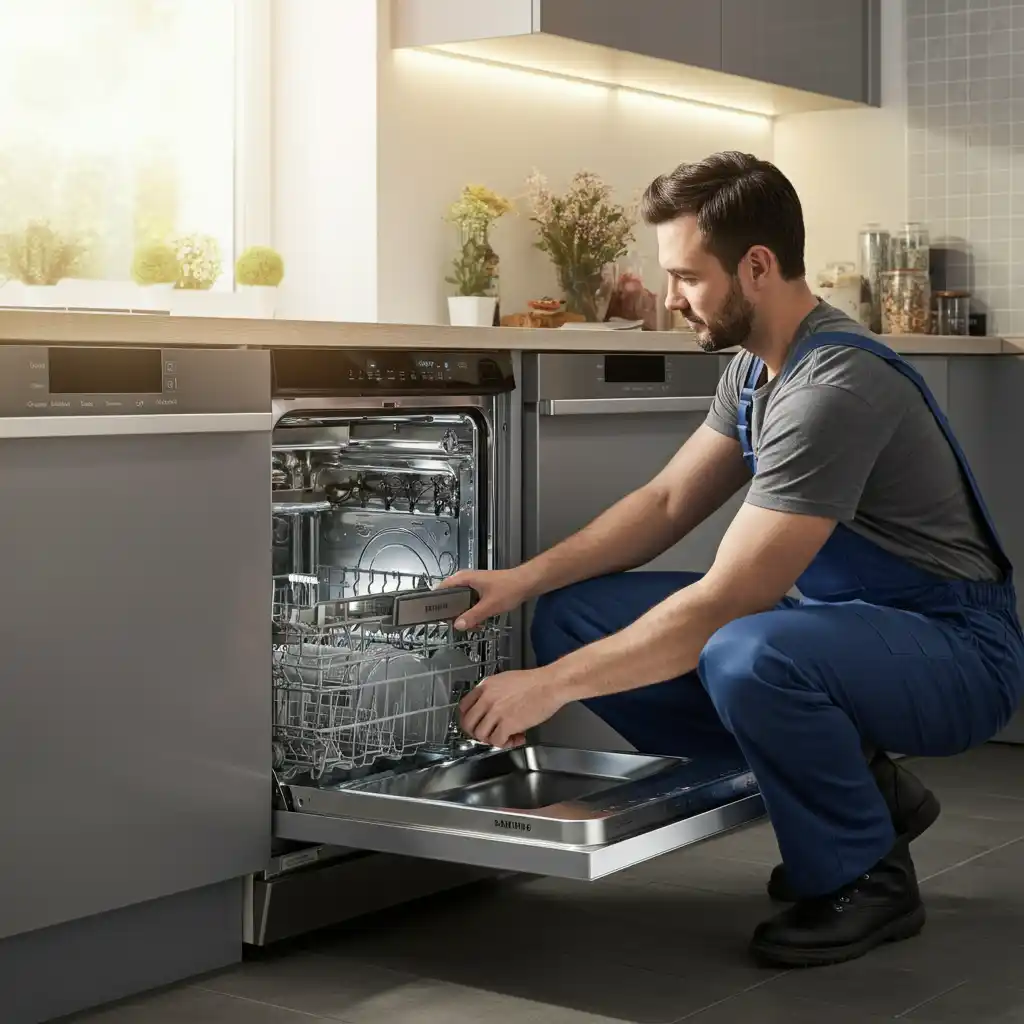
A small amount of vibration can also be normal because the pump and motor are mechanical components. What matters is the severity and behavior of the vibration.
Normal behavior may include:
- Mild humming
- Water-spraying sounds
- Soft pump vibration
- Occasional clicking
- Light movement of plastic items
- Minor rack movement
- Brief vibration during pump startup or shutdown
Abnormal behavior may include:
- Dishwasher visibly shaking
- Dishwasher moving inside the cabinet opening
- Cabinets rattling strongly
- Countertop vibrating noticeably
- Repeated banging
- Grinding accompanied by vibration
- Loud rattling throughout the entire cycle
- Vibration that suddenly appeared after years of quiet operation
- Hoses repeatedly striking the cabinet
- Door or tub contacting surrounding cabinetry
A dishwasher that is improperly leveled or insufficiently secured can transfer otherwise normal mechanical vibration into the cabinetry, making the appliance seem considerably louder than it actually is.
Why Is My Dishwasher Vibrating?
There are several possible causes. The most common are installation and loading problems, followed by plumbing interference and mechanical issues.
| Possible Cause | Typical Symptom | Difficulty |
|---|---|---|
| Dishwasher not level | Whole appliance shakes or rocks | Easy |
| Loose mounting | Unit shifts inside opening | Easy–Moderate |
| Cabinet contact | Rattling or buzzing against cabinets | Easy |
| Incorrect loading | Intermittent rattling | Easy |
| Loose rack | Repetitive rattling | Easy |
| Spray arm hitting dishes | Clicking/tapping | Easy |
| Drain hose touching cabinet | Buzzing/rattling during drain | Easy |
| Water line contacting cabinet | Tapping or vibration | Easy |
| Dirty filter/pump area | Unusual pump noise | Easy–Moderate |
| Foreign object near pump | Grinding or rattling | Moderate |
| Worn pump or motor | Persistent mechanical vibration | Professional |
| Damaged mounting hardware | Movement during operation | Moderate |
| Uneven floor | Difficulty keeping appliance level | Moderate |
The best approach is to begin with the simplest possibilities before disassembling anything.
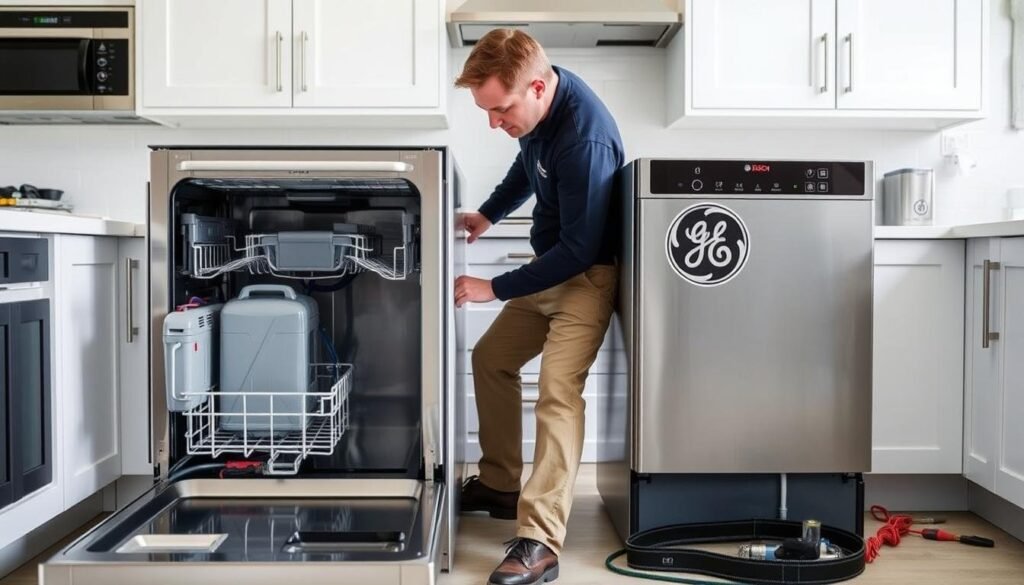
1. Check Whether the Dishwasher Is Level
One of the first things to check is whether the dishwasher is properly leveled.
A dishwasher needs stable support from its leveling system and floor. Manufacturer installation guidance specifically requires checking level from front to back and side to side. An improperly leveled dishwasher can also contribute to excessive noise and other operating problems.
An unlevel dishwasher can behave differently depending on the cycle. The pump and motor may generate vibration that is relatively harmless when the appliance is stable but becomes more noticeable when the unit is sitting unevenly.
How to check it
Open the dishwasher door and place a suitable level on the appliance according to the installation instructions for your model.
Check:
- Side-to-side level
- Front-to-back level
- Stability of the unit
- Whether all required supports are contacting the floor
- Whether the appliance rocks when gently tested
Some models use adjustable front legs, while others have different rear-leg adjustment mechanisms. The exact procedure varies by design, so the manufacturer’s installation instructions should be followed.
2. Adjust the Leveling Legs
If the dishwasher is not level, the leveling legs may need adjustment.
Many built-in models have adjustable legs that allow the installer to raise or lower different parts of the appliance. Manufacturer guidance commonly specifies turning the legs to achieve proper alignment and then rechecking the level after the appliance is positioned.
Do not assume that making the front look level is sufficient. The dishwasher should be checked in multiple directions.
Basic adjustment process
- Turn off the dishwasher.
- Follow the manufacturer’s safety instructions.
- Remove the lower access panel if required.
- Check the level.
- Adjust the appropriate leveling mechanism.
- Recheck side-to-side alignment.
- Recheck front-to-back alignment.
- Make sure the appliance is stable.
- Reinstall the access panel.
- Run a short cycle and listen for improvement.
Never force a leveling mechanism beyond the adjustment range specified for the model.
3. Make Sure the Dishwasher Cannot Rock
A dishwasher can be technically close to level but still unstable.
With the appliance safely positioned, gently check whether it rocks or shifts. A stable dishwasher should remain supported rather than wobbling from corner to corner.
If the dishwasher rocks, vibration generated by the motor or pump can cause the entire cabinet to move.
This can result in:
- Cabinet rattling
- Countertop vibration
- Door movement
- Increased operating noise
- Movement inside the installation opening
Leveling and stability should therefore be treated as two related but separate checks.
4. Check the Dishwasher Mounting Brackets
Built-in dishwashers normally need to be secured according to the manufacturer’s installation instructions.
The mounting arrangement may attach the dishwasher to:
- The countertop
- Adjacent cabinetry
- A side mounting structure
- The floor using an approved mounting solution
The correct method depends on the appliance and kitchen construction.
Installation documentation specifies that the dishwasher should be secured so it does not shift when the door is opened or closed. Proper mounting also helps prevent unwanted movement during operation.
If mounting screws or brackets have loosened, the appliance may vibrate against surrounding structures.
Signs of a mounting problem
You may notice:
- The dishwasher moves when you pull the rack out
- The unit shifts when opening the door
- The top edge moves against the countertop
- Vibration is strongest when the circulation pump runs
- The cabinet opening rattles
- The appliance appears to sit differently from when it was installed
Do not improvise mounting locations. Use the manufacturer’s specified attachment points and hardware.
5. Check Whether the Dishwasher Is Touching the Cabinets
Cabinet contact is one of the easiest causes of vibration to overlook.
A dishwasher may generate only moderate mechanical vibration, but if its metal housing is pressed against a cabinet, countertop structure, trim panel, or another hard surface, the vibration can be transferred into that structure.
The result may sound much louder than the appliance itself.
Manufacturer installation instructions emphasize correct alignment and clearance around the dishwasher. Door and cabinet contact can also cause squeaking and other noises.
Check for contact around:
- Left side
- Right side
- Top edge
- Door
- Toe-kick
- Cabinet framing
- Countertop structure
If the appliance is touching something it should not, correcting its alignment may substantially reduce vibration.
6. Check the Door for Cabinet Contact
Open and close the dishwasher door slowly.
Listen for:
- Scraping
- Squeaking
- Rubbing
- Clicking
- Metal-to-cabinet contact
A door that rubs against cabinetry can produce noise that is sometimes mistaken for internal dishwasher vibration.
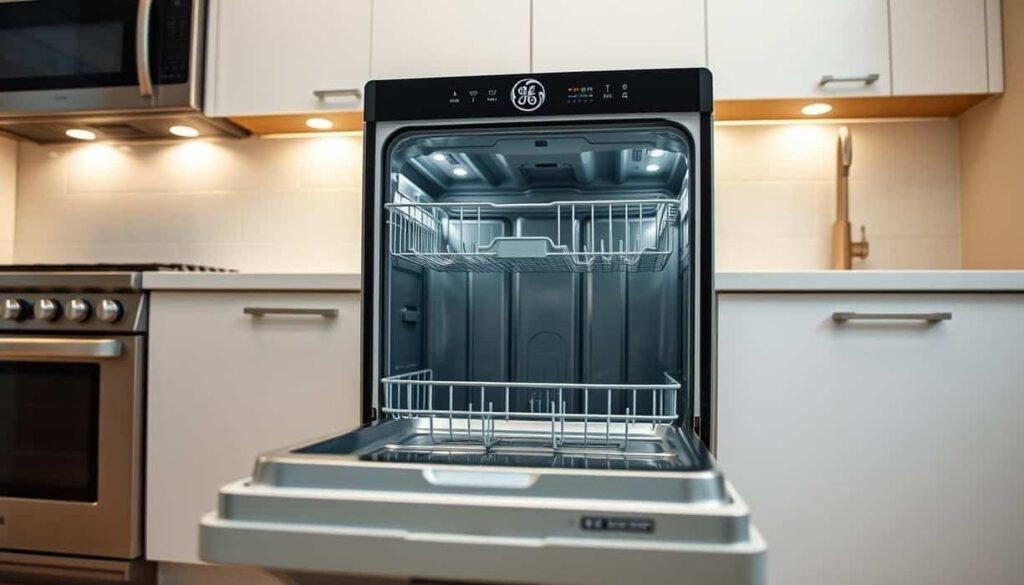
The dishwasher should be properly centered and aligned within its opening. Manufacturer troubleshooting guidance specifically recommends checking that the door is not rubbing against cabinets or other surfaces.
7. Inspect the Lower Toe-Kick Area
The toe-kick or lower access panel can sometimes rattle while the dishwasher operates.
Because this panel is relatively light compared with the appliance body, vibration from the machine can cause it to buzz or vibrate against nearby surfaces.
Check that:
- The panel is properly installed.
- Screws or clips are secure.
- The panel is not touching moving components.
- Nothing is trapped behind it.
- The panel is not contacting the floor incorrectly.
Factory insulation and panels should not simply be removed to make room or reduce noise. Installation documentation specifically notes that insulation can contribute to noise reduction.
8. Do Not Remove the Dishwasher’s Factory Insulation
Many modern dishwashers include insulation designed to reduce sound transmission.
Depending on the model, insulation can surround parts of the appliance or be incorporated into the installation system.
Removing it may make the appliance louder.
Installation documentation explicitly instructs installers not to remove certain insulation blankets because they reduce sound levels.
If the insulation looks unusual, do not automatically assume it is packaging material.
Some foam or insulation components are deliberately installed as part of the appliance.
9. Check How the Dishwasher Is Loaded
Incorrect loading can create a surprising amount of rattling.
Lightweight objects can move when exposed to strong water spray. Larger objects can touch one another or contact the racks.
Overloading can cause dishes to contact each other, while underloading can allow lightweight items to move around. Properly positioning heavier items on the lower rack and securing lighter items can reduce incidental noise.
Common causes of loading-related vibration
- Plastic containers moving around
- Loose lids
- Lightweight bowls
- Cutlery touching each other
- Large pans contacting the rack
- Glasses touching each other
- Plates incorrectly positioned
- Items blocking spray arms
If the vibration occurs only with particular loads, loading is one of the first things to investigate.
10. Make Sure the Spray Arms Can Rotate Freely
A spray arm that repeatedly strikes dishes can create clicking, tapping, or rattling.
This may sound like a mechanical problem even though the pump and motor are functioning normally.
Before starting a cycle, manually rotate the spray arm where appropriate and confirm that it can move freely without hitting:
- Plates
- Pans
- Cutting boards
- Utensils
- Tall glasses
- Container lids
Incorrect loading can cause the spray arm to hit dishes during operation.
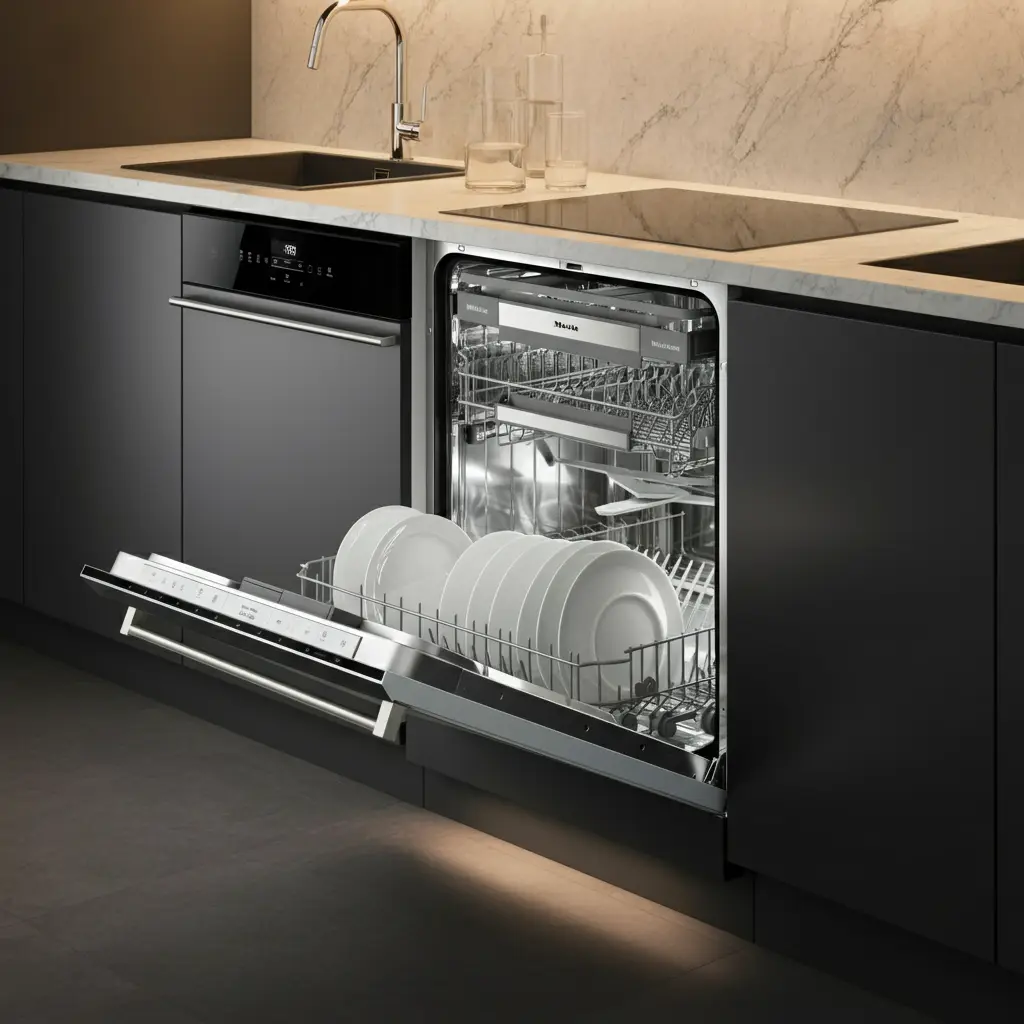
11. Check the Dishwasher Racks
Dishwasher racks can produce their own vibration.
A rack may rattle if:
- A wheel is damaged
- A rack stop is loose
- A tine is bent
- A rail is worn
- The rack is not properly seated
- A small object is trapped underneath
Remove the rack and inspect its wheels and rails.
Then reinstall it and make sure it moves smoothly.
If the vibration disappears when a particular rack is removed, investigate that rack rather than immediately assuming the motor is failing.
12. Check the Filter
A dishwasher filter collects food particles and debris.
When a filter becomes heavily contaminated, it can interfere with normal water circulation or drainage and may contribute to unusual operating sounds.
Routine filter maintenance is therefore important even when vibration is not the original problem. Manufacturer troubleshooting guidance recommends cleaning filters and checking spray arms as part of dishwasher maintenance.
Basic filter inspection
- Remove the lower rack.
- Locate the filter.
- Remove it according to the manual.
- Rinse away accumulated debris.
- Inspect for broken glass or hard objects.
- Clean the surrounding area as permitted.
- Reinstall the filter securely.
Never operate the dishwasher with a removable filter incorrectly installed.
13. Inspect the Pump Area for Foreign Objects
Small objects can sometimes reach areas near the pump.
Potential debris includes:
- Broken glass
- Small bones
- Food fragments
- Plastic pieces
- Labels
- Small utensils
- Hard mineral deposits
A foreign object can create rattling, clicking or grinding sounds.
Some manufacturer troubleshooting procedures recommend checking the pump for foreign objects when unusual noises occur.
Important safety rule
Never reach into an unfamiliar pump area while the dishwasher is connected to power.
Follow the model’s instructions for accessing the pump and disconnect electrical power when the procedure requires it.
If the pump cannot be safely inspected without substantial disassembly, professional service is preferable.
14. Check the Drain Hose
The drain hose can sometimes transmit vibration into the cabinet.
If the hose touches the cabinet wall, plumbing, dishwasher frame, or another rigid surface, vibration may be transferred through the hose.
Some installation instructions specifically recommend routing the drain line so that it does not contact adjacent cabinet surfaces in order to minimize vibration noise.
Look for:
- Hose touching the cabinet
- Hose sharply bent
- Hose trapped behind the appliance
- Hose rubbing against plumbing
- Hose vibrating during drainage
The drain hose must still be routed correctly for drainage and according to local installation requirements. Do not sacrifice proper drainage simply to reduce noise.
15. Check the Water Supply Line
The water supply line can also become a source of noise.
If the line is positioned against a rigid surface, normal water movement or appliance vibration can produce tapping or buzzing.
During installation, hoses and water lines should be routed without kinks or unnecessary contact with the dishwasher structure.
Some manufacturer instructions specifically warn installers to route plumbing to avoid vibration and interference.
16. Check for Water-Hammer-Type Noise
If the noise occurs mainly when the dishwasher fills, the source may be related to the water supply system rather than the dishwasher’s motor.
A rapid change in water flow can produce pipe movement or a knocking sound.
Clues include:
- Noise occurs immediately after the fill valve opens
- Pipes or cabinets shake briefly
- Noise stops after filling
- The dishwasher itself does not visibly move
This situation may require plumbing investigation rather than dishwasher repair.
If the sound appears throughout the wash cycle instead of only during filling, investigate other causes as well.

17. Check the Drain Cycle Separately
Pay attention to exactly when the vibration occurs.
If vibration occurs during washing:
Possible causes include:
- Circulation pump
- Spray-arm interference
- Dish movement
- Motor vibration
- Cabinet contact
- Installation problems
If vibration occurs during draining:
Possible causes include:
- Drain pump
- Foreign object
- Drain hose movement
- Drain connection
- Plumbing contact
If vibration occurs during filling:
Possible causes include:
- Water inlet valve
- Water supply line
- Plumbing movement
- Water pressure-related noise
Identifying the cycle stage can dramatically narrow the possibilities.
18. Listen for Grinding
A grinding sound deserves more attention than a simple hum.
A grinding noise may indicate something interfering with a pump or another moving component.
Possible causes include:
- Broken glass
- Food debris
- Foreign objects
- Pump damage
- Worn mechanical components
If cleaning the filter and checking the accessible areas does not resolve the noise, avoid repeatedly running the dishwasher in the hope that the sound disappears.
A persistent grinding noise should be evaluated according to the manufacturer’s troubleshooting procedure or by a qualified technician.
19. Distinguish Vibration From a Rattling Object
Sometimes the dishwasher itself is stable, but something inside is rattling.
A useful diagnostic technique is to compare the sound with an empty dishwasher and a normal load.
If the vibration disappears when the racks are empty, inspect the dishes and utensils.
If the vibration remains with the dishwasher empty, installation or mechanical causes become more likely.
Do not run the appliance without components that the manufacturer requires for safe operation.
20. Check Whether the Dishwasher Recently Moved
If your dishwasher was recently:
- Installed
- Reinstalled
- Removed for flooring work
- Moved during cabinet work
- Repaired
- Replaced with another model
then installation should be one of your first areas of investigation.
A dishwasher that was quiet before being moved but suddenly vibrates afterward may have a leveling, mounting, clearance, hose-routing or insulation issue.
Installation documentation emphasizes correct positioning, leveling and securing before normal use.
21. Check the Floor Beneath the Dishwasher
The dishwasher ultimately depends on the floor for support.
If the floor is uneven, damaged, flexible, or otherwise unsuitable, maintaining stable appliance alignment may be difficult.
This can be especially relevant when:
- Flooring was recently replaced
- A dishwasher was installed over uneven tile
- The floor has settled
- Cabinet work changed the opening
- The appliance is installed on an unusual platform
Do not place random pieces of wood, cardboard or soft material underneath the dishwasher as a permanent solution.
Any support method should be compatible with the manufacturer’s installation requirements.
22. Should You Use Anti-Vibration Pads?
Anti-vibration materials can be useful in certain appliance applications, but a dishwasher should not automatically be placed on generic rubber pads.
The appliance is designed to be installed in a specific manner. Changing its support height or position can affect:
- Stability
- Door alignment
- Cabinet mounting
- Drainage
- Water connections
- Clearance
- Appliance level
If your dishwasher requires additional isolation, use an approved accessory or installation solution compatible with the specific model.
Some dishwasher floor-mounting accessories are specifically intended to prevent shifting and reduce noise during operation.
23. Do Not Block Ventilation Openings
Trying to make a dishwasher quieter by covering vents or openings is not a safe soundproofing strategy.
A dishwasher’s ventilation and drying system is designed around the appliance’s construction.
Never cover:
- Manufacturer-designated vents
- Air openings
- Electrical access areas
- Drain connections
- Water connections
Sound reduction should be achieved through correct installation, insulation and vibration control rather than blocking components that the appliance requires.
24. Avoid Improvised Foam Around the Dishwasher
Adding large quantities of foam around an appliance may seem like an easy solution, but it can create problems.
Improper insulation can:
- Interfere with installation
- Block ventilation
- Trap moisture
- Interfere with service access
- Put pressure on components
- Prevent proper cabinet alignment
The correct approach is to preserve factory insulation and use only materials or accessories that are appropriate for the appliance and installation.

25. How to Stop a Dishwasher From Vibrating Against the Countertop
If the dishwasher is transferring vibration into the countertop, first determine why.
Possible causes include:
- Appliance not level
- Appliance not centered
- Mounting hardware loose
- Dishwasher touching countertop structure
- Cabinet opening too tight
- Structural resonance
- Pump or motor vibration
Do not simply wedge a soft material between the dishwasher and countertop.
First correct the installation.
A properly secured dishwasher should remain stable while the door is opened and closed.
26. How to Stop Dishwasher Cabinet Vibration
Cabinet vibration can make a relatively quiet dishwasher sound much louder.
The cabinet may act as a resonating surface.
Check whether the noise changes when you lightly place your hand against nearby cabinet panels while the dishwasher is operating.
If a particular panel is vibrating, investigate whether:
- The dishwasher is touching it
- The panel itself is loose
- A mounting point is loose
- A hose is contacting the panel
- The dishwasher is transmitting vibration through its frame
Do not place your hand near moving or electrical components.
27. What If the Dishwasher Vibrates Only When Empty?
An empty dishwasher can sometimes sound different from a loaded dishwasher because dishes and racks absorb or alter some of the sound.
However, strong physical shaking when the dishwasher is empty is not something to ignore.
Check:
- Leveling
- Mounting
- Floor support
- Cabinet contact
- Pump operation
- Spray-arm condition
- Foreign objects
If the entire appliance visibly moves, installation should be checked before assuming that the motor is defective.
28. What If the Dishwasher Vibrates Only When Full?
A vibration that occurs only with a particular load is often related to loading.
Look for:
- Large pans touching the rack
- Loose lids
- Plastic containers
- Tall items hitting spray arms
- Cutlery contacting the rack
- Dishes touching one another
Try rearranging the load and running another cycle.
Proper loading is specifically recommended for reducing movement and incidental dishwasher noise.
29. Dishwasher Vibrates After Installation: What to Check
If a new dishwasher vibrates, check the installation before assuming it is defective.
Installation checklist
- Is the appliance level?
- Is it stable?
- Are the leveling legs properly adjusted?
- Is it securely mounted?
- Is it centered?
- Is the door aligned?
- Is the countertop clear?
- Are side cabinets clear?
- Is the toe-kick properly installed?
- Is factory insulation still present?
- Are hoses routed correctly?
- Is the drain hose touching cabinetry?
- Is the water line touching the cabinet?
- Are shipping materials removed as instructed?
Installation problems are particularly important because a dishwasher can operate normally while still transferring excessive vibration to the surrounding kitchen.
30. Dishwasher Vibrates After Years of Quiet Operation
A dishwasher that suddenly becomes noisy after years of normal operation deserves a different diagnostic approach.
Potential causes include:
- Foreign object
- Dirty filter
- Pump obstruction
- Worn pump
- Loose mounting
- Damaged rack
- Hose movement
- Cabinet movement
- Deteriorated component
- Change in installation position
Start with simple external checks.
If the noise appeared suddenly and is accompanied by grinding, unusual electrical sounds, leaking, poor cleaning or drainage problems, professional diagnosis may be appropriate.

31. Can a Dirty Filter Cause Dishwasher Vibration?
A dirty filter is not necessarily the direct cause of whole-appliance shaking, but it can contribute to abnormal operating conditions and unusual pump sounds.
Food particles and debris can accumulate around filtration and pump areas.
Regular filter cleaning is therefore part of good preventive maintenance. Manufacturer guidance recommends cleaning filters and maintaining spray arms to support proper operation.
32. Can a Bad Dishwasher Pump Cause Vibration?
Yes, a pump can potentially be responsible for abnormal vibration.
A circulation or drain pump is a mechanical component, so damage, obstruction or wear can produce unusual sounds and movement.
However, pump vibration should not be diagnosed solely by sound.
A professional may need to determine whether the problem is:
- Pump obstruction
- Impeller issue
- Pump bearing wear
- Motor problem
- Installation vibration
- Foreign material
If a pump is making persistent grinding or severe mechanical noise, continued operation may not be advisable.
33. Can the Motor Cause Dishwasher Vibration?
The motor and pump assembly can create vibration during normal operation.
Modern dishwashers are designed to control this vibration through their mechanical construction and installation.
If vibration becomes excessive, possibilities include:
- Mechanical wear
- Loose mounting
- Damaged component
- Foreign object
- Installation problem
A sudden change in motor sound is more significant than a consistent low-level hum that has always been present.
34. Dishwasher Vibration vs Dishwasher Noise
These are related but different problems.
Dishwasher noise
Noise is the sound you hear.
Dishwasher vibration
Vibration is physical movement or oscillation.
A dishwasher can be noisy without shaking significantly.
Likewise, a dishwasher may create moderate vibration that becomes very loud because the vibration is transferred into cabinets or countertops.
This distinction is useful because reducing sound alone may not solve the underlying problem.
35. Best Order for Troubleshooting Dishwasher Vibration
Do not start by replacing expensive components.
Use this sequence:
Step 1: Listen
Determine whether the sound occurs during:
- Filling
- Washing
- Draining
- Drying
- The entire cycle
Step 2: Check the load
Remove or rearrange dishes that may be touching.
Step 3: Check spray-arm clearance
Make sure the spray arms can rotate freely.
Step 4: Inspect racks
Look for loose wheels, rails and damaged components.
Step 5: Clean the filter
Remove food debris and inspect accessible areas.
Step 6: Check level
Verify side-to-side and front-to-back alignment.
Step 7: Check stability
Make sure the appliance does not rock.
Step 8: Check mounting
Verify that the dishwasher is secured according to its installation instructions.
Step 9: Check cabinet contact
Look for rubbing or hard contact.
Step 10: Check hoses
Inspect water and drain lines for contact with rigid surfaces.
Step 11: Investigate pump noises
If abnormal mechanical sounds remain, follow the manufacturer’s troubleshooting process.
Step 12: Call for service
If the problem involves electrical components, persistent grinding, leaks or internal mechanical failure, professional service may be appropriate.
36. How to Reduce Dishwasher Vibration in an Apartment
Apartments can make dishwasher vibration more noticeable because kitchen cabinets, flooring and walls can transmit sound between structures.
The most effective approach is to address the source.
Start with:
- Leveling the appliance
- Securing it properly
- Keeping it away from unnecessary cabinet contact
- Checking hoses
- Cleaning filters
- Correcting rack movement
- Maintaining factory insulation
- Using appropriate cycles and loading practices
Do not make permanent modifications to rented property without permission.
If the dishwasher is supplied by the landlord or property manager, excessive vibration may need to be reported as an appliance or installation issue.
37. Dishwasher Vibration in Older Kitchens
Older kitchens may present additional challenges.
The cabinet opening may have changed over time, flooring may have settled, or previous renovations may have altered the dishwasher’s position.
Potential issues include:
- Uneven floor
- Cabinet movement
- Loose mounting
- Incorrect opening dimensions
- Plumbing modifications
- Older electrical arrangements
A modern dishwasher should still be installed according to its current manufacturer’s requirements rather than simply copying the previous installation.
38. USA Dishwasher Installation Considerations
In the United States, dishwasher installation should follow the manufacturer’s instructions and applicable local electrical, plumbing and building requirements.
The exact requirements can vary by jurisdiction and appliance type.
For DIY work involving electrical connections, water connections or permanent installation, homeowners should understand their local requirements and use qualified professionals when appropriate.
The physical principles of reducing vibration remain the same:
- Level the appliance.
- Secure it correctly.
- Maintain required clearances.
- Route hoses correctly.
- Preserve insulation.
- Prevent cabinet contact.
39. UK Dishwasher Installation Considerations
UK installations have their own electrical and installation requirements.
Safety guidance emphasizes following the manufacturer’s instructions, using appropriate electrical arrangements and having appliances installed by a competent person where required. Dishwashers should have suitable access to water, drainage and electrical supply, and extension leads should not be used as a substitute for an appropriate installation.
If unusual buzzing, crackling, repeated circuit-breaker trips, overheating or other electrical warning signs accompany the vibration, stop using the appliance and seek qualified assistance.
40. Canadian Dishwasher Installation Considerations
Canadian installations should follow the appliance manufacturer’s instructions as well as applicable provincial, territorial and local requirements.
The same fundamental troubleshooting process applies:
- Verify leveling.
- Verify mounting.
- Check cabinet contact.
- Check racks and loading.
- Inspect filter and accessible pump areas.
- Check plumbing connections.
- Investigate abnormal mechanical sounds.
Where electrical or plumbing work is required, follow the applicable local requirements and use qualified professionals when necessary.
41. Should You Put a Rubber Mat Under a Dishwasher?
This is not automatically recommended.
A rubber mat can alter the dishwasher’s height and stability and may interfere with proper installation.
It may also create problems with:
- Door alignment
- Leveling
- Mounting
- Drain routing
- Cabinet clearance
If vibration isolation is required, use an installation solution specifically approved or compatible with the appliance.
42. Should You Tighten Everything?
Not necessarily.
Loose mounting hardware should be corrected, but indiscriminately tightening screws can create new problems.
Over-tightening can:
- Damage cabinet material
- Distort brackets
- Stress components
- Affect alignment
- Cause metal-to-metal contact
Use the correct hardware and installation procedure for the specific dishwasher.
43. How Often Should You Check Dishwasher Vibration?
There is no universal requirement to perform a dedicated vibration inspection at a fixed interval.
Instead, pay attention to changes in normal behavior.
A good maintenance routine includes:
- Cleaning the filter regularly
- Checking spray arms
- Inspecting racks
- Watching for leaks
- Listening for unusual sounds
- Checking installation stability after major kitchen work
- Investigating sudden changes promptly
If the dishwasher remains stable and operates normally, routine observation is usually sufficient.
44. Signs You Should Stop Using the Dishwasher
Not every unusual noise requires immediate shutdown, but certain symptoms should receive prompt attention.
Stop using the appliance and seek appropriate assistance if vibration is accompanied by:
- Water leaking onto electrical components
- Burning smell
- Smoke
- Electrical arcing
- Repeated circuit-breaker trips
- Severe grinding
- Strong scraping
- Damaged wiring
- Appliance movement
- Structural damage
- Severe overheating
Electrical safety guidance specifically warns against ignoring unusual appliance sounds, burning marks, arcing, repeated fuse or breaker problems, or excessive heat.
45. When Should You Call a Dishwasher Technician?
Professional service is appropriate when the cause is not obvious or the repair requires internal component access.
Consider professional diagnosis when:
- The dishwasher vibrates even when empty.
- The pump produces persistent grinding.
- The motor makes abnormal mechanical sounds.
- The dishwasher leaks.
- The appliance cannot be leveled correctly.
- The mounting system is damaged.
- Electrical components are involved.
- A replacement pump or motor is suspected.
- The dishwasher repeatedly develops the same vibration after installation corrections.
Attempting to repair sealed electrical or mechanical components without the required experience can create safety risks.
46. Quick Dishwasher Vibration Troubleshooting Checklist
Use this checklist before calling for service:
Loading
- Dishes are not touching excessively.
- Lightweight items are secured.
- Cutlery is not rattling.
- Large cookware is positioned correctly.
- Spray arms can rotate freely.
Racks
- Rack wheels are intact.
- Racks are properly seated.
- Rails are not damaged.
- Nothing is trapped underneath.
Installation
- Dishwasher is level.
- Dishwasher does not rock.
- Leveling legs are stable.
- Mounting brackets are secure.
- Appliance is centered.
- Door does not rub cabinets.
Cabinet
- Dishwasher is not pressing against cabinetry.
- Toe-kick is secure.
- Countertop is not contacting the appliance incorrectly.
Plumbing
- Drain hose is not hitting the cabinet.
- Water line is not vibrating against a rigid surface.
- Hoses are not kinked.
- Connections are secure.
Maintenance
- Filter is clean.
- Accessible pump area is free of debris.
- Spray arms are clear.
Mechanical
- No persistent grinding.
- No severe motor noise.
- No sudden unexplained change in operation.
47. Preventing Dishwasher Vibration in the Future
Prevention is easier than diagnosing a dishwasher that has already become extremely noisy.
Maintain correct loading
Avoid allowing dishes to touch unnecessarily and keep lightweight objects secure.
Keep the filter clean
Regular filter maintenance supports proper water flow and helps prevent debris from reaching areas where it can cause problems.
Keep spray arms clear
Check periodically for food debris and ensure they can rotate freely.
Watch the installation
If kitchen cabinets, flooring or countertops are modified, verify that the dishwasher remains correctly positioned afterward.
Respond to unusual sounds early
A small change in sound is easier to investigate than a severe mechanical problem that has been ignored for months.
48. The Most Effective DIY Fixes
For many homeowners, the most useful DIY solutions are surprisingly simple.
Fix 1: Re-level the dishwasher
This is one of the first things to check.
Fix 2: Secure loose mounting hardware
Make sure the appliance is installed according to its instructions.
Fix 3: Rearrange the dishes
Prevent dishes, lids and utensils from moving.
Fix 4: Check spray-arm clearance
Make sure nothing is being struck during rotation.
Fix 5: Clean the filter
Remove accumulated food debris and inspect accessible areas.
Fix 6: Secure hose routing
Prevent plumbing lines from touching cabinets where this is inconsistent with the installation requirements.
Fix 7: Correct cabinet contact
Make sure the dishwasher is not rubbing against surrounding structures.
Fix 8: Preserve factory insulation
Do not remove sound-reducing insulation simply because it looks unusual.
49. What Not to Do When Trying to Stop Dishwasher Vibration
Avoid these common mistakes:
Do not use random wooden shims
They may alter appliance alignment and stability.
Do not block vents
Ventilation openings should remain unobstructed.
Do not remove factory insulation
It may be part of the dishwasher’s noise-control system.
Do not use hand dish soap
This is unrelated to vibration but can create excessive foam and additional operating problems.
Do not ignore electrical warning signs
Buzzing, crackling, burning smells or repeated breaker trips require attention.
Do not repeatedly operate a severely grinding dishwasher
If an internal component is damaged or obstructed, continued operation may worsen the problem.
Do not over-tighten mounting hardware
Use the correct installation procedure.
50. Frequently Asked Questions
Why is my dishwasher vibrating so much?
Common causes include incorrect leveling, loose mounting, cabinet contact, dish or rack movement, hose contact, pump problems and foreign objects.
Should a dishwasher vibrate during operation?
Some mild mechanical vibration is normal. Strong shaking, movement or cabinet rattling is not something to ignore.
Can an unlevel dishwasher cause vibration?
Yes. An improperly leveled dishwasher can contribute to excessive noise and vibration and may also affect other aspects of operation.
How do I know if my dishwasher is level?
Use a suitable level and check the appliance in both directions. Follow the specific leveling instructions for your model.
Why does my dishwasher shake the cabinets?
The appliance may be transmitting vibration through direct cabinet contact or loose mounting.
Can loose mounting brackets cause vibration?
Yes. A dishwasher that is not properly secured can shift and transmit vibration to surrounding structures.
Why does my dishwasher vibrate only during draining?
The drain pump or drain hose may be responsible. A foreign object or hose contacting the cabinet can also create noise.
Why does my dishwasher vibrate during washing?
Possible causes include the circulation system, spray-arm interference, dish movement, installation problems or mechanical issues.
Can dishes cause dishwasher vibration?
Yes. Lightweight or improperly positioned dishes can move during operation and create rattling and vibration.
Can a dishwasher rack cause vibration?
Yes. Damaged wheels, rails, loose components or incorrectly seated racks can create rattling.
Why does my dishwasher rattle when it is empty?
If the vibration remains with no dishes inside, investigate installation, mounting, cabinet contact, hoses and internal mechanical components.
Why does my dishwasher vibrate only when full?
The load may be allowing dishes, cookware or utensils to move against one another or the racks.
Can a dirty filter cause vibration?
A dirty filter can contribute to poor water-flow conditions and unusual pump sounds, although it is not always the direct cause of whole-appliance shaking.
Can a broken glass cause dishwasher vibration?
Broken glass or another foreign object near the pump can cause abnormal rattling or grinding.
Can the dishwasher drain hose cause vibration?
Yes. If the hose contacts cabinetry or another rigid surface, vibration may be transmitted through it.
Can the water supply line cause dishwasher noise?
Yes. Movement or contact of the water line can create tapping or vibration-related sounds.
Should I put rubber underneath my dishwasher?
Do not automatically do so. A rubber mat can alter leveling, stability and installation clearances. Use only an appropriate installation solution.
Can I use foam to stop dishwasher vibration?
Do not install random foam around the appliance. It can interfere with ventilation, service access, alignment and other installation requirements.
Should I remove the dishwasher insulation?
No. Factory insulation may be specifically designed to reduce sound. Installation instructions may explicitly require it to remain in place.
Why does my dishwasher vibrate against the countertop?
The appliance may be improperly leveled, incorrectly positioned or improperly mounted.
Why is my dishwasher door rubbing?
The dishwasher may not be level, square or properly positioned in the cabinet opening.
Why does my dishwasher make a grinding noise?
A foreign object, pump obstruction, damaged pump or mechanical wear can cause grinding.
Is a humming dishwasher normal?
A soft hum can be normal, particularly during pump operation. A new or unusually loud hum should be investigated.
Is a clicking dishwasher normal?
Some clicking can occur from valves, dispensers or other normal operations. Repeated clicking associated with vibration may require inspection.
Why does my dishwasher buzz?
Possible causes include cabinet contact, pump operation, electrical components or vibration transferred through plumbing.
Why does my dishwasher shake the floor?
Strong vibration can be transferred through the appliance’s feet into the floor. Check leveling, stability and mechanical operation.
Can an uneven floor cause dishwasher vibration?
Yes. An uneven floor can make stable leveling difficult.
Why did my dishwasher suddenly become noisy?
Possible causes include debris, a damaged pump, loose mounting, rack problems, hose movement or changes in installation.
My dishwasher was quiet for years. Why is it vibrating now?
A new vibration can result from wear, debris, loosened hardware, damaged components or changes around the installation.
Can a pump cause the entire dishwasher to vibrate?
A pump or motor problem can create abnormal mechanical vibration, especially if accompanied by unusual grinding or humming.
How do I know if the circulation pump is bad?
Look for persistent abnormal noise, poor washing performance or unusual mechanical behavior. A technician may be required for a definitive diagnosis.
How do I know if the drain pump is bad?
Drain-related grinding, abnormal humming, poor drainage or persistent unusual noise may indicate a problem.
Can hard water cause vibration?
Hard-water scale is more commonly associated with deposits and reduced efficiency than direct whole-appliance vibration. However, severe deposits or component problems can contribute to abnormal operation.
Can a blocked spray arm cause vibration?
A blocked spray arm can affect water distribution and produce abnormal sounds, particularly if it contacts dishes.
Can overloading cause vibration?
Yes. Overloading can cause dishes to touch and move against each other.
Can underloading cause vibration?
It can allow lightweight dishes or utensils to move more freely, creating rattling.
Does dishwasher age affect vibration?
Older appliances can develop worn components or loose hardware, but age alone does not mean a dishwasher should vibrate excessively.
Should a new dishwasher vibrate?
A new dishwasher should operate according to its design. Strong vibration immediately after installation should prompt an installation check.
Can incorrect installation make a quiet dishwasher noisy?
Yes. Leveling, mounting, insulation and cabinet contact can significantly affect perceived noise.
Can cabinet contact amplify dishwasher vibration?
Yes. Hard cabinet surfaces can transmit and amplify structure-borne vibration.
Can a loose toe-kick cause vibration?
Yes. A loose access panel can rattle when the dishwasher operates.
Why does my dishwasher vibrate more at night?
The dishwasher may not actually be vibrating more. Lower background noise can make normal appliance sounds more noticeable.
Can apartment floors amplify dishwasher vibration?
Yes. Building structure and kitchen cabinetry can transmit mechanical vibration.
Should I repair a vibrating dishwasher myself?
Simple tasks such as checking loading, cleaning the filter and verifying obvious installation issues may be suitable for homeowners. Electrical or internal mechanical repairs should be approached according to the manufacturer’s instructions and your level of competence.
When should I stop using a vibrating dishwasher?
Stop using it and seek assistance if vibration is severe or accompanied by leaking, burning smells, smoke, electrical arcing, repeated breaker trips or severe grinding.
Can a dishwasher vibration damage cabinets?
Persistent structure-borne vibration can contribute to annoying rattling and movement. Correcting the source is preferable to allowing prolonged vibration.
Can vibration damage the dishwasher?
Persistent abnormal vibration may indicate a mechanical or installation problem. Investigating it early is better than continuing to operate an appliance with severe abnormal behavior.
Is dishwasher vibration dangerous?
Mild operating vibration is generally part of normal appliance operation. Severe vibration, electrical problems, movement or leaks require attention.
Can I reduce vibration without replacing my dishwasher?
Often, yes. Correct leveling, mounting, loading, hose routing, cabinet clearance and maintenance may substantially reduce vibration.
What is the first thing I should check?
Check whether the dishwasher is level and stable, then inspect loading, mounting and cabinet contact.
What is the most common reason a dishwasher vibrates?
Installation-related issues such as leveling, stability, mounting or contact with surrounding structures are among the first things worth checking.
Should I replace my dishwasher if it vibrates?
Not necessarily. Diagnose the cause first. A simple installation problem may be much less expensive to correct than replacing the appliance.
Final Thoughts
A vibrating dishwasher does not automatically mean that the appliance is failing.
In many cases, the problem begins with something relatively simple: the dishwasher is not level, the mounting hardware is loose, the appliance is touching the cabinet, a hose is transmitting vibration, or dishes and racks are moving during the wash cycle.
The best troubleshooting strategy is therefore to start with installation and loading before moving toward expensive mechanical repairs.
Check the dishwasher’s level, stability, mounting, cabinet clearance and hose routing. Then inspect the racks, spray arms, filter and accessible pump area. If the dishwasher still produces persistent grinding, severe vibration or other abnormal mechanical sounds, professional diagnosis may be appropriate.
Correct installation is particularly important because vibration is not simply about how much movement the dishwasher produces. It is also about where that movement goes. A properly supported and secured dishwasher can contain much of its normal operating movement, while a poorly installed appliance can transfer relatively small vibrations into the countertop, cabinets, floor and surrounding kitchen.
For USA, UK and Canadian households, the safest approach is to follow the specific installation and maintenance instructions supplied with the dishwasher and comply with applicable local electrical, plumbing and building requirements.
With proper leveling, secure mounting, correct loading, good maintenance and appropriate plumbing installation, many dishwasher vibration problems can be reduced without replacing the appliance.