
The Bosch Series 8 dishwasher range is designed for buyers who want a premium appliance with strong everyday cleaning performance, advanced drying technology, quiet operation, and flexible loading. Depending on the model and market, Series 8 dishwashers can offer features such as Zeolith-based PerfectDry technology, adjustable racks, specialised cleaning zones, automatic wash programmes, smart connectivity, and safety systems designed to help protect the home from water damage.
However, buying a premium dishwasher involves more than choosing a recognised brand or the highest product series. The most important questions are whether the machine cleans heavily soiled dishes consistently, dries plastics effectively, fits your kitchen, operates quietly enough for your home, and remains affordable to maintain over time.
It is also important to understand that Bosch Series 8 and Bosch 800 Series are not exactly the same product range. Series 8 is the designation used in many international and European markets, including the UK. In the United States and Canada, Bosch commonly uses the 800 Series name for a premium dishwasher range. Although these ranges can share design principles and some technologies, their model numbers, dimensions, controls, programmes, drying systems, and specifications can differ.
This review focuses on the Bosch Series 8 dishwasher concept and the features found on representative European and international models. It also explains what North American buyers should know when comparing the related Bosch 800 Series. Because features vary between individual models and generations, the specifications of the exact dishwasher you intend to buy should always take priority over general series-level descriptions.
Overall, Bosch Series 8 is worth considering if you value sophisticated drying, thoughtful rack design, efficient operation, and a premium built-in appearance. Whether it offers the best value depends on the model’s price, your household’s needs, and the alternatives available in your country.
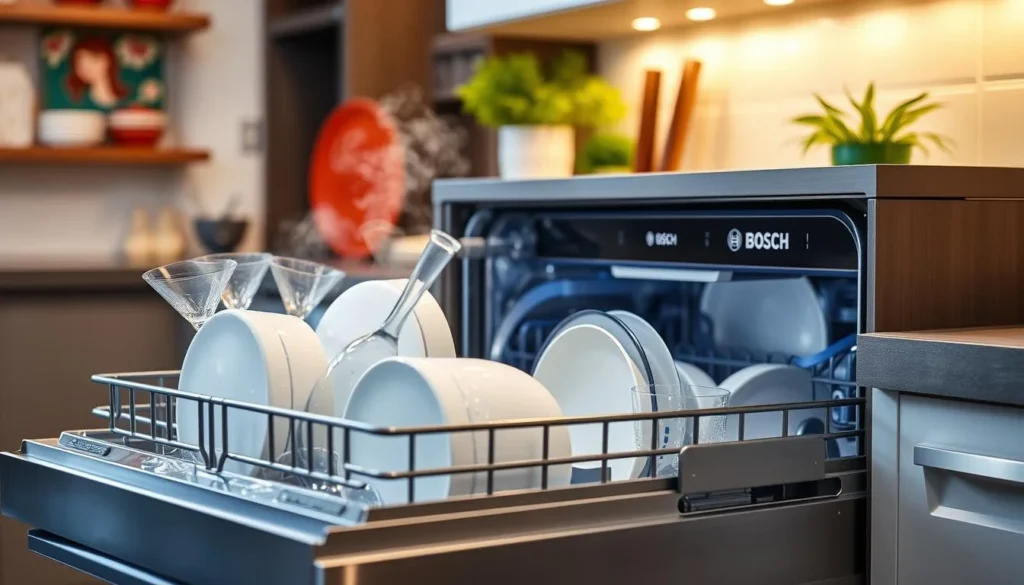
1. Bosch Series 8 Dishwasher Range Explained
Bosch divides many of its European-market dishwashers into different series, with Series 8 positioned toward the premium end of the range. It generally emphasises advanced drying, additional convenience features, flexible loading, and refined controls.
Not every Series 8 dishwasher has exactly the same features. Some models may have more advanced racks, additional wash options, particular drying technologies, or different connectivity capabilities. Model numbers are therefore essential when comparing machines.
Built-in, fully integrated, and semi-integrated models
Bosch Series 8 dishwashers are available in different installation formats, depending on the market and product generation.
A fully integrated dishwasher sits behind a cabinet door, so the appliance blends into the surrounding kitchen. Its controls are typically positioned along the top edge of the door. This arrangement is popular in contemporary kitchens because it creates a clean, uninterrupted appearance.
A semi-integrated dishwasher leaves some of the control panel visible while the lower part of the door can be matched to the cabinetry. This can be convenient for buyers who prefer visible controls and an easier view of the operating status.
Freestanding models are also available in some markets. These have a finished exterior and can be installed where the kitchen layout permits, without requiring a custom cabinet door.
The best format depends on the kitchen design, available space, and how easily you want to see the controls. Fully integrated models can look particularly attractive, but the cabinet panel and installation requirements must be considered as part of the total cost.
Standard-width and taller models
Many European Series 8 built-in models use a nominal 60 cm width, with some taller models available for different kitchen arrangements. Actual dimensions vary by model, and the nominal width does not tell you the precise height, depth, or installation clearance required.
Before buying, check the installation diagram for the exact model. A dishwasher that is only slightly too tall or deep can create problems with the countertop, plumbing, adjacent cabinets, or door movement.
Which models should you compare?
Rather than relying on a single general review, compare the specifications of the individual models offered in your market. Relevant details include:
- Exact model number and product generation.
- Energy rating and published energy consumption.
- Water consumption per cycle.
- Noise rating.
- Drying system.
- Wash programmes and additional options.
- Rack arrangement and capacity.
- Dimensions and installation requirements.
- Warranty and local repair support.
Range verdict: Series 8 is a premium product category, not one identical dishwasher. A lower-priced Series 8 model may have a different configuration from a more expensive one, so check features individually before paying extra.
2. Design and Build Quality
Design is one of the reasons buyers consider a premium Bosch dishwasher. The appliance should not only clean well but also fit naturally into the kitchen and make loading and unloading comfortable.
Exterior appearance
Depending on the model, the exterior may feature stainless steel, a brushed-metal finish, a white or other finished surface, or a panel-ready design intended to match cabinetry.
Stainless steel suits many modern kitchens and coordinates well with other appliances. Panel-ready designs are especially attractive when the aim is to hide appliances behind cabinet fronts.
The finish should be judged in the context of the whole kitchen. Different manufacturers use slightly different stainless-steel shades, so a dishwasher may not match an existing refrigerator or oven perfectly even when both are described as stainless steel.
Interior construction
Many premium Series 8 models feature a stainless-steel interior. This material is suitable for the hot and wet environment inside a dishwasher and provides a durable surface for regular household use.
However, an attractive stainless-steel tub does not automatically guarantee superior cleaning. Wash performance depends on the spray system, water circulation, filtration, heating, detergent distribution, and programme design.
The racks and moving components also matter. Check whether the rack slides smoothly, whether the adjustment mechanisms feel secure, and whether foldable supports can be moved without excessive force. A well-designed rack should make it easy to load a range of plates, glasses, bowls, and pans.
Controls and displays
Depending on the model, Bosch Series 8 dishwashers can include touch controls, digital displays, remaining-time information, or projected indicators that show programme status on the floor.
A projected status indicator can be useful on a fully integrated dishwasher because the controls are hidden when the door is closed. A more advanced display can make it easier to understand the selected programme and additional options.
The drawback is that more sophisticated controls may be less intuitive for people who prefer simple physical buttons. When possible, inspect the controls in person or review the operating instructions before purchase.
Door and installation design
Some Series 8 models include features intended to improve door operation or support handleless kitchen designs. The exact mechanism depends on the product.
For an integrated model, correct installation is crucial. The cabinet panel must have compatible dimensions and weight, and the door must open without striking nearby cabinets or handles.
Design verdict: Bosch Series 8 generally aims to deliver a refined, integrated appearance and a well-organised interior. Its practical value depends on how the exact controls, racks, and door design suit your kitchen and daily routine.
3. Cleaning Performance: How Well Does Bosch Series 8 Wash Dishes?
Cleaning performance is the most important part of a dishwasher review. A premium machine must reliably remove food residue from plates, cups, cookware, and cutlery without requiring excessive manual washing beforehand.
Bosch Series 8 models can combine spray-arm systems, sensors, automatic programmes, and targeted washing options to manage different loads. Nevertheless, no dishwasher can compensate completely for incorrect loading, unsuitable detergent, blocked spray arms, or a programme that is poorly matched to the soil level.
Everyday dishes and mixed loads
For normal daily use, a dishwasher should clean plates, bowls, mugs, glasses, and cutlery effectively in one cycle. Series 8 models are designed for this type of household workload, with programme choices that can adapt to different levels of soiling.
Loading has a significant influence on the result. Plates should be arranged so that water can reach their surfaces, bowls should not trap water unnecessarily, and cutlery should not be packed so tightly that pieces shield one another.
Avoid placing large pans or utensils where they block the spray arms. After loading, rotate the arms by hand to check that they can move freely.
Automatic wash programmes
Some Series 8 models include an automatic programme that uses sensors to assess conditions such as the soil level of the wash water. The dishwasher can then adjust aspects of the programme to suit the load.
Automatic programmes can be convenient when dishes have mixed levels of soiling. Instead of requiring the user to choose an intensive cycle every time, the machine can make decisions based on the conditions it detects.
However, the precise sensors and programme behaviour vary by model. Buyers should check the manual to understand what the automatic setting is designed to do and whether additional options can be selected with it.
Intensive cleaning for cookware
Pans, casserole dishes, baking trays, and plates with dried-on food may require a more intensive programme than everyday crockery.
Certain Bosch models also offer targeted cleaning areas, such as an Extra Clean Zone in the upper rack. This feature directs additional washing action toward selected items, helping to clean heavily soiled dishes without necessarily increasing the intensity of the entire load.
A targeted zone can be useful for bowls, cups, and smaller items that collect stubborn residue. It does not mean that every heavily soiled pan can be placed anywhere in the dishwasher and expected to emerge spotless.
For dried-on food, choose an appropriate programme, avoid overcrowding, and follow the detergent manufacturer’s directions. If the dishwasher consistently leaves residue on ordinary loads, inspect the filter, spray arms, water supply, and heating performance before assuming that the machine’s overall design is inadequate.
Glassware and delicate dishes
Glassware needs effective cleaning without unnecessary damage. The machine’s temperature control, detergent dosage, water conditions, and rack stability all influence the result.
Some Bosch Series 8 models incorporate glass-protection features and dedicated supports to help keep fragile items stable. These are valuable for households that regularly wash wine glasses and other delicate glassware.
Even with these features, glassware should not touch other items during washing. Avoid placing fragile glasses where they may vibrate against the rack or be struck by heavy dishes.
Filter and water circulation
The filter captures food particles and helps prevent them from repeatedly circulating through the dishwasher. If it becomes clogged, drainage and cleaning performance may suffer.
Check and clean the filter according to the instructions for your model. Inspect spray-arm openings for trapped debris and ensure that the arms can rotate without obstruction.
If cleaning remains poor after basic maintenance, the cause may involve a circulation pump, heating system, water supply, sensor, or other component. These faults require a more thorough diagnosis.
Cleaning verdict: Bosch Series 8 offers a sophisticated set of cleaning technologies on selected models. Its strongest results come when the programme, detergent, water conditions, and loading arrangement are all appropriate for the dishes being washed.
4. PerfectDry and Zeolith Technology: The Biggest Advantage
Drying is one of the most important reasons buyers consider a premium Bosch dishwasher. Some Series 8 models use PerfectDry technology based on Zeolith, a mineral material that can absorb moisture and release heat during the drying process.
This technology is designed to improve drying while managing energy use. It is particularly relevant for households that dislike unloading a dishwasher only to find water droplets on plastic containers, cups, or the bases of bowls.
However, PerfectDry is not fitted to every Bosch dishwasher, and the availability of Zeolith-based drying depends on the specific model and market. Confirm the feature on the product specification sheet rather than assuming that every Series 8 machine includes it.
How Zeolith drying works
Zeolith is a mineral that can absorb moisture and release heat as part of the drying process. In a compatible dishwasher, the technology helps manage moisture from the wash chamber and directs warm, dry air back into the machine.
This is different from relying only on the residual heat of dishes and the evaporation of water from their surfaces. The aim is to improve drying performance while avoiding the need to depend entirely on additional electrical heating.
The exact system design and control strategy vary by model, but the underlying principle is to use the moisture-absorbing properties of Zeolith to support efficient drying.
Does PerfectDry work on plastic dishes?
Plastic is one of the most difficult materials to dry in a conventional dishwasher. It often retains more visible droplets than glass or ceramic because it behaves differently during the cooling and drying stages.
Bosch promotes PerfectDry on compatible models for drying performance that includes plastic items. This can be a meaningful advantage for families who regularly wash lunch boxes, reusable containers, children’s cups, and plastic lids.
Results still depend on the shape of the item, the way it is positioned, and the selected programme. A container with a recessed base may trap water even when the surrounding load dries well. No drying system can eliminate every possible water pocket in every item.
Is Zeolith better than automatic door opening?
Some Bosch models use alternative drying approaches, including systems that automatically open the door near the end of a programme. Allowing humid air to escape can improve drying by helping moisture leave the wash chamber.
The better option depends on your priorities. Zeolith-based drying is designed to improve drying through moisture absorption and heat release, while automatic door opening relies partly on ventilation and the conditions around the appliance.
If you have a kitchen with cabinetry that is sensitive to moisture, follow the installation and care instructions for the selected model. Automatic opening should only be used as designed by the manufacturer.
What about extra-dry settings?
Some Bosch models provide additional drying options that extend or intensify the drying stage. These can be useful for loads containing items that are harder to dry.
An extra-dry option may increase the cycle’s energy use or duration, depending on the model. Use it when the additional drying performance is worth the trade-off rather than selecting it automatically for every load.
Drying verdict: PerfectDry with Zeolith is one of the most compelling features of compatible Bosch Series 8 dishwashers. It is particularly attractive for households that regularly wash plastic containers, but buyers must confirm that the model they choose includes this technology.
5. Noise Levels: Is Bosch Series 8 Quiet?
Noise matters when a dishwasher runs in an open-plan kitchen, an apartment, or a home where people work, study, or sleep near the kitchen.
Bosch positions Series 8 as a premium range and offers quiet-operation features on selected models. Some published specifications list noise levels in the low-40-decibel range, while others may be different depending on the model and its operating mode.
Do not assume that every Series 8 dishwasher has the same noise rating. Compare the figure for the exact model, and make sure you understand whether the published number applies to a standard programme or a dedicated silence programme.
What does a decibel rating tell you?
Decibels measure sound level, but the number alone does not describe every aspect of how a dishwasher sounds. A machine may produce a gentle background hum, intermittent water noises, or occasional sounds from valves and pumps.
The character of the sound can matter as much as the headline rating. A low, steady sound may be less noticeable than an intermittent rattle, even if the measured levels are similar.
Does a quiet programme affect cleaning?
Some models offer a silence programme or an app-controlled function that reduces noise for a period. Depending on the design, reducing noise may involve changes to operating conditions or programme timing.
A quieter cycle may take longer. That does not necessarily make it a poor choice, particularly if you want the dishwasher to run while people are in the kitchen.
Check the manual for the available programme combinations and any limitations on special options.
Installation affects noise
Even a quiet dishwasher can become noisy if it is not installed correctly. An unlevel machine, loose mounting hardware, a vibrating panel, or a hose touching the cabinet can create rattling and vibration.
The appliance should be level, secured, and installed with the required clearances. If an established machine suddenly becomes louder, check for loose dishes, spray-arm obstruction, and changes in the installation before assuming that the motor has failed.
Noise verdict: Bosch Series 8 is worth considering for homes where low operating noise is important. Verify the exact decibel rating and remember that correct installation is essential to achieving the expected result.
6. Rack Design and Loading Flexibility
Rack design determines whether a dishwasher is convenient to use day after day. A machine with a large advertised capacity may still be frustrating if tall glasses do not fit, pans occupy too much space, or cutlery is difficult to arrange.
Bosch Series 8 models can offer advanced rack systems, but the exact arrangement depends on the model and generation.
Adjustable upper rack
A height-adjustable upper rack allows the available space to be redistributed between the upper and lower baskets. This is useful when washing tall glasses, large plates, or bulky cookware.
Some models use a multi-stage adjustment mechanism that allows the upper rack to be repositioned. The adjustment is particularly valuable for households with a mixture of large dinner plates and tall drinking glasses.
Before buying, check that the adjustment can be operated conveniently and that the rack remains stable when loaded. Look at the available clearance in both the upper and lower sections rather than judging the feature by its name alone.
VarioDrawer and cutlery arrangements
Selected Bosch dishwashers include a VarioDrawer or a related third-level cutlery tray. This provides a dedicated space for cutlery and smaller utensils above the main racks.
A third-level tray can free up room in the lower basket by reducing reliance on a traditional cutlery basket. It can also separate utensils to improve water access.
The trade-off is that a tray occupies vertical space at the top of the dishwasher. Very tall glasses or awkwardly shaped utensils may need to be placed differently, depending on the model’s layout.
Other configurations use a cutlery basket or combine a tray with a basket. Consider which arrangement best suits your cooking and eating habits.
Foldable tines and flexible supports
Foldable plate supports make it easier to accommodate pots, pans, large bowls, and unusual items. When the supports are folded down, the rack can be adapted for larger pieces of cookware.
Flexible rack systems are particularly useful in family households because the dishwasher may handle different loads throughout the week. One cycle might contain mostly plates and glasses, while another contains pans, food-storage containers, and serving dishes.
Glass holders and anti-slip features
Some Series 8 models include dedicated supports intended to keep glasses stable. Anti-slip strips and improved rack-running mechanisms can also help make loading and unloading more convenient.
These details may seem minor, but they affect everyday usability. A rack that slides smoothly and holds delicate items securely can make a premium dishwasher more pleasant to use.
Capacity and real-world loading
Certain Bosch Series 8 models are specified for 14 place settings, although capacity varies by product. A place-setting figure is a standardised measure, not a guarantee that every household’s dishes will fit equally well.
If you use oversized dinner plates, wide serving bowls, tall glasses, or large pans, check the internal dimensions and rack layout before purchasing. Where possible, compare the layout with your actual dishes.
Rack verdict: Flexible racks and a third-level cutlery tray can make Series 8 models especially convenient. The best arrangement is the one that fits your dishes without forcing you to rearrange every item for each cycle.
7. Wash Programmes and Special Options
A premium dishwasher should provide enough programme flexibility to handle everyday dishes, heavily soiled cookware, delicate glassware, and lightly soiled loads without requiring unnecessary water or energy.
The programme list varies by model. Representative Bosch Series 8 dishwashers have offered combinations of Eco, Automatic, Intensive, Express, Glass, Silence, and favourite or personalised programmes.
Eco programme
The Eco programme is designed to reduce resource consumption while meeting its intended cleaning performance. It may take considerably longer than a quick or standard cycle.
A longer cycle does not automatically mean higher energy consumption. The Eco programme may use a lower-temperature strategy and manage water more efficiently, so total consumption can be lower despite the longer runtime.
For routine loads, Eco is often worth considering if the dishes are suitable for the programme and you do not need them cleaned quickly.
Automatic programme
An Automatic programme uses sensor information to adapt washing conditions to the load. It can be useful when the amount of food residue varies from one cycle to another.
Instead of always choosing the most intensive setting, the user can allow the dishwasher to adjust the programme according to the conditions it detects.
The exact operation differs between models. Read the manual to understand which additional options are compatible with the Automatic programme.
Intensive programme
An Intensive programme is intended for cookware and dishes with more stubborn residue. It may use a higher temperature or a more intensive washing strategy than a lighter programme.
It is useful for pots, pans, and heavily soiled plates, but it should not necessarily be used for every load. Match the programme to the dishes and the manufacturer’s guidance.
Express programmes
Express settings are useful when time is limited and the load is not heavily soiled. They can be helpful after a meal when dishes need to be cleaned sooner than a full Eco cycle would allow.
A shorter programme may not offer the same drying performance or suitability for baked-on food as a longer programme. Check the cycle description before using it for a demanding load.
Glass programme
A Glass programme is intended for suitable glassware and may use conditions designed to balance cleaning with care. This can be useful for delicate items, but the correct detergent dosage and water conditions remain important.
Glass corrosion can occur over time and is not always reversible. Follow the manual’s recommendations for glassware, particularly if you regularly wash delicate or valuable items.
Hygiene options
Some Bosch models include a Hygiene+ or similar option that adjusts the wash conditions for a hygiene-focused result. Availability and the precise performance claims vary by model and market.
Use such an option when it suits the load and the manufacturer’s intended use. It should not be treated as a substitute for appropriate food-safety practices or special cleaning requirements outside the dishwasher’s intended purpose.
SpeedPerfect and time-saving options
Certain models offer SpeedPerfect+ or comparable options designed to reduce programme duration. Shortening a cycle can be convenient when the dishwasher needs to finish sooner, but it may affect energy use and other operating conditions.
If you use a time-saving function frequently, compare its consumption and results with the normal programme. Convenience is valuable, but the shortest cycle is not necessarily the most economical one.
Programme verdict: Bosch Series 8 offers a useful selection of programmes on many models. Its flexibility is most valuable when the settings are matched to the load rather than using one intensive or quick cycle for everything.
8. Energy Efficiency and Water Consumption
Energy and water use contribute to the long-term cost of running a dishwasher. A premium model may have sophisticated sensors and efficient washing systems, but the actual operating cost depends on the specific machine and the way it is used.
Understanding energy ratings
Energy labels differ between markets and have changed over time. In the UK and European markets, newer labels use an A-to-G scale. Older products may display ratings from an earlier system, so those ratings should not be compared directly with current labels without understanding the difference.
In the United States and Canada, buyers should consult the applicable energy information and any relevant ENERGY STAR qualification. The exact test procedures and label formats may differ from those used in Europe.
For an accurate comparison, check the current product documentation for the model being sold in your country. Do not rely on a broad claim that Series 8 is efficient or on a rating from a different model generation.
Water consumption
Published specifications for some Bosch Series 8 models list water consumption around 9.5 litres per Eco cycle, while other models use different amounts. This figure is an example rather than a universal specification for the range.
Water consumption can vary with the programme, model, and testing conditions. Use the precise figure for the dishwasher you are considering when comparing it with alternatives.
Calculating running costs
To estimate electricity costs, use the dishwasher’s published energy consumption and the number of cycles you expect to run. Multiply the energy used per cycle by your local electricity price, then estimate the annual total based on your household’s usage.
Water costs can be calculated in a similar way if you know the consumption per cycle and your local water and wastewater charges.
The result will be an estimate rather than a guarantee. Real-world use can differ from standard test conditions, particularly if you frequently use intensive, quick, or extra-dry options.
How to reduce consumption
A few simple practices can help reduce unnecessary energy and water use:
- Run full loads without overcrowding the racks.
- Use the Eco programme for suitable everyday loads.
- Select intensive settings only when needed.
- Keep the filter clean and spray arms unobstructed.
- Use the recommended detergent dosage.
- Avoid unnecessary pre-rinsing when the manual does not require it.
- Check for leaks and repair faults promptly.
Efficiency verdict: Bosch Series 8 models can provide efficient washing, but compare the exact energy and water figures rather than assuming that every model has the same operating cost. Programme choice and household habits make a meaningful difference.
9. Home Connect and Smart Features
Selected Bosch Series 8 dishwashers support Home Connect, a connected-appliance platform that allows users to access certain dishwasher functions through a compatible mobile device.
Smart features can make the dishwasher easier to manage, particularly in busy households. However, connectivity varies by model, country, software version, and the availability of supported services.
Remote monitoring and control
Depending on the model, the app may allow users to check the appliance’s status, receive notifications, or initiate certain operations remotely. This can be useful when the dishwasher is installed behind a cabinet panel and does not have a prominent exterior display.
Remote operation may require the dishwasher to be configured correctly and connected to a compatible home network. Some functions may also require confirmation at the appliance itself.
Programme recommendations
Certain connected models offer programme assistance or recommendations based on the type of load and the desired outcome. This can help users choose a suitable programme without having to remember every setting.
Such functions are conveniences rather than essential cleaning technologies. A dishwasher should still be evaluated on its normal performance, ease of use, and reliability if you rarely use connected features.
Updates and compatibility
Smart-appliance functions may change as software and supported services evolve. Before buying, confirm that the specific model supports the features you want and that those features are available in your country.
Consider whether you are comfortable connecting a kitchen appliance to your home network and managing its settings through an app. If you prefer simple physical controls, connectivity may not be worth paying extra for.
Smart-feature verdict: Home Connect can add useful convenience, but its value depends on how often you will use remote monitoring, notifications, or programme assistance. It should be a secondary consideration behind cleaning, drying, and reliability.
10. Reliability and Expected Lifespan
A dishwasher is a long-term household purchase, so reliability matters just as much as its initial performance. Bosch has a substantial dishwasher range and established service operations in many markets, but that does not mean every Series 8 model will have the same reliability record.
The lifespan of an individual machine depends on its design, usage, maintenance, installation, water conditions, and the availability of replacement parts. The condition of a used dishwasher also matters considerably.
Does Series 8 mean better reliability?
Series 8 is a premium product category, but a higher series designation does not guarantee fewer breakdowns. Premium models may contain more sophisticated controls, sensors, drying components, and connectivity features. These can improve convenience but may also create additional components that require diagnosis or repair if something fails.
When comparing models, look for reliable independent information about the exact appliance or product family. Brand reputation can provide useful context, but it cannot predict the outcome for every individual machine.
Common components that may need attention
Over time, dishwashers can develop problems involving drainage pumps, circulation pumps, heating systems, door seals, inlet valves, spray arms, sensors, or electronic controls.
These are general dishwasher failure categories rather than a list of defects unique to Bosch Series 8. A machine with poor drainage, for example, may simply have a blocked filter or hose rather than a failed pump.
Correct diagnosis is important because replacing parts unnecessarily can become expensive.
Parts and servicing
Before buying a premium dishwasher, check the availability of qualified technicians and compatible replacement parts in your area. Bosch has service and parts support in several major markets, but the practical convenience of that support varies by location and model age.
If you live outside a major service area, ask the retailer who will handle warranty repairs and whether service visits involve additional travel charges. For an older or discontinued model, check that essential parts can still be obtained.
Warranty considerations
Warranty terms vary by country, model, seller, and purchase date. Confirm what is covered, whether labour is included, how to arrange repairs, and whether any registration requirements apply.
In the UK, check the terms offered with the exact product and seller. In the United States and Canada, confirm the local warranty documentation rather than relying on terms published for a European model.
Reliability verdict: Bosch Series 8 is a reasonable candidate for buyers seeking a premium dishwasher, but it should not be purchased on reputation alone. Model-specific evidence, service access, warranty coverage, and repair costs all deserve attention.
11. Common Bosch Series 8 Dishwasher Problems
The following are general troubleshooting issues that can occur in dishwashers, including premium models. They should not be interpreted as evidence that every Series 8 machine has these faults.
Dishes are not coming out clean
Poor cleaning may result from blocked spray arms, a dirty filter, incorrect detergent dosage, unsuitable loading, low incoming water temperature, or a programme that is not appropriate for the soil level.
Begin with the simple checks. Clean the filter as directed, inspect the spray arms, and confirm that plates and pans are not blocking water circulation.
If the problem continues, a technician may need to investigate the water supply, circulation system, heating, or sensors.
Dishes remain wet
Wet dishes can result from the selected drying system, the programme used, rinse-aid settings, or the way items are positioned. Plastic containers are particularly likely to retain water.
If the model includes PerfectDry with Zeolith, confirm that the feature is available and being used as intended. If it uses another drying system, check the relevant instructions for drying options and cycle completion.
Make sure that cups and bowls are positioned so water can drain from their surfaces. If all types of dishes remain unusually wet, consult the manual and arrange service if necessary.
The dishwasher does not drain
Standing water can be caused by a blocked filter, an obstructed drain hose, a plumbing problem, or a faulty drain pump.
Switch off the appliance before inspecting accessible components, and follow the manual’s safety instructions. Do not dismantle electrical parts or sealed components unless you are qualified to do so.
If the accessible filter and drain area are clear but the problem persists, seek professional diagnosis.
The dishwasher will not start
Possible causes include a power-supply issue, an improperly closed door, an activated control lock, a delayed-start setting, or an internal fault.
Check the power supply, door closure, display, and instructions for the model. If the dishwasher repeatedly trips a circuit breaker, shows signs of electrical damage, or emits a burning smell, stop using it and obtain professional assistance.
Unusual noise or vibration
Some pump and water sounds are normal. Persistent grinding, loud rattling, or a sudden change in noise may indicate a blocked spray arm, a loose item, incorrect installation, or a mechanical problem.
Check for dishes touching the spray arms and make sure the machine is securely installed. If the noise continues or occurs alongside poor cleaning or drainage, arrange a service inspection.
Warning lights or error codes
Modern Bosch dishwashers can display warning indicators or fault codes to identify certain operating problems. The meaning of an indicator depends on the model and should be checked in the correct manual.
Record the code before switching the machine off. Follow the manufacturer’s recommended troubleshooting steps, but do not repeatedly reset a machine that continues to show a fault.
Water leakage
A leak may originate from a damaged seal, a loose connection, a blocked drain, excessive suds, or an internal component.
Stop the programme if safe to do so and isolate the water and electrical supplies when appropriate. If water is near electrical components, avoid touching the wet area and seek qualified help.
Do not assume that every leak comes from the door seal. A technician may need to inspect hoses, connections, pumps, and internal components.
12. Maintenance Tips for Long-Term Performance
Regular maintenance can help a dishwasher operate effectively and prevent avoidable problems. Always follow the maintenance instructions for your particular model.
Clean the filter
Inspect the filter regularly, especially if the machine is used frequently. Remove food particles and clean the removable parts as instructed.
A clogged filter can affect drainage and contribute to odours or residue on dishes. Reinstall it correctly after cleaning.
Inspect the spray arms
Check the spray-arm openings for visible debris or mineral deposits. Clean the arms according to the manual and ensure that they rotate freely after the racks have been loaded.
Do not force sharp objects into the openings, as this can damage the components.
Use the right detergent and rinse aid
Use detergent designed for automatic dishwashers. Handwashing liquid can produce excessive foam and should not be used.
Rinse aid can help water drain from dishes and reduce spotting. Follow the manufacturer’s guidance on dosage and adjust settings if the results indicate that a change is needed.
Run the recommended machine-care programme
Some Bosch models provide a Machine Care programme or specific cleaning instructions. Use the recommended product and procedure rather than assuming that any household cleaner is suitable.
Avoid harsh chemicals that are not approved for the appliance, because they may damage seals, metal surfaces, or internal components.
Check the door seal and visible hoses
Wipe the accessible door seal and inspect it for damage or trapped debris. Look at visible supply and drain connections for signs of leakage or deterioration.
Do not pull a built-in dishwasher out of its cabinet unless you can do so safely without damaging the hoses or electrical connections.
Respond to faults promptly
A minor problem can become more expensive if ignored. Persistent drainage issues, leaks, heating faults, and unusual noises should be investigated promptly.
Keep the model number, purchase documentation, warranty details, and repair history available. These can help a technician identify compatible parts and understand previous problems.
13. Bosch Series 8 in the UK, USA, and Canada
The main regional difference is that Bosch does not use one identical dishwasher range and specification worldwide. Product names, dimensions, electrical requirements, programmes, and available features can vary.
Buying in the United Kingdom
In the UK, Bosch Series 8 is a premium dishwasher range available in configurations that may include fully integrated, semi-integrated, and other built-in formats.
For a UK purchase, check the current energy label, water consumption, noise rating, dimensions, and included programmes. The current A-to-G energy label should be used when comparing products sold under the current labelling system.
Many UK kitchens are designed around 60 cm built-in dishwashers, but actual cabinet dimensions and installation clearances must still be checked.
Buyers should also verify the warranty, local service arrangements, and any installation costs associated with panel-ready models.
Buying in the United States
In the United States, Bosch commonly uses the 800 Series designation for a premium dishwasher range. This is related to Bosch’s broader premium dishwasher positioning but is not simply a different spelling for every European Series 8 model.
North American models may use different dimensions, electrical requirements, control layouts, programme names, and drying systems. A feature found on one European Series 8 dishwasher may not be available on a similarly positioned US model.
Check the full model number and US specification sheet. Confirm installation requirements, energy information, warranty coverage, and the availability of authorised service.
Buying in Canada
Canadian buyers should likewise compare the exact local model rather than relying on a European Series 8 review alone. A Bosch 800 Series dishwasher sold in Canada may differ in specification from a Series 8 product sold in the UK.
Check the dimensions, electrical requirements, energy information, warranty terms, and local parts availability. If you are buying through a retailer, ask whether installation and warranty servicing are handled locally.
Can you import a Series 8 dishwasher from another country?
Importing a dishwasher can introduce problems that are not obvious from the purchase price. Electrical compatibility, plumbing requirements, safety approvals, warranty validity, replacement parts, and the availability of qualified technicians all need to be considered.
A model designed for a 230-volt, 50 Hz supply should not automatically be assumed compatible with a 120-volt, 60 Hz installation, or vice versa. A plug adapter does not resolve differences in voltage, frequency, or appliance design.
For most buyers, purchasing the model intended for their local market is the simpler and safer choice.
14. Bosch Series 8 vs Bosch Series 6
Series 6 is another premium-oriented Bosch range and may offer many features that overlap with Series 8. The exact differences depend on the models being compared.
Series 8 generally emphasises advanced drying, additional premium features, and refined loading arrangements on selected products. Some models include Zeolith-based PerfectDry, advanced rack systems, and additional convenience options.
Series 6 models may still provide strong cleaning, flexible loading, efficient programmes, and connected features. Depending on the configuration, a Series 6 dishwasher may offer the functions that matter most to a household at a lower price.
The key is to compare like for like. If drying plastic items is a major concern, check whether the Series 6 model you are considering includes PerfectDry or another drying system that meets your needs. If noise, rack flexibility, or connectivity is more important, compare those specifications directly.
Which should you choose? Series 8 is worth the extra cost when its additional features solve a real problem for you. Series 6 may offer better value if you do not need the more advanced drying or convenience features.
15. Bosch Series 8 vs Miele Dishwashers
Miele is another premium dishwasher brand, with models that offer different combinations of cleaning programmes, rack flexibility, drying systems, and connected functions.
Bosch Series 8 may appeal to buyers who value PerfectDry with Zeolith on compatible models, a flexible rack layout, and the overall Bosch kitchen-appliance ecosystem.
Miele may be attractive to buyers whose preferred model offers the specific loading, cleaning, drying, or maintenance features they want. Neither brand is universally better for every household.
Compare the exact models for cleaning and drying performance, energy and water use, noise, warranty, and parts availability. Consider how much you would pay for each appliance over its expected period of ownership, not just the initial purchase price.
16. Bosch Series 8 vs Mainstream Dishwasher Brands
Mainstream dishwasher ranges can provide excellent everyday functionality without the premium price of a top-tier model. Depending on the product, brands such as Whirlpool and GE offer machines with a range of cleaning programmes, rack arrangements, and drying features.
Bosch Series 8 may justify a higher price if you value its particular drying technology, quiet operation, integrated design, or advanced racks. But if you mainly want a machine that cleans everyday dishes and is straightforward to maintain, a less expensive model may meet your needs.
The best comparison considers the complete package: cleaning performance, drying, noise, capacity, efficiency, warranty, repair access, and total cost.
17. Advantages and Disadvantages of Bosch Series 8 Dishwashers
Main advantages
Advanced drying on compatible models: PerfectDry with Zeolith is designed to improve drying results, including for plastic items.
Quiet-operation options: Selected models have low published noise ratings and dedicated quiet settings.
Flexible rack systems: Adjustable upper racks, foldable supports, and third-level cutlery trays can make loading more convenient.
Useful automatic programmes: Sensor-based washing can help adapt the cycle to different levels of soil.
Premium integrated design: Fully integrated and panel-ready configurations can suit modern kitchens.
Smart features on selected models: Home Connect can provide remote status information, notifications, and additional programme functions.
Efficient programme options: Eco settings and load-sensing features can help manage water and energy consumption.
Main disadvantages
Higher purchase price: The premium features may not be worth the extra cost for every household.
Model-to-model differences: Not every Series 8 dishwasher has Zeolith drying, the same racks, the same controls, or the same connected functions.
Longer Eco cycles: Efficient programmes may take several hours, which can be inconvenient when dishes are needed quickly.
More complex features: Advanced electronics and drying systems may require specialist diagnosis if faults occur.
Regional naming differences: UK Series 8 and North American 800 Series models are not interchangeable descriptions for identical machines.
Installation needs careful planning: Integrated models require suitable cabinet dimensions, panel compatibility, and correct plumbing and electrical connections.
No guarantee of perfect drying: Loading, water conditions, programme choice, and the shape of the dishes can still affect the results.
18. Is Bosch Series 8 Worth Buying?
For the right household, Bosch Series 8 can be a worthwhile premium dishwasher. Its most compelling advantages are the drying technology available on compatible models, thoughtful rack design, quiet-operation options, and the range of programmes intended for different loads.
It is particularly worth considering if you regularly wash plastic containers, want a discreet integrated appliance, or value flexible loading arrangements. A model with PerfectDry may be especially attractive if wet plasticware is a recurring frustration with your current dishwasher.
However, buyers should avoid paying extra for features they will rarely use. If your household primarily washes lightly soiled plates and cups, a less expensive dishwasher may already provide all the cleaning performance you need.
Buy Bosch Series 8 if:
- You want a premium built-in dishwasher.
- Drying performance is a high priority.
- You value adjustable racks and flexible loading.
- You need quiet operation for an open-plan home.
- The exact model’s energy and water figures compare well with alternatives.
- Local warranty and service support are available.
Consider an alternative if:
- Your budget is limited.
- You rarely use advanced programmes or connected features.
- A cheaper model offers the drying system and rack design you need.
- The specific Series 8 model has installation requirements that do not suit your kitchen.
- Local repair support or parts availability is a concern.
Final buying advice
Before purchasing, identify the exact model number and download its specification sheet and installation instructions. Compare its noise rating, drying system, energy and water consumption, programme options, capacity, and dimensions with at least two alternatives.
If you are buying in the United States or Canada, compare the local Bosch 800 Series models rather than assuming that a European Series 8 review describes them exactly. In the UK, use the specifications and energy label for the locally sold Series 8 model.
Final Verdict: Should You Buy a Bosch Series 8 Dishwasher?
The Bosch Series 8 dishwasher range offers a compelling combination of premium design, flexible loading, useful programmes, and advanced drying technology on selected models. PerfectDry with Zeolith is a particular attraction for buyers who want better drying performance, especially for plastic items. Quiet-operation features and thoughtful rack arrangements can also improve the everyday experience.
Its main limitation is cost. Series 8 models can be more expensive than mid-range alternatives, and not every model includes the same features. Reliability and long-term value depend on the individual machine, how it is used, and the availability of service and replacement parts.
Overall recommendation: Bosch Series 8 is worth shortlisting if you want a premium dishwasher and its specific features meet your needs. Choose by model number rather than series name, verify the regional specification, and make sure the extra cost delivers practical benefits for your household.
Frequently Asked Questions About Bosch Series 8 Dishwashers
1. Is the Bosch Series 8 dishwasher good?
Bosch Series 8 is a premium range offering advanced drying, flexible racks, and quiet-operation features on selected models. Whether a particular model is a good buy depends on its cleaning performance, price, efficiency, warranty, and suitability for your kitchen.
2. What is the main advantage of a Bosch Series 8 dishwasher?
One of the main advantages is PerfectDry with Zeolith on compatible models. This technology is designed to improve drying results while managing energy use. Flexible rack arrangements and quiet-operation options are other important benefits.
3. Does every Bosch Series 8 dishwasher have Zeolith drying?
No. Features vary by model, generation, and market. Confirm that the exact dishwasher includes PerfectDry with Zeolith before buying.
4. What is Bosch PerfectDry?
PerfectDry is Bosch’s drying feature associated with Zeolith technology on compatible dishwashers. The system uses the moisture-absorbing properties of Zeolith to help generate warm air and improve drying performance.
5. Does Bosch Series 8 dry plastic dishes well?
Compatible PerfectDry models are designed to improve drying for plastic items as well as other dishes. Results still depend on the shape of the item, how it is loaded, and the selected programme.
6. Is Bosch Series 8 quiet?
Many Series 8 models are designed for quiet operation, but noise ratings differ. Check the published dBA figure for the exact model and remember that installation quality affects vibration and sound.
7. How much water does a Bosch Series 8 dishwasher use?
Water consumption varies by model and programme. Some published specifications list around 9.5 litres per Eco cycle, but this is not a universal figure. Use the specification sheet for the exact dishwasher.
8. Are Bosch Series 8 dishwashers energy efficient?
Certain models offer efficient wash programmes and advanced drying systems. Compare the current energy label and published consumption figures for the specific model rather than relying on the Series 8 name alone.
9. How many place settings does a Bosch Series 8 dishwasher hold?
Capacity depends on the model. Some 60 cm Series 8 dishwashers are rated for 14 place settings, but the actual layout and size of your dishes affect how much you can load comfortably.
10. Do Bosch Series 8 dishwashers have a third rack?
Many models include a third-level cutlery tray or a related loading arrangement, but not every model has the same configuration. Check the product specifications and rack layout before purchasing.
11. What is the difference between Bosch Series 8 and Series 6?
Series 8 generally focuses on premium features such as advanced drying and additional loading or convenience options on selected models. Series 6 may provide many useful functions at a lower price. The best comparison is between the exact models you are considering.
12. Is Bosch Series 8 the same as Bosch 800 Series?
No. Series 8 is used in many European and international markets, while 800 Series is a common designation for premium Bosch dishwashers in North America. They may share technologies, but specifications and features can differ.
13. Is Bosch Series 8 available in the USA?
US buyers will commonly find Bosch’s 800 Series rather than European models marketed under the Series 8 name. Check the local model’s specifications rather than assuming it is identical to a European Series 8 dishwasher.
14. Is Bosch Series 8 available in Canada?
Availability depends on the local product range. Canadian buyers should check the models sold in Canada, including applicable 800 Series products, and verify local warranty and service support.
15. Can I install a Bosch Series 8 dishwasher in the UK?
A model designed for the UK market can generally be installed according to its instructions and local requirements. An imported model requires additional checks for electrical compatibility, dimensions, safety compliance, warranty, and service support.
16. Why are my Bosch Series 8 dishes still wet?
Possible causes include the drying system, programme selection, rinse-aid settings, or loading. Plastic containers and recessed items may retain water. Check the manual and confirm whether the model includes PerfectDry or another drying feature.
17. Why is my Bosch Series 8 dishwasher not draining?
Possible causes include a blocked filter, an obstructed drain hose, a plumbing problem, or a faulty pump. Check accessible components according to the manual. If the problem persists, arrange professional diagnosis.
18. How often should I clean the filter?
Check the filter regularly and clean it as directed in the manual. Frequent use and heavily soiled loads may mean it needs more attention. A clean filter helps support effective drainage and cleaning.
19. Is Bosch Series 8 better than Miele?
There is no universal winner. Bosch Series 8 may appeal to buyers who value PerfectDry and its particular rack arrangements, while Miele offers its own premium features. Compare specific models, warranty terms, service availability, and total ownership costs.
20. Is Bosch Series 8 worth the extra money?
It can be worth the extra cost if you value its drying technology, flexible racks, quiet operation, and premium integration. If you do not need those features, a less expensive dishwasher may offer better value.
21. How long does a Bosch Series 8 dishwasher last?
Lifespan depends on the individual model, usage, maintenance, installation, water conditions, and repair history. No specific lifespan can be guaranteed. Regular maintenance and prompt attention to faults can help avoid unnecessary damage.
22. Does Bosch Series 8 have Wi-Fi?
Some models support Home Connect and compatible connected features. Availability depends on the exact model and country, so confirm the specifications before purchasing if app control is important to you.
23. Can I use ordinary washing-up liquid in a Bosch Series 8 dishwasher?
No. Use detergent designed for automatic dishwashers. Handwashing liquid can create excessive suds and may cause operating problems.
24. What should I check before buying a Bosch Series 8 dishwasher?
Check the model number, drying system, noise rating, energy and water consumption, programmes, rack layout, dimensions, installation requirements, warranty, and local repair support. Compare the total price with competing models.
25. What is the biggest disadvantage of Bosch Series 8?
The main disadvantage is the premium price, particularly if you do not need its advanced features. Model differences also mean buyers must verify the exact specification rather than assume that every Series 8 dishwasher offers the same technology.