
The Bosch 800 Series dishwasher sits near the premium end of Bosch’s mainstream residential dishwasher range, combining quiet operation, sophisticated washing technology, advanced drying, flexible racks, stainless-steel construction and smart-home connectivity. In the current U.S. range, representative 800 Series models such as the SHP78CM5N and SHX78CM5N operate at 42 dBA and combine PrecisionWash, PowerControl, CrystalDry, a flexible third rack, EasyGlide rack components and Home Connect connectivity.
For shoppers in the United States and Canada, the 800 Series is positioned as a premium 24-inch dishwasher rather than an entry-level machine. Current U.S. examples are listed around the $1,400-$1,550 range depending on model, configuration and finish, while comparable Canadian models can be priced substantially higher in Canadian dollars. Prices and availability change frequently, so the model number and local specification sheet should always be checked before purchase.
There is an important regional distinction for UK shoppers. Bosch does not simply use the American “800 Series” naming system across every market. In the UK, comparable premium Bosch machines are generally identified within the Serie range, with Serie 8 models offering technologies such as PerfectDry based on Zeolith, VarioFlex baskets, Home Connect on selected models and advanced drying and washing programs. Therefore, a UK buyer should compare the actual model number and specifications rather than assuming that a U.S. 800 Series model is the same appliance sold in Britain.
Bosch 800 Series Dishwasher Review at a Glance
The Bosch 800 Series is designed around several priorities: strong cleaning, very low operating noise, improved drying, flexible loading and premium convenience features. Current 800 Series models use a stainless-steel tub, hidden or top controls depending on configuration, a third rack, adjustable rack components, soil-sensing technology and ENERGY STAR certification on applicable North American models.

The most important technologies are PrecisionWash and, on current PowerControl models, the additional PowerControl spray arm. PrecisionWash uses sensors and targeted water delivery to adjust the washing process, while PowerControl provides additional control over the lower-rack washing area. The result is a system intended to concentrate cleaning action where heavily soiled cookware needs it without requiring a completely separate heavy-duty dishwasher.
Drying is another major reason people consider the 800 Series. CrystalDry uses mineral-based technology to absorb moisture and release heat, helping dry items that traditionally remain wet in many dishwashers, including plastic containers. Bosch states that its CrystalDry system can heat the circulating air to as much as 176°F and reports improved drying performance compared with its PureDry system.
Noise is also one of the defining characteristics. Current U.S. 800 Series models such as the SHP78CM5N and SHX78CM5N are specified at 42 dBA. Independent testing of multiple Bosch 800 Series models has also found excellent noise performance, although actual perceived sound can vary with installation, cabinet construction, plumbing and the specific cycle selected.
What Is the Bosch 800 Series?
The Bosch 800 Series is a family of premium built-in dishwashers rather than one single model. Different model numbers can have different finishes, control layouts, rack configurations, panel-ready designs and feature combinations. This is important because the phrase “Bosch 800 Series” by itself does not describe every feature available in every model.
Current U.S. examples include the SHP78CM5N, SHX78CM5N, SHX78DM5N, SHP78DM5N and other 800 Series configurations. Some are top-control stainless-steel models, while others are custom-panel-ready machines intended to blend with kitchen cabinetry. There are also narrower 18-inch 800 Series models for kitchens where a full 24-inch dishwasher cannot be installed.
The common theme across the current 800 Series is the combination of premium washing and drying technologies with low noise and flexible loading. Depending on the specific model, shoppers may encounter CrystalDry, PowerControl, Home Connect, a flexible third rack, EasyGlide rack movement, AquaStop leak protection and InfoLight.
This model-by-model variation means that buyers should not purchase an 800 Series dishwasher solely because the box says “800 Series.” Check the exact model number, especially when comparing an older 800 Series machine with a current-generation product. Bosch continues to update its model range, so features that were once associated with one generation may not be identical on another.
Bosch 800 Series Cleaning Performance
Cleaning performance is arguably the most important reason to spend more on a dishwasher. The Bosch 800 Series uses PrecisionWash technology to monitor conditions during the wash and adjust the cleaning process. Current models with PowerControl add a targeted lower-rack spray system intended to provide more focused cleaning for difficult loads.
PrecisionWash is designed to avoid treating every load as if it has exactly the same soil level. Sensors can monitor conditions during the cycle and the dishwasher can adjust aspects of operation accordingly. This is particularly useful for mixed loads containing lightly soiled glasses, everyday plates and heavily soiled cookware.
PowerControl takes this approach further on compatible models. Bosch describes the technology as a spray arm that allows users to specify or control different washing areas through the connected system. Bosch also states that the technology does not require additional water beyond the dishwasher’s normal water use simply because PowerControl is being used.
Independent testing provides useful support for the cleaning claims. Consumer testing of several Bosch 800 Series models has reported very good or excellent washing performance on heavily soiled loads. For example, the SHPM78W55N received an “excellent” result in the cited washing test, while other 800 Series models have received “very good” results.

This distinction matters because manufacturer feature lists cannot tell the entire story. A dishwasher can have sophisticated spray arms and sensors but still perform differently depending on loading technique, detergent, water temperature, soil level and selected cycle. The independent results indicate that Bosch’s cleaning system is capable of strong performance, but real-world results still depend on correct loading and maintenance.
Cleaning Baked-On Food
The 800 Series is particularly suited to households that frequently put heavily soiled cookware into the dishwasher. Independent testing of multiple 800 Series models has found strong results on heavily soiled loads, including excellent lower-rack washing performance on some tested models.
However, no dishwasher should be treated as a substitute for correct loading. Large pots, pans or plates can block spray patterns and prevent water from reaching other dishes. The adjustable rack system helps create clearance, but users still need to position bulky cookware so that it does not interfere with spray arms.
For particularly dirty cookware, using the appropriate intensive or heavy-duty program and allowing enough cycle time can produce better results than attempting to shorten the wash. Faster programs are useful when dishes are only lightly or moderately soiled, but heavily baked-on food generally benefits from more washing time and appropriate temperature.
Bosch 800 Series CrystalDry: Does It Really Dry Better?
Drying is one of the biggest advantages of the Bosch 800 Series. Traditional dishwasher drying systems often struggle with plastic because plastic does not retain heat like ceramic, glass or stainless steel. Water can therefore remain on plastic containers even after the dishwasher has finished.
CrystalDry approaches the problem differently. Bosch describes its technology as using natural minerals that absorb moisture and convert that moisture into heat. The resulting warm air is circulated through the dishwasher to help dry the load, including difficult-to-dry plastic items.
Bosch reports that CrystalDry provides up to 60% better drying performance than its PureDry system based on aggregate testing across household loads containing plastics, glass, steel and porcelain. This is a manufacturer comparison rather than an independent universal measurement, so the result should not be interpreted as meaning every load will be exactly 60% drier.
The practical benefit is more important than the headline percentage. If your household frequently washes reusable food containers, plastic bowls, lunch boxes and lightweight storage items, improved drying can reduce the amount of hand drying required after every cycle.
The technology also matters in kitchens where dishes are unloaded immediately after the cycle. A dishwasher that leaves many plastics wet creates extra work even when the washing itself is excellent. The 800 Series attempts to address that problem as part of its core design rather than treating drying as an afterthought.
CrystalDry and Energy Efficiency
One interesting aspect of mineral-based drying is that the drying process is designed around moisture absorption and heat generation rather than simply relying on conventional electric heating. Bosch describes the mineral process as transforming moisture into heat, with hot air circulating inside the tub.
The UK version of the technology is marketed under the PerfectDry name and is also based on Zeolith minerals. Bosch explains that the mineral absorbs moisture and releases heat during drying, allowing the dishwasher to dry dishes efficiently, including many plastic items.
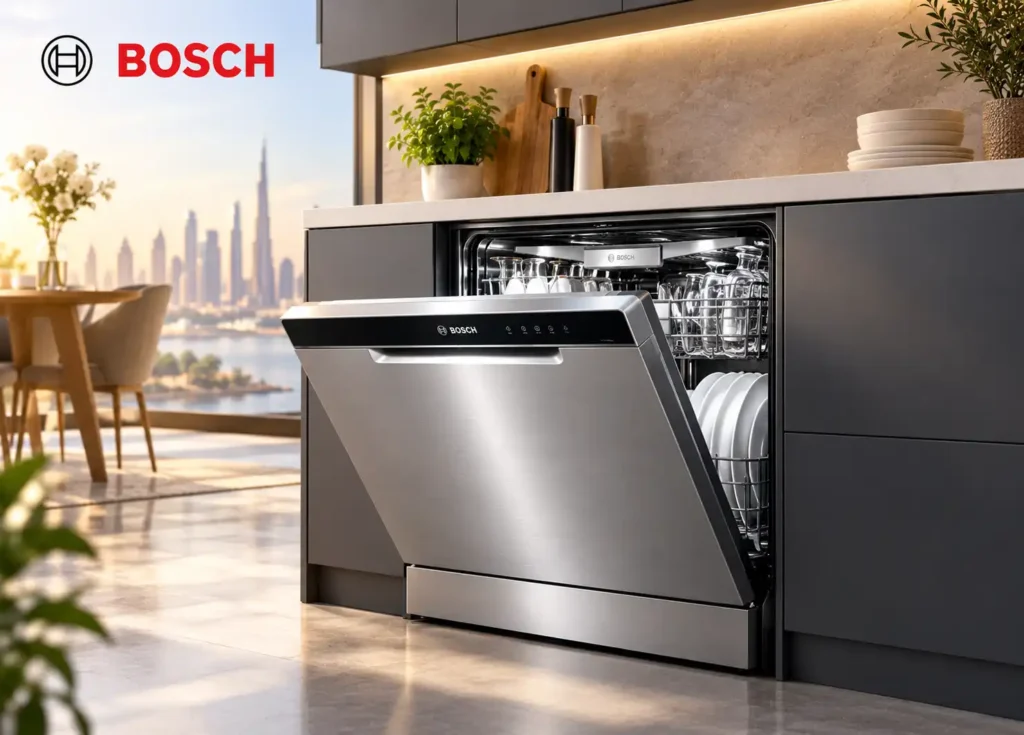
This makes the drying technology particularly interesting for buyers who want both better drying and reasonable energy consumption. Nevertheless, actual electricity use depends on the selected program, options, household usage and regional energy standards. A premium drying system does not mean every cycle will consume the same amount of energy.
Bosch 800 Series Noise Level
Noise is one of the strongest characteristics of the 800 Series. Current North American models such as the SHP78CM5N and SHX78CM5N are rated at 42 dBA. Bosch positions the 800 Series as a quiet dishwasher range designed for kitchens where normal conversation and household activities continue while the dishwasher is running.
A 42 dBA rating is considerably quieter than many older dishwashers, but a numerical rating should not be interpreted as meaning that the dishwasher will be completely silent. Dishwashers contain pumps, motors, water valves and drainage systems, and users may hear different sounds during filling, spraying, draining and drying.
Independent testing supports the strong noise performance of Bosch 800 Series models. Several tested examples have received excellent noise results, including models tested under full-load conditions.
Installation can also influence what you hear. Cabinet construction, flooring, surrounding appliances, water pressure and the quality of installation can affect perceived sound. A dishwasher rated at 42 dBA in laboratory specifications can therefore sound slightly different in two different kitchens.
For open-plan kitchens, apartments, kitchens beside living rooms and homes where people frequently work or watch television nearby, the low-noise design is especially useful. It also makes it more practical to operate the dishwasher during evenings without creating the pronounced mechanical noise associated with older machines.
Bosch 800 Series Rack System
Rack design is another area where the 800 Series is built for flexibility. Current models include a flexible third rack intended primarily for utensils and smaller kitchen items, while the upper rack can be adjusted to create additional clearance for taller cookware.
The third rack can make a substantial difference in how much useful space the dishwasher provides. Instead of placing every utensil in a traditional basket, users can spread cutlery and small tools across a dedicated upper level. This can free space on the lower racks for plates, bowls and cookware.
Rack flexibility is particularly valuable when washing mixed loads. Wine glasses, large dinner plates, cereal bowls, saucepans and utensils do not all require the same amount of vertical clearance. Adjustable rack components allow the interior to be configured around the day’s load instead of forcing users to follow one fixed layout.
The EasyGlide rack system is another convenience feature available on current 800 Series models. Bosch describes the system as providing smoother rack movement, which can make loading and unloading easier when the racks are heavily loaded.
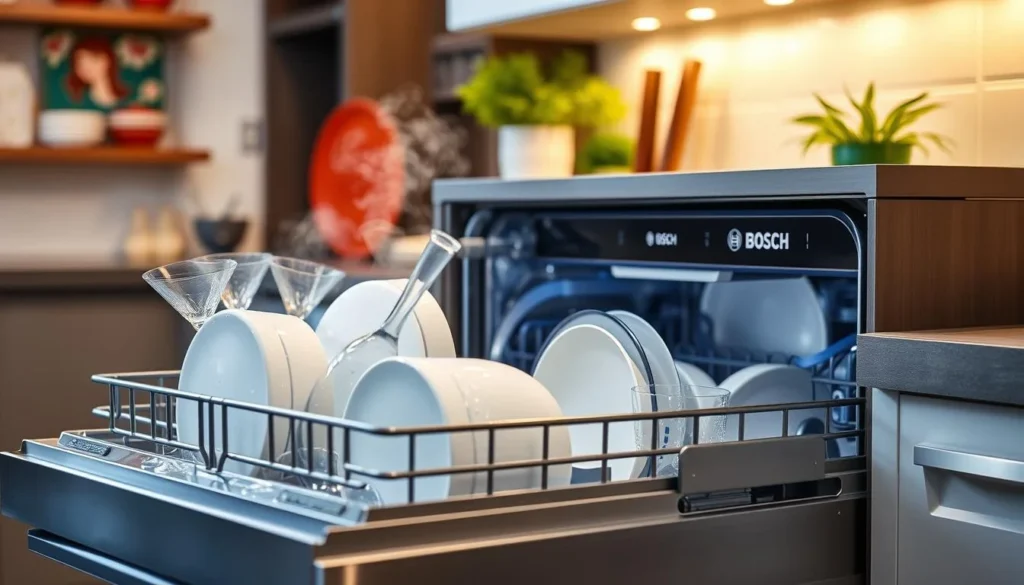
Third Rack: One of the Best Features
A third rack is particularly useful for households that wash a lot of flat utensils, cooking tools, chopsticks, serving spoons and small kitchen accessories. Rather than forcing these items into a crowded lower basket, the third level gives them a dedicated washing position.
The exact shape and adjustability of the third rack vary by model. This is another reason to inspect the precise model number before purchasing. A third rack may be advertised across a series, but its depth, fold-down sections and compatibility with taller utensils can differ between generations.
For households that use large chef’s knives, long utensils or unusual kitchen tools, the third rack should be physically inspected if possible. A flexible rack is valuable only if it accommodates the items you actually use.
Bosch 800 Series Capacity
Most full-size North American 800 Series models are designed around a standard 24-inch installation footprint. For example, current SHP78CM5N and SHX78CM5N models are approximately 33 7/8 inches high, 23 9/16 inches wide and 23 3/4 inches deep.
These dimensions make the dishwasher suitable for many standard kitchen openings, but installation should never be based only on nominal width. Cabinet height, flooring thickness, countertop clearance, door clearance, water connections and drain routing all need to be checked before installation.
The 800 Series also includes custom-panel-ready configurations. These allow the dishwasher door to receive a cabinet-matching panel, making the appliance visually integrate with the surrounding kitchen.
In the UK, full-size Bosch dishwashers commonly use a 60 cm width format. Current premium models can offer capacities up to around 14 place settings, while specific models and basket arrangements vary.
Stainless-Steel Interior
A stainless-steel interior is a standard characteristic of many Bosch 800 Series models. The material provides a durable interior surface and is commonly paired with the sound insulation and premium construction expected in this segment.
Stainless steel also interacts well with modern drying systems and high-temperature washing. It is not, by itself, proof that a dishwasher will clean better than every dishwasher with a different interior, but it is an important part of the overall construction of the 800 Series.
The stainless tub also contributes to the premium appearance when the door is opened. Combined with the adjustable racks and third rack, it gives the interior a more engineered feel than many basic dishwasher designs.
Bosch 800 Series Home Connect Smart Features
Selected 800 Series models support Home Connect, Bosch’s connected-appliance platform. Compatible models can be controlled or monitored using a smartphone, providing access to remote functions and information about the dishwasher.
Smart connectivity is useful when the dishwasher is located in another part of the house. Instead of repeatedly opening the door to check its status, users can access information through the connected system. Availability of individual features depends on the model and local service configuration.
Connected functions should be considered a convenience rather than the main reason to buy the dishwasher. Cleaning, drying, noise and rack design remain more important for most households because they affect every load. Smart controls are most valuable when they solve a real problem in your daily routine.

Home Connect can also be relevant for advanced features such as PowerControl on compatible models. Bosch states that the app can allow users to independently control different washing areas, providing more targeted washing for certain loads.
Bosch 800 Series Energy Efficiency
Energy efficiency is another important part of the 800 Series design. Current North American 800 Series models are offered with ENERGY STAR certification, and independent testing of Bosch 800 Series machines has found very good or excellent energy performance on tested models.
A modern efficient dishwasher can use less water than washing the same quantity of dishes by hand under continuously running water, although actual savings depend heavily on how the dishwasher and sink are used. The Bosch system uses sensors and controlled spray patterns to manage water delivery rather than continuously filling the tub with fresh water.
Bosch states that its normal dishwasher cycles generally use around 3 to 5 gallons of water in the North American context, although actual consumption varies by cycle and model. This should be treated as a general manufacturer estimate rather than a guarantee for every 800 Series program.
For Canadian shoppers, current product information for the 800 Series similarly emphasizes ENERGY STAR certification and energy efficiency. Exact energy and water figures should be checked against the energy label for the specific model because specifications can differ.
UK buyers should use the European energy label rather than North American ENERGY STAR terminology. Current Bosch UK machines report an A-to-G energy class and water consumption in litres per Eco cycle, so comparisons need to be made using the local labeling system.
Bosch 800 Series Water Consumption
Water efficiency is closely related to the dishwasher’s sensor system. Instead of relying entirely on a fixed amount of washing for every load, modern sensor-controlled dishwashers can adjust operation based on the condition of the load.
Bosch estimates normal-cycle water use for its dishwashers at approximately 3 to 5 gallons, while individual cycles may consume different amounts. Heavy-duty, intensive, sanitation or special programs should not be assumed to use the same quantity as a normal or Eco cycle.
For Canadian and U.S. buyers concerned about utility costs, the energy label and official product specification sheet for the exact model are more useful than generalized series-level water figures. This is especially important when comparing different generations of the 800 Series.
Bosch 800 Series Reliability
Reliability is more difficult to evaluate than cleaning or noise because it requires years of ownership data rather than a single laboratory test. Independent consumer research incorporates owner survey information into its assessment of dishwasher brands and individual products, while manufacturer specifications mainly describe design and warranty information.
Consumer testing of current and previous Bosch 800 Series models shows that several models have performed strongly in washing, energy and noise tests. However, this should not be interpreted as a guarantee that every 800 Series machine will be trouble-free for its entire service life.
Consumer Reports’ current methodology also separates laboratory performance from predicted reliability and owner satisfaction. Its dishwasher survey data includes 77,011 newly purchased dishwashers across 27 brands, purchased between 2015 and 2025. That large sample can provide useful context, but brand-level survey results do not predict the experience of every individual owner.
For a buyer, the more useful approach is to consider reliability alongside local service availability, warranty coverage, installation quality and maintenance requirements. A technically sophisticated dishwasher can still experience problems if it is improperly installed, operated with blocked spray arms or neglected for years.
Common Bosch 800 Series Problems to Watch For
Premium dishwashers are not immune to problems. Potential issues can involve pumps, inlet valves, drainage, sensors, electronic controls, door seals, racks or other components. The presence of sophisticated technology means there are also more components that may eventually require diagnosis.
One practical issue is that users sometimes interpret long cycle times as a malfunction. Modern efficient dishwashers can take substantially longer than older machines because they use controlled water and energy more carefully. Independent testing of Bosch 800 Series models has sometimes rated cycle time as fair compared with their strong washing and noise performance.
Another potential source of dissatisfaction is the manually cleaned filter found on several tested 800 Series models. The filter needs periodic cleaning so food particles do not interfere with drainage and cleaning performance.
Hard water can also affect dishwasher performance over time. Mineral deposits can accumulate on components and dish surfaces, while glassware can develop spots or film. Water hardness varies significantly by location, so the appropriate detergent and rinse-aid strategy should be based on local water conditions and the appliance manual.
Bosch 800 Series Filter Maintenance
The dishwasher filter is one of the most important user-maintained components. Food particles captured by the filtration system need to be removed periodically rather than being allowed to accumulate indefinitely.
A dirty filter can contribute to unpleasant odors, poor drainage and reduced cleaning performance. It can also allow debris to circulate through the dishwasher. The exact cleaning procedure should follow the model’s user manual because filter designs differ between generations.
Spray arms should also be inspected periodically. Food particles or mineral deposits can obstruct spray openings, reducing the amount of water reaching dishes. Keeping the spray paths clear is particularly important in a machine that relies on precisely directed water.
Bosch 800 Series and Hard Water
Hard water is a significant consideration for dishwasher owners in many parts of the United States, Canada and the UK. Calcium and magnesium minerals can leave spots on glassware and deposits inside appliances.
The solution depends on local water hardness and the exact model. Some Bosch product families sold in different regions offer different approaches to water conditioning, and Bosch’s Canadian comparison information indicates that an integrated water softener is associated with the Benchmark level rather than being a universal 800 Series feature.
This distinction is important. A shopper with very hard water should not assume that buying a premium dishwasher automatically provides a built-in water softener. Check the specifications of the exact model before purchasing if water hardness is a major concern.
Rinse aid can also be important for reducing water spots and improving drying. Bosch’s UK PerfectDry guidance specifically recommends maintaining rinse aid and keeping filters and spray arms clean to preserve drying performance.
Bosch 800 Series Leak Protection
Leak protection is another important consideration in a built-in dishwasher because even a small leak can cause damage to cabinetry or flooring. Current Canadian 800 Series models advertise AquaStop leak protection, while some configurations offer enhanced 24/7 AquaStop Plus protection.
The exact protection system depends on the model and market. Buyers should therefore verify whether the model they are considering includes the specific AquaStop configuration they want rather than assuming all Bosch dishwashers have identical protection.
UK Bosch dishwasher documentation also identifies AquaStop on compatible models, and Bosch’s UK warranty information describes a lifetime AquaStop liability warranty for qualifying water damage caused by a defective AquaStop system, subject to the stated installation and warranty conditions.
Leak protection does not eliminate the need for correct installation. Water connections, drain connections and the AquaStop system need to be installed according to the manufacturer’s instructions.
Bosch 800 Series Warranty and Service
Warranty terms vary considerably by country and sometimes by model, so this is one area where a general “Bosch warranty” statement can be misleading. U.S., Canadian and UK buyers should use the warranty terms applicable to the model purchased in their market.
The current UK warranty program is particularly different from the standard North American assumptions. Bosch UK currently advertises five-year warranty coverage for selected appliances purchased during the specified 2026-2027 promotional period and registered within the required timeframe. It also describes lifetime AquaStop warranty protection for qualifying water damage caused by a defective AquaStop system.
North American buyers should check the warranty documentation attached to the exact model rather than assuming that a UK warranty offer applies in the United States or Canada. Product pages provide access to warranty information and model-specific documentation.
Service availability is another important consideration. Bosch provides model-specific support pages with manuals, installation documentation, replacement parts and troubleshooting resources, which can be useful when diagnosing a problem or finding maintenance information.
Bosch 800 Series in the United States
For U.S. buyers, the current 800 Series is primarily a 24-inch premium built-in dishwasher range. Current models include top-control stainless-steel machines, custom-panel-ready models and different finish options.
Current U.S. 800 Series examples such as the SHP78CM5N and SHX78CM5N are rated at 42 dBA and feature CrystalDry, PrecisionWash, PowerControl, a flexible third rack, EasyGlide and Home Connect.
U.S. models are also marketed with ENERGY STAR certification on applicable products, making them relevant for households that want to reduce dishwasher energy and water consumption.
Bosch 800 Series in Canada
The Canadian 800 Series has many of the same core technologies as the U.S. range. Current models include CrystalDry, PrecisionWash, PowerControl on compatible versions, flexible third racks, 42 dBA operation and Home Connect on selected products.
Canadian models also advertise AquaStop protection on relevant configurations and ENERGY STAR certification. This makes the 800 Series a direct premium option for Canadian kitchens, although pricing and model numbers differ from the U.S. market.
Canadian pricing can also be significantly higher in nominal currency than U.S. pricing. Current Bosch Canada listings show representative 800 Series models around C$2,299, although prices can change with promotions, finishes and availability.
Bosch 800 Series in the UK
The UK market requires a slightly different approach. Bosch generally organizes its premium dishwashers by Serie rather than using the American 100/300/500/800 terminology. Series 8 sits at the premium end of that hierarchy and can include technologies such as PerfectDry, Zeolith drying, VarioFlex baskets and Home Connect.
PerfectDry is especially important in the UK because it addresses one of the same issues as North American CrystalDry: drying difficult items, particularly plastics. Bosch describes Zeolith as a natural mineral that absorbs moisture and releases heat during drying.
UK buyers should therefore search for the equivalent Serie 8 specification rather than trying to import a U.S. 800 Series machine. Electrical standards, installation requirements, controls, dimensions, energy labeling and warranty arrangements differ between markets.
Bosch 800 Series Cycle Time
One of the main compromises associated with modern efficient dishwashers is that some full cleaning cycles can take a long time. Independent testing of Bosch 800 Series machines has sometimes rated cycle time as fair even when washing, energy and noise performance were strong.
Long cycles are not necessarily a sign of poor performance. Modern dishwashers can use longer, carefully controlled cycles to reduce water and energy consumption while still delivering strong cleaning.
If speed is important, buyers should check the exact model’s quick or speed options. Bosch’s UK range, for example, offers SpeedPerfect+ on compatible models, which is designed to shorten compatible programs while maintaining cleaning performance.
The key is to decide whether you prioritize minimum cycle time or efficient cleaning with low water and energy consumption. For most households, the dishwasher’s everyday performance matters more than whether every load finishes as quickly as possible.
Bosch 800 Series Pros
Strong cleaning performance
Independent testing of several Bosch 800 Series models has found very good or excellent washing performance, including strong results on heavily soiled loads.
Excellent noise performance
Current 800 Series models are rated around 42 dBA, and independent testing has also found excellent noise performance on multiple tested models.
Advanced drying
CrystalDry uses mineral-based drying technology designed to improve drying of plastics as well as conventional dishes.
Flexible third rack
The third rack provides dedicated space for utensils and smaller items while helping free room on the main racks.
Flexible loading
Adjustable racks and tines make it easier to accommodate different sizes of cookware and dishware.
Smart connectivity
Selected models provide Home Connect functionality for smartphone-based monitoring and control.
Premium construction
Stainless-steel interiors, sophisticated rack systems and advanced washing and drying technologies give the 800 Series a premium configuration.
Bosch 800 Series Cons
Higher purchase price
The 800 Series costs more than Bosch’s lower series and many mainstream dishwasher alternatives. Current U.S. and Canadian listings demonstrate the premium positioning.
Long cycles
Independent testing has found cycle-time performance less impressive than the washing, energy and noise results on some 800 Series models.
Not every feature is on every model
PowerControl, Home Connect, rack designs, finishes and other specifications vary by model. Buyers need to check the exact model number.
Filter requires maintenance
Several tested 800 Series models use manually cleaned filters, so owners need to perform routine cleaning rather than expecting the filtration system to maintain itself indefinitely.
UK and North American models are different
The American 800 Series should not be assumed to be identical to a UK Serie 8 dishwasher. The technologies can be similar, but model numbers, specifications, energy labels and warranty terms vary by region.
Is the Bosch 800 Series Worth the Extra Money?
Whether the Bosch 800 Series is worth the additional cost depends on which features matter in your kitchen. The biggest practical advantages are not cosmetic. They are the combination of low noise, strong cleaning, advanced drying and flexible loading.
If your kitchen opens directly into a living room, the 42 dBA operating level can be a meaningful advantage. If you frequently wash plastic containers, CrystalDry can also address one of the most common dishwasher frustrations: plastic items remaining wet after the cycle.
The flexible third rack can also make a difference for families that wash large quantities of utensils and small kitchen items. Instead of simply adding another feature to the specification sheet, it can change how the entire dishwasher is loaded.
On the other hand, a household that primarily washes lightly soiled dishes and does not care about exceptionally quiet operation or advanced drying may not need every premium feature in the 800 Series. Lower Bosch series can provide many of the fundamental dishwasher functions at a lower purchase price.
Bosch 800 Series vs Bosch 500 Series
The Bosch 500 Series is positioned below the 800 Series and offers a lower-cost route into Bosch’s premium dishwasher ecosystem. Current Bosch product listings show 500 Series models with different noise ratings and feature combinations, while the 800 Series adds technologies such as CrystalDry and, on applicable models, PowerControl.
The most important difference for many shoppers is drying. If excellent drying of plastics is a priority, the 800 Series’s CrystalDry system becomes a meaningful reason to move up the range.
Noise can also influence the decision. Bosch’s Canadian comparison places the 500 Series at 44 dBA and the 800 Series at 42 dBA, although individual models can vary.
For buyers who want the most sophisticated feature set without moving to the Benchmark range, the 800 Series occupies a logical position within the Bosch North American lineup.
Bosch 800 Series vs Bosch Benchmark
Benchmark sits above the 800 Series in the North American range. Current Canadian comparison information shows Benchmark models reaching as low as 39 dBA and offering additional features such as an integrated water softener, more advanced display options and, on selected models, interior lighting and enhanced rack systems.
That does not make the 800 Series a basic dishwasher. The 800 Series already includes CrystalDry, flexible racks, advanced cleaning systems and low-noise operation. The Benchmark range is aimed at shoppers who want additional premium features beyond that package.
For many households, the practical question is whether those additional Benchmark features solve a genuine problem. If they do not, the 800 Series may provide a more appropriate feature set without moving to the top of the range.
Who Should Buy the Bosch 800 Series?
The Bosch 800 Series makes particular sense for households that prioritize quiet operation. A 42 dBA dishwasher is well suited to open-plan kitchens, apartments and homes where the kitchen is close to the living or working area.
It is also well suited to people who dislike wet plastic. CrystalDry is one of the most distinctive features of the series and is specifically intended to improve drying of difficult materials.
Families can benefit from the flexible third rack and adjustable rack system because these features help accommodate large mixed loads. The dishwasher can be configured differently depending on whether the load contains plates, glasses, cookware, utensils or food containers.
Smart-home users may also appreciate Home Connect, especially when remote monitoring or app-based functions are useful in their daily routine.
Who May Not Need a Bosch 800 Series?
A buyer on a tight budget may find the 800 Series unnecessarily expensive. Current U.S. pricing places representative models well above many mainstream dishwashers, while Canadian pricing is also firmly in the premium category.
Someone who does not care about drying plastics may also find some of the 800 Series’s biggest advantages less important. CrystalDry is a significant part of the premium package, but its value depends on how you use your dishwasher.
Similarly, users who want the shortest possible cycles should carefully compare cycle times and speed options before buying. Independent testing has not always found Bosch 800 Series cycle times to be a standout strength.
Bosch 800 Series Buying Checklist
Before buying a Bosch 800 Series dishwasher, check the following:
- Exact model number: Do not compare only the words “800 Series.”
- Noise rating: Current models can be around 42 dBA.
- Drying system: Verify whether the model includes CrystalDry.
- PowerControl: Check whether the specific model includes PowerControl.
- Third rack: Check its configuration and flexibility.
- Home Connect: Verify smart features if connectivity matters to you.
- Leak protection: Confirm the exact AquaStop configuration.
- Installation dimensions: Check the official dimensions before ordering.
- Energy label: Compare the exact model’s energy and water information.
- Warranty: Check the warranty for your country and model.
- Water hardness: Determine whether your local water conditions require additional water treatment.
- Service availability: Check whether authorized service is readily available in your area.
Final Bosch 800 Series Review
The Bosch 800 Series is a premium dishwasher family built around four major strengths: strong cleaning, advanced drying, quiet operation and flexible loading. Current models combine PrecisionWash with sophisticated rack systems and, on compatible models, PowerControl, while CrystalDry addresses the difficult problem of drying plastic items.
Independent testing provides meaningful support for the 800 Series’s performance. Multiple tested models have achieved very good or excellent washing results, very good or excellent energy performance and excellent noise results, although cycle time has been less consistently impressive.
The biggest practical advantage may be the combination of these characteristics rather than any single feature. A dishwasher that cleans well but is noisy can be frustrating in an open kitchen. A quiet dishwasher that leaves plastics wet can create extra work. A dishwasher with good drying but inflexible racks can be difficult to load. The 800 Series attempts to address all of these areas together.
There are compromises. The purchase price is high compared with mainstream dishwashers, cycle times can be long, filter maintenance is still required, and not every 800 Series model has exactly the same features. Buyers also need to be careful when comparing U.S., Canadian and UK products because regional model ranges and specifications differ.
For shoppers who value a quiet kitchen, strong cleaning, excellent drying, flexible loading and premium dishwasher technology, the Bosch 800 Series represents a comprehensive high-end package. The best way to choose among the different models is not simply to select the most expensive version, but to identify which features—CrystalDry, PowerControl, third-rack configuration, Home Connect, AquaStop protection, finish and panel design—actually matter for your kitchen.
Frequently Asked Questions About Bosch 800 Series Dishwashers
Is the Bosch 800 Series a good dishwasher?
The 800 Series combines advanced cleaning, drying, low-noise operation and flexible loading. Independent testing of several 800 Series models has reported very good or excellent washing and noise performance, although results vary by model.
How quiet is the Bosch 800 Series?
Current North American 800 Series models such as the SHP78CM5N and SHX78CM5N are rated at 42 dBA. Actual perceived sound can vary with installation and cycle.
Does the Bosch 800 Series dry plastic?
Models equipped with CrystalDry are specifically designed to improve drying of plastic and other difficult-to-dry items.
What is CrystalDry?
CrystalDry uses natural minerals to absorb moisture and transform it into heat, which is then used to circulate warm air through the dishwasher.
Does every Bosch 800 Series dishwasher have CrystalDry?
No. Feature combinations vary by model and generation, so buyers should verify the exact model specification.
What is PowerControl?
PowerControl is an enhanced spray-arm system designed to provide more targeted cleaning in selected lower-rack areas. Compatible models can provide control of washing zones through the connected system.
Does PowerControl use more water?
Bosch states that PowerControl does not require additional water beyond the dishwasher’s normal water use simply because the targeted spray function is being used.
Does the Bosch 800 Series have a third rack?
Many current 800 Series models include a flexible third rack for utensils and smaller items.
Is the third rack adjustable?
The exact configuration varies by model. Some 800 Series machines use flexible third-rack designs, so the specification for the individual model should be checked before purchase.
Does Bosch 800 Series have Wi-Fi?
Selected 800 Series models support Home Connect and smartphone-based wireless control or monitoring.
Does the Bosch 800 Series have stainless steel inside?
Many current 800 Series models use stainless-steel interiors.
Is Bosch 800 Series ENERGY STAR certified?
Applicable current North American models are ENERGY STAR certified. Always check the exact model’s certification and energy label before purchase.
How much water does a Bosch dishwasher use?
Bosch estimates normal dishwasher operation at approximately 3 to 5 gallons for its North American dishwashers, although actual consumption varies by cycle and model.
Does Bosch 800 Series have a water softener?
Do not assume that it does. Bosch’s Canadian comparison identifies an integrated water softener with the Benchmark level rather than as a universal 800 Series feature.
Is Bosch 800 Series good for hard water?
It can work in hard-water areas, but mineral buildup and water spotting need to be managed appropriately. The exact water-conditioning requirements depend on local hardness and model specifications.
Does Bosch 800 Series need rinse aid?
Rinse aid can help improve drying and reduce water spotting. Bosch’s maintenance guidance recommends keeping the rinse-aid reservoir filled for proper drying performance.
Does Bosch 800 Series have AquaStop?
Many current North American 800 Series models include AquaStop, while some configurations offer enhanced AquaStop Plus protection. Check the exact model.
Is Bosch AquaStop a lifetime warranty?
In the UK, Bosch currently describes a lifetime AquaStop warranty covering qualifying water damage caused by a defective AquaStop system, subject to its stated conditions. This should not automatically be applied to U.S. or Canadian warranty terms.
How long does a Bosch 800 Series dishwasher take?
Cycle duration depends on the selected program, options and model. Independent testing has found cycle time less impressive than washing and noise performance on some 800 Series models.
Why does my Bosch dishwasher run for so long?
Modern efficient dishwasher programs can use longer controlled cycles to achieve cleaning while managing water and energy. A long cycle is therefore not automatically an indication of a fault.
Does Bosch 800 Series have a quick cycle?
Specific quick or speed options vary by model and market. UK models with SpeedPerfect+ can reduce the duration of compatible programs.
Is Bosch 800 Series better than Bosch 500 Series?
The two series target different feature levels. The 800 Series adds technologies such as CrystalDry and, on compatible models, PowerControl, while the 500 Series is positioned below it.
Is Bosch 800 Series better than Benchmark?
Benchmark sits above the 800 Series in the North American range and can add features such as lower noise ratings, enhanced displays, water softening and additional premium options.
Is Bosch 800 Series worth the money?
The answer depends on how much value you place on quiet operation, advanced drying, flexible racks and premium cleaning technology. The additional features are most relevant when they solve specific problems in your kitchen.
Is Bosch 800 Series good for families?
The flexible third rack, adjustable racks and large full-size configuration can be useful for households that regularly wash mixed loads containing dishes, utensils, cookware and containers.
Is Bosch 800 Series good for an open kitchen?
Its low operating noise makes it particularly suitable for kitchens connected to living and dining spaces. Current models are rated around 42 dBA.
Does Bosch 800 Series have a self-cleaning filter?
Several tested 800 Series models use manually cleaned filters. Owners should therefore expect to perform periodic filter maintenance.
How often should I clean the Bosch dishwasher filter?
The appropriate interval depends on usage and the model’s instructions. Regular inspection and cleaning are important, particularly if the dishwasher is used frequently or handles heavily soiled loads.
Can Bosch 800 Series wash pots and pans?
Yes. Its lower-rack design and strong cleaning system are intended to handle mixed loads that can include cookware. Heavily soiled cookware should be positioned so it does not block spray arms or other dishes.
Can Bosch 800 Series wash delicate glasses?
Compatible Bosch programs are designed to accommodate delicate glassware, but users should still position fragile items securely and select an appropriate program. UK Bosch models, for example, include dedicated glass-care programs on certain configurations.
Can Bosch 800 Series wash plastic containers?
Yes. CrystalDry models are specifically designed to improve drying of plastic containers and other difficult-to-dry materials.
Does Bosch 800 Series have hidden controls?
Many current 800 Series models use top controls that are hidden when the dishwasher door is closed. Exact control design depends on model.
Does Bosch 800 Series have a remaining-time display?
The availability of a remaining-time display depends on the specific model. Some tested models do not display remaining time on the appliance itself, while other Bosch configurations use projection or display technologies.
Is Bosch 800 Series made in the USA?
Manufacturing location can vary by model and should be checked on the individual product documentation. The Bosch brand sells different dishwasher models across multiple markets and does not make one universal manufacturing-location claim for the entire 800 Series.
Can I install a Bosch 800 Series myself?
Dishwasher installation involves electrical, water and drainage connections, so it should be completed according to the official installation instructions and applicable local requirements. Professional installation can be appropriate where local codes or existing plumbing make the work complex.
Does the Bosch 800 Series fit a standard 24-inch opening?
Many full-size North American 800 Series models are designed for standard 24-inch dishwasher openings. However, the exact cabinet opening dimensions should always be checked against the model’s installation documentation.
Are Bosch 800 Series dishwashers available in Canada?
Yes. Bosch Canada currently lists multiple 800 Series models, including stainless-steel, black-steel and custom-panel configurations.
Are Bosch 800 Series dishwashers available in the UK?
The UK market uses different series naming. Comparable premium products are generally found under the Serie 8 range rather than the North American 800 Series designation.
Is the U.S. Bosch 800 Series the same as the UK Serie 8?
No. The naming and model ranges differ by region. Technologies such as advanced mineral drying may be similar, but model numbers, dimensions, energy labels, programs and warranty terms can differ.
What is the biggest advantage of Bosch 800 Series?
The biggest practical advantage is the combination of strong cleaning, advanced drying and very quiet operation rather than a single feature. Current models combine these characteristics with flexible loading and smart connectivity.
What is the biggest disadvantage of Bosch 800 Series?
The main considerations are its premium purchase price, potentially long cycles and the need to compare individual model specifications rather than assuming every 800 Series dishwasher has the same features.
How long can a Bosch 800 Series dishwasher last?
Actual service life varies with usage, installation, maintenance, water quality and individual component reliability. No responsible review can guarantee a specific lifespan for every unit. Regular filter, spray-arm and general maintenance can help keep the appliance operating properly.
Final FAQ: Should you buy a Bosch 800 Series dishwasher?
The Bosch 800 Series is designed for shoppers who want a premium dishwasher with strong washing performance, very low noise, advanced drying and flexible loading. The exact model should be selected based on your kitchen dimensions, preferred drying technology, rack configuration, noise requirements, connectivity needs, water conditions and local warranty/service arrangements.