
The Bosch 500 Series dishwasher occupies an interesting position in the premium dishwasher market. It is designed to provide many of the features associated with higher-end dishwashers without moving all the way into Bosch’s 800 Series or Benchmark range. Current North American 500 Series models combine PrecisionWash cleaning, stainless-steel interiors, flexible third racks, adjustable racks, quiet 44 dBA operation, ENERGY STAR certification and, on selected models, AutoAir drying, Zone Wash and Wi-Fi connectivity.
The 500 Series is therefore not simply a basic dishwasher with a premium badge. It is built around a specific balance of cleaning performance, quiet operation, loading flexibility, drying and price. The exact feature package varies according to model number, so a Bosch 500 Series review needs to consider the entire family rather than treating every 500 Series dishwasher as identical.
For U.S. and Canadian buyers, current 500 Series models such as the SHP65DM5N, SHX65DM5N, SHP65CM5N and SHX65CM5N demonstrate how the range has evolved. Depending on the model, shoppers can find 44 dBA operation, AutoAir, Zone Wash, Flexible 3rd Rack, PrecisionWash, Home Connect, AquaStop and ENERGY STAR certification.
UK buyers need to be careful when searching for a “Bosch 500 Series dishwasher.” Bosch uses different series naming in the UK. A comparable premium mainstream Bosch dishwasher is generally found in the Serie 6 range rather than being marketed as the North American 500 Series. Current UK Serie 6 models can offer technologies such as Zeolith drying, Home Connect, flexible baskets and advanced programs.
This distinction is important because the American 500 Series and UK Serie 6 are not necessarily identical machines. They can share Bosch engineering concepts and technologies, but dimensions, programs, energy labels, drying systems, model numbers and warranty arrangements can differ by market.
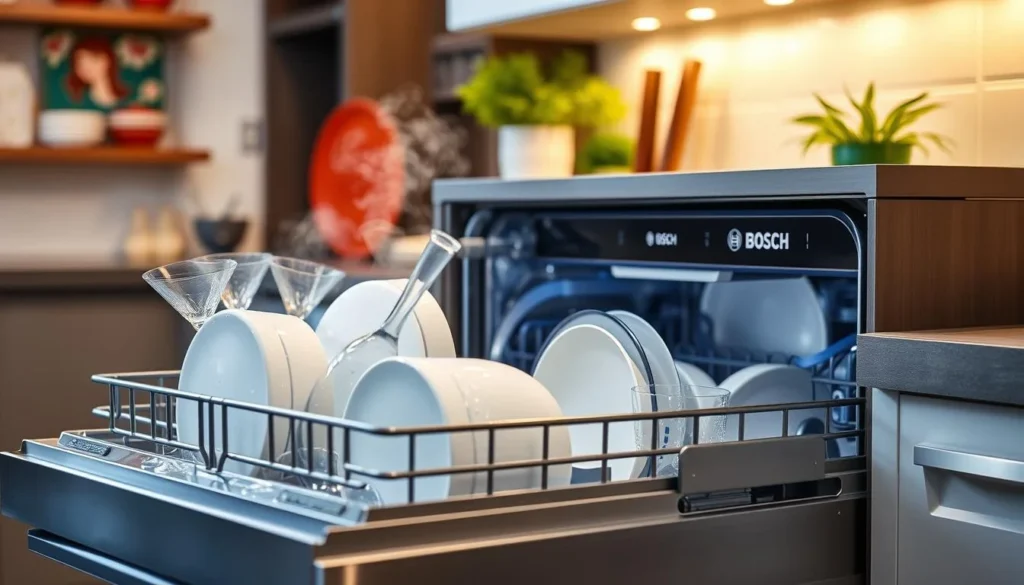
Bosch 500 Series Dishwasher Review at a Glance
The Bosch 500 Series is aimed at households looking for a quiet, well-built dishwasher with strong cleaning performance and useful loading flexibility. Current North American models are generally rated at 44 dBA, which places them among the quieter full-size residential dishwashers.
The range also benefits from PrecisionWash, Bosch’s sensor-based cleaning system. On selected current 500 Series models, Zone Wash adds a dedicated intensive washing area designed to provide substantially more water power to heavily soiled items placed in the designated lower-rack zone.
Drying depends heavily on the model. PureDry is the base drying system, while selected 500 Series models add AutoAir, which automatically opens the door at the end of the drying cycle to allow fresh air to enter and moisture to escape. Bosch says AutoAir produces an average of 40% drier dishes after seven hours compared with PureDry under its stated testing conditions.
The range also provides a Flexible 3rd Rack on many current models. This gives users an additional level for cutlery, utensils and smaller objects and can make better use of the dishwasher’s vertical space.
Independent testing provides an important perspective. Testing of the Bosch 500 Series SHP65CM5N found very good washing performance on heavily soiled dishes, excellent energy performance, very good noise performance and a weaker cycle-time result.
That combination tells us something important about the 500 Series: its strengths are primarily cleaning, energy efficiency, quiet operation and flexible loading, while cycle speed is not necessarily its defining advantage.
What Is the Bosch 500 Series?
The Bosch 500 Series is a family of built-in dishwashers positioned above the entry-level and midrange Bosch ranges and below the 800 Series and Benchmark lines in North America. The exact specifications vary between top-control, pocket-handle, bar-handle, stainless-steel and custom-panel configurations.
The current range demonstrates Bosch’s approach of offering a common cleaning platform while adding different levels of drying, rack flexibility, connectivity and premium features as customers move higher within the lineup. PrecisionWash is used broadly throughout Bosch’s dishwasher range, while technologies such as AutoAir and Zone Wash appear on selected 500 Series models.
This means two Bosch 500 Series dishwashers can look very similar but offer different ownership experiences. One may have AutoAir and Zone Wash, while another may rely on PureDry and standard cleaning features. Some models offer Home Connect, while Canadian comparison information shows that connectivity can vary according to the specific model and configuration.
For that reason, shoppers should always compare the exact model number rather than simply searching for “Bosch 500 Series.”
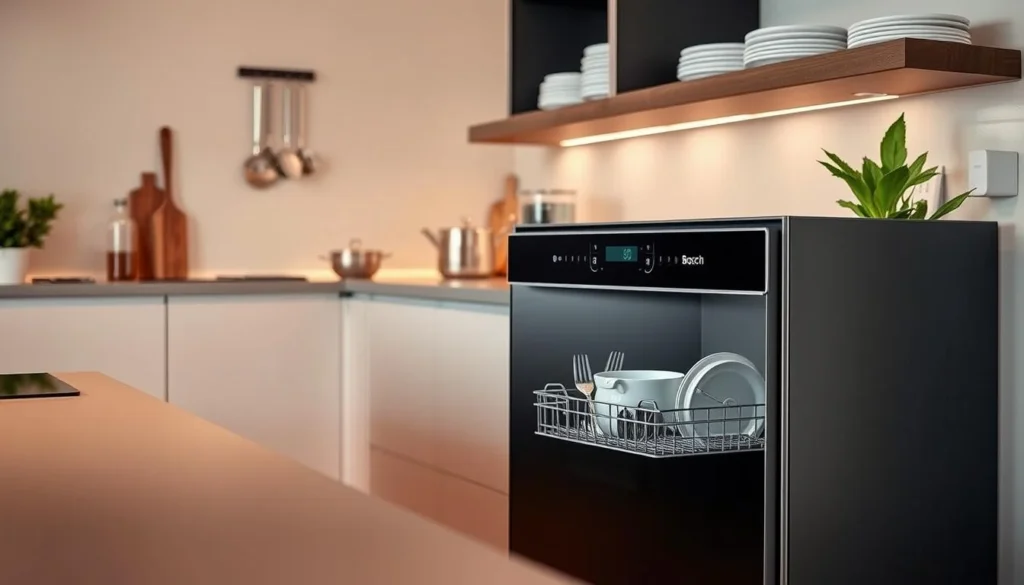
Bosch 500 Series Cleaning Performance
Cleaning performance is one of the strongest reasons to consider the Bosch 500 Series.
The range uses PrecisionWash, a sensor-based system designed to monitor soil conditions and optimize the wash process. Instead of simply treating every load exactly the same way, the dishwasher uses sensing and targeted water delivery to adjust the cleaning process.
The practical advantage is that a mixed household load can contain different levels of soil without necessarily requiring the user to manually preselect an elaborate cleaning strategy for every dish. Plates, glasses, bowls and cookware can be washed together when they are loaded correctly and the appropriate cycle is selected.
Independent testing supports the cleaning capability of the current 500 Series. Testing of the SHP65CM5N found that it performed “very good” in washing heavily soiled dishes. The SHX65CM5N received the same very-good assessment in its detailed testing.
That is significant because heavily soiled loads are considerably more demanding than lightly used plates and glasses. A dishwasher that performs well on baked-on or heavily soiled dishes has a stronger practical cleaning profile than one evaluated only on relatively easy loads.
Previous 500 Series models have also demonstrated excellent washing performance in independent testing. The SHP65T55UC and SHPM65W55N, for example, received excellent washing results in their respective laboratory tests.
These results should not be interpreted as a guarantee that every 500 Series model will produce identical results. Bosch has changed the model range over time, and loading technique, detergent, water hardness, cycle selection and dish placement all influence the final result.
Bosch PrecisionWash Technology
PrecisionWash is central to the Bosch dishwasher experience.
The technology uses sensors to monitor the load and help optimize washing conditions. The objective is to deliver water and cleaning action where it is needed rather than simply relying on a fixed washing pattern for every load.
This becomes especially useful when a household frequently washes mixed loads. A dishwasher may have lightly soiled drinking glasses in the upper rack while heavily soiled plates or cookware are positioned below.
The sensing system is designed to respond to the load rather than requiring the owner to manually determine every aspect of the wash process. This is one reason Bosch positions PrecisionWash as a standard technology across its dishwasher range.
The important point is that PrecisionWash is not the same as a “self-cleaning” dishwasher. Owners still need to load dishes correctly, keep filters clean and make sure spray arms are not obstructed.
Bosch 500 Series Zone Wash
Zone Wash is one of the most interesting additions to selected current 500 Series models.
Bosch describes Zone Wash as a dedicated intensive wash area in the lower rack. When activated through the appropriate deep-clean cycle, a dedicated spray arm delivers concentrated cleaning power to the designated area.
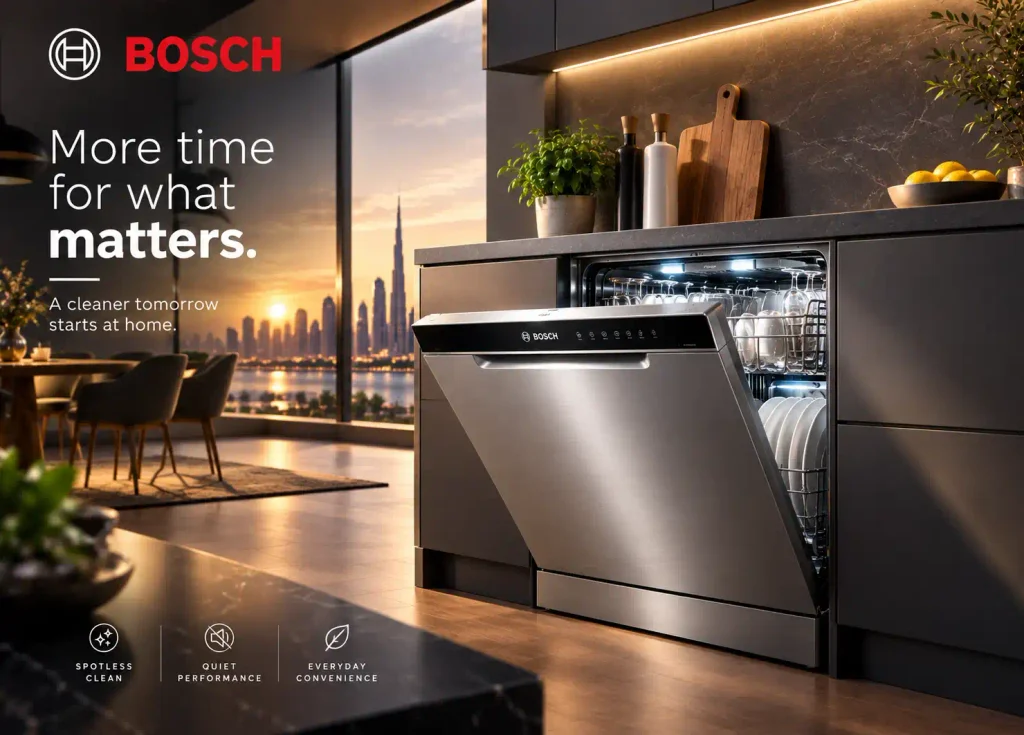
Bosch states that the Zone Wash area delivers three times more water power than the corresponding lower-rack area of a dishwasher without the Zone Wash spray arm. This is a manufacturer comparison and should be understood as a comparison of water power in the designated area rather than a claim that the entire dishwasher cleans three times better.
This feature is particularly relevant for cookware.
Large casserole dishes, lasagna pans and pots can accumulate baked-on food that requires more aggressive washing than ordinary plates. Zone Wash gives the user a dedicated area for those difficult items.
The feature also illustrates why model numbers matter. Not every Bosch 500 Series dishwasher has identical Zone Wash capabilities. Current Bosch listings specifically identify Zone Wash on selected models.
Bosch 500 Series Drying Performance
Drying is one of the areas where Bosch differentiates the 500 Series from simpler dishwasher designs.
Bosch’s base PureDry system uses condensation-based drying. Selected 500 Series models add AutoAir, which opens the dishwasher door after the cycle to allow moisture to escape and fresh air to circulate.
AutoAir is particularly interesting because it addresses one of the limitations of traditional closed-door drying: trapped humidity.
When the door automatically opens after the appropriate part of the cycle, humid air can escape instead of remaining inside the tub. Bosch reports an average of 40% drier dishes after seven hours compared with PureDry under its stated test conditions.
This does not mean that every dish will always be completely dry. Material, shape, loading position and the selected program affect drying. Plastic items, in particular, can retain water differently from glass, ceramic and stainless steel.
Still, AutoAir can be a meaningful improvement for households that regularly unload the dishwasher several hours after a cycle finishes.
Does Bosch 500 Series Dry Plastic?
Plastic is one of the most difficult materials for many dishwashers to dry.
Plastic containers generally do not retain heat as effectively as ceramic or glass, so water can remain on their surfaces after the drying stage.
The 500 Series addresses this through AutoAir on compatible models. By opening the door and allowing fresh air to circulate, the system is designed to reduce residual moisture.
However, the Bosch 500 Series should not be confused with the CrystalDry technology used on selected 800 Series models. CrystalDry uses mineral-based drying technology to provide a different approach to moisture removal and is positioned as a more advanced drying system.
Therefore, if plastic drying is your highest priority, compare the 500 and 800 Series carefully rather than assuming every Bosch dishwasher uses the same drying technology.
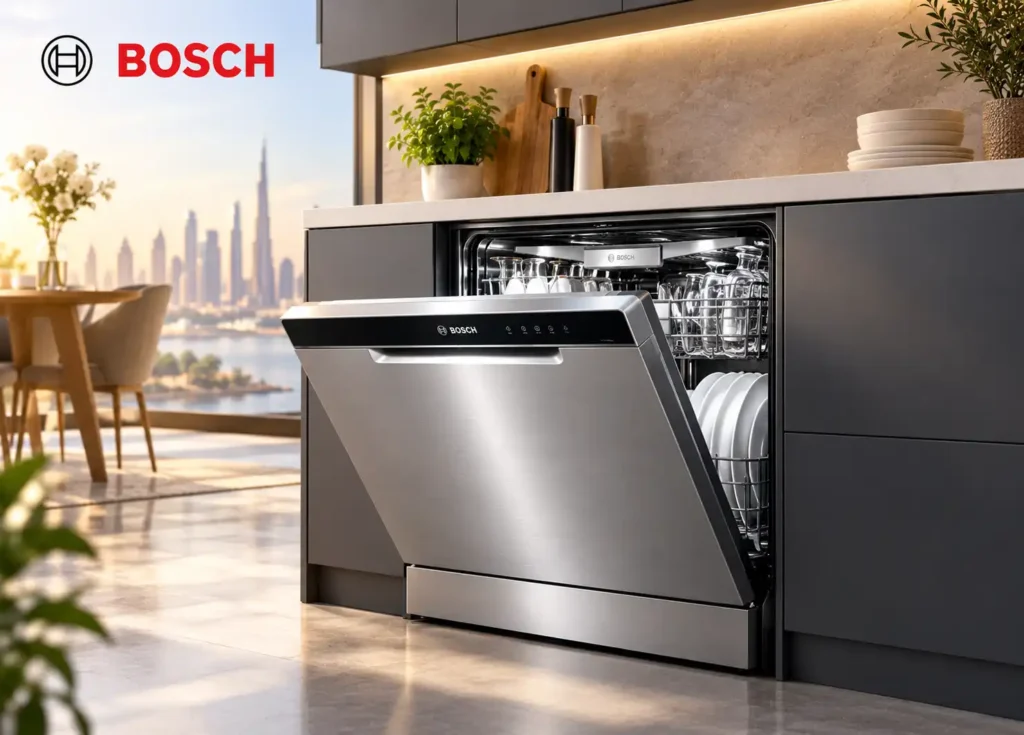
Bosch 500 Series AutoAir Review
AutoAir is arguably one of the most useful features in the 500 Series because it operates without requiring the owner to manually open the door.
After the appropriate cycle stage, the dishwasher automatically releases the door to allow air exchange. Bosch’s published testing reports an average 40% improvement in drying after seven hours compared with PureDry.
The feature also has an everyday convenience advantage. A user can start the dishwasher before going to bed or leaving the house and return later to dishes that have had additional time to dry naturally.
There is a trade-off, however. The automatic door opening means that the dishwasher needs appropriate clearance in front of the appliance. Installation instructions and cabinetry dimensions should therefore be checked before installation.
Bosch 500 Series Noise Level
Quiet operation is another major strength of the 500 Series.
Current North American Bosch 500 Series models are generally specified at 44 dBA. Bosch’s Canadian comparison table lists the 500 Series at 44 dBA, compared with 42 dBA for the 800 Series and 39 dBA for certain Benchmark models.
A 44 dBA dishwasher is quiet enough to be practical for many open kitchens, apartments and homes where the dishwasher is near living spaces.
Independent testing supports this. The SHP65CM5N and SHX65CM5N both received very-good noise results in laboratory testing.
The numerical rating should nevertheless be treated as a specification rather than a promise of absolute silence. Dishwashers make different sounds at different stages of operation, including filling, spraying, draining and pumping.
Installation can also affect perceived sound. Cabinets, flooring and the surrounding kitchen can transmit or absorb sound differently.
Is 44 dBA Quiet Enough for an Open Kitchen?
For many households, yes.
A dishwasher operating at 44 dBA is considerably quieter than many older machines, making it suitable for kitchens connected to dining rooms, family rooms or living areas.
Bosch itself advises shoppers with open-plan or eat-in kitchens to pay particular attention to dishwasher noise. It describes around 40 dBA as very quiet and provides multiple noise levels throughout its range.
The 500 Series therefore provides a useful middle ground. Buyers who want an extremely quiet dishwasher can move toward the 800 Series or Benchmark models, while shoppers who want quiet operation without paying for the highest feature level can consider the 500 Series.
Bosch 500 Series Third Rack
The Flexible 3rd Rack is another major feature.
A third rack creates additional horizontal space for utensils, cutlery and smaller kitchen tools. This can free the lower rack from objects that would otherwise occupy valuable space in the main loading areas.
The third rack is particularly useful for households that use many cooking utensils.
Serving spoons, spatulas, chopsticks, measuring tools and other narrow items can be spread across the upper rack rather than being packed into a conventional silverware basket.
Bosch’s current comparison information identifies a Flexible Third Rack for the 500 Series.
The exact design varies between models, so buyers should inspect the rack layout before purchasing if they have unusually long utensils or large quantities of cutlery.
Bosch 500 Series Rack Flexibility
The rack system is designed to accommodate different sizes and shapes of dishware.
Current 500 Series models provide adjustable racks and flexible loading features. Bosch’s Canadian comparison table identifies rack adjustability and FlexSpace tines within the 500 Series feature set.
Adjustable tines are useful because plates and bowls do not always have identical shapes. Being able to change the position of the tines can create more space for unusual dishes or cookware.
The upper rack can also be adjusted to accommodate taller items below. Independent testing of the SHP65CM5N and SHX65CM5N confirms the presence of adjustable upper racks and adjustable tines.
This flexibility is important in real-world use because dishwasher capacity is not simply about the number of place settings. Usable capacity depends on how efficiently the interior can accommodate the actual objects a household owns.
Bosch 500 Series Capacity
Current North American 500 Series models are designed around the standard 24-inch full-size dishwasher format. For example, the SHP65DM5N measures approximately 33 7/8 inches high, 23 9/16 inches wide and 23 3/4 inches deep.
The ENERGY STAR listing for the SHP65CM family identifies a 24-inch class dishwasher with a maximum capacity of 13 place settings.
This makes the 500 Series suitable for typical family kitchens, although capacity in practice depends on rack configuration and loading habits.
A family that regularly washes large cookware may experience usable capacity differently from a household that mostly washes plates, bowls and glasses.
Bosch 500 Series Stainless-Steel Interior
A stainless-steel interior is a standard characteristic of many current 500 Series models.
Independent testing identifies stainless-steel interiors on models such as the SHP65CM5N and SHX65CM5N.
Stainless steel is well suited to dishwasher environments because it is durable and compatible with the high-temperature conditions associated with dishwasher operation.
It also contributes to the premium appearance of the appliance.
However, stainless steel alone should not be treated as proof of superior cleaning. Cleaning performance depends on the complete washing system, including spray patterns, sensors, detergent, temperature and cycle design.
Bosch 500 Series Energy Efficiency
Energy efficiency is one of the most compelling aspects of the current 500 Series.
ENERGY STAR certification data for the SHX65CM family identifies annual energy consumption of approximately 240 kWh per year, compared with a federal standard of 307 kWh per year. The same data identifies water use of 3.2 gallons per cycle compared with a federal standard of 5 gallons per cycle.
The corresponding SHP65CM family is also listed at approximately 240 kWh per year and 3.2 gallons per cycle in ENERGY STAR data.
These figures are valuable because they provide a standardized reference point rather than relying solely on manufacturer marketing claims.
Actual household consumption can still vary according to cycle selection, frequency of use, options, water temperature and loading.
Bosch 500 Series Water Consumption
Water efficiency is closely connected to the dishwasher’s sensor-based cleaning system.
The ENERGY STAR listing for current SHX65CM models reports 3.2 gallons of water per cycle under the relevant certification measurement. That is substantially below the 5-gallon federal reference used in the same listing.
This makes the 500 Series attractive for households that want to reduce water consumption while still using a full-size dishwasher.
The actual amount of water used in a particular program can differ, however. Intensive cycles, sanitation options and other settings can alter energy and water consumption.
Consumers should therefore compare the official energy label for the exact model rather than assuming every Bosch 500 Series dishwasher has identical annual consumption.
Bosch 500 Series Reliability
Reliability is more complicated than cleaning performance because it involves long-term ownership rather than a single laboratory test.
Independent testing evaluates both appliance performance and, in some cases, reliability and owner satisfaction through survey data. The current SHP65CM5N review includes predicted reliability and owner satisfaction among its overall assessment categories, although the detailed scores require access to the full rating.
The laboratory results provide a clearer picture of what can be measured directly. Current 500 Series testing has demonstrated very good washing, excellent energy performance and very good noise performance.
A good performance record does not guarantee that every individual dishwasher will operate without repair for many years. Appliance reliability is affected by usage, installation, water quality, maintenance and individual component failure.
For that reason, buyers should consider warranty and service availability alongside performance.
Common Bosch 500 Series Problems
The Bosch 500 Series uses sophisticated electronics, sensors, pumps, valves, heating components and drying systems. Like any modern dishwasher, individual units can eventually experience component problems.
Potential problems can involve drainage, water supply, spray performance, sensors, door seals, electronic controls or drying performance.
However, a perceived problem is not always an actual component failure.
For example, a long cycle may be completely normal. Independent testing of the current SHP65CM5N and SHX65CM5N rated their cycle-time performance as fair, despite stronger results in washing, energy and noise.
Users should therefore avoid assuming that a long program means the dishwasher is defective.
Similarly, a small amount of moisture on some plastic containers does not necessarily indicate that the drying system has failed. Plastic can behave differently from glass and ceramic, and drying performance depends on the selected technology and cycle.
Bosch 500 Series Cycle Time
Cycle duration is one of the more important compromises to understand before purchasing.
Independent testing of current Bosch 500 Series models found fair cycle-time performance on heavily soiled loads.
Modern dishwashers often use longer cycles because they are designed to achieve cleaning while managing water and energy consumption.
A longer cycle therefore does not automatically mean the machine is inefficient.
For households that usually run the dishwasher overnight, cycle duration may have very little practical importance. Someone who needs to wash several loads during a busy day may place much greater value on speed.
The 500 Series should therefore be evaluated according to the household’s routine rather than judging cycle time in isolation.
Bosch 500 Series Filter Maintenance
The filter is an important part of dishwasher maintenance.
Independent specifications for current 500 Series models identify a manually cleaned filter rather than a self-cleaning filter.
That means the owner needs to periodically inspect and clean the filter.
Food debris that accumulates in the filtration system can contribute to unpleasant odors, poor drainage and reduced washing performance if maintenance is neglected.
Cleaning frequency depends on how heavily the dishwasher is used and how much food residue is present on dishes.
Owners should follow the instructions for their exact model because filter design and recommended maintenance procedures can vary.
Bosch 500 Series Hard Water Performance
Hard water can be an important consideration for dishwasher owners in many parts of the United States, Canada and the UK.
Calcium and magnesium minerals can contribute to spotting, mineral deposits and buildup over time.
The Bosch North American range does not include an integrated water softener across every 500 Series configuration. Bosch’s current Canadian comparison information identifies a water softener as a Benchmark-level feature rather than a universal 500 Series feature.
This is important for shoppers living in particularly hard-water regions.
A premium dishwasher should not automatically be assumed to contain every water-treatment feature. Users should check local water hardness and the exact model specifications.
Appropriate detergent, rinse aid and cleaning practices can help manage water-related problems, while households with severe hardness may need additional water-treatment solutions.
Bosch 500 Series Rinse Aid
Rinse aid can improve drying and reduce water spotting.
It is particularly useful in areas with hard water because minerals left behind by evaporating water can produce visible spots on glasses and other surfaces.
The exact dosage and usage should follow the dishwasher’s instructions because Bosch appliances are designed to manage rinse-aid dispensing according to the selected settings.
Rinse aid is especially relevant when using the standard PureDry system, although it can also contribute to overall drying performance when AutoAir is available.
Bosch 500 Series Leak Protection
Leak protection is an important consideration for any built-in dishwasher.
Current Bosch 500 Series models use AquaStop protection in relevant North American configurations. Bosch’s Canadian comparison information lists 24/7 AquaStop for the 500 Series.
Some individual models provide specific AquaStop configurations, so the exact product specification should be checked before purchase.
Leak protection does not eliminate the need for proper installation. Water supply connections, drainage, positioning and electrical connections must all be completed correctly.
A dishwasher’s leak-protection system is therefore one layer of protection rather than a replacement for proper installation and maintenance.
Bosch 500 Series Home Connect
Home Connect is available on selected 500 Series models.
Current models such as the SHP65DM5N advertise Wi-Fi-enabled Home Connect functionality, while Bosch’s Canadian product comparison shows that connectivity varies between series and specific configurations.
Smart connectivity can allow owners to interact with the appliance through a compatible mobile application.
The usefulness of this feature depends heavily on the household.
If the dishwasher is located near the kitchen and the user can easily see or hear it, smartphone connectivity may have limited value.
For larger homes, open-plan layouts or people who frequently start a dishwasher before leaving home, remote monitoring can be more useful.
Home Connect should therefore be treated as a convenience feature rather than the central reason to buy the appliance.
Bosch 500 Series Controls
Many current 500 Series models use hidden top controls.
The controls are positioned along the top edge of the door, keeping the exterior cleaner and more streamlined when the dishwasher is closed.
Independent testing of the SHP65CM5N and SHX65CM5N confirms hidden or top-control configurations depending on the model.
This design works particularly well with modern kitchens because the dishwasher front remains visually simple.
The trade-off is that the controls are not visible when the door is closed. Some Bosch models use InfoLight to indicate that a cycle is running, which can be useful in a quiet dishwasher where sound alone does not make the operating status obvious.
Bosch 500 Series Installation Dimensions
A current 24-inch 500 Series example such as the SHP65DM5N measures approximately 33 7/8 inches high, 23 9/16 inches wide and 23 3/4 inches deep.
This is broadly consistent with the standard full-size North American dishwasher format.
However, buyers should never rely solely on the phrase “24-inch dishwasher.”
Cabinet openings can vary, countertops can sit at different heights and flooring thickness can affect the available vertical space.
The water line, drain hose and electrical connection also need sufficient clearance.
Before ordering, measure the existing opening and compare those measurements with the official installation instructions for the exact model.
Bosch 500 Series in the United States
The U.S. 500 Series is currently represented by models including SHP65DM5N, SHX65DM5N, SHP65CM5N, SHX65CM5N and other configurations.
The current generation includes 44 dBA models, with selected machines offering AutoAir, Zone Wash, Home Connect, Flexible 3rd Rack and AquaStop.
The U.S. range is therefore suitable for shoppers looking for a premium dishwasher without moving to the highest Bosch product level.
ENERGY STAR certification is also available on applicable models, and current certification data demonstrates relatively low annual energy and water consumption.
Bosch 500 Series in Canada
The Canadian market includes 500 Series models such as SHX65CM5N, SHP65CM5N and SHX65DM5N.
Current Canadian listings identify 44 dBA operation, PrecisionWash, Flexible 3rd Rack, ENERGY STAR certification and, depending on the model, AutoAir, Zone Wash and Home Connect.
Canadian pricing is generally expressed in Canadian dollars and can differ considerably from U.S. pricing.
Availability can also fluctuate. For example, some current Canadian 500 Series models are listed as temporarily out of stock while other configurations are available.
Canadian shoppers should therefore compare available models rather than assuming that the U.S. and Canadian lineups are identical.
Bosch 500 Series in the UK
The UK market requires special attention because Bosch uses a different series naming system.
Instead of simply searching for an American-style 500 Series model, UK shoppers should generally look at comparable Serie 6 products.
Current UK Serie 6 dishwashers can feature Zeolith-based drying, heat-exchanger technology, VarioFlex baskets, Home Connect and other advanced features.
A current UK Bosch dishwasher using PerfectDry based on Zeolith can specifically advertise strong drying performance even on plastic dishes.
Therefore, a UK buyer should not assume that the American 500 Series’s AutoAir system is the equivalent of every UK Serie 6 dishwasher.
The underlying goal—improving drying—is similar, but the technology can be different.
Bosch 500 Series vs Bosch 300 Series
The 500 Series sits above the 300 Series in Bosch’s North American range.
The most significant distinctions include drying and rack features.
Bosch’s current comparison information identifies a standard third rack for the 300 Series and a Flexible Third Rack for the 500 Series. It also identifies 44 dBA operation for both 300 and 500 Series top-control models, while the 500 Series adds features such as improved rack flexibility and selected drying technologies.
Selected 500 Series models also add AutoAir, which automatically opens the door after the cycle.
For shoppers who value improved drying and a more flexible loading system, the 500 Series therefore provides meaningful upgrades over the lower range.
Bosch 500 Series vs Bosch 800 Series
The 800 Series is positioned above the 500 Series and offers a more advanced feature set.
The most important distinction is drying.
Selected 500 Series models use AutoAir, while selected 800 Series models use CrystalDry. Bosch describes CrystalDry as a mineral-based drying system that converts moisture into heat and is designed to produce substantially drier results, including on plastics.
Noise is another distinction.
Bosch’s current Canadian comparison lists the 500 Series at 44 dBA and the 800 Series at 42 dBA.
The 800 Series can also add PowerControl on selected models, providing additional targeted washing capability.
This does not mean every household needs the 800 Series.
For many users, 44 dBA, PrecisionWash, Flexible Third Rack and AutoAir provide a strong combination without paying for the more advanced features of the 800 Series.
Bosch 500 Series vs Benchmark
Benchmark sits above the 800 Series in Bosch’s North American hierarchy.
Bosch’s current comparison information identifies features such as an integrated water softener, lower noise levels on selected models, more advanced rack configurations and additional premium features in the Benchmark range.
The 500 Series therefore targets a different buyer.
It is aimed at someone who wants a premium dishwasher but does not necessarily need the most advanced Bosch feature package available.
Bosch 500 Series Pros
Strong cleaning
Independent testing of current models has found very good washing performance on heavily soiled dishes.
Quiet operation
Current 500 Series models are generally rated around 44 dBA, and independent testing has also found very good noise performance.
Excellent energy performance
Current certified models use approximately 240 kWh per year under the applicable ENERGY STAR measurement and about 3.2 gallons per cycle for the listed model family.
Flexible third rack
The Flexible Third Rack provides useful additional loading space for utensils and smaller items.
AutoAir on selected models
AutoAir automatically opens the door to improve drying by allowing fresh air to circulate.
Zone Wash on selected models
Zone Wash provides concentrated cleaning power for heavily soiled items placed in the designated lower-rack area.
Stainless-steel interior
Many current models use stainless-steel interiors, contributing to durability and the premium interior design.
Smart features on selected models
Home Connect is available on selected 500 Series configurations.
Bosch 500 Series Cons
Higher purchase price
The 500 Series costs more than many entry-level and mainstream dishwashers, although it remains below Bosch’s higher-end product levels.
Long cycle times
Independent testing has rated cycle-time performance as fair on current tested models, particularly when using heavily soiled loads.
AutoAir is not universal
Not every 500 Series dishwasher includes AutoAir. Buyers need to verify the exact model.
CrystalDry is not part of the 500 Series package
Shoppers who specifically want Bosch’s most advanced North American drying technology need to compare 800 Series and Benchmark models.
Manual filter maintenance
Current tested models use manually cleaned filters, so owners need to perform routine maintenance.
Different regional specifications
U.S., Canadian and UK Bosch dishwashers use different model numbering and sometimes different technologies, so international comparisons must be made carefully.
Is the Bosch 500 Series Worth the Money?
The Bosch 500 Series makes the most sense for buyers who want a premium dishwasher but do not necessarily need the highest level of Bosch technology.
Its combination of quiet operation, good washing performance, energy efficiency, flexible racks and selected drying improvements creates a balanced package.
The independent testing results are particularly relevant. Current models have demonstrated very good washing, excellent energy performance and very good noise performance.
For a family, the third rack and flexible rack system can be more useful than many electronic features because they affect every load.
For an open-plan kitchen, 44 dBA operation can make a meaningful difference.
For households that regularly wash plastic containers, AutoAir can provide an advantage over a conventional closed drying system.
However, buyers who want the very best plastic drying, lower noise levels or more advanced cleaning technology may prefer to compare the 800 Series.
Who Should Buy the Bosch 500 Series?
The Bosch 500 Series is particularly suitable for households that want a quiet dishwasher without moving into the highest price bracket.
It is also suitable for families because of its flexible loading design and third rack.
People who frequently wash cookware should consider models with Zone Wash because the dedicated intensive area is specifically intended for difficult food residue.
People who frequently wash plastic containers should consider a model with AutoAir.
Open-plan kitchen owners should consider the 44 dBA operating level.
Energy-conscious households should also consider the current ENERGY STAR figures because the certified models demonstrate relatively low energy and water consumption.
Who May Not Need a Bosch 500 Series?
A budget-focused shopper may find a lower Bosch series or another mainstream dishwasher more appropriate.
If your dishwasher is used only occasionally, the additional features may not justify the higher purchase price.
Similarly, if your priority is maximum drying performance on plastics, the 800 Series’s CrystalDry technology deserves comparison.
And if your priority is the shortest possible cycle time, the Bosch 500 Series may not be the strongest choice because independent testing has identified cycle duration as a relative weakness.
Bosch 500 Series Buying Checklist
Before buying, check these points:
- Exact model number: Do not buy based solely on the “500 Series” name.
- Noise rating: Current North American models are commonly 44 dBA.
- Drying technology: Determine whether the model has PureDry or AutoAir.
- Zone Wash: Verify whether the model includes the dedicated intensive lower-rack wash area.
- Third rack: Check the exact Flexible Third Rack configuration.
- Home Connect: Verify whether Wi-Fi connectivity is included.
- AquaStop: Check the exact leak-protection configuration.
- Energy use: Compare the official energy label for the exact model.
- Water consumption: Check the certified gallons-per-cycle or regional equivalent.
- Dimensions: Measure the cabinet opening before ordering.
- Filter: Be prepared for regular manual filter cleaning.
- Hard water: Check local water hardness and appropriate detergent/rinse-aid requirements.
- Warranty: Verify the warranty applicable to your country and exact model.
- Service: Confirm authorized service availability in your area.
- Regional model: UK shoppers should compare Serie 6 rather than assuming a North American 500 Series model is sold locally.
Final Bosch 500 Series Dishwasher Review
The Bosch 500 Series is a well-balanced premium dishwasher family that focuses on the things that matter most during everyday use: cleaning performance, quiet operation, flexible loading, energy efficiency and improved drying on selected models.
Current independent testing is particularly encouraging in the areas that are easiest to measure objectively. The SHP65CM5N has demonstrated very good washing performance on heavily soiled dishes, excellent energy performance and very good noise performance. The SHX65CM5N has produced a similar testing profile.
The 500 Series is also more flexible than a basic dishwasher because of features such as the Flexible Third Rack and adjustable loading components. These features can make a substantial difference to how efficiently a family can load a dishwasher.
Selected models add Zone Wash, which gives heavily soiled cookware a concentrated cleaning area, while AutoAir models automatically open the door after the cycle to improve drying through fresh-air circulation.
Energy efficiency is another strong point. Current ENERGY STAR data for the SHX65CM and SHP65CM families reports approximately 240 kWh of annual energy consumption and 3.2 gallons of water per cycle under the applicable certification measurements.
The main compromise is cycle time. Independent testing has rated cycle-time performance as fair on current models, meaning that buyers who prioritize fast completion should take this into account.
The 500 Series also does not offer every premium feature found higher in the Bosch lineup. CrystalDry, PowerControl, lower noise ratings and additional luxury features are associated with selected 800 Series and Benchmark models.
Overall, the Bosch 500 Series is best understood as a premium all-round dishwasher rather than an appliance designed around one spectacular feature. It combines quiet operation, strong washing, useful rack flexibility, good efficiency and optional advanced drying in a package positioned below Bosch’s highest-end models.
For U.S. and Canadian shoppers, it is important to select the exact model according to the features that matter most: AutoAir if drying is important, Zone Wash if heavily soiled cookware is common, Home Connect if smart functionality is useful, and the Flexible Third Rack if maximizing usable capacity is a priority.
For UK shoppers, the equivalent research should focus on Bosch Serie 6 products because the regional naming and specifications differ. Some current Serie 6 machines offer Zeolith-based PerfectDry technology, which provides a different drying approach from the AutoAir system found on selected North American 500 Series models.
Frequently Asked Questions About Bosch 500 Series Dishwashers
Is the Bosch 500 Series a good dishwasher?
The current 500 Series combines PrecisionWash cleaning, quiet 44 dBA operation, flexible racks and energy-efficient operation. Independent testing of current models has found very good washing and noise performance and excellent energy performance.
How quiet is the Bosch 500 Series?
Current North American 500 Series models are generally rated at 44 dBA.
Is 44 dBA quiet for a dishwasher?
Yes. A 44 dBA dishwasher is designed for relatively quiet operation and is suitable for many open-plan kitchens and living spaces.
Does Bosch 500 Series have PrecisionWash?
Yes. PrecisionWash is a standard Bosch cleaning technology and is included across current Bosch dishwasher lines, including the 500 Series.
What is Bosch PrecisionWash?
PrecisionWash uses sensing and targeted water delivery to help optimize the cleaning process according to the load and soil conditions.
Does Bosch 500 Series have Zone Wash?
Selected current 500 Series models have Zone Wash. It provides an intensive lower-rack area for heavily soiled cookware.
What is Bosch Zone Wash?
Zone Wash uses a dedicated spray arm to provide concentrated water power to a designated area of the lower rack. Bosch states that this area receives three times more water power than the corresponding area on a dishwasher without the Zone Wash spray arm.
Does every Bosch 500 Series have AutoAir?
No. AutoAir is available on selected 500 Series models.
What is AutoAir?
AutoAir automatically opens the dishwasher door at the end of the drying process to allow fresh air to circulate and moisture to escape.
Does AutoAir dry plastic?
AutoAir is designed to improve overall drying, including difficult-to-dry items, but plastic may still retain some moisture depending on its shape, material and position.
Is Bosch 500 Series good at drying?
Drying performance depends on the exact model. Models with AutoAir have an additional drying feature designed to improve moisture removal, while other 500 Series models use PureDry.
Does Bosch 500 Series have CrystalDry?
CrystalDry is associated with selected 800 Series and Benchmark models rather than being the standard drying system for the 500 Series.
Does Bosch 500 Series have a third rack?
Many current 500 Series models include a Flexible Third Rack for utensils and smaller items.
Is the Bosch 500 Series third rack useful?
It can be very useful for cutlery, cooking utensils and smaller kitchen items because it provides another dedicated loading level.
Does Bosch 500 Series have adjustable racks?
Yes. Current 500 Series models provide rack adjustability and adjustable loading components.
Does Bosch 500 Series have stainless steel inside?
Current tested 500 Series models have stainless-steel interiors.
Does Bosch 500 Series have Wi-Fi?
Selected models have Home Connect Wi-Fi connectivity.
Does Bosch 500 Series have AquaStop?
Current North American 500 Series configurations include AquaStop leak protection. Exact protection details vary by model.
Is Bosch 500 Series ENERGY STAR certified?
Current SHP65CM and SHX65CM families are listed as ENERGY STAR certified.
How much water does a Bosch 500 Series use?
ENERGY STAR certification data for the SHX65CM family reports 3.2 gallons per cycle under the applicable test conditions.
How much electricity does Bosch 500 Series use?
ENERGY STAR data for the SHX65CM and SHP65CM families reports approximately 240 kWh per year under the applicable certification measurements.
Is Bosch 500 Series good for hard water?
It can be used in hard-water areas, but water hardness should be considered when selecting detergent, rinse aid and maintenance procedures. The 500 Series does not universally include an integrated water softener.
Does Bosch 500 Series have a water softener?
Do not assume it does. Bosch’s current North American comparison identifies an integrated water softener with the Benchmark range rather than as a standard 500 Series feature.
Does Bosch 500 Series require rinse aid?
Rinse aid can improve drying and help reduce water spotting, especially in areas with harder water.
Does Bosch 500 Series have a self-cleaning filter?
Current tested models use manually cleaned filters rather than self-cleaning filters.
How often should I clean a Bosch 500 Series filter?
The frequency depends on usage and food residue. Regular inspection and cleaning are important for maintaining drainage and cleaning performance.
Why does my Bosch 500 Series take so long?
Modern dishwasher programs can be long because they are designed to manage water and energy while still cleaning heavily soiled loads. Independent testing has rated cycle-time performance as fair on some current 500 Series models.
Does a long Bosch dishwasher cycle mean something is wrong?
Not necessarily. Cycle duration depends on the selected program, options, temperature and load.
Can Bosch 500 Series wash pots and pans?
Yes. Models with Zone Wash are particularly designed to provide more intensive cleaning for heavily soiled cookware.
Can Bosch 500 Series wash baked-on food?
Current independent testing found very good washing performance on heavily soiled dishes, while Zone Wash on selected models provides an additional intensive area for difficult cookware.
Is Bosch 500 Series good for families?
Its flexible third rack, adjustable racks and full-size configuration make it suitable for households that wash mixed loads frequently.
Is Bosch 500 Series good for apartments?
Its relatively quiet 44 dBA operation makes it suitable for many apartments, particularly where the kitchen is close to living or sleeping areas.
Is Bosch 500 Series good for open-plan kitchens?
Yes. Its 44 dBA noise rating makes it a practical option for open kitchens.
Is Bosch 500 Series better than Bosch 300 Series?
The 500 Series adds features such as the Flexible Third Rack and, on selected models, AutoAir and Zone Wash.
Is Bosch 500 Series better than Bosch 800 Series?
The two ranges target different feature levels. The 800 Series adds technologies such as CrystalDry, lower noise ratings on many models and PowerControl on selected models.
Is Bosch 500 Series worth the money?
Its value depends on how much you use features such as quiet operation, flexible loading, AutoAir and Zone Wash. Independent testing confirms strong washing, energy and noise performance on current models.
What is the biggest advantage of Bosch 500 Series?
Its combination of strong cleaning, quiet operation, energy efficiency and flexible loading makes it a well-rounded premium dishwasher.
What is the biggest disadvantage of Bosch 500 Series?
Cycle time is one of the main compromises identified by independent testing. The exact feature set also varies considerably by model.
Does Bosch 500 Series open automatically?
Models equipped with AutoAir automatically open the door after the drying cycle. Not every 500 Series dishwasher includes AutoAir.
Does opening the Bosch dishwasher door improve drying?
Yes. AutoAir is specifically designed to release moisture and allow fresh air to circulate, and Bosch reports improved drying compared with PureDry under its stated test conditions.
Does Bosch 500 Series have hidden controls?
Many current models use top controls that are hidden when the door is closed.
Does Bosch 500 Series have a remaining-time display?
The availability of a remaining-time display depends on the model. Independent testing of some current 500 Series models identifies no remaining-time display on the appliance itself.
Is Bosch 500 Series made in the USA?
Manufacturing location should be checked for the exact model. The 500 Series is a multi-market product family and manufacturing location should not be generalized across the entire range.
Can I install Bosch 500 Series myself?
Installation involves water, drainage and electrical connections and should follow the official installation instructions and applicable local requirements.
Does Bosch 500 Series fit a standard 24-inch opening?
Current North American models are designed around the 24-inch dishwasher format, but the exact opening dimensions must be checked before installation.
Is Bosch 500 Series available in Canada?
Yes. Current Canadian listings include multiple 500 Series models.
Is Bosch 500 Series available in the UK?
Bosch uses different series naming in the UK. Comparable products are generally found in the Serie 6 range rather than being marketed using the North American 500 Series designation.
What is the UK equivalent of Bosch 500 Series?
There is no universally identical one-to-one model, but Bosch Serie 6 is the closest general position in the UK lineup. Individual features must be compared model by model.
Does the UK Bosch Serie 6 use the same drying technology?
Not necessarily. Current UK Serie 6 models can use Zeolith-based PerfectDry, while North American 500 Series models may use PureDry or AutoAir depending on the configuration.
How long can a Bosch 500 Series dishwasher last?
No manufacturer or reviewer can guarantee a specific lifespan for every individual appliance. Service life depends on usage, installation, maintenance, water conditions and component reliability.
Does Bosch 500 Series need regular maintenance?
Yes. Owners should periodically clean the filter, inspect spray arms, maintain appropriate rinse aid and follow the model-specific care instructions.
Is Bosch 500 Series good for plastic containers?
It can wash plastic containers effectively, while AutoAir-equipped models provide additional drying assistance. Plastic may still retain some moisture because of its material and shape.
Is Bosch 500 Series good for glassware?
The controlled washing system and adjustable racks make it suitable for normal household glassware, while the appropriate delicate/glass program should be selected where available.
Should I buy Bosch 500 Series with AutoAir?
AutoAir is particularly relevant if drying performance is important to you and you often leave dishes inside the machine for several hours after a cycle.
Should I buy Bosch 500 Series with Zone Wash?
Zone Wash is particularly useful if your household regularly washes pots, casserole dishes, lasagna pans or other heavily soiled cookware.
Final FAQ: Who is the Bosch 500 Series best for?
The Bosch 500 Series is best suited to buyers looking for a quiet, energy-efficient, premium dishwasher with strong cleaning performance, flexible loading and useful optional technologies such as AutoAir and Zone Wash. The exact model should be selected according to the household’s drying requirements, cookware habits, noise sensitivity, water conditions, connectivity preferences and local service availability.