
The GE Profile PDT715SMNES is a built-in dishwasher from GE Profile’s 700 Series, designed for households that want a quiet wash system, flexible loading, enhanced drying, and a premium-looking kitchen appliance. Its most recognisable feature is its fingerprint-resistant Slate exterior, which gives it a darker, more understated appearance than traditional stainless steel. Inside, it combines a stainless-steel tub, three wash levels, a removable third rack, a Piranha hard-food disposer, dedicated silverware jets, and Dry Boost with fan assistance. It also offers a sanitising option and the possibility of connected features through an optional Wi-Fi accessory. These features make it an interesting appliance for families and homeowners who prioritise everyday cleaning performance over an unusually large collection of smart functions.
However, the PDT715SMNES requires a slightly different buying assessment in 2026 than it did when it was originally sold. The model was manufactured from August 2019 through May 2023 and is no longer in production. Buyers are therefore more likely to encounter remaining stock, refurbished units, or second-hand appliances. That makes the actual condition, warranty, installation requirements, and availability of replacement parts particularly important. A well-maintained unit at a substantial discount could be a sensible purchase, whereas an expensive used unit with uncertain service history may not represent good value.
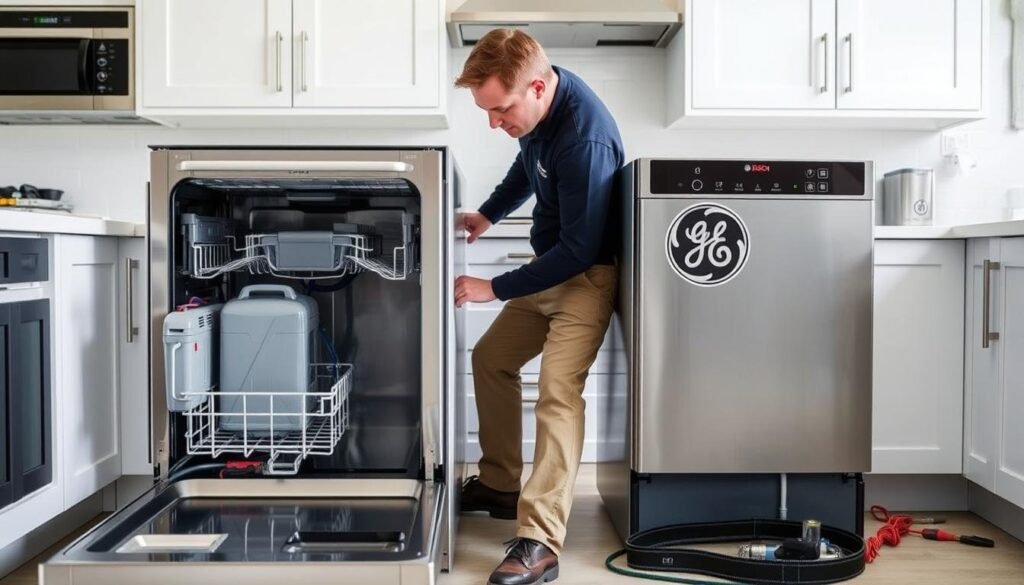
This review examines the PDT715SMNES as a practical household appliance rather than treating its specification sheet as proof of real-world superiority. It explores cleaning technology, drying performance, noise, rack design, energy use, maintenance, reliability considerations, installation, and suitability for buyers in the United States, Canada, and the United Kingdom.
One distinction is essential throughout this review: the PDT715SMNES shares much of its technical platform with related GE Profile dishwashers, but test results from another model should not automatically be treated as direct test results for this exact finish and model number. Where model-specific laboratory evidence is unavailable, the discussion focuses on documented specifications and reasonable ownership considerations rather than inventing performance scores.
1. GE Profile PDT715SMNES: Key Specifications
The PDT715SMNES is a standard-width, under-counter dishwasher with top-mounted controls and a full-length door. Its fingerprint-resistant Slate finish is intended to complement darker kitchen cabinetry, black appliances, and contemporary interior designs. The washing chamber and door liner are stainless steel, while the rack system includes an adjustable upper rack and a removable third-level cutlery tray.
The appliance’s published noise rating is 45 dBA. Its electrical specification is 120 volts at 60 hertz, with a listed current rating of 6.6 amps. Those electrical details are particularly important when considering the appliance outside its intended North American market.
| Specification | PDT715SMNES details |
|---|---|
| Brand | GE Profile |
| Model | PDT715SMNES |
| Appliance type | Built-in dishwasher |
| Exterior finish | Fingerprint-resistant Slate |
| Interior | Stainless-steel tub and door liner |
| Control position | Hidden top controls |
| Published noise rating | 45 dBA |
| Drying system | Dry Boost with fan assistance |
| Wash levels | Three |
| Third rack | Removable |
| Food-residue management | Piranha hard-food disposer and removable filter |
| Special cleaning features | Deep Clean Silverware Jets, bottle jets, Clean Sensor |
| Sanitising option | Yes |
| Connectivity | Optional Wi-Fi accessory |
| Overall width | 23.75 inches (approximately 60.3 cm) |
| Overall height | Approximately 34 inches (86.4 cm) |
| Overall depth | 24 inches (61 cm) |
| Depth including handle | Approximately 25.6 inches (65 cm) |
| Adjustable height range | Approximately 33.375–34.625 inches |
| Electrical supply | 120 V, 60 Hz |
| Production period | August 2019–May 2023 |
These figures are manufacturer-published specifications. Exact dimensions and electrical requirements should be verified against the identification plate and installation documentation supplied with the individual appliance.
The distinction between the cabinet opening and the appliance’s overall dimensions is especially important. A dishwasher that measures approximately 24 inches deep may project farther into the room once its handle and door are considered. Its adjustable height range can also affect whether it fits beneath a particular countertop, especially when flooring has been replaced or built up since the original kitchen installation.
Buyers should also confirm the complete model number. Similar GE Profile dishwashers can share a door shape, rack layout, and many internal components while differing in exterior finish or feature package. The PDT715SMNES should not be confused with the stainless-steel-finish PDT715SYNFS simply because their names are similar.
2. Exterior Design: The Fingerprint-Resistant Slate Finish
The exterior finish is one of the most distinctive features of the PDT715SMNES. Rather than the bright metallic appearance of conventional stainless steel, Slate provides a darker, muted finish that can work well in kitchens with charcoal cabinets, black fixtures, stone worktops, or mixed-metal hardware.
The fingerprint-resistant treatment is intended to make everyday handling marks less conspicuous. This is particularly useful on a dishwasher because the door is opened frequently throughout the day. A household may open it when unloading breakfast dishes, adding mugs during the afternoon, loading cookware after dinner, and checking whether a cycle has finished. Reducing the visibility of fingerprints can make routine cleaning less noticeable and less frequent.
However, fingerprint resistance should not be confused with a surface that never needs cleaning. Grease, dried food, water marks, and scratches can still appear. The finish should be cleaned using methods suitable for the manufacturer’s specified exterior material. Abrasive pads and aggressive cleaners may damage the surface or leave visible marks.
The top-control design contributes to the appliance’s clean appearance. The controls are concealed along the upper edge of the door when it is closed, leaving the front largely uninterrupted. This can make the dishwasher look more integrated with adjacent cabinets and appliances.
There is a practical trade-off. Because the controls are hidden, the selected cycle and its remaining time may not be visible from across the room in the way they are on some front-control models. Buyers who prefer to see the operating status without opening the door should investigate the specific indicators and display functions available on this model.
The handle is another consideration. The manufacturer lists a rounded handle and an overall depth of approximately 25.6 inches with the handle included. That projection matters in a narrow kitchen or where a dishwasher sits opposite an island. Before purchasing a used unit, measure the available walkway and confirm that the open door will not obstruct nearby cabinets or traffic.
Overall, the Slate finish is an aesthetic advantage rather than a performance feature. It is worth paying attention to if the appliance needs to coordinate with an existing kitchen, but cleaning performance, condition, noise, and installation compatibility should remain the primary purchasing criteria.
3. Cleaning Performance: Understanding the Three-Level Wash System
The PDT715SMNES uses a three-level wash arrangement, with lower, middle, and upper wash levels. Its documented features include three wash levels, a Clean Sensor, automatic temperature control, dual pumps and motors, and a spray system advertised with more than 90 spray jets. The purpose of this arrangement is to distribute water across different areas of the dishwasher and accommodate a mixture of dishes, utensils, and cookware.
The benefit of multiple wash levels is that a dishwasher can direct water towards different parts of a load rather than relying on one simple spray pattern. Nevertheless, the number of jets alone does not establish how well a dishwasher cleans. The result depends on water pressure, temperature, detergent distribution, the movement of the spray arms, programme duration, and the degree to which the load blocks the water.
For ordinary family meals, the appliance is designed to handle plates, cups, bowls, glasses, cutlery, and everyday cookware. The Clean Sensor helps the washing system respond to the condition of the load, while automatic temperature control supports the wash process. These features are intended to make routine operation more adaptable than a fixed programme that always behaves identically regardless of the amount of soil present.
Heavy food residue presents a more demanding test. Dried sauce, baked-on cheese, greasy pans, and starch-rich leftovers can require longer exposure to detergent and appropriately heated water. Users should select a suitable intensive or heavy programme when the load requires it rather than expecting a short cycle to provide equivalent results.
A well-designed dishwasher can still produce poor results when it is loaded badly. Plates placed too close together can prevent water from reaching their surfaces. Deep bowls positioned so that they collect water may not drain properly. Tall utensils can obstruct a spray arm, and large pans can shield smaller items behind them. Good loading technique is therefore a significant part of achieving the performance that the appliance is designed to deliver.
The PDT715SMNES also has dedicated silverware jets. This feature is intended to improve washing around cutlery, where utensils can nest together and shield one another from water. It is potentially useful for families who regularly wash a large quantity of forks, spoons, and knives. The practical result will depend on how the cutlery is positioned and whether water can reach the surfaces of each piece.
An important evidence limitation should be made clear. Independent laboratory information is available for the closely related PDT715SYNFS, which received a very good assessment for washing heavily soiled dishes. That supports the general interest in this dishwasher platform, but it is not a direct laboratory score for the PDT715SMNES. The exact model should not be assigned the sibling model’s test rating as though it had been tested separately.
The sensible verdict is that the PDT715SMNES has a substantial and thoughtfully equipped washing system. Its specifications suggest good flexibility for mixed household loads, but the exact cleaning outcome depends on programme selection, loading, detergent, water conditions, and maintenance.
4. Dry Boost with Fan Assistance: A Major Selling Point
Drying is one of the PDT715SMNES’s most important advertised features. Its Dry Boost system includes fan assistance intended to remove moist air and improve drying, particularly for items that are difficult to dry using conventional heated drying alone.
This matters because different materials behave differently at the end of a wash cycle. Glass and ceramic plates can retain heat and release moisture relatively effectively, whereas lightweight plastic containers may cool quickly and hold water droplets on their surfaces. Lids, recessed handles, and containers with raised edges can also retain water even when the dishwasher has cleaned them successfully.
The manufacturer states that Dry Boost with fan assistance can make hard-to-dry items such as plastics up to three times drier than heated-dry cycles. This is a manufacturer claim under its specified comparison conditions, not a guarantee that every load will be completely dry or that every plastic item will show the same improvement.
The fan-assisted approach is useful because it addresses moisture removal rather than relying exclusively on the heat retained by the dishes. Even so, drying performance will vary according to the selected cycle, how the dishes are arranged, the shape of each item, and whether water can drain freely from its surfaces.
Loading technique remains important. Cups should be placed at an angle that allows water to run off. Bowls should not be arranged so that their bases collect puddles. Plastic containers should be positioned securely and spaced so that moisture can escape. Items with deep recesses may still need a brief shake or hand-dry after the cycle.
Rinse aid is another useful consideration. It helps water drain more effectively from suitable surfaces and can reduce visible droplets and spotting. If the dishwasher repeatedly leaves water marks on glassware, check the rinse-aid supply and the recommended setting before assuming that the drying system has failed.
The distinction between cleaning and drying is also worth remembering. Dishes can be perfectly clean while remaining slightly damp. Conversely, a dry-looking plate is not proof that it has been cleaned effectively. Each outcome should be evaluated separately.
For households that wash a lot of plastic lunch containers, reusable lids, and lightweight storage boxes, Dry Boost with fan assistance is a meaningful feature. Buyers should still compare the PDT715SMNES with newer appliances if consistently dry plastics are a high priority, because drying technology and programme design can differ significantly between models.
5. Noise Performance: Is 45 dBA Quiet?
The PDT715SMNES has a published noise rating of 45 dBA. This is a relatively quiet specification for a built-in dishwasher and should appeal to households where the kitchen opens into a dining room, living room, or shared family space.
Noise matters more than it might initially seem. A dishwasher can run for a substantial portion of the evening, when people are watching television, talking, working from home, or putting children to bed. A quieter appliance is less likely to become a noticeable part of those activities.
The machine includes several quiet-oriented design features, including insulation and a quiet water valve. However, the 45 dBA rating does not mean that it is silent. Users may still hear water entering the machine, the circulation system operating, the drain pump running, and dishes making contact with one another.
The sound perceived in a real kitchen also depends on the installation. An appliance that is not level or properly secured can transmit vibration to surrounding cabinets. A drain hose touching a cabinet panel can create rattling, while loosely positioned dishes can knock together during washing. Such sounds should not automatically be interpreted as a design defect.
When comparing the PDT715SMNES with other dishwashers, buyers should look at the published noise figures for the exact models being considered. A lower numerical rating may be attractive, but the sound character and the way the appliance is installed can also affect the experience.
The available independent noise-testing evidence for the related PDT715SYNFS is encouraging, but that is not a model-specific laboratory result for the PDT715SMNES. The latter’s documented 45 dBA rating remains a useful basis for comparison without overstating the evidence.
For most households that value quiet operation, the PDT715SMNES looks appealing on paper. Its noise specification is one of its strongest practical advantages, provided the machine is installed correctly and the buyer understands that quiet operation is not the same as complete silence.