
The GE Profile PDT715SBNTS is a built-in dishwasher designed for homeowners who want a combination of modern styling, flexible loading, quiet operation, and enhanced drying performance. Part of GE Appliances’ Profile range, this model combines a stainless-steel interior, concealed top-mounted controls, a third rack, specialised silverware jets, a hard-food disposal system, and fan-assisted drying. It was manufactured from August 2019 through June 2023, making it a discontinued model that prospective buyers are now more likely to encounter through remaining inventory, clearance offers, or the second-hand market.
At first glance, the PDT715SBNTS appears to offer many of the conveniences associated with premium dishwashers without relying entirely on sophisticated connected features. Its emphasis is on everyday practicality: fitting more utensils into each load, cleaning cutlery thoroughly, handling ordinary food residue, and helping dishes emerge dry enough to put away. GE’s published specifications establish a solid foundation, but independent testing of a closely related model reveals important limitations that buyers should understand before paying a premium price.
The central question is whether the PDT715SBNTS delivers sufficiently consistent cleaning and drying to justify its original premium positioning. The answer depends on the type of food residue you typically wash, your expectations for drying plastics, the price available today, and whether you can obtain dependable local service. It is also important to recognize that this is principally a North American appliance, not a straightforward replacement for a standard British dishwasher.
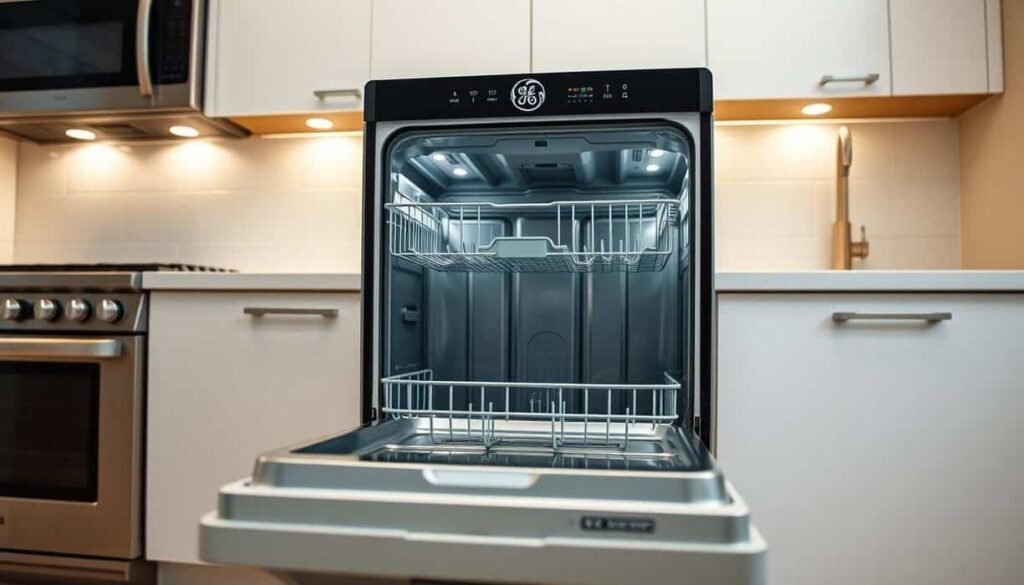
1. GE Profile PDT715SBNTS: Key Specifications
The PDT715SBNTS is a conventional built-in dishwasher with a 24-inch-class installation footprint, concealed controls, a stainless-steel interior, and a range of specialised washing features. GE positions it as a premium everyday appliance rather than a basic dishwasher with only a handful of wash programmes.
Its headline features include Dry Boost with Fan Assist, Steam + Sani, a removable filtration system, the Piranha hard-food disposer, a third rack, and Deep Clean Silverware Jets. These features address different problems: drying difficult items, loosening stubborn soil, managing food particles, expanding loading capacity, and directing water toward cutlery.
The following table summarises the main specifications and features documented for the model and its product family.
| Specification | GE Profile PDT715SBNTS |
|---|---|
| Appliance type | Built-in automatic dishwasher |
| Product range | GE Profile |
| Model status | Discontinued production |
| Production period | August 2019–June 2023 |
| Installation class | Approximately 24-inch |
| Listed dimensions | Approximately 34 in high × 23.75 in wide × 24 in deep |
| Interior | Stainless steel |
| Control placement | Concealed top controls |
| Loading arrangement | Multiple racks, including a third rack |
| Drying system | Dry Boost with fan assistance |
| Special wash feature | Steam + Sani |
| Food-particle handling | Piranha hard-food disposer and filtration |
| Cutlery cleaning | Deep Clean Silverware Jets |
| Energy certification | ENERGY STAR certification documented for the model family |
| Intended market | Primarily the United States and Canada |
Dimensions and certification details should always be confirmed against the exact unit, its rating label, and the installation documentation. The model’s discontinued status also means that an online product page should not be mistaken for proof that a new unit is readily available.
A further distinction matters when reading specifications online: the PDT715SBNTS and PDP715SBNTS are different models. The PDT version has concealed top controls, while the PDP version uses a different front-control arrangement. Reviews of the PDP model can provide useful information about closely related washing hardware, but their findings should not automatically be presented as direct test results for the PDT model.
2. Design and Build Quality
A restrained, contemporary appearance
The GE Profile PDT715SBNTS uses a design that suits modern fitted kitchens. Its controls are positioned along the upper edge of the door, leaving the visible front comparatively uncluttered. This arrangement works particularly well in kitchens where appliances sit alongside flat-front cabinetry, stone worktops, or other stainless-steel finishes.
Concealed controls are not merely a styling decision. They also reduce the amount of information displayed on the front of the appliance and make it less likely that someone will accidentally press a control while passing through the kitchen. However, the arrangement means that users generally need to open the door to select a programme or inspect the control panel.
A status indicator on the door helps communicate whether the machine is washing, drying, or finished. This is useful because a quiet dishwasher can be difficult to judge by sound alone, especially in an open-plan kitchen.
Stainless-steel interior
The stainless-steel tub is another positive feature. A stainless interior is generally desirable in a premium dishwasher because it provides a durable washing chamber and works well with modern condensation and fan-assisted drying arrangements. It also gives the interior a more substantial feel than an all-plastic tub.
Nevertheless, stainless steel should not be treated as proof that every component will last longer. Pumps, seals, electronic controls, spray mechanisms, racks, and inlet valves remain separate components with their own failure risks. Long-term reliability depends on the complete appliance and its maintenance, not just the material used for the tub.
Rack construction and loading flexibility
The rack arrangement is one of the more useful aspects of the PDT715SBNTS. The upper and lower racks are designed to accommodate different kinds of kitchenware, while adjustable or fold-down tines help users create space for larger bowls, plates, and cookware.
This flexibility is valuable in a household that alternates between everyday plates and bulkier items such as serving dishes. Instead of forcing every item into a fixed grid, the user can adjust the layout to suit the load.
The overall design therefore makes a favourable first impression. Its most meaningful advantage is not decorative sophistication, but the combination of concealed controls, a stainless-steel interior, and adaptable loading arrangements.
3. Cleaning Performance: How Well Does It Wash Dishes?
Cleaning performance deserves more scrutiny than the number of features printed on a dishwasher’s specification sheet. A machine can have several spray systems, a filtration assembly, and a specialised heavy-duty programme while still struggling with a particular kind of food residue.
The PDT715SBNTS belongs to a product family with GE’s 700 Series wash system, a soil sensor, multiple wash levels, and a hard-food disposer. These technologies are intended to distribute water effectively, respond to the condition of the load, and manage food particles during a wash.
Everyday plates, cups, and bowls
For routine loads containing ordinary food residue, the design offers several useful advantages. A soil-sensing system can adjust aspects of washing according to the detected condition of the water, while multiple wash levels help direct water throughout the tub. Correct loading is still essential: dishes must not block one another, and the spray arms need enough clearance to rotate freely.
For households that scrape plates after meals rather than leaving thick deposits to dry, this feature set is appropriate for regular daily use. It is reasonable to expect good results on typical mixed loads when the correct cycle, suitable detergent, and proper loading practices are used.
That expectation, however, should not be confused with a claim that every stain will disappear on the Normal cycle. The actual results depend on the food involved, how long it has been sitting on the dishes, the selected programme, and whether spray reaches the affected surface.
The important spinach-test finding
Independent testing of the closely related GE Profile PDP715SBNTS by Reviewed provides an important caution. In its laboratory tests, the publication found that the Normal and one-hour programmes performed very well on several common food soils, including meat, milk, egg, and oatmeal. However, the machine struggled significantly with pureed spinach.
Reviewed reported that the Normal and one-hour cycles removed only about 7% to 22% of the spinach stain in its tests. The Heavy cycle performed substantially better, removing more than 93% of the spinach stain and over 99% of most other tested soils.
This finding is significant because pureed spinach is a challenging residue containing fine particles that can be difficult to remove when the spray pattern does not reach the stain effectively. The result suggests that a machine’s performance can vary considerably according to the type of soil, even when it performs well on other test foods.
There is an important limitation to this evidence: the tested appliance was the PDP715SBNTS, not the exact PDT715SBNTS. Their related design and shared product-family features make the test relevant context, but it is not a direct laboratory score for the top-control model. Buyers should regard it as a warning about a closely related design rather than a definitive measurement of the exact model.
Does the Heavy cycle solve the problem?
The independent test suggests that the Heavy cycle is the better choice when dishes contain difficult residues. This is a useful option for cookware, casserole dishes, and plates with dried or persistent food.
The trade-off is time and potentially greater resource consumption. Heavy-duty programmes commonly use more intensive washing conditions than lighter cycles, so depending on the load and programme settings, the extra cleaning capability may come at the expense of a quicker turnaround.
For most households, this is manageable. A dishwasher does not need to complete every load in the shortest possible time to be useful. However, a premium machine should ideally deliver dependable cleaning across its everyday programmes. If you frequently wash plant-based purees, thick sauces, or stubborn residues, the independent test is a reason to compare alternatives before buying.
Do you need to pre-rinse?
Pre-rinsing is generally unnecessary for modern dishwashers when dishes are loaded properly and the detergent and programme are suitable. GE’s filtration and food-disposal features are intended to manage normal food particles during washing.
Scraping off large food scraps is still sensible. It reduces unnecessary debris in the machine and helps prevent avoidable maintenance issues. Extremely thick, dried-on food may need a more intensive cycle, but routinely rinsing every plate under running water defeats some of the convenience and water-saving benefits of using a dishwasher.
The practical verdict on cleaning is therefore mixed but not unfavourable: the PDT715SBNTS has a substantial feature set for everyday washing, while the closely related model’s laboratory results show why difficult stains and programme selection deserve attention.
4. Drying Performance: The Role of Dry Boost With Fan Assist
Drying is one of the PDT715SBNTS’s principal selling points. GE’s Dry Boost with Fan Assist is designed to improve the drying of items that tend to retain water, particularly plastic containers and other hard-to-dry pieces.
Traditional dishwasher drying often relies heavily on the heat retained by dishes after the final rinse. Water evaporates from warm surfaces and may condense on cooler parts of the machine. Plastic items can be more troublesome because they do not retain heat in the same way as ceramic plates and glassware.
How fan-assisted drying helps
The fan-assisted system helps remove moist air from the dishwasher during the drying process. By managing moisture more actively, it is intended to improve results compared with relying on residual heat alone.
GE markets this system as capable of making difficult-to-dry items up to three times drier than heated-dry cycles. This is a manufacturer claim, not a guarantee that every plastic container will emerge completely dry in every load. The actual result can depend on how the items are positioned, the amount of water trapped in their shapes, the selected options, and the ambient conditions.
What to expect from plastics
Plastic lunch boxes, food-storage lids, measuring cups, and lightweight containers are common sources of frustration for dishwasher owners. Water can collect in recessed surfaces, rims, and upturned bases. The PDT715SBNTS’s drying technology is specifically intended to help with these problems.
It is reasonable to regard fan assistance as a meaningful advantage, but users should still load plastics at an angle where possible and avoid creating pockets that trap water. Containers placed upright with deep bases facing upward may retain water regardless of the drying system.
Glassware, ceramic plates, and cutlery
Glass and ceramic items generally retain heat better than plastics, so they may benefit from the drying process without requiring as much additional help. Cutlery can also dry well when positioned correctly, although spoons nested together or utensils with deep handles may retain droplets.
Rinse aid is important because it helps water drain from surfaces rather than forming persistent droplets. It can improve drying and reduce visible spotting, especially where local water is hard.
Is it a substitute for premium mineral drying?
No. Fan-assisted drying is a distinct approach from systems that use specialised minerals or other mechanisms to absorb moisture and release heat. A buyer comparing this GE model with a higher-priced competitor should assess the exact drying technology of each model rather than assuming that all advanced drying systems work identically.
Overall, Dry Boost with Fan Assist is a credible practical feature. Its value is greatest for households that regularly wash plastics and want to reduce the amount of hand-drying required after a cycle.
5. Steam + Sani: Cleaning and Sanitisation
The PDT715SBNTS includes GE’s Steam + Sani feature, which combines a steam-assisted approach to loosening difficult soil with a sanitisation option.
The steam stage is intended to help soften stubborn residue before the main wash, potentially reducing the need for soaking or extensive manual scrubbing. This can be particularly useful for cookware and dishes with dried-on food, although it should not be interpreted as a guarantee that heavily burnt or baked-on residue will always disappear without intervention.
The sanitisation function serves a different purpose. GE states that the sanitisation cycle reduces 99.999% of bacteria on dishes under the specified test conditions. That is a manufacturer performance claim tied to the appliance’s sanitisation process; it should not be taken to mean that every load is sterile or that the machine eliminates every type of microorganism under all circumstances.
For families, this option may be useful when washing items that benefit from a sanitising wash, provided the items themselves are dishwasher-safe. It may also appeal to households that want an additional sanitisation option rather than relying exclusively on a standard everyday cycle.
The important point is to distinguish sanitisation from ordinary cleaning. A dish can look clean without having undergone a validated sanitising process, while a sanitising option still requires the machine to be loaded correctly and used according to the manufacturer’s instructions.
Users should also avoid putting delicate items into a high-temperature programme unless the item’s care instructions permit it. Wooden utensils, certain plastics, delicate glassware, and items with special coatings may not tolerate every programme.
6. Piranha Hard-Food Disposer and Removable Filtration
Food-particle management is another notable feature of the PDT715SBNTS. GE equips this product family with a Piranha hard-food disposer and a filtration system designed to handle food debris during the wash.
The disposer helps break down suitable food particles, while filtration captures material circulating through the washing system. Together, these features are intended to support cleaning and reduce the burden of handling ordinary food residue manually.
Why food-particle management matters
Dishwasher water is recirculated throughout the programme. If food particles are not managed effectively, they can interfere with the washing process or contribute to residue being redeposited on dishes. Filtration helps manage this problem by separating debris from the water used during washing.
A disposer does not mean the dishwasher is maintenance-free. Fibrous food, labels, bones, seeds, and other unsuitable debris should not be treated as harmless simply because the machine has a hard-food disposal system. Large scraps should still be removed before loading.
Does it eliminate filter cleaning?
No. The PDT715SBNTS has a removable filtration arrangement, and owners should follow the manual’s cleaning and inspection instructions. The exact frequency will depend on how heavily the dishwasher is used and what goes into it.
Regularly checking the filter, spray arms, and accessible areas for debris can help maintain performance. If the machine begins leaving grit on dishes, developing unpleasant smells, or draining poorly, food accumulation is one of several possible causes worth investigating.
The combination of a disposer and filtration is useful because it reduces some of the routine work associated with food particles. Its long-term benefit still depends on sensible loading and basic maintenance.
7. Third Rack and Loading Capacity
The third rack is one of the most immediately useful design features for households that wash a mixture of plates, mugs, utensils, and cookware.
Rather than reserving all the lower and upper rack space for cutlery and small utensils, a third rack provides a separate location for selected flat items. Depending on the item’s shape and the available clearance, it can accommodate spatulas, lids, serving utensils, and additional cutlery.
Why the third rack matters
A conventional cutlery basket can occupy valuable space in the lower rack. Moving suitable utensils to a third rack creates more room for plates and cookware, which can help reduce the number of loads required.
It can also make unloading more organised. Cutlery and small utensils are easier to separate and retrieve when they are arranged across a dedicated surface rather than crowded together in a basket.
The benefits are not unlimited, however. A third rack is not automatically suitable for every kitchen utensil, and bulky items can interfere with the clearance needed for the rack above or below. Users should check that the upper spray system is not obstructed after loading.
Adjustable racks and fold-down tines
Adjustable racks and fold-down tines are useful for awkward items. A standard arrangement may be ideal for everyday dinner plates but less suitable for mixing bowls, wide serving dishes, or tall cookware.
By adjusting the tines and placing items carefully, users can create a layout that better matches each load. This is particularly useful in family kitchens, where the contents of the dishwasher vary from one meal to the next.
Is the capacity suitable for a family?
The machine’s 24-inch-class footprint is conventional for a North American full-size built-in dishwasher. That makes it suitable in principle for many family kitchens, couples who cook frequently, and households that regularly use reusable food containers.
Actual capacity depends on the shapes and sizes of the dishes rather than a single headline number. Tall glasses, large plates, deep bowls, and oversized cookware can all affect how much fits into one load.
For the best results, users should arrange dishes so that water can reach the surfaces and should avoid nesting bowls or overlapping plates. A dishwasher that is packed beyond its practical capacity may use the same cycle but produce worse results.
8. Noise Levels and Everyday Comfort
Noise matters more than many buyers expect, particularly when the kitchen opens into a dining or living area. A loud dishwasher can become intrusive during conversation, evening television, or work from home.
The PDT715SBNTS has a design intended for modern domestic use, but the model-specific sound rating should be checked on the manufacturer’s specifications for the exact appliance. A reliable decibel figure should not be inferred from another GE Profile model or from a product listing that describes the entire range.
Independent testing of the closely related PDP715SBNTS describes owners as generally appreciating its quiet operation. Consumer Reports’ testing of the related PDT715SYNFS also rated noise performance very good. These are encouraging family-level indicators, but neither finding is a direct acoustic measurement of the PDT715SBNTS.
In practical terms, the dishwasher’s concealed controls and door status indicator are convenient in an open kitchen, where sound alone may not tell you whether the cycle has finished. Noise perception also depends on installation quality, the level of the floor, cabinet fit, plumbing, and whether dishes or utensils vibrate against one another.
If low noise is a priority, confirm the exact model’s sound specification and compare it with competing machines tested under the same conditions. A difference in a published decibel figure can matter, but a properly installed appliance may also sound different from one that has been fitted poorly.
9. Energy Efficiency and Water Consumption
Energy and water use should be considered alongside purchase price. A dishwasher is used repeatedly over many years, so even modest differences in resource consumption can add up.
GE’s historical product catalogue lists the PDT715SBNTS product family at approximately 270 kWh of annual energy use and 3.5 US gallons of water per Normal cycle under the catalogue’s stated specifications. These are historical figures, not a prediction of what every owner will use in a year. Actual consumption varies according to cycle selection, load frequency, options, incoming water temperature, and household habits.
The dishwasher’s ENERGY STAR certification is a positive point, but certification criteria and testing methods change over time. ENERGY STAR’s current standard-size dishwasher criteria, effective from July 2023, set maximum annual energy use of 240 kWh and maximum water use of 3.2 US gallons per cycle. Those current limits should not be retroactively substituted for the model’s older published figures.
This distinction matters when comparing an older dishwasher with a newer certified machine. A product can have been certified under the rules applicable at the time while newer standards impose different thresholds. Buyers should check the exact model entry and its energy label rather than relying on the ENERGY STAR logo alone.
How much might it cost to run?
A meaningful running-cost estimate requires the local electricity tariff and a realistic estimate of annual consumption. For example, if a household uses 270 kWh per year and electricity costs $0.20 per kWh, the electricity component would be approximately $54 annually.
That calculation is illustrative rather than a universal estimate. Electricity rates vary widely between US states, Canadian provinces, and UK suppliers. The total cost of operation may also include the water supply, wastewater charges, detergent, rinse aid, and maintenance.
For a more useful comparison, use the energy label or official product data for the exact dishwasher being considered and apply your own utility rates. A newer dishwasher with lower consumption may offer long-term savings, but those savings should be compared with the difference in purchase price.
How to reduce consumption
The most practical measures are straightforward:
- Run full loads whenever possible without overcrowding the racks.
- Scrape food off plates rather than routinely rinsing every item under running water.
- Use a suitable cycle for the soil level instead of automatically selecting the most intensive programme.
- Keep filters and spray arms clean.
- Use detergent and rinse aid according to the manufacturer’s instructions.
- Avoid adding intensive drying options unnecessarily when the dishes do not need them.
The PDT715SBNTS offers useful efficiency features, but its age means that current alternatives deserve a direct comparison before a purchase decision is made.
10. Controls, Programmes, and Ease of Use
The concealed control panel provides a clean exterior while retaining access to the dishwasher’s main functions. The model’s documented feature set includes ordinary washing options, a one-hour programme, a heavy-duty wash, Steam + Sani, and drying options.
The availability and exact combinations of settings should be verified in the manual supplied for the individual appliance. Not every cycle necessarily supports every additional option, and the time taken by a programme can change when extra washing or drying features are selected.
The one-hour wash option
A one-hour wash is useful when the household needs a quicker turnaround for moderately soiled dishes. It is particularly convenient when the dishwasher must be emptied and reloaded more than once during a busy day.
A shorter cycle should not automatically be expected to match the performance of a longer intensive programme on dried-on food. Its suitability depends on the type of residue and the degree of soiling.
Soil sensing and automatic adjustments
Soil sensing helps the dishwasher respond to the condition of the wash water. This can improve the balance between cleaning and resource consumption by adjusting aspects of the cycle as needed.
It is not a substitute for choosing an appropriate programme in every situation. A heavily soiled load may still benefit from a dedicated intensive cycle, and loading mistakes can prevent the machine from delivering the intended results.
A straightforward ownership experience
The machine’s overall approach is conventional enough for most users to understand without extensive setup. The most important learning points involve rack arrangement, detergent use, selecting the right cycle, and keeping the filtration system clean.
For buyers who do not want to depend on a smartphone application to operate a dishwasher, the physical controls and standard wash options are practical advantages. Connected features should not be assumed merely because other GE Profile models offer them; confirm the exact capabilities of the PDT715SBNTS before buying.
11. Reliability, Maintenance, and Long-Term Ownership
Reliability is difficult to assess from a product specification sheet. A stainless-steel tub and a broad feature set can indicate a well-equipped machine, but neither establishes the expected service life of the appliance.
The PDT715SBNTS was manufactured from August 2019 through June 2023, according to GE’s support documentation. In 2026, that makes age and condition particularly important for anyone considering a used unit or old stock. A machine that has been sitting in a warehouse for years is not equivalent to a newly released model, and a used dishwasher’s history may be incomplete.
What to inspect before buying
For a used unit, inspect the interior for corrosion, damage, or unusual deposits. Examine the racks and tine coatings for wear, check the door seals, and look for evidence of leaks or previous repairs. If possible, ask the seller to demonstrate a complete operating cycle or provide credible service records.
Pay attention to the condition of the drain system, filter, spray arms, door latch, and electronic controls. These components are important to day-to-day performance, and repairs may become less attractive if the purchase price is already close to that of a newer machine.
Routine maintenance
Owners should follow GE’s official maintenance instructions for filter cleaning, spray-arm inspection, detergent use, and cleaning the interior. They should also avoid using unsuitable chemicals or abrasive tools that could damage finishes and seals.
If dishes remain dirty, first check loading, spray-arm movement, detergent suitability, filter condition, and programme selection. Poor cleaning can have several causes, so replacing parts without diagnosis is not always the best approach.
Warranty considerations
GE’s official product support page provides the model’s owner documentation and service resources. Warranty coverage depends on the original terms, purchase date, country, and any applicable seller or extended-warranty arrangements.
A second-hand buyer should not assume that the original warranty transfers or remains valid. Before purchasing, obtain written confirmation of any remaining coverage and check whether authorised service is available in the buyer’s area.
The best ownership proposition is therefore a well-maintained machine at a sensible price, supported by available parts and competent local repair service. A premium model with uncertain condition and no practical service support can quickly become an expensive gamble.
12. Installation Requirements and Compatibility
The PDT715SBNTS is designed around a North American installation format. GE lists its dimensions at approximately 34 inches high, 23.75 inches wide, and 24 inches deep. These measurements provide a useful starting point, but installation should be planned using the official installation instructions, including the required clearances and connections.
Before buying, measure the available opening rather than assuming that every appliance described as 24 inches wide will fit identically. Check the height adjustment range, depth behind the cabinetry, door clearance, water supply, drainage route, and electrical connection.
United States
For a US installation, the model’s intended market and standard built-in format make it a natural candidate for a compatible kitchen opening. The installer should still confirm the required electrical circuit, grounding, water connection, and drain arrangement using the appliance documentation and local code requirements.
Canada
The model family is also associated with the Canadian market. Buyers should nevertheless verify the precise model’s availability, electrical rating, installation instructions, warranty, and service coverage with the retailer or manufacturer in their province.
Canada’s geography and service networks make local support especially important when purchasing discontinued appliances. A model that is available only through an out-of-province seller may not be as convenient to service as a currently stocked alternative.
United Kingdom
The UK requires particular caution. The PDT715SBNTS is a North American dishwasher, and its published electrical rating is based on a 120-volt, 60-hertz supply. Standard UK domestic mains electricity is approximately 230 volts at 50 hertz.
This is not a straightforward plug-and-play appliance for a typical UK kitchen. A simple plug adapter does not convert the supply voltage or frequency, and using an unsuitable transformer or improvised installation can create safety, compatibility, and warranty problems. The dishwasher should not be connected to UK mains unless a qualified professional has established that a compliant installation is technically appropriate.
There is also the question of service support, spare parts, installation standards, and warranty validity. Even if the appliance could be installed through a properly engineered arrangement, those practical considerations may make a dishwasher designed for the UK market a much better purchase.
For UK readers, the PDT715SBNTS is best treated as a product for technical comparison rather than a normal domestic purchase recommendation. A comparable 60 cm dishwasher rated for UK electrical supply is usually the more sensible option.
13. Price and Value for Money
Value depends on what you pay, what condition the appliance is in, and how its performance compares with currently available alternatives.
At its original premium positioning, the PDT715SBNTS offers a convincing set of convenience features. The third rack, stainless-steel interior, specialised cutlery jets, fan-assisted drying, and sanitisation option all have practical applications. However, independent testing of the closely related PDP715SBNTS raised concerns about difficult stains on everyday cycles.
Reviewed’s assessment of that related model concluded that its performance was difficult to justify at a high price and suggested it became more attractive at a substantial discount. That recommendation was based on the PDP model and prices at the time of testing, so its original price threshold should not be treated as a current 2026 valuation for the PDT715SBNTS.
A sensible buyer should compare the total installed cost against newer dishwashers with independently tested cleaning performance, suitable drying technology, a clear warranty, and local service support. The cost of delivery, installation, removal of the old appliance, and any required plumbing or electrical work can materially affect the final decision.
For a used unit, the discount should reflect the age, condition, unknown service history, and remaining expected useful life. A small saving on a discontinued dishwasher is rarely compelling if a newer model offers stronger documented performance and a full warranty.
The PDT715SBNTS is most appealing when it is offered at a genuinely competitive price, has been checked carefully, and can be serviced locally. It is less attractive when the seller charges a premium simply because the appliance originally belonged to GE’s Profile range.
14. GE Profile PDT715SBNTS: Pros and Cons
Pros
- Useful third rack: Creates additional space for cutlery and suitable utensils, helping free the main racks for dishes.
- Stainless-steel interior: Gives the machine a durable, premium-style washing chamber.
- Fan-assisted drying: Targets the moisture problems associated with plastics and other difficult-to-dry items.
- Steam + Sani option: Provides an additional approach to loosening difficult soil and sanitising suitable dishes.
- Specialised cutlery washing: Deep Clean Silverware Jets are designed to improve water delivery to the silverware basket.
- Hard-food management: The Piranha disposer and removable filtration system help handle food particles.
- Concealed controls: Create a clean front appearance that works well in contemporary kitchens.
- Flexible loading: Adjustable rack features can make room for a variety of dish shapes and cookware.
Cons
- Discontinued model: Production ended in 2023, so availability, parts, and service should be checked carefully.
- Uncertain value at premium prices: Older inventory should be compared with newer dishwashers before purchase.
- Related-model cleaning concerns: Independent testing of the PDP715SBNTS identified weak performance on pureed spinach in the Normal and one-hour programmes.
- No guarantee of completely dry plastics: Fan assistance improves drying but cannot eliminate every trapped water droplet.
- Routine maintenance remains necessary: The filter and accessible washing components still need care.
- Regional limitations: The North American electrical design makes it unsuitable as a straightforward UK domestic installation.
- Model confusion: Reviews of the PDP and other PDT variants do not necessarily describe the exact performance or features of the PDT715SBNTS.
- Warranty uncertainty for used units: Coverage must be verified rather than assumed.
15. How Does It Compare With Other Dishwashers?
A fair comparison should focus on the features that affect daily ownership rather than counting how many functions each product advertises.
GE Profile PDT715SBNTS versus the GE Profile PDP715SBNTS
These models belong to a closely related family and share important features, including the general wash-system design and fan-assisted drying. The most immediately visible distinction is the control arrangement: the PDT model uses concealed top controls, whereas the PDP model uses a different front-control layout.
The distinction matters because the independent laboratory review often cited in discussions of this family tested the PDP715SBNTS. Its findings are useful context for evaluating the family, but they should not be described as a direct test of the PDT715SBNTS.
Buyers should compare the exact model numbers, not just the product photographs or the shared Profile branding.
GE Profile versus Bosch 800 Series
The Bosch 800 Series is a relevant competitor for buyers who prioritise premium drying technology and cleaning performance. Some Bosch 800 models use specialised drying systems that differ from GE’s fan-assisted approach.
However, the 800 Series is a product family rather than a single specification. Noise levels, rack design, drying method, capacity, and pricing vary by model and market. Buyers should compare the specific Bosch model against the exact GE unit using reliable test results and local service information.
The key question is not whether one brand is universally better. It is whether the specific machine performs well on the types of dishes you wash, dries items to your satisfaction, and offers acceptable ownership costs.
Older GE Profile versus a current-generation dishwasher
A newer dishwasher may offer revised wash programmes, updated efficiency figures, improved rack arrangements, or a more comprehensive warranty. On the other hand, an older premium machine can still make sense when it is in excellent condition and heavily discounted.
A useful comparison should include independently tested washing and drying performance, annual energy use, water consumption, installation cost, noise rating, warranty, and the availability of replacement parts. A newer model is not automatically superior in every category, but a discontinued appliance should have a clear price advantage to compensate for its age.
16. Who Should Buy the GE Profile PDT715SBNTS?
The PDT715SBNTS may suit a buyer who wants a conventional full-size dishwasher with useful rack flexibility, a stainless-steel interior, and fan-assisted drying. Its third rack and specialised cutlery jets are particularly relevant to households that wash a variety of utensils and dishes.
It may also suit a buyer who finds a well-maintained unit at a substantial discount and has access to local servicing. In that situation, its feature set can still provide practical value despite the model’s age.
However, buyers who regularly wash difficult food residues should pay attention to the independent findings on the related PDP model. Those results do not establish that the PDT model will perform identically, but they do justify looking for direct evidence of cleaning performance before spending premium money.
For a UK household, the recommendation is different: this is not a straightforward appliance for standard UK electrical installation. A dishwasher designed for the local market is generally the safer and more practical choice.
17. Final Verdict: Is the GE Profile PDT715SBNTS Worth Buying?
The GE Profile PDT715SBNTS is a feature-rich dishwasher with a practical combination of flexible loading, specialised cutlery washing, food-particle management, a sanitisation option, and fan-assisted drying. Its design remains appealing for households that want more than the basics without making smartphone connectivity the centre of the ownership experience.
Its weaknesses are chiefly about value, age, and the need to interpret cleaning-performance evidence carefully. Independent testing of the closely related PDP715SBNTS showed that the Normal and one-hour cycles could struggle with pureed spinach, even though they handled several other common food soils very well. That finding is a meaningful caution, but it is not a direct test result for the PDT715SBNTS.
The model’s discontinued status also changes the buying calculation. Availability, warranty coverage, parts, service access, and the condition of the individual unit may matter more than the original retail specification. A well-priced machine with verified condition may still be worth considering, while an expensive used example offers less compelling value.
Overall recommendation: The GE Profile PDT715SBNTS is worth considering for a North American buyer who values its rack design and drying features, can verify the exact unit’s condition, and can obtain it at a competitive price. It is not an automatic recommendation at a premium price, and buyers who prioritise consistently strong performance on difficult stains should compare it with current independently tested alternatives. In the UK, a locally rated dishwasher designed for the country’s electrical supply is generally the more appropriate choice.