
The GE Profile PDT715SYNFS is a built-in, top-control dishwasher designed for households that want dependable cleaning, a relatively quiet kitchen, flexible loading, and a stainless-steel finish without moving into the most expensive premium appliance category. Its main attractions include a stainless-steel interior, a third-level cutlery rack, a fingerprint-resistant exterior, a dedicated sanitising option, Dry Boost drying technology, and a noise rating of 45 decibels. These features make it an interesting option for busy family kitchens, open-plan living spaces, and households that regularly wash mixed loads of plates, glasses, cutlery, and cookware. However, its strengths need to be considered alongside its longer wash cycles, installation requirements, and discontinued-product status.
The first important consideration is that the PDT715SYNFS is no longer manufactured. Its documented production period ran from August 2019 to June 2023, meaning that buyers researching it in 2026 will generally be considering remaining stock, a used appliance, a refurbished unit, or an installation that already exists in their home. This does not automatically make it a poor purchase, but it changes the buying decision: condition, warranty coverage, replacement-part availability, and the price compared with newer models become just as important as its original feature list.
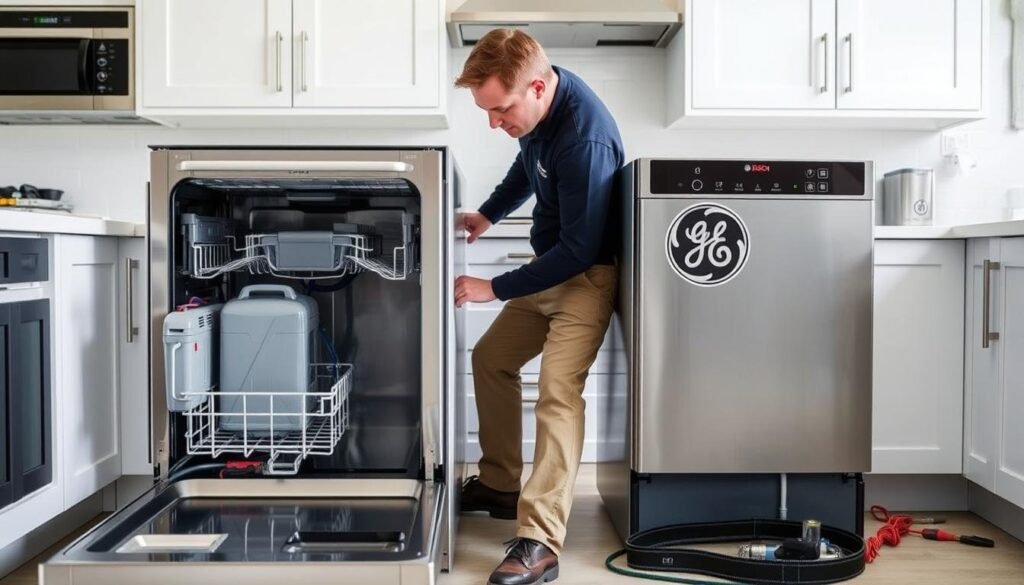
This review evaluates the dishwasher as a real-world ownership proposition rather than simply repeating its advertised specifications. It examines its cleaning ability, drying system, noise, rack design, energy considerations, maintenance needs, potential drawbacks, and suitability for different household sizes. It also addresses an especially important issue for international readers: the PDT715SYNFS is a North American electrical appliance, so its suitability for a kitchen in the United Kingdom cannot be assumed merely because its physical dimensions appear convenient.
1. GE Profile PDT715SYNFS: Key Specifications
The PDT715SYNFS belongs to GE Profile’s built-in dishwasher range. It combines a conventional under-counter installation with hidden top-mounted controls, a full-length door, and a fingerprint-resistant stainless-steel exterior. Its overall dimensions are approximately 34 inches high, 23.75 inches wide, and 24 inches deep, although the installation opening, levelling range, handle projection, and door clearance must be checked separately before fitting. The manufacturer lists its quiet package at 45 dBA and identifies the appliance as ENERGY STAR qualified.
The following table summarises the principal details relevant to buyers. These figures describe the North American model and should be checked against the rating plate and installation documents for any individual appliance being considered.
| Specification | Details |
|---|---|
| Brand and range | GE Profile |
| Model number | PDT715SYNFS |
| Appliance type | Built-in dishwasher |
| Control position | Top-mounted, hidden when the door is closed |
| Exterior | Fingerprint-resistant stainless steel |
| Interior | Stainless steel |
| Overall width | Approximately 23.75 inches (60.3 cm) |
| Overall height | Approximately 34 inches (86.4 cm) |
| Overall depth | Approximately 24 inches (61 cm), excluding additional handle projection |
| Published noise rating | 45 dBA |
| Drying technology | Dry Boost |
| Sanitising option | Yes |
| Cutlery storage | Removable third rack |
| Energy certification | ENERGY STAR qualified |
| Electrical supply | 120 V AC, 60 Hz |
| Production status | Discontinued; manufactured August 2019–June 2023 |
A useful distinction is that overall appliance dimensions are not identical to the dimensions of the cabinet opening needed for installation. The available height can be affected by flooring, adjustable feet, and the underside of the worktop, while the depth calculation must account for the door, handle, hoses, and electrical connection. A dishwasher can be nominally 24 inches deep yet still be unsuitable for a particular kitchen if the available space behind it is restricted.
The model number also matters. GE has produced several visually similar Profile dishwashers, including variants with different handles, drying systems, noise ratings, and feature packages. Specifications from a related model should not be transferred to the PDT715SYNFS without confirmation. When buying used or comparing replacement parts, verify the complete model number on the appliance identification label rather than relying on a retailer’s shortened product title.
2. Design and Exterior Finish
One of the PDT715SYNFS’s strongest design features is its restrained appearance. The stainless-steel exterior works with many contemporary kitchen styles, including kitchens with stainless-steel ovens, refrigerators, and sinks. The fingerprint-resistant treatment is intended to reduce the appearance of smudges and everyday handling marks, which can make the appliance easier to maintain visually in a busy household. It does not make the surface immune to fingerprints, grease, water spots, or scratches, so occasional cleaning is still necessary.
The top-control layout is another practical advantage. Rather than displaying a row of buttons across the front of the door, the controls sit along the upper edge and become visible when the dishwasher is opened. This gives the front a cleaner, more integrated appearance and can be preferable in kitchens where appliances share a consistent, minimalist design. The trade-off is that the selected programme and remaining time are not necessarily visible from across the room when the door is closed.
The handle is a full-length external design rather than a completely handleless push-to-open arrangement. This gives users a clear point to grip when opening the door, although the handle’s projection should be included in cabinetry and walkway measurements. In compact kitchens, even a small difference in door projection can affect access to nearby drawers, islands, or cabinets when the dishwasher is open.
Inside, the stainless-steel tub offers a durable, non-porous washing chamber that is designed for repeated exposure to hot water, detergent, and food residues. Stainless steel is a useful feature in a dishwasher expected to last for years, but the presence of a stainless-steel interior alone does not guarantee superior drying, quiet operation, or long-term electronic reliability. Those outcomes depend on the complete appliance design, installation, maintenance, and use.
Overall, the design is functional rather than experimental. Buyers who prioritise a conventional stainless-steel finish, hidden controls, and an integrated appearance should find the styling appealing. Those seeking a fully flush, handleless design or a highly visible cycle countdown should compare the physical layout carefully with their kitchen requirements.
3. Cleaning Performance: One of Its Strongest Features
Cleaning is the most important test for any dishwasher, and the PDT715SYNFS has encouraging independent test results. Laboratory testing has rated its performance very good when washing heavily soiled dishes. That matters because cleaning dried food, sauce residue, grease, and everyday meal remains is a more demanding task than washing lightly used plates that have already been rinsed. The test results suggest that this model’s cleaning system can perform well when the load and programme are appropriate.
Its cleaning performance should nevertheless be understood in context. A laboratory result does not mean every load will emerge spotless regardless of how the dishwasher is packed. Water must reach the surfaces of the dishes, detergent must dissolve and circulate properly, and the selected cycle must provide sufficient time and temperature for the soil present. Deep bowls placed together, overlapping plates, or a tall item obstructing a spray arm can undermine the performance of an otherwise capable machine.
For everyday family use, the dishwasher’s combination of multiple wash levels and a dedicated heavy-wash programme gives it flexibility. Lightly soiled breakfast dishes do not necessarily require the same treatment as roasting trays, casserole dishes, or plates carrying dried-on dinner residue. Selecting the appropriate cycle is therefore more useful than automatically choosing the shortest programme for every load. The available cycle names and options should be confirmed in the model’s own use-and-care documentation.
The dishwasher is also equipped with a sanitizing option. This is useful when a load requires a designated high-temperature sanitizing treatment, but sanitizing should not be confused with ordinary cleaning. Removing visible soil is one objective; achieving the specified sanitizing conditions is another. The result depends on selecting the appropriate option, loading the machine correctly, and completing the cycle without interruption. Users should consult the appliance instructions for the intended use and conditions of the sanitizing programme.
A further consideration is detergent selection. Modern dishwashers generally benefit from detergent formulated for automatic dishwashing, and the amount required can vary with water hardness, the product used, and the degree of soiling. Excess detergent is not necessarily better: it can contribute to residue or poor results under some conditions. Following the detergent instructions and the dishwasher’s recommendations is a sensible starting point.
The practical verdict on cleaning is positive. Independent test results provide stronger support for this model than marketing language alone, particularly for heavily soiled dishes. The main qualification is that performance depends on sensible loading, suitable cycle selection, detergent, water conditions, and regular care. Buyers should not interpret a strong cleaning rating as proof that every item, especially tightly packed cookware or awkwardly shaped containers, will always come out perfectly clean.
4. Drying Performance: What Dry Boost Can and Cannot Do
Drying is an important part of the PDT715SYNFS’s appeal. The model features Dry Boost, a system designed to improve drying results, including on items that tend to retain water. Plastic containers, reusable lids, and lightweight bowls can be more difficult to dry than glassware or ceramic plates because they retain less heat after the final rinse. A drying enhancement can help, but the outcome will still vary according to the material, shape, position, and selected settings.
It is important not to confuse the standard Dry Boost feature with every other drying system offered across the GE Profile range. Other models may have different fan-assisted or twin-turbo arrangements. A feature advertised on a newer or more expensive model should not be assumed to exist on this discontinued dishwasher simply because the names are similar. The exact feature set is determined by the PDT715SYNFS documentation.
Drying performance is also affected by the way items are loaded. Cups and bowls should be positioned so that water can drain rather than collect in their bases. Plastic containers should be placed where they are secure and where the spray pattern can reach their surfaces. Items that trap water in recessed handles, rims, or folded edges may remain damp even after an otherwise successful cycle.
Rinse aid can also help improve drainage and reduce water droplets on suitable surfaces. It is particularly worth considering if glasses emerge with spots or if water clings to the dishes after a completed cycle. However, rinse aid cannot correct a blocked spray arm, an incorrectly loaded rack, an interrupted cycle, or an underlying mechanical fault. It is one part of a broader approach to drying rather than a substitute for proper operation.
For households that unload the dishwasher immediately after a cycle, the difference between reasonably dry dishes and completely dry plastics may be noticeable. Allowing the load to finish its drying phase and cool before unloading can also make handling easier. The PDT715SYNFS offers a useful drying feature, but buyers who demand consistently bone-dry plastics should evaluate the specific programme options and compare the machine with newer models that explicitly advertise more advanced drying systems.
5. Noise Levels: Is 45 dBA Quiet Enough?
The PDT715SYNFS has a published noise rating of 45 dBA. This is a relatively quiet specification for a conventional built-in dishwasher and is one of the model’s strongest selling points. It makes the appliance worth considering for kitchens that open directly into living or dining areas, where a noisy wash cycle can become distracting during conversation, television viewing, or evening relaxation.
Independent testing has also rated this model very good for noise performance. This is important because a manufacturer’s decibel figure is a specification, while a laboratory evaluation provides a separate assessment of the machine’s noise characteristics under testing conditions. Together, they support the view that the PDT715SYNFS is a good choice for buyers who place a high value on quiet operation.
Nevertheless, 45 dBA does not mean that the dishwasher will be completely silent. Users may still hear water entering the machine, the circulation system operating, the drain pump running, or dishes making contact with one another. The perceived sound can also change with the installation, the cabinetry around the appliance, the floor, and the room’s acoustic characteristics.
Correct installation is particularly important. An appliance that is not level, is poorly secured, or has a pipe touching the cabinet can transmit vibration or produce noises that are not representative of its intended operation. Before deciding that a dishwasher is inherently loud, it is worth checking that the installation follows the manufacturer’s instructions and that dishes and cutlery are properly secured.
For a typical family kitchen, the noise performance is a clear advantage. It is not an absolute guarantee of inaudibility, but it makes the PDT715SYNFS more appealing than models that place less emphasis on noise reduction. Buyers comparing it with a newer machine should compare published decibel ratings alongside independent test results rather than relying on vague claims such as “whisper quiet.”
6. Rack Design and Loading Flexibility
A dishwasher’s capacity is not determined solely by its external size. Rack geometry, tine spacing, clearance between levels, and the way cutlery is organised all influence how many usable items fit into a load. The PDT715SYNFS includes a removable third rack for cutlery and smaller utensils, giving users an additional loading area above the main racks.
The third rack can help free up space in the lower cutlery basket and make small items easier to separate. This is useful for households that wash a large amount of cutlery, measuring spoons, serving utensils, or other dishwasher-safe pieces. It can also help organise the load so that small items are less likely to become tangled together.
However, the third rack is not a universal replacement for a conventional cutlery basket. Larger serving spoons, deep ladles, and unusually shaped utensils may fit better elsewhere. The best arrangement depends on the size of the item and whether its shape prevents water from reaching the surfaces that need cleaning. A rack that looks spacious when empty may be less convenient when loaded with a family’s actual collection of utensils.
The upper rack is another area to inspect before purchase. Its available height and arrangement determine whether it can accommodate drinking glasses, mugs, small bowls, and taller items. The lower rack needs to handle plates, pots, pans, and heavier cookware without forcing users to leave large areas unused. Buyers should test the rack layout against the dishes they use most frequently rather than assuming that every standard-size dishwasher will accommodate every large plate or pan.
There is a practical limitation to keep in mind: the model’s third rack does not mean that every piece of cookware belongs on the top level, and it does not eliminate the need for sensible spacing. Water must circulate around each item. Overloading can reduce cleaning performance, while items extending into the spray-arm path can interfere with the washing system.
For everyday household use, the third rack is a genuine convenience feature. It offers better organisation and can make loading and unloading easier, especially for families that run the dishwasher frequently. Its value is greatest when the rack layout suits the household’s own plates, mugs, utensils, and cookware.
7. Wash Cycles and Everyday Convenience
Different wash cycles serve different purposes. A normal cycle is suited to routine mixed loads, while a heavy cycle is intended for more demanding soil. A quick or one-hour programme, where available, is useful when turnaround time matters, but it should not automatically be treated as equivalent to a longer programme for baked-on food or heavily soiled cookware. The exact cycle list and available combinations should be confirmed in the PDT715SYNFS’s official manual.
A useful rule is to match the cycle to the load rather than choosing solely by duration. Lightly soiled dishes may be suitable for a shorter programme, while pots and plates carrying dried food often benefit from a more intensive wash. If the machine repeatedly leaves food on dishes, changing the loading arrangement or using a more appropriate cycle may be more effective than immediately assuming that the appliance has failed.
Sanitising is another option to use selectively. It is relevant when the household specifically wants a high-temperature sanitising treatment, but it may lengthen the overall programme. The same principle applies to additional drying settings: convenience options can improve the result for certain loads, but they may increase the amount of time or energy used.
The controls are hidden at the top of the door, so the appliance presents a tidy appearance when closed. This design may be less convenient for someone who prefers to see a countdown without opening the door. Buyers who want detailed progress indicators or smart notifications should verify the precise capabilities of this model instead of assuming that every function offered by current connected appliances is included.
In general, the PDT715SYNFS provides a practical selection of everyday functions rather than a radically different approach to dishwashing. Its convenience comes from the combination of conventional wash programmes, a dedicated sanitising option, a third rack, and enhanced drying not from an expectation that every load will finish in the shortest possible time.
8. Wash Time: The Main Performance Trade-Off
One of the clearest disadvantages identified in independent testing is cycle duration. The PDT715SYNFS received a poor assessment for cycle time when tested with a full, heavily soiled load, including the relevant temperature-boost option and heated drying where available. This is an important qualification because a dishwasher can clean very well and still be inconvenient for households that need dishes ready quickly.
Longer cycles are not necessarily evidence of poor cleaning or a defect. The programme may need time to heat water, circulate detergent, remove soil, rinse thoroughly, and complete the drying phase. A heavily soiled load also presents a different challenge from a small load of lightly used glasses. The important question is whether the cycle duration suits the way the household uses its kitchen.
For a household that runs the dishwasher overnight, a long programme may be a minor concern. If the machine is loaded after dinner and unloaded the following morning, the exact completion time may not matter. By contrast, a household that cooks several meals a day or regularly needs the same pots and dishes again within an hour may find the longer intensive cycle frustrating.
The practical solution is to reserve the most intensive programmes for loads that need them and use an appropriate shorter cycle when the dishes are lightly soiled and the manual permits it. This should not mean selecting a quick cycle for every load regardless of the results. If a shorter programme consistently leaves food behind, the apparent time saving is lost when dishes have to be washed again.
Cycle duration should therefore be a central part of the buying decision. The PDT715SYNFS is more attractive to users who prioritise cleaning quality and quiet operation over speed. Buyers who value rapid turnaround above almost everything else should compare cycle times and test results carefully before choosing this model.
9. Energy Efficiency and Water Consumption
The PDT715SYNFS is listed as ENERGY STAR qualified, indicating that it met the applicable energy-efficiency criteria for its certification. This is a positive sign for buyers who want to avoid a needlessly inefficient appliance, but certification alone does not reveal the exact running cost of an individual dishwasher under every household’s conditions.
Energy and water use depend on the selected programme, how often the machine is run, the household’s utility rates, incoming water temperature, and the way the appliance is loaded. A household that consistently runs full loads can obtain more useful washing from each cycle than one that frequently washes only a few items in a standard full-load programme. The appropriate half-load or zone options should be checked in the exact model’s manual before use.
It is also important to distinguish a product’s original certification from a current certification status or a newer regulatory threshold. The model is discontinued, and buyers in the United States and Canada should consult the relevant product and efficiency records when comparing it with newly manufactured alternatives. A certification label should not be interpreted as proof that the dishwasher is the most efficient option currently available.
To estimate the cost of ownership, start with the model-specific energy documentation if it is available. Multiply the measured or published energy consumption per cycle by the number of cycles expected each year and by the household’s electricity rate. Water and sewer charges can be estimated separately where applicable. These calculations will be more useful than relying on a general statement that an appliance is inexpensive to operate.
For buyers who care about energy and water efficiency, the PDT715SYNFS has a credible starting point because of its certification. However, the model should be compared against current alternatives using actual energy and water figures rather than certification status alone. Its cleaning performance, cycle duration, and likely purchase price all belong in the same calculation.