
The Whirlpool WDTA50SAKZ is a 24-inch built-in dishwasher designed for households that want dependable everyday cleaning, quiet operation, flexible loading options, and a stainless steel interior without paying the premium price of some luxury dishwasher brands. Its main attractions include a third rack, adjustable upper rack, sensor-controlled washing, hidden top controls, fingerprint-resistant stainless steel, and a rated operating noise level of 47 dBA.
But is the Whirlpool WDTA50SAKZ actually worth buying? Does it clean heavily soiled dishes effectively? How well does it dry plastics, how much space does it offer, and what should you know about its maintenance and potential drawbacks?
This detailed review examines the dishwasher’s design, washing system, drying performance, noise level, energy efficiency, rack layout, ownership considerations, and value for money. It is written for readers in the United States, Canada, and the United Kingdom, with regional installation and purchasing differences explained where relevant.
The review distinguishes between the model’s documented specifications, independent laboratory findings, and practical considerations for everyday use. That distinction matters because a feature listed on a specification sheet does not automatically guarantee perfect results in every kitchen.
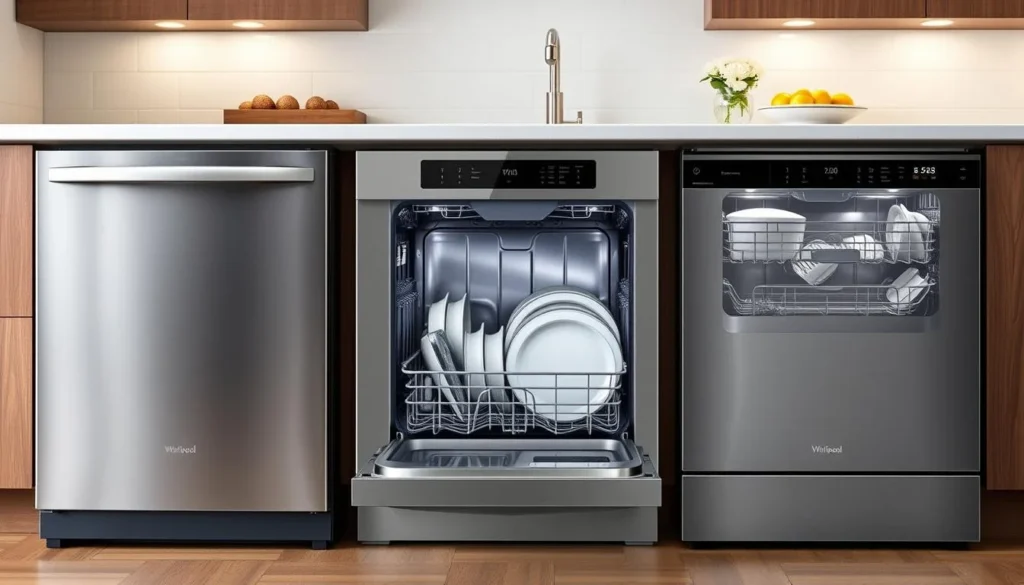
Whirlpool WDTA50SAKZ: Quick Overview
Product appearance and interior layout are illustrative; verify the exact finish and configuration with the retailer.
| Specification | Details |
|---|---|
| Brand | Whirlpool |
| Model | WDTA50SAKZ |
| Dishwasher type | Built-in, under-counter |
| Nominal width | 24 inches (approximately 61 cm) |
| Noise rating | 47 dBA |
| Interior | Stainless steel |
| Control location | Hidden, top-mounted |
| Rack configuration | Three racks, including a third rack |
| Upper rack | Adjustable |
| Wash system | Sensor-controlled washing |
| Wash cycles | Normal, Heavy, Quick Wash, Soak & Clean and others, depending on the applicable feature configuration |
| Delay start | Up to 24 hours |
| Smart connectivity | No built-in Wi-Fi listed for this model |
| Energy certification | ENERGY STAR certified in the documented US specification |
| Best suited for | Households seeking flexible loading and quiet everyday cleaning |
The model’s official product information identifies it as a 47 dBA dishwasher with a stainless steel interior and hidden controls. Its documented features also include a third rack, an adjustable second rack, a soil sensor, folding tines, and a delay-start function. Exact cycle names, accessories, and available finishes should be confirmed against the product’s current regional specification sheet.
1. Design and build quality
The WDTA50SAKZ uses a modern, minimalist design intended to blend into contemporary kitchens. The stainless steel exterior, recessed pocket handle, and hidden control panel give it a cleaner appearance than many traditional dishwashers with a prominent front-facing control strip.
Fingerprint-resistant stainless steel
The fingerprint-resistant finish is a practical advantage for families and households that frequently open the dishwasher throughout the day. Stainless steel can show fingerprints, water marks, and smudges, but a resistant finish helps reduce their visibility.
It does not make the exterior completely maintenance-free. Grease marks and dried water spots can still appear, particularly in kitchens where the appliance is handled frequently. A soft microfiber cloth and an appropriate stainless steel cleaner are generally sufficient for routine cleaning.
One point worth considering is that the exterior finish should be inspected carefully when the appliance arrives. Some owner feedback about this model has raised concerns about rust or finish deterioration. Such reports do not establish how frequently the problem occurs, but they make it sensible to check the door edges, seams, and lower exterior during delivery and installation.
Stainless steel interior
The stainless steel tub is another positive feature. It provides a durable, nonporous interior surface and gives the dishwasher a more premium construction than many lower-priced models with predominantly plastic tubs.
A stainless steel interior can also help retain heat during the drying stage. However, the tub material alone does not guarantee that every item will emerge completely dry. The type of drying system, rinse-aid use, cycle selection, and the materials being washed all affect the final result.
For everyday household use, the stainless steel interior is a worthwhile feature, especially if you plan to keep the appliance for several years.
Hidden controls and exterior appearance
The controls are positioned along the top edge of the door. When the door is closed, the front remains relatively uncluttered.
This layout is particularly useful if you prefer a built-in appearance without a visible display dominating the kitchen. The controls remain accessible when you open the door, although you cannot check the selected cycle or remaining time from across the room in the same way you might with a dishwasher that has a prominent front-facing display.
The model includes a cycle-status indicator and remaining-time information, but the precise visibility of these indicators depends on the design of the control interface.
Design verdict: The WDTA50SAKZ looks more expensive than a basic entry-level dishwasher. Its stainless steel finish, concealed controls, and stainless steel tub are attractive features, although the exterior should be maintained and inspected like any other coated appliance.
2. Cleaning performance: How well does it wash dishes?
Cleaning performance is the most important consideration when evaluating a dishwasher. Attractive styling and convenient racks matter, but neither is useful if food remains on plates or glasses come out cloudy.
The WDTA50SAKZ uses a sensor-controlled wash system designed to adjust washing according to the conditions detected during a cycle. Its available wash programs include Normal, Heavy, Quick Wash, Sensor Wash, and Soak & Clean.
Independent laboratory testing has reported very good performance for this model when washing heavily soiled dishes. Its energy-use performance was also rated very good in the same testing program. These results provide a stronger basis for evaluating the dishwasher than relying on individual customer reviews alone.
Nevertheless, laboratory results do not guarantee identical performance in every home. Water hardness, detergent quality, loading patterns, incoming water temperature, and maintenance can all influence the outcome.
Everyday plates, bowls, and cups
For routine family meals, the Normal or Sensor Wash cycle should be the starting point. These programs are designed for ordinary dishwashing rather than the most difficult baked-on messes.
The sensor system helps the dishwasher respond to soil conditions instead of relying entirely on a fixed wash routine. This can be useful when one load contains lightly used cups and plates while another contains more heavily soiled cookware.
For best results:
- Scrape large food particles into the bin before loading.
- Keep plates facing the spray action rather than directly against one another.
- Avoid nesting bowls so tightly that water cannot circulate.
- Place cups and glasses at an angle to reduce water pooling.
- Use detergent according to the product instructions and your local water conditions.
Pre-rinsing every dish is usually unnecessary with a properly functioning modern dishwasher. Removing large food scraps is generally enough, although heavily dried food may need a longer cycle or brief soaking.
Dried-on food and stubborn grease
The Heavy cycle is designed for pots, pans, plates, and other items with more difficult soil. It generally uses additional time and more intensive washing conditions compared with a standard cycle.
The Soak & Clean cycle is another useful option when food has dried onto dishes before the dishwasher is started. It can help loosen stubborn residue during the washing process, reducing the need to scrub everything by hand.
However, there are limits to what any household dishwasher can accomplish. Thick, burnt-on residue may still require manual attention, particularly if cookware is unsuitable for dishwasher cleaning or has been left dirty for an extended period.
A common mistake is to load a pan with its dirty surface facing a wall or another item. Even a powerful wash system cannot clean a surface that receives insufficient water circulation.
Cleaning the upper rack
The upper rack typically holds glasses, cups, mugs, small bowls, and suitable plastic containers. These items can be harder to clean when they are packed tightly together.
The WDTA50SAKZ’s adjustable upper rack gives you more flexibility to accommodate different combinations of dishes. When cleaning tall glasses or bulky items below, adjusting the rack can help improve clearance.
Still, loading technique is essential. Glasses should not block spray paths, and lightweight containers should be positioned so that they cannot turn over and fill with dirty water.
Cleaning the lower rack
The lower rack is intended for larger plates, serving dishes, pots, pans, and other heavier items. Folding tines allow you to change the available space when you have an unusual load.
For example, you can fold down selected tines to create more room for a large casserole dish. When loading plates, leave enough space between them for the spray to reach both sides.
Avoid allowing a tall tray or pan to obstruct the detergent dispenser or interfere with the spray arm. If the spray arm cannot rotate freely, cleaning results can deteriorate even when the machine itself is operating normally.
Does it clean without pre-rinsing?
The dishwasher’s sensor-controlled wash system and strong reported laboratory cleaning performance make it a promising option for households that want to avoid extensive pre-rinsing.
However, no responsible review should promise that every load will emerge spotless without preparation. Dried rice, egg, oatmeal, starch, and thick sauces can be difficult for dishwashers when they have hardened onto surfaces.
The best approach is to scrape dishes, load them correctly, use a suitable detergent, and select a cycle appropriate for the amount of soil.
Cleaning verdict: The WDTA50SAKZ is one of the more convincing aspects of this model. Independent testing supports its ability to handle heavily soiled dishes, making it a strong candidate for normal family use as well as occasional tougher loads.
3. The sensor wash system: Is it useful?
The dishwasher’s sensor-based washing system is intended to adjust the wash process according to detected soil conditions.
Instead of treating every load identically, the dishwasher can use sensor information to help determine the appropriate washing response. This is particularly valuable when loads vary considerably from one day to another.
For example, a household might run a load containing mostly glasses and lightly used dinner plates after breakfast, followed by a load of greasy cookware and food-covered dishes after dinner. Sensor-based washing can help the machine respond to those changing conditions.
The system should not be confused with artificial intelligence in the sense of a connected appliance that learns your household’s habits through an online account. The WDTA50SAKZ does not list built-in Wi-Fi connectivity, and its sensor features do not require a smart-home connection.
The practical benefits are straightforward:
- It can adapt washing to detected soil conditions.
- It may help avoid unnecessary washing intensity in some circumstances.
- It reduces the need to choose a specialized program for every ordinary load.
- It complements the Heavy and Soak & Clean programs for more challenging dishes.
Its limitations are equally important. Sensors cannot compensate for blocked spray arms, incorrect detergent dosing, a clogged filter, or dishes loaded in a way that prevents water from reaching them.
For most users, the sensor system is a useful convenience rather than a reason by itself to purchase the dishwasher.
4. Third rack: One of the best features
The third rack is among the most useful features of the WDTA50SAKZ because it creates a separate loading area above the conventional upper rack.
Depending on the item and the available clearance, this area can accommodate cutlery, cooking utensils, small serving pieces, and other relatively flat items.
How the third rack improves capacity
Without a third rack, smaller items often occupy valuable space in the main silverware basket or lie awkwardly between dishes.
A separate upper level gives you more options for organizing those items. It can also make unloading easier because smaller utensils are grouped together rather than mixed with the main load.
The model’s documented capacity is 13 place settings. That is a useful reference point, but actual capacity depends on the shape of the plates, the size of the glasses, the number of pots and pans, and how much space bulky cookware occupies.
A place-setting figure is not a promise that 13 complete sets of your particular dishes will fit comfortably in every load.
Is the third rack adjustable?
The important distinction is between an adjustable second rack and an adjustable third rack. The WDTA50SAKZ has an adjustable upper rack, but you should not assume that its third rack can be raised or lowered in the same way.
Before buying, check the rack diagram and manual for the exact configuration. If you regularly wash tall wine glasses, oversized mugs, or unusually large cookware, the clearance between the racks is particularly important.
Is the third rack useful for families?
Yes, particularly if your household uses numerous utensils, lunch containers, small cups, and serving tools. It can improve the organization of a mixed load and reduce the amount of space that smaller items consume in the lower racks.
For households that mostly wash large pots and pans, its benefit may be less dramatic. Even so, having an extra loading level generally provides more flexibility than relying on two racks alone.
5. Adjustable racks and loading flexibility
The WDTA50SAKZ combines a third rack with an adjustable second rack and folding tines. These features are designed to make the interior more adaptable to different types of dishes.
Adjustable upper rack
The adjustable second rack helps when you need to change the vertical clearance between the upper and lower loading areas.
For instance, you may need more room below for dinner plates, a large mixing bowl, or a tall pot. At other times, you may need more space above for glasses and cups.
This flexibility is useful in households where the load changes from day to day.
Folding tines
Folding tines let you create additional space for wider or unusually shaped items. A large serving bowl may fit more securely when a section of the rack is folded down, while a normal load of plates benefits from the standard arrangement.
The key is to maintain enough separation between items for water to circulate. Filling every available gap does not necessarily improve capacity if doing so prevents proper cleaning.
Silverware basket
The model uses a silverware basket in the lower rack, with a three-piece, separable configuration documented in the manufacturer’s specifications.
A divided basket gives you more flexibility when arranging forks, knives, and spoons. Depending on the load, you can position the sections to create room for larger dishes.
Avoid packing all utensils tightly together. Spoons can nest against each other, and closely grouped cutlery may emerge with food residue trapped between pieces.
Loading verdict: The third rack, adjustable second rack, folding tines, and divided silverware basket make the WDTA50SAKZ a flexible choice for households with varied dishware.
6. Drying performance: Are dishes completely dry?
Drying is an area where expectations need to be realistic.
The WDTA50SAKZ has a vented drying system with a heating element and offers Heated Dry and Extended Dry options. The heated-dry option is intended to help remove moisture from dishes, while extended drying can provide additional drying time when needed.
The stainless steel interior is also useful because it retains heat during the wash and drying process. However, neither a stainless steel tub nor a heated drying option guarantees that every item will be completely dry.
Drying ceramic plates and glassware
Ceramic plates, glass tumblers, and many conventional dishes generally dry more readily than plastics because their surfaces and thermal properties behave differently during the drying stage.
To improve results, avoid overcrowding and make sure cups, bowls, and containers are positioned so that water can drain away rather than collect in their bases.
Using rinse aid according to the manufacturer’s instructions can also help water spread into a thinner film and drain more effectively.
Drying plastic containers
Plastic containers are a more difficult challenge for almost every dishwasher. They retain less heat than ceramic dishes and can hold water droplets on flat surfaces, rims, and recessed bases.
The WDTA50SAKZ’s heated drying option can help, but plastics may still require a brief period of air drying after the cycle.
For the best result:
- Load dishwasher-safe plastic containers securely.
- Angle containers to prevent water from pooling.
- Avoid placing lightweight items where they can turn over.
- Use rinse aid if recommended for your detergent and water conditions.
- Select an appropriate drying option when the load contains many plastics.
Check the manufacturer’s instructions for each plastic item before using heated drying.
Drying stainless steel and cutlery
Cutlery generally dries well when arranged with enough space between pieces. However, water may remain in spoon bowls, utensil handles, and recessed surfaces.
Separating utensils and avoiding tight clusters can help.
Is this a good dishwasher for people who want perfectly dry dishes?
It is a reasonable option, especially if you use the available heated-dry features and load items carefully. Nevertheless, people who place a particularly high priority on automatically drying plastic containers should compare the complete drying systems of competing models before deciding.
Drying verdict: Good practical flexibility, but not a guarantee of completely dry plastics in every load. Rinse aid, suitable loading, and cycle selection make a meaningful difference.
7. Noise level: How quiet is 47 dBA?
The WDTA50SAKZ has a rated noise level of 47 dBA. That is quiet enough for many open-plan kitchens and everyday household environments.
Decibels use a logarithmic scale, so a change of a few decibels can be noticeable. However, perceived loudness depends on the sound’s character, the room’s acoustics, the installation, and background noise.
A dishwasher’s noise level is not necessarily constant throughout a cycle. Filling, draining, circulation, and the movement of water can produce different sounds at different stages.
Is 47 dBA quiet enough for an open-plan kitchen?
For most households, yes. At this rating, the dishwasher should generally be less intrusive than many older or noisier machines.
Independent laboratory testing has also rated this model very good for noise performance. That provides additional support for its suitability in kitchens connected to dining or living spaces.
However, 47 dBA is not the same as near-silent operation. If your priority is the quietest possible dishwasher, compare models rated around 38–42 dBA and consider the sound-insulation package and independent test results.
Why can the dishwasher sound louder after installation?
Several factors can influence the sound you hear:
- An uneven or poorly secured installation.
- Cabinets or countertops vibrating against the machine.
- A drain hose or water line touching the cabinet.
- Dishes or utensils interfering with a spray arm.
- An obstruction or maintenance problem within the wash system.
A properly installed dishwasher can sound noticeably different from one that is not level or securely mounted.
Noise verdict: The 47 dBA rating is a strong feature for everyday use. It is suitable for most modern homes, although exceptionally noise-sensitive buyers may prefer a quieter premium model.
8. Wash cycles and additional options
The WDTA50SAKZ offers five principal wash cycles and several additional options. These programs make it possible to adjust washing and drying according to the load rather than using one setting for everything.
Cycle descriptions below explain their intended uses. Actual duration and consumption vary with selected options, soil levels, water temperature, and operating conditions.
| Cycle or option | Best use | What to expect |
|---|---|---|
| Normal | Everyday plates, cups, and cutlery | Balanced cleaning for routine loads |
| Heavy | Pots, pans, and heavily soiled dishes | More intensive washing, generally with a longer cycle |
| Quick Wash | Lightly soiled dishes needed sooner | Shorter washing, but not necessarily the best choice for dried-on food |
| Sensor Wash | Mixed loads with varying soil levels | Washing adjusted according to sensor readings |
| Soak & Clean | Dishes with stubborn or dried-on residue | Helps loosen food during the wash process |
| Heated Dry | Loads where better drying is desired | Uses heat to assist moisture removal |
| Extended Dry | Loads needing additional drying time | Extends the drying process |
| High Temperature Wash | Suitable loads needing more intensive washing conditions | Raises wash temperature as specified by the program |
| Sani Rinse | Loads requiring the sanitizing option | Uses a specified high-temperature rinse process |
| Delay Start | Washing at a more convenient time | Schedules the cycle to start later |
Normal cycle
The Normal cycle should handle most day-to-day dishwashing. It is the sensible default for plates, mugs, bowls, and cutlery that have not been left with heavily dried food for an extended period.
If your dishes are routinely coming out dirty on this cycle, first inspect the loading arrangement, filter, detergent dispenser, and spray arms before assuming that the dishwasher lacks cleaning power.
Heavy cycle
The Heavy cycle is appropriate for difficult loads, particularly when pots and pans have accumulated grease or food residue. Its more intensive approach generally comes with additional running time.
Using Heavy for every load is not necessarily beneficial. For ordinary dishes, the Normal or Sensor Wash cycle may be sufficient.
Quick Wash
The manufacturer describes Quick Wash as a program intended to clean dishes in about an hour under its stated conditions. Actual time can vary.
This is useful when you need clean dishes relatively quickly, but it should not be treated as a universal substitute for a full wash cycle. Heavily soiled dishes may need the Normal, Sensor Wash, or Heavy program.
Soak & Clean
This cycle is particularly useful when dishes cannot be washed immediately after a meal. It helps address dried-on food without requiring you to manually scrub every plate before loading.
It is still worth scraping off large food particles and following the instructions for cookware and delicate items.
Sani Rinse
Sanitizing options are relevant for households that want an additional high-temperature rinse under specified conditions. Whirlpool advertises a reduction of 99.999% of food-based bacteria for this model’s Sani Rinse feature.
That is a manufacturer claim associated with the specified sanitizing process, not a guarantee that every load, item, or operating condition achieves the same outcome. Correct loading and use of the required cycle and options remain important.
Delay Start
The 1–24-hour Delay Start option lets you schedule a wash to begin later. This is convenient if you prefer to run the machine after dinner, before waking up, or at another time that fits your household routine.
Before scheduling a cycle while away from home, follow the installation and safety instructions and ensure that the water and drain connections are sound.
9. Energy efficiency and water consumption
Energy consumption is an important part of the total cost of owning a dishwasher. The appliance uses electricity to run its pumps and controls and, where applicable, heat water and assist drying.
The WDTA50SAKZ’s sensor system and selection of wash programs are designed to support efficient everyday operation. However, there is an important distinction between having efficiency-oriented features and carrying a current energy-efficiency certification.
The manufacturer’s current comparison information has shown inconsistent certification fields for this model. Therefore, buyers should verify the exact model number against the current US EnergyGuide label and applicable certification database rather than assume that the WDTA50SAKZ currently qualifies for ENERGY STAR based solely on older or third-party descriptions.
How much electricity does it use?
The most reliable way to estimate annual electricity consumption is to check the EnergyGuide label supplied with the exact model and compare it with other dishwashers of similar capacity.
Your real-world consumption depends on:
- How many cycles you run each week.
- Which wash programs you select.
- Whether heated drying is used.
- Incoming water temperature.
- The condition of the machine and its components.
- Local electricity prices.
For a household that runs the dishwasher once daily, a small difference in electricity consumption per cycle can accumulate over a year. It is worth comparing the energy labels when two models have similar purchase prices.
How much water does it use?
Water use varies with the selected program, load conditions, and the appliance’s operating design. Do not assume that every cycle uses the same amount.
A modern dishwasher can also be more water-efficient than washing a large quantity of dishes by hand under a continuously running tap. The exact comparison depends on how you wash dishes manually and the number of items being cleaned.
To get the most from the WDTA50SAKZ, scrape dishes rather than extensively pre-rinsing them, run appropriately full loads, and choose a suitable cycle.
Is it economical to operate?
For a typical household, the WDTA50SAKZ offers a practical combination of everyday washing options and sensor-based operation. Nevertheless, whether it is more economical than a competing dishwasher depends on the competing model’s verified energy and water figures.
My recommendation: Before purchasing, compare the WDTA50SAKZ’s EnergyGuide information with that of at least two similarly priced alternatives. Use the current label for the exact model and regional market.
10. Dimensions, capacity, and installation
The WDTA50SAKZ is designed for a standard-width built-in dishwasher space. Its nominal 24-inch width makes it relevant to many kitchens in the United States and Canada, although the available opening must still be measured carefully.
| Dimension | Manufacturer-listed measurement |
|---|---|
| Width | 23.875 inches |
| Height | Approximately 33.625 inches |
| Depth, excluding the handle | 24.5 inches |
| Depth with door open | Approximately 50.2 inches |
| Listed place-setting capacity | 13 |
The measurements are useful for planning, but you should use the installation instructions for the exact model when checking cabinet clearance, countertop height, hose routing, and door movement.
Will it fit under my kitchen counter?
Do not assume that a nominal 24-inch dishwasher will fit every 24-inch cabinet opening. The opening must accommodate the appliance’s actual dimensions, mounting arrangements, water connection, drain hose, and electrical supply.
Measure the width at several points, including the top and bottom of the opening. Check the minimum and maximum installation height, as well as the available depth behind the appliance.
Also account for the door when it is open. The door needs room to lower without hitting an island, cabinet, or nearby obstruction.
Water supply and drainage
A built-in dishwasher requires a suitable water supply and a correctly installed drain connection. The drain hose must be routed according to the installation instructions and local plumbing requirements.
Improper drainage arrangements can contribute to water backing up into the dishwasher, standing water, odors, or drainage problems.
The WDTA50SAKZ’s listed package information indicates that the drain hose is included, but you should not assume that every required installation accessory is supplied. The electrical cord and water-supply connection may need to be purchased separately, depending on the installation and retailer package.
Electrical requirements
The US specification lists a 120-volt electrical supply. Electrical requirements and permitted installation methods differ between countries, so the American specification must not be applied automatically to a UK kitchen or another international installation.
Use a qualified installer who can confirm compatibility with the local electrical system and applicable regulations.
Is professional installation worthwhile?
For a replacement in a correctly prepared kitchen, installation may be relatively straightforward for an experienced technician. However, modifications to plumbing, cabinetry, electrical connections, or countertop mounting can make the job more complicated.
Professional installation is particularly worthwhile when replacing an older appliance with different connection positions or when the existing installation has signs of leaks or damage.
11. Reliability and expected lifespan
Reliability is more difficult to judge than a feature such as rack count or noise level. A dishwasher can perform very well in laboratory cleaning tests and still develop a component failure during years of ownership.
The WDTA50SAKZ has a stainless steel tub, a removable filter, electronic controls, a sensor-based wash system, and several moving components. These are common elements of modern dishwashers, but their long-term performance depends on manufacturing quality, installation, maintenance, and use.
What do independent tests tell us?
Independent testing has rated this model very good for heavily soiled dishwashing, energy use, and noise. These are positive findings about its tested performance.
They do not, by themselves, prove that the model will be trouble-free for ten years or establish a precise failure rate.
Reliability data should ideally come from long-term ownership surveys covering a substantial number of appliances, with results specific to the model or clearly identified brand-level data. Without that evidence, assigning a precise reliability score would be misleading.
What do customer reviews suggest?
Retailer and manufacturer reviews often praise the WDTA50SAKZ for quiet operation, flexible loading, and cleaning performance. Some owners have also reported problems, including drying concerns, exterior rust, and service visits for faults.
These reports are useful for identifying issues worth checking, but they have limitations. Customers who have a particularly positive or negative experience may be more likely to leave a review, and the circumstances of a reported failure may not be fully known.
A complaint about a faulty control board, for example, does not establish the overall failure rate of that component across every unit sold.
How long might it last?
There is no defensible way to guarantee the lifespan of an individual WDTA50SAKZ from its specifications alone.
The best approach is to consider the appliance’s purchase price, the length and scope of the warranty, the availability of replacement parts, and access to qualified service technicians.
Keeping the filter clean, using suitable detergent, preventing blockages, and correcting leaks promptly can help avoid preventable problems. Maintenance cannot eliminate manufacturing defects, but it can reduce avoidable strain on the appliance.
12. Common problems to watch for
The following are troubleshooting considerations for the WDTA50SAKZ and comparable sensor-controlled dishwashers. They are not claims that every unit experiences these faults.
| Symptom | Possible causes | First step |
|---|---|---|
| Dishes remain dirty | Incorrect loading, blocked spray arms, dirty filter, unsuitable cycle | Check loading and clean the filter |
| Glasses have spots | Hard water, inadequate rinse aid, detergent issues | Check water hardness and rinse aid |
| Plastics remain wet | Water pooling, limited heat retention, drying settings | Reposition items and use an appropriate drying option |
| Dishwasher will not start | Door not latched, power issue, control lock or fault | Check the door, power supply, and manual |
| Water remains in the bottom | Clogged filter, drain obstruction, hose installation issue | Inspect the filter and accessible drain area |
| Unusual rattling | Loose dishes, utensils touching a spray arm, installation vibration | Check the load and spray-arm movement |
| Water appears outside the unit | Door seal, hose connection, plumbing or appliance leak | Stop operation and investigate safely |
| Exterior finish deteriorates | Damage to coating, cleaning chemicals, moisture exposure | Document the damage and contact the seller or manufacturer |
Dishes are not getting clean
First inspect the removable filter and spray arms. Food debris can obstruct water movement, while an incorrectly positioned dish may prevent the spray arm from rotating.
Also confirm that the detergent dispenser is not blocked and that the selected cycle is suitable for the load.
If poor cleaning persists despite correct loading and maintenance, consult the troubleshooting guide or arrange qualified service.
The dishwasher does not drain
Check for visible debris in the filter and accessible drain area, following the manual’s instructions. Confirm that the drain hose has been installed correctly and is not kinked.
Never reach into an area containing sharp debris without appropriate precautions, and do not disassemble electrical or pump components while the machine is connected to power.
If the dishwasher repeatedly leaves standing water, stop relying on repeated cycles to clear the issue and arrange diagnosis.
The dishwasher leaks
A leak can originate from a water-supply hose, drain connection, door seal, damaged tub, or another component. Not every leak is detectable by the appliance’s leak-identification feature.
If water is escaping onto the floor, stop the dishwasher and follow the safe shutdown instructions. Isolate the water supply if it can be done safely, and disconnect power only through a safe method.
Do not continue operating a leaking dishwasher in the hope that the problem will disappear.
The dishwasher is noisier than expected
Check whether cutlery, plates, or pans are contacting the spray arms. Also inspect for loose mounting or contact between the appliance and surrounding cabinetry.
A new grinding, buzzing, or repeated knocking sound that persists after checking the load deserves further investigation.
The exterior develops rust or discoloration
Inspect the affected area and take photographs. Avoid abrasive cleaners or improvised repairs that could worsen the finish.
Contact the retailer or manufacturer promptly, particularly if the appliance is new or still under warranty. Warranty coverage depends on the exact terms, the cause of the damage, and the applicable market.
13. Maintenance: How to keep the WDTA50SAKZ working properly
Regular maintenance is important for cleaning performance, drainage, odor control, and long-term operation. Fortunately, most routine care does not require specialist tools.
Clean the removable filter
The WDTA50SAKZ uses a removable filter wash system. The filter helps capture food particles and should be inspected periodically.
- Switch off the dishwasher and follow the instructions in the owner’s manual.
- Remove the filter using the specified procedure.
- Rinse away food debris and buildup.
- Clean it with a soft brush if necessary and permitted by the manual.
- Reinstall it securely before running the next cycle.
Avoid running the dishwasher with a filter that has not been correctly reinstalled.
Inspect the spray arms
Check that the spray arms rotate freely and are not obstructed by plates, pans, or utensils.
If the spray openings become blocked by mineral deposits or food particles, clean them according to the manufacturer’s instructions. Avoid forcing sharp objects into the openings, as this can damage the components.
Maintain the detergent dispenser
Use a dishwasher detergent intended for automatic dishwashers. Handwashing liquid is unsuitable because it can create excessive foam and potentially cause leaks or operating problems.
Store detergent in a dry location and ensure that the dispenser can open freely during the cycle.
Check rinse aid
Rinse aid can improve water drainage from dish surfaces and help reduce spotting. Adjust the setting according to the instructions and the results you observe.
Too little rinse aid may contribute to spotting or poor drying, while an unsuitable setting may cause other issues. Follow the dispenser instructions rather than assuming that the maximum setting is always best.
Clean the door and exterior
Wipe the exterior with a soft cloth and a suitable cleaner. Avoid harsh abrasives that may damage the fingerprint-resistant finish.
Pay attention to the door edges and gasket area, where moisture and food residue may accumulate. Clean these areas gently and avoid pulling or stretching the seal.
Run a cleaning cycle when necessary
If you notice persistent odors, mineral buildup, or interior residue, use a dishwasher cleaner compatible with the appliance and follow its instructions.
A cleaning product is not a substitute for removing a blocked filter or correcting a drainage fault. If the odor returns quickly, investigate the underlying cause.
14. Warranty and ownership costs
Warranty coverage is an important part of the buying decision, particularly for a dishwasher with electronic controls and multiple wash-system components.
The WDTA50SAKZ is associated with a limited manufacturer’s warranty, but buyers should verify the applicable warranty document for the precise model suffix, country, purchase date, and installation circumstances.
Do not assume that a warranty offered in the United States automatically applies in Canada or the United Kingdom.
Before purchasing, confirm:
- The duration of coverage for parts and labor.
- Whether particular components have different coverage periods.
- Whether an authorized service provider is required.
- Which installation or maintenance issues are excluded.
- Whether transport, removal, or reinstallation costs are covered.
- The procedure for reporting a defect.
What about repair costs?
The total cost of ownership includes more than the initial purchase price. A dishwasher may need replacement hoses, a drain pump, a heating component, a control component, or other service during its useful life.
Actual repair costs vary considerably according to the fault, labor rates, parts availability, and location.
For a dishwasher bought at a discounted price, even a moderate repair bill can affect its overall value. Before purchasing, check whether replacement parts are available locally and whether a qualified technician can service the model.
Extended warranties or protection plans should be evaluated by their price, exclusions, claim limits, and the repairs they actually cover. They are not automatically worthwhile for every household.
15. Whirlpool WDTA50SAKZ price and value for money
The WDTA50SAKZ has been positioned around the midrange of the built-in dishwasher market, with manufacturer-listed US pricing around $599 in the product information reviewed for this article. Actual prices can vary by retailer, finish, promotion, delivery arrangements, and availability.
Treat that figure as a reference rather than a guaranteed current selling price.
At this general price level, the dishwasher offers several desirable features:
- A stainless steel interior.
- A third rack.
- Sensor-controlled washing.
- A 47 dBA noise rating.
- Adjustable loading arrangements.
- Heated drying options.
- Hidden controls and a fingerprint-resistant finish.
These features make it more versatile than a basic dishwasher that provides only a small selection of wash cycles and two conventional racks.
However, the best value depends on the price difference between this model and its competitors. If another dishwasher costs only slightly more and offers a quieter operation, a stronger drying system, or better verified energy performance, that alternative may be worth considering.
Similarly, if the WDTA50SAKZ is substantially discounted and you value its third rack and washing performance, it could be an attractive purchase.
Is it worth buying on sale?
It can be, provided the appliance fits your kitchen and its feature set matches your priorities.
I would pay particular attention to the current selling price, warranty conditions, installation costs, and any documented service concerns. A discount is less compelling if the final installed cost approaches that of a competing model with features you value more.
16. Is the WDTA50SAKZ suitable for the UK, USA, and Canada?
Although this review is relevant to readers in all three countries, the exact model’s regional availability and installation compatibility are important.
United States
The WDTA50SAKZ is a US-market model with a nominal 24-inch width and a listed 120-volt electrical supply. It is designed for conventional built-in residential installation.
American buyers should verify the current price, EnergyGuide label, warranty, and installation requirements before ordering.
Canada
The nominal width is relevant to many Canadian kitchens, but the exact appliance configuration and availability should be confirmed with a Canadian retailer.
Check the Canadian energy label and applicable warranty documentation. Do not assume that every specification, finish, or service arrangement is identical to the US version.
United Kingdom
UK buyers should be more cautious about treating this exact model as a straightforward replacement for a domestic European dishwasher.
A 24-inch appliance is approximately 61 cm wide, but width alone does not establish compatibility. Electrical supply, installation arrangements, plumbing connections, regional product availability, and warranty support all need to be confirmed.
Do not connect a US-market 120-volt appliance directly to a UK 230-volt supply. A transformer is not automatically a suitable or approved solution for a high-power household appliance. Buy a model explicitly designed and approved for the local electrical system.
If you live in the UK and want a dishwasher with similar features, a locally marketed model with a third rack, stainless steel interior, adjustable racks, and an appropriate noise rating may be the more practical choice.
17. Whirlpool WDTA50SAKZ vs competing dishwashers
The WDTA50SAKZ should be compared with models that offer similar capacity, construction, and pricing rather than with much cheaper entry-level appliances or substantially more expensive premium models.
The comparisons below describe broad feature differences. Exact specifications vary by model and market.
| Comparison | Main advantage of the WDTA50SAKZ | When the alternative may be better |
|---|---|---|
| Whirlpool WDT730HAMZ | Lower noise rating and stainless steel interior on the WDTA50SAKZ | If the WDT730HAMZ is substantially cheaper and its features meet your needs |
| Whirlpool WDTA80SAKZ | Similar basic wash-cycle selection and third-rack concept | If you value the quieter 41 dBA rating and additional wash features offered by the WDTA80SAKZ |
| Bosch 500 Series | Whirlpool offers a straightforward control layout and useful loading flexibility | If a particular Bosch model offers a drying system, rack design, or noise level better suited to your needs |
| Bosch 800 Series | Whirlpool may provide better value when its price is considerably lower | If premium drying, quieter operation, or additional convenience features justify the extra expense |
Whirlpool WDTA50SAKZ vs WDT730HAMZ
These models share a similar overall purpose: built-in dishwashing for households that want useful loading options without moving into the highest price bracket.
The WDTA50SAKZ’s listed advantages include its 47 dBA noise rating, stainless steel tub, and third rack. Before choosing between them, compare the WDT730HAMZ’s exact tub construction, drying arrangement, rack configuration, and current price.
If the WDTA50SAKZ is only modestly more expensive, its stainless steel interior and quieter rated operation may justify the difference.
Whirlpool WDTA50SAKZ vs WDTA80SAKZ
The WDTA80SAKZ is a more premium alternative in Whirlpool’s lineup. Manufacturer comparison information lists it at 41 dBA, compared with 47 dBA for the WDTA50SAKZ, and identifies additional rack and wash-system features.
If your kitchen opens directly into a living room, the quieter model may be appealing. On the other hand, the WDTA50SAKZ can make more sense when the price difference is substantial and you are satisfied with its existing feature set.
Whirlpool WDTA50SAKZ vs Bosch 500 Series
The comparison depends on the exact Bosch 500 Series model and the market in which it is sold.
Both product families include models intended for buyers who want more than a basic dishwasher. Compare the noise rating, rack flexibility, drying performance, warranty, and independent test results rather than assuming one brand is universally superior.
If drying plastics is especially important to you, investigate the specific drying system before choosing.
Whirlpool WDTA50SAKZ vs Bosch 800 Series
Bosch 800 Series models can offer additional premium features, depending on the exact configuration. Those features may be worthwhile for buyers who prioritize specialized drying, refined rack arrangements, or lower operating noise.
The WDTA50SAKZ is more compelling when the purchase price is lower and its main features already satisfy your requirements.
Comparison verdict: The WDTA50SAKZ is most attractive as a practical midrange option. It becomes less compelling if its price approaches a model that offers a clearly better feature set for your household.
18. Pros and cons of the Whirlpool WDTA50SAKZ
Pros
Strong tested cleaning performance. Independent laboratory results are favorable for heavily soiled dishes.
Quiet operation. The 47 dBA rating is suitable for many open-plan kitchens.
Useful third rack. Provides additional space for cutlery and smaller utensils.
Stainless steel interior. A desirable feature for durability and heat retention.
Flexible loading. Adjustable upper rack and folding tines accommodate different dishes.
Useful wash options. Heavy, Quick Wash, Sensor Wash, and Soak & Clean cover different cleaning needs.
Cons
47 dBA is not ultra-quiet. Buyers who prioritize minimal noise may prefer a quieter premium model.
Plastic drying may be inconsistent. Lightweight plastics can retain droplets even with heated drying.
No built-in Wi-Fi. It is not the right choice for buyers who require connected monitoring or app control.
Certification needs verification. Check the current energy label because manufacturer comparison fields have been inconsistent.
Some owners report finish or service issues. These reports merit attention but do not establish the model’s overall failure rate.
Regional compatibility matters. The US model should not be assumed compatible with UK electrical requirements.
19. Who should buy the Whirlpool WDTA50SAKZ?
This dishwasher is worth considering if you want a midrange built-in appliance with a stainless steel interior, a third rack, sensor-based washing, and a reasonable noise rating.
It is particularly suitable for:
- Families that wash dishes regularly.
- Households that want a third rack for utensils.
- Owners replacing an older, noisier dishwasher.
- Buyers who prefer hidden controls and a modern stainless steel finish.
- People who want a range of wash programs without paying for extensive smart-home functionality.
You may want to consider other models if you need the quietest possible operation, specialized drying for plastic containers, connected appliance controls, or a verified efficiency certification that the WDTA50SAKZ does not currently demonstrate in the documentation available to you.
It is also not a suitable automatic choice for a UK installation unless the exact appliance is confirmed to be compatible with the local electrical supply and approved installation requirements.
20. Frequently asked questions
Is the Whirlpool WDTA50SAKZ a good dishwasher?
Yes, it is a worthwhile midrange option to consider. Its main strengths are cleaning performance, a 47 dBA noise rating, a stainless steel interior, a third rack, and flexible loading. Its overall value depends on the current price, warranty, and how its drying and efficiency features compare with competing models.
How loud is the Whirlpool WDTA50SAKZ?
It has a rated sound level of 47 dBA. That is generally quiet enough for everyday household use, including many open-plan kitchens, although some premium dishwashers operate at lower sound levels.
Does the WDTA50SAKZ have a third rack?
Yes. It has a third rack above the main upper rack, providing extra room for suitable cutlery, utensils, and smaller items.
Does the Whirlpool WDTA50SAKZ have a stainless steel tub?
Yes. The manufacturer lists a stainless steel interior.
Does the WDTA50SAKZ dry dishes well?
It has Heated Dry and Extended Dry options to help remove moisture. Ceramic dishes and glassware may dry more readily than plastics, which can retain water droplets. Loading, rinse aid, and cycle selection influence the results.
Does this dishwasher have a quick-wash cycle?
Yes. It has a Quick Wash program intended for relatively rapid cleaning. It is most appropriate for suitable loads that do not require the more intensive treatment of the Heavy cycle.
Can the WDTA50SAKZ clean heavily soiled dishes?
Independent laboratory testing has reported very good cleaning performance on heavily soiled dishes. Correct loading, suitable detergent, and proper maintenance remain important for achieving similar results at home.
Does the WDTA50SAKZ have a soil sensor?
Yes. Its sensor-based wash system is designed to respond to detected soil conditions and adjust the washing process.
Is the Whirlpool WDTA50SAKZ energy-efficient?
Its sensor-based washing and selection of programs are intended to support efficient operation. However, buyers should verify the exact model’s current EnergyGuide label and certification status before making a purchase based on an efficiency claim.
Does the WDTA50SAKZ have Wi-Fi?
No built-in Wi-Fi connectivity is listed for this model. It is best viewed as a conventional dishwasher with sensor-controlled washing rather than a connected smart appliance.
What is the capacity of the WDTA50SAKZ?
The manufacturer lists a capacity of 13 place settings. Actual loading capacity varies with the size and shape of your plates, glasses, pans, and utensils.
Does it have a delay-start feature?
Yes. The model offers a Delay Start function that can schedule the cycle to begin between one and 24 hours later.
What should I do if the dishwasher does not drain?
Inspect the removable filter and accessible drain area according to the manual. Check that the drain hose is not kinked and has been installed correctly. Persistent standing water may require professional diagnosis.
What should I do if the dishwasher leaks?
Stop the cycle and follow the safe shutdown instructions. If possible, isolate the water supply safely and arrange an inspection. Do not continue running the machine while water is escaping.
How long will the Whirlpool WDTA50SAKZ last?
Its precise lifespan cannot be guaranteed. Installation quality, maintenance, frequency of use, water conditions, and component reliability all influence longevity. Check the warranty and local service support before purchasing.
Is the WDTA50SAKZ worth buying in 2026?
It can be a good choice if you find it at a competitive price and want a quiet, flexible dishwasher with strong documented cleaning performance. Before buying in 2026, confirm current availability, the exact specification, the energy label, and the warranty for your market.
Is the WDTA50SAKZ suitable for the United Kingdom?
Do not assume that the US-market version is suitable for direct installation in the UK. Its electrical requirements differ from the UK’s standard domestic supply. UK buyers should look for a model explicitly designed for the local market or obtain confirmation of compatibility and approved installation arrangements.
Final verdict: Should you buy the Whirlpool WDTA50SAKZ?
The Whirlpool WDTA50SAKZ is a capable midrange dishwasher whose strongest selling points are its tested cleaning performance, 47 dBA operating rating, stainless steel interior, third rack, and flexible loading arrangements.
It is particularly appealing to households that want to wash everyday dishes and occasional heavily soiled cookware without moving into the most expensive dishwasher category. The sensor-based wash system and multiple programs also make it practical for households with varied dishwashing needs.
Its limitations deserve equal attention. Drying performance on plastics may not meet everyone’s expectations, the appliance lacks built-in Wi-Fi, and customer reports of finish deterioration and service problems mean that warranty support should be checked carefully. Its current energy-efficiency certification should also be verified using the exact model documentation.
My recommendation is to consider the WDTA50SAKZ a good midrange candidate, rather than an automatic best buy. If its current price is competitive and you value its rack layout, cleaning performance, and noise rating, it deserves a place on your shortlist. If you prioritize ultra-quiet operation, advanced drying, or the strongest independently verified efficiency credentials, compare it with higher-tier alternatives before making your final decision.