
The Whirlpool WDF520PADM is a traditional, front-control, 24-inch built-in dishwasher designed for buyers who want straightforward dishwashing without paying for premium features. It offers a 14-place-setting capacity, a one-hour wash cycle, a removable filter, a soil sensor, heated drying, and a sanitizing rinse option.
Its appeal is easy to understand: it provides the essential functions many households need at a relatively accessible price. However, independent testing and owner feedback reveal a more complicated picture. The model has demonstrated good cleaning performance and excellent combined energy and water results in laboratory testing, but its noise level, drying performance, rack construction, and reports of inconsistent cleaning deserve careful consideration.
In this detailed review, we examine the Whirlpool WDF520PADM’s design, cleaning performance, wash cycles, drying system, energy efficiency, capacity, reliability, maintenance, installation, and ownership costs. We also discuss its suitability for households in the United States, Canada, and the United Kingdom.
Whirlpool WDF520PADM: Quick Specifications
Specifications below refer to the North American WDF520PADM configuration. Verify the documentation supplied with the exact appliance before purchasing.
| Feature | Specification |
|---|---|
| Model | Whirlpool WDF520PADM |
| Type | Built-in dishwasher |
| Width | Approximately 23⅞ inches |
| Height | Approximately 34½ inches |
| Depth | Approximately 24½ inches |
| Capacity | 14 place settings |
| Noise rating | 55 dBA |
| Control panel | Front-mounted electronic controls |
| Interior tub | Plastic |
| Number of racks | Two |
| Silverware basket | In-door basket |
| Filter | Removable, manually cleaned filter |
| Soil sensor | Yes |
| Wash cycles | Four |
| Quick wash | 1-Hour Wash |
| Heavy cycle | Yes |
| Normal cycle | Yes |
| Sanitizing option | Sani Rinse |
| Drying option | Heated Dry |
| High-temperature option | Yes |
| Delay start | Four-hour delay |
| Wi-Fi connectivity | No |
| Energy certification | ENERGY STAR certified in the US |
The WDF520PADM is an entry-level dishwasher rather than a feature-rich premium model. Its design emphasizes conventional controls, a straightforward two-rack layout, and familiar wash programs.
One important distinction is that this model should not be confused with the more expensive Whirlpool WDT750SAKZ. The WDF520PADM has a plastic tub, two racks, front controls, and a 55 dBA noise rating. It does not have the same three-rack configuration or hidden controls as the WDT750SAKZ.
That difference matters when comparing prices or reading reviews online. A review of one Whirlpool model should not automatically be treated as an accurate description of another.
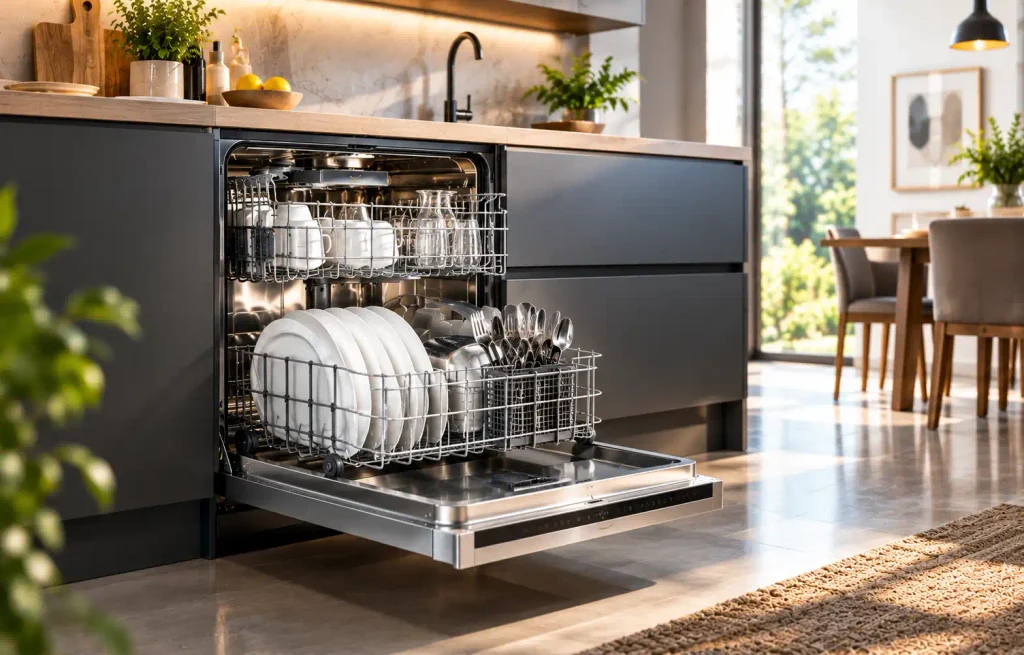
1. Design and Build Quality
The WDF520PADM features a conventional dishwasher design with controls located on the front of the door. This makes the buttons visible when the dishwasher is closed and provides a straightforward operating interface.
The model’s monochromatic stainless steel finish offers a modern appearance without requiring the appliance to have a premium stainless steel interior. The exterior finish and interior tub are separate components, and buyers should not confuse the stainless-look exterior with the material used inside the washing chamber.
Front-control design
Front controls are useful for people who prefer to see the selected cycle and options without opening the door. The design is familiar, easy to understand, and suitable for households that do not need an elaborate digital interface.
The main disadvantage is aesthetic rather than functional. Front controls create a more visible control strip, which may not appeal to people seeking a seamless, minimalist kitchen.
The control arrangement is nevertheless practical for renters, homeowners, and anyone replacing an older dishwasher with a similar configuration.
Plastic interior tub
One of the most important compromises is the plastic tub.
Plastic interiors are common in budget-oriented dishwashers because they can help manufacturers control production costs. A well-maintained plastic tub can provide years of ordinary service, but it differs from stainless steel in its thermal behavior and resistance to certain forms of wear.
Stainless steel tubs are generally better at retaining heat and can support condensation-based drying strategies. A plastic tub does not inherently mean that a dishwasher cleans poorly, but buyers should assess drying performance and long-term condition separately from the tub material.
The WDF520PADM includes a heated drying option, which helps address the challenge of drying dishes after the wash cycle.
Rack construction
The two-rack arrangement keeps the interior simple, but it offers less flexibility than newer designs with adjustable racks or a dedicated third rack.
Some independent reviewers have criticized the rack construction and the protective coating used on the tines. Owners should check for loose components, damaged coating, bent tines, and other signs of deterioration, especially when considering a used unit.
Design verdict: The WDF520PADM is functional and uncomplicated, but its conventional rack layout and plastic interior reflect its budget-oriented positioning.
2. Cleaning Performance: Does the WDF520PADM Clean Dishes Properly?
Cleaning performance is the most important part of any dishwasher review. On this point, the WDF520PADM has a genuine strength: independent laboratory testing has rated its performance very good on heavily soiled dishes.
That result is encouraging for an affordable dishwasher. It suggests that the machine can remove stubborn food residue effectively under controlled test conditions, even though it does not have all the advanced rack and drying features found in more expensive appliances.
However, there is an important qualification. Other independent reviews and customer reports have described inconsistent cleaning, including dirty dishes, cloudy glasses, and detergent that does not dissolve properly. These reports do not necessarily contradict the laboratory results: a machine can perform well under standardized testing while still being sensitive to loading, installation, detergent, water temperature, maintenance, or component faults.
Everyday plates, bowls, and cutlery
For routine meals, the WDF520PADM should be capable of cleaning ordinary plates, bowls, cups, and utensils when the load is arranged correctly.
The Normal cycle is intended for typical household loads, while the soil sensor helps the dishwasher respond to washing conditions. Users should scrape large pieces of food from plates rather than rinse every item thoroughly before loading.
The key is to allow water to reach every surface. Plates positioned too closely together, nested bowls, and utensils packed tightly into the basket can prevent proper cleaning even when the machine is operating normally.
For the best everyday results:
- Scrape off large food scraps before loading.
- Place plates so that water can circulate between them.
- Angle cups and bowls to prevent water from collecting inside them.
- Avoid blocking the spray arms with oversized cookware.
- Use detergent formulated for automatic dishwashers.
- Clean the filter according to the manufacturer’s instructions.
Cleaning heavily soiled cookware
The Heavy cycle and High Temperature Wash option make the WDF520PADM more versatile than a dishwasher with only a basic wash program.
These options can help with greasy cookware, sauce-covered plates, and dishes that need more intensive treatment. Nevertheless, a budget dishwasher should not be expected to remove every type of baked-on food without preparation.
Burnt-on cheese, dried oatmeal, and heavily scorched pans may require soaking or additional manual attention. Items should also be positioned so that they do not prevent the spray arms from rotating.
If dishes repeatedly come out dirty, do not immediately assume that the machine needs replacing. First check the filter, spray-arm openings, detergent dispenser, incoming water temperature, and loading arrangement. If the problem persists, the appliance may require professional diagnosis.
Glasses and cloudy residue
Glassware deserves special attention because film, spots, and mineral deposits can make an otherwise clean load look disappointing.
Cloudy glasses do not always indicate poor washing. Hard-water minerals, excessive detergent, insufficient rinse aid, and permanent glass corrosion can produce similar symptoms.
If glasses develop a white film, inspect a sample carefully to distinguish removable mineral deposits from permanent damage. Review the detergent dosage, check the rinse aid dispenser, and consider local water hardness.
However, if glasses consistently emerge dirty or covered in residue despite appropriate detergent, correct loading, and maintenance, the dishwasher’s performance should be investigated further.
Independent testing versus everyday experience
The independent laboratory results are encouraging, but the owner reports suggest that performance is not uniformly satisfactory for everyone.
The sensible conclusion is not that every WDF520PADM cleans badly or that it is guaranteed to clean exceptionally well. Rather, it is a relatively basic dishwasher with demonstrated cleaning capability whose real-world results can depend significantly on operating conditions and the condition of the individual unit.
3. AccuSense Soil Sensor: What Does It Do?
The WDF520PADM includes a soil sensor, identified in its product specifications as AccuSense technology.
A soil sensor helps the dishwasher assess the condition of the wash water and adjust the cleaning process according to the detected soil level. This is useful because a lightly soiled breakfast load does not necessarily need the same treatment as plates covered in greasy dinner residue.
Benefits of sensor-based washing
The technology is designed to help the appliance manage cleaning without relying entirely on a fixed wash routine.
Potential benefits include:
- Adjusting the wash process to suit detected soil conditions.
- Helping maintain consistent cleaning across different loads.
- Avoiding unnecessary intensive treatment when it is not required.
- Supporting a balance between cleaning performance and resource consumption.
These benefits depend on the machine’s programmed controls and the conditions detected during operation.
What the soil sensor cannot do
The sensor cannot correct every problem. It will not reliably compensate for a blocked spray arm, a clogged filter, a failed circulation pump, unsuitable detergent, or incorrectly loaded dishes.
It also cannot guarantee that every glass, plastic container, or piece of cookware will emerge spotless and dry.
The soil sensor is a useful feature, but it should not be mistaken for the more extensive automatic wash systems that may be found in higher-priced models.
4. Wash Cycles and Available Options
The WDF520PADM offers four wash cycles, supported by options intended to improve cleaning, drying, and convenience.
| Cycle or option | Purpose | When to use it |
|---|---|---|
| Normal | General-purpose washing | Everyday household dishes |
| Heavy | More intensive cleaning | Suitable cookware and stubborn food residue |
| 1-Hour Wash | Shorter washing program | Suitable loads needed sooner |
| Rinse cycle | Rinses dishes without a full wash | When dishes need a preliminary rinse before a later wash |
| Heated Dry | Adds drying assistance | When drier dishes are preferred |
| High Temperature Wash | Raises wash temperature as programmed | Suitable greasy or more demanding loads |
| Sani Rinse | Provides a sanitizing rinse under specified conditions | Loads for which the sanitizing option is appropriate |
| Delay Start | Delays the start of the cycle | Scheduling a wash for a later time |
| Control Lock | Helps prevent unintended control operation | Households where accidental button presses are a concern |
The precise names and behavior of individual programs should be checked against the supplied cycle guide, particularly when buying a used or older unit.
Normal cycle
The Normal cycle is the sensible default for ordinary household washing. It is designed for a mixed load of everyday plates, glasses, bowls, and utensils.
For many households, using the appropriate general-purpose cycle consistently is more practical than selecting the most intensive wash every time.
Heavy cycle
Heavy washing is intended for more demanding loads, such as suitable pots, pans, and dishes with stubborn food residue.
It may require more resources than a lighter program. Use it when the soil level justifies the extra treatment, rather than as an automatic response to every load that contains a dirty plate.
1-Hour Wash
The one-hour program is one of the model’s most useful convenience features. It is designed to wash suitable loads in a shorter period than a conventional full cycle.
This is particularly valuable when dishes are needed again quickly. However, a shorter program is not always the best choice for heavily soiled cookware or food that has dried onto dish surfaces.
The advertised one-hour duration should also be understood as a program designation rather than a guarantee that every cycle will finish in exactly 60 minutes under every operating condition.
High Temperature Wash
The High Temperature Wash option increases the wash temperature according to the program’s controls. This can help with greasy residue and suitable heavily soiled loads.
It is not appropriate for every item. Delicate glassware, heat-sensitive plastics, and certain decorated dishes may require different treatment.
Sani Rinse
Sani Rinse is designed to provide a sanitizing rinse when the dishwasher reaches the required operating conditions.
This may be useful for households that want an additional sanitation-focused option. However, a sanitizing cycle should not be confused with ordinary washing, and selecting the option does not guarantee a particular outcome if the appliance is malfunctioning or the cycle is interrupted.
Heated Dry
Heated Dry adds drying assistance after washing. It is an important feature in this model because the plastic interior does not retain heat in the same way as a stainless steel tub.
The results can still vary considerably with the type of dishware, rinse aid, water temperature, loading arrangement, and selected cycle.
5. Drying Performance: A Significant Weakness
Drying is one of the main reasons to examine the WDF520PADM carefully before purchasing it.
Independent testing has rated its drying performance as average rather than outstanding. Owner feedback also includes repeated complaints about wet dishes, particularly plastic items, even when users have selected Heated Dry and added rinse aid.
This does not mean that every load will come out wet. It does mean that buyers who expect to unload completely dry dishes should consider the model’s limitations.
Why does it leave dishes wet?
Several factors can contribute to poor drying.
Plastic tub: The interior does not retain heat in the same way as stainless steel, which can affect the drying process.
Plastic containers: Plastic does not retain heat as effectively as glass or metal, so water can remain on it after the cycle finishes.
Poor drainage from dish surfaces: Cups, bowls, and containers with recessed bases can collect water that does not evaporate easily.
Rinse aid: Rinse aid encourages water to form a thinner film and drain from surfaces. An empty dispenser or unsuitable settings can contribute to spotting and residual droplets.
Loading arrangement: Incorrectly angled bowls, crowded racks, and items that trap water can reduce drying effectiveness.
Does Heated Dry solve the problem?
Heated Dry can improve the results, but it is not a guarantee of completely dry dishes.
Rinse aid may also help, particularly with glassware and conventional plates. Follow the manufacturer’s instructions for dosage and adjustment rather than assuming that adding more will always improve performance.
After the cycle finishes, carefully opening the door to allow moisture to escape may help, provided this is consistent with the operating instructions and safe in your household.
Is the drying problem serious?
For people who primarily wash plates, cutlery, and glassware, the performance may be acceptable. For families that rely on reusable plastic containers, run multiple loads each day, or want to unload immediately, the extra drying time can become inconvenient.
This is an important distinction: a dishwasher that cleans food residue well may still be a poor match for someone whose main priority is fully dry dishes.
Drying verdict: The WDF520PADM’s drying system is adequate for some households but is not a standout feature. Buyers who prioritize drying should compare it with models that have demonstrated better independent drying results.
6. Noise Level: Is 55 dBA Too Loud?
The Whirlpool WDF520PADM has a manufacturer-rated noise level of 55 dBA. This is one of its clearest disadvantages when compared with quieter contemporary dishwashers.
A 55 dBA dishwasher is not necessarily excessively loud, but it is more noticeable than models rated at 45–47 dBA. The difference can matter in an open-plan kitchen, a small apartment, or a home where the dishwasher operates near a living room or bedroom.
What does 55 dBA sound like?
During a wash cycle, you may hear water circulating, the pump operating, and occasional changes in motor sound. The noise can become more noticeable in a quiet home, especially at night.
The actual experience depends on the installation, surrounding cabinets, floor construction, and the types of dishes inside the machine.
A properly installed dishwasher should not produce persistent grinding, harsh rattling, or unusual banging. If those noises develop, inspect the loading arrangement and contact a qualified technician if the problem continues.
Is it suitable for an open-plan home?
It can be, but buyers who regularly run the dishwasher during conversations, television viewing, or quiet evening activities may prefer a quieter model.
If low noise is a priority, compare the WDF520PADM with dishwashers rated at 47 dBA or lower. Remember that sound ratings are useful for comparison, but independent listening tests and installation conditions also matter.
Noise verdict: The WDF520PADM is acceptable for households that do not require particularly quiet operation. Noise-sensitive buyers should look elsewhere if a similarly priced, quieter alternative is available.
7. Capacity and the In-Door Silverware Basket
The WDF520PADM is rated for 14 place settings, which makes it a practical size for many households.
Its two-rack design is straightforward, but it differs from newer dishwashers that include a dedicated third rack for flatware and smaller utensils.
What does 14 place settings mean?
Place-setting capacity is a standardized way of describing how much tableware a dishwasher can accommodate. It does not mean that the machine will comfortably fit 14 people’s cooking utensils, pots, pans, and serving dishes in every load.
Real-world capacity depends on the size and shape of the items being washed.
For example, a load containing mostly dinner plates and drinking glasses may fit efficiently. A load with large casserole dishes, frying pans, travel mugs, and serving bowls may use considerably more space.
In-door silverware basket
One distinctive feature is the silverware basket mounted inside the door.
This arrangement can free up some space in the main lower rack and provides a convenient location for cutlery. The basket also allows users to organize utensils separately from plates and cookware.
However, the design requires attention to loading. Utensils should be placed so that water can reach their surfaces, and the basket must be positioned correctly for the door to close without obstruction.
Some owners prefer a traditional basket in the lower rack, while others appreciate the extra space created by an in-door arrangement. Personal preference and the types of utensils used regularly will influence how convenient this feature feels.
Does it have an adjustable upper rack?
The WDF520PADM is listed without an adjustable upper rack or adjustable tines.
That is an important limitation for households that frequently wash tall glasses, oversized bowls, or bulky cookware. You cannot rely on the same rack-height flexibility offered by some more expensive models.
Before buying, consider the tallest glasses and plates you normally use. If possible, inspect the interior and confirm that your regular dishware fits comfortably.
8. Energy Efficiency and Water Consumption
Energy efficiency is one of the WDF520PADM’s more encouraging characteristics.
Independent laboratory testing has rated its combined energy and water use excellent for a heavily soiled load. The model is also identified as ENERGY STAR certified in its US product specifications.
These results are valuable because they suggest that the dishwasher can deliver effective cleaning without necessarily requiring excessive energy and water.
However, actual household consumption depends on cycle selection, heated drying, the number of loads, local water temperature, and the condition of the appliance.
How much electricity does it use?
The exact amount depends on usage and operating conditions. Rather than relying on a generic estimate, check the energy documentation for the specific unit and calculate the cost using your electricity tariff.
For illustration, if an appliance uses 250 kWh per year and electricity costs $0.18 per kWh, its estimated annual electricity cost would be $45.
This is an example calculation, not a verified annual consumption figure for the WDF520PADM.
Can it save water compared with handwashing?
A properly loaded dishwasher can use less water than washing an equivalent quantity of dishes by hand, particularly when the tap runs continuously.
To improve efficiency:
- Run full loads when practical.
- Avoid excessive pre-rinsing.
- Use the Normal cycle for ordinary loads.
- Reserve Heavy washing for more demanding situations.
- Follow the manufacturer’s detergent recommendations.
- Maintain the filter and spray arms.
A blocked filter or malfunctioning circulation system can undermine cleaning efficiency, so regular maintenance remains important.
What should UK and Canadian buyers know?
The WDF520PADM is a North American model. US energy certification and consumption information should not automatically be treated as equivalent to a UK energy label or Canadian energy documentation.
Buyers should examine the actual energy information supplied for the appliance available in their market. Imported units may also require different electrical arrangements or may not qualify for the same local support.
9. Installation and Dimensions
The WDF520PADM is designed for a standard North American built-in dishwasher opening.
Its published dimensions are approximately 34½ inches high, 23⅞ inches wide, and 24½ inches deep. These measurements are useful for initial planning, but the complete installation documentation should always be checked.
Before installation
Confirm the following:
- Cabinet opening: Measure the available width, height, and depth.
- Door clearance: Make sure the door can open without hitting nearby cabinets or appliances.
- Water supply: Check the shutoff valve, supply line, and connection fittings.
- Drainage: Verify the drain hose routing and connection requirements.
- Electrical supply: Confirm that the supply matches the appliance’s rating and local electrical regulations.
- Mounting: Ensure that the dishwasher can be securely installed.
- Leak protection: Follow the specified installation procedures and inspect connections before using the machine.
Professional installation is advisable if plumbing, electrical wiring, or cabinetry needs modification.
Can it be installed in the United Kingdom?
The WDF520PADM should not be treated as a direct replacement for every UK-market dishwasher.
Although many UK dishwashers fit a nominal 60 cm opening, the exact appliance dimensions, electrical supply, plumbing arrangements, and installation requirements must all be checked.
The WDF520PADM is designed for North American electrical specifications, including a 120 V, 60 Hz supply. A UK household normally supplies 230 V, 50 Hz electricity. A simple plug adapter is not an appropriate solution to this difference.
For UK buyers, a locally specified dishwasher is generally the more practical choice unless a qualified professional confirms that the imported model can be installed safely and supported appropriately.
Canadian buyers should likewise verify the precise regional specifications and installation guide.
10. Reliability and Common Problems
Reliability is a major consideration when buying a budget dishwasher. A low initial price becomes less attractive if the appliance repeatedly needs repairs or fails before delivering reasonable service.
The WDF520PADM has received mixed customer feedback. Some users appreciate its cleaning performance, simple controls, and convenient silverware basket. Others report persistent cleaning problems, poor drying, leakage, detergent-dispensing difficulties, or failures involving the wash system.
These accounts should be treated as warning signs to investigate, not as evidence that every appliance will experience the same problems.
Problem 1: Dishes remain dirty
Possible causes include:
- A clogged filter.
- Blocked spray-arm openings.
- Incorrectly loaded dishes.
- Inadequate water supply or temperature.
- Unsuitable detergent or excessive detergent residue.
- A malfunctioning circulation pump or related component.
Start with the maintenance and loading checks described in the manual. If water is not circulating properly or the machine repeatedly fails to clean, professional diagnosis may be necessary.
Problem 2: Detergent does not dissolve
Undissolved detergent may result from poor water circulation, an obstructed dispenser, a short or unsuitable cycle, or water that is not reaching the required temperature.
Check that the dispenser is not blocked by a plate or utensil and that the detergent is fresh and suitable for automatic dishwashers.
If the problem persists, do not assume that changing detergent brands will fix a mechanical or heating fault.
Problem 3: Dishes remain wet
This is a commonly reported concern with the model.
Use Heated Dry, check the rinse aid supply, and arrange dishes so water can drain naturally. If the results remain unsatisfactory, consider whether the model’s drying limitations are acceptable for your household.
Problem 4: Water leaks
Leaks may originate from a damaged hose, loose connection, door seal problem, overfilling, or an internal component failure.
If water is leaking onto the floor, stop using the dishwasher and follow the manufacturer’s instructions for safely shutting off the water and electrical supply. Do not continue operating a leaking machine simply to determine whether the problem recurs.
A technician should investigate leaks that cannot be traced to a simple, safe installation issue.
Problem 5: The wash cycle stops or the machine fails to drain
A cycle that repeatedly stops or leaves water in the tub may indicate a drainage, filling, electrical, or mechanical problem.
Check the user guide for the appropriate troubleshooting procedure. If the dishwasher displays a fault code, record it before resetting the appliance and use the correct model-specific diagnostic information.
Repeatedly restarting a faulty machine without investigating the cause can waste water and electricity and may worsen the underlying problem.
Overall reliability assessment
The available evidence does not justify promising a specific lifespan or declaring that every WDF520PADM will fail prematurely.
However, the combination of basic construction, less flexible racks, and mixed owner feedback means that buyers should place considerable importance on warranty coverage, repair support, and the availability of replacement parts.
11. Maintenance: How to Keep It Working Properly
The WDF520PADM uses a removable filter that requires manual cleaning. This is a practical maintenance task, but it should not be overlooked.
Clean the filter regularly
Food particles can accumulate in the filter and reduce cleaning or drainage performance.
Inspect and clean it according to the manufacturer’s instructions. Avoid using tools or cleaning methods that could damage the filter components.
Inspect the spray arms
Check that the spray arms rotate freely and that their openings are not blocked by food debris or mineral deposits.
If the spray arms cannot distribute water correctly, dishes may emerge dirty even when the wash cycle appears to run normally.
Use the correct detergent
Use detergent intended for automatic dishwashers. Ordinary handwashing liquid can create excessive foam and should never be placed in the dishwasher’s detergent dispenser.
Follow the detergent manufacturer’s recommendations and adjust for the local water conditions where appropriate.
Check the rinse aid dispenser
Rinse aid can improve water drainage from dishes and help reduce spotting. Refill it according to the instructions and observe whether the selected setting suits your household’s water conditions.
Clean the interior
Grease, food residue, and mineral deposits can accumulate around the door, seals, and interior surfaces.
Use an approved dishwasher cleaner when necessary and follow the recommended maintenance schedule. Avoid abrasive products that could damage the interior or seals.
Monitor the door seal
Inspect the door seal for visible damage, accumulated residue, or signs of leakage. Clean it using the method specified by the manufacturer.
Regular inspection can help identify minor problems before they lead to more serious inconvenience.
12. Warranty and Long-Term Ownership Costs
The purchase price is only one component of a dishwasher’s total cost.
Owners should account for installation, detergent, rinse aid, electricity, water, maintenance, and any repair expenses that occur during the appliance’s life.
The standard US warranty documentation should be checked for the exact unit. Coverage may differ depending on the purchase date, jurisdiction, and any additional protection plan.
Before purchasing a new or used WDF520PADM, investigate:
- The remaining parts and labor coverage.
- The retailer’s return and replacement policy.
- Local availability of authorized repair services.
- The cost and availability of replacement racks and wash-system components.
- Whether the unit has a documented repair history.
- The cost of professional installation.
For a used appliance, request a demonstration of a complete wash cycle if possible. A dishwasher that fills and powers on is not necessarily a dishwasher that cleans, drains, and dries correctly.
In the UK, imported North American appliances can present additional warranty and servicing difficulties. Local consumer protections and manufacturer support may not apply in the same way as they do to an appliance purchased through an authorized local retailer.
13. Whirlpool WDF520PADM: Pros and Cons
Pros
- Good cleaning performance in independent laboratory testing.
- Excellent combined energy and water results in independent testing.
- ENERGY STAR certification in the US.
- 14-place-setting capacity.
- Convenient one-hour wash program.
- Soil sensor helps adapt washing to load conditions.
- Heated Dry, High Temperature Wash, and Sani Rinse options.
- In-door silverware basket frees some space in the lower rack.
- Straightforward front-mounted controls.
- Familiar, uncomplicated operating design.
Cons
- 55 dBA noise rating is louder than many newer alternatives.
- Drying performance is not a standout feature.
- Plastic interior rather than stainless steel.
- Only two racks.
- No adjustable upper rack or adjustable tines.
- Basic rack construction has received criticism.
- Customer feedback includes inconsistent cleaning and repair concerns.
- Manual filter cleaning is required.
- No Wi-Fi connectivity.
- North American electrical specifications limit straightforward UK compatibility.
14. Whirlpool WDF520PADM vs. Other Dishwashers
The WDF520PADM is best compared with other affordable built-in dishwashers rather than premium models with very different feature sets.
| Comparison factor | WDF520PADM | More advanced alternatives |
|---|---|---|
| Cleaning | Good independent laboratory results | Varies by model |
| Noise | 55 dBA | Some models are considerably quieter |
| Interior | Plastic | Stainless steel available |
| Racks | Two | Adjustable racks and third racks available |
| Drying | Heated Dry | Some models offer more advanced drying systems |
| Smart features | No Wi-Fi | Connected options available |
| Maintenance | Removable manual-clean filter | Filter design varies |
| Main appeal | Basic functionality and resource efficiency | Greater convenience, flexibility, or quieter operation |
The WDF520PADM may be attractive if its purchase price is substantially lower than a better-equipped alternative. However, the price difference should be large enough to justify its limitations.
For example, if a slightly more expensive model offers quieter operation, better drying, more flexible racks, and a stronger warranty, the higher initial cost could be worthwhile over several years of use.
Do not assume that a more expensive dishwasher automatically cleans better. Compare independent results for the precise model numbers and examine the features that matter most in your household.
15. Who Should Buy the Whirlpool WDF520PADM?
The WDF520PADM may suit buyers who need a straightforward built-in dishwasher and do not want to pay extra for advanced features.
It is worth considering for:
- Budget-conscious households: The model focuses on essential washing functions rather than luxury features.
- Small and medium-sized families: The 14-place-setting rating provides useful everyday capacity.
- People who value a quick cycle: The one-hour wash program is convenient for suitable loads.
- Buyers who prefer visible controls: The front-control design is simple to operate.
- Households prioritizing energy and water performance: Independent testing has produced encouraging results in these areas.
It may be a poor fit for:
- Noise-sensitive households: The 55 dBA rating is relatively high compared with quieter models.
- People who want completely dry dishes: Drying results are mixed.
- Buyers who need flexible racks: There is no adjustable upper rack or third rack.
- People seeking a premium interior: The tub is plastic.
- UK buyers seeking a direct replacement: Electrical and installation compatibility must be resolved first.
- Buyers who prioritize long-term reliability above the purchase price: The mixed owner feedback deserves careful consideration.
16. Final Verdict: Is the Whirlpool WDF520PADM Worth Buying?
The Whirlpool WDF520PADM is a basic dishwasher with some meaningful strengths. Its independent cleaning results are encouraging, its combined energy and water performance is strong, and its 14-place-setting capacity should meet the needs of many households.
However, its 55 dBA noise rating, plastic interior, fixed two-rack layout, and less impressive drying performance make it feel dated compared with some newer alternatives.
The mixed customer feedback also means that reliability should be considered carefully. The reports do not establish that every unit is defective, but they reinforce the importance of a good warranty, appropriate maintenance, and access to local repairs.
Our verdict: The Whirlpool WDF520PADM is worth considering when available at a genuinely competitive price and when its basic features meet your needs. It is not our first choice for buyers who prioritize quiet operation, excellent drying, or modern rack flexibility.
If the price is close to that of a better-equipped dishwasher, compare the alternatives before committing. A modest increase in purchase price may deliver a noticeably better everyday experience.
For US and Canadian buyers, verify the exact regional specifications and warranty. For UK buyers, a locally specified dishwasher will generally be a more straightforward option than importing this North American model.
Frequently Asked Questions
1. Is the Whirlpool WDF520PADM a good dishwasher?
It can be a reasonable budget-oriented choice. Independent laboratory testing has shown good cleaning performance and excellent combined energy and water results, but drying, noise, and rack flexibility are notable compromises.
2. How loud is the Whirlpool WDF520PADM?
Its rated noise level is 55 dBA. It is likely to be more noticeable than a dishwasher rated at 45–47 dBA, particularly in a quiet or open-plan home.
3. Does the WDF520PADM have a stainless steel tub?
No. It has a plastic interior tub, although the exterior is available in a monochromatic stainless steel finish.
4. How many place settings does the WDF520PADM hold?
It is rated for 14 place settings. Actual usable capacity depends on the size and shape of the dishes, cookware, and utensils being loaded.
5. Does the Whirlpool WDF520PADM have a third rack?
No. It has two racks and an in-door silverware basket.
6. Does the WDF520PADM have an adjustable upper rack?
No. Its specifications list neither an adjustable upper rack nor adjustable tines.
7. Does the WDF520PADM have a quick wash cycle?
Yes. It includes a 1-Hour Wash program for suitable loads that need a shorter cleaning cycle.
8. Does the Whirlpool WDF520PADM dry dishes properly?
Drying performance is mixed. Heated Dry can help, but plastic items and dishes with recessed surfaces may remain wet. Rinse aid and correct loading may improve results.
9. Is the WDF520PADM energy-efficient?
Independent testing has rated its combined energy and water use excellent for a heavily soiled load. The US model is also listed as ENERGY STAR certified. Actual consumption depends on how the appliance is used.
10. Does the WDF520PADM have a soil sensor?
Yes. It includes a soil sensor that helps adjust the washing process according to detected conditions.
11. What are the common problems with the Whirlpool WDF520PADM?
Reported issues include inconsistent cleaning, wet dishes, undissolved detergent, leaks, and wash-system failures. These are customer-reported problems and do not establish that every unit will experience them.
12. Why does my WDF520PADM leave dishes dirty?
Check the filter, spray arms, detergent dispenser, loading arrangement, and water supply. If the dishwasher repeatedly fails to clean properly after these checks, a technician may need to inspect its circulation and heating systems.
13. Why does detergent remain in the dispenser?
Possible causes include a blocked dispenser, restricted water circulation, unsuitable cycle selection, or insufficient water temperature. Check the loading arrangement first and seek professional diagnosis if the problem persists.
14. Does the WDF520PADM have a self-cleaning filter?
No. It uses a removable filter that requires manual cleaning according to the manufacturer’s instructions.
15. Is the Whirlpool WDF520PADM suitable for a large family?
Its 14-place-setting capacity can accommodate many family loads. However, the fixed rack layout may be less convenient for households that frequently wash oversized cookware and large quantities of mixed dishware.
16. Can I install the WDF520PADM in the UK?
It is not a straightforward plug-in replacement for a UK-market dishwasher. The model is designed for North American electrical specifications, so the electrical supply, installation requirements, and local service arrangements must be assessed before purchase. A locally specified model is generally more practical.
17. How long does the Whirlpool WDF520PADM last?
Its actual lifespan depends on usage, maintenance, installation, water conditions, and component reliability. Available evidence does not establish a guaranteed model-specific lifespan.
18. Is the Whirlpool WDF520PADM worth buying in 2026?
It may be worth considering if it is available at a competitive price and its features meet your needs. Check the current warranty, replacement-part availability, condition of the particular unit, and the price of newer alternatives before buying.
19. Is the WDF520PADM better than the Whirlpool WDT750SAKZ?
They serve different needs. The WDF520PADM has two racks, a plastic tub, front controls, and a 55 dBA rating. The WDT750SAKZ offers a stainless steel tub, a third rack, hidden controls, and a lower 47 dBA rating. Compare their current prices and drying results before choosing.
20. Should I buy a used Whirlpool WDF520PADM?
Only after checking its condition carefully. Inspect the racks, door seal, detergent dispenser, filter, and visible plumbing connections. If possible, run a complete cycle and confirm that the machine fills, washes, drains, and heats correctly. Also verify that replacement parts and repairs remain available.