
GE Profile dishwashers occupy the premium end of the GE dishwasher family, combining advanced washing systems with quieter operation, stainless-steel interiors, third racks, specialized jets, drying technologies, smart connectivity, and features designed to keep the dishwasher itself fresher between cycles. The current range includes conventional 24-inch built-in models, UltraFresh System models, smart dishwashers, compact configurations, an 18-inch model, and a distinctive double-drawer design.
The important point when reviewing a GE Profile dishwasher is that there is no single specification that represents the entire range. Some Profile models operate at about 44 dBA, others at 42 dBA, while the higher-end PDT795 series reaches 39 dBA. Rack configuration, drying technology, third-rack washing, Microban protection, UltraFresh ventilation, Wi-Fi, and wash-system design can also differ substantially between models.
Independent laboratory testing also shows why model selection matters. For example, testing of the GE Profile PDT795SYVFS found very strong performance in washing, energy use, and noise, while cycle time was its weaker category. Testing of the related Profile PDT755SYRFS found very good washing, excellent energy performance, very good noise performance, and good cycle time. These results should be treated as model-specific rather than automatically applying to every dishwasher carrying the Profile name.
GE Profile Dishwasher Review at a Glance
| Category | GE Profile Dishwasher |
|---|---|
| Main market | USA and Canada |
| Typical configuration | 24-inch built-in |
| Premium features | Yes |
| Stainless-steel interior | Common across current Profile models |
| Third rack | Available on many models |
| Smart connectivity | Available on many models |
| UltraFresh System | Available on selected models |
| Microban protection | Available on UltraFresh/Profile models |
| Noise levels | Approximately 39–44 dBA on many current premium models |
| Drying options | Heated Dry, Dry Boost, Twin Turbo Dry Boost depending on model |
| Specialized jets | Bottle Jets and Deep Clean Silverware Jets on selected models |
| Hard-food disposer | Available on many Profile models |
| Energy certification | Many current models are ENERGY STAR qualified |
| Warranty | Generally one year, with exact terms varying by model/market |
| Compact option | Yes |
| Double-drawer option | Yes |
| UK suitability | Verify local availability, voltage, installation and warranty before importing |
Current specifications show that several mainstream Profile models use a 24-inch cabinet, approximately 34-inch overall height, stainless-steel tubs, 120-volt electrical systems, and annual energy consumption around 240 kWh.
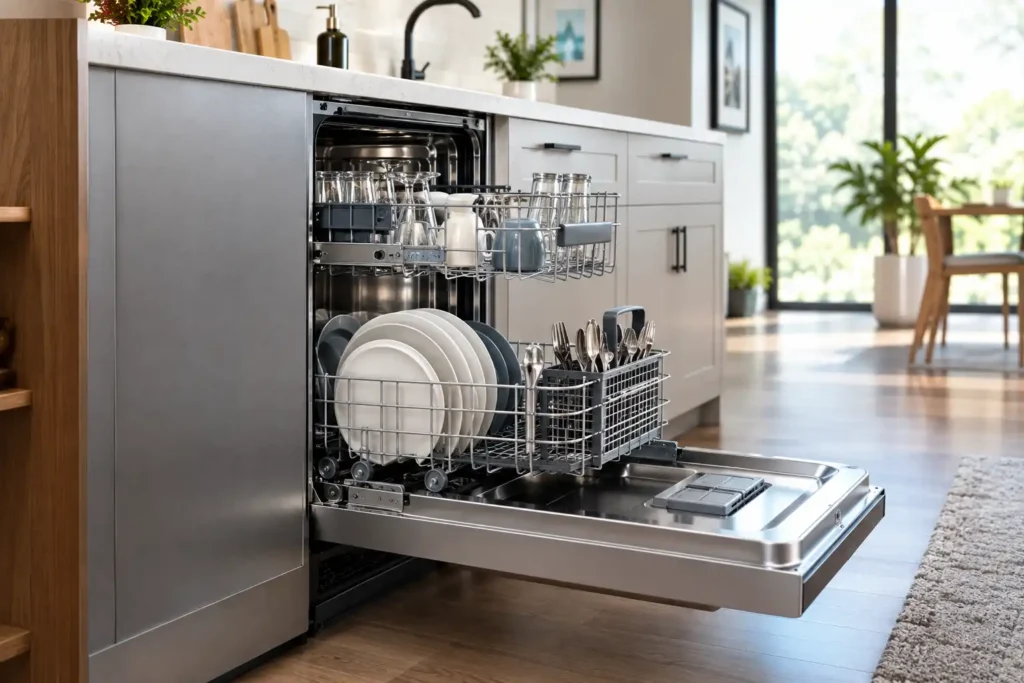
What Is GE Profile?
GE Profile is positioned as a higher-end appliance line within the GE family. In dishwashers, the range emphasizes features beyond basic washing, including more sophisticated wash systems, quiet operation, enhanced drying, third racks, smart connectivity, specialized jets, and technologies intended to control moisture and odors inside the appliance.
This positioning means a GE Profile dishwasher is generally aimed at buyers who want more than a basic machine. Instead of focusing only on getting dishes clean, Profile models attempt to address several common dishwasher frustrations simultaneously: difficult-to-clean cookware, wet plastics, unpleasant interior odors, limited rack space, noisy operation, and uncertainty about the status of a cycle.
The result is a dishwasher family with considerable technological variety. A buyer comparing two Profile models should therefore examine the exact model number rather than assuming that all Profile dishwashers have identical features.
GE Profile Dishwasher Cleaning Performance
Cleaning performance is arguably the most important part of a dishwasher review, and GE Profile has several technologies designed specifically around washing heavily soiled dishes.
Current Profile models use multi-level wash systems, multiple spray arms or wash levels, variable-speed pumps and motors on selected models, bottle jets, dedicated silverware jets, automatic temperature control, and filtration systems. Higher-end UltraFresh models can provide four wash levels, including a washing third rack.
The Piranha hard-food disposer is another important component on many Profile models. Rather than relying entirely on a conventional filter to retain food particles, the system incorporates a hard-food disposal mechanism and removable filtration. This is particularly useful for households that regularly put dishes containing substantial food residue into the dishwasher.
However, a disposer does not eliminate the need for proper dishwasher maintenance. Filters, spray arms, seals and the sump area still need appropriate care, and loading technique remains important because even a sophisticated wash system cannot compensate for dishes blocking one another or spray jets being obstructed. Manufacturer support documentation specifically addresses drainage, filling, washing performance, detergent use and maintenance.
Independent testing provides useful evidence that the washing system can perform strongly. The PDT795SYVFS performed better than average in testing involving heavily soiled dishes, while the related PDT755SYRFS was rated very good for washing. An older Profile model, the PDT846SSJSS, also achieved excellent washing results in laboratory testing.
GE Profile Deep Clean Washing Third Rack
One of the more unusual features on selected GE Profile models is a third rack that is not merely storage space.
The current PDT755 and PDT795 UltraFresh models use a washing third rack. Dedicated water jets can target utensils, spatulas, ramekins and other smaller items placed in this uppermost rack. This provides another washing level rather than simply adding a flat shelf for silverware.
This can be particularly useful for households that frequently wash cooking utensils, measuring cups, small bowls and serving tools. It also makes better use of the vertical space inside a tall-tub dishwasher.
The benefit depends on how you load it. A third rack is most useful when it genuinely replaces items that would otherwise occupy the middle or lower rack. If a household mainly washes large plates, pots and pans, the value of a washing third rack may be lower than it is for a household with many small utensils.
Bottle Jets
Bottle jets are another practical GE Profile feature.
Selected Profile models use dedicated bottle jets designed to direct water and detergent into tall, narrow items. These jets can be useful for reusable bottles, narrow glasses, jars, travel cups and similar containers where conventional spray patterns may have difficulty reaching the interior.
For families using sports bottles or reusable drinking containers every day, this feature can make a noticeable difference in loading flexibility.
It is still important to position bottles correctly. Specialized jets work as part of the dishwasher’s overall spray pattern, so items should not be positioned in a way that blocks the water stream.
Deep Clean Silverware Jets
Silverware can be difficult to clean because food particles can become trapped around forks, spoons, knives and serving utensils.
GE Profile addresses this with Deep Clean Silverware Jets on selected models. The system directs water toward the silverware area to improve cleaning of utensils with stuck-on food.
This feature is particularly relevant for households that frequently wash cutlery with dried-on sauces, cereals, sauces, eggs or other residue.
GE Profile Drying Performance
Drying is one of the areas where modern dishwashers can differ substantially.
A dishwasher may clean dishes extremely well while leaving plastic containers wet. GE Profile therefore offers several drying technologies, including Dry Boost and Twin Turbo Dry Boost, depending on model.
Dry Boost is designed to improve drying of difficult items, with manufacturer specifications stating that certain models can get hard-to-dry items such as plastics up to three times drier than standard heated drying.
The higher-end Twin Turbo Dry Boost system adds two fans and an inline heater to improve air movement and moisture removal. This is particularly relevant to plastic containers and sports bottles, which tend to retain water because plastic does not retain heat like glass or ceramic.
The presence of these technologies does not mean every dish will always emerge completely dry. Dishwasher loading, detergent, rinse aid, cycle selection, ambient conditions and the material of the dish all influence drying results.
GE Profile Twin Turbo Dry Boost
Twin Turbo Dry Boost is one of the more advanced drying systems offered in the Profile range.
Instead of depending only on a conventional heated drying element, the system combines heating with active airflow. This is intended to remove moisture more effectively and improve results on plastics and other challenging items.
For families using large quantities of plastic food containers, reusable bottles and lunch boxes, this feature can be more useful than a simple heated-dry option.
It can also reduce the need to manually towel-dry dishes after the cycle, although results will vary according to load and cycle selection.
Is a GE Profile Dishwasher Quiet?
Noise is one of the strongest reasons some buyers move from a basic dishwasher to a premium model.
Current GE Profile models include machines rated around 44 dBA, 42 dBA and 39 dBA. The PDT795 series is specified at 39 dBA, while the PDT755 series is specified at 42 dBA. The double-drawer model is rated at 45 dBA when one drawer is operating and 48 dBA when both drawers operate.
A lower dBA rating generally corresponds to quieter operation, but the number alone does not tell the entire story. Water entering the machine, drain operation, pump sounds and the particular installation environment can affect what a homeowner actually hears.
Independent testing supports the conclusion that some Profile models are genuinely quiet. Testing of the PDT795SYVFS found that it performed better in noise testing, while the PDT755SYRFS performed very well.
For open-plan kitchens, apartments and homes where the dishwasher operates during conversation, the quieter Profile models can therefore be particularly relevant.
GE Profile Dishwasher Third Rack
A third rack is now common in premium dishwashers, but GE Profile offers several variations.
Some models provide a conventional third rack with a removable caddy, while higher-end models add washing capability through dedicated jets. The third rack can hold silverware, spatulas, lids and smaller utensils, allowing the lower racks to concentrate on plates, bowls, cookware and larger objects.
A full third rack can increase usable loading space without increasing the external size of the dishwasher.
However, households should check the rack height before buying. Large dinner plates, tall glasses and oversized cookware can require adjustments to the upper rack. GE Profile models with adjustable upper racks provide greater flexibility, but the exact rack arrangement differs by model.
GE Profile Stainless-Steel Interior
Stainless-steel interiors are common throughout the current Profile range.
A stainless-steel tub is associated with premium dishwasher construction and is used across models such as the PDT720, PDT755 and PDT795.
One advantage is that stainless steel tolerates the hot, wet dishwasher environment well and is commonly paired with quieter insulation packages.
However, the presence of stainless steel should not be treated as proof that a particular dishwasher is automatically quieter or more reliable. Overall construction, insulation, pump design, rack design and wash system all contribute to the ownership experience.
GE Profile UltraFresh System
UltraFresh is one of the most distinctive features associated with current GE Profile dishwashers.
Traditional dishwashers can retain moisture inside the tub after a cycle. If the door remains closed, that damp environment can contribute to stale odors over time.
UltraFresh addresses this problem by using air circulation and smart controls designed to reduce moisture and refresh the dishwasher interior between cycles. Current systems can circulate fresh air through the dishwasher when it is not operating and use clean water through the sump and filtration system when needed.
This is a useful concept because dishwasher odor is not always caused by dirty dishes. Moisture, trapped food residue, filters and stagnant water can all contribute to unpleasant smells.
UltraFresh does not eliminate the need for maintenance. Cleaning the filter, checking the spray arms, using appropriate detergent and maintaining the dishwasher remain important.
Microban Technology
Selected Profile UltraFresh models also incorporate Microban antimicrobial technology into specific high-touch and internal components.
The technology is intended to inhibit bacterial growth on treated surfaces rather than functioning as a substitute for the dishwasher’s wash and sanitation process. The manufacturer describes treated surfaces as remaining cleaner than untreated surfaces under specified testing conditions.
This distinction matters. Antimicrobial protection should not be interpreted as meaning that the dishwasher sterilizes its entire interior continuously.
Instead, it is another layer of design intended to help keep selected surfaces cleaner between normal dishwasher cycles.
GE Profile Sanitize Cycle
Sanitization is another feature available on many Profile models.
The high-temperature sanitize function is intended to provide a hotter final rinse and reduce bacteria on dishes. Manufacturer specifications describe the sanitize cycle as capable of reducing 99.999% of bacteria under specified conditions.
Sanitize can be useful for households that want additional hygiene for dishes, baby-related items or other situations where a high-temperature cycle is appropriate.
It should not be confused with medical sterilization. A household dishwasher’s sanitize cycle operates within the appliance’s certified cycle parameters and should be used according to the manufacturer’s instructions.
GE Profile Smart Dishwasher Features
Smart connectivity is available on many Profile models.
With built-in Wi-Fi and the SmartHQ system, compatible dishwashers can communicate cycle status, provide notifications and allow certain functions to be monitored remotely. Some models can also support additional cycles or functions through the connected platform.
For example, the PDT795SYVFS includes built-in Wi-Fi, cycle notifications, remote capabilities and additional app-based functions.
Smart functions can be useful, but they should not be the main reason to purchase a dishwasher. Cleaning performance, rack design, noise, drying and serviceability are likely to have a much larger impact on everyday satisfaction.
GE Profile Dishwasher Energy Efficiency
Many current GE Profile models are ENERGY STAR qualified.
For example, the PDT755SYVFS and PDT720SYZFS list annual energy consumption of approximately 240 kWh and are specified as ENERGY STAR qualified models.
Energy consumption depends on the model, cycle selection, drying settings, household usage and local electricity rates. Therefore, the annual figure should be treated as a standardized comparison figure rather than a guarantee of an individual household’s electricity bill.
For buyers comparing dishwashers, the Energy Guide information is more useful than simply looking at the presence or absence of an ENERGY STAR label.
GE Profile Water Efficiency
Water efficiency is closely connected to dishwasher design.
Modern dishwashers recycle and filter water during portions of the wash process rather than continuously using fresh water from the household supply.
Profile’s filtration systems and sensor-based washing systems are designed to manage water and cleaning performance efficiently. Current models use clean sensors, automatic temperature control and filtration systems, with some higher-end models incorporating 100% filtration and hard-food disposal.
Actual water use varies according to cycle and model, so consumers should consult the specific Energy Guide and owner’s documentation for the dishwasher they are considering.
GE Profile Dishwasher Capacity
Most full-size GE Profile dishwashers are designed around the standard 24-inch built-in format.
Current models such as the PDT755SYVFS have approximately 24-inch cabinet dimensions and tall-tub interiors, while selected models can accommodate substantial place-setting capacity.
The third rack effectively expands usable loading space because small items can be moved above the conventional upper rack.
This makes a Profile dishwasher potentially well suited to families, couples who cook frequently, and households that run fewer but fuller dishwasher loads.
GE Profile Double Drawer Dishwasher
One of the most unusual products in the Profile range is the double-drawer dishwasher.
Rather than using one large conventional tub, the design provides two separate dishwasher drawers stacked vertically. Each drawer can be operated independently, meaning a homeowner can wash a smaller load without running the entire dishwasher.
The manufacturer states that each drawer can hold up to seven place settings, with the combined configuration offering up to 14 place settings. The upper drawer can accommodate larger items than the lower drawer in the specified configuration.
This design can be especially useful for households that generate dishes throughout the day rather than all at once.
It also provides a more ergonomic loading height because the drawers can be accessed separately.
The trade-off is that the double-drawer design is fundamentally different from a conventional full-height dishwasher, so buyers should carefully consider how their cookware, plates and serving pieces will fit.
GE Profile Compact Dishwasher
GE Profile also offers a compact smart dishwasher intended for locations where a conventional 24-inch dishwasher may not be practical.
The current compact configuration can be installed on a countertop, built into cabinetry or installed under a sink, depending on the installation requirements. It is designed around approximately six place settings and supports multiple cycles.
This can be relevant for apartments, small kitchens, dorm-style environments, RV applications and secondary kitchen areas.
It should not, however, be treated as a replacement for a full-size dishwasher if a household regularly produces large loads.
GE Profile 18-Inch Dishwasher
An 18-inch Profile dishwasher is another option for smaller kitchens.
The current 18-inch model has an eight-place-setting capacity and stainless-steel tub, with a three-stage manual-clean filtration system and Piranha hard-food disposer.
This size can be useful for apartments, smaller homes, compact kitchens and situations where a 24-inch opening is unavailable.
The main compromise is capacity. Families that frequently wash large loads may find the 18-inch configuration restrictive compared with a standard full-size dishwasher.
GE Profile Dishwasher Reliability
Reliability is one of the most difficult categories to judge because it requires long-term ownership data rather than a list of features.
Independent reliability research combines owner surveys and model testing rather than simply assuming that a premium price guarantees greater reliability. Current independent testing of Profile models includes owner satisfaction and predicted reliability as separate components of overall evaluation.
That distinction is important.
A dishwasher can have excellent washing performance but still experience component failures over time. Conversely, a simpler dishwasher may have fewer features and fewer electronic components but may not offer the same washing or drying capabilities.
For this reason, buyers should examine the exact Profile model, warranty, service availability and parts support rather than relying solely on the Profile brand name.
GE Profile Warranty
Current U.S. Profile dishwasher specifications generally show a limited one-year warranty covering the appliance, although the exact warranty wording and whether labor is in-home can differ between models. For example, the PDT755SYVFS lists a limited one-year parts and labor warranty, while the PDT775SYNFS specifies a full one-year in-home labor warranty with limited one-year parts coverage.
In Canada, the standard manufacturer’s warranty is generally one year, with specific models potentially carrying additional coverage for particular components. The exact terms should always be checked against the model’s Canadian warranty documentation.
Warranty coverage should therefore be considered alongside the availability of authorized service in your region.
GE Profile Service and Maintenance
GE provides model-specific dishwasher support covering problems such as failure to drain, failure to fill, washing problems, blinking lights, detergent issues and other common dishwasher faults. The manufacturer also provides model-specific service and parts resources.
Maintenance remains important even with an advanced dishwasher.
The filter should be maintained according to the owner’s manual, spray arms should remain unobstructed, detergent should be used appropriately, and the dishwasher should not be overloaded.
Hard-water households may need additional attention because mineral deposits can accumulate on spray components, heating elements, filters and interior surfaces.
GE Profile Dishwashers and Hard Water
Hard water can affect virtually any dishwasher.
Calcium and magnesium minerals can leave deposits on glassware and interior components. Over time, mineral accumulation can affect spray performance and heating efficiency.
A GE Profile dishwasher does not eliminate hard-water problems simply because it has sophisticated washing technology.
Homes with hard water should pay attention to detergent selection, rinse aid use, filter maintenance and cleaning procedures appropriate for their water conditions.
In regions with particularly hard water, the household water-softening system may be more important than the dishwasher brand itself.
Common GE Profile Dishwasher Problems
Like any appliance, GE Profile dishwashers can experience problems.
Common categories include failure to drain, poor cleaning, poor drying, unusual noises, water filling problems, leaks, blinking lights and error conditions. The manufacturer’s support system specifically provides troubleshooting information for several of these categories.
A dishwasher that does not drain may have an obstruction in the drain system.
A dishwasher that does not fill may have a problem involving the water supply or flood-control components.
Poor washing can result from loading, detergent, spray-arm obstruction, filtration issues or other mechanical problems.
Poor drying can be affected by cycle selection, rinse aid, loading and the type of materials being washed.
These symptoms do not automatically indicate a failed pump or electronic control board.
Is GE Profile Good for Large Families?
A full-size GE Profile dishwasher can be a practical option for a large household because the 24-inch format, tall-tub design and third rack provide substantial loading flexibility.
The third rack is especially helpful because small utensils can be moved away from the main racks. Models with adjustable upper racks can also make room for larger cookware and tall glasses.
Families should pay particular attention to place-setting capacity and rack layout rather than simply assuming that all 24-inch dishwashers have equivalent usable space.
Is GE Profile Good for Apartments?
The answer depends on the apartment’s available opening, noise requirements and plumbing arrangement.
The quieter Profile models can be relevant to open-plan apartments because several models operate in the low-40-dBA range and the highest-end models can reach 39 dBA.
For small apartments, the 18-inch or compact Profile configurations may be more appropriate.
However, installation compatibility should always be checked before purchase.
GE Profile for Open-Plan Kitchens
Noise becomes especially important when the kitchen and living room occupy the same space.
A 39–42 dBA dishwasher is designed to minimize audible operation compared with louder traditional machines. Independent testing of current Profile models also found strong noise performance.
This makes quieter Profile models relevant to open kitchens, apartments and households that prefer running the dishwasher while people are eating, working or watching television.
GE Profile for Plastic Containers
Plastic is one of the hardest materials to dry in a dishwasher.
The material does not retain heat as effectively as ceramic or glass, so water droplets can remain after the cycle.
GE’s Dry Boost and Twin Turbo Dry Boost technologies specifically target this issue. Certain models are designed to improve drying of plastics through enhanced heat and airflow.
For households that use plastic food containers every day, this is one of the more meaningful reasons to consider a higher-level Profile model.
GE Profile Dishwasher Energy and Running Cost
A dishwasher’s operating cost is determined by electricity consumption, water consumption, cycle selection and local utility rates.
Current Profile models such as the PDT755SYVFS and PDT720SYZFS list approximately 240 kWh of annual energy use under standardized conditions.
To estimate annual electricity cost, multiply the dishwasher’s annual kWh figure by your local electricity price.
For example, at an electricity price of $0.20 per kWh, 240 kWh would represent approximately $48 per year for electricity under the standardized annual consumption figure.
Actual household cost can be higher or lower depending on usage.
GE Profile Dishwasher Installation
Most full-size Profile dishwashers are designed for standard 24-inch openings.
Current specifications commonly show approximately 23.75 inches of product width, 24 inches of cabinet depth and approximately 34 inches of overall height, with installation height adjustment available.
Before purchasing, measure the opening rather than relying on the nominal 24-inch description.
Also check the location of the water supply, drain connection, electrical connection, flooring height and countertop clearance.
GE Profile in the USA
The United States is the core market for the current GE Profile dishwasher portfolio.
The current U.S. range includes multiple 24-inch Profile models, smart UltraFresh models, compact products, an 18-inch option and the double-drawer dishwasher.
The United States also uses 120-volt electrical specifications for these models, meaning that the North American models should not simply be purchased and connected to a different electrical system without checking compatibility.
GE Profile in Canada
GE Profile dishwashers are also offered in Canada.
The Canadian range includes UltraFresh System models with Microban technology, third racks, Dry Boost, Wi-Fi connectivity, bottle jets and other features depending on model.
Canadian buyers should select Canadian-market model numbers whenever possible because pricing, warranty terms, availability, installation services and model configurations can differ from the United States.
GE Profile in the UK
UK buyers need to be more careful.
The current GE Profile dishwasher portfolio researched for this review is primarily configured around North American products, including 120-volt electrical specifications and North American dimensions. Current manufacturer materials prominently identify the United States and Canada as the main dishwasher markets.
Therefore, a UK consumer should not assume that a U.S. GE Profile dishwasher can simply be imported and installed.
Voltage, frequency, plumbing connections, physical dimensions, installation requirements, warranty coverage, spare parts and authorized service availability should all be confirmed before importing a North American model.
For UK buyers, a dishwasher specifically sold and supported for the UK market may be more straightforward than importing a North American Profile model.
GE Profile Pros
Strong washing technology
Multiple spray levels, specialized jets, variable-speed pumps on selected models and hard-food disposal systems provide a sophisticated approach to cleaning.
Excellent quiet-operation options
Current Profile models extend into the low-40-dBA range, with selected premium models reaching 39 dBA.
Strong drying options
Dry Boost and Twin Turbo Dry Boost address one of the most common dishwasher complaints: wet plastics.
Third racks
Many Profile models provide third-rack storage, while selected UltraFresh models add dedicated washing jets to the third rack.
Smart features
Wi-Fi connectivity and app-based monitoring are available on many current models.
UltraFresh System
Selected models actively address moisture and odor concerns between cycles.
Multiple configurations
The range includes standard 24-inch models, 18-inch models, compact models and a double-drawer design.
GE Profile Cons
Higher purchase price
The additional washing, drying, noise-control and smart technologies place many Profile models in the premium portion of the dishwasher market.
Feature differences between models
Not every Profile dishwasher has UltraFresh, Twin Turbo Dry Boost, a washing third rack or the same number of spray levels.
More technology can mean more complexity
Wi-Fi, sensors, fans, multiple pumps, electronic controls and specialized wash systems provide additional functionality but also create more components than a basic dishwasher.
Some cycles can be long
Independent testing of the PDT795SYVFS specifically found cycle time to be its weakest tested category despite strong washing, energy and noise performance.
UK compatibility requires special attention
North American Profile models use electrical specifications that should not be assumed to be compatible with standard UK installation requirements.
GE Profile Dishwasher Review: Who Should Buy One?
A GE Profile dishwasher makes the most sense for buyers who place substantial value on quiet operation, advanced drying, flexible racks and specialized cleaning features.
It is particularly relevant for households that regularly wash plastic containers, reusable bottles, cooking utensils and heavily soiled dishes.
It can also make sense for open kitchens where noise is important.
The UltraFresh models are particularly interesting for households concerned about moisture and dishwasher odors because the system is specifically designed to refresh the interior between cycles.
Who May Not Need a GE Profile Dishwasher?
A buyer who simply wants a basic dishwasher to clean plates, bowls and glasses may not need the additional technology of the Profile range.
If Wi-Fi, third racks, specialized bottle jets and advanced drying are not important, a less expensive dishwasher may satisfy the same basic cleaning requirement.
Similarly, buyers who rarely use plastic containers may place less value on advanced drying technology.
The right choice therefore depends on how the dishwasher will actually be used rather than how many features appear on the specification sheet.
What to Check Before Buying a GE Profile Dishwasher
Before purchasing, check these points carefully:
- Exact model number
- Noise rating
- Third-rack configuration
- Whether the third rack has washing jets
- Dry Boost or Twin Turbo Dry Boost
- UltraFresh availability
- Microban protection
- Bottle jets
- Silverware jets
- Hard-food disposer
- Filter design
- Number of wash levels
- Place-setting capacity
- Upper-rack adjustability
- Energy consumption
- Sanitize-cycle availability
- Wi-Fi capability
- Warranty
- Local service availability
- Electrical requirements
- Cutout dimensions
- Door clearance
- Water and drain connections
- Availability of replacement parts
These details can differ significantly between Profile models.
GE Profile Dishwasher Review: Final Assessment
GE Profile represents a feature-rich dishwasher family rather than a single appliance. The strongest models combine advanced washing systems, specialized jets, stainless-steel interiors, third racks, quiet operation, improved drying, smart connectivity and, on selected models, the UltraFresh System with Microban technology.
Independent testing provides evidence that some Profile models perform particularly well in washing, energy consumption and noise. The PDT795SYVFS, for example, performed better in washing and noise testing and performed best in its energy test, although its cycle-time result was weaker. The PDT755SYRFS also produced very good washing and noise results with excellent energy performance in independent testing.
The biggest strength of the GE Profile range is its combination of cleaning and convenience features. Bottle jets, silverware jets, third-rack washing, hard-food disposal, enhanced drying and quiet operation address practical problems that many dishwasher owners encounter.
The biggest consideration is complexity and model selection. A GE Profile dishwasher should not be purchased simply because it carries the Profile name. Buyers should compare the exact model’s rack system, drying technology, noise rating, wash system, energy use, warranty and service support.
For U.S. and Canadian consumers, the current range provides several configurations capable of meeting very different household requirements.
For UK consumers, the critical issue is market compatibility. North American models use electrical specifications and installation standards that should be verified before any import purchase. A locally supported model with appropriate electrical requirements and warranty coverage should be considered where available.
Overall, the GE Profile range is most compelling for consumers who want a quiet, technologically advanced dishwasher and are prepared to pay for features beyond basic washing. The exact model remains more important than the brand name alone.
Frequently Asked Questions About GE Profile Dishwashers
1. Are GE Profile dishwashers good?
GE Profile dishwashers offer advanced cleaning systems, third racks, specialized jets, enhanced drying and quiet operation. Independent testing of several Profile models has also shown strong washing, energy and noise results.
2. Is GE Profile better than regular GE?
Profile generally provides more premium features and configurations than standard GE dishwashers. The exact difference depends on the models being compared.
3. Are GE Profile dishwashers quiet?
Many current Profile models are designed for quiet operation, with models rated around 39, 42 or 44 dBA.
4. What is the quietest GE Profile dishwasher?
The PDT795 series is specified at 39 dBA, making it one of the quietest current Profile configurations.
5. Does GE Profile have a third rack?
Yes. Many Profile models have a third rack, and selected UltraFresh models provide washing capability in the third rack.
6. Does the GE Profile third rack wash dishes?
Selected models do. The Deep Clean Washing 3rd Rack uses dedicated jets to wash items placed in the third rack.
7. Does GE Profile have bottle jets?
Yes. Selected models have dedicated bottle jets designed to direct water into narrow and tall containers.
8. Does GE Profile have a hard-food disposer?
Many current Profile models use the Piranha hard-food disposer together with a removable filter.
9. Does GE Profile dry plastic well?
Models equipped with Dry Boost or Twin Turbo Dry Boost are specifically designed to improve drying of difficult items such as plastics.
10. What is Twin Turbo Dry Boost?
It combines fans and heating technology to improve moisture removal and drying performance, particularly on difficult-to-dry items.
11. What is UltraFresh on a GE Profile dishwasher?
UltraFresh is a system designed to reduce moisture and help control odors inside the dishwasher between cycles by circulating fresh air and managing the dishwasher’s internal environment.
12. Does GE Profile use Microban?
Selected Profile UltraFresh models incorporate Microban antimicrobial protection into specified surfaces and components.
13. Does GE Profile have Wi-Fi?
Many current Profile dishwashers have built-in Wi-Fi, while some models may require an optional connectivity accessory. Always check the exact model specification.
14. Can you control a GE Profile dishwasher from a phone?
Compatible smart models can be monitored and controlled through the connected app, with functions varying by model.
15. Does GE Profile have a sanitize cycle?
Many Profile models provide a sanitize function or high-temperature sanitation option. The exact availability should be checked for the specific model.
16. Are GE Profile dishwashers ENERGY STAR certified?
Many current Profile models are ENERGY STAR qualified.
17. How much electricity does a GE Profile dishwasher use?
Several current Profile models list approximately 240 kWh per year under standardized conditions. Actual household consumption varies with cycles and usage.
18. How long do GE Profile dishwashers last?
There is no reliable single lifespan that applies to every Profile model. Actual service life depends on usage, installation, water quality, maintenance, component durability and repairs.
19. Are GE Profile dishwashers reliable?
Reliability should be evaluated at the model level rather than assumed from the Profile name. Independent evaluation incorporates both laboratory testing and owner-survey information.
20. Do GE Profile dishwashers have stainless-steel tubs?
Many current Profile models use stainless-steel interiors.
21. Are GE Profile dishwashers good for hard water?
They can work in hard-water homes, but hard water still requires appropriate detergent, rinse aid and maintenance practices. No dishwasher completely eliminates mineral deposits.
22. Are GE Profile dishwashers good for large families?
Full-size 24-inch models with tall tubs and third racks can provide substantial loading capacity and flexibility.
23. Does GE Profile make an 18-inch dishwasher?
Yes. A current Profile 18-inch model provides eight place settings and a stainless-steel interior.
24. Does GE Profile make a compact dishwasher?
Yes. The Profile range includes a compact model designed for countertop, built-in or under-sink installation depending on the configuration.
25. Does GE Profile make a double-drawer dishwasher?
Yes. The Profile PDD415PYYFS is a double-drawer dishwasher with separate upper and lower drawers.
26. Can you run only one drawer of the GE Profile double dishwasher?
Yes. The double-drawer design allows one drawer to operate while the other remains available for loading.
27. How many place settings does the GE Profile double drawer hold?
The manufacturer describes the configuration as providing up to 14 place settings, with each drawer capable of holding up to seven place settings.
28. Does GE Profile have a removable filter?
Many current models combine removable filtration with the Piranha hard-food disposer.
29. Does GE Profile require rinse aid?
Rinse aid can improve drying performance, particularly for plastics and other difficult-to-dry items. Follow the instructions for the specific model and detergent system.
30. Why are my GE Profile dishes still wet?
Possible causes include cycle selection, insufficient rinse aid, loading patterns, plastic materials, blocked airflow or dishwasher settings. Models with enhanced drying technology can improve results but cannot make every material equally dry.
31. Why does my GE Profile dishwasher smell?
Odors can be associated with food residue, filters, stagnant moisture, drainage problems or infrequent maintenance. UltraFresh-equipped models are specifically designed to help manage moisture and odor between cycles.
32. Does UltraFresh mean the dishwasher never needs cleaning?
No. Filters, spray arms, seals and other components still require maintenance according to the owner’s manual.
33. Are GE Profile dishwashers expensive?
They are positioned as a premium range, and advanced models generally cost more than basic dishwasher configurations.
34. Is a GE Profile dishwasher worth the extra money?
The answer depends on which features you will actually use. Buyers who value quiet operation, third-rack washing, advanced drying, specialized jets and smart functions may place greater value on Profile’s additional features.
35. Does GE Profile have long wash cycles?
Some models can have long cycles, particularly when using options designed for heavily soiled dishes or enhanced drying. Independent testing of the PDT795SYVFS specifically found cycle time weaker than its washing, energy and noise results.
36. Are GE Profile dishwashers good for open kitchens?
The quieter Profile models can be particularly suitable for open kitchens because several current models operate in the low-40-dBA range or below.
37. Does GE Profile offer a fingerprint-resistant finish?
Selected models are available with fingerprint-resistant stainless finishes.
38. What warranty comes with a GE Profile dishwasher?
Many current U.S. models have a one-year warranty, although the exact parts and labor terms vary by model. Canadian warranty terms also generally begin with a one-year manufacturer’s warranty, subject to model-specific provisions.
39. Can GE service a Profile dishwasher?
The manufacturer provides dishwasher troubleshooting, parts and service resources and model-specific support.
40. Can I import a GE Profile dishwasher into the UK?
It should not be assumed to be straightforward. North American Profile models use specifications such as 120V/60Hz, so UK buyers must verify electrical compatibility, installation requirements, warranty coverage and local service before importing.
41. Is GE Profile better for families or couples?
Both can benefit from Profile, but the most useful features differ. Families may value capacity, third-rack washing and specialized jets, while couples may value quiet operation, flexible loading and the ability to run smaller loads.
42. Does GE Profile clean pots and pans?
Profile models are designed for heavily soiled dishes and use multiple spray levels, specialized jets and high-temperature washing technologies on selected models. Proper loading remains important.
43. Does GE Profile have a food grinder?
Selected models use the Piranha hard-food disposer combined with filtration.
44. Is the GE Profile third rack removable?
Selected models use removable third-rack components or removable caddies. The exact design depends on the model.
45. What should I check before buying a GE Profile dishwasher?
Check the exact model number, dimensions, noise level, third-rack design, drying technology, wash system, energy consumption, electrical requirements, warranty and local service availability.
46. Are all GE Profile dishwashers the same?
No. Features vary considerably between models, including noise level, drying system, third-rack design, Wi-Fi, wash levels, UltraFresh availability and configuration.
47. Does GE Profile make a portable dishwasher?
The broader GE dishwasher portfolio includes portable dishwashers, but buyers should distinguish standard GE portable models from the specific Profile lineup.
48. Is the GE Profile dishwasher good for plastic bottles?
Models equipped with bottle jets and advanced drying can be particularly useful for reusable bottles. Bottle jets target the inside of narrow containers, while enhanced drying helps reduce residual moisture.
49. What is the biggest advantage of GE Profile?
The main distinguishing characteristic is the combination of advanced washing, drying, quiet operation, rack flexibility and smart features rather than one single technology.
50. What is the biggest thing to watch when buying GE Profile?
Do not compare only the brand name. Compare the exact model number and verify the features you actually need, because two Profile dishwashers can have significantly different wash, dry, rack and connectivity systems.
Final Verdict on GE Profile Dishwashers
GE Profile dishwashers are designed for consumers who want a more sophisticated dishwasher than a basic machine. The current lineup offers strong cleaning technology, quiet operation, third racks, specialized jets, enhanced drying, smart connectivity and the distinctive UltraFresh system on selected models.
Independent testing of multiple Profile models supports strong performance in important categories such as washing, energy efficiency and noise, although cycle time can be a weakness on certain models.
For USA and Canada, the range provides several configurations suitable for different kitchen sizes and household requirements. For UK buyers, electrical compatibility and local support require particular attention before considering a North American model.
The most important lesson from this GE Profile dishwasher review is that the individual model matters more than the Profile name alone. A buyer should choose based on the combination of cleaning performance, drying requirements, noise level, rack design, capacity, maintenance needs, energy use, warranty and service availability.
That approach provides a much more useful way to evaluate whether a particular GE Profile dishwasher fits a household than simply judging the brand as a whole.