
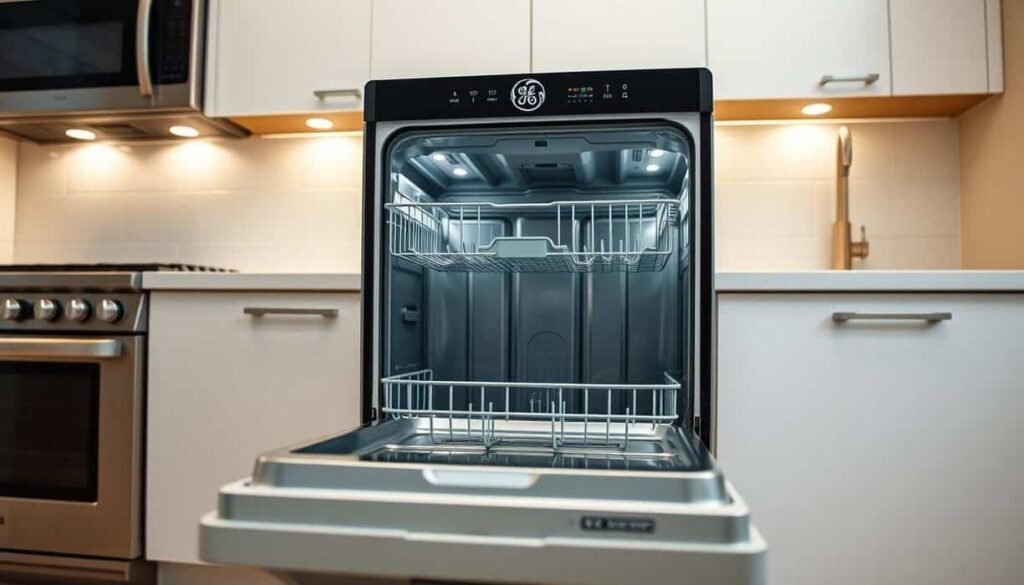
The GE GDP645SYNFS is a 24-inch built-in dishwasher designed for households that want a combination of practical cleaning features, flexible loading arrangements, enhanced drying, and a stainless-steel interior. It belongs to GE’s conventional built-in dishwasher range and includes features such as Dry Boost with fan assistance, bottle-washing jets, an adjustable upper rack, a hard-food disposer, a sanitizing cycle, and selectable wash zones.
At first glance, the GDP645SYNFS appears to offer an attractive balance between everyday convenience and more advanced dishwasher technology. Its hidden top-mounted controls create a clean exterior appearance, while the fingerprint-resistant stainless-steel finish is intended to reduce the visible smudges that often accumulate on appliance doors. Inside, the stainless-steel tub provides a more premium interior finish than the plastic tubs found in some budget-oriented dishwashers.
The model also has a relatively quiet published operating rating of 48 decibels, making it an interesting option for households with open-plan kitchens. Its adjustable upper rack and dedicated bottle jets add flexibility for people who regularly wash different types of dishes, drinking glasses, and reusable containers.
However, the most important question is not how many features a dishwasher offers, but how well those features perform in everyday use. Independent laboratory testing of the GDP645SYNFS found that its cleaning results were mixed. Its Heavy cycle performed comparatively well, but food particles could redeposit on dishes, and its enhanced drying setting could add considerable time to a wash cycle.
These findings make the GDP645SYNFS a more nuanced purchase than its specification sheet might suggest. It has several worthwhile advantages, but prospective buyers should understand its limitations before choosing it over a competing dishwasher.
Another important consideration is its age. GE lists the manufacturing period as August 2019 through June 2023, and the model is no longer being manufactured. Consequently, buyers in 2026 should pay particular attention to availability, warranty coverage, replacement parts, and the condition of any remaining stock or refurbished units.
This detailed review examines the dishwasher’s design, cleaning performance, drying system, noise level, energy efficiency, loading flexibility, reliability considerations, maintenance requirements, and suitability for households in the United States, Canada, and the United Kingdom.
GE GDP645SYNFS Specifications at a Glance
The following table summarizes the principal specifications and features of the GDP645SYNFS.
| Specification | Details |
|---|---|
| Brand | GE |
| Model number | GDP645SYNFS |
| Appliance type | Built-in dishwasher |
| Exterior finish | Fingerprint-resistant stainless steel |
| Control location | Top-mounted, concealed when the door is closed |
| Nominal width | 23.75 inches |
| Overall height | Approximately 34 inches |
| Overall depth | Approximately 24 inches |
| Interior tub | Stainless steel |
| Published noise rating | 48 dBA |
| Listed capacity | Up to 16 place settings |
| Main wash cycles | AutoSense, Heavy, Normal, Light, and 1 Hour |
| Drying system | Dry Boost with fan assistance |
| Heated drying | Yes |
| Upper rack | Adjustable |
| Bottle-washing jets | Four |
| Food-disposal system | Piranha hard-food disposer |
| Sanitize function | Yes |
| Steam prewash | Yes |
| Selectable wash zones | Upper or lower rack |
| Delayed start | 1–12 hours |
| Energy certification | ENERGY STAR qualified |
| Smart connectivity | Optional Wi-Fi adapter, depending on configuration and availability |
| Manufacturing period | August 2019–June 2023 |
| Current production status | Discontinued |
These specifications apply to the North American GDP645SYNFS configuration. Buyers should consult the documentation for the exact appliance being offered, especially when comparing closely related model numbers.
The published dimensions are important when replacing an existing dishwasher. Although the model belongs to the standard 24-inch category, the stated width is approximately 23.75 inches. The actual installation opening, floor height, countertop clearance, plumbing connections, and electrical arrangement must all comply with the installation instructions.
The capacity of 16 place settings is a manufacturer-listed maximum. It does not mean that every household can fit 16 fully occupied place settings alongside bulky cookware, large serving bowls, and oversized containers in every load.
The 48 dBA noise rating is another important specification. It places the dishwasher in a relatively quiet category for everyday residential use, although actual sound levels and perceived noise will depend on the installation and operating conditions.
Design and Exterior Appearance
The GDP645SYNFS has a modern, understated appearance that should suit many conventional and contemporary kitchens. Its fingerprint-resistant stainless-steel exterior provides a neutral metallic finish that can coordinate with refrigerators, ovens, microwaves, and other stainless-steel appliances.
The fingerprint-resistant treatment is particularly useful in busy kitchens. Stainless-steel doors can quickly accumulate fingerprints, greasy marks, and smudges, especially in homes where several family members operate the dishwasher throughout the day. The special finish is intended to make these marks less noticeable and routine cleaning easier.
It does not make the door completely resistant to dirt or fingerprints, but it can help maintain a cleaner appearance between wipe-downs.
One of the most noticeable design features is the top-mounted control panel. The buttons sit along the upper edge of the door and are concealed when the dishwasher is closed. This creates a more streamlined front compared with models that have a visible control panel across the upper portion of the door.
The concealed controls also reduce the likelihood of accidental button presses while the dishwasher is closed. However, users need to become familiar with the indicator lights and display arrangements because the main controls are not visible during operation.
The door has a full-length appearance and a pocket-style handle integrated into the overall design. This keeps the exterior relatively uncluttered and avoids the prominent projecting handle found on some traditional models.
The GDP645SYNFS is a built-in appliance rather than a portable or countertop dishwasher. It is intended to be installed beneath a kitchen countertop and secured according to the manufacturer’s instructions.
Overall, its exterior design is a strength. The combination of concealed controls and fingerprint-resistant stainless steel gives it a more refined appearance than many entry-level dishwashers, without requiring a fully integrated custom cabinet panel.
Stainless-Steel Interior: Why It Matters
The GDP645SYNFS has a stainless-steel tub, which is an important distinction for buyers comparing it with dishwashers that use a plastic interior.
A stainless-steel tub provides a durable interior surface and is generally more resistant to staining and discoloration than many plastic alternatives. It can also tolerate the repeated exposure to hot water and detergents that occurs during normal dishwasher operation.
Another advantage is its relationship with drying. Stainless steel can retain heat during a wash cycle, helping support evaporation and drying under suitable operating conditions. Nevertheless, the tub material alone does not guarantee that all dishes will emerge completely dry.
Plastic containers can still retain water droplets because of their material properties and surface shapes. Concave cups, recessed bases, and lids with channels may also trap water even when the rest of the load dries satisfactorily.
The stainless-steel interior gives the GDP645SYNFS a more premium specification than a basic plastic-tub dishwasher. However, it should not automatically be interpreted as evidence that the entire appliance will last longer. Overall durability depends on the quality and condition of the pumps, heating system, electronics, seals, racks, and other components.
For buyers who specifically prefer stainless-steel interiors, the GDP645SYNFS is worth considering. For those whose main priorities are cleaning performance and repair costs, the tub material should be one factor among several rather than the deciding consideration.
Loading Capacity and Rack Design
The dishwasher has a listed capacity of up to 16 place settings, making it suitable for households that regularly wash substantial quantities of dishes.
The lower rack accommodates plates, serving dishes, pots, pans, and larger kitchen items. The upper rack is intended for glasses, cups, bowls, and smaller dishes. Its adjustable-height design allows users to change the available vertical clearance when loading different combinations of items.
This adjustability is especially useful when washing tall drinking glasses, reusable bottles, or large platters. Instead of having to fit every item around a fixed rack height, users can adapt the interior to suit the load.
The upper rack can accommodate items up to approximately 10.5 inches tall under the manufacturer’s specified configuration. The exact clearance depends on the rack position and the space occupied by other dishes, so buyers should consult the loading diagrams before assuming that a particularly tall item will fit.
The racks include practical features such as stemware supports and utensil accommodation. These details help keep selected items in position and reduce unnecessary movement during washing.
Nevertheless, loading capacity should be judged by the types of dishes a household actually uses. Large dinner plates, deep mixing bowls, bulky frying pans, and tall tumblers can occupy substantially more room than standard place-setting measurements suggest.
It is also important to avoid overcrowding. Even a large-capacity dishwasher cannot clean effectively if dishes block the spray arms, prevent detergent from reaching surfaces, or nest together so tightly that water cannot circulate.
The adjustable upper rack is one of the model’s useful everyday features. It provides more flexibility than a fixed rack arrangement, particularly for households that alternate between ordinary dinnerware and larger cookware.
Bottle-Washing Jets: A Useful Feature for Reusable Containers
The GDP645SYNFS includes four dedicated bottle-washing jets in the upper rack. These jets direct water into suitable tall containers, helping clean interior surfaces that can be difficult to reach with a dishwasher’s general spray pattern.
This feature is particularly relevant to households that use reusable water bottles, narrow drinking glasses, tall jars, and certain other containers. Such items can be challenging to clean because their openings restrict the flow of water and make it harder to remove residue from the bottom.
The dedicated jets are intended to direct water and detergent into the containers, improving access to their internal surfaces.
Their effectiveness depends on positioning. Containers must fit correctly over the jets, and their openings must allow water to enter. If a bottle is placed incorrectly, it may not receive the intended spray coverage.
The jets also do not make every bottle dishwasher-safe. Some insulated containers, vacuum-sealed bottles, decorated glassware, and products with special coatings must be washed by hand or placed only in a specified rack. Always follow the container manufacturer’s care instructions.
For people who regularly wash reusable bottles, this feature can be a meaningful convenience. For households that mainly wash standard plates and cups, it may be less important than the dishwasher’s cleaning consistency, drying performance, or reliability.
Cleaning Performance: How Well Does the GDP645SYNFS Wash Dishes?
Cleaning performance is the central issue in this review, and independent laboratory testing provides a more balanced picture than the manufacturer’s feature descriptions alone.
Testing published in 2020 found that the GDP645SYNFS could clean dishes reasonably well, particularly on its Heavy cycle. However, the results also revealed a problem with redeposit: small food particles could remain on dishes or be transferred back onto surfaces during washing.
Redeposit occurs when food residue is not adequately removed from the wash water and subsequently lands on dishes. A plate may therefore appear mostly clean but still have small food specks remaining after the cycle.
This issue matters because cleaning should be judged by the finished load, not simply by the amount of soil removed from the original dishes. A dishwasher that removes most food residue but redistributes some of it can still leave users disappointed.
The independent test reported cleaning results of approximately 98.1% for the Normal cycle and 99.6% for the Heavy cycle under its specific laboratory conditions. These figures should not be interpreted as universal household cleaning percentages, because results depend on the test method, soil mixture, load arrangement, and operating settings.
The findings suggest that the Heavy cycle is the stronger option for more demanding loads, while the Normal cycle is better suited to ordinary everyday dishes. However, the redeposit issue means that loading practices and filter maintenance are particularly important.
The dishwasher’s AutoSense cycle is designed to detect the soil level and amount of dishes, adjusting the wash settings accordingly. This can reduce the need for users to select a cycle entirely by guesswork.
The Light cycle offers another option for less demanding loads, while the one-hour program provides a faster alternative when the dishes do not require an extended intensive wash.
No cycle should be expected to deliver identical results under every condition. Dried-on cheese, baked-on food, greasy pans, and heavily soiled dishes can present different challenges from recently used plates and cups.
Overall, the GDP645SYNFS offers capable cleaning in some conditions, but its independent test results are not consistently outstanding. Buyers who expect spotless results from every cycle should give this limitation serious consideration.
Heavy Cycle Performance
The Heavy cycle is one of the more encouraging aspects of the GDP645SYNFS. Independent testing found that it produced the strongest cleaning results among the principal cycles evaluated.
This makes it the most appropriate choice for loads containing heavily soiled plates, pots, pans, and dishes with stubborn food residue, provided the items are dishwasher-safe.
The cycle is designed for more demanding cleaning conditions than a normal everyday wash. Its performance is particularly relevant for households that regularly cook meals from scratch and wash cookware with substantial food deposits.
However, stronger cleaning does not eliminate the need for proper loading. Large items should be positioned so they do not obstruct the spray arms, and dishes should be arranged to allow water to reach their surfaces.
It is also important to keep expectations realistic. Independent testing identified redeposit as a broader limitation of the appliance, so the Heavy cycle should not be regarded as an absolute guarantee of perfect results.
The cycle may also take longer than a lighter program. This is a reasonable trade-off when the load requires intensive cleaning, but it may be inconvenient for users who frequently need dishes returned to service quickly.
For households with demanding cleaning requirements, the Heavy cycle is a meaningful strength. It is also a reason to keep the filter clean and use appropriate detergent, because these practices can help the dishwasher perform more consistently.
Normal Cycle Performance
The Normal cycle is intended for everyday dishwashing, including ordinary plates, glasses, cups, and cutlery.
Independent testing found that it removed much of the tested soil, but its results were affected by redeposit. This means that some dishes could emerge with small food particles remaining despite appearing largely clean.
For lightly or moderately soiled household loads, the Normal cycle may be adequate. However, users who regularly wash dishes with dried-on food may find that they need to select the Heavy cycle more often than expected.
The way dishes are loaded can influence the outcome. Overlapping plates, nested bowls, and blocked spray arms can prevent water from reaching the areas that need cleaning. Food scraps should be removed before loading, even though the dishwasher has a built-in food disposer.
A suitable detergent and rinse aid can also help support consistent results. Users should follow the product instructions rather than assuming that more detergent will necessarily improve cleaning.
The Normal cycle remains an important everyday program, but the independent findings suggest that the GDP645SYNFS performs best when users pay attention to loading, soil level, and routine maintenance.
AutoSense and One-Hour Wash
AutoSense is designed to adjust wash conditions according to the detected soil level and the amount of dishes in the load. This makes it a convenient option for households that wash different combinations of dishes throughout the week.
Rather than requiring users to choose an intensive cycle every time, AutoSense attempts to match the wash to the load. Its actual duration and resource use may vary depending on the detected conditions.
The one-hour cycle serves a different purpose. It is intended for faster turnaround when dishes need to be cleaned without waiting for a longer program.
A shorter cycle can be useful after breakfast, for a lightly soiled load, or when clean dishes are needed relatively quickly. However, it should not be treated as a guaranteed substitute for a heavy-duty cycle when food is dried onto cookware or plates.
The one-hour program’s convenience depends on the load and the level of cleaning required. Choosing the correct program is generally more effective than using the fastest cycle for every situation.
Together, AutoSense and the one-hour program provide flexibility, although neither removes the need to understand the limitations of the dishwasher’s cleaning system.
Drying Performance: Is Dry Boost Effective?
Drying performance is one of the most important factors to evaluate when choosing the GDP645SYNFS. A dishwasher can clean dishes reasonably well but still be inconvenient if glasses, plastic containers, and bowls remain wet when the cycle ends.
GE equips this model with Dry Boost technology and fan assistance, designed to remove moist air and improve drying results. The system is particularly relevant for difficult-to-dry items, including plastic food containers and their lids.
The manufacturer states that Dry Boost can make difficult-to-dry items up to three times drier than standard heated-dry dishwashers. This is a manufacturer comparison, not a guarantee that every item will be completely dry after every cycle.
Independent testing identified a significant trade-off between drying effectiveness and cycle duration. With the enhanced drying setting disabled, dishes were noticeably wet after washing. Enabling the enhanced drying option improved results considerably, but it also extended cycle times substantially.
In one test, the Normal cycle took approximately 78 minutes with the enhanced drying setting disabled and around 183 minutes with it enabled. These are laboratory observations rather than guaranteed cycle times for every household.
This distinction is important for buyers who want both rapid operation and completely dry dishes. The GDP645SYNFS can provide better drying, but the improved result may require considerable additional time.
The dishwasher’s heated-drying capability and stainless-steel tub are useful components of its drying arrangement, but neither eliminates the need to load dishes correctly. Cups and bowls should be positioned so water can drain away rather than collect in their bases. Plastic containers should be arranged to avoid trapping water in recessed surfaces.
Rinse aid can also help water drain more evenly from dish surfaces, reducing droplets and spotting.
Overall, Dry Boost is a useful feature, but it is not an unqualified advantage. Buyers who prioritize dry dishes should understand that the enhanced setting may substantially increase the time required to complete a load.
Noise Level: How Quiet Is the GE GDP645SYNFS?
The GDP645SYNFS has a published noise rating of 48 dBA. This is a relatively quiet rating for a household dishwasher and makes the model appealing to people who use their kitchens throughout the day.
Noise is particularly important in open-plan homes, where the kitchen shares space with the dining room or living area. A loud dishwasher can become distracting during conversations, television viewing, or work performed at home.
The dishwasher’s sound insulation and operating design are intended to keep everyday operating noise relatively restrained. Nevertheless, the published decibel rating does not mean that the appliance will be completely silent.
Dishwasher noise can come from circulating water, the pump, the drain system, the inlet valve, and the movement of water against dishes. Poor loading can also create additional noise if items touch one another or interfere with the spray arms.
Installation conditions make a difference as well. An appliance that is not level or properly secured may vibrate more than one installed according to the manufacturer’s instructions. Loose plumbing connections and poorly positioned items can also create avoidable sounds.
For buyers prioritizing a quiet kitchen, 48 dBA is a positive specification. However, anyone comparing it with a newer model should consider both the advertised rating and independent listening tests, because the character of the noise can be just as noticeable as its measured level.
Energy Efficiency and Water Consumption
The GDP645SYNFS is ENERGY STAR qualified, indicating that it met the applicable efficiency criteria for its certification. This is useful when comparing it with other dishwashers, but the certification should not be interpreted as a guarantee of identical energy consumption under all conditions.
Actual consumption depends on the selected cycle, soil level, water temperature, heated-drying settings, and how frequently the appliance is used.
The Normal and AutoSense cycles may be suitable for ordinary household loads, while the Heavy cycle is intended for more demanding cleaning. Enhanced drying can increase operating time and may affect electricity consumption.
The fact that a cycle takes longer does not automatically mean that it consumes proportionally more energy. Dishwashers use electricity for different purposes at different stages, including heating water, circulating it, and drying dishes. The most reliable comparison comes from the manufacturer’s energy documentation rather than cycle duration alone.
For an accurate estimate of running costs, buyers should obtain the model’s applicable EnergyGuide figures and use their local electricity rates. A dishwasher’s advertised electrical supply rating should not be confused with annual energy consumption.
Water usage should be considered alongside electricity consumption. The best way to compare two models is to review their published water and energy figures under the applicable test conditions.
Users can help avoid unnecessary consumption by running appropriately full loads, selecting suitable cycles, and following the manufacturer’s recommendations. However, they should not overload the dishwasher simply to avoid running another load, because poor water circulation can compromise cleaning.
The GDP645SYNFS offers a useful starting point for efficiency-conscious buyers, but it should be compared with newer ENERGY STAR-qualified models before purchase, particularly if its price is close to that of a current appliance.
Sanitization and Steam Prewash
The GDP645SYNFS includes Steam Prewash and a sanitize option. These features are intended to address different cleaning needs and can be useful when handling more demanding loads.
Steam Prewash is designed to help loosen stubborn food residue before the main washing stage. This can be helpful when cleaning dishes with dried-on food, although it does not mean that users should load excessive food scraps into the machine.
The sanitize function uses a higher-temperature wash process to meet the applicable sanitization requirements. The model’s sanitizing cycle is listed as certified to NSF/ANSI Standard 184.
The manufacturer’s stated performance is a reduction of 99.999% of bacteria on dishes under the specified test conditions. This should not be interpreted as a guarantee that every item in every load will be free of microorganisms.
The sanitize option may be useful for households that want an additional level of heat-based sanitization, provided the items being washed are suitable for the selected cycle.
Users should check the care instructions for plastics, coated cookware, delicate glassware, and other heat-sensitive items before using a high-temperature program. The sanitize function may also affect cycle duration and energy consumption.
These features provide useful flexibility, but they do not replace appropriate detergent, correct loading, or routine cleaning of the dishwasher’s filter and interior.
Piranha Hard-Food Disposer and Filter Maintenance
The GDP645SYNFS includes a Piranha hard-food disposer designed to break down food particles during washing. Its stainless-steel impellers are specified to rotate at 3,600 revolutions per minute, and the system is designed to reduce the risk of jamming.
This arrangement can be convenient for households that prefer not to remove and rinse a conventional filter after every load. However, the dishwasher still has a filter that requires appropriate maintenance.
The distinction is important because independent testing identified redeposit as a weakness of the GDP645SYNFS. If food particles are not adequately removed from the circulating water, they can end up on dishes that were otherwise cleaned successfully.
Regular filter inspection is therefore especially important for this model. Follow the manufacturer’s instructions for removing, cleaning, and reinstalling the filter. A clogged or incorrectly seated filter can undermine cleaning performance.
Scraping large food scraps from plates before loading is also sensible. A hard-food disposer should not be treated as permission to place large bones, packaging, or excessive food waste in the dishwasher.
The disposer is a useful convenience feature, but it does not eliminate the need for basic maintenance. Buyers who want consistently clean dishes should regard filter care as part of normal operation.
Everyday Convenience and Control Features
The GDP645SYNFS combines its five main wash cycles with several additional options, including selectable wash zones, delayed start, child lock, and cycle-status indicators.
The hidden controls contribute to the clean exterior design, while the cycle display and indicator lights help users understand the dishwasher’s operating status.
The delayed-start function allows the dishwasher to be scheduled to begin later, within the supported 1–12-hour range. This can be useful when users want to run a cycle at a more convenient time.
The upper- and lower-rack wash-zone options are another useful feature. They allow users to concentrate washing on one rack when a full load is unnecessary, subject to the compatible cycles and operating instructions.
However, selecting one wash zone does not necessarily reduce water and electricity consumption by exactly half. Actual savings depend on the program, heating requirements, and how the dishwasher manages the selected rack.
The model also supports an optional Wi-Fi adapter, depending on the configuration and availability of the required accessory. Buyers should verify whether the adapter is included, whether it remains available, and which connected functions are supported before treating smart connectivity as a reason to buy.
Overall, the controls provide a good range of options for a conventional built-in dishwasher. The main limitation is that additional options cannot compensate for the cleaning and drying trade-offs identified during independent testing.
Reliability and Long-Term Durability
Reliability deserves particular attention because the GDP645SYNFS is no longer manufactured.
GE lists its production period as August 2019 through June 2023. As a result, a unit purchased in 2026 may have been sitting in inventory for some time or may be a refurbished or used appliance.
The model’s stainless-steel tub is a positive design feature, but it does not guarantee that the pumps, electronic controls, heating system, disposer, door seals, and other components will remain trouble-free.
The available cleaning tests also do not establish a comprehensive long-term failure rate. It would be misleading to claim that this particular model is exceptionally reliable or especially prone to breakdowns without sufficient model-specific reliability evidence.
Before purchasing a used or refurbished unit, ask about its service history, inspect the door seals and racks, and check for leaks, unusual noises, and visible corrosion or damage.
If possible, observe a complete wash cycle. Confirm that the appliance fills, circulates water, drains, and completes the drying stage without displaying an error or leaving unexpected standing water.
Replacement-part availability is equally important. Check whether the parts most relevant to the appliance’s condition can still be obtained and whether local technicians are willing to service the model.
Warranty coverage should be confirmed in writing. The original warranty should not be assumed to transfer to a second-hand buyer or cover a unit that has been stored for several years.
The most sensible approach is to assess the actual appliance rather than assume that its age alone makes it unsuitable. A well-maintained unit with a meaningful warranty may be worth considering, while a heavily used unit with uncertain history may represent poor value even at a low price.
Maintenance Tips for Better Performance
Routine maintenance can help the GDP645SYNFS deliver more consistent results and reduce avoidable operating problems.
Clean the filter regularly. Inspect the filter for accumulated food particles and follow the manufacturer’s instructions for cleaning it. This is especially important given the independent testing observations concerning redeposit.
Keep the spray arms clear. Check that they can rotate freely and that their openings are not blocked by food debris or mineral deposits.
Use suitable detergent. Choose detergent intended for automatic dishwashers and follow the recommended dosage. Excess detergent does not necessarily produce cleaner dishes.
Refill the rinse aid. Rinse aid can improve water drainage from dish surfaces and reduce spotting, particularly when using heated drying.
Load dishes correctly. Avoid nesting bowls, overlapping plates, or positioning tall pans where they obstruct the spray arms.
Check the door gasket. Remove accumulated dirt from the seal and inspect it for damage that could contribute to leakage.
Inspect the drain area. If water remains in the bottom after a completed cycle, follow the troubleshooting instructions and check for an obstruction. Persistent drainage problems may require professional attention.
Address hard-water deposits. In areas with hard water, mineral buildup can affect spray openings and leave deposits on dishes. Use only cleaning and maintenance products approved for the appliance.
Protect the electrical and water connections. Check accessible connections for signs of damage or leakage. Disconnect power and isolate the water supply before performing work that requires access to internal components, following the manufacturer’s safety instructions.
These steps cannot guarantee that an older dishwasher will remain trouble-free, but they can help preserve its performance and identify problems before they become more serious.
Pros and Cons of the GE GDP645SYNFS
Advantages
- Stainless-steel tub: Provides a durable interior and a more premium finish than many plastic-tub alternatives.
- Fingerprint-resistant exterior: Helps reduce the visibility of smudges on the stainless-steel door.
- 48 dBA noise rating: Makes it a potentially suitable choice for open-plan kitchens.
- Adjustable upper rack: Accommodates different combinations of glasses, bottles, and larger dishes.
- Four bottle jets: Provide targeted water delivery for suitable tall containers.
- Dry Boost with fan assistance: Offers enhanced drying for difficult-to-dry items.
- Hard-food disposer: Breaks down food particles during washing.
- Sanitize function: Provides a certified sanitizing cycle under specified conditions.
- Wash-zone selection: Offers flexibility when a full load is unnecessary.
- Listed 16-place-setting capacity: Can accommodate substantial household loads when dishes are arranged correctly.
- ENERGY STAR qualification: Indicates that the model met applicable efficiency criteria when certified.
Disadvantages
- Cleaning performance is not consistently outstanding: Independent testing found that food particles could redeposit on dishes.
- Drying can extend cycle times substantially: Enhanced drying improved results but added considerable time during testing.
- Manual filter maintenance: The filter needs regular attention to help maintain cleaning performance.
- Discontinued model: Buyers must verify stock, warranty coverage, and parts availability.
- Not every item dries equally well: Plastic containers and recessed dishes may retain moisture.
- Optional smart accessory: Connected functions may require a separately purchased adapter.
- Installation compatibility matters: The North American electrical specification is not directly compatible with a typical UK domestic supply.
Is the GE GDP645SYNFS Suitable for the United States?
For American households, the GDP645SYNFS may be a reasonable choice if it is available at a competitive price and the particular unit is in good condition.
Its dimensions, built-in format, and listed electrical requirements are designed for North American residential installations. The concealed controls and stainless-steel finish may also appeal to buyers replacing an older dishwasher with a more contemporary-looking model.
The main consideration is value. Since the appliance is discontinued, buyers should compare the price of remaining new stock or refurbished units with current dishwashers that offer a fresh warranty and readily available service.
If the price difference is small, a newer appliance may be a better long-term purchase. If the GDP645SYNFS is substantially discounted and has reliable warranty coverage, it may still be worth considering.
Before installation, confirm the cabinet opening, water supply, drainage arrangement, electrical connection, and mounting requirements.
Is the GE GDP645SYNFS Suitable for Canada?
Canadian buyers can assess this model using broadly the same considerations as American buyers.
The listed 120 V, 60 Hz electrical specification aligns with the standard North American supply used in Canadian homes. However, installation suitability still depends on the actual kitchen opening, plumbing, electrical connection, and local requirements.
Availability may be more challenging because the model is no longer being manufactured. Buyers should check local appliance retailers, refurbished-appliance suppliers, service providers, and replacement-parts availability before committing to a purchase.
Warranty coverage should also be confirmed for the specific Canadian transaction rather than assumed from an offer made by an American seller.
The ENERGY STAR qualification is useful, but operating costs will depend on local electricity prices, selected cycles, and how frequently the appliance is used.
For Canadian households that prioritize a quiet dishwasher with a stainless-steel tub and adjustable loading arrangements, the model has several attractive features. Its cleaning and drying limitations should nevertheless be weighed against newer alternatives.
Can the GE GDP645SYNFS Be Used in the United Kingdom?
The GDP645SYNFS is not a straightforward choice for a typical UK kitchen.
Its North American electrical specification is 120 V at 60 Hz, whereas the standard UK domestic supply is nominally 230 V at 50 Hz. This difference is significant, and a simple plug adapter does not make the dishwasher electrically compatible.
Attempting to connect the appliance directly to an incompatible supply could damage the dishwasher or create a serious electrical safety hazard. Any alternative electrical arrangement would need to be assessed by a suitably qualified professional and would have to comply with the appliance’s requirements and applicable regulations.
Buyers must also consider installation dimensions, plumbing connections, drainage, local compliance, and the availability of service and replacement parts.
For most UK households, a dishwasher designed and certified for the local market is the more practical option. Such a model will generally be easier to install, service, and support under local warranty arrangements.
The GDP645SYNFS can still be relevant to UK readers researching dishwasher features, but it should not be regarded as a direct plug-and-play recommendation for a typical British home.
Who Should Buy the GE GDP645SYNFS?
The GDP645SYNFS is most suitable for buyers who value a stainless-steel interior, a relatively quiet published noise rating, flexible loading, and dedicated bottle-washing features.
It may appeal to:
- American or Canadian homeowners replacing a compatible built-in dishwasher.
- Households that regularly wash reusable bottles and tall containers.
- Buyers who prefer concealed controls and a fingerprint-resistant stainless-steel finish.
- Families that need substantial loading capacity and an adjustable upper rack.
- People who want a sanitizing option and enhanced drying features.
- Buyers who can obtain a well-maintained unit at a sufficiently attractive price.
It is less suitable for people who prioritize consistently excellent cleaning results from every cycle, rapid drying without a significant increase in cycle duration, or the reassurance of buying a current model with full manufacturer support.
It is also not a practical direct-installation choice for a typical UK domestic electrical supply.
Final Verdict: Is the GE GDP645SYNFS Worth Buying?
The GE GDP645SYNFS is a reasonably well-equipped built-in dishwasher with several meaningful advantages. Its stainless-steel interior, fingerprint-resistant finish, 48 dBA noise rating, adjustable upper rack, bottle jets, hard-food disposer, and enhanced drying system make it an attractive specification on paper.
Independent testing, however, reveals some important limitations. The Heavy cycle delivered the strongest cleaning results, but redeposit affected overall performance. Dry Boost improved drying considerably, yet it could extend a Normal cycle from around 78 minutes to approximately 183 minutes under the reported test conditions.
These trade-offs mean that the dishwasher is not necessarily the best choice for everyone. Buyers who value quiet operation, stainless-steel construction, and loading flexibility may find it appealing. Those who want consistently excellent cleaning and fast, thorough drying may prefer to compare it with newer alternatives.
Its discontinued status also makes the purchase price, warranty, and condition especially important.
Our verdict: The GE GDP645SYNFS is worth considering for American and Canadian buyers who can find a well-maintained unit at a competitive price. Its features are useful, but its cleaning and drying limitations should not be overlooked. For UK buyers, a dishwasher designed for the local electrical supply is the more practical option.
Frequently Asked Questions
1. Is the GE GDP645SYNFS a good dishwasher?
It has several attractive features, including a stainless-steel tub, adjustable upper rack, bottle jets, enhanced drying, and a relatively quiet published noise rating. However, independent testing found that food particles could redeposit on dishes and that enhanced drying significantly increased cycle time. Its suitability depends on which features matter most to the buyer.
2. Is the GE GDP645SYNFS discontinued?
Yes. Its listed manufacturing period was August 2019 through June 2023, and it is no longer being manufactured. Buyers in 2026 should verify whether a unit is remaining new stock, refurbished, or used.
3. How many place settings does the GDP645SYNFS hold?
The manufacturer lists a capacity of up to 16 place settings. Actual capacity depends on the size of the dishes, cookware, and utensils being loaded.
4. Does the GDP645SYNFS have a stainless-steel tub?
Yes. It has a stainless-steel interior, which is one of its more attractive specifications compared with models that use a plastic tub.
5. How loud is the GE GDP645SYNFS?
Its published noise rating is 48 dBA. This is relatively quiet for a residential dishwasher, although the actual sound experienced will depend on installation, loading, and operating conditions.
6. Does the GDP645SYNFS have bottle jets?
Yes. It has four dedicated bottle-washing jets designed to direct water into suitable tall containers.
7. Does Dry Boost work well?
Dry Boost is designed to improve drying, particularly for plastics and other difficult-to-dry items. Independent testing found that enhanced drying improved results, but it also substantially increased cycle duration.
8. How long does a cycle take?
Cycle times vary by program, options, and operating conditions. In independent testing, the Normal cycle took approximately 78 minutes without enhanced drying and around 183 minutes with the enhanced drying setting enabled. These are test observations, not guaranteed durations for every load.
9. Does the GDP645SYNFS have a sanitize cycle?
Yes. Its sanitizing cycle is listed as certified to NSF/ANSI Standard 184 under specified conditions. It is designed to reduce bacteria on dishes when operated according to the manufacturer’s instructions.
10. Is the GE GDP645SYNFS energy-efficient?
It is ENERGY STAR qualified. Actual energy and water consumption depend on the selected cycle, drying settings, load, and operating conditions. Consult the applicable energy documentation when comparing it with other models.
11. Does this dishwasher have a food disposer?
Yes. It includes a Piranha hard-food disposer designed to break down food particles during washing. The filter still requires regular maintenance.
12. Why might the GDP645SYNFS leave food particles on clean dishes?
Independent testing identified redeposit as a limitation. Food particles can remain in the wash water and be transferred back onto dishes. Regular filter cleaning, correct loading, suitable detergent, and removal of large food scraps can help support better results.
13. Does the dishwasher have Wi-Fi?
It supports an optional Wi-Fi adapter, depending on the configuration and availability of the accessory. Buyers should verify whether the adapter is included and whether the connected functions remain supported.
14. Can I install the GDP645SYNFS in Canada?
It may be suitable for a compatible Canadian kitchen because its listed electrical requirements are 120 V and 60 Hz. Check the installation opening, plumbing connections, warranty, and local service availability before purchasing.
15. Can I use the GE GDP645SYNFS in the UK?
It is not directly compatible with a typical UK domestic electrical supply. The appliance is specified for 120 V, 60 Hz, while UK domestic supply is nominally 230 V, 50 Hz. A standard plug adapter will not resolve this difference. A locally specified dishwasher is generally the safer and more practical option.
16. Is the GDP645SYNFS suitable for an open-plan kitchen?
Its 48 dBA rating makes it worth considering for an open-plan kitchen. However, buyers who are particularly sensitive to noise should compare it with newer models and consider independent assessments of operating noise.
17. Does the GDP645SYNFS dry plastic containers completely?
Not necessarily. Dry Boost is intended to improve drying for plastics, but results depend on the container’s shape, material, position, and selected settings. Water can remain in recessed surfaces and lids.
18. Is the GE GDP645SYNFS worth buying in 2026?
It may be worth buying if the price is attractive, the appliance is in good condition, and warranty and replacement-part support are available. A newer model may provide better overall value if the price difference is small or the older appliance has an uncertain history.
Conclusion
The GE GDP645SYNFS offers a compelling collection of features for a conventional built-in dishwasher, including a stainless-steel tub, fingerprint-resistant exterior, adjustable upper rack, bottle jets, hard-food disposer, sanitizing cycle, and enhanced drying.
Its main weaknesses are the redeposit issue identified in independent testing and the additional time required for enhanced drying. Its discontinued status also means that buyers need to pay close attention to condition, warranty, price, and service support.
For American and Canadian households, a carefully inspected unit at the right price may still be a sensible choice. For UK households, a model designed for the local electrical supply is the more practical recommendation.
Ultimately, the GDP645SYNFS is best judged by its actual condition and purchase price, together with a realistic understanding of its cleaning and drying performance, rather than by its feature list alone.