
The Bosch SHP878ZD2N is a 24-inch built-in dishwasher from the Bosch 800 Series DLX family. It is a pocket-handle model finished in white and was designed for households looking for a combination of quiet operation, high loading capacity, advanced washing technology, and improved drying performance. The exact model is rated at 42 dBA, accommodates 16 place settings, uses a Flexible 3rd Rack, incorporates CrystalDry, and has a stainless-steel tub.
The SHP878ZD2N is particularly interesting because it belongs to an earlier generation of Bosch 800 Series dishwashers that introduced CrystalDry technology into a conventional 24-inch North American configuration. Bosch’s documentation identifies the dishwasher as an 800 Series DLX model with six wash cycles, six options, a five-level wash system, RackMatic adjustment, PrecisionWash, AquaStop leak protection, InfoLight, and a 16-place-setting capacity.
One important point should be established before looking at its performance: the SHP878ZD2N is a North American model, with a specification of 120 volts, 60 Hz and 12 amps. It is therefore not the same type of appliance as Bosch’s European 60 cm dishwashers. For UK readers, the technology and review remain useful for understanding the model, but this exact appliance should not be treated as a normal UK 230 V installation.
Another important 2026 consideration is availability. The manufacturer’s current U.S. product page identifies the SHP878ZD2N as no longer available, although Bosch continues to maintain model-specific service documentation, manuals, specifications and support information. That means this review is particularly useful for people who already own the dishwasher, are considering a remaining unit, or are comparing a used/refurbished SHP878ZD2N with newer models.
Bosch SHP878ZD2N Specifications at a Glance
| Feature | Bosch SHP878ZD2N |
|---|---|
| Series | 800 Series DLX |
| Model | SHP878ZD2N |
| Type | Built-in dishwasher |
| Handle | Pocket handle |
| Finish | White |
| Width | 23 9/16 inches |
| Height | 33 7/8 inches |
| Depth | 23 3/4 inches |
| Capacity | 16 place settings |
| Noise level | 42 dBA |
| Wash cycles | 6 |
| Options | 6 |
| Third rack | Flexible 3rd Rack |
| Upper rack | RackMatic |
| Wash system | Five-level wash |
| Cleaning technology | PrecisionWash |
| Drying | CrystalDry option |
| Interior | Stainless steel |
| Water use | 3.5 gallons/cycle |
| Annual energy | 269 kWh |
| ENERGY STAR | Qualified |
| Water softener | No |
| Leak protection | 24/7 AquaStop |
| Sanitize | NSF-certified option |
| InfoLight | Yes |
| Delay start | 24 hours |
| Electrical | 120 V / 60 Hz / 12 A |
| Power | 1,440 W |
| Net weight | Approximately 102 lb in the Bosch specification |
| Minimum water pressure | 14 psi |
These specifications come from the exact SHP878ZD2N documentation. The model should not be confused with SHP878ZD5N or SHP878ZD6N, which are different finish variants within the same model family.
What Is the Bosch SHP878ZD2N?
The SHP878ZD2N is a 24-inch built-in dishwasher with a pocket handle. Unlike a freestanding dishwasher, it is designed to be installed beneath the kitchen countertop and integrated into the cabinetry. The model has a white exterior, stainless-steel interior and a tall-tub design.
Its 16-place-setting capacity is one of the most significant specifications. A 16-place-setting rating gives the dishwasher substantial loading capacity for everyday household dishes, particularly when the user makes effective use of the third rack and adjustable upper rack.
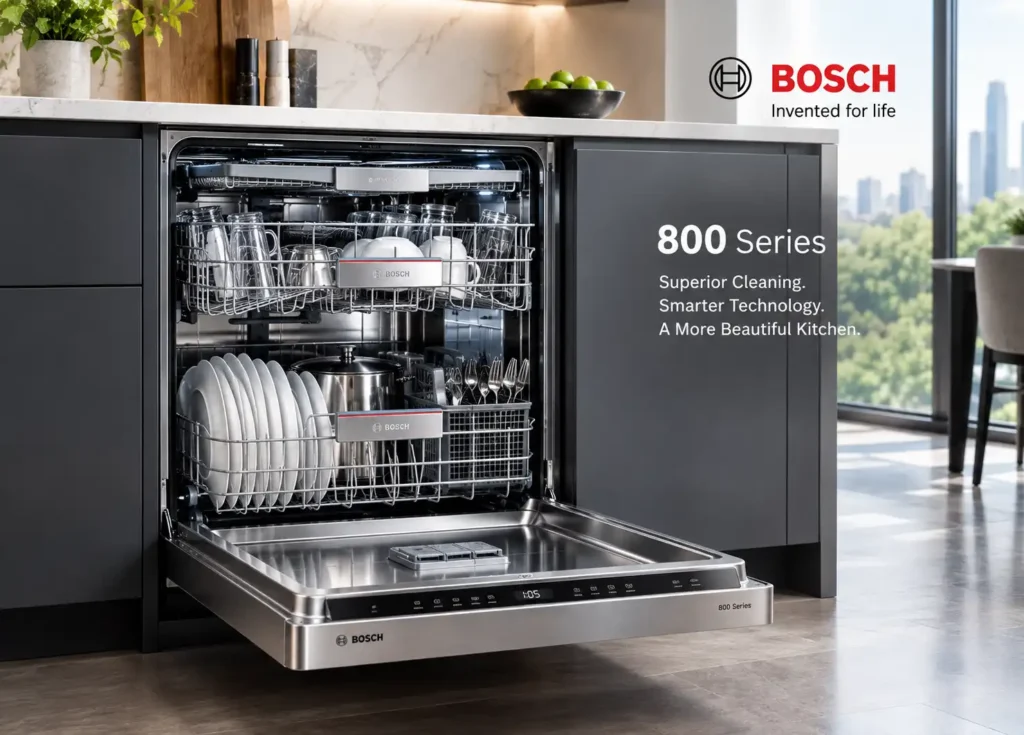
The pocket-handle design gives the front of the appliance a relatively streamlined appearance. Because the handle is recessed rather than projecting substantially outward, it can work well where the dishwasher sits close to adjacent cabinets or where a more integrated visual appearance is desired.
Design and Build Quality
The SHP878ZD2N uses a stainless-steel interior and concealed heating element. Stainless steel is particularly useful inside a dishwasher because the tub is repeatedly exposed to hot water, detergent, moisture and changing temperatures.
The tall-tub configuration provides the internal space needed for the 16-place-setting capacity while keeping the appliance within the standard 24-inch North American dishwasher footprint. The published dimensions are 33 7/8 inches high, 23 9/16 inches wide and 23 3/4 inches deep.
The required cutout is approximately 33 7/8 inches high, 23 5/8 inches wide and 24 inches deep according to the model documentation. Bosch also advises that installation instructions should be consulted for final dimensional requirements because installation conditions can affect the actual fit.
For anyone replacing an existing dishwasher, these dimensions should be measured rather than assumed. A nominal 24-inch dishwasher opening can still have issues involving flooring height, countertop clearance, cabinet sidewalls, water connections, drain routing and electrical access.
16 Place Settings: A Major Capacity Advantage
The SHP878ZD2N is rated for 16 place settings, which is a substantial capacity for a standard 24-inch household dishwasher.
The significance of this capacity becomes clearer when combined with the three-level loading arrangement. The third rack handles smaller items, while the upper and lower racks remain available for plates, bowls, cookware, glasses and larger utensils.
However, place-setting numbers should not be interpreted as a guarantee that 16 people’s entire collection of dishes, cookware and serving pieces will fit simultaneously. Standardized place-setting measurements are useful for comparing nominal capacity, but actual usable space depends heavily on the shape and arrangement of the dishes.
The SHP878ZD2N addresses that limitation through adjustable racks and folding tines. This makes the interior more adaptable when a load contains unusually shaped cookware instead of a uniform collection of plates and glasses.
Flexible Third Rack
The Flexible 3rd Rack is one of the most useful features of the SHP878ZD2N.
Bosch states that the third rack has fold-down sides and provides approximately 30% more loading area compared with a Bosch dishwasher with two racks. This is a manufacturer comparison, so it should not be interpreted as a universal industry capacity measurement.
The third rack is intended primarily for smaller objects such as utensils, ramekins and other items that can be difficult to arrange efficiently in a conventional silverware basket.
The advantage is not simply extra physical space. Moving small utensils upward can free valuable room in the lower two racks for plates and cookware.
For households that wash a large quantity of cutlery and cooking utensils, the third rack can therefore have a noticeable effect on loading efficiency.
RackMatic Adjustable Upper Rack
The SHP878ZD2N uses RackMatic on the upper rack.
The rack has three height adjustments and up to nine possible rack positions, allowing the user to change the internal arrangement according to the load.
This is particularly useful when a load contains tall glasses, large plates, cooking pots or other objects that compete for vertical clearance.
A fixed upper rack forces the user to work around one configuration. RackMatic provides several possible configurations, making the dishwasher more adaptable.
This feature is particularly valuable when the household’s dishware changes from one load to another. A dinner-party load might require more glassware capacity, while a post-cooking load might require greater clearance for pots and pans.
FlexSpace Tines
The lower rack includes FlexSpace tines that can fold back to accommodate larger pots and pans.
This is important because large cookware is one of the biggest challenges for a dishwasher with a fixed rack layout.
Dinner plates tend to occupy predictable positions, while pans and mixing bowls have irregular shapes.
Being able to fold sections of the rack down allows the user to convert some of the normal plate positions into larger open spaces.
The practical benefit depends on how the household loads its dishwasher, but the feature is particularly relevant for people who frequently wash cookware rather than simply plates and glasses.
Flexible Silverware Basket
Although the dishwasher has a third rack, Bosch also provides a flexible silverware basket.
The basket can be split into two pieces and positioned in different locations, providing another way to organize the lower rack.
This is useful when the household needs to choose between maximizing third-rack use and retaining a conventional silverware basket.
A flexible basket can also be useful when washing larger utensils that do not fit comfortably into the third rack.
Cleaning Performance
The SHP878ZD2N uses PrecisionWash, a sensor-based washing system designed to monitor the washing process and adjust operation according to the conditions inside the dishwasher.
The dishwasher also uses a five-level wash system. The combination of multiple spray levels and sensor-controlled operation is intended to distribute water throughout the racks rather than relying on a single washing zone.
This is particularly important in a 16-place-setting dishwasher because larger loads create more potential obstructions between the spray water and the dish surfaces.
Good loading technique therefore remains essential even with PrecisionWash. Plates should not be packed together so tightly that water cannot reach their surfaces, and tall objects should not block the spray arms.
Load Size Sensor
The dishwasher includes a load-size sensor that Bosch describes as automating wash-temperature decisions.
Sensors can help modern dishwashers avoid treating every load as though it contains the maximum possible amount of soil.
That is important because household dishwasher loads can vary substantially. A load of lightly used breakfast dishes does not necessarily require the same washing strategy as a collection of heavily soiled cookware.
The sensor system is therefore part of the dishwasher’s broader effort to automate the wash process rather than requiring the user to manually determine every operating parameter.
Wash Cycles
The SHP878ZD2N provides six wash programmes and six options.
The documented programme family includes options such as Heavy, Auto, Normal/Economy, Rinse and Speed60, with programme availability and terminology depending on the specific control configuration and documentation version.
Having multiple programmes matters because no single wash cycle is ideal for every load.
A heavy cycle can be used when cookware and dried food require more aggressive treatment, while a shorter cycle can be used when speed is more important and the dishes are not heavily soiled.
Speed60: Fast Cleaning and Drying
One of the more recognizable features is Speed60.
Bosch describes Speed60 as getting dishes from dirty to dry in approximately one hour.
This is useful when dishes need to be available quickly.
However, users should understand the difference between a speed-focused programme and an efficiency-focused programme. A rapid programme is not necessarily designed to achieve the same resource profile as an Eco-oriented cycle.
It is therefore better to think of Speed60 as a convenience option for appropriate loads rather than the default programme for every dishwasher load.
ExtraScrub Option
The ExtraScrub option increases pressure and temperature in the lower rack for difficult food soils.
This is particularly useful when heavily soiled cookware is concentrated in the lower rack.
Rather than treating every item in the dishwasher as though it needs maximum cleaning intensity, the option concentrates additional cleaning power where it is needed.
The feature should not eliminate the need for sensible loading. Extremely large objects can still block spray patterns, and baked-on or heavily carbonized material may require manual treatment before loading.
Sanitize Option
The SHP878ZD2N includes an NSF-certified sanitize option.
The specification identifies certification to NSF/ANSI Standard 184 for residential dishwashers.
The sanitize option is intended for situations where the user wants a higher-temperature sanitation phase than a standard wash.
The option can also contribute to drying performance because higher final-rinse temperatures can leave dishes with more stored heat.
It is worth remembering that a sanitation option is not the same thing as sterilization. The appliance should be used according to its intended residential application and the manufacturer’s operating instructions.
CrystalDry: The Standout Feature
The most distinctive technology in the SHP878ZD2N is CrystalDry.
Bosch states that the system uses natural minerals to transform moisture into heat, with the technology designed to produce substantially drier dishes, including plastics. Bosch’s published figure describes dishes as 60% drier compared with Bosch dishwashers using PureDry, based on an aggregate average drying comparison involving plastics, glass, steel and porcelain. Bosch also explicitly notes that drying performance can vary by dish type.
That qualification is important.
The 60% figure is a manufacturer test claim and should not be interpreted as an independent laboratory score or as a promise that every plastic container will be completely dry after every cycle.
Nevertheless, the technology addresses a genuine problem with conventional dishwasher drying: plastic items generally behave differently from glass, ceramic and stainless steel.
How CrystalDry Works
CrystalDry uses a mineral-based moisture-management process.
According to the product documentation, the technology transforms moisture into heat, with temperatures described as reaching up to approximately 176°F.
The process is designed to help remove moisture from the dishwasher interior and transfer that moisture-management capability into the drying stage.
This makes the SHP878ZD2N particularly interesting for households that frequently wash plastic food containers, reusable storage boxes, baby bottles and other items that can remain wet after conventional dishwasher drying.
Does CrystalDry Completely Dry Plastics?
It can improve plastic drying substantially, but it should not be interpreted as an absolute guarantee.
The shape of a plastic container can be just as important as the drying technology. A container with a recessed bottom can trap water, while a lid with a channel can retain droplets.
Loading position also matters.
If water pools on an object during the wash, the dishwasher has to remove that water during drying. Correctly angling containers can therefore improve results.
Bosch itself notes that drying performance varies by dish type, which is an important qualification to the 60% manufacturer comparison.
Rinse Aid and Drying
Rinse aid remains relevant even when CrystalDry is present.
Rinse aid helps water drain from dish surfaces and can reduce the tendency of water to remain as droplets.
This can be particularly helpful with glasses, plates and other smooth surfaces.
CrystalDry should therefore be viewed as one part of the drying system rather than as a replacement for correct detergent, rinse-aid use and appropriate loading.
42 dBA Noise Level
The SHP878ZD2N is rated at 42 dBA.
That is one of the defining characteristics of the dishwasher and helps explain why this model was designed for kitchens where operating noise matters.
Bosch’s product literature historically used the 42 dBA specification in describing the dishwasher’s quiet operation.
A numerical noise rating, however, does not mean the dishwasher will be completely silent.
The sound produced during filling, draining, spray-arm movement and circulation can vary depending on the stage of the programme.
Kitchen acoustics also matter. Hard surfaces can make appliance sounds more noticeable than a room with substantial sound absorption.
Is 42 dBA Quiet Enough for an Open-Plan Kitchen?
The 42 dBA specification makes the SHP878ZD2N appropriate for households where the dishwasher is located close to living or dining areas.
The advantage becomes particularly noticeable when the dishwasher is allowed to operate during meals, conversations or evening activities.
However, installation quality matters. A dishwasher that is not level or has plumbing components vibrating against cabinetry can produce sounds that are not representative of its rated operating noise.
Proper installation and clearance around hoses and connections are therefore important.
InfoLight Floor Indicator
Because the controls are positioned along the upper edge of the door, it can be difficult to tell whether a fully integrated dishwasher is operating.
The SHP878ZD2N addresses this with InfoLight.
The system projects a red light onto the floor while the dishwasher is running. When the cycle is finished, the light turns off.
This is a simple feature, but it solves a practical problem.
Without an indicator, a user might accidentally open the dishwasher while it is operating simply because the appliance looks inactive from the outside.
Touch Controls
The SHP878ZD2N uses touch controls.
Touch controls provide a relatively clean exterior and avoid the need for large mechanical switches on the front panel.
Because the controls are located at the top of the door, the front of the dishwasher remains visually streamlined.
The model also includes an LED remaining-time display, allowing the user to see cycle information without relying solely on the floor indicator.
24-Hour Delay Start
A 24-hour delay-start timer is included.
This allows users to schedule the dishwasher to begin later rather than starting immediately.
Delay start can be useful for households that want to run the dishwasher overnight or during a period when the kitchen is not being used.
It can also help users organize dishwashing around electricity-rate periods where time-of-use pricing is available.
The exact financial benefit depends entirely on the local utility tariff.
AquaStop Leak Protection
The SHP878ZD2N includes 24/7 AquaStop leak protection.
Bosch describes the system as being designed to contain leaks by shutting down operation and pumping out water if a leak occurs.
Leak protection is particularly valuable for built-in dishwashers because a water leak can potentially affect cabinetry, flooring and nearby structures.
AquaStop should not be interpreted as meaning that a dishwasher is physically incapable of leaking. Instead, it is a protective system designed to detect and respond to certain water-related failures.
Correct installation and maintenance remain important.
Water Efficiency
The exact SHP878ZD2N specification lists 3.5 gallons of water per cycle and approximately 623.5 gallons of annual water consumption under the applicable test methodology.
The model is also identified as ENERGY STAR qualified in its Bosch specification.
The current ENERGY STAR dishwasher criteria for standard-size models set maximum limits of 240 kWh per year and 3.2 gallons per cycle under the current specification. Because the SHP878ZD2N’s published 269 kWh and 3.5-gallon figures come from an older certification/testing framework, they should not be compared directly with current-model figures without accounting for changes in the test method and qualification criteria.
This is an important distinction when reviewing an older dishwasher in 2026.
A model’s historical ENERGY STAR qualification does not necessarily mean it would meet today’s criteria if retested under the current requirements.
Annual Energy Consumption
Bosch’s exact specification lists 269 kWh per year.
The annual figure is a standardized estimate rather than a guarantee of what every household will actually consume. Real consumption depends on how frequently the dishwasher is used, the selected programme, options, incoming water temperature and other operating conditions.
Someone running a full load every evening will naturally have a different annual energy profile from someone using the dishwasher two or three times a week.
This is why energy-label figures are most useful for comparing appliances under standardized conditions rather than predicting an individual’s exact electricity bill.
Is the SHP878ZD2N ENERGY STAR Certified?
The Bosch specification identifies the SHP878ZD2N as ENERGY STAR qualified.
However, the current ENERGY STAR criteria changed in 2023, and the current standard-size threshold is 240 kWh/year and 3.2 gallons per cycle.
Therefore, it is more accurate to say that the SHP878ZD2N was qualified under the applicable ENERGY STAR requirements for its certification period, rather than suggesting that its older 269 kWh/3.5-gallon specifications meet the current maximum criteria.
This distinction is particularly important when comparing an older SHP878ZD2N with a current 2026 dishwasher.
Does the SHP878ZD2N Have a Water Softener?
No.
The exact Bosch specification lists Water Softener: No.
This is an important point for buyers in hard-water areas.
A dishwasher without an integrated water-softening system may require greater attention to detergent selection, rinse aid, dishwasher salt compatibility where applicable, local water treatment and maintenance practices.
Users should not assume that every Bosch 800 Series dishwasher has identical water-softening equipment.
The SHP878ZD2N’s specification specifically states that this model does not include a built-in water softener.
Hard Water and the SHP878ZD2N
Hard water can contribute to mineral deposits and spotting on dishes and internal dishwasher components.
Because this model does not include an integrated water softener, households with particularly hard water should pay attention to the local water conditions and the cleaning products recommended for their installation.
The correct approach depends on the water chemistry and the detergent being used.
A user should not simply increase detergent indefinitely because excessive detergent can itself create residue problems.
Regular cleaning and correct rinse-aid use are also important.
Stainless-Steel Tub
The stainless-steel tub is another significant construction feature.
A stainless-steel interior provides a durable washing chamber and is well suited to repeated exposure to hot water and detergent.
The SHP878ZD2N also uses a concealed heating element, which keeps the heating component out of the main loading area.
This helps maintain a more usable interior surface and reduces the chance of dishes sitting directly against an exposed heating element.
Detergent Tray
The dishwasher includes a detergent tray designed to optimize detergent dissolving.
This can help prevent detergent from remaining trapped in the dispenser or being released at an inappropriate point in the cycle.
Correct detergent dosage remains important.
Using more detergent than necessary does not automatically improve cleaning. The correct quantity depends on detergent formulation, water hardness, soil level and the selected programme.
Maintenance
A sophisticated dishwasher still needs routine maintenance.
Filters should be inspected and cleaned as necessary, spray arms should be checked for blocked openings, and the dishwasher interior should be maintained according to the instructions.
Food particles, mineral deposits and detergent residue can gradually affect cleaning performance.
If the dishwasher begins leaving food on dishes, users should therefore check basic maintenance and loading conditions before assuming that the pump, motor or spray system has failed.
Common Cleaning Problems
Several common dishwasher symptoms can have straightforward causes.
Poor cleaning can result from overloaded racks, blocked spray arms, incorrectly positioned dishes, insufficient detergent or using a cycle that is too gentle for the soil level.
The SHP878ZD2N’s PrecisionWash and sensor technology can optimize the cycle, but no sensor can compensate completely for a dish physically blocking another dish from the spray pattern.
Correct loading therefore remains one of the most important factors in real-world performance.
What If the Dishes Are Still Wet?
If dishes remain wet, users should first consider the selected drying option, rinse aid, loading position and the material of the dishes.
Plastic is inherently more difficult to dry than glass and ceramic.
CrystalDry is designed to improve this problem, but Bosch explicitly states that drying performance varies by dish type.
Water trapped in the bottom of cups, containers or recessed plastic surfaces can remain even when the dishwasher’s drying system is functioning normally.
What If Dishes Are Not Getting Clean?
Start by checking the spray arms.
The spray arms need to rotate freely, and their openings need to remain unobstructed.
Next, inspect the filters and make sure dishes are not packed so tightly that water cannot reach their surfaces.
For heavily soiled lower-rack cookware, the ExtraScrub option can increase pressure and temperature in the lower rack.
If the problem persists despite correct loading and maintenance, the appliance may require professional diagnosis.
Is the SHP878ZD2N Good for Large Families?
The 16-place-setting capacity makes the SHP878ZD2N particularly well suited to households that regularly accumulate large dishwasher loads.
The third rack adds another level of usable space for utensils and smaller items, while RackMatic allows the upper basket to be adjusted when larger cookware is being washed.
Families that cook frequently can also benefit from FlexSpace tines and ExtraScrub because they make the lower rack more adaptable to pots and pans.
Is It Good for Plastic Containers?
Plastic drying is one of the strongest reasons to look at this dishwasher.
CrystalDry was specifically developed to improve drying performance, and Bosch’s published testing indicates substantially improved drying on a mixed household load containing plastics, glass, steel and porcelain compared with PureDry.
Still, the result depends on the individual container.
A flat plastic plate will generally behave differently from a deep food-storage container with a recessed base.
Users should position plastic items so that water can drain rather than pool.
Is It Good for Open-Plan Kitchens?
The 42 dBA noise rating makes this dishwasher appropriate for many open-plan kitchen environments.
The dishwasher is designed to operate quietly enough that normal kitchen conversations are less likely to be interrupted by appliance noise.
The actual experience will depend on kitchen acoustics and installation.
A dishwasher installed next to loose cabinetry or with hoses vibrating against the cabinet can sound considerably louder than expected.
Is the Bosch SHP878ZD2N Smart?
Unlike some newer Bosch models, the SHP878ZD2N documentation does not identify Home Connect as one of its features.
The exact specification instead focuses on conventional controls, LED remaining-time display, InfoLight and the 24-hour delay timer.
This distinction is important because Bosch’s newer 800 Series models may include Wi-Fi and app-based features that should not automatically be attributed to the SHP878ZD2N.
The SHP878ZD2N should therefore be treated as a non-smart dishwasher unless a specific appliance configuration has documentation showing otherwise.
Warranty
For U.S. Bosch dishwashers, the published warranty structure provides a one-year limited warranty covering the entire appliance, parts and labor. Additional limited coverage applies to electronics and racks from the second through fifth years, while specified rust-through coverage applies to the inner tub liner and stainless-steel door under the published terms.
Warranty terms can depend on the exact purchase date, model suffix, market and warranty documentation supplied with the appliance.
Because the SHP878ZD2N is now an older model, someone purchasing a used or remaining unit should not assume that the original warranty automatically transfers or remains active.
Service and Parts Support
One advantage for owners is that the manufacturer continues to maintain a dedicated service page for SHP878ZD2N/01.
The support record provides access to manuals, short instructions, installation instructions, product specifications, energy documentation, CAD information, replacement parts and owner-support resources.
That is useful for existing owners because model-specific documentation is much safer than relying on generic instructions for a different Bosch dishwasher.
When ordering parts, the full E-Nr/model number should be checked, including the suffix where applicable.
Installation Requirements
The SHP878ZD2N is designed around a standard North American 24-inch dishwasher opening.
The published dimensions are 33 7/8 inches high, 23 9/16 inches wide and 23 3/4 inches deep, while the specified cutout is approximately 33 7/8 × 23 5/8 × 24 inches.
The appliance requires a 120 V, 60 Hz electrical supply and is rated at 12 amps and 1,440 watts.
The minimum water pressure listed in the specification is 14 psi, and the documentation includes a 79-inch outlet hose.
Final installation should follow the model-specific installation instructions rather than relying solely on the headline dimensions.
USA Compatibility
The SHP878ZD2N is a North American dishwasher specified for 120 V, 60 Hz operation, making its electrical configuration appropriate for the typical U.S. dishwasher environment when installed according to the applicable instructions.
The 24-inch width also corresponds to the common North American dishwasher format.
For a U.S. replacement installation, the important checks include cabinet opening dimensions, electrical connection, water supply, drain routing and floor height.
Canada Compatibility
Canadian buyers should pay attention to the exact electrical and installation configuration of the individual unit.
The SHP878ZD2N’s published electrical specification is 120 V and 60 Hz, which is consistent with the North American appliance configuration.
However, buyers sourcing an older or imported appliance should verify the complete model number and regional documentation rather than assuming that every Bosch dishwasher carrying a similar model designation has the same configuration.
UK Compatibility
This is where the SHP878ZD2N requires the most caution.
The exact model is specified for 120 V, 60 Hz, while standard UK domestic electrical installations operate on a different supply arrangement.
Therefore, the SHP878ZD2N should not be treated as a normal direct-install UK dishwasher.
UK readers can still use this review to understand Bosch’s CrystalDry, PrecisionWash, rack design, noise characteristics and other technologies, but someone looking for an actual UK installation should verify that the appliance is specifically intended and approved for the local electrical system.
A transformer or improvised electrical conversion should not be treated as a substitute for purchasing an appliance designed for the local market. Electrical installation should comply with applicable local requirements and be performed by a suitably qualified professional.
Bosch SHP878ZD2N Pros
1. 16-place-setting capacity
The 16-place-setting rating provides substantial loading capacity for a 24-inch dishwasher.
2. CrystalDry
The CrystalDry system is the model’s major drying technology and is particularly relevant to plastic containers.
3. 42 dBA operation
The 42 dBA rating makes quiet operation one of the defining characteristics of the dishwasher.
4. Flexible third rack
The third rack provides additional space for utensils and smaller items and includes fold-down sides.
5. RackMatic
Three height adjustments and multiple rack positions make it easier to adapt the dishwasher to different loads.
6. ExtraScrub
ExtraScrub provides stronger lower-rack cleaning for difficult food soils.
7. AquaStop
The 24/7 leak-protection system adds an additional layer of water protection.
8. Stainless-steel tub
The stainless-steel interior provides a durable internal washing chamber.
9. InfoLight
The floor-projected indicator makes it easier to tell when the integrated dishwasher is operating.
10. Flexible loading
The combination of a third rack, RackMatic and FlexSpace tines gives the interior considerable loading flexibility.
Bosch SHP878ZD2N Cons
1. The model is no longer available as a current product
The current product page identifies the SHP878ZD2N as no longer available, although support documentation remains available.
2. No built-in water softener
The exact specification lists the water softener as absent, which can matter in hard-water regions.
3. No modern smart connectivity listed
The exact documentation does not identify Home Connect/Wi-Fi as a feature of this model.
4. Older efficiency specification
Its 269 kWh/year and 3.5 gallons/cycle figures reflect the applicable historical certification framework rather than today’s stricter ENERGY STAR criteria.
5. North American electrical specification
The 120 V/60 Hz configuration means this exact model is not a normal UK-market dishwasher.
Bosch SHP878ZD2N vs Newer Bosch Dishwashers
The SHP878ZD2N remains technically interesting because several of its technologies continue to be relevant.
CrystalDry remains important to people who care about plastic drying, while a flexible third rack remains useful for maximizing loading capacity.
However, newer Bosch models may introduce newer versions of rack systems, smart connectivity, energy-efficiency improvements, updated controls and revised drying technologies.
Therefore, the SHP878ZD2N should not automatically be considered equivalent to every newer Bosch 800 Series dishwasher simply because both carry the 800 Series name.
Model numbers matter.
This is particularly important when comparing a used SHP878ZD2N against a current dishwasher whose specifications may be substantially different.
Should You Buy a Used Bosch SHP878ZD2N?
For a used unit, condition becomes just as important as the original specification.
A buyer should inspect the racks, rack wheels, spray arms, filters, door seal, detergent dispenser, third rack, drain system and electrical components.
Because the model is no longer listed as a current product, buyers should also confirm parts availability for the exact model suffix before paying a significant price.
The continued model-specific support documentation is useful, but availability of individual parts can change as appliances age.
What Should You Check Before Buying a Remaining SHP878ZD2N?
First, verify the complete model number.
Second, inspect the door seal for damage.
Third, make sure the racks slide smoothly.
Fourth, verify that the third rack is present.
Fifth, inspect the lower rack for corrosion or damaged wheels.
Sixth, run a complete wash cycle if purchasing a used appliance.
Seventh, verify that CrystalDry operates correctly.
Eighth, inspect for standing water after the cycle.
Finally, verify the electrical configuration and installation requirements before transporting the dishwasher to a new location.
Is CrystalDry Worth Paying Attention To?
If drying performance is one of your main concerns, yes.
CrystalDry is one of the features that differentiates this Bosch generation from more conventional drying systems.
Its purpose is particularly relevant to plastics, which are often the items most likely to remain wet after a dishwasher cycle.
However, buyers should distinguish Bosch’s 60% drier claim from an independent performance rating. It is a manufacturer aggregate comparison, and Bosch explicitly states that results vary by dish type.
Is 42 dBA Really Quiet?
The 42 dBA specification indicates that the dishwasher was engineered for low-noise operation.
For practical purposes, this makes the model suitable for kitchens where the dishwasher may operate during normal household activities.
Nevertheless, the dishwasher will still produce some sounds during filling, spraying and draining.
The room itself can also influence how loud the appliance seems.
Therefore, 42 dBA should be treated as a standardized acoustic specification, not a promise of complete silence.
Is 16 Place Settings Enough?
For many households, 16 place settings provide substantial capacity in a standard 24-inch dishwasher.
The third rack increases the usefulness of the internal volume because smaller utensils can be moved away from the main dish racks.
The adjustable upper rack also helps convert vertical space depending on what is being washed.
The practical capacity, however, still depends on the size and shape of the user’s dishes.
Is the SHP878ZD2N Good for Pots and Pans?
It has several features that make it suitable for cookware.
FlexSpace tines can fold back to create room for larger objects, while ExtraScrub increases cleaning pressure and temperature in the lower rack.
Large cookware still needs to be positioned carefully.
A pan should not block the spray arm or prevent water from reaching nearby dishes.
Is the SHP878ZD2N Good for Glassware?
The dishwasher’s adjustable racks and sensor-controlled cleaning system can be useful for mixed loads containing glassware.
However, fragile or valuable glassware should always be checked for dishwasher compatibility before being placed inside.
The user should also make sure glasses are securely positioned so they cannot contact each other during washing.
Is the Bosch SHP878ZD2N Reliable?
There is not enough model-specific independent evidence to assign a numerical reliability rate to the SHP878ZD2N.
It would therefore be misleading to claim that a particular percentage of these dishwashers will last a certain number of years.
The more defensible approach is to examine its construction, service documentation, parts availability and warranty provisions.
The model has a stainless-steel tub, concealed heating element, AquaStop, a documented service system and a manufacturer-supported parts and manual infrastructure.
Bosch SHP878ZD2N Lifespan
Dishwasher lifespan depends on usage frequency, water quality, maintenance, installation, component wear and repair history.
There is no model-specific official lifespan guarantee for the SHP878ZD2N.
Consequently, buyers should avoid claims such as “this dishwasher will last exactly 10 or 15 years.”
Instead, regular filter cleaning, correct detergent use, proper loading, appropriate water management and timely repair can help preserve performance.
Final Review of the Bosch SHP878ZD2N
The Bosch SHP878ZD2N is an older but technically interesting 800 Series DLX 24-inch dishwasher.
Its core specification remains impressive: 16 place settings, 42 dBA noise, CrystalDry, PrecisionWash, a flexible third rack, RackMatic, FlexSpace tines, ExtraScrub, AquaStop, stainless-steel construction and a sanitize option.
The most distinctive feature is CrystalDry. Its mineral-based drying technology was designed specifically to improve the drying of difficult materials, particularly plastics. Bosch’s published testing reports a 60% drier result against its PureDry system on an aggregate household load, although that should be treated as a manufacturer claim rather than an independent laboratory rating.
The loading system is another major strength. Sixteen place settings combined with the Flexible 3rd Rack, RackMatic upper rack and FlexSpace tines give users several ways to reorganize the dishwasher for different types of loads.
The 42 dBA rating also remains relevant for open-plan kitchens and households that prefer to operate their dishwasher without significant appliance noise.
There are, however, several reasons to be cautious in 2026. The manufacturer now lists the SHP878ZD2N as no longer available, meaning that buyers are generally looking at existing stock, used units, refurbished appliances or replacement situations rather than a current model sold as part of the latest range.
Its energy figures also need historical context. Bosch’s documentation lists 269 kWh/year and 3.5 gallons per cycle, while the current ENERGY STAR criteria for standard dishwashers use tighter limits of 240 kWh/year and 3.2 gallons per cycle. The historical certification should therefore not be presented as equivalent to current certification standards.
Another limitation is the absence of a water softener. For households with hard water, water-quality management becomes more important.
The model also does not have the modern smart-home connectivity that appears on many newer dishwasher generations.
For UK readers, the electrical specification is a decisive consideration. The SHP878ZD2N is specified at 120 V and 60 Hz, so it is not a conventional UK-market 230 V dishwasher.
For U.S. and Canadian households with a compatible 24-inch installation, the electrical configuration is much more appropriate, but the age and availability of the model should be considered before purchasing.
The overall technical picture is therefore quite clear: the SHP878ZD2N was designed as a premium North American dishwasher emphasizing quiet operation, drying performance, large capacity and flexible loading. Its CrystalDry system, third rack and rack-adjustment system remain useful features, while its older efficiency specification, lack of a water softener, lack of modern smart connectivity and discontinued status are the main considerations for someone evaluating it today.
Frequently Asked Questions
1. What is the Bosch SHP878ZD2N?
The Bosch SHP878ZD2N is a 24-inch 800 Series DLX built-in dishwasher with a pocket handle, 16-place-setting capacity, CrystalDry, PrecisionWash, a flexible third rack and a 42 dBA noise rating.
2. Is the SHP878ZD2N still available?
The manufacturer’s current U.S. product page identifies the SHP878ZD2N as no longer available, although model-specific service documentation remains accessible.
3. How many place settings does it hold?
The dishwasher has a rated capacity of 16 place settings.
4. How quiet is the SHP878ZD2N?
It has a rated sound level of 42 dBA.
5. Does the SHP878ZD2N have CrystalDry?
Yes. CrystalDry is one of the principal drying technologies of this model.
6. Does CrystalDry dry plastic?
It is specifically designed to improve drying of plastics. Bosch’s published comparison reports a 60% drier result against PureDry on an aggregate mixed household load, although performance varies by dish type.
7. Does it have a third rack?
Yes. It has a Flexible 3rd Rack with fold-down sides.
8. Does the third rack replace the silverware basket?
No. The model also includes a flexible silverware basket that can be split into two sections.
9. Does it have RackMatic?
Yes. RackMatic provides three upper-rack height adjustments and up to nine possible rack positions.
10. Does it have PrecisionWash?
Yes. PrecisionWash is part of the dishwasher’s cleaning system.
11. Does it have a stainless-steel tub?
Yes. The exact specification lists stainless steel as the tub material.
12. Does it have AquaStop?
Yes. The dishwasher uses 24/7 AquaStop leak protection.
13. Does it have a water softener?
No. The exact specification lists the water softener as absent.
14. Is the SHP878ZD2N good for hard water?
It can be used in hard-water areas, but because it does not have a built-in water softener, users need to pay closer attention to local water conditions, detergent, rinse aid and maintenance.
15. How much water does it use?
The published specification lists 3.5 gallons per cycle and approximately 623.5 gallons of annual water consumption under the applicable test methodology.
16. How much electricity does it use?
The specification lists 269 kWh per year under the applicable standardized test conditions.
17. Is it ENERGY STAR certified?
The Bosch specification identifies it as ENERGY STAR qualified. However, its published 269 kWh/year and 3.5-gallon figures should be understood under the historical certification framework because current ENERGY STAR requirements are stricter.
18. Does it have a sanitize option?
Yes. The specification identifies an NSF-certified sanitize option.
19. Does it have ExtraScrub?
Yes. ExtraScrub increases pressure and temperature in the lower rack for difficult food soils.
20. Does it have Speed60?
Yes. Speed60 is designed to take dishes from dirty to dry in approximately one hour under the appropriate conditions.
21. Does it have a delay start?
Yes. It includes a 24-hour delay-start timer.
22. Does it have InfoLight?
Yes. InfoLight projects a red light onto the floor while the dishwasher is running.
23. Does it have Wi-Fi?
The exact SHP878ZD2N documentation does not list Home Connect or Wi-Fi connectivity as a feature.
24. Is the SHP878ZD2N a fully integrated dishwasher?
It is a built-in dishwasher with a pocket-handle design and controls positioned on the upper door area.
25. What are its dimensions?
The appliance is approximately 33 7/8 inches high, 23 9/16 inches wide and 23 3/4 inches deep.
26. What size cutout does it require?
The Bosch specification lists approximately 33 7/8 inches high × 23 5/8 inches wide × 24 inches deep, with the installation instructions used for final verification.
27. What voltage does the SHP878ZD2N use?
It is specified for 120 V, 60 Hz operation at 12 amps.
28. Can the SHP878ZD2N be installed in the UK?
The exact model is not a normal UK electrical configuration because it is specified for 120 V/60 Hz. UK buyers should use a dishwasher designed for the local electrical supply rather than assuming this North American model is directly compatible.
29. Is it suitable for the USA?
Its 120 V/60 Hz specification is designed around the North American electrical environment, subject to correct installation and local requirements.
30. Is it suitable for Canada?
The electrical configuration is North American at 120 V/60 Hz, but buyers should verify the exact regional documentation and model suffix before purchasing an older or imported appliance.
31. Is CrystalDry better for plastic than conventional drying?
CrystalDry is specifically designed to improve plastic drying, and the manufacturer reports improved drying performance compared with PureDry. Actual results depend on the type and shape of the plastic item.
32. Can it wash pots and pans?
Yes. FlexSpace tines provide additional room for larger cookware, while ExtraScrub is designed to increase cleaning intensity in the lower rack.
33. Does it have an adjustable upper rack?
Yes. RackMatic provides three height adjustments and up to nine possible positions.
34. Does it have a stainless-steel interior?
Yes.
35. Does it have a concealed heating element?
Yes.
36. Does it have a self-latching door?
Yes. The product specification lists a self-latching door.
37. Does it have child lock?
The exact specification lists ChildLock as No.
38. Does it have a water softener?
No.
39. What is the biggest feature of the SHP878ZD2N?
CrystalDry is arguably the most distinctive technology because it specifically addresses dishwasher drying, including plastic items. The manufacturer reports a 60% drier result compared with PureDry on its aggregate test load.
40. Is the 60% CrystalDry figure an independent test?
No. It is a manufacturer-published aggregate comparison, and the documentation states that drying performance varies by dish type.
41. Does the SHP878ZD2N have six wash cycles?
Yes. The exact Bosch specification lists six wash cycles and six options.
42. Does it have a quick wash?
Yes. Speed60 is designed around a roughly one-hour dirty-to-dry cycle under suitable conditions.
43. Is the SHP878ZD2N a current Bosch 800 Series model?
No. The current product page identifies this exact model as no longer available, although Bosch continues to provide model-specific support documentation.
44. Can I still get manuals for it?
Yes. The model-specific support page provides access to manuals, installation instructions, specifications and other documentation.
45. Can I still get replacement parts?
Model-specific replacement-parts support remains available through the manufacturer’s service system, although individual part availability can change as an appliance ages.
46. What warranty did it have?
The U.S. warranty structure for dishwashers includes one year of parts-and-labor coverage for the entire appliance, with additional limited coverage for specified electronics, racks and rust-through conditions under the published terms.
47. Is the SHP878ZD2N good for large families?
Its 16-place-setting capacity, third rack and adjustable rack system make it well suited to households that regularly generate large dishwasher loads.
48. Is it suitable for an open-plan kitchen?
Its 42 dBA rating makes it appropriate for kitchens where minimizing appliance noise is important.
49. Does it have a third rack and silverware basket?
Yes. It has both a Flexible 3rd Rack and a flexible silverware basket.
50. Is the Bosch SHP878ZD2N worth considering today?
It can still be relevant when evaluating an existing unit, used dishwasher or remaining inventory, particularly because of its 42 dBA operation, 16-place capacity, flexible racks and CrystalDry system. However, its discontinued status, older efficiency specifications and lack of current smart features should be considered when comparing it with newer models.
Conclusion
The Bosch SHP878ZD2N remains an interesting 800 Series dishwasher because it combines several features that address the most common practical dishwasher concerns: cleaning performance, loading flexibility, noise and drying.
Its 16-place-setting capacity gives it substantial loading room, while the Flexible 3rd Rack, RackMatic upper rack and FlexSpace tines make that capacity more adaptable to real-world dishware and cookware.
Its 42 dBA noise rating is another important characteristic, particularly for open kitchens and households that run the dishwasher while people are using nearby rooms.
The standout technology remains CrystalDry. Its mineral-based drying approach was developed to improve drying performance, particularly on plastics, although Bosch’s published 60% figure should be understood as a manufacturer comparison rather than an independent performance score.
The main considerations in 2026 are its no-longer-available status, historical energy specification, lack of a built-in water softener, lack of documented Wi-Fi connectivity and North American 120 V electrical configuration.
For a U.S. or compatible Canadian installation, those factors need to be weighed against the appliance’s strong feature set. For UK readers, the 120 V specification makes regional electrical compatibility the first issue to resolve before considering the dishwasher further.
In short, the SHP878ZD2N is best understood not as a current-generation Bosch model, but as an older premium 800 Series dishwasher whose CrystalDry drying system, 42 dBA operation and flexible 16-place-setting interior remain technically relevant today.