
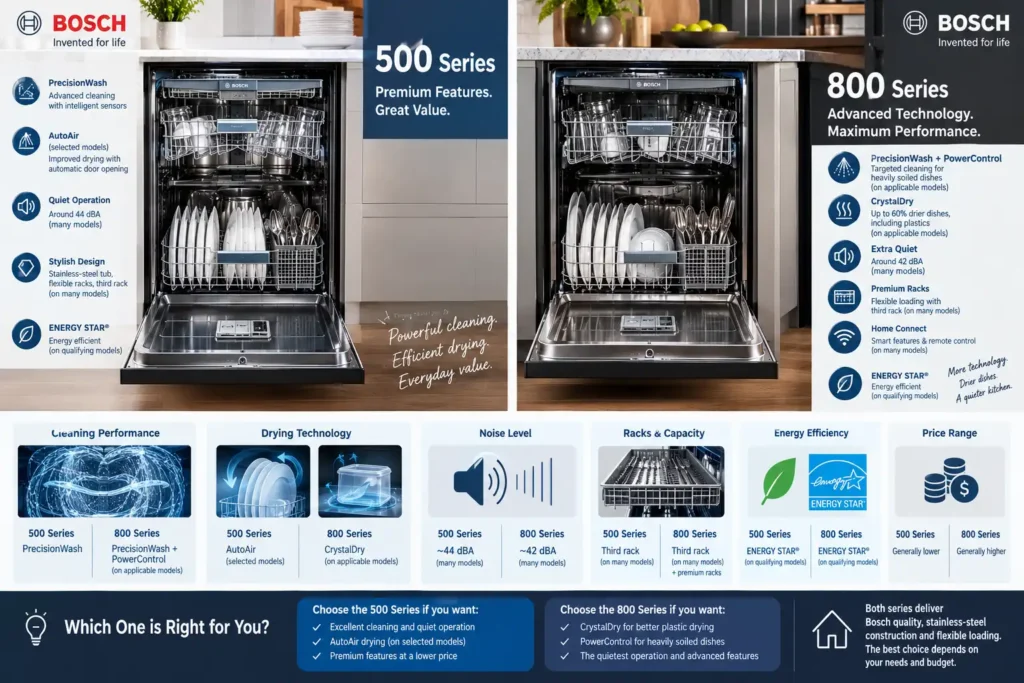
Choosing between the Bosch 500 Series and Bosch 800 Series can be difficult because both sit in the premium portion of the dishwasher market and share many of the technologies that have made Bosch dishwashers popular. Both series offer stainless-steel interiors on many current models, third racks, adjustable racks, sensor-based washing, quiet operation, Wi-Fi connectivity, and strong energy performance. The biggest differences appear in drying technology, sound levels, wash-system technology, rack features, and price.
The word “ratings” also needs some clarification. A dishwasher can receive several different types of ratings: an independent laboratory performance rating, a predicted reliability rating, an owner-satisfaction rating, an energy-efficiency rating, a noise rating, and a retailer/customer rating. These measurements do not mean the same thing. Independent laboratory testing can measure washing, drying, noise and energy performance, while owner surveys can provide information about reliability and satisfaction.
Current independent testing places Bosch among the strongest dishwasher brands overall, and current testing includes both 500 Series and 800 Series models. The available results show that both series can deliver very good washing performance and strong energy performance, while the 800 Series models tested have particularly strong noise and drying characteristics.
For buyers in the United States and Canada, the current 500 and 800 Series lineup provides a useful direct comparison because both series are widely represented in the North American market. The situation is somewhat different in the United Kingdom, where Bosch’s model naming and product ranges can differ from North American series names. Therefore, the 500-vs-800 comparison in this article primarily refers to the North American Bosch lineup, while the underlying technologies and buying considerations are relevant to UK consumers as well.
Bosch 500 Series vs 800 Series Ratings at a Glance
| Category | Bosch 500 Series | Bosch 800 Series |
|---|---|---|
| Typical position in lineup | Premium | Higher premium |
| Current example model | SHP65DM5N | SHP78CM5N |
| Example U.S. list price | About $1,249 | About $1,499 |
| Noise on current examples | 44 dBA | 42 dBA |
| Interior | Stainless steel on cited models | Stainless steel |
| Third rack | Yes | Yes |
| Adjustable upper rack | Yes | Yes |
| Wi-Fi | Home Connect | Home Connect |
| Leak protection | AquaStop | AquaStop |
| Drying | AutoAir | CrystalDry |
| Washing | PrecisionWash / Zone Wash depending on model | PrecisionWash / PowerControl depending on model |
| ENERGY STAR | Yes on cited models | Yes on cited models |
| Independent wash testing | Very good | Very good |
| Independent energy testing | Excellent | Very good |
| Independent noise testing | Very good | Excellent |
| Cycle-time assessment | Fair | Fair |
| Drying emphasis | Strong | More advanced |
| Current customer rating example | 4.5/5 | 4.5/5 |
| Main difference | Strong premium performance | More advanced drying and wash technology |
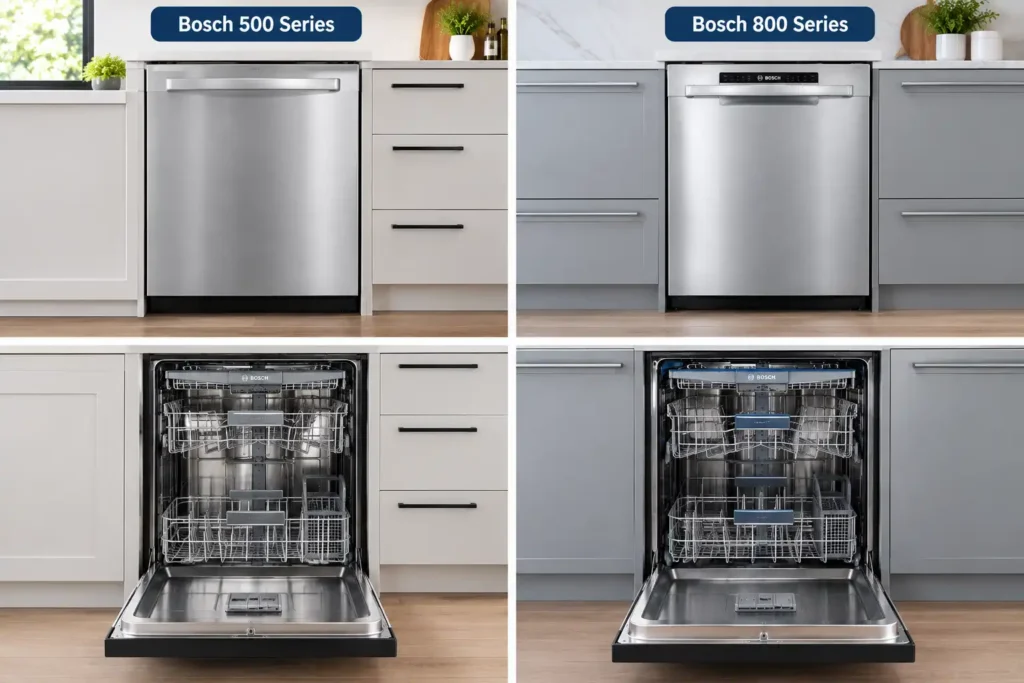
The table uses representative current models rather than claiming that every model within either series has identical specifications. Bosch’s current U.S. product listings show the SHP65DM5N as a 500 Series dishwasher at 44 dBA and the SHP78CM5N as an 800 Series dishwasher at 42 dBA.
What Do Bosch Dishwasher Ratings Actually Measure?
Dishwasher ratings should be interpreted carefully because different organizations and retailers measure different things.
Independent laboratory testing can evaluate how well a dishwasher cleans heavily soiled dishes, how effectively it dries dishes, how much energy and water it uses, how noisy it is, and how convenient it is to operate. Current testing methodology also incorporates owner-survey information into certain overall scores.
Predicted reliability is different from cleaning performance. Reliability ratings estimate the probability that a dishwasher will develop a problem during a defined ownership period. They do not measure how well the machine cleans a load today.
Customer ratings are different again. A 4.5-star customer rating represents the experiences and opinions of purchasers who submitted reviews, while a laboratory performance rating is based on controlled testing.
This distinction matters when comparing the 500 and 800 Series because a model can perform similarly in washing while having substantially different drying technology.
Bosch 500 Series Rating Overview
A representative current 500 Series model is the SHP65DM5N.
The current product information lists a 44 dBA operating level, a stainless-steel interior, Zone Wash, AutoAir drying, Home Connect connectivity, AquaStop leak protection, and a third rack. The current listed price is approximately $1,249, although prices can change with retailer promotions and market conditions.
Independent testing of the closely related SHP65CM5N found very good washing performance for heavily soiled dishes and excellent energy performance. Noise performance was rated very good, while cycle time was rated fair.
The 500 Series therefore should not be viewed simply as a lower-end version of an 800 Series dishwasher. It already incorporates many features associated with premium dishwashers, including a stainless-steel interior, third rack, adjustable rack system, sensor-based operation, Wi-Fi connectivity and advanced drying.
Bosch 800 Series Rating Overview
The 800 Series moves further up Bosch’s lineup and adds technologies intended to improve drying and washing performance.
A current example, the SHP78CM5N, is listed at 42 dBA and includes CrystalDry, PrecisionWash with PowerControl, a flexible third rack, EasyGlide rack technology, stainless-steel interior construction and Home Connect connectivity. Its current listed price is approximately $1,499.
Independent testing of the SHP78CM5N’s closely related tested configuration found very good performance when washing heavily soiled dishes, very good energy performance, and excellent noise performance. Its cycle-time rating was fair.
The principal technical distinction is therefore not that the 800 Series suddenly makes the 500 Series obsolete. Instead, Bosch adds technologies intended to address particular areas, especially drying and more targeted washing.
Bosch 500 Series vs 800 Series Washing Performance
Washing performance is one of the most important ratings because the primary purpose of a dishwasher is to remove food soil.
The representative 500 Series model tested by independent laboratory evaluation performed very well in heavily soiled-dish washing tests. Its energy performance was also rated excellent.
The representative 800 Series model likewise performed very well in heavily soiled-dish testing and very well in the combined energy test.
This means the difference between the two series should not be described as a basic dishwasher versus a dramatically superior dishwasher. Both are designed around sophisticated sensor-controlled washing systems.
Bosch’s broader lineup uses sensors that monitor conditions during the cycle and adjust operation to improve cleaning efficiency. The 800 Series adds PowerControl on applicable models, giving the lower spray system greater ability to target different zones of the lower rack.
What Is Bosch PrecisionWash?
PrecisionWash is Bosch’s sensor-based washing system.
The dishwasher uses sensors to monitor the wash process and adjust operation according to conditions inside the machine. This allows the dishwasher to adapt rather than simply running exactly the same washing pattern for every load.
PrecisionWash is important because it means that the 500 Series already incorporates sophisticated washing control.
Therefore, consumers should not assume that upgrading to the 800 Series is necessary simply because they want sensor-controlled washing.
Both tiers provide this general concept, although specific 800 Series models can add PowerControl technology.
What Is PowerControl on the Bosch 800 Series?
PowerControl is one of the more significant technological differences in applicable 800 Series models.
Bosch describes PowerControl as a motorized spray arm that can target different areas of the lower rack. The system can be programmed for different wash intensities in four zones.
Independent testing found that when the PowerControl arm was programmed for a heavy wash, the test configuration achieved about 5% greater cleaning performance than a standard cycle using automatic soil sensors.
That does not mean that every load will be 5% cleaner.
The result came from a controlled test of a specific configuration and wash setting. Real-world results depend on loading, food soil, detergent, water temperature, cycle selection and other factors.
Nevertheless, PowerControl gives the 800 Series a more sophisticated approach to directing water toward heavily soiled areas.
Bosch 500 Series Drying Rating
Drying is one of the most important differences between the 500 and 800 Series.
The current 500 Series SHP65DM5N uses AutoAir. Bosch describes AutoAir as allowing fresh air into the dishwasher to help improve drying.
AutoAir addresses one of the limitations of traditional condensation drying by allowing the dishwasher to release humid air after the cycle.
This can be particularly useful for glassware, dishes and other items that retain water droplets after a conventional condensation-drying cycle.
However, plastics can remain more difficult to dry because they retain less heat than ceramic or metal items.
Bosch 800 Series Drying Rating
The 800 Series uses CrystalDry on applicable models.
CrystalDry uses a mineral-based drying system designed to transform moisture into heat. Bosch states that CrystalDry can produce substantially drier results, including on plastic items, compared with its PureDry system.
This is one of the main reasons consumers consider moving from the 500 Series to the 800 Series.
Plastic containers, lids and lightweight food-storage items are among the most difficult objects for conventional dishwasher drying systems.
The 800 Series’ CrystalDry technology is specifically intended to improve this area.
CrystalDry vs AutoAir
| Drying characteristic | 500 Series AutoAir | 800 Series CrystalDry |
|---|---|---|
| Uses airflow | Yes | Part of overall drying system |
| Designed to improve drying | Yes | Yes |
| Addresses humid air | Yes | Yes |
| Particularly focused on plastics | Less specialized | Yes |
| Mineral-based drying technology | No | Yes |
| Bosch’s advanced drying system | No | Yes |
| Main benefit | Improved general drying | Stronger overall drying, especially difficult plastics |
The important distinction is that both systems attempt to improve drying beyond basic condensation drying, but CrystalDry represents a more advanced approach. Bosch specifically promotes CrystalDry for improving drying performance on plastics.
Bosch 500 Series vs 800 Series Noise Ratings
Noise is another area where the 800 Series has a measurable specification advantage.
The current 500 Series SHP65DM5N is rated at 44 dBA, while the current 800 Series SHP78CM5N is rated at 42 dBA.
A difference of 2 dBA may appear small on paper, but dishwasher noise ratings should not be interpreted simply as a linear volume scale.
The acoustic character of the machine also matters. A dishwasher can produce intermittent sounds from pumps, water movement and drainage that may be more noticeable than the average operating sound level.
Independent testing evaluates both measured and perceived noise. The representative 500 Series model received a very good noise assessment, while the representative 800 Series model received an excellent noise assessment.
For open-plan kitchens, apartments and homes where the dishwasher runs during conversations or overnight, the lower 800 Series rating can therefore be relevant.
Is 42 dBA Noticeably Quieter Than 44 dBA?
The answer depends on the environment.
Both are already relatively quiet dishwasher ratings.
The 800 Series specification of 42 dBA provides a lower rated sound level than the 500 Series example at 44 dBA.
However, the practical difference can be less obvious when the dishwasher is enclosed beneath cabinets and surrounded by kitchen surfaces.
Independent testing remains useful because it considers both measured sound and listener judgments rather than relying solely on the manufacturer’s stated decibel figure.
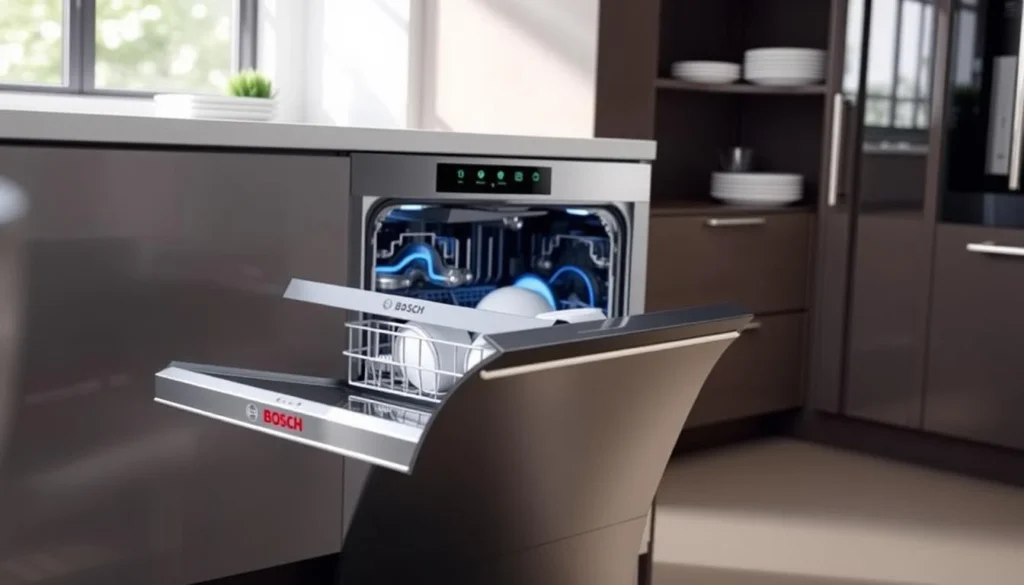
Bosch 500 Series vs 800 Series Energy Ratings
Energy efficiency is another area where both series perform strongly.
A representative Bosch 500 Series dishwasher listed in the ENERGY STAR database uses 239 kWh per year and 3.2 gallons per cycle, with a hybrid plastic-and-steel tub on that particular model.
ENERGY STAR’s current standard-dishwasher criteria require qualifying models to remain at or below 240 kWh per year and 3.2 gallons per cycle under the applicable test methodology.
This illustrates how efficient current Bosch models can be.
However, exact annual energy consumption varies by model, cycle, options and configuration. Buyers should therefore check the EnergyGuide label and model-specific energy data rather than assuming every 500 or 800 Series model has exactly the same consumption.
Does the 800 Series Use Less Energy?
The 800 Series is not necessarily purchased primarily for energy savings.
Both series are engineered around efficient water and energy use, and individual ENERGY STAR-certified models can meet demanding efficiency criteria.
The major reasons to consider the 800 Series generally involve its drying technology, lower noise rating, and additional wash-system capabilities rather than expecting a dramatic reduction in electricity costs.
Independent testing of both representative models found strong energy performance. The 500 Series SHP65CM5N was rated excellent in the energy test, while the 800 Series SHP78CM5N was rated very good.
Bosch 500 Series vs 800 Series Water Usage
Water efficiency should be considered alongside energy efficiency.
Modern dishwashers use substantially less water than many consumers assume because the machine recirculates wash water and uses filtration systems to reduce the amount of fresh water needed.
Current ENERGY STAR standards set a maximum of 3.2 gallons per cycle for standard qualified dishwashers under the applicable test method.
A specific Bosch 500 Series model in the ENERGY STAR database is listed at 3.2 gallons per cycle.
The exact water consumption of a Bosch 800 Series dishwasher depends on model and cycle. Therefore, consumers should use the model-specific energy label rather than assuming that moving from 500 to 800 automatically reduces water use.
Bosch 500 Series vs 800 Series Rack Ratings
Rack design is another area where the difference between the two series can be subtle.
Both representative series models include a third rack and adjustable upper-rack functionality.
The third rack is useful for flatware, utensils, cooking tools and other shallow items.
A third rack can also create more flexibility because smaller items no longer need to occupy valuable space in the main racks.
The exact rack configuration varies between models, however, so shoppers should inspect the particular rack layout rather than assuming every 500 or 800 Series dishwasher is identical.
Bosch EasyGlide Rack System
Many current models use Bosch’s EasyGlide rack system.
The purpose is to make the racks move smoothly when loaded.
This is a practical feature because racks can become significantly heavier when filled with plates, cookware and glassware.
Current 800 Series models such as the SHP78CM5N specifically list EasyGlide rack technology.
Some 500 Series models also offer EasyGlide functionality, depending on the exact configuration. The SHX65DM5N, for example, lists EasyGlide among its features.
Bosch 500 Series vs 800 Series Interior Rating
Both series include models with stainless-steel interiors.
The representative 500 Series SHP65CM5N has a stainless-steel interior, and the representative 800 Series SHP78CM5N also uses stainless steel.
This means the interior material is not necessarily a reason to move from the 500 Series to the 800 Series.
Instead, the more meaningful differences are found in the drying system, sound level, wash technology and specific rack configuration.
Bosch 500 Series vs 800 Series Smart Features
Both series support Bosch’s Home Connect ecosystem on current models.
The system allows compatible dishwashers to connect to a smartphone and provides features such as remote monitoring, cycle information and other connected functions.
This is another area where the difference between the two series is smaller than the price difference might suggest.
A consumer choosing the 500 Series does not necessarily give up smart-home connectivity.
The 800 Series adds advanced appliance technology, but Home Connect itself is available across both tiers.
Bosch 500 Series vs 800 Series Leak Protection
AquaStop is another feature shared across many Bosch models.
Bosch’s series comparison chart identifies 24/7 AquaStop leak protection on the 500 and 800 Series.
This is significant because leak protection is a practical ownership feature rather than merely a luxury feature.
The exact implementation and warranty implications should always be checked in the product documentation for the specific model.
Bosch 500 Series vs 800 Series Reliability Ratings
Reliability should be separated from performance ratings.
Current independent dishwasher research uses owner surveys and statistical modeling to estimate the probability that a dishwasher develops a problem by the end of its fifth year. The methodology includes tens of thousands of owner responses and many thousands of assessed dishwashers.
Current Bosch-specific model pages provide reliability information as part of their broader rating framework, but the exact score for a specific model may be restricted depending on access to the full rating database.
The available public evidence does not justify saying that the 800 Series is inherently more reliable than the 500 Series simply because it costs more.
The two series share substantial underlying technology, and reliability can depend on the exact model and ownership conditions.
Bosch 500 Series vs 800 Series Owner Satisfaction
Owner satisfaction is another separate measurement.
A dishwasher owner may be highly satisfied because the machine is quiet and dries plastics well even if its cleaning performance is similar to another model.
Another owner may prioritize price and consider the additional 800 Series technology unnecessary.
Independent owner-satisfaction ratings are therefore useful as a separate category rather than as a substitute for technical testing.
This distinction becomes especially important when comparing two Bosch series that already perform well.
Bosch 500 Series vs 800 Series Price Ratings
Current U.S. pricing provides a useful illustration of the price difference.
The Bosch SHP65DM5N 500 Series is currently listed around $1,249, while the SHP78CM5N 800 Series is listed around $1,499.
That represents a difference of approximately $250 before taxes, installation, delivery and any retailer-specific promotion.
The difference can become larger or smaller depending on the exact model.
The 500 Series therefore occupies a premium price category without reaching the 800 Series price level in these representative examples.
What Are You Paying Extra for With the 800 Series?
The additional money primarily buys a collection of higher-level features rather than a completely different dishwasher architecture.
Important additions can include:
- CrystalDry
- PowerControl on applicable models
- 42 dBA operation
- More advanced drying
- More sophisticated targeted washing
- Additional rack and finish configurations on certain models
Bosch’s current 800 Series information emphasizes CrystalDry, PowerControl, 42 dBA operation and flexible rack design as major features.
Therefore, the financial question is less about whether the 800 Series can wash dishes and more about whether the additional features address problems that matter to the household.
When the 500 Series Makes More Sense
The 500 Series provides a strong combination of washing performance, energy efficiency, quiet operation, rack flexibility and drying technology.
Independent testing of the representative SHP65CM5N found very good washing performance, excellent energy performance and very good noise performance.
The current SHP65DM5N adds AutoAir, Zone Wash, a third rack, Home Connect and AquaStop while operating at 44 dBA.
For a household that wants a premium dishwasher without paying for every available advanced feature, the 500 Series provides a broad feature set.
It also makes sense for buyers who do not have a particular need for maximum plastic drying or PowerControl.
When the 800 Series Features Become More Relevant
The 800 Series becomes more relevant when drying performance, especially on plastics, is a major concern.
CrystalDry is specifically designed to improve drying and is promoted for difficult-to-dry plastic items.
The 800 Series can also be relevant when extremely quiet operation matters.
The current representative model is rated at 42 dBA compared with 44 dBA for the representative 500 Series model.
The PowerControl system can also be useful for households that frequently place heavily soiled cookware or dishes in particular areas of the lower rack.
Bosch 500 Series vs 800 Series for Plastic Drying
Plastic drying deserves its own section because it is one of the clearest differences.
Plastic items do not retain heat as effectively as ceramic, glass or metal. Consequently, condensation-based drying can leave water droplets behind.
Bosch’s CrystalDry system is designed specifically to address this challenge.
Bosch states that its CrystalDry technology transforms moisture into heat and can provide 60% drier dishes on combined household loads including plastics, glass, steel and porcelain compared with Bosch dishwashers using PureDry.
This is a manufacturer-reported comparison, so the exact result will depend on the load and model.
Nevertheless, it explains why the 800 Series has a meaningful technological distinction from the 500 Series.
Bosch 500 Series vs 800 Series for Families
Families often run dishwashers frequently and place a wide variety of items inside.
A third rack can provide useful extra capacity for utensils and flatware, while flexible racks can make it easier to accommodate different cookware. Both series offer these types of features on representative models.
For families with many plastic food containers, the 800 Series drying system may have greater practical value.
For families primarily washing plates, glasses, bowls and stainless-steel cookware, the 500 Series may provide sufficient drying capability.
Bosch 500 Series vs 800 Series for Open Kitchens
Noise can become particularly important in open-concept homes.
The 500 Series example operates at 44 dBA, while the 800 Series example operates at 42 dBA.
Both are designed for quiet operation, but the 800 Series provides the lower rated sound level.
Independent testing also rated the 800 Series representative model excellent for noise, while the 500 Series representative model was rated very good.
For kitchens adjacent to living rooms, dining areas or bedrooms, this difference can be more meaningful than it would be in a closed kitchen.
Bosch 500 Series vs 800 Series for Apartments and Condos
Apartments and condos can make noise and space particularly important.
A 42 dBA dishwasher can reduce the amount of operating sound compared with a 44 dBA model, although actual perceived sound depends on installation and kitchen construction.
Both series use a standard 24-inch format in the representative models discussed here.
Before purchasing, consumers should check cabinet dimensions, electrical requirements, water connections, door clearance and installation requirements.
Bosch 500 Series vs 800 Series for Hard Water
Hard water can affect any dishwasher.
Mineral deposits can accumulate on internal surfaces, filters and spray components, while water hardness can influence detergent performance and spotting.
Neither the 500 nor 800 Series should be treated as completely immune to hard-water effects.
Routine filter cleaning, correct detergent use and appropriate rinse-aid settings remain important.
A dishwasher’s premium price does not eliminate the need for maintenance.
Bosch 500 Series vs 800 Series Maintenance
Both series require routine care.
Dishwasher filters should be checked and cleaned according to the model’s instructions.
Spray arms should be inspected when cleaning performance declines.
The door seal should be kept clean, and detergent and rinse-aid systems should be maintained correctly.
A premium dishwasher can still perform poorly if the filter is blocked or the spray arms cannot distribute water correctly.
This is particularly relevant when interpreting ratings: laboratory testing assumes proper operation and maintenance, while real-world owners may experience different results because of loading and maintenance practices.
Bosch 500 Series vs 800 Series Cycle Time
Cycle time is an area where neither representative model receives an especially strong independent rating.
The tested 500 Series SHP65CM5N received a fair cycle-time assessment, and the tested 800 Series SHP78CM5N also received a fair cycle-time assessment.
This is an important reminder that upgrading to the 800 Series does not necessarily mean substantially faster washing.
Modern high-efficiency dishwashers often use longer cycles to achieve cleaning and energy objectives.
Consumers who prioritize speed should therefore pay attention to cycle options and specific program durations rather than assuming that the more expensive series will finish faster.
Bosch 500 Series vs 800 Series for Heavy Soil
Both series are designed to handle heavily soiled dishes.
The representative 500 Series model performed very well in the independent heavy-soil washing test.
The representative 800 Series model also performed very well.
The 800 Series PowerControl system can add targeted washing capability in applicable models, which may be useful for concentrated areas of heavy soil.
However, loading technique remains critical.
Blocking a spray arm or nesting dirty dishes together can reduce cleaning performance regardless of whether the dishwasher belongs to the 500 or 800 Series.
Bosch 500 Series vs 800 Series for Everyday Dishes
For everyday loads containing plates, bowls, glasses, cutlery and moderately soiled cookware, both series provide sophisticated cleaning systems.
The 500 Series already includes PrecisionWash and sensor-based washing, while current 800 Series models can add PowerControl.
The difference therefore becomes more noticeable in specialized situations rather than ordinary loads.
For example, plastic drying, extremely quiet operation and targeted lower-rack washing can provide reasons to consider an 800 Series model.
Bosch 500 Series vs 800 Series Customer Ratings
Current Bosch product pages show strong customer ratings for representative models.
The SHP65DM5N 500 Series is currently displayed at approximately 4.5 out of 5 stars from more than 900 ratings on Bosch’s U.S. site.
The SHP78CM5N 800 Series is currently displayed at approximately 4.5 out of 5 stars from several thousand ratings on the same product platform.
These customer ratings should be treated separately from laboratory ratings.
They reflect purchaser experiences and can be influenced by installation, expectations, delivery, customer service and individual household circumstances.
Why Customer Ratings and Laboratory Ratings Can Differ
A laboratory can control soil levels, water conditions, loading patterns and testing procedures.
A real household cannot.
One household may have extremely hard water, another may use soft water. One owner may wash mostly ceramic dishes, while another frequently washes plastic containers.
A consumer review can therefore describe an experience that is completely genuine while not necessarily representing how the dishwasher performs under standardized testing.
Independent testing is useful for controlled comparisons, while customer reviews can provide additional information about ownership experiences. Neither should automatically replace the other.
Bosch 500 Series vs 800 Series: Rating Categories
| Rating Category | 500 Series | 800 Series |
|---|---|---|
| Washing | Very good on representative tested model | Very good on representative tested model |
| Energy performance | Excellent on representative tested model | Very good on representative tested model |
| Noise | Very good | Excellent |
| Drying technology | AutoAir | CrystalDry |
| Cycle time | Fair | Fair |
| Smart connectivity | Yes | Yes |
| Third rack | Yes | Yes |
| Stainless interior | Yes on representative model | Yes on representative model |
| Leak protection | AquaStop | AquaStop |
| Targeted washing | Zone Wash on current example | PowerControl on applicable models |
| Current example customer rating | ~4.5/5 | ~4.5/5 |
These results are representative rather than universal ratings for every model in each series.
Bosch 500 Series vs 800 Series for the USA
The North American lineup provides the clearest direct 500-versus-800 comparison.
Current U.S. models include the 500 Series SHP65DM5N and multiple 800 Series models, with the latter generally positioned at a higher price and lower noise level.
U.S. buyers should pay attention to the EnergyGuide information, installation dimensions, electrical requirements, warranty terms and model-specific features.
The 800 Series’ CrystalDry technology is particularly relevant for consumers who frequently wash plastic containers.
Bosch 500 Series vs 800 Series for Canada
The Bosch dishwasher ecosystem is also represented in Canada.
Current Canadian Bosch information identifies multiple Bosch dishwasher models that receive independent recognition, including 500 and 800 Series models.
Canadian buyers should nevertheless verify the exact model number because product availability, finishes, pricing, electrical specifications and model codes can vary between the United States and Canada.
Water hardness can also vary substantially between Canadian communities, making detergent and rinse-aid adjustment important.
Bosch 500 Series vs 800 Series for the UK
The 500 Series and 800 Series naming discussed in this article is primarily based on Bosch’s North American product hierarchy.
Bosch uses different product naming conventions and ranges in some European markets, including the United Kingdom.
Therefore, a UK buyer should not assume that a dishwasher marketed under a different European series name is directly equivalent to a North American 500 or 800 Series model.
The underlying comparison points remain useful, however: drying technology, noise, water consumption, energy efficiency, rack design, cleaning technology, warranty and repair support.
Bosch 500 Series vs 800 Series Ratings and Reliability
Reliability is one of the most important areas to consider when purchasing a premium dishwasher.
Current independent reliability methodology uses owner survey data to estimate the probability that a dishwasher will develop a problem by the fifth year. The current database includes tens of thousands of owner responses and more than 86,000 dishwashers assessed across its reliability research.
Bosch currently performs strongly at the brand level in independent dishwasher evaluations, including reliability and owner satisfaction. Current 2026 reporting places Bosch prominently among evaluated dishwasher brands.
However, reliability should not be interpreted as an automatic reason to choose one Bosch series over another.
The 500 and 800 Series share many fundamental systems, and individual model design can matter more than the series label.
Does the 800 Series Last Longer Than the 500 Series?
There is insufficient evidence to state that every 800 Series dishwasher will last longer than every 500 Series dishwasher.
The 800 Series includes additional technology, particularly CrystalDry and PowerControl on applicable models, but more technology does not automatically establish a longer service life.
Long-term durability can be influenced by installation, water conditions, maintenance, usage frequency, electrical conditions and the specific model.
The appropriate way to evaluate durability is therefore to look at model-specific reliability evidence rather than assuming that a higher series number means a longer lifespan.
Bosch 500 Series vs 800 Series Repair Considerations
The two series contain many similar basic dishwasher systems, including pumps, valves, controls, filtration, heating components, sensors and drainage systems.
The 800 Series can have additional technology that is not present in lower tiers, so repairs can involve a different set of components depending on the model.
Bosch provides model-specific service information, manuals, replacement parts and support resources for current and older models.
This is one reason why consumers should keep the exact model and serial information after purchasing the appliance.
Bosch 500 Series vs 800 Series Ratings for Different Households
| Household Situation | Relevant 500 Series Characteristics | Relevant 800 Series Characteristics |
|---|---|---|
| Small household | Quiet, efficient, flexible racks | Even quieter, advanced drying |
| Large family | Third rack, Zone Wash | Third rack, PowerControl, CrystalDry |
| Lots of plastics | AutoAir | CrystalDry |
| Open kitchen | 44 dBA example | 42 dBA example |
| Heavy cookware | Zone Wash | PowerControl on applicable models |
| Smart-home use | Home Connect | Home Connect |
| Energy-conscious household | Strong efficiency | Strong efficiency |
| Premium features | Extensive | More extensive |
| Budget within premium Bosch range | Lower entry price | Higher price |
| Focus on drying | AutoAir | CrystalDry |
The exact feature combination depends on the model, so this table should be used as a framework rather than a substitute for the specification sheet of the dishwasher being considered.
Bosch 500 Series vs 800 Series Ratings: Important Buying Mistakes to Avoid
Mistake 1: Assuming every 800 Series model is identical
Bosch sells multiple 800 Series configurations, including different handles, finishes, panel-ready designs and feature combinations.
Current U.S. listings show several 800 Series models with different prices and configurations.
Mistake 2: Comparing only the series number
The difference between two specific models can sometimes be more relevant than the difference between the series names.
Always compare the model numbers.
Mistake 3: Assuming higher price means better cleaning
Independent testing shows that representative models from both series perform very well in washing tests.
Mistake 4: Ignoring drying performance
For households using many plastic containers, drying technology can be more important than a small difference in wash performance.
Mistake 5: Ignoring noise
A 42 dBA dishwasher and a 44 dBA dishwasher are both quiet, but the difference can matter in open kitchens.
Mistake 6: Treating retailer star ratings as laboratory ratings
Customer reviews represent owner experiences, while controlled laboratory testing measures standardized performance.
Bosch 500 Series vs 800 Series: Overall Rating Perspective
The available evidence shows that both series occupy a high-performance part of the Bosch dishwasher lineup.
The 500 Series provides very good washing performance, strong energy performance, quiet operation, AutoAir drying, third-rack functionality and smart connectivity on representative current models.
The 800 Series builds on that platform with CrystalDry, lower 42 dBA operation and PowerControl on applicable models. Independent testing of the representative 800 Series model found very good washing and energy performance and excellent noise performance.
The differences are therefore concentrated in particular features rather than representing a complete change in dishwasher quality.
Bosch 500 Series vs 800 Series: Frequently Asked Questions
1. What is the main difference between Bosch 500 and 800 Series dishwashers?
The biggest differences are drying technology, noise level and selected wash technologies. The 500 Series uses AutoAir on representative current models, while the 800 Series uses CrystalDry and can include PowerControl.
2. Which Bosch Series is quieter?
Representative current specifications show the 500 Series SHP65DM5N at 44 dBA and the 800 Series SHP78CM5N at 42 dBA.
3. Does the Bosch 800 Series dry plastic better?
CrystalDry is specifically designed to improve drying performance, including on plastics. Bosch reports substantially improved drying on combined household loads compared with PureDry systems.
4. Does Bosch 500 Series have a third rack?
Yes. Representative current 500 Series models include a third rack.
5. Does Bosch 800 Series have a third rack?
Yes. Current representative 800 Series models include a flexible third rack.
6. Is Bosch 500 Series ENERGY STAR certified?
Many current models are ENERGY STAR certified. Specific certification should be verified for the exact model. An ENERGY STAR database entry for a Bosch 500 Series model lists 239 kWh/year and 3.2 gallons/cycle.
7. Is Bosch 800 Series ENERGY STAR certified?
Many current 800 Series models are ENERGY STAR certified. The exact certification and energy consumption should be checked against the individual model’s energy label.
8. Does the Bosch 500 Series have CrystalDry?
The representative current 500 Series models discussed here use AutoAir rather than CrystalDry.
9. Does every Bosch 800 Series dishwasher have PowerControl?
Not necessarily. PowerControl depends on the specific 800 Series model. Bosch identifies PowerControl as part of the 800 Series platform, but exact configurations should be checked before purchase.
10. Does the Bosch 500 Series clean heavily soiled dishes?
The representative tested 500 Series model performed very well in an independent heavily soiled-dish washing test.
11. Does the Bosch 800 Series clean heavily soiled dishes?
The representative tested 800 Series model also performed very well in heavily soiled-dish testing.
12. Is the Bosch 800 Series worth the higher price?
That depends on which features matter to the household. The additional cost is associated with technologies such as CrystalDry, lower noise and PowerControl on applicable models.
13. Is Bosch 500 Series a premium dishwasher?
Yes. The current 500 Series includes features such as a stainless-steel interior, third rack, Wi-Fi, AquaStop and advanced washing and drying technology.
14. Is Bosch 800 Series a premium dishwasher?
Yes. It sits above the 500 Series within Bosch’s North American lineup and adds technologies including CrystalDry and PowerControl on applicable models.
15. Does the 800 Series wash faster?
Not necessarily. Independent testing rated the representative 800 Series model’s cycle time as fair. The representative 500 Series model also received a fair cycle-time assessment.
16. Which Series has better drying?
The 800 Series provides the more advanced drying system through CrystalDry on applicable models.
17. Which Series is better for plastic containers?
The 800 Series CrystalDry system is specifically designed to improve drying of difficult items such as plastics.
18. Which Series has better noise performance?
Representative testing gives the 800 Series an excellent noise assessment compared with very good for the representative 500 Series model.
19. Does Bosch 500 Series have Wi-Fi?
Yes. Representative current models include Home Connect Wi-Fi functionality.
20. Does Bosch 800 Series have Wi-Fi?
Yes. Current representative models include Home Connect.
21. Does Bosch 500 Series have AquaStop?
Current representative 500 Series models list AquaStop leak protection.
22. Does Bosch 800 Series have AquaStop?
Bosch’s series feature chart lists 24/7 AquaStop protection for the 800 Series.
23. Is the Bosch 500 Series quieter than most traditional dishwashers?
The representative current 500 Series model is rated at 44 dBA, placing it in the quiet category of modern dishwashers.
24. Is 42 dBA very quiet for a dishwasher?
Yes. The current 800 Series representative model is rated at 42 dBA, and independent testing assessed its noise performance as excellent.
25. Does Bosch 500 Series have stainless steel interiors?
The representative SHP65DM5N/SHP65CM5N configurations use stainless-steel interiors. Exact construction should be checked for the specific model.
26. Does Bosch 800 Series have a stainless-steel interior?
Yes, representative 800 Series models use stainless-steel interiors.
27. Does a higher Bosch Series guarantee better reliability?
No. Series position and reliability are separate considerations. Reliability depends on the specific model, usage, installation, maintenance and other factors.
28. Does Bosch 800 Series use less water?
Not necessarily. Water consumption varies by model and cycle. Specific energy-label information should be checked rather than assuming the higher series automatically uses less water.
29. Are Bosch 500 Series dishwashers good for families?
Their third racks, flexible loading systems, strong cleaning performance and quiet operation make them suitable for many family kitchens.
30. Are Bosch 800 Series dishwashers good for families?
The 800 Series adds advanced drying and targeted washing features that can be useful for households with large mixed loads and many plastic items.
31. Which Bosch Series is better for an open-concept kitchen?
Both are designed for quiet operation, but the representative 800 Series model has the lower 42 dBA rating compared with 44 dBA for the representative 500 Series model.
32. Which Bosch Series is better for hard water?
Neither series is immune to hard-water effects. Proper detergent, rinse aid and filter maintenance remain important regardless of series.
33. Does Bosch 500 Series have AutoAir?
Current representative 500 Series models use AutoAir, which is designed to improve drying through fresh-air circulation.
34. What is CrystalDry?
CrystalDry is Bosch’s advanced drying technology that uses a mineral-based system to transform moisture into heat and improve drying performance.
35. What is PowerControl?
PowerControl is a Bosch wash technology using a motorized spray arm to target different areas of the lower rack with different wash intensities on applicable 800 Series models.
36. Does the 500 Series have PowerControl?
The current 500 Series feature chart lists PrecisionWash rather than PowerControl as its wash system.
37. Does the Bosch 800 Series have a better rack system?
Both series offer flexible rack systems. The 800 Series has additional configurations and EasyGlide features on representative models, but rack design varies by exact model.
38. Do both series have sensor washing?
Yes. Bosch uses sensor-based washing technology across its dishwasher lineup, including the 500 and 800 Series.
39. Are Bosch dishwasher cycles long?
Some Bosch cycles are relatively long, particularly when using options intended for heavy cleaning or enhanced drying. Independent testing rated cycle time as fair for representative 500 and 800 Series models.
40. Which Bosch Series has the strongest drying technology?
The 800 Series provides the more advanced CrystalDry system on applicable models.
41. Which Bosch Series has better energy performance?
Both have strong energy performance. The representative 500 Series model received an excellent energy-performance assessment, while the representative 800 Series model received a very good assessment.
42. Can the Bosch 500 Series clean as well as the 800 Series?
Representative independent tests show very good washing performance from both.
43. Is the Bosch 800 Series mainly about drying?
Drying is one of its major distinctions, but the series also adds PowerControl on applicable models, lower noise ratings and other premium configurations.
44. Are all Bosch 500 Series models rated the same?
No. Ratings and specifications can vary by model, configuration, handle, finish and feature package.
45. Are all Bosch 800 Series models rated the same?
No. Bosch offers multiple 800 Series configurations, and independent testing may cover one model while another is expected to perform similarly but is not individually tested.
Final Comparison: Bosch 500 Series vs 800 Series Ratings
The Bosch 500 Series and 800 Series are both premium dishwasher platforms with strong washing performance, efficient operation, quiet designs, flexible racks and smart connectivity.
The representative 500 Series model tested independently achieved very good washing performance, excellent energy performance and very good noise performance, while its cycle-time assessment was fair.
The representative 800 Series model achieved very good washing performance, very good energy performance and excellent noise performance, while its cycle-time assessment was also fair.
The most significant technological distinction is drying. The current 500 Series example uses AutoAir, while the 800 Series uses CrystalDry, which is specifically designed to improve drying performance, including on plastic items.
The 800 Series also has PowerControl on applicable models, allowing the dishwasher to direct different wash intensities toward different sections of the lower rack. Controlled testing of an 800 Series configuration found a measurable cleaning improvement when the heavy PowerControl setting was used, although that result should not be interpreted as a universal percentage improvement for every household load.
Noise is another measurable distinction. A representative 500 Series model is rated at 44 dBA, while a representative 800 Series model is rated at 42 dBA. Both are quiet, but the 800 Series has the lower specification and received the stronger independent noise assessment in the representative testing.
Energy performance is strong in both tiers. A current ENERGY STAR database entry for a Bosch 500 Series model lists 239 kWh per year and 3.2 gallons per cycle, while independent testing also found excellent energy performance for the representative 500 Series model.
The practical difference between the series is therefore largely about how much advanced technology the household needs. The 500 Series already provides a sophisticated dishwasher with strong cleaning, quiet operation, flexible loading, AutoAir drying and smart connectivity. The 800 Series adds more advanced drying, lower rated noise and additional wash technology on applicable models.
For consumers in the United States and Canada, the current North American 500 and 800 Series models provide a direct comparison. UK shoppers should be more careful about series-name equivalence because Bosch’s European product hierarchy and model numbers can differ from North American products.
Ultimately, the most useful way to interpret Bosch Dishwasher 500 Series vs 800 Series ratings is to compare the exact model numbers rather than relying exclusively on the series label. The model’s drying system, sound rating, rack configuration, wash technology, energy label, warranty, dimensions and independent test results can all influence the ownership experience.
The current evidence shows that both series occupy a high-performance segment, while the 800 Series adds several technologies aimed at improving drying, targeted washing and acoustic performance. The 500 Series, meanwhile, already delivers strong independent test results and a substantial collection of premium features.