
When comparing Amana vs Frigidaire dishwasher energy efficiency, it is important to look beyond the brand name. Dishwasher efficiency is determined by several measurable factors, including annual electricity consumption, water consumption per cycle, drying method, soil-sensing technology, filtration, dishwasher capacity, cycle selection, and the way the appliance is tested and rated.
Current certified-model data provides a useful example. A current Amana ADFS2524R-series dishwasher is listed at 240 kWh per year and 3.2 gallons of water per cycle, while a current Frigidaire FDSP4401-series dishwasher is also listed at 240 kWh per year and 3.2 gallons per cycle. Both are standard-size models and both are certified for the U.S. and Canadian markets.
That does not mean every Amana dishwasher and every Frigidaire dishwasher has identical energy performance. Both manufacturers have multiple models, and specifications can differ substantially between models. The most useful comparison is therefore between models with similar capacity, construction, drying technology, and features.
For consumers in the United States and Canada, the annual energy-use figure is particularly useful because it provides a standardized way to compare appliances. In the United Kingdom, the comparison needs to be made using the applicable UK energy label and product information because the labeling and efficiency framework differs from the North American system.
This guide explains how Amana and Frigidaire compare in energy efficiency, water consumption, drying technology, energy-saving cycles, sensors, filtration, capacity, operating costs, and long-term efficiency.
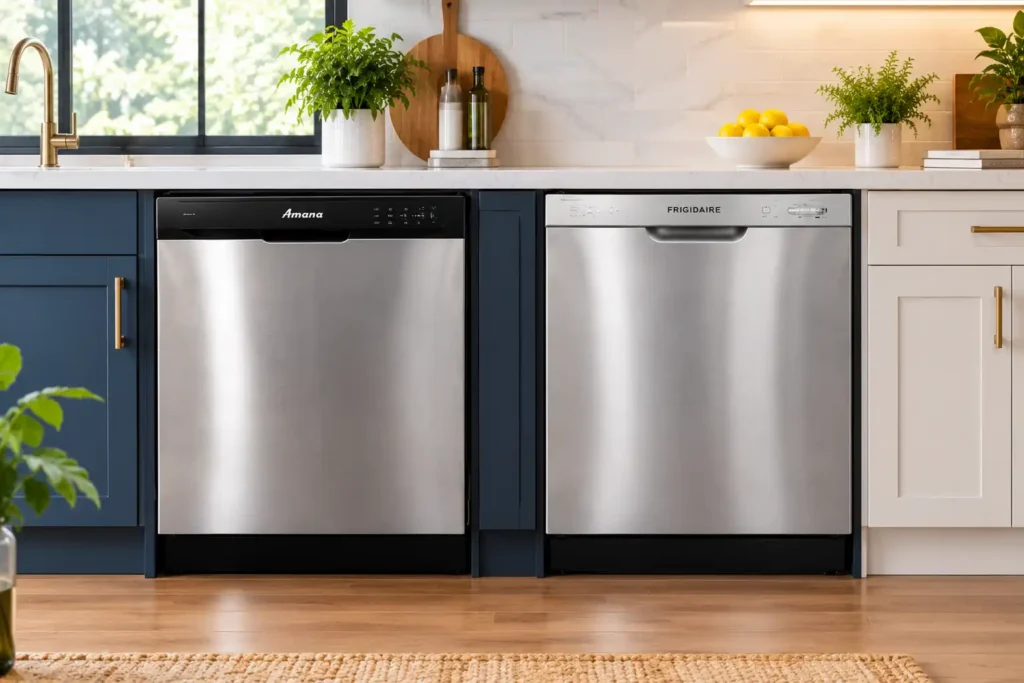
Amana vs Frigidaire Dishwasher Energy Efficiency at a Glance
| Energy-Efficiency Factor | Amana | Frigidaire |
|---|---|---|
| ENERGY STAR models | Yes | Yes |
| Current representative annual energy use | 240 kWh/year | 240 kWh/year |
| Current representative water use | 3.2 gal/cycle | 3.2 gal/cycle |
| Standard-size efficiency limit | 240 kWh/year for ENERGY STAR | 240 kWh/year for ENERGY STAR |
| Soil sensing | Available on selected models | Available on selected models |
| Heated drying | Available | Available |
| Fan-assisted drying | Model dependent | Available on selected models |
| Plastic tub models | Available | Available |
| Stainless-steel tub models | Available depending on model | Available |
| U.S. market | Yes | Yes |
| Canadian market | Selected models | Selected models |
| UK comparison | Market availability must be verified | Market availability must be verified |
The current model data demonstrates why model-to-model comparison is more meaningful than a blanket brand comparison. A current Amana ADFS2524R-series model uses 240 kWh annually and 3.2 gallons per cycle, while the Frigidaire FDSP4401-series has the same listed annual electricity consumption and water consumption.
What Does Dishwasher Energy Efficiency Actually Mean?
Dishwasher energy efficiency refers to how much electricity and water the appliance requires to complete its standardized cleaning cycles.
Electricity is used for several functions, including operating the pump, motor, controls, sensors and other electrical components. A particularly important energy demand is heating water because dishwashers generally need relatively hot water to achieve effective cleaning. Drying can also contribute to electricity consumption depending on the drying technology used.
Water efficiency is closely related to energy efficiency because heating water requires energy. Using less water can therefore reduce both water consumption and some of the energy required to heat that water.
Modern efficient dishwashers use technologies such as soil sensors, improved filtration, efficient spray systems and optimized rack arrangements to reduce unnecessary water and energy use while maintaining cleaning performance.
Consequently, a dishwasher should not be judged only by the wattage of its motor or heating element. The entire washing process needs to be considered.
How Dishwasher Energy Consumption Is Measured
For U.S. ENERGY STAR qualification, dishwasher energy performance is measured according to a standardized Department of Energy test procedure.
The current ENERGY STAR dishwasher specification uses annual energy consumption and water consumption as key efficiency measurements. Standard-size qualifying dishwashers must use no more than 240 kWh per year and 3.2 gallons per cycle under the applicable test methodology.
The annual figure is not simply the amount of electricity the dishwasher would use if it ran continuously. It is an estimated annual consumption calculated using standardized assumptions about dishwasher use.
The current test methodology uses an average of 215 cycles per year for the annual calculation.
This is important because your actual electricity consumption can be higher or lower depending on how frequently you operate the dishwasher.
Amana Dishwasher Energy Efficiency
Amana has several dishwasher configurations that meet current efficiency requirements.
A current Amana ADFS2524R-series dishwasher is listed as a standard-size ENERGY STAR-certified dishwasher with an annual energy use of 240 kWh, water consumption of 3.2 gallons per cycle, a 12-place-setting capacity and heated drying. The model is listed for both the United States and Canada.
This places that Amana model directly at the current ENERGY STAR maximum annual energy-use threshold for standard-size dishwashers.
The same model’s 3.2-gallon-per-cycle water consumption also meets the current ENERGY STAR maximum water-use criterion for standard dishwashers.
This is a useful illustration of how an Amana dishwasher can combine relatively modest water consumption with an annual energy-use figure that qualifies for the current efficiency standard.
Frigidaire Dishwasher Energy Efficiency
Frigidaire also offers ENERGY STAR-certified dishwashers with strong efficiency specifications.
A current Frigidaire FDSP4401-series dishwasher is listed with 240 kWh per year, 3.2 gallons per cycle, a 14-place-setting maximum capacity, stainless-steel tub and fan-assisted drying. The certified model is listed for both the United States and Canada.
Another current Frigidaire FDPH4316-series model is listed at 240 kWh per year and 3.2 gallons per cycle, with a 12-place-setting capacity, heated drying, soil sensing and a plastic tub.
This demonstrates that Frigidaire’s energy-efficient lineup is not limited to one particular construction or drying configuration.
Amana vs Frigidaire: Annual Energy Consumption
The most direct comparison between the representative current models is straightforward.
Amana ADFS2524R-series
240 kWh/year
Frigidaire FDSP4401-series
240 kWh/year
Both are at the current ENERGY STAR maximum annual energy-consumption threshold for standard-size dishwashers.
Therefore, based strictly on these two model specifications, there is no difference in their listed annual electricity consumption.
However, this does not mean every Amana and Frigidaire dishwasher consumes exactly 240 kWh annually.
Individual models can have different capacities, cycles, drying systems and efficiency specifications.
Amana vs Frigidaire: Water Consumption
Water consumption is another major part of dishwasher efficiency.
The representative Amana ADFS2524R-series model uses 3.2 gallons per cycle, while the Frigidaire FDSP4401-series also uses 3.2 gallons per cycle.
The current ENERGY STAR criterion for standard dishwashers is also 3.2 gallons per cycle.
This means both representative models meet the current ENERGY STAR water-consumption threshold.
Water efficiency matters beyond the water bill because the dishwasher must generally heat incoming water. Reducing the quantity of hot water required can reduce the energy required for water heating.
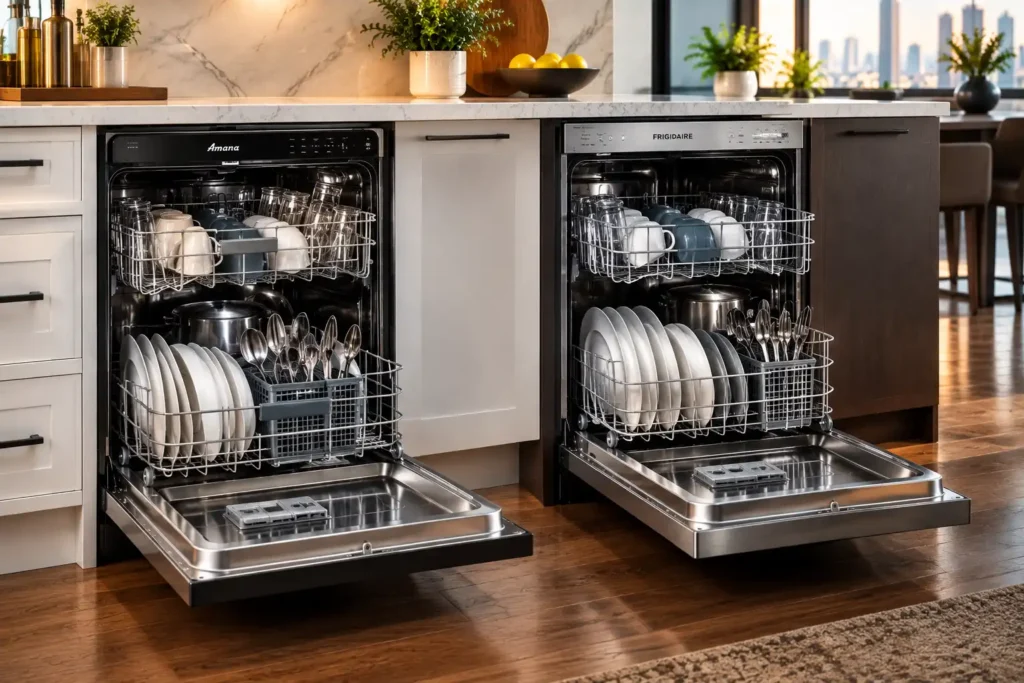
Why Water Efficiency Matters for Energy Efficiency
A dishwasher does not simply consume electricity directly from the electrical outlet.
A substantial portion of its energy demand can be associated with heating water.
Consequently, reducing water consumption can contribute to lower energy consumption when less water needs to be heated.
Modern dishwasher designs use targeted spray patterns, filtration and sensor-controlled cycles to avoid repeatedly replacing large quantities of water. ENERGY STAR specifically identifies improved filtration, soil sensors, efficient jets and rack design as technologies that can help reduce water and energy consumption.
This is one reason why an efficient dishwasher should be evaluated as a complete system rather than by looking at a single component.
Soil Sensors and Energy Efficiency
Soil sensing can contribute to efficiency by allowing the dishwasher to respond to the actual condition of the dishes.
A dishwasher with soil-sensing capability can monitor the water and determine whether the load is heavily or lightly soiled.
This can allow the dishwasher to adjust aspects of its operation rather than treating every load as though it has the same soil level.
ENERGY STAR specifically recommends automatic-sensing cycles because soil sensors can help save water while still providing appropriate cleaning.
However, not every Amana or Frigidaire model has soil sensing.
The current Amana ADFS2524R-series example is listed without soil-sensing capability, while the Frigidaire FDSP4401-series and FDPH4316-series examples are listed with soil-sensing capability.
Therefore, this is an important model-level distinction when comparing energy efficiency.
Amana SoilSense and Energy Efficiency
Some Amana dishwashers use SoilSense technology.
A representative Amana model with SoilSense can automatically sense the size and soil level of the load and adjust the cycle accordingly. The technology is designed to reduce the need for users to determine every wash parameter manually.
Automatic cycle adjustment can be useful for efficiency because lightly soiled loads do not necessarily require the same treatment as heavily soiled cookware.
The actual energy savings depend on the model’s programming and the particular load, so SoilSense should be viewed as an efficiency-supporting technology rather than a guarantee of a specific energy saving.
Frigidaire SoilSense and Sensor Technology
Frigidaire also offers models with soil-sensing capability.
The current FDSP4401-series and FDPH4316-series ENERGY STAR listings both identify soil-sensing capability.
This allows certain Frigidaire models to automatically adapt operation based on load conditions.
The practical advantage is that consumers do not always have to select the longest or most intensive cycle simply because some dishes are heavily soiled.
Using the correct automatic or sensor cycle can therefore help avoid unnecessary water and energy consumption.
Does Soil Sensing Automatically Make a Dishwasher More Efficient?
Not necessarily.
Soil sensing is a useful technology, but the overall efficiency of the dishwasher still depends on the complete design.
Annual energy consumption, water consumption, capacity, drying method and test results provide more direct measures of efficiency.
A dishwasher without soil sensing can still meet ENERGY STAR requirements if its overall performance meets the applicable criteria.
Likewise, having a soil sensor does not automatically mean that a particular model will have lower annual energy use than every model without one.
Heated Dry and Energy Consumption
Drying is one of the most important differences between dishwasher designs.
Heated drying uses electrical energy to assist evaporation.
Amana’s current ADFS2524R-series ENERGY STAR listing identifies Heated Dry as its drying method.
Frigidaire also has models using heated drying. Its FDPH4316-series ENERGY STAR model is listed with heated drying, while other Frigidaire models use fan-assisted drying.
Heated drying can improve drying performance, particularly for materials that retain water, but it can also influence electricity consumption.
This is why the annual energy-use figure is more useful than simply assuming that one drying method is always more efficient.
Fan-Assisted Drying
Fan-assisted drying uses airflow to help remove moisture.
The current Frigidaire FDSP4401-series model is listed with fan-assisted drying while maintaining an annual energy-use rating of 240 kWh and water consumption of 3.2 gallons per cycle.
Fan assistance can improve moisture removal without relying exclusively on high heat.
However, the energy impact depends on the complete system, including the fan, heater, cycle programming and drying duration.
Consumers should therefore compare the model’s certified annual energy figure rather than assuming that fan-assisted drying automatically means lower energy consumption.
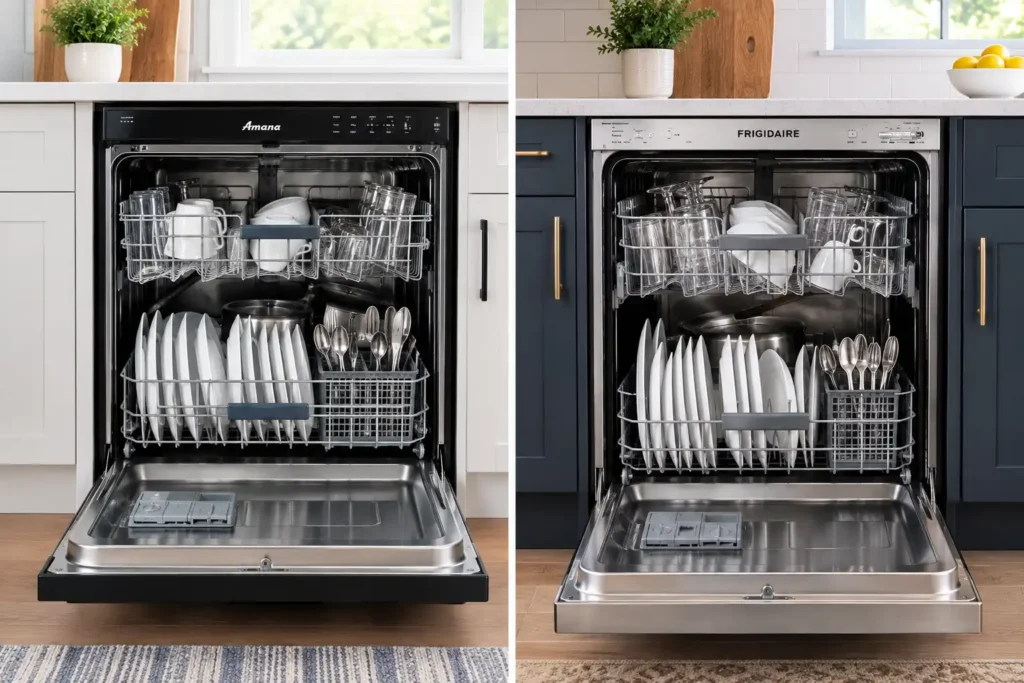
Amana Heated Dry vs Frigidaire Fan-Assisted Dry
This comparison illustrates why drying technology should not be evaluated in isolation.
A representative Amana model uses heated drying and is rated at 240 kWh annually.
A representative Frigidaire model uses fan-assisted drying and is also rated at 240 kWh annually.
Therefore, the drying mechanism by itself does not establish which dishwasher is more energy efficient.
The standardized annual energy rating provides the more meaningful comparison.
Energy Efficiency and Dishwasher Capacity
Capacity is often overlooked when comparing energy efficiency.
A larger dishwasher may consume similar energy per standardized cycle while washing more dishes.
This can make energy consumption per dish potentially more favorable when the dishwasher is fully loaded.
ENERGY STAR recommends choosing an appropriately sized dishwasher and notes that standard-capacity models hold more than eight place settings plus six serving pieces, while compact models hold less.
A compact dishwasher is not automatically more energy efficient in practical household use if it requires substantially more cycles to clean the same quantity of dishes.
Amana 12-Place-Setting Capacity
The current Amana ADFS2524R-series model is rated for 12 place settings.
This is a standard-size capacity appropriate for many households.
When the dishwasher is filled efficiently, the energy and water used for one cycle can be distributed across a larger number of dishes.
This is one reason running full loads is an important efficiency practice.
Frigidaire 12- and 14-Place-Setting Models
Frigidaire has several efficiency-certified configurations with different capacities.
The FDPH4316-series is listed at 12 place settings, while the FDSP4401-series is listed at up to 14 place settings.
If two models consume similar energy per standardized cycle but one accommodates more dishes, the larger model may be more practical for a household that can consistently fill it.
However, buying a larger dishwasher solely for capacity is not necessarily efficient if the household rarely has enough dishes to fill it.
Running Full Loads
One of the simplest ways to improve dishwasher efficiency is to avoid running partially filled loads unnecessarily.
ENERGY STAR states that dishwashers use approximately the same amount of energy and water regardless of the number of dishes inside and recommends running full loads whenever possible.
This means household behavior can have a substantial effect on real-world efficiency.
A highly efficient dishwasher operated several times with half-full loads can use more total energy and water than a somewhat less efficient dishwasher operated fewer times with full loads.

Scraping Instead of Pre-Rinsing
Pre-rinsing dishes under a running tap can waste water and energy.
Modern efficient dishwashers and detergents are designed to handle food residues without requiring dishes to be extensively rinsed beforehand.
Current efficiency guidance recommends scraping leftover food into the waste or compost stream rather than thoroughly rinsing dishes before loading.
This can reduce the total amount of water used by the household.
It also prevents the dishwasher from receiving already-clean dishes that still require a full wash cycle.
Choosing the Correct Wash Cycle
The selected cycle can affect energy and water consumption.
A heavily soiled load may require intensive cleaning, while lightly soiled dishes may not require the same treatment.
ENERGY STAR recommends looking for multiple cycle options and using lighter cycles for lightly soiled dishes where appropriate.
Both Amana and Frigidaire offer different cycle configurations depending on model.
Therefore, consumers should examine the available cycles instead of assuming that every dishwasher in a brand’s lineup operates identically.
Quick Wash and Energy Efficiency
Quick or one-hour cycles can be useful when dishes need to be cleaned rapidly.
However, consumers should not automatically assume that the shortest cycle is the most energy efficient.
The amount of water used, water temperature, wash intensity, drying method and cycle programming all affect energy consumption.
The most efficient cycle for a particular household can depend on the load.
For lightly soiled dishes, an appropriately designed shorter or lighter cycle may reduce resource use. For heavily soiled dishes, an unnecessarily short cycle may not provide adequate cleaning and could result in additional washing.
Eco Cycles and Energy Efficiency
Eco programs are specifically designed around resource efficiency.
The UK framework requires household dishwashers to provide an eco programme and specifies efficiency requirements for covered products.
Eco programs can use lower temperatures, optimized water quantities and longer cycle times to reduce total energy consumption.
This can appear counterintuitive because the cycle may take longer.
A longer cycle does not necessarily mean greater energy consumption.
The dishwasher may spend much of that time washing or soaking with relatively low energy input, while the actual heating periods can be carefully controlled.
Why Longer Dishwasher Cycles Can Use Less Energy
Many consumers assume that a one-hour cycle must be more efficient than a three-hour eco cycle.
That assumption is not necessarily correct.
Energy consumption depends on how much power is used and for how long, as well as how much water is heated.
A longer cycle can operate with lower heating intensity and optimized water use.
This is why standardized energy measurements are more useful than cycle duration alone.
Energy Efficiency of Filtration Systems
Filtration can contribute to dishwasher efficiency because the machine can reuse wash water rather than continuously replacing it.
Amana offers models with filtration systems such as Triple Filter Wash, while ENERGY STAR identifies improved water filtration as one of the technologies used in modern efficient dishwashers.
Efficient filtration can help remove food particles from recirculating water while allowing the dishwasher to continue washing.
This can reduce the amount of fresh water required during a cycle.

Amana Triple Filter Wash
Amana’s Triple Filter Wash system is designed to filter food particles from the wash water.
Some Amana models combine this technology with SoilSense, allowing the dishwasher to adapt cleaning based on load conditions.
From an efficiency perspective, filtration can be important because it allows water to be reused within the cleaning system.
The filtration system itself is only effective when properly maintained.
Dishwasher Maintenance and Energy Efficiency
A dishwasher that is not maintained correctly may not operate as efficiently as intended.
Food particles can accumulate in filters and affect water flow.
Spray-arm openings can become restricted by mineral deposits or debris.
Hard-water deposits can also accumulate inside components over time.
Regular cleaning and maintenance can help the machine maintain proper water circulation and cleaning performance.
This matters because poor cleaning performance may cause users to rerun cycles, increasing total energy and water consumption.
Hard Water and Efficiency
Hard water can create mineral deposits that affect dishwasher performance.
This issue is particularly relevant in parts of the United States, Canada and the UK where water hardness varies by region.
Mineral buildup can affect spray patterns, heating components and other internal surfaces.
When a dishwasher does not clean efficiently, users may compensate by selecting more intensive cycles or running additional cycles.
That can increase resource consumption.
The appropriate response depends on the water hardness and the dishwasher’s instructions.
Rinse Aid and Energy Efficiency
Rinse aid is primarily associated with drying performance rather than direct electricity savings.
However, better drying can affect how consumers operate the dishwasher.
If dishes remain wet, users may run additional drying periods, manually dry dishes or leave the dishwasher open for extended periods.
Proper rinse-aid use can help water drain from dish surfaces more effectively.
The efficiency benefit is therefore indirect and depends on the dishwasher design.
Energy Efficiency and Stainless-Steel Tubs
Tub material can affect dishwasher design, but stainless steel does not automatically mean lower energy consumption.
The current Frigidaire FDSP4401-series is listed with a stainless-steel tub, fan-assisted drying and 240 kWh/year energy use.
The Amana ADFS2524R-series is listed with a plastic tub, heated drying and the same 240 kWh/year annual energy-use figure.
This is an excellent example of why consumers should not use tub material as a substitute for actual energy data.
Amana vs Frigidaire: Energy Efficiency for Plastic-Tub Models
Plastic-tub dishwashers can still be highly energy efficient.
The current Amana ADFS2524R-series is a useful example because it combines a plastic tub with a 240 kWh annual energy-use rating and 3.2 gallons per cycle.
The Frigidaire FDPH4316-series similarly uses a plastic tub while achieving the same 240 kWh/year and 3.2-gallon-per-cycle rating.
Therefore, plastic construction does not automatically indicate poor energy efficiency.

Amana vs Frigidaire: Energy Efficiency for Stainless-Steel Models
Frigidaire also offers stainless-steel-tub efficiency-certified models.
The FDSP4401-series is listed with a stainless-steel tub, 14-place capacity, fan-assisted drying, 240 kWh/year and 3.2 gallons per cycle.
This provides consumers with another example of a premium-style construction that still meets the current ENERGY STAR efficiency criteria.
When comparing stainless-steel models, however, consumers should still examine the actual annual energy figure rather than assuming all stainless-steel dishwashers have the same efficiency.
Amana vs Frigidaire: Energy Efficiency and Noise
Noise rating and energy efficiency are separate measurements.
A dishwasher can be quiet without necessarily being the most energy efficient.
Similarly, a dishwasher can be highly efficient without having the lowest possible sound rating.
Therefore, consumers should evaluate both specifications separately.
If your priority is low electricity consumption, examine annual kWh.
If your priority is quiet operation, examine the dBA rating.
If both matter, find a model that meets both requirements.
ENERGY STAR Certification
ENERGY STAR certification is one of the simplest ways for U.S. consumers to identify qualifying efficient dishwashers.
The current standard-size dishwasher criteria require no more than 240 kWh per year and 3.2 gallons per cycle.
The certification does not mean every certified dishwasher has identical energy consumption.
Instead, it means the model has met defined efficiency requirements under the applicable testing procedure.
The ENERGY STAR Product Finder can then be used to examine the specifications of individual models.
ENERGY STAR vs Federal Minimum Standards
It is important to understand the difference between an efficiency certification and a regulatory minimum.
Current ENERGY STAR criteria for standard dishwashers use a maximum of 240 kWh/year and 3.2 gallons/cycle.
The ENERGY STAR product records for the representative Amana and Frigidaire models show a U.S. federal standard of 307 kWh/year and 5.0 gallons per cycle, compared with their certified 240 kWh/year and 3.2 gallons per cycle.
This means these representative models are substantially below the listed federal limits in the certification database.
Amana vs Frigidaire Energy Efficiency in Canada
Canadian consumers need to consider the Canadian efficiency framework as well as U.S. information.
Canadian regulations require an EnerGuide label for dishwashers and establish federal energy-efficiency requirements.
The current Canadian standard lists a maximum total annual energy consumption of 307 kWh for standard dishwashers and a maximum water consumption of 18.93 litres per cycle.
The Canadian system therefore provides a standardized framework for comparing dishwasher efficiency.
Canadian EnerGuide Label
The EnerGuide label is particularly useful when comparing Amana and Frigidaire models sold in Canada.
It provides information about the appliance’s energy consumption and allows consumers to compare it with similar products.
Canadian shoppers should use the exact Canadian model number because a U.S. model and Canadian model may have different specifications, even if their names appear similar.
The current Amana ADFS2524R-series and Frigidaire FDSP4401-series ENERGY STAR records both identify Canada as a supported market.
Amana vs Frigidaire Energy Efficiency in the UK
The UK requires a different approach to energy-efficiency comparison.
Dishwashers are covered by UK energy-information regulations, and applicable products must provide standardized energy information at the point of sale. This includes online sales.
UK rules also require applicable products to be accompanied by product information and technical documentation.
This means consumers should not simply take a North American Amana or Frigidaire kWh figure and assume that it represents the same UK energy-label performance.
The exact UK-market model and its UK energy label should be checked.
UK Eco Programme Requirements
UK rules require household dishwashers to provide an eco programme.
The applicable regulations specify that the programme must be named “eco” and establish efficiency requirements for household dishwashers.
The UK framework also includes an energy-efficiency index for dishwashers, with additional requirements applying to larger-capacity models from March 2024.
Therefore, UK shoppers should evaluate the actual UK energy label and product fiche rather than comparing U.S. ENERGY STAR numbers directly.
Why UK, USA and Canada Numbers Should Not Be Mixed
One of the biggest mistakes in international dishwasher comparisons is treating all energy numbers as though they were calculated under exactly the same conditions.
The U.S. ENERGY STAR system uses a specific test methodology and annual-use assumptions.
Canada has its own regulatory and labeling framework, although many products are shared across the North American market.
The UK uses its own energy-information and ecodesign framework.
Consequently, a number from one market should be interpreted within that market’s testing and labeling system.
Actual Electricity Cost of an Amana Dishwasher
Suppose an Amana dishwasher is rated at 240 kWh per year.
If your electricity rate were:
$0.15 per kWh
then:
240 × $0.15 = $36 per year
At:
$0.25 per kWh
the same 240 kWh would cost:
240 × $0.25 = $60 per year
At:
$0.35 per kWh
the cost would be:
240 × $0.35 = $84 per year
These are simple illustrations. Actual household costs depend on electricity rates, usage and the model’s real-world consumption.
Actual Electricity Cost of a Frigidaire Dishwasher
If a Frigidaire dishwasher also has a certified annual consumption of 240 kWh, the same electricity-rate calculation applies.
At $0.15/kWh:
240 × $0.15 = $36 per year
At $0.25/kWh:
240 × $0.25 = $60 per year
At $0.35/kWh:
240 × $0.35 = $84 per year
This illustrates why two dishwashers with identical annual energy ratings will have essentially the same electricity cost when operated under comparable conditions.
How Often You Run the Dishwasher Matters
The standardized annual rating is based on a defined test assumption.
Your actual use may be substantially different.
If your household runs the dishwasher every day, actual annual consumption can differ from the standardized estimate.
If you run it only three times per week, consumption may be lower.
The most important household efficiency behavior is therefore to use the dishwasher efficiently rather than assuming the label number precisely predicts your individual electricity bill.
Daily Dishwasher Use
If you run your dishwasher approximately once per day, annual usage is around 365 cycles.
That is substantially more than the 215 cycles used in the current U.S. standardized annual calculation.
Consequently, heavy users should pay particularly close attention to water and energy efficiency.
A small difference in energy consumption per cycle can accumulate over hundreds of cycles.
Three or Four Loads Per Week
A household running three or four cycles per week may operate the dishwasher approximately 156–208 times per year.
This is closer to the standardized U.S. testing assumption.
For such a household, differences between models may have a smaller absolute impact on annual electricity consumption than they would for a household running two or three cycles every day.

Does Hand Washing Use More Energy?
Energy efficiency should also be considered relative to hand washing.
ENERGY STAR states that a new certified dishwasher can use substantially less energy and water than hand washing under its comparison methodology. It estimates that replacing hand washing with an ENERGY STAR dishwasher can save significant amounts of water and energy over time.
This is an important point because some consumers assume that washing dishes manually must always consume fewer resources.
The actual result depends on how much water and hot water is used during hand washing.
Full Loads vs Half Loads
Running a dishwasher half full is generally less efficient than waiting until you have a full load, assuming the dishes can safely and hygienically wait.
The reason is simple: many of the dishwasher’s major energy and water demands occur during the cycle regardless of the number of dishes loaded.
ENERGY STAR specifically recommends running full loads whenever possible.
This recommendation applies regardless of whether you own an Amana or Frigidaire dishwasher.
Drying Options and Efficiency
Drying is another area where consumers can influence resource use.
A heated drying option can consume additional electricity because it uses a heating element.
Air-based or fan-assisted drying can use a different combination of electrical energy and heat.
However, the most important comparison remains the model’s standardized annual energy-use figure.
A dishwasher with heated drying can still meet the same annual efficiency threshold as another dishwasher with fan-assisted drying.
The current Amana and Frigidaire examples demonstrate this clearly.
Can Turning Heated Dry Off Save Energy?
In many dishwasher designs, reducing or eliminating heated drying can reduce electricity consumption.
ENERGY STAR specifically recommends looking for models that allow users to turn heated dry off as one potential way to save energy.
The trade-off is that dishes may take longer to dry and plastics may retain more moisture.
Whether this is worthwhile depends on your household priorities.
Energy Efficiency and Water Temperature
Dishwashers need sufficiently hot water to clean effectively.
Heating water requires energy.
The dishwasher’s design, incoming water temperature and internal heating system can therefore affect energy use.
Some modern dishwashers heat water internally, while the household’s hot-water system may supply initially warm water.
The efficiency of the home’s water-heating system can therefore also influence the overall environmental and financial cost of running a dishwasher.

Why Dishwasher Efficiency Is More Than Electricity
A truly comprehensive comparison should consider:
- electricity;
- water;
- heating;
- drying;
- detergent;
- household hot-water production;
- number of cycles;
- dishwasher capacity;
- maintenance;
- cycle selection.
A dishwasher that uses slightly more electricity but significantly fewer cycles because it holds more dishes could have a different overall household impact.
Likewise, a dishwasher that uses very little water but requires frequent repeat cycles may not perform as efficiently in actual use.
Amana vs Frigidaire: Efficiency by Category
| Category | Amana Example | Frigidaire Example |
|---|---|---|
| Annual energy | 240 kWh/year | 240 kWh/year |
| Water consumption | 3.2 gal/cycle | 3.2 gal/cycle |
| Capacity | 12 place settings | 14 place settings |
| Drying | Heated | Fan-assisted |
| Soil sensor | Not on representative ADFS2524R model | Yes on FDSP4401 |
| Tub | Plastic | Stainless steel |
| ENERGY STAR | Yes | Yes |
| Markets | U.S./Canada | U.S./Canada |
These specifications come from current certification records and illustrate that different construction approaches can achieve the same annual energy-use rating.
Which Amana Dishwasher Features Help Efficiency?
Depending on model, useful efficiency-related features can include:
- SoilSense;
- filtration;
- multiple wash cycles;
- high-temperature washing;
- automatic cycle adjustment;
- appropriate capacity;
- optional heated drying;
- ENERGY STAR certification.
Amana’s SoilSense technology can automatically detect load size and soil level on equipped models, while Triple Filter Wash helps manage food particles in recirculated wash water.
These technologies are intended to improve the way water and cleaning resources are used.
Which Frigidaire Dishwasher Features Help Efficiency?
Depending on model, Frigidaire offers:
- soil sensing;
- improved spray systems;
- filtration;
- fan-assisted drying;
- heated drying;
- multiple cycles;
- larger capacities;
- ENERGY STAR-certified configurations.
The current FDSP4401-series, for example, combines soil sensing, a stainless-steel tub, fan-assisted drying, 14-place capacity, 240 kWh/year and 3.2 gallons per cycle.
The FDPH4316-series combines soil sensing, heated drying, 12-place capacity and the same 240 kWh/year and 3.2-gallon-per-cycle figures.
Energy Efficiency vs Cleaning Performance
Consumers sometimes worry that using less energy means getting weaker cleaning performance.
That is not necessarily true.
Modern efficiency standards are designed around both resource consumption and required performance.
ENERGY STAR-certified dishwasher technology includes soil sensing, improved filtration, efficient jets and rack designs intended to maintain cleaning performance while reducing energy and water consumption.
The objective is not simply to use less water.
The objective is to use resources more intelligently.
Energy Efficiency vs Cycle Duration
A long cycle is not automatically inefficient.
A short cycle is not automatically efficient.
The amount of energy consumed depends on:
- heating;
- pumping;
- water volume;
- motor operation;
- drying;
- standby operation;
- cycle programming.
An eco cycle can run for several hours while consuming relatively modest amounts of energy during portions of the cycle.
This is why annual kWh and water-use figures are more useful than cycle duration alone.
Standby Energy
Modern efficiency calculations also account for standby energy.
The current U.S. ENERGY STAR dishwasher methodology includes standby energy in the annual energy calculation.
This is useful because a dishwasher can consume small amounts of energy outside the main wash cycle depending on its electronic controls and features.
For basic non-connected dishwashers, standby consumption is generally a small part of the overall picture, but standardized testing accounts for it.
Smart Features and Energy Consumption
Connected features can provide convenience but should not automatically be assumed to reduce energy consumption.
A Wi-Fi-enabled dishwasher may allow users to monitor cycles, receive notifications or access remote functions.
However, the energy impact depends on the particular model.
Consumers interested primarily in energy efficiency should prioritize the certified energy-use figure rather than paying extra for connectivity unless the feature provides a meaningful practical benefit.
Energy Efficiency and Dishwasher Age
Older dishwashers can consume substantially more water and energy than modern efficient models.
Modern efficiency standards and technologies have improved over time.
ENERGY STAR notes that dishwasher technology has improved significantly and that newer certified models incorporate soil sensing, better filtration, more efficient jets and improved rack designs.
For households with a very old dishwasher, replacing it with a modern efficient model can potentially reduce resource consumption.
Should You Replace an Older Amana or Frigidaire Dishwasher?
Replacement should be considered based on the appliance’s age, condition, repair needs and energy consumption.
If an older dishwasher still operates efficiently and reliably, immediate replacement solely for efficiency may not always make financial sense.
If it consumes significantly more water and energy, has repeated repair problems or no longer cleans properly, replacement may be more compelling.
Compare the old appliance’s actual specifications with current certified models.
Amana vs Frigidaire Dishwasher Energy Efficiency: USA Buying Advice
For U.S. consumers, follow these steps:
Step 1: Check ENERGY STAR
Confirm whether the exact model is certified.
Step 2: Check EnergyGuide
Look at estimated annual electricity use and operating cost.
Step 3: Check water consumption
Compare gallons per cycle.
Step 4: Check capacity
Make sure the dishwasher is large enough for your household.
Step 5: Check drying
Compare heated, fan-assisted and other drying technologies.
Step 6: Check sensors
Determine whether soil sensing is included.
Step 7: Check actual price
A highly efficient dishwasher can have a higher initial purchase price.
Step 8: Calculate long-term cost
Include electricity, water and maintenance.
The standardized energy label information provides a more reliable comparison than marketing claims alone.
Amana vs Frigidaire Dishwasher Energy Efficiency: Canada Buying Advice
Canadian consumers should:
- Check the exact Canadian model number.
- Look for the EnerGuide label.
- Compare annual energy consumption.
- Compare water consumption.
- Confirm ENERGY STAR certification where applicable.
- Check capacity.
- Compare drying systems.
- Consider electricity and water rates in the province.
- Check warranty and service availability.
Canadian regulations require EnerGuide labeling for dishwashers, and the current federal framework specifies energy and water performance requirements.
Amana vs Frigidaire Dishwasher Energy Efficiency: UK Buying Advice
For UK consumers:
- Verify the exact UK model.
- Check the UK energy label.
- Check the efficiency class.
- Check water consumption.
- Check the eco programme.
- Check noise emissions.
- Check annual or standardized energy information supplied for the model.
- Verify local warranty and service.
- Avoid assuming that a North American model has an equivalent UK energy rating.
UK regulations require energy information to be displayed at the point of sale, including online, and applicable products must have the required product information documentation.
How to Make an Amana Dishwasher More Energy Efficient
Even an efficient dishwasher can be used inefficiently.
Follow these practices:
Run full loads
Avoid unnecessary half-full cycles.
Scrape instead of pre-rinsing
Remove large food particles without washing every dish under the tap.
Use appropriate cycles
Avoid unnecessarily intensive cycles for lightly soiled dishes.
Use eco or energy-saving cycles
Where suitable, choose the lower-resource programme.
Maintain the filter
A clean filtration system helps maintain water circulation.
Keep spray arms clear
Restricted spray patterns can reduce cleaning performance.
Use rinse aid correctly
Better drying can reduce the need for additional drying or manual drying.
Avoid unnecessary heated drying
If your model permits it and you are comfortable with longer drying times, reducing heated drying can lower electricity use.
How to Make a Frigidaire Dishwasher More Energy Efficient
The same basic principles apply:
- run full loads;
- avoid unnecessary pre-rinsing;
- use sensor cycles;
- choose appropriate wash programs;
- maintain filters;
- clean spray arms;
- use efficient drying options when practical;
- avoid repeated cycles;
- follow the manufacturer’s maintenance instructions.
Frigidaire’s sensor-equipped models can automatically adjust operation according to soil conditions, while different drying technologies are available across its lineup.
Is Amana More Energy Efficient Than Frigidaire?
There is no brand-wide answer.
Current representative certified models demonstrate identical annual energy consumption and water consumption:
Amana ADFS2524R-series: 240 kWh/year and 3.2 gallons/cycle.
Frigidaire FDSP4401-series: 240 kWh/year and 3.2 gallons/cycle.
This means it would be inaccurate to claim that one brand is universally more energy efficient.
The correct approach is to compare the exact models.
Is Frigidaire More Water Efficient Than Amana?
Again, there is no universal brand-level answer.
The representative Amana and Frigidaire models discussed in this comparison both use 3.2 gallons per cycle.
Both therefore meet the current ENERGY STAR water-use limit for standard dishwashers.
Other models can have different specifications.
Which Has Better Energy Efficiency: Amana or Frigidaire?
The answer depends on the models being compared.
If two models both have:
- 240 kWh/year;
- 3.2 gallons/cycle;
then their certified energy and water consumption are effectively the same under the applicable test methodology.
The differences then become related to:
- capacity;
- drying;
- sensors;
- tub material;
- rack configuration;
- cycle options;
- actual usage patterns.
Does Frigidaire’s Fan-Assisted Drying Use Less Energy Than Amana’s Heated Dry?
It cannot be determined from the drying-method name alone.
The representative Frigidaire FDSP4401-series uses fan-assisted drying and is rated at 240 kWh/year.
The representative Amana ADFS2524R-series uses heated drying and is also rated at 240 kWh/year.
This demonstrates that the complete appliance design and standardized testing matter more than simply comparing the drying labels.
Does ENERGY STAR Mean the Dishwasher Is the Most Efficient Available?
No.
ENERGY STAR certification means the model meets defined efficiency criteria.
Some models use less energy than the ENERGY STAR maximum.
The ENERGY STAR product database also identifies a separate “Most Efficient” category for models that represent the strongest efficiency performance within the program. Current listings include numerous models below the 240 kWh/year maximum.
Therefore, consumers seeking maximum efficiency should compare the actual annual kWh values rather than stopping at the ENERGY STAR logo.
Can an Amana or Frigidaire Dishwasher Use Less Than 240 kWh?
Yes.
The 240 kWh figure is the current maximum annual energy consumption for standard-size dishwashers under the current ENERGY STAR qualification criteria, not a mandatory consumption figure for every certified product.
Some certified dishwashers from other manufacturers have annual consumption well below 240 kWh, demonstrating that lower consumption is technically possible.
The exact Amana or Frigidaire model should be checked individually.
Is a Larger Dishwasher Less Energy Efficient?
Not necessarily.
A larger dishwasher may use similar energy per standardized cycle while accommodating more dishes.
If it allows a household to clean more dishes in fewer cycles, it can potentially reduce total household energy and water use.
ENERGY STAR recommends choosing the appropriate capacity for the household rather than automatically choosing the smallest appliance.
Is a Compact Dishwasher Always More Efficient?
No.
A compact dishwasher may use fewer resources per cycle, but if it requires more cycles to clean the same quantity of dishes, the total household consumption can be higher.
This is why capacity needs to be considered alongside annual energy consumption.
Does Running a Dishwasher at Night Save Energy?
Running a dishwasher at night does not automatically make the appliance more energy efficient.
However, some households have time-of-use electricity tariffs where electricity costs less during certain hours.
The financial benefit depends on the utility’s pricing structure.
The dishwasher’s physical energy consumption does not automatically decrease simply because it is operated at night.
Does Using Eco Mode Always Save Money?
Eco modes are designed for efficient operation, but the actual savings depend on the dishwasher, load and household use.
Eco programs often use lower temperatures and optimized water consumption.
They can take longer than intensive programs but still consume less energy overall.
The exact energy consumption should be verified using the appliance’s official energy information.
Does Drying Plastic Dishes Use More Energy?
Plastic items can be more difficult to dry because they do not retain heat as effectively as ceramic or metal dishes.
Some consumers may therefore use additional drying options.
If drying is a priority, compare the dishwasher’s drying system before purchasing.
Frigidaire offers models with fan-assisted drying, while Amana offers heated drying on the representative current model examined here.
Does Rinse Aid Improve Energy Efficiency?
Rinse aid primarily improves drying by helping water run off surfaces.
Its direct energy-saving effect is limited.
However, better drying can reduce the need for additional drying steps or manual drying, depending on the household.
It should therefore be viewed mainly as a drying-performance aid rather than an energy-efficiency technology.
What Is the Most Important Energy-Efficiency Number?
For U.S. consumers, the annual energy-use figure in kWh is one of the most useful numbers.
For water efficiency, examine gallons per cycle.
For Canadian consumers, use the appropriate EnerGuide information.
For UK consumers, use the official UK energy label and product fiche.
These standardized measurements are more useful than statements such as “eco-friendly” or “energy saving” without supporting specifications.
Amana vs Frigidaire Dishwasher Energy Efficiency: Final Verdict
The available current model data does not support a simple statement that Amana is always more energy efficient than Frigidaire or that Frigidaire is always more efficient than Amana.
Instead, the comparison needs to be made at the model level.
A current Amana ADFS2524R-series dishwasher is certified at 240 kWh/year and 3.2 gallons per cycle, while the Frigidaire FDSP4401-series is also certified at 240 kWh/year and 3.2 gallons per cycle.
The two models differ in other ways. The Amana example has a 12-place capacity, heated drying and a plastic tub, while the Frigidaire example has up to 14-place capacity, fan-assisted drying, soil sensing and a stainless-steel tub.
This is an important lesson for anyone researching dishwasher energy efficiency.
Energy efficiency should not be judged by brand reputation alone.
Instead, compare:
- annual kWh consumption;
- water consumption per cycle;
- capacity;
- drying technology;
- soil sensing;
- filtration;
- cycle options;
- tub construction;
- actual household usage;
- energy prices;
- water prices;
- installation;
- long-term ownership.
For U.S. consumers, ENERGY STAR certification and EnergyGuide information provide standardized tools for comparing models.
For Canadian consumers, the EnerGuide label and Canadian energy-efficiency requirements should be used to evaluate the exact model.
For UK consumers, the applicable UK energy label, eco-programme requirements and product information should be used rather than directly importing North American energy figures into a UK comparison.
The most energy-efficient dishwasher for a household is also not necessarily the one with the lowest advertised kWh number.
If a dishwasher is too small, requires additional cycles, is poorly loaded or is frequently rerun because dishes were not cleaned properly, the household’s total energy consumption can increase.
Similarly, an extremely efficient dishwasher may not provide good value if its capacity, drying performance or cycle options do not suit the household.
The most practical approach is to select a dishwasher that combines low certified energy consumption, low water consumption, appropriate capacity and effective cleaning and drying performance.
For many consumers, the comparison between Amana and Frigidaire will therefore come down to the exact models being considered rather than the brand names themselves.
Frequently Asked Questions
Is Amana energy efficient?
Yes, selected Amana dishwashers are ENERGY STAR certified. A current ADFS2524R-series model is listed at 240 kWh/year and 3.2 gallons per cycle.
Is Frigidaire energy efficient?
Yes, selected Frigidaire dishwashers are ENERGY STAR certified. Current models include configurations rated at 240 kWh/year and 3.2 gallons per cycle.
Which is more energy efficient, Amana or Frigidaire?
There is no universal brand-level answer. Current representative models from both brands have identical certified annual energy and water-use figures.
How much electricity does an Amana dishwasher use?
A current Amana ADFS2524R-series ENERGY STAR model is rated at 240 kWh per year under the applicable standardized test methodology.
How much electricity does a Frigidaire dishwasher use?
A current Frigidaire FDSP4401-series ENERGY STAR model is rated at 240 kWh per year.
How much water does an Amana dishwasher use?
The current ADFS2524R-series model examined here is rated at 3.2 gallons per cycle.
How much water does a Frigidaire dishwasher use?
The current FDSP4401-series model examined here is rated at 3.2 gallons per cycle.
Are Amana dishwashers ENERGY STAR certified?
Selected models are. The current ADFS2524R-series is ENERGY STAR certified and listed for the United States and Canada.
Are Frigidaire dishwashers ENERGY STAR certified?
Selected Frigidaire models are ENERGY STAR certified, including current FDSP4401 and FDPH4316 series.
What is the ENERGY STAR limit for a standard dishwasher?
The current ENERGY STAR criterion for a standard-size dishwasher is no more than 240 kWh per year and 3.2 gallons of water per cycle.
Does ENERGY STAR guarantee the lowest energy consumption?
No. ENERGY STAR establishes qualifying efficiency criteria. Some certified models consume less than the maximum threshold.
Is 240 kWh per year good for a dishwasher?
It meets the current ENERGY STAR maximum annual energy-use criterion for a standard-size dishwasher. Some models consume less, so shoppers seeking maximum efficiency should compare exact annual kWh figures.
Does dishwasher capacity affect energy efficiency?
Yes. A larger dishwasher can clean more dishes per cycle, potentially reducing the number of cycles required by a household. ENERGY STAR recommends choosing the appropriate size and running full loads.
Is a 12-place dishwasher energy efficient?
It can be. Capacity alone does not determine efficiency. The Amana ADFS2524R-series, for example, has a 12-place capacity and a 240 kWh/year ENERGY STAR rating.
Is a 14-place Frigidaire dishwasher energy efficient?
Selected 14-place Frigidaire models are ENERGY STAR certified. The FDSP4401-series is listed at 240 kWh/year and 3.2 gallons per cycle.
Does fan-assisted drying save energy?
Not automatically. Fan-assisted drying is a different drying method, but the appliance’s complete energy performance must be considered. A current Frigidaire fan-assisted model and a current Amana heated-dry model both have 240 kWh/year ratings.
Does heated drying use more electricity?
Heated drying can require additional electrical energy because it uses heat, but the overall dishwasher’s standardized annual energy consumption is the more useful comparison.
Can turning off heated dry save energy?
It can reduce electricity consumption in models that allow heated drying to be disabled. Efficiency guidance specifically recommends considering the ability to turn heated drying off.
Does soil sensing improve energy efficiency?
Soil sensing can help a dishwasher adjust operation according to the condition of the load. It can therefore support efficient water and energy use, although it does not guarantee that every sensor-equipped model consumes less energy than every non-sensor model.
Does Amana have soil sensing?
Some Amana dishwashers do. Amana models equipped with SoilSense can automatically sense load size and soil level.
Does Frigidaire have soil sensing?
Selected Frigidaire models do. Current FDSP4401 and FDPH4316 ENERGY STAR records list soil-sensing capability.
Is stainless steel more energy efficient than plastic?
Not necessarily. A current Frigidaire stainless-steel-tub model and a current Amana plastic-tub model both have a listed annual energy use of 240 kWh.
Does running the dishwasher full save energy?
Generally, yes. The dishwasher uses substantial resources during each cycle regardless of the number of dishes inside, so running full loads can reduce resource use per dish.
Should I pre-rinse dishes?
Generally, extensive pre-rinsing is unnecessary with modern dishwashers. Scraping large food particles is generally preferable to using running water to rinse dishes before loading.
Does eco mode use less electricity?
Eco programmes are designed around resource efficiency, although actual performance depends on the appliance and cycle. UK rules specifically require covered household dishwashers to provide an eco programme.
Why can an eco cycle take longer but use less energy?
Eco cycles can reduce energy consumption by optimizing heating and water use even when the overall programme takes longer.
Does running the dishwasher every day increase energy use?
Your total annual energy consumption depends partly on the number of cycles you run. The standardized U.S. annual figure is based on 215 cycles per year, so households running substantially more cycles can use more energy.
Is hand washing more energy efficient than a dishwasher?
Not necessarily. Efficient modern dishwashers can use considerably less water and energy than certain hand-washing practices.
What is the most important energy number to compare in the USA?
Compare the annual kWh figure on the applicable energy information and use it alongside the dishwasher’s water-use figure.
What should Canadian consumers compare?
Canadian consumers should check the EnerGuide label, annual energy consumption, water consumption and the exact Canadian model number.
What should UK consumers compare?
UK consumers should use the official UK energy label, product information sheet, eco-programme information and applicable efficiency data for the exact UK-market model.
Can I compare a U.S. Amana energy rating directly with a UK Frigidaire energy rating?
Not reliably. The markets use different regulatory and labeling frameworks, so the exact local model and its applicable energy information should be used.
Does a higher-priced dishwasher use less energy?
Not automatically. Purchase price and energy consumption are separate characteristics. Compare the actual annual energy figure.
Is a 240 kWh dishwasher better than a 260 kWh dishwasher?
From an energy-consumption perspective, the 240 kWh model has the lower standardized annual electricity-use figure, assuming the figures are calculated under comparable testing conditions. Other factors such as capacity and water consumption should also be considered.
Does dishwasher maintenance affect energy efficiency?
Yes. Poor filtration, blocked spray arms, mineral buildup and reduced cleaning performance can cause inefficient operation or repeat cycles.
Does hard water affect dishwasher efficiency?
Hard-water deposits can affect dishwasher components and cleaning performance. Maintaining the dishwasher according to the manufacturer’s instructions can help minimize performance problems.
Does rinse aid save energy?
Rinse aid primarily improves drying rather than directly reducing electricity consumption. Its efficiency benefit is generally indirect.
Should I choose Amana or Frigidaire for energy efficiency?
Compare the exact models rather than choosing solely by brand. Current certified examples from both brands demonstrate that very similar annual energy and water consumption can be achieved with different technologies.
What is the best way to reduce dishwasher energy consumption?
Run full loads, avoid unnecessary pre-rinsing, use appropriate cycles, maintain filters and spray arms, use eco or efficient programs where appropriate, and compare the appliance’s standardized energy information before purchasing.
Final Takeaway
The Amana vs Frigidaire dishwasher energy efficiency comparison cannot be reduced to a simple brand-level answer.
Current certified examples show that both brands offer models capable of achieving 240 kWh/year and 3.2 gallons per cycle, demonstrating that Amana and Frigidaire can occupy essentially the same efficiency range.
The more meaningful differences can appear in capacity, soil sensing, drying method, tub construction, rack design and cycle programming.
For the USA, look at the exact annual kWh and water-use figures and verify ENERGY STAR and EnergyGuide information.
For Canada, use the EnerGuide label and Canadian model information.
For the UK, use the applicable UK energy label and product fiche rather than converting North American ratings directly.
Most importantly, remember that the most efficient dishwasher on paper is not automatically the most efficient dishwasher for your household.
A correctly sized dishwasher that is filled efficiently, operated on appropriate cycles and properly maintained can provide much better real-world efficiency than an appliance that has excellent specifications but is poorly matched to the household’s needs.
When comparing Amana and Frigidaire, the best approach is therefore to compare the exact model numbers, annual energy consumption, water consumption, capacity and drying technology before making a purchase.