
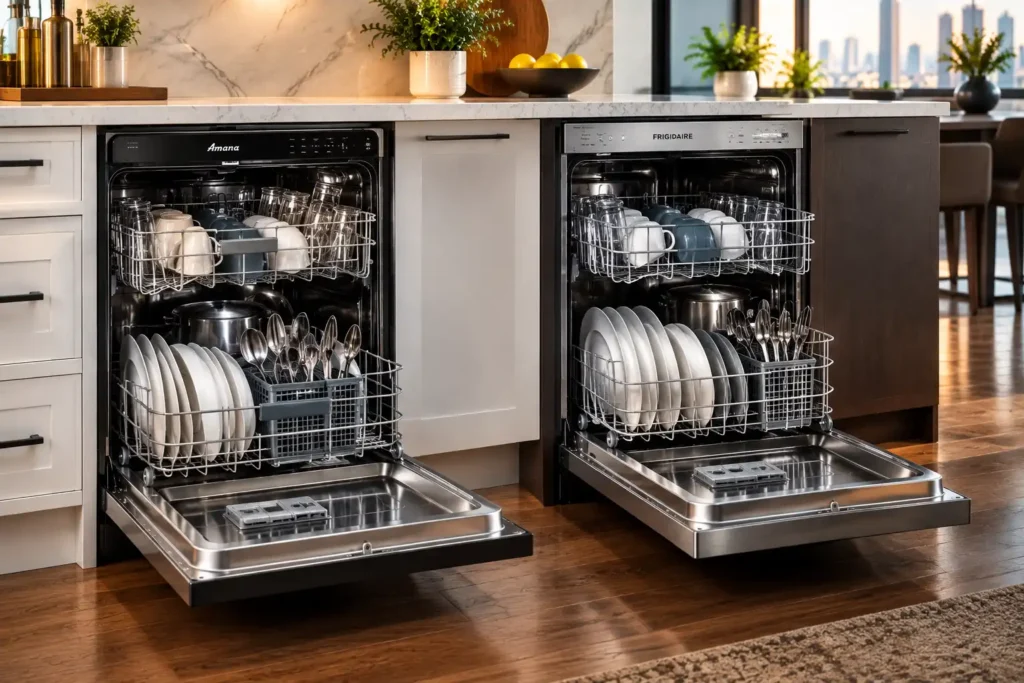
When comparing Amana and Frigidaire dishwashers, the soil sensor is one of the less obvious features that can have a meaningful effect on everyday dishwasher performance. A soil-sensing system is designed to reduce the need for the user to decide exactly how much washing a particular load requires. Instead of treating every load as though it contains the same amount of food residue, the dishwasher can evaluate conditions during the wash process and adjust aspects of the cycle accordingly.
Amana currently markets this capability as the SoilSense Cycle, while Frigidaire markets comparable technology under the DishSense Sensor Technology name. Both approaches are intended to respond to the soil level of the dishes, but the two brands do not publish enough technical information to conclude that the underlying sensors or control algorithms are identical. Therefore, the most useful comparison is based on what each manufacturer states the technology does, how it affects the wash cycle, and how the technology fits into the dishwasher’s broader filtration, spray, heating, drying, and efficiency systems.
For shoppers in the United States and Canada, this comparison is particularly relevant because soil sensing is now an established feature of modern efficient dishwashers. In the United Kingdom, the terminology and available model ranges can differ, so the same principles apply even when a particular Amana or Frigidaire model is not sold locally.
What Is a Dishwasher Soil Sensor?
A dishwasher soil sensor is a sensing system that helps the appliance determine how dirty the wash water is during a cycle. Rather than relying entirely on a fixed program, the dishwasher can use information about the condition of the water to determine whether additional washing, rinsing, or other cycle adjustments are necessary.
The basic idea is relatively simple. Food residue is removed from dishes and enters the circulating wash water. The dishwasher can monitor characteristics of that water and use the resulting information as an input to its electronic controls. Depending on the appliance design, the control system can then modify cycle behavior.
This is different from simply selecting a “Heavy” or “Normal” cycle manually. With a conventional fixed cycle, the dishwasher follows a predetermined sequence regardless of whether the load contains lightly used glasses or heavily soiled cookware. A soil-sensing system introduces an additional layer of automatic decision-making.

Modern automatic-sensing dishwashers can therefore adjust the amount of washing required instead of treating every load exactly the same. This is one reason soil sensing is associated with both cleaning optimization and resource efficiency.
Amana SoilSense: How It Works
Amana currently describes its SoilSense Cycle as a system that automatically senses the size and soil level of the load and adjusts the cycle accordingly. The manufacturer specifically states that its sensors automatically adjust cycle time and water usage to provide the appropriate cleaning for the load.
This is an important point because Amana’s description goes beyond simply saying that the dishwasher detects dirty water. The company presents SoilSense as a load-responsive system that considers both load size and soil level.
The practical advantage is that the user does not necessarily have to decide whether a particular load deserves a longer or shorter treatment. The dishwasher can make adjustments automatically after the cycle has been selected and started.
Amana currently offers SoilSense on models such as the ADB1500ADS. That model combines the SoilSense Cycle with a Triple Filter Wash System, a 12-place-setting capacity, a heated dry option, a high-temperature wash option, and other wash features. This shows why a soil sensor should not be considered an isolated component: its effectiveness depends on how it works with the dishwasher’s entire wash system.
Frigidaire DishSense: How It Works
Frigidaire uses the name DishSense Sensor Technology for its soil-sensing system. Current Frigidaire product specifications describe DishSense as technology that adjusts cleaning performance based on the soil level of the dishes.
The manufacturer specifically promotes the technology as a way to reduce or eliminate the need for pre-rinsing. That is significant because modern dishwashers are designed to remove food particles through their filtration and wash systems rather than requiring users to wash dishes before placing them in the machine.
Current Frigidaire models equipped with DishSense include examples across several price levels. Depending on the model, the sensor technology may be combined with features such as multiple wash cycles, rotating spray systems, heated or fan-assisted drying, stainless-steel tubs, sanitation options, and ENERGY STAR certification.
Consequently, two Frigidaire dishwashers can both have DishSense while delivering different overall experiences because the surrounding wash system can be substantially different.
Amana vs Frigidaire Soil Sensor: The Basic Difference
At the technology level, the most important similarity is that both systems are designed to respond to soil conditions rather than forcing every load through exactly the same washing pattern.
The main difference is in the way each manufacturer describes the system.
| Feature | Amana | Frigidaire |
|---|---|---|
| Sensor system name | SoilSense Cycle | DishSense Sensor Technology |
| Soil detection | Yes on SoilSense models | Yes on DishSense models |
| Automatic response | Yes | Yes |
| Soil level considered | Yes | Yes |
| Load size referenced | Yes | Not emphasized in the same way |
| Cycle adjustment | Yes | Yes |
| Water usage adjustment | Specifically stated | Cycle performance/resource adjustment depends on model |
| Pre-rinsing reduction | Supported through wash system | Explicitly promoted |
| Available across multiple models | Depends on model | Available across multiple models and product tiers |
The table should not be interpreted as proving that one company’s physical sensor is inherently more advanced. The manufacturers do not provide enough technical information to make that conclusion. Instead, the documented difference is mainly in how the brands describe the functions provided by their respective systems.
Why Soil Level Matters
A dishwasher does not encounter the same amount of food residue in every load. A load consisting mostly of drinking glasses and lightly used plates is very different from a load containing dried oatmeal, pasta sauce, egg residue, grease, and baked-on food.
If the appliance used exactly the same wash pattern for every load, it could potentially use more time, water, and energy than necessary for lightly soiled loads. Conversely, a cycle that was too short or gentle could struggle with heavily soiled dishes.
Soil sensing is intended to help address this variation.
The sensor does not magically remove food. Instead, it provides information to the dishwasher’s electronic control system. The dishwasher still depends on water temperature, detergent chemistry, spray pressure, filtration, circulation, wash time, and loading arrangement to actually remove the soil.
Does a Soil Sensor Make a Dishwasher Clean Better?
A soil sensor can help a dishwasher select an appropriate cleaning response, but it should not be interpreted as a guarantee that every load will come out cleaner.
Cleaning performance depends on numerous factors.
The amount and type of food residue matter. Loading also matters because spray water must reach the surfaces being cleaned. Detergent concentration, water temperature, filter condition, spray-arm operation, and incoming water conditions can also affect results.
A dishwasher with an excellent sensor but poorly loaded dishes can still leave food behind. Likewise, a dishwasher with a sensor and a well-designed spray system can perform very well when dishes are loaded correctly.
The sensor should therefore be considered a control technology, not a replacement for the physical washing system.
Soil Sensor and Automatic Cycle Selection
One of the biggest advantages of a soil sensor is automatic cycle adjustment.
A traditional fixed cycle might operate according to a predetermined sequence. A sensor-equipped machine can use information gathered during the cycle to determine whether the load requires more or less washing.
This can be especially useful for households where the dishwasher sees very different loads from day to day.
For example, one load might contain lightly used breakfast dishes, while another might contain dinner plates covered with sauces and starches. A sensing system gives the dishwasher more information with which to manage those differences.
This does not mean the dishwasher can always identify every type of food or determine exactly how long each item needs to be washed. The sensor is part of an automated control system, not an artificial-intelligence food-recognition system.
Amana SoilSense and Water Usage
Amana explicitly states that SoilSense sensors can adjust water usage as well as cycle time. This is one of the most important documented benefits of the system.
Water efficiency is particularly relevant because dishwashers recirculate water during washing rather than continuously drawing fresh water from the household supply.
If the control system determines that a load requires a different treatment, it can modify the cycle according to the programmed logic.
However, consumers should not assume that every SoilSense load will automatically use dramatically less water. The actual consumption depends on the model, selected cycle, soil conditions, options, and other design factors.
The appliance’s official EnergyGuide information is therefore more useful for comparing annual energy consumption between specific models than the presence of a soil sensor alone.

Frigidaire DishSense and Water Efficiency
Frigidaire’s DishSense system is similarly designed to respond to soil conditions. Frigidaire promotes the technology as a way to adjust cleaning performance based on how dirty the dishes are.
The broader efficiency picture also depends on filtration and spray design. For example, some current Frigidaire models combine DishSense with wash systems designed to provide extensive spray coverage without requiring unnecessarily large amounts of water.
This illustrates an important point: a soil sensor is only one component of dishwasher efficiency.
A dishwasher’s annual energy and water performance can also be influenced by the heating system, cycle structure, filtration, spray-arm design, drying method, tub construction, and electronic controls.
Soil Sensors and ENERGY STAR Dishwashers
Soil sensing has become sufficiently important in modern dishwasher design that it is specifically recognized within current efficiency testing and product information.
ENERGY STAR explains that an automatic-sensing dishwasher uses a soil sensor to detect whether water leaving the dishes is dirty or clean. The organization notes that this can help save water while maintaining appropriate cleaning performance.
Current ENERGY STAR dishwasher criteria also distinguish soil-sensing machines in the federal test procedure. This matters because energy and water ratings are not simply based on a manufacturer’s marketing description; qualifying products are evaluated using standardized procedures.
Consequently, consumers should look at both the presence of a soil sensor and the model’s certified energy and water information.
Soil Sensor vs Hard Food Filter
A common misunderstanding is that a soil sensor and a dishwasher filter perform the same function.
They do not.
A filter physically removes food particles and debris from the wash water. A sensor, by contrast, provides information to the dishwasher’s control system.
Amana’s SoilSense models can combine sensing with a Triple Filter Wash System. This combination is logical because the sensor and filtration system have different jobs.
The filter helps keep removed food particles from continuously circulating through the wash system. The sensor helps the dishwasher determine how the cycle should respond to the load.
The two technologies therefore complement each other rather than replace each other.
Why Filtration Still Matters
Even the most sophisticated soil-sensing system cannot compensate indefinitely for poor filtration.
Food particles removed from dishes enter the wash water. Effective filtration helps separate those particles from the water so that the dishwasher can continue circulating relatively clean water.
Amana’s Triple Filter Wash System is specifically designed to remove food particles from the wash water. Frigidaire likewise provides filtration systems on its dishwasher models and recommends maintaining filters for proper operation.
This means that cleaning the filter remains important even when a dishwasher has automatic soil sensing.
A dirty or obstructed filter can affect water circulation and cleaning performance, potentially creating problems that users may incorrectly blame on the soil sensor.
Soil Sensor and Pre-Rinsing
Both brands’ current messaging supports the broader modern dishwasher practice of scraping dishes rather than thoroughly pre-rinsing them.
Frigidaire explicitly promotes DishSense as a reason to skip pre-rinsing. Amana similarly promotes its modern wash and filtration systems as allowing users to pre-rinse less.
This is important because excessive pre-rinsing can waste water before the dishwasher even begins its cycle.
The better approach is generally to remove large pieces of food and load the dishes appropriately. Small amounts of remaining food residue provide the dishwasher’s wash system with the type of soil it is designed to handle.
Does Soil Sensing Work With Heavy Loads?
Yes, but the presence of a soil sensor does not mean every dishwasher can automatically replace a dedicated Heavy cycle.
A heavily soiled load may still benefit from a Heavy or Intensive cycle, especially when dishes contain baked-on or dried food.
Sensor-based automatic cycles are designed to adjust the treatment according to the dishwasher’s programmed operating range. They do not necessarily provide the same mechanical and thermal treatment as a dedicated heavy-duty program.
This distinction is important when comparing an Amana and Frigidaire dishwasher. Look at the complete list of cycles rather than assuming that a soil sensor eliminates the need for specialized cycles.
Soil Sensor and Cycle Time
Cycle time is another area where soil sensing can make a difference.
Amana specifically states that SoilSense can automatically adjust cycle time according to the detected needs of the load.
A lightly soiled load may not require the same amount of washing as a heavily soiled load. Conversely, a load that requires more cleaning can receive additional treatment according to the dishwasher’s programming.
This can sometimes make automatic cycles appear unpredictable to users. A person may expect the same cycle to finish in exactly the same amount of time every time, but sensor-based systems are designed to respond to changing conditions.
Therefore, a longer cycle does not necessarily mean something is wrong with the dishwasher.
Why Sensor Cycles Can Take Longer Than Expected
Modern efficient dishwashers often have long cycles, even when they are working correctly.
This can be confusing because consumers sometimes associate efficiency with speed. However, a dishwasher can use less water while spending more time circulating that water and maintaining appropriate temperatures.
Sensor-equipped cycles can also change their behavior depending on detected soil.
If the dishwasher determines that additional treatment is appropriate, the cycle may continue longer than it would for a lightly soiled load.
The correct way to judge the machine is therefore not simply by looking at elapsed time. Cleaning performance, water consumption, energy consumption, and the manufacturer’s specified cycle characteristics are more meaningful measures.

Amana SoilSense: Advantages
The main advantages of Amana’s SoilSense approach are its automatic operation, explicit adjustment of cycle time and water usage, and integration with the brand’s filtration system.
It can be particularly useful for households with inconsistent load sizes and soil levels.
Someone who frequently alternates between lightly soiled dishes and heavier dinner loads may appreciate not having to manually select a different wash intensity each time.
The system can also make the dishwasher easier for multiple household members to use because the machine takes over more of the decision-making process.
Amana SoilSense: Limitations
The most important limitation is that SoilSense is not available on every Amana dishwasher.
Consumers therefore need to check the exact model number rather than assuming that all Amana dishwashers have automatic soil sensing.
Another limitation is that Amana does not publish detailed engineering information explaining exactly how the sensor hardware works, how frequently it samples water conditions, or the precise algorithm used to determine the final cycle adjustments.
That means it would be inappropriate to claim that Amana’s sensor is inherently more accurate or sophisticated than Frigidaire’s.
Frigidaire DishSense: Advantages
Frigidaire’s DishSense system offers similar benefits, particularly automatic adjustment based on soil level.
A major advantage is that DishSense appears across several current Frigidaire product tiers, including standard Frigidaire and Gallery models, with additional sensor-based systems available in higher-end products.
This gives shoppers the opportunity to combine soil sensing with other features such as improved spray coverage, different drying technologies, stainless-steel tubs, quiet operation, sanitation options, and multiple wash programs.
Frigidaire also directly connects DishSense with reducing the need for pre-rinsing, which can make the feature especially attractive to households seeking a simpler dishwasher routine.
Frigidaire DishSense: Limitations
The main limitation is the same fundamental limitation found with Amana: DishSense is not the entire dishwasher.
A model with DishSense can still have different wash performance from another model with DishSense because spray-arm design, filtration, heating, tub construction, detergent delivery, cycle programming, and drying technology can differ.
Consumers should therefore avoid comparing the sensor name alone.
Amana vs Frigidaire Soil Sensor Accuracy
There is not enough publicly available manufacturer information to declare that Amana’s sensor is more accurate than Frigidaire’s or vice versa.
Neither brand provides consumers with a standardized consumer-facing accuracy measurement such as a percentage showing how accurately its sensor measures soil concentration.
The more defensible comparison is functional.
Amana states that SoilSense detects load size and soil level and adjusts cycle time and water usage. Frigidaire states that DishSense adjusts cleaning performance based on soil level.
Both therefore provide automated soil-responsive washing.

Amana vs Frigidaire: Which Sensor Is Better for Lightly Soiled Dishes?
For lightly soiled dishes, the primary advantage of either system is that the dishwasher has the ability to recognize that the load does not necessarily require the same treatment as a heavily soiled load.
This can potentially reduce unnecessary resource use and avoid applying a heavy treatment to a light load.
However, the exact benefit depends on the model’s programming and efficiency characteristics.
If two models are being compared, look at their official water-use and annual-energy figures rather than assuming that the brand with the more prominent sensor name will necessarily use less water.
Amana vs Frigidaire: Which Sensor Is Better for Heavily Soiled Dishes?
For heavily soiled dishes, the sensor is only one part of the equation.
The dishwasher also needs sufficient spray pressure, appropriate water temperature, detergent, filtration, and cycle duration.
Frigidaire models can combine DishSense with systems such as OrbitClean spray technology and specialized cycles. Amana models can combine SoilSense with filtration and high-temperature wash options.
For very dirty cookware, the complete wash system matters more than the sensor branding.
Soil Sensors and Detergent
A soil sensor does not eliminate the need for correct detergent use.
Dishwasher detergent works through a combination of chemistry, water temperature, mechanical action, and time. If insufficient detergent is used, heavily soiled dishes may remain dirty even when the sensor operates correctly.
Likewise, excessive detergent is not automatically better.
Users should follow the detergent manufacturer’s instructions and the dishwasher’s owner’s manual.
Soil Sensors and Water Temperature
Water temperature remains an important part of dishwasher cleaning.
A sensor can determine that more cleaning is required, but the dishwasher still needs suitable thermal conditions for detergent performance and grease removal.
Some Amana models with SoilSense also offer high-temperature washing and sanitizing options. Frigidaire models can similarly provide high-temperature and NSF-certified sanitizing options depending on the model.
Therefore, a soil sensor should be viewed as part of a larger cleaning strategy rather than a substitute for heat.

Soil Sensors and Drying Performance
A soil sensor primarily concerns washing and resource management rather than directly determining whether dishes will be dry.
Drying is influenced by the dishwasher’s drying method, heating system, fan technology, tub material, rinse-aid use, and cycle design.
For example, current Frigidaire models with DishSense may also use heated or fan-assisted drying systems, while Amana SoilSense models can include heated drying.
Consequently, if your main concern is dry dishes rather than cleaning, compare drying technologies separately from soil-sensing capabilities.
Soil Sensor and Stainless-Steel Tubs
Tub construction is another separate consideration.
A stainless-steel tub can provide different heat-retention characteristics from a plastic interior, but the presence of a soil sensor does not automatically determine tub material.
Both brands sell dishwashers with different interior configurations.
Therefore, when comparing an Amana and Frigidaire model, evaluate the tub, sensor, filtration, drying system, and spray system individually.
Soil Sensor and Dishwasher Noise
Soil sensing also does not inherently determine dishwasher noise.
Noise is primarily related to the motor, pump, insulation, spray action, cabinet construction, and other mechanical factors.
For example, current Amana SoilSense models can be rated around the mid-50 dBA range, while some Frigidaire DishSense models are available at substantially quieter sound ratings.
This demonstrates why a model-by-model comparison is more useful than a brand-level comparison.
Soil Sensor and Dishwasher Reliability
Adding electronics and sensors introduces additional components into a dishwasher, but that does not mean a soil-sensing dishwasher is automatically less reliable.
Reliability depends on the quality and durability of the complete appliance, including pumps, motors, valves, heating components, wiring, controls, seals, filtration, and sensors.
A sensor can also operate reliably for years when the dishwasher is properly maintained.
Users should keep filters clean, ensure spray arms are not blocked, use appropriate detergent, and follow the manufacturer’s maintenance recommendations.

Can a Dirty Filter Cause Sensor Problems?
A dirty filter can certainly affect overall wash performance, but it should not automatically be diagnosed as a failed soil sensor.
Because the sensor responds to conditions within the wash system, abnormal water circulation or excessive food debris can potentially complicate the dishwasher’s operating conditions.
If dishes suddenly become dirty, users should first check the simplest possibilities: loading, detergent, filter condition, spray-arm blockage, incoming water temperature, and selected cycle.
A genuine sensor fault should generally be investigated only after these basic causes have been eliminated.
How to Maintain a Soil-Sensing Dishwasher
Maintenance for a soil-sensing dishwasher is not dramatically different from maintenance for other modern dishwashers.
The filter should be cleaned according to the manufacturer’s instructions. Spray arms should remain free of food particles and mineral deposits. The dishwasher should not be overloaded, and dishes should be positioned so water can reach their surfaces.
In hard-water areas, mineral buildup can also become an issue. Deposits may accumulate around spray openings, heating components, filters, and other water-contact surfaces.
Regular maintenance helps the entire wash system operate as designed.
Amana vs Frigidaire Soil Sensor in Hard-Water Areas
Hard water deserves special consideration in the United States, Canada, and the United Kingdom because water chemistry varies significantly by region.
Minerals can leave deposits on dishes and dishwasher components. Over time, mineral accumulation can interfere with spray patterns and contribute to reduced cleaning performance.
A soil sensor does not remove hard-water minerals.
Therefore, users in hard-water areas should pay particular attention to rinse aid, detergent selection, dishwasher cleaning, filter maintenance, and any water-softening recommendations applicable to their appliance.
Amana vs Frigidaire Soil Sensor for Large Families
Large families often run dishwashers frequently and may generate substantially different soil levels from one cycle to another.
In this situation, automatic sensing can be useful because not every load requires identical treatment.
A household might have one lightly soiled load after breakfast and a much heavier load after a family dinner.
Both Amana SoilSense and Frigidaire DishSense can reduce the need for constant manual adjustment, although exact behavior depends on the model.
Capacity should still be considered separately. A sensor cannot compensate for a dishwasher that is too small for the household’s normal load.

Amana vs Frigidaire Soil Sensor for Couples and Small Households
Smaller households may benefit from sensor technology for a different reason.
When a dishwasher is not filled every day, loads can vary considerably. One cycle might contain only cups and plates, while another may include cookware and food containers.
Automatic sensing can help the machine respond to those differences.
However, buyers should compare compact or standard-capacity models based on their actual household requirements rather than choosing a dishwasher solely because it has a soil sensor.
Does Every Amana Dishwasher Have SoilSense?
No.
The exact model specification must be checked.
Amana currently has models that specifically advertise the SoilSense Cycle, but not every Amana dishwasher should be assumed to include it.
This is especially important when shopping older inventory, clearance models, or used appliances.
Always check the complete model number and the manufacturer’s specification sheet.
Does Every Frigidaire Dishwasher Have DishSense?
No.
DishSense is available on many Frigidaire models, but the feature should not be assumed to be present across the entire product range.
A shopper should verify the exact model specifications before purchasing.
This distinction becomes particularly important when comparing two similarly priced dishwashers because one may have automatic soil sensing while another relies more heavily on fixed cycles.
Amana vs Frigidaire Soil Sensor: Model-Level Comparison Is More Important
The biggest mistake in a brand comparison is treating every dishwasher from a manufacturer as though it uses exactly the same technology.
Amana and Frigidaire both have multiple dishwasher models with different specifications.
A Frigidaire model with DishSense may have a stainless-steel tub, advanced spray coverage, a quiet motor, and enhanced drying. Another Frigidaire model with the same basic sensor branding may have a simpler configuration.
The same principle applies to Amana.
Therefore, a meaningful comparison should always identify the exact model numbers.

How to Compare Two Models With Soil Sensors
If you are deciding between an Amana and Frigidaire dishwasher, compare these specifications:
- Soil-sensing capability
- Number of wash cycles
- Heavy-wash capability
- Water consumption
- Annual energy consumption
- Filtration system
- Spray-arm design
- Tub material
- Drying system
- Noise rating
- Place-setting capacity
- Adjustable rack configuration
- Third-rack availability
- Sanitation option
- Warranty
- Local service availability
- Replacement-part availability
- Purchase price
- Installation requirements
- Expected operating environment
The sensor should be one item on the list rather than the only deciding factor.
Amana vs Frigidaire Soil Sensor: Energy Efficiency
Soil sensing can contribute to efficient operation because it gives the dishwasher information about the load rather than forcing every load through identical treatment.
However, a sensor alone does not establish that one dishwasher is more energy efficient than another.
For U.S. shoppers, the EnergyGuide label and ENERGY STAR certification provide more useful model-level information. In Canada, consumers can use the applicable efficiency information and certification listings when comparing products.
In the UK, shoppers should use the energy information provided for the specific locally sold model because product ranges and regulatory labeling can differ from North American models.
Amana vs Frigidaire Soil Sensor: Water Efficiency
The same principle applies to water use.
Amana explicitly says its SoilSense system can adjust water usage. Frigidaire says DishSense adjusts cleaning performance according to soil level.
The potential advantage is that the dishwasher can avoid treating every load as equally dirty.
Nevertheless, water consumption should be judged using the specific model’s published specifications rather than the sensor name.
A dishwasher with a sensor but an inefficient overall design is not automatically more water efficient than every dishwasher without one.
What the Federal Test Procedure Means
The U.S. federal dishwasher test procedure recognizes a distinction between soil-sensing and non-soil-sensing dishwashers.
This matters because automatic sensing affects how a dishwasher behaves under different soil conditions. The standardized test methodology is designed to account for those differences when evaluating energy and water performance.
For consumers, this reinforces an important point: sensor-equipped dishwashers should be evaluated using standardized model information rather than vague marketing claims.
What Canadian Consumers Should Know
Canadian consumers have a particularly useful reason to pay attention to soil sensing because current efficiency guidance specifically describes soil sensors as a technology that evaluates how dirty the rinse water is and adjusts washing accordingly.
Current Canadian guidance also recommends scraping excess food rather than extensively rinsing dishes before loading.
This fits naturally with sensor-based dishwasher operation.
However, the same model-comparison principles apply: soil sensing should be considered alongside the dishwasher’s water consumption, energy use, capacity, filtration, drying system, and cycle options.
What UK Consumers Should Know
The UK market can differ substantially from the North American market in terms of available brands, model numbers, dimensions, electrical specifications, water connections, and efficiency labeling.
Therefore, a UK buyer should not assume that an Amana or Frigidaire model sold in the United States or Canada is available with identical specifications in Britain.
The underlying soil-sensing principle remains relevant: an automatic cycle can use information about wash-water conditions to adapt the cleaning process.
When purchasing locally, verify the exact UK model and its official specification information.
Common Misconceptions About Soil Sensors
Myth 1: A soil sensor recognizes individual foods
Generally, consumers should not think of the sensor as a camera or food-identification system.
It is a sensing component used to provide information about wash conditions.
Myth 2: A soil sensor guarantees perfectly clean dishes
It does not.
Loading, detergent, water temperature, spray coverage, filtration, and cycle selection remain important.
Myth 3: Soil sensing means the dishwasher always uses less water
Not necessarily.
The purpose is to adapt operation to the load. Actual water consumption depends on the model, cycle, soil level, options, and programmed response.
Myth 4: Soil sensors eliminate Heavy cycles
They do not necessarily do so.
A Heavy cycle can still provide a specialized treatment for difficult loads.
Myth 5: A sensor means the dishwasher requires no maintenance
The opposite approach is more appropriate.
Filters, spray arms, seals, and other components still require appropriate maintenance.
Amana vs Frigidaire Soil Sensor: Overall Comparison
Amana and Frigidaire have taken broadly similar approaches to automatic soil-responsive dishwashing.
Amana’s SoilSense system is explicitly described as sensing load size and soil level and automatically adjusting cycle time and water usage. Frigidaire’s DishSense system is described as adjusting cleaning performance according to soil level and is promoted as helping users skip pre-rinsing.
The two systems therefore share the same fundamental objective: make the dishwasher more responsive to the actual load.
The most important difference for consumers is not necessarily the sensor itself but the dishwasher surrounding it.
An Amana SoilSense dishwasher with a particular filtration system, tub, drying method, spray system, and cycle selection can behave differently from another Amana model. The same is true for Frigidaire.
Therefore, the best comparison is between specific Amana and Frigidaire model numbers, not simply between the two brand names.
Final Takeaway
If automatic soil sensing is important to you, both Amana and Frigidaire offer dishwasher models designed to adjust washing based on soil conditions.
Amana calls its technology SoilSense, and its current documentation specifically says the system senses load size and soil level and automatically adjusts cycle time and water usage.
Frigidaire calls its system DishSense, and its current product information says the technology adjusts cleaning performance according to the soil level of the dishes and helps reduce the need for pre-rinsing.
Neither technology should be viewed as a complete measure of dishwasher quality. The sensor works alongside filtration, spray coverage, detergent, water temperature, cycle programming, drying, and loading.
For a purchase decision, the most meaningful approach is therefore to compare the exact Amana and Frigidaire models you are considering. Check their soil-sensing capability, water and energy ratings, filtration systems, cycles, drying systems, noise levels, capacity, warranty, and price.
For lightly soiled everyday loads, automatic sensing can make dishwasher operation more adaptive. For heavily soiled loads, the sensor remains only one part of the cleaning system. And for households concerned about water and energy use, the sensor can contribute to efficiency, but the appliance’s certified model-level consumption figures remain more important than the sensor name itself.
Frequently Asked Questions
1. What is the difference between Amana SoilSense and Frigidaire DishSense?
Amana SoilSense and Frigidaire DishSense are both automatic soil-sensing technologies. Amana specifically describes SoilSense as sensing load size and soil level and adjusting cycle time and water usage. Frigidaire describes DishSense as adjusting cleaning performance according to the soil level of the dishes.
2. Does Amana have a soil sensor?
Yes. Selected Amana dishwashers feature the SoilSense Cycle. The exact availability depends on the model.
3. Does Frigidaire have a soil sensor?
Yes. Selected Frigidaire dishwashers use DishSense Sensor Technology. The exact availability depends on the model.
4. Does a soil sensor save water?
It can help reduce unnecessary water use by allowing the dishwasher to respond to the actual soil conditions of the load. However, actual water consumption depends on the dishwasher model, selected cycle, options, and load.
5. Does a soil sensor save electricity?
Potentially, because adapting the cycle can reduce unnecessary washing and heating. However, the actual annual energy use should be checked on the specific model’s energy documentation.
6. Can I skip pre-rinsing with Amana SoilSense?
Modern Amana dishwashers with SoilSense and appropriate filtration are designed to reduce the need for extensive pre-rinsing. Large pieces of food should still generally be removed before loading.
7. Can I skip pre-rinsing with Frigidaire DishSense?
Frigidaire specifically promotes DishSense as technology that allows users to skip pre-rinsing. Large food scraps should still be removed from dishes.
8. Does the soil sensor detect grease?
The sensor is designed to evaluate wash conditions associated with soil, but consumers should not interpret this as precise identification of individual food substances such as grease, starch, or protein.
9. Can a soil sensor fail?
Like any electronic component, a sensor or its associated wiring and controls can potentially fail. However, poor cleaning performance should not automatically be diagnosed as a sensor failure.
10. Can a dirty filter affect a sensor dishwasher?
A dirty filter can interfere with overall dishwasher performance and water circulation. Filter maintenance is therefore important even when the dishwasher has automatic soil sensing.
11. Is SoilSense available on every Amana dishwasher?
No. SoilSense is a model-specific feature. Check the exact model specifications.
12. Is DishSense available on every Frigidaire dishwasher?
No. DishSense is available on selected models. Always verify the exact model number.
13. Does a soil sensor make a dishwasher quieter?
No. Soil sensing itself does not determine noise level. Noise depends primarily on the motor, pump, insulation, spray system, and overall appliance construction.
14. Does a soil sensor improve drying?
Not directly. Drying performance depends on the dishwasher’s drying technology, heating system, fan operation, tub material, rinse aid, and cycle design.
15. Is a soil sensor useful for a small household?
Yes. It can be useful because small households may run loads with significantly different soil levels from one cycle to another.
16. Is a soil sensor useful for large families?
It can be particularly convenient for large families because the soil level and type of load can change considerably between cycles.
17. Should I choose Amana or Frigidaire only because it has a soil sensor?
No. Soil sensing is only one feature. Compare the complete dishwasher specification, including cleaning system, filtration, drying, water consumption, energy use, capacity, noise, warranty, and price.
18. Does soil sensing replace the Heavy cycle?
No. A Heavy cycle can still provide a dedicated treatment for heavily soiled cookware and difficult food residue.
19. Does a soil sensor mean the dishwasher can clean anything?
No. Proper loading, detergent, water temperature, filtration, spray coverage, and appropriate cycle selection remain essential.
20. What should I check before buying an Amana or Frigidaire dishwasher with a soil sensor?
Check the exact model number and compare soil-sensing capability, wash cycles, filtration, spray system, water consumption, annual energy use, drying technology, noise level, tub material, capacity, warranty, installation requirements, and price.
21. Is soil sensing important for ENERGY STAR efficiency?
Soil sensing is one of the technologies associated with modern efficient dishwasher operation. ENERGY STAR specifically recognizes soil-sensing capability and the ability of automatic cycles to respond to the condition of the wash water.
22. Is soil sensing useful in hard-water areas?
It can still be useful, but it does not solve hard-water problems. Mineral buildup must be managed separately through appropriate detergent, rinse aid, maintenance, and any recommended water-softening measures.
23. Does the sensor eliminate the need to clean the dishwasher?
No. Filters, spray arms, interior surfaces, and other components still require appropriate maintenance.
24. Are Amana and Frigidaire soil sensors the same?
There is no sufficient public technical information to conclude that they use identical sensors or algorithms. They provide broadly similar functions but are branded and implemented by their respective manufacturers.
25. What is the most important thing to remember?
The soil sensor is a control feature, not the entire cleaning system. A dishwasher’s real-world performance depends on how the sensor works together with filtration, spray coverage, water temperature, detergent, cycle programming, drying, and proper loading.