
A dishwasher that suddenly stops working can create an expensive dilemma. Should you spend money repairing the appliance you already own, or is it time to purchase a new one? The answer is not always straightforward. A relatively inexpensive repair can restore an older dishwasher to reliable operation, while an expensive repair on an appliance approaching the end of its useful life may simply delay an unavoidable replacement.
The decision becomes more complicated when you consider the dishwasher’s age, the cost of replacement parts, labour charges, energy consumption, water efficiency, warranty coverage and the possibility of additional failures. A dishwasher that is ten years old and needs a new door latch is very different from a twelve-year-old machine with a leaking tub, a failing circulation pump and an electronic control problem.
Many homeowners rely on the familiar 50% rule: if a repair costs more than half the price of a new dishwasher, replace the appliance. Although this can be a useful starting point, it should not be treated as a universal rule. A relatively expensive repair may still be worthwhile if the dishwasher is otherwise in excellent condition, while a cheaper repair may be a poor investment if several other components are deteriorating.
This detailed guide explains how to evaluate dishwasher repair and replacement decisions in the United States, the United Kingdom and Canada. It examines common dishwasher failures, repair costs, appliance age, energy efficiency, environmental considerations, warranty protection and consumer rights. It also provides practical calculations and examples to help you decide whether repairing your existing dishwasher or purchasing a replacement makes better financial sense.
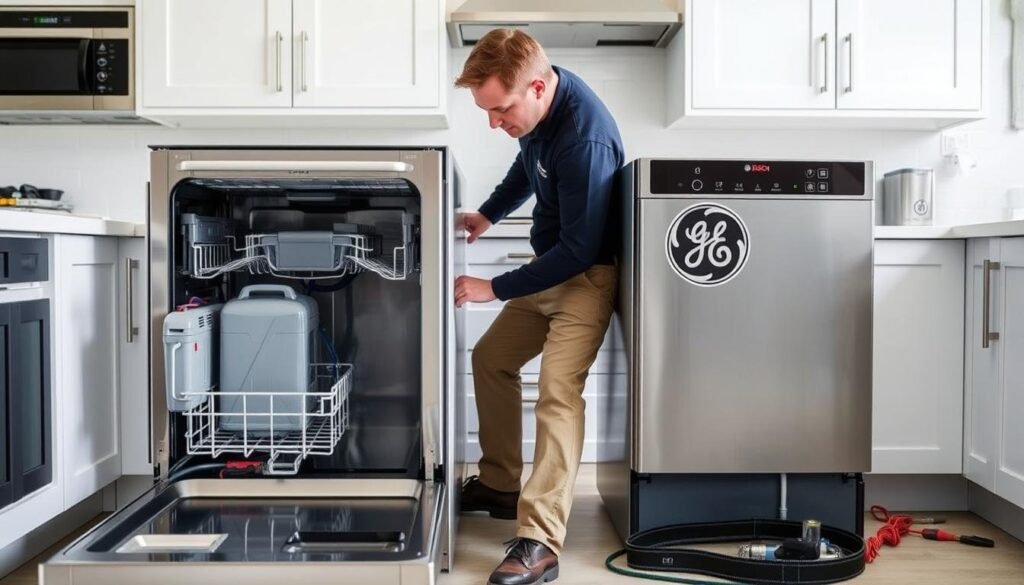
1. Repair or Replace a Dishwasher: What Is the Best Choice?
The best decision depends on five major factors:
- Age: How long has the dishwasher been operating?
- Repair cost: How much will the complete repair cost, including parts and labour?
- Type of failure: Is the problem minor, or does it involve an expensive major component?
- Overall condition: Are other parts showing signs of deterioration?
- Replacement value: How much would a suitable new dishwasher cost, including installation?
A dishwasher that is only three or four years old and has developed an isolated drainage problem will often be a reasonable candidate for repair. Replacing a relatively new appliance because of a failed pump, door latch or water inlet valve may create unnecessary expense.
On the other hand, an older dishwasher that has experienced repeated breakdowns, poor cleaning performance, water leaks and electronic failures may be approaching the point where further repairs are difficult to justify.
The important distinction is between repairing an isolated defect and repeatedly spending money on an appliance that is becoming unreliable.
A professional diagnosis is often the best starting point. The technician should identify the failed component, explain why it failed, provide a complete repair estimate and assess whether other parts are showing signs of deterioration.
Do not make a replacement decision based solely on a fault code or the dishwasher’s age. A fault code identifies a condition that the appliance has detected; it does not always identify the exact component that needs replacing.
2. How Long Does a Dishwasher Usually Last?
Dishwasher lifespan is one of the most important considerations when deciding whether to repair or replace an appliance. However, there is no single lifespan that applies to every dishwasher.
Many consumer appliance estimates place the practical service life of a household dishwasher at approximately 9–12 years. Some machines operate for longer, while others develop expensive problems much earlier. Large-scale appliance lifetime studies have also produced higher estimates, depending on how they measure product survival and what counts as the end of useful service.
These differences are important. An appliance that remains in service for 14 years may have experienced several repairs along the way. Another dishwasher may stop being economical to operate after nine years even though it can technically still be repaired.
Factors that influence dishwasher lifespan
Frequency of use
A dishwasher operated once daily experiences a different workload from one used several times every day. Frequent operation places additional demands on pumps, door mechanisms, heating components and other moving or electrical parts.
However, high usage does not automatically mean that a dishwasher will fail early. A well-designed appliance that receives proper maintenance can operate reliably for many years.
Water quality
Hard water can contribute to mineral deposits inside the appliance. Over time, scale may affect heating performance, spray-arm openings, water passages and other components.
Dishwashers equipped with water-softening systems may require dishwasher salt and suitable hardness settings. Following the manufacturer’s instructions can help reduce avoidable scale-related problems.
Maintenance habits
Cleaning the filter, checking spray arms, keeping the door seal clean and removing foreign objects can help maintain performance. Neglecting basic maintenance may contribute to drainage restrictions, poor cleaning and unnecessary strain on components.
Installation quality
Incorrect water connections, unsuitable drainage arrangements, poor levelling and electrical installation problems can contribute to leaks and operating failures.
Component quality and appliance design
Dishwashers differ in their construction, materials, electronic controls and component arrangements. Some models use relatively straightforward mechanical systems, while others have more advanced sensors, electronic controls and connected features.
A more complicated design does not automatically mean that an appliance will fail sooner, but the cost and availability of replacement components can influence whether repairing it remains economical.
Dishwasher age and the repair decision
The following table provides a general guide rather than a fixed replacement schedule.
| Dishwasher age | General recommendation | What to consider |
|---|---|---|
| 0–3 years | Usually repair | Check manufacturer warranty and retailer responsibilities first |
| 4–6 years | Repair is often sensible | Compare repair cost with replacement cost |
| 7–9 years | Evaluate carefully | Consider the failed component and overall condition |
| 10–12 years | Compare repair and replacement | Investigate possible future failures and efficiency |
| 13–15 years | Replacement becomes more attractive | Repair may still make sense for an inexpensive isolated fault |
| Over 15 years | Usually consider replacement | Parts availability, reliability and operating costs become increasingly important |
These age categories should not be treated as automatic rules. A well-maintained 13-year-old dishwasher with a minor fault may deserve repair, while a six-year-old machine with severe corrosion and repeated leaks may be uneconomical to keep.
3. Common Dishwasher Problems That Are Usually Worth Repairing
Not every dishwasher failure requires a replacement appliance. Many common problems involve individual components that can be replaced without rebuilding the entire machine.
The following faults are often worth investigating before purchasing a new dishwasher.
A. Dishwasher not draining
A dishwasher that finishes its cycle with standing water may have a blocked filter, obstructed drain hose, damaged drain pump or another drainage-related problem.
Before assuming that the drain pump has failed, inspect the accessible filter and drainage area according to the manufacturer’s instructions. Food particles, labels, glass fragments and other debris can restrict water flow.
If the blockage is minor, the problem may be resolved without replacing any major component. If the drain pump has failed, replacing it may still be economical, particularly when the dishwasher is relatively new.
Repair is usually worth considering when:
- The dishwasher is otherwise in good condition.
- The filter or drain hose is blocked.
- The drain pump is available as a replacement part.
- There are no signs of serious corrosion or repeated leaks.
- The repair cost is reasonable compared with replacement.
Replacement may be more sensible when:
- The appliance has experienced repeated drainage failures.
- The pump and electronic control system both require replacement.
- The dishwasher has several additional problems.
- The repair quote is close to the cost of a new comparable appliance.
B. Dishwasher not filling with water
If the dishwasher starts but does not fill, the cause may involve the water supply, inlet valve, float assembly, door latch or electronic control system.
First, check that the household water supply is turned on and that the dishwasher’s water connection has not been accidentally restricted. Also confirm that the door closes properly.
A defective water inlet valve is often a replaceable component. However, the technician should establish whether the valve itself has failed or whether another problem is preventing the appliance from requesting water.
Repair is usually worthwhile when the fault is limited to an accessible water inlet component and the rest of the dishwasher is functioning correctly.
C. Dishwasher door latch failure
A faulty door latch can prevent the dishwasher from starting because the machine may not detect that the door is securely closed.
This problem can sometimes be mistaken for a major electrical failure. However, the actual cause may be a damaged latch, door switch, alignment problem or loose connection.
A replacement latch is generally less complicated than replacing a major pump or electronic control assembly.
If the dishwasher is relatively new and the door mechanism is otherwise in good condition, repairing the latch is usually worth considering.
D. Dishwasher not heating water
A dishwasher that does not heat water properly may have a defective heating element, temperature sensor, thermostat, wiring connection or electronic control component.
Poor heating can lead to unsatisfactory cleaning, longer cycles and poor drying performance.
The technician should test the heating circuit and identify the exact cause. Replacing a heating element may be reasonable, but if the failure involves several electronic components in an older dishwasher, the overall repair cost may become substantial.
E. Dishwasher not drying dishes
Poor drying performance does not always indicate a major failure. The problem may involve rinse aid, loading arrangements, programme selection, water temperature or the appliance’s drying system.
Some dishwashers use heated drying, while others rely more heavily on condensation drying, automatic door opening or other drying arrangements.
Before replacing the appliance, check the drying instructions and settings. If the dishwasher has a defective fan, heating component or related electrical part, obtain a repair estimate.
F. Dishwasher spray arm not rotating
Spray arms distribute water throughout the dishwasher. If they become blocked with food debris or mineral deposits, cleaning performance may deteriorate.
Remove and inspect the spray arms only as instructed in the manual. Clean blocked openings carefully without enlarging them or damaging the component.
If the spray arm is physically damaged, replacement may be inexpensive compared with buying another dishwasher.
G. Dishwasher leaking from the door
A leak around the door may be caused by a damaged gasket, incorrect levelling, excessive foam, poor loading or a problem with the door assembly.
A damaged door seal may be relatively inexpensive to replace. However, a leak originating from an internal hose, pump housing or corroded tub may require a more substantial repair.
Do not continue operating a dishwasher that is leaking significantly. Water can damage kitchen flooring, cabinets and electrical components.
4. Major Dishwasher Failures That May Make Replacement More Attractive
Some dishwasher repairs are considerably more expensive than routine component replacements. The cost can become especially difficult to justify when the appliance is older or has experienced multiple failures.
A. Failed circulation pump
The circulation pump moves water through the spray arms during the wash cycle. If it fails, the dishwasher may fill with water but fail to wash dishes properly.
A circulation pump replacement can involve significant labour and parts costs, depending on the dishwasher’s design.
If the appliance is relatively new and the pump is the only defective component, repair may be worthwhile.
However, if an older dishwasher also has heating problems, leakage or electronic faults, the total cost may approach the price of a replacement.
B. Electronic control board failure
The control board manages many dishwasher functions, including cycle selection, water filling, heating, draining and sensor operation.
A defective control board can cause several different symptoms:
- Dishwasher does not start.
- Wash cycles stop unexpectedly.
- Buttons become unresponsive.
- The appliance displays repeated fault codes.
- Heating or drainage functions operate incorrectly.
- The dishwasher behaves inconsistently.
Control-board replacement can be expensive because the part may be costly and diagnosis may require additional labour.
Before approving the repair, ask the technician whether the control board has been tested and whether another component could be responsible for the symptoms.
Replacing an electronic board without confirming the cause can result in unnecessary expense.
C. Severe internal leakage
A dishwasher that leaks from an internal hose, pump assembly or tub connection may require extensive dismantling.
If water has reached electrical components or caused corrosion, the repair may involve several parts rather than a single seal.
A leak from a corroded tub is particularly concerning. Unlike a replaceable hose or gasket, structural corrosion may be difficult or uneconomical to repair.
When the dishwasher has a damaged tub, repeated leaks or widespread corrosion, replacement is often the more practical choice.
D. Multiple component failures
An older dishwasher may develop several problems within a relatively short period.
For example, the circulation pump may fail first. A few months later, the control board may develop a fault, followed by a leak from an internal hose.
Even if each individual repair appears affordable, the combined expenditure may become excessive.
Before approving another repair, ask the technician to assess the general condition of the appliance. The goal is to determine whether the latest failure is isolated or part of a broader pattern of deterioration.
E. Severe corrosion
Corrosion around the dishwasher tub, door frame, internal supports or other structural areas can indicate that the appliance is deteriorating.
Surface discolouration is not always a reason to replace a dishwasher, but perforation, structural damage or corrosion associated with water leakage should be taken seriously.
If corrosion has compromised the tub or another major structural component, replacement may be safer and more economical than attempting extensive repairs.
5. The 50% Rule: Should You Replace a Dishwasher If Repairs Cost More Than Half the Price of a New One?
The 50% rule is a popular method for evaluating appliance repairs. It suggests that when a repair costs more than 50% of the price of a new comparable appliance, replacement should be considered.
For example, imagine that a new dishwasher with similar capacity and features costs 900 units of your local currency, including basic installation. A technician quotes 500 for repairing your existing dishwasher.
The repair represents approximately 56% of the replacement cost.
In this situation, replacement deserves serious consideration, particularly if the existing dishwasher is already old or has experienced previous failures.
However, the 50% rule should not be used in isolation.
Why the 50% rule is not always reliable
The age of the dishwasher matters
A repair representing 55% of replacement cost may be reasonable for a four-year-old dishwasher in excellent condition. The same repair may be difficult to justify for a fourteen-year-old appliance.
The type of repair matters
Replacing one major component may restore an otherwise reliable dishwasher. Replacing several unrelated components may indicate that the appliance is deteriorating more broadly.
Replacement prices vary
A basic replacement dishwasher may cost considerably less than a premium model. Comparing an expensive repair with the price of a much cheaper appliance may produce a misleading result.
Installation costs matter
A new built-in dishwasher may require delivery, removal of the old unit, installation, new connections or cabinet adjustments. These costs must be included in the replacement calculation.
Future reliability matters
A repair may solve the immediate problem without addressing other ageing components. Consider whether the appliance is likely to provide several more years of useful service.
A more useful version of the 50% rule
Use the following guide:
| Repair cost as a percentage of replacement cost | General approach |
|---|---|
| Under 25% | Repair is often attractive |
| 25–40% | Compare age, condition and repair type |
| 40–50% | Evaluate carefully before approving |
| 50–60% | Replacement deserves serious consideration |
| Above 60% | Replacement is often more economical |
These percentages are decision-making guidelines, not engineering standards or legal rules. A low repair percentage does not guarantee that the dishwasher is worth saving, and a high percentage does not automatically mean replacement is the only sensible choice.
6. How to Calculate the True Cost of Repairing a Dishwasher
A common mistake is comparing the price of a replacement part with the advertised price of a new dishwasher.
The actual cost of a professional repair usually includes more than the part itself.
Costs to include in a repair estimate
- Initial diagnostic or inspection fee.
- Technician call-out charge.
- Replacement component.
- Labour for dismantling and reassembly.
- Transportation or service charges.
- Additional parts such as seals, clips or connectors.
- Applicable taxes.
- Follow-up visits if the repair is unsuccessful.
Ask the technician to provide a written estimate showing the complete cost.
Also ask whether the repair includes a guarantee on the replacement part and labour. A repair that comes with meaningful parts and labour protection may offer better value than a cheaper repair with no assurance.
Example: Calculating a repair decision
Imagine you own an eight-year-old dishwasher.
A technician identifies a failed circulation pump and provides the following estimate:
| Repair item | Cost |
|---|---|
| Diagnostic inspection | 60 |
| Replacement pump | 180 |
| Labour | 140 |
| Additional materials | 20 |
| Total repair cost | 400 |
A comparable new dishwasher costs 850, while delivery, installation and removal add another 150.
The complete replacement cost is therefore 1,000.
The repair represents 40% of the replacement cost.
At first glance, repair appears financially attractive. However, you should also consider the dishwasher’s condition, whether it has experienced previous breakdowns and whether the technician expects other components to require attention.
If the machine has been reliable and the pump is the only problem, repairing it may be a sensible choice.
If the appliance has already experienced a control-board failure and two leaks, replacement may offer better long-term value.
7. How to Calculate the Total Cost of Replacing a Dishwasher
The purchase price is only one part of the replacement expense. Before ordering a new dishwasher, calculate the complete installed cost.
A. Purchase price
Dishwashers are available in several price categories, from basic models to premium appliances with advanced washing systems, quieter operation and smart features.
Compare models with similar capacity and installation requirements. A cheaper compact dishwasher is not necessarily a suitable replacement for a full-size built-in model.
B. Delivery charges
Some retailers include delivery, while others charge separately. Delivery may also involve additional fees for difficult access, stairs or restricted installation locations.
C. Installation cost
A replacement dishwasher may fit into the existing opening, but the installer still needs to disconnect the old appliance, position the new one and connect the water, drainage and electrical supply correctly.
If the new dishwasher has different dimensions or connection requirements, additional work may be necessary.
D. Removal and disposal
Some retailers provide removal of the old dishwasher as part of their service. Others charge separately or require the customer to arrange disposal.
E. Additional accessories
Depending on the model and installation, you may need new hoses, fittings, mounting brackets or other accessories.
F. Taxes
Include sales tax in the United States and Canada where applicable, or VAT in the United Kingdom.
Replacement cost checklist
| Expense | Include in your calculation? |
|---|---|
| New dishwasher | Yes |
| Delivery | Yes |
| Installation | Yes |
| Removal of old dishwasher | Yes |
| New hoses or fittings | If required |
| Cabinet modifications | If required |
| Electrical or plumbing work | If required |
| Taxes | Yes |
| Extended protection plan | Only if you choose to purchase one |
Once you calculate the full replacement cost, compare it with the complete repair estimate rather than the advertised appliance price.
8. Energy Efficiency: Can a New Dishwasher Save Money?
Energy efficiency is another important factor in the repair-versus-replace decision.
Older dishwashers may consume more electricity and water than modern efficient models. Improvements in water filtration, soil sensors, spray-arm design and wash-cycle control have helped newer appliances reduce operating consumption.
However, replacing a dishwasher purely because a newer model is more efficient does not automatically produce a financial saving. You need to compare the difference in annual operating costs with the purchase and installation price.
How newer dishwashers can reduce energy consumption
Improved water management
Modern dishwashers often use sensors to assess water conditions and adjust wash operation. This can help the appliance use water more efficiently.
More efficient spray systems
Improved spray-arm designs and water circulation arrangements can help distribute water effectively while controlling consumption.
Better filtration
Modern filtration systems can remove food particles from wash water and support efficient water circulation.
Improved cycle management
Some dishwashers offer automatic or eco programmes that adjust washing conditions to the load and soil level.
More efficient drying options
Certain models offer air-drying, automatic door opening or other features that can reduce reliance on energy-intensive heated drying.
How much can a new dishwasher save?
Savings depend on the age and efficiency of the existing appliance, how frequently it is used, the local cost of electricity and water, and the efficiency of the replacement model.
For example, a modern certified dishwasher in North America may use substantially less water than an older inefficient model. However, the actual household savings will vary.
Do not rely solely on general advertising claims. Compare the energy and water consumption figures for the exact models.
Compare annual operating costs
In the United States, use the EnergyGuide information and annual energy-consumption figures where available.
In Canada, compare the EnerGuide information and look for recognised efficiency certification.
In the United Kingdom, compare the energy label and the annual or programme-specific consumption information provided for the models.
A useful calculation is:
Annual operating cost = Annual electricity cost + Annual water and wastewater cost
For a more complete comparison, include detergent and any other relevant consumable costs, although these may be similar between models.
If the new dishwasher saves only a small amount each year, it may take many years to recover the purchase price through utility savings. If the old appliance is extremely inefficient and used frequently, the financial case for replacement may be stronger.
9. Water Consumption: Should Water Efficiency Influence Your Decision?
Water efficiency can be particularly important in regions where water supply and wastewater charges are high.
Older dishwashers may use more water per cycle than modern efficient models. Newer certified appliances are designed to clean dishes using carefully controlled water circulation and filtration.
Natural Resources Canada reports that certified efficient dishwashers use, on average, less energy and water than standard models. The exact difference depends on the comparison models and test conditions.
When water efficiency becomes important
Replacing an older dishwasher may make more sense when:
- The existing appliance uses unusually high quantities of water.
- Your household runs several cycles each day.
- Water and wastewater charges are high.
- The replacement model has substantially lower consumption.
- The existing dishwasher also needs an expensive repair.
However, water efficiency should be evaluated alongside the total cost of replacement.
If your existing dishwasher uses a reasonable amount of water and needs only a small repair, the environmental and financial benefits of replacing it may be limited.
10. Environmental Considerations: Repairing May Reduce Waste
Financial savings are important, but environmental impact is another reason to consider repairing a dishwasher.
Discarding an appliance creates waste and requires resources to manufacture, transport and install its replacement. Dishwashers contain metals, plastics, electronic components, wiring and other materials that need appropriate handling at the end of their useful life.
Repairing a dishwasher can extend its service life and reduce the immediate need to manufacture another appliance.
Benefits of repairing an existing dishwasher
- Reduces the amount of discarded appliance material.
- Avoids some of the environmental impact associated with manufacturing a replacement.
- Makes better use of existing components.
- Can reduce transportation and installation-related impacts.
- May provide several additional years of service.
However, repairing an inefficient dishwasher indefinitely is not necessarily the most environmentally responsible option.
If the appliance consumes substantially more energy and water than a modern alternative, or requires repeated replacement parts, a new efficient dishwasher may offer environmental benefits over its operating life.
The most balanced decision considers both the environmental cost of manufacturing a replacement and the resources consumed while operating the existing appliance.
Responsible dishwasher disposal
If you decide to replace the dishwasher, avoid disposing of it with ordinary household waste where local rules provide specialist appliance collection or recycling.
In the United States, check local appliance recycling and waste-management programmes.
In the United Kingdom, electrical appliances may be covered by applicable waste electrical and electronic equipment collection and recycling arrangements.
In Canada, check provincial, territorial and municipal recycling programmes.
Some retailers also provide old-appliance removal when delivering a replacement.
11. Should You Repair a Dishwasher Under Warranty?
Before paying for a repair, check whether the dishwasher is still covered by a manufacturer’s warranty, extended warranty or retailer protection plan.
A dishwasher may have separate coverage periods for the appliance, motor, tub, racks and other components. A longer parts warranty does not always mean that labour, transportation and installation costs are included.
If the appliance is still covered, contact the manufacturer or retailer before arranging independent repairs.
Check the following details
- Original purchase date.
- Warranty start date.
- Standard warranty duration.
- Separate component warranties.
- Parts and labour coverage.
- Service-call charges.
- Installation-related exclusions.
- Registration requirements.
- Whether the repair must be authorised before work begins.
Do not assume that a dishwasher outside its standard manufacturer’s warranty is automatically outside all consumer protection.
Depending on the country and circumstances, you may have separate legal rights against the retailer.
12. Repair or Replace: Consumer Rights in the USA, UK and Canada
Consumer protection laws differ between countries. A manufacturer’s warranty is not necessarily the same as statutory rights, and the end of a written warranty does not automatically settle every consumer claim.
United States
In the United States, written warranties for household appliances are governed by applicable federal and state law.
The Magnuson-Moss Warranty Act provides protections relating to written consumer product warranties. Among other things, a manufacturer generally cannot condition warranty coverage on the consumer using a particular branded replacement part or service provider unless the applicable legal requirements are met.
This means that a manufacturer should not automatically reject every warranty claim simply because an independent repair business was used. However, it may refuse coverage for damage actually caused by an unsuitable replacement part or improper repair.
State laws may also provide implied warranty protections. The duration and application of those protections can differ between states and may depend on the transaction.
Before paying for a repair on a recently purchased dishwasher, contact the seller and manufacturer. Check whether the problem is covered by the written warranty, a recall or another applicable protection programme.
United Kingdom
In the United Kingdom, consumers have statutory rights under the Consumer Rights Act 2015.
Goods supplied to consumers must meet legal requirements, including satisfactory quality, fitness for purpose and conformity with their description.
Where a dishwasher does not conform to the contract, the consumer may have rights to repair or replacement. The appropriate remedy depends on the circumstances, including whether the remedy is possible or disproportionate.
Where repair or replacement is the applicable remedy, the retailer must generally provide it within a reasonable time, without significant inconvenience and without charging necessary costs to the consumer.
The end of a manufacturer’s guarantee does not automatically eliminate a consumer’s statutory rights against the retailer.
For example, if a dishwasher develops a significant defect after the manufacturer’s guarantee has expired, the retailer may still have legal responsibilities depending on the appliance’s age, the nature of the fault and the evidence.
Consumers should distinguish between a genuine manufacturing or conformity problem and damage caused by misuse, accidental damage or incorrect installation.
Canada
In Canada, consumer protection and implied warranty rules are largely governed by provincial and territorial legislation.
In general, implied warranties may require consumer goods to be fit for the purposes for which they are sold. However, the application of these rights depends on the province or territory, the nature of the transaction and the relevant legal provisions.
Quebec has specific consumer protection legislation that includes legal warranties relating to the durability and fitness of goods.
Canadian consumers should check the rules applicable in their province or territory before assuming that the manufacturer’s written warranty is the only protection available.
Comparison of consumer protection
| Country | Main consumer protection consideration | What it means when a dishwasher develops a fault |
|---|---|---|
| USA | Federal and state warranty and consumer protection laws | Check written warranty, implied warranty rights and applicable state rules |
| UK | Consumer Rights Act 2015 | Statutory remedies against the retailer may exist beyond the manufacturer’s guarantee |
| Canada | Provincial and territorial consumer protection laws | Implied warranties and other legal protections may apply depending on location |
This is a general overview rather than legal advice. The exact rights and remedies depend on the purchase, the seller, the appliance and the circumstances of the fault.
13. Parts Availability: Can an Older Dishwasher Still Be Repaired?
Parts availability can determine whether repairing an older dishwasher is practical.
A machine may be mechanically sound, but if its circulation pump, control board or other essential component is unavailable, repair may become difficult or uneconomical.
Before replacing an older dishwasher, ask the technician to check whether the required component is still available.
Parts that may need replacement
- Drain pump.
- Circulation pump.
- Water inlet valve.
- Heating element.
- Electronic control board.
- Temperature sensor.
- Door latch.
- Door gasket.
- Drain hose.
- Spray arm.
- Rack wheels and clips.
- Float switch.
- Wiring harness.
Some parts are relatively inexpensive, while others can represent a significant percentage of the price of a new dishwasher.
Spare-part availability in the United Kingdom
UK ecodesign rules establish minimum availability periods for specified dishwasher spare parts.
For certain major components, manufacturers, authorised representatives or importers must make parts available to professional repairers for a minimum period of seven years after the last unit of the model is placed on the market.
For certain other parts, including door seals, drain filters, racks and spray arms, the minimum availability period is ten years.
These requirements help improve repairability, but they do not mean that every part for every old dishwasher will always be available at an affordable price. They also do not guarantee that a repair will be economical.
What about the USA and Canada?
Parts availability varies by manufacturer, model and age. Some manufacturers continue supplying components for older models, while others discontinue particular parts.
Ask the repair technician to confirm availability and the expected delivery time before approving the work.
If the replacement component is expensive or difficult to obtain, compare the cost and waiting time with purchasing a new dishwasher.
14. Signs That It Is Time to Replace Your Dishwasher
There are situations where replacement is generally more practical than continuing to repair the existing appliance.
1. The dishwasher has repeated breakdowns
If the dishwasher requires frequent repairs, the cumulative cost may exceed the value of keeping it.
Repeated breakdowns can also indicate that several components are reaching the end of their useful service life.
2. The tub is severely corroded
Structural corrosion can create leaks and may be difficult or impossible to repair economically.
A dishwasher with a damaged tub may be a poor candidate for further investment.
3. The control board and major mechanical parts have failed
Replacing several expensive components in an older dishwasher can make the repair cost approach the price of a new appliance.
4. The dishwasher no longer cleans properly despite repairs
If cleaning performance remains poor after the filter, spray arms, water supply and relevant components have been checked, further diagnosis may be necessary.
If the appliance requires several repairs to restore acceptable performance, replacement may offer better value.
5. Essential parts are unavailable
If the manufacturer has discontinued a critical component and a suitable replacement cannot be obtained, the appliance may no longer be practical to maintain.
6. The dishwasher has serious safety problems
Repeated electrical faults, burning smells, significant water leakage or damaged wiring should not be ignored.
If the technician determines that safe operation cannot be restored economically, replacement is usually the sensible option.
7. The repair cost is too close to replacement cost
When the complete repair estimate approaches the installed price of a new comparable dishwasher, replacement deserves serious consideration.
The age and overall condition of the appliance should determine how much additional value you expect to receive from the repair.
15. When Repairing an Older Dishwasher Still Makes Sense
Age alone should not determine whether a dishwasher is replaced.
There are several circumstances where repairing an older appliance can still be a good decision.
The fault is isolated. If the dishwasher has performed reliably for years and develops one identifiable problem, repairing the failed component may restore normal operation.
The repair is inexpensive. Replacing a door latch, gasket, hose, filter or other relatively affordable component may be worthwhile even on an older appliance.
The dishwasher has a strong build quality. Some older appliances are well constructed and remain in good mechanical condition. If the tub, racks, door and major systems are sound, a repair may extend useful life.
The replacement cost is high. A premium built-in dishwasher with custom cabinet integration may be expensive to replace. If the repair is reasonable, retaining the existing appliance may make financial sense.
The replacement model does not offer meaningful benefits. If a new dishwasher would provide only a small improvement in efficiency or convenience, the cost of replacement may be difficult to justify.
You want to reduce waste. Extending the life of a repairable appliance can avoid unnecessary disposal and manufacturing impacts.
The important requirement is a credible diagnosis. Do not spend money on an older dishwasher simply because you hope it will continue operating. Establish the likely condition of the appliance before approving an expensive repair.
16. A Practical Repair vs. Replace Decision Matrix
The following matrix can help you make a decision after obtaining a professional diagnosis.
| Situation | Recommended direction | Reason |
|---|---|---|
| Dishwasher under manufacturer warranty | Check warranty first | Repair may be covered |
| Dishwasher under four years old with an isolated fault | Usually repair | Significant useful life may remain |
| Six-year-old dishwasher with a minor repair | Usually consider repair | Repair may be much cheaper than replacement |
| Eight-year-old dishwasher with one major failure | Compare both options | Age and repair cost become important |
| Ten-year-old dishwasher with repeated faults | Lean towards replacement | Future repair risk may be higher |
| Dishwasher with damaged tub and serious leakage | Usually replace | Structural damage may be uneconomical |
| Dishwasher with blocked filter or spray arm | Repair or maintain | May not require replacement parts |
| Dishwasher with several major failures | Usually replace | Combined repair cost may be excessive |
| Older dishwasher with unavailable parts | Consider replacement | Repair may not be practical |
| New dishwasher with a covered defect | Contact manufacturer or retailer | Consumer protection may apply |
This matrix is a general guide. The correct decision depends on the diagnosis, repair quote, replacement price and expected future reliability.
17. Questions to Ask a Dishwasher Repair Technician Before Approving a Repair
A technician’s diagnosis can have a major influence on your decision. Instead of asking only how much the repair will cost, ask questions that help establish whether the appliance is worth saving.
Ask these questions:
- What exactly has failed?
- Has the faulty component been tested?
- Is there more than one problem?
- Could the fault be caused by a blocked filter, hose or external plumbing issue?
- Is the replacement part original or compatible?
- Is the part currently available?
- How much will the part cost?
- How much will labour cost?
- Does the quote include the diagnostic fee?
- Is there a guarantee on the repair?
- Are other components showing signs of deterioration?
- How long could the dishwasher reasonably continue operating after the repair?
- Would you recommend repairing this appliance if it were your own?
- What would make replacement a better financial decision?
A professional technician should be able to explain the diagnosis in understandable terms. Be cautious about approving an expensive control-board or pump replacement when the technician has not established that the component is defective.
18. Repairing a Dishwasher Yourself: Is DIY Worth It?
Some dishwasher problems can be resolved through simple maintenance and troubleshooting. Cleaning the filter, removing food debris, checking spray arms and confirming the water supply are examples of tasks that many owners can perform by following the owner’s manual.
However, internal repairs require greater care.
Dishwashers combine electricity, water, heating components and moving mechanical parts. Incorrect repairs can create electric shock risks, leaks, overheating or additional damage.
DIY tasks that may be suitable for owners
- Cleaning the removable filter.
- Removing visible debris from the accessible drain area.
- Cleaning spray arms according to the manual.
- Checking that the water supply is turned on.
- Confirming that the door is properly closed.
- Checking for an accidentally tripped circuit breaker.
- Cleaning the door gasket.
- Checking that the racks are not obstructing the spray arms.
Repairs that generally require a qualified technician
- Replacing an internal circulation pump.
- Repairing electrical wiring.
- Replacing an electronic control board.
- Diagnosing a heating circuit.
- Repairing internal water connections.
- Replacing a damaged internal hose.
- Investigating repeated leakage.
- Testing safety devices.
Before attempting any maintenance or repair, disconnect the power and water supply where the manufacturer’s instructions require it. Never work on live electrical components or bypass safety devices.
Also check the warranty before carrying out work that could affect coverage. In the United States, federal warranty protections restrict certain blanket restrictions on independent repairs, but damage caused by an improper repair may still be excluded.
19. How to Choose a New Dishwasher If Replacement Is the Better Option
If you decide to replace your dishwasher, avoid purchasing the cheapest available model without checking whether it meets your household’s requirements.
A good replacement should provide suitable capacity, reliable washing performance, reasonable operating costs and appropriate installation compatibility.
A. Choose the correct size
Most households use a standard built-in dishwasher, but compact and portable models are also available.
Measure the existing cabinet opening before purchasing a replacement. Check the height, width and depth, including the space needed for hoses, connections and door movement.
B. Compare energy consumption
Compare annual energy consumption figures rather than relying only on general efficiency claims.
Look for recognised efficiency certification and check the relevant energy information for your country.
C. Check water consumption
Water consumption per cycle can vary significantly between models and programmes.
Compare the figures for the programmes you expect to use most frequently.
D. Consider noise levels
If the kitchen is connected to an open-plan living or dining area, a quieter dishwasher may be worth paying extra for.
Compare the published noise rating rather than assuming that a more expensive dishwasher will automatically be quieter.
E. Evaluate the drying system
Dishwashers use different drying technologies. Some rely on heated drying, while others use condensation, automatic door opening or specialised drying systems.
Choose a design that suits your household’s expectations and the types of dishes you regularly wash.
F. Check spare-part availability
A dishwasher that is easier to maintain and repair may provide better long-term value.
Check whether important replacement parts are available and whether the manufacturer provides suitable repair support.
G. Review the warranty
Compare the length of coverage, parts and labour protection, separate component warranties and exclusions.
A long motor warranty is not necessarily equivalent to a long full-appliance warranty.
H. Consider installation requirements
Confirm whether the new dishwasher can use the existing plumbing and electrical connections. If modifications are required, include those costs in your purchase budget.
20. Real-Life Examples: Repair or Replace?
The following examples demonstrate how different circumstances can change the decision.
Example 1: A four-year-old dishwasher with a failed drain pump
A household owns a four-year-old dishwasher that has otherwise performed reliably. The appliance stops draining, and a technician confirms that the drain pump has failed.
The pump is available, the tub is in excellent condition and the repair quote is relatively low compared with the cost of replacement.
Recommended decision: Repair.
The appliance is relatively young, the fault is isolated and the repair is likely to provide better value than buying another dishwasher.
Example 2: A nine-year-old dishwasher with a failed control board
A nine-year-old dishwasher suddenly stops responding to the control panel. A technician diagnoses a defective electronic control board and provides a substantial repair estimate.
The dishwasher has also experienced occasional drainage problems.
Recommended decision: Compare both options carefully.
The control board may be repairable, but the owner should consider the history of previous problems and whether other components are approaching the end of their useful life.
If the repair is a large percentage of the installed replacement cost, replacement may be more sensible.
Example 3: An eleven-year-old dishwasher with a damaged door gasket
An eleven-year-old dishwasher develops a small leak around the door. The technician identifies a worn gasket, while the pump, heating system and tub remain in good condition.
Recommended decision: Repair.
A relatively inexpensive gasket replacement may extend the appliance’s useful life. Its age alone does not justify immediate replacement.
Example 4: A thirteen-year-old dishwasher with multiple failures
An older dishwasher has a leaking internal hose, a failing circulation pump and intermittent control-board problems. The repair quote is close to the cost of a new comparable dishwasher.
Recommended decision: Replace.
Multiple major failures suggest that further repairs may become expensive. A new appliance may provide better reliability and a fresh warranty.
Example 5: A seven-year-old dishwasher with poor cleaning performance
The owner assumes that the dishwasher is reaching the end of its life because dishes are coming out dirty.
A technician discovers a heavily blocked filter, obstructed spray arms and incorrect detergent use. No major component has failed.
Recommended decision: Maintain and continue using it.
The problem may be resolved through cleaning and correct operation rather than a major repair or replacement.
Example 6: A ten-year-old dishwasher with a severely corroded tub
A dishwasher develops repeated water leaks. Inspection reveals significant corrosion around the tub and internal structure.
Recommended decision: Replace.
Structural corrosion and recurring leakage can make repairs impractical. Continuing to operate the appliance may also expose the kitchen to further water damage.
21. A Simple Step-by-Step Method to Make Your Final Decision
If you are still unsure, follow this process before spending money.
Step 1: Identify the actual problem.
Record the symptoms, fault codes, unusual noises and any visible leakage. Check the owner’s manual for basic troubleshooting guidance.
Step 2: Check warranty and consumer protection.
Before paying for repairs, confirm whether the manufacturer warranty, retailer responsibility or another protection programme applies.
Step 3: Obtain a professional diagnosis.
Ask a qualified technician to identify the failed component and assess the overall condition of the appliance.
Step 4: Get a complete written repair quote.
Include parts, labour, call-out charges, diagnostic fees and taxes.
Step 5: Calculate the installed replacement price.
Compare equivalent models and include delivery, installation, removal, accessories and taxes.
Step 6: Consider appliance age and reliability.
Think about previous breakdowns, maintenance history, visible deterioration and the condition of major components.
Step 7: Compare operating costs.
Check the energy and water consumption of your existing dishwasher against a suitable replacement.
Step 8: Consider future repair risk.
Ask whether the technician expects the repair to resolve an isolated problem or whether other components may soon need attention.
Step 9: Make a decision based on total value.
Choose repair when the cost is reasonable and the appliance is otherwise dependable. Choose replacement when the repair is expensive, the machine is deteriorating or the new appliance offers a meaningful long-term advantage.
Frequently Asked Questions About Repairing or Replacing a Dishwasher
1. Is it cheaper to repair or replace a dishwasher?
Repairing is usually cheaper when the fault involves an inexpensive component and the dishwasher is otherwise in good condition. Replacement may be more economical when the appliance is old, has several major failures or requires a repair costing a large percentage of the price of a new comparable model.
Always compare the complete repair cost with the full installed replacement cost.
2. How many years should a dishwasher last?
Many practical consumer estimates place dishwasher lifespan around 9–12 years, although some appliances last considerably longer. Actual lifespan depends on design, frequency of use, water quality, installation, maintenance and repair history.
A dishwasher should not automatically be replaced simply because it reaches ten years.
3. Is a ten-year-old dishwasher worth repairing?
It can be. If the dishwasher has been reliable and needs only a minor repair, keeping it may be more economical than purchasing a replacement.
However, if it needs a major control board, circulation pump or several components, compare the repair cost with the installed price of a new appliance.
4. What is the 50% rule for dishwasher repair?
The 50% rule suggests considering replacement when the repair costs more than half the price of a new comparable dishwasher.
It is a useful financial guideline, but it is not a fixed rule. The appliance’s age, condition, repair type and expected remaining service life should also influence the decision.
5. Is it worth replacing a dishwasher pump?
Often, yes. A failed pump does not automatically mean that the entire dishwasher needs replacing.
If the appliance is relatively new and the pump is the only problem, replacement may be worthwhile. On an older machine with multiple failures, a pump replacement may not provide sufficient long-term value.
6. Should I replace my dishwasher if the control board fails?
Not necessarily. A control-board failure can be repaired, but the replacement component may be expensive.
Ask the technician to confirm the diagnosis and compare the complete repair quote with the installed cost of a new dishwasher. Consider the age and repair history before deciding.
7. Is a leaking dishwasher worth repairing?
It depends on the source of the leak. A damaged door gasket or loose connection may be inexpensive to repair. A corroded tub, damaged pump housing or widespread internal leakage may make replacement more attractive.
Stop using a dishwasher that is leaking significantly until the cause has been identified.
8. Can a blocked filter make a dishwasher appear broken?
Yes. A blocked filter can interfere with drainage and water circulation, resulting in poor cleaning performance or standing water.
Check the filter according to the owner’s manual before assuming that a pump or other major component has failed.
9. Is it worth repairing a fifteen-year-old dishwasher?
Sometimes, but the decision should be made carefully. A minor repair on a well-maintained appliance may be reasonable. An expensive repair involving major electrical or mechanical components is often difficult to justify at that age.
Parts availability and future reliability should also be considered.
10. Do newer dishwashers use less electricity?
Many modern dishwashers are more energy-efficient than older models because of improvements in sensors, water circulation, filtration and cycle management.
However, the actual savings depend on the existing appliance and the replacement model. Compare annual consumption figures before assuming that replacement will significantly reduce utility bills.
11. Do new dishwashers use less water?
Modern efficient dishwashers can use considerably less water than some older models. The difference depends on the appliance, selected programme, load size and testing conditions.
Compare the published water-consumption figures for the exact models.
12. Can a dishwasher last twenty years?
It is possible, but twenty years is longer than the typical practical service-life estimates for many household dishwashers.
An appliance that lasts this long may require maintenance and component replacements along the way. Its repair history and operating condition matter more than age alone.
13. Should I repair a dishwasher that keeps breaking down?
Repeated breakdowns are a strong reason to consider replacement. The total cost of previous repairs, the latest repair quote and the likelihood of additional failures should be evaluated together.
If several major components are deteriorating, replacement may provide better long-term value.
14. Is it better to repair an expensive premium dishwasher?
Premium dishwashers can be more expensive to replace, so repairing them may make financial sense when the fault is isolated and parts remain available.
However, premium status does not guarantee that every repair is worthwhile. Compare the repair cost with the installed price of a suitable replacement.
15. Does a dishwasher warranty cover repairs after the warranty expires?
A manufacturer’s written warranty generally applies only for the stated coverage period and conditions. However, separate consumer rights may exist beyond the manufacturer’s warranty.
In the UK, statutory rights against the retailer may apply under the Consumer Rights Act 2015. In the United States and Canada, other consumer protection and implied warranty rules may apply depending on the circumstances and jurisdiction.
16. Should I replace a dishwasher because it is noisy?
Not necessarily. Noise may be caused by incorrect loading, a loose spray arm, an obstruction, an installation problem or a worn mechanical component.
If the noise is new, unusually loud or accompanied by poor performance, have the cause investigated before replacing the appliance.
17. Is it worth repairing a dishwasher that does not heat water?
It can be. The problem may involve a heating element, sensor, thermostat, wiring or control system.
The technician should identify the actual cause. If the heating component is the only failed part, repair may be sensible. If several expensive components are involved, replacement may be better.
18. Should I replace my dishwasher if spare parts are unavailable?
If an essential component cannot be obtained, repair may no longer be practical. However, check with more than one reputable parts supplier or service provider before deciding.
If the required part is discontinued and no suitable replacement exists, purchasing a new dishwasher may be the only realistic option.
19. Is repairing a dishwasher better for the environment?
Repairing can reduce appliance waste and avoid the immediate environmental impact of manufacturing and transporting a replacement.
However, an extremely inefficient dishwasher that requires repeated repairs may be better replaced by a modern efficient model. The environmental decision should consider both manufacturing impacts and operating consumption.
20. How much should I spend repairing an old dishwasher?
There is no universal amount. Compare the complete repair cost with the installed price of a new comparable dishwasher, then consider the appliance’s age, condition and previous failures.
The 25–50% range can provide a useful starting point for evaluation, but it should not replace a proper assessment.
21. Can I repair my dishwasher myself?
Owners can usually perform basic maintenance such as cleaning filters and spray arms, provided they follow the manual.
Internal electrical, pump, heating and water-system repairs are more complicated and may require a qualified technician. Incorrect work can create safety risks and additional damage.
22. Should I buy a cheap dishwasher instead of repairing an expensive one?
Not automatically. A low-priced replacement may have fewer features, different capacity or higher operating costs than your existing appliance.
Compare similar models and include installation and delivery costs. The objective is to find the best overall value, not simply the lowest purchase price.
23. Does replacing a dishwasher increase home value?
A new dishwasher may improve kitchen convenience and the overall presentation of a property, but it does not guarantee a specific increase in resale value.
The benefit depends on the condition of the kitchen, buyer expectations and the quality of the replacement appliance.
24. How can I make my dishwasher last longer?
Clean the filter regularly, keep spray arms free of blockages, use suitable detergent, maintain the correct water-hardness settings and follow the manufacturer’s instructions.
Avoid overloading the appliance, keep the door gasket clean and address unusual noises or leaks promptly.
25. What is the biggest mistake people make when deciding whether to repair or replace?
The biggest mistake is making the decision based only on the age of the dishwasher or the price of one replacement part.
A reliable decision requires a confirmed diagnosis, a complete repair quote, a realistic replacement cost and an assessment of the appliance’s overall condition.
Final Verdict: Repair or Replace Your Dishwasher?
Deciding whether to repair or replace a dishwasher requires more than looking at its age or the cost of one faulty component. The most sensible choice depends on the appliance’s condition, the exact failure, the repair estimate, future reliability and the cost of purchasing and installing a suitable replacement.
For a relatively new dishwasher with an isolated problem, repairing the failed component is often the better financial decision. A blocked filter, damaged door latch, worn gasket, faulty inlet valve or replaceable pump does not necessarily justify buying an entirely new appliance.
For an older dishwasher with repeated breakdowns, severe corrosion, structural leakage, multiple major component failures or unavailable spare parts, replacement may offer better long-term value.
The 50% rule can help you compare the options, but it should never be the only deciding factor. A repair costing 55% of replacement value may still be worthwhile on a dependable appliance, while a cheaper repair may be a poor investment if the dishwasher is approaching the end of its useful life.
Before spending money, obtain a professional diagnosis, request a complete written repair estimate and check whether your warranty or consumer protection rights apply. If you choose replacement, compare energy and water consumption, installation requirements, capacity, noise levels and spare-part availability.
The best decision is not always to buy a new dishwasher or repair the old one. It is to choose the option that delivers the greatest reliability and value over the years ahead.