
A dishwasher warranty can provide valuable protection against manufacturing defects, faulty components, electrical failures and certain problems that develop during normal household use. However, many owners discover that having a valid warranty does not automatically mean every repair will be covered. The manufacturer may investigate how the appliance was installed, operated, maintained, repaired and connected to the home’s plumbing and electrical systems before approving a claim.
The most frustrating part is that warranty exclusions are not always obvious when you purchase a dishwasher. Important conditions may be buried in the warranty booklet, installation instructions or product manual. A dishwasher might appear to have a straightforward one-year or two-year warranty, while the fine print contains restrictions relating to installation, water supply, detergent, maintenance, commercial use, unauthorized modifications and accidental damage.
These conditions matter in the United States, the United Kingdom and Canada. Although consumer protection laws differ between these markets, manufacturers commonly exclude damage caused by misuse, neglect, improper installation, unauthorized modifications and failure to follow operating instructions. The exact wording and legal effect of an exclusion depend on the warranty and the consumer protection rules applicable to the purchase.
This guide explains seven important fine-print traps that can put dishwasher warranty coverage at risk. It also explains how to avoid these problems, what evidence to keep, how to respond when a warranty claim is rejected, and why a manufacturer warranty is not necessarily the same as your statutory consumer rights.
Important distinction: A warranty exclusion does not necessarily mean that the entire dishwasher warranty automatically disappears. In many cases, the manufacturer may refuse to cover only the fault or damage connected to the excluded activity. Whether it can reject a particular claim depends on the written terms, the evidence and the law in the country where the appliance was purchased.
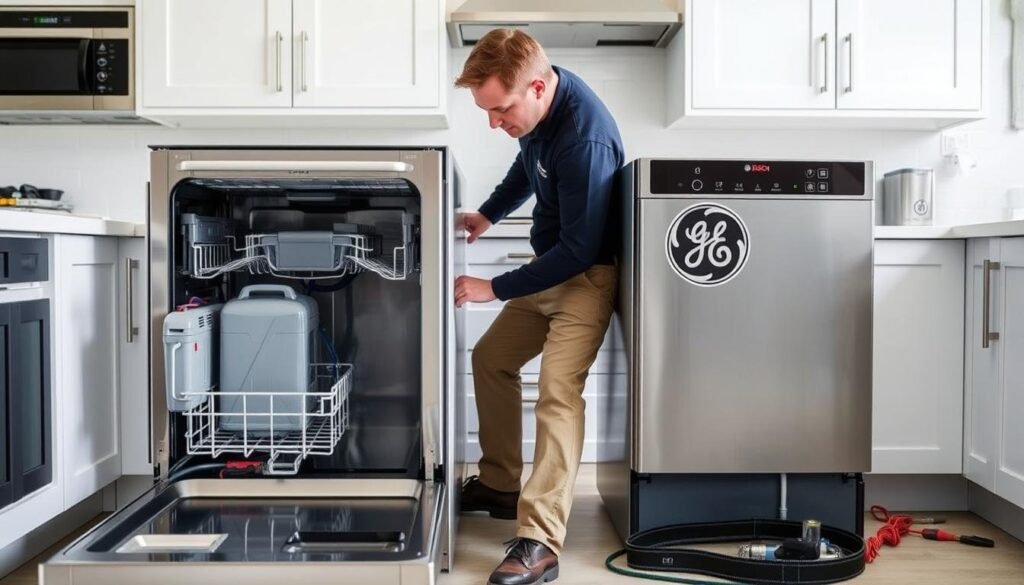
1. Improper Dishwasher Installation: The Warranty Trap Many Owners Overlook
One of the most common reasons for a disputed dishwasher warranty claim is improper installation. A dishwasher is not simply an electrical appliance that can be plugged in and placed under a kitchen counter. It needs the correct water connection, drainage arrangement, electrical supply, levelling, cabinet clearance and protection against leaks. If one of these requirements is ignored, the appliance may develop problems that the manufacturer considers installation-related rather than manufacturing defects.
Many dishwasher warranties distinguish between a fault caused by a defective factory component and a problem resulting from incorrect installation. For example, if a drain hose is fitted incorrectly and wastewater flows back into the dishwasher, the manufacturer may argue that the resulting drainage issue is not a product defect. Similarly, a leak caused by a poorly tightened water inlet connection may not be treated in the same way as a leak caused by a defective internal hose or valve.
This distinction is important because installation-related damage can sometimes affect several components. A poorly installed dishwasher may leak into the base pan, damage electrical connections, affect flooring or cabinetry, and trigger a leak-protection system. The appliance may display a fault code or stop operating, but the original cause could be an installation error rather than a failed electronic control board.
The installation mistakes that can create warranty problems
Incorrect water supply connection
Dishwashers require a water supply connected according to the model’s installation instructions. Incorrect fittings, unsuitable hoses, excessive water pressure or an improperly secured connection can cause leaks or prevent the appliance from filling correctly.
If a manufacturer determines that the water connection was installed incorrectly, it may reject repairs for the resulting damage. This does not mean that every water inlet failure is automatically excluded. A defective inlet valve or factory-fitted hose may still be a covered defect if the warranty applies.
Incorrect drain hose positioning
The drain hose must be installed at the correct height and in the configuration specified by the manufacturer. Depending on the appliance and local plumbing arrangement, the instructions may require a high loop or an approved air gap to help prevent wastewater from flowing back into the dishwasher.
An incorrectly positioned hose can contribute to drainage problems, unpleasant odours or contamination from wastewater. If the manufacturer can establish that the problem resulted from an installation that did not follow the instructions, coverage may be disputed.
Failure to level the dishwasher
A dishwasher that is not level may cause operational problems. Door alignment can become uneven, the door may not close properly, and water may collect in areas where it should drain away. In some circumstances, incorrect levelling can contribute to leakage or poor washing performance.
The installation instructions generally explain how to adjust the appliance’s feet and secure it correctly. Owners should not assume that a dishwasher will automatically sit level simply because it fits inside the cabinet opening.
Incorrect electrical installation
A dishwasher must be connected to an electrical supply that meets the manufacturer’s requirements and applicable local codes. An unsuitable circuit, incorrect wiring, improper grounding or an incorrectly fitted connection can create safety problems and damage electrical components.
If a control board, wiring harness or other component fails, the manufacturer may investigate whether the failure was caused by a defective part or an unsuitable electrical installation.
Incorrect cabinet or mounting installation
Built-in dishwashers must be installed with the correct clearances and mounting arrangements. If the appliance is secured incorrectly, cabinet pressure or movement may interfere with the door, hinges or surrounding components.
How to avoid this warranty trap
Before installation, obtain the installation guide for the exact dishwasher model. Do not rely entirely on instructions for a similar model because dimensions, hose arrangements and electrical requirements can differ.
If you hire an installer, choose someone suitably qualified for the work required in your country. Keep the installation invoice, service details and any written confirmation that the dishwasher was installed according to the manufacturer’s instructions.
Take photographs of the connections and installation before the appliance is pushed into its final position. These photographs may be useful if a leak or installation dispute develops later.
In the United States, the United Kingdom and Canada, local electrical and plumbing requirements may apply in addition to the manufacturer’s instructions. A qualified installer should understand the relevant requirements rather than relying on guesswork.
The key lesson: A dishwasher that has been installed incorrectly may develop symptoms that look like product defects. Correct installation and proper documentation can help protect both the appliance and your warranty claim.
2. Unauthorized Repairs and DIY Modifications: Opening the Dishwasher Without Understanding the Risk
Another major warranty trap involves repairing or modifying a dishwasher without understanding the manufacturer’s conditions. When a dishwasher stops working, many owners immediately remove the lower access panel, open the door assembly, disconnect wiring, replace a pump or attempt to repair an electronic control board. Although some basic troubleshooting is reasonable, more invasive work can create complications if it damages the appliance or is performed contrary to the warranty terms.
Manufacturers commonly exclude damage caused by unauthorized service, improper repairs, tampering or modifications. The important distinction is between a repair that causes damage and a repair that simply happens to be performed by an independent technician.
For example, suppose your dishwasher develops a drainage problem during the warranty period. You remove the drain pump, accidentally damage its electrical connector and then discover that the replacement pump does not solve the original problem. When you contact the manufacturer, the technician may find evidence of physical damage or incorrect reassembly. The manufacturer could argue that the additional damage was caused by the repair attempt.
However, it is important not to misunderstand this condition. In the United States, federal warranty law generally restricts manufacturers from denying warranty coverage solely because a consumer used an independent repairer or a third-party part. A manufacturer may generally refuse coverage for damage actually caused by the unauthorized part or service, but a blanket statement that every independent repair automatically cancels the entire warranty can raise legal issues. The specific facts and applicable law matter.
In the UK and Canada, the written warranty terms and local consumer protection laws also matter. A manufacturer may have legitimate grounds to reject a claim where an unsuitable repair caused the fault, but consumers should not automatically assume that every independent inspection or repair eliminates all their rights.
Common DIY actions that create problems
Opening the control panel
The electronic control panel contains wiring, connectors and circuit-board components. Removing it without following the service procedure can damage clips, connectors or wiring insulation. If the dishwasher later develops an electrical fault, the manufacturer may investigate whether the panel was previously opened or altered.
Replacing the drain pump incorrectly
A drain pump may appear easy to replace, but the work can involve electrical connections, seals, mounting arrangements and water drainage components. A poorly installed pump can leak or fail to operate correctly.
Modifying the wiring
Never bypass a door switch, thermal protection device, leak sensor or other safety component to make a dishwasher operate. Such modifications can create electrical hazards and may give the manufacturer a valid reason to reject damage caused by the alteration.
Installing incompatible replacement parts
A replacement pump, valve, sensor, heating element or control board must be suitable for the exact model and revision. A component that looks identical may have different electrical specifications or connector arrangements.
Using unofficial software or electronic modifications
Some modern dishwashers contain advanced electronic controls and network-connected features. Modifying control systems, bypassing safety functions or installing incompatible electronic components may create problems that are not covered by the manufacturer’s warranty.
What should you do before attempting a repair?
Start with the owner’s manual and its troubleshooting section. Many common problems can be investigated without opening the appliance. Examples include checking whether the dishwasher has power, confirming that the water supply is open, cleaning the filter, checking for a blocked spray arm and ensuring that the door is fully closed.
If the problem requires internal electrical or mechanical work, contact the manufacturer or an authorized service provider before proceeding. Ask whether the proposed repair will affect the warranty and request clarification in writing.
Keep any repair invoice and request a detailed description of the work performed. If a technician replaces a part, the invoice should identify the component and the reason for replacement.
The key lesson: Do not confuse basic owner maintenance with internal repair work. Follow the manual for routine tasks, and obtain guidance before carrying out repairs that could damage wiring, seals, pumps or electronic components.
3. Ignoring Maintenance Instructions: Small Neglected Tasks Can Become Expensive Warranty Disputes
Many dishwasher owners assume that a warranty covers every mechanical or electrical problem that occurs during the coverage period. However, warranties generally do not turn routine maintenance into the manufacturer’s responsibility. Dishwashers contain filters, spray arms, seals, drainage passages and other components that need periodic cleaning and inspection.
When an appliance develops a problem because it has not been maintained according to the instructions, the manufacturer may classify the issue as neglect or failure to maintain the product. This can become a warranty problem even when the owner did not deliberately misuse the dishwasher.
Consider a dishwasher that stops draining because its filter has become heavily blocked with food debris. The owner assumes that the drain pump has failed and requests a warranty repair. During inspection, the technician finds that the filter and drainage area have not been cleaned for an extended period. The manufacturer may determine that the problem is related to maintenance rather than a defective pump.
That does not mean every blocked filter or dirty dishwasher is a reason to cancel warranty coverage. A defective pump should not automatically become an excluded maintenance problem simply because the appliance also needs cleaning. The manufacturer should identify the cause of the particular fault.
Maintenance tasks that should not be ignored
Cleaning the dishwasher filter
Many modern dishwashers have removable filters that collect food particles and debris. If the filter becomes clogged, water circulation and drainage can be affected. Food particles may also remain on dishes, and unpleasant smells can develop.
Check the owner’s manual to determine how frequently the filter should be inspected and cleaned. Some models require more frequent attention than others, particularly when the dishwasher is used heavily or dishes are loaded with substantial food residue.
Do not use sharp tools or excessive force when removing the filter. Damaging the filter housing or locking mechanism can create another problem.
Inspecting spray arms
Spray arms distribute water throughout the dishwasher. Their openings can become blocked by food particles, mineral deposits or other debris. Restricted spray-arm movement or blocked openings can lead to poor cleaning performance.
Remove and clean spray arms only as instructed by the manufacturer. Do not enlarge the water openings with metal tools because this can permanently alter the component.
Cleaning the door gasket
The door gasket helps prevent water from escaping during operation. Food residue, grease and detergent deposits can accumulate around the seal. Cleaning the gasket according to the manual helps maintain a proper sealing surface.
Avoid using harsh chemicals or abrasive cleaning materials unless the manufacturer specifically permits them. An unsuitable cleaning product may damage rubber or plastic components.
Keeping the drain area clear
Food debris, labels, glass fragments and other foreign objects can interfere with drainage. Inspect the accessible filter and drain area carefully when the manual recommends it. If you suspect that an object has entered an internal pump or hose, avoid forcing it deeper into the system.
Following the recommended cleaning cycle
Some dishwashers have a cleaning or maintenance cycle. The manufacturer may recommend a suitable dishwasher cleaner and a particular procedure to remove grease, deposits and odours. Follow the instructions for your model rather than assuming that any household cleaning product is suitable.
Could a dirty dishwasher void the entire warranty?
Usually, the more relevant question is whether neglected maintenance caused the specific failure. A manufacturer may have grounds to refuse a claim for damage directly caused by a blocked filter or neglected cleaning, but that does not automatically establish that an unrelated electronic or manufacturing defect is excluded.
For example, a dishwasher may have a blocked filter and a separate defective display board. The filter condition does not, by itself, prove that the display-board failure was caused by neglect.
If a claim is rejected on maintenance grounds, ask the manufacturer to explain which maintenance instruction was not followed and how that failure caused the component to malfunction.
How to protect yourself
Create a simple maintenance routine based on the owner’s manual. Record important cleaning tasks if the dishwasher is expensive or has a complicated maintenance schedule. Keep receipts for any manufacturer-approved cleaning products if they are relevant to a warranty condition.
Do not assume that every dishwasher requires the same maintenance interval. A household using the appliance once a day may have different cleaning needs from a household running several cycles daily.
The key lesson: Routine cleaning is part of responsible dishwasher ownership. Follow the model-specific maintenance instructions and do not allow a preventable blockage to become an expensive repair dispute.
4. Using the Wrong Detergent, Rinse Aid or Cleaning Chemicals
Dishwasher detergent may look like a simple household product, but using the wrong type can create serious operating problems. One of the most common mistakes is using ordinary washing-up liquid or hand dishwashing soap inside an automatic dishwasher.
Hand dishwashing liquid is designed to create foam. Automatic dishwasher detergent is formulated to work with the water circulation, temperature and washing conditions inside a dishwasher. When ordinary washing-up liquid is used, excessive foam can develop and escape through the door or other openings.
The resulting problem may look like a leak, but the cause is not necessarily a defective seal or water valve. Foam can interfere with normal operation, create residue and potentially contribute to damage if the appliance is repeatedly operated under unsuitable conditions.
A manufacturer may reject a claim for damage caused by using an unsuitable detergent or cleaning chemical. This is a common type of misuse exclusion.
Detergent-related mistakes that can affect coverage
Using hand dishwashing liquid
This is one of the clearest examples of incorrect product use. Handwashing liquid is not intended for automatic dishwashers. It can create excessive foam, causing the machine to leak or stop operating correctly.
If the dishwasher overflows after someone pours ordinary washing-up liquid into the detergent dispenser, the manufacturer may reasonably investigate the incident as a misuse-related problem.
Using laundry detergent
Laundry detergent is not a substitute for automatic dishwasher detergent. Its formulation, foaming behaviour and intended use are different. Using it inside a dishwasher can cause excessive suds and leave unsuitable residues.
Using unsuitable cleaning chemicals
Strong household cleaners, bleach-based products, drain cleaners and abrasive chemicals should not be placed inside a dishwasher unless the manufacturer specifically permits them for the intended task. Some chemicals can damage seals, metal surfaces, plastic components or internal hoses.
Overfilling the detergent dispenser
Adding too much detergent may leave residue, create excessive foam or contribute to poor rinsing. Always use the amount recommended for the detergent type, water conditions and wash programme.
Using unsuitable rinse aid
Rinse aid helps water drain from dish surfaces and can improve drying performance. However, the wrong product, incorrect dosage or improper filling may cause residue or other problems. Use a product that is suitable for automatic dishwashers and follow the instructions for the dispenser.
Ignoring detergent compatibility
Some dishwashers have specific recommendations for detergent type, including powder, gel or tablets. Although many models accept several detergent formats, owners should check the manual before using a product that is not listed or recommended.
Does using a third-party detergent automatically void the warranty?
Not necessarily. A manufacturer recommendation does not always mean that the consumer must purchase a particular brand of detergent. What matters is whether the detergent is suitable for automatic dishwashers and whether its use caused the reported damage.
In the United States, restrictions that require consumers to purchase particular branded replacement parts or services can raise issues under federal warranty law. That principle should not be confused with a manufacturer’s ability to reject damage actually caused by an unsuitable chemical or incorrect product use.
In the UK and Canada, the warranty wording and applicable consumer protection rules should also be considered.
How to avoid detergent-related warranty problems
- Use detergent specifically designed for automatic dishwashers.
- Never pour ordinary handwashing liquid into the dishwasher.
- Follow the detergent dosage instructions.
- Check whether your model accepts powder, gel, tablets or a combination of formats.
- Use rinse aid only as directed.
- Avoid experimenting with household cleaning chemicals.
- If excessive foam develops, stop the cycle and follow the manufacturer’s instructions for dealing with the situation.
- Keep the detergent packaging if you suspect a product has caused a problem.
If you contact customer service after a detergent-related incident, explain honestly what product was used. Hiding the circumstances may make the diagnosis more difficult and undermine your credibility.
The key lesson: A dishwasher is designed to work with automatic dishwasher detergent, not ordinary household soap. Using unsuitable chemicals can turn a simple washing problem into a warranty dispute.
5. Commercial Use, Rental Properties and Heavy-Duty Operation
Another fine-print trap is the difference between residential use and commercial or other non-residential use. Many household dishwashers are designed for normal domestic operation. Their warranties may exclude commercial use, use in business premises or operation in circumstances that exceed the intended household application.
This condition can surprise owners who purchase a residential dishwasher for a small business, rental property, holiday accommodation or shared kitchen. The appliance may be used in a way that looks similar to domestic operation, but the warranty may classify the environment differently.
For example, a household dishwasher in a family home may run once or twice daily. The same model installed in a café, guesthouse or staff kitchen may run repeatedly throughout the day. The increased workload can place greater demands on pumps, heating systems, door mechanisms and other components.
A manufacturer may argue that the appliance was not designed or warranted for that type of use.
Situations that may be classified as non-residential use
Restaurant or café kitchens
A domestic dishwasher installed in a restaurant kitchen may be operating outside its intended purpose. Commercial kitchens often require equipment designed for higher throughput, more demanding cleaning conditions and different operating schedules.
Office and staff kitchens
A dishwasher in an office may be used by many people throughout the day. Whether this qualifies as commercial or non-residential use depends on the warranty wording and the actual circumstances.
Holiday rentals and short-term accommodation
A dishwasher in a holiday rental may be used by different guests, potentially with inconsistent loading habits and maintenance practices. Some warranties distinguish between a private household and a property used for commercial accommodation.
Multiple-family or shared accommodation
Certain warranty terms specifically exclude multiple-family or non-residential use. A dishwasher installed in a shared facility may therefore receive different treatment from one installed in a private home.
Business premises
A dishwasher used in a salon, workshop, staff facility or other business environment may fall outside a residential warranty, even if it is not being used to wash restaurant cookware.
Does running several cycles daily automatically void a warranty?
Not necessarily. High household usage is not automatically the same as commercial use. A large family may operate a dishwasher several times a day, and that does not automatically mean the appliance is being used commercially.
The relevant questions include the intended use, the location, the nature of the business activity and the precise wording of the warranty. Some warranties refer to commercial use, while others also mention non-residential or multiple-family use.
What should landlords and property owners check?
If you are purchasing a dishwasher for a rental property, check the warranty before buying it. Ask the manufacturer whether the warranty covers the intended arrangement, especially if the property is used for short-term accommodation or multiple occupants.
Do not assume that a standard domestic warranty covers every rental or business environment.
For a restaurant, café, hotel or other commercial operation, consider a dishwasher designed and warranted for commercial use. Commercial appliances may have different installation requirements, service arrangements and operating specifications.
How to avoid this warranty trap
- Identify where the dishwasher will be installed before purchasing it.
- Explain the intended use to the retailer or manufacturer.
- Ask whether rental or shared accommodation is covered.
- Check the warranty definition of residential, commercial and non-residential use.
- Select a commercial model where the operating environment requires one.
- Keep written confirmation of any special coverage arrangement.
The key lesson: A residential dishwasher warranty is not automatically suitable for every property or business. Confirm the intended-use conditions before installation, not after a breakdown.
6. Ignoring Water Quality, Hard Water and Supply Conditions
Water quality is another area that can lead to warranty disputes. Dishwashers are designed to operate within specified water-supply conditions. Hard water, excessive mineral deposits, unsuitable water pressure, contaminated supply and incorrect plumbing arrangements can affect performance and contribute to component problems.
Hard water contains higher concentrations of dissolved minerals, particularly calcium and magnesium. During heating and drying, mineral deposits can accumulate on surfaces and internal components. Owners may notice white marks on glasses, cloudy dishes, scale around the filter area or deposits inside the dishwasher.
Although hard water is common in many regions of the United States, the United Kingdom and Canada, the exact water conditions vary considerably by location. Some households receive relatively soft water, while others have substantial mineral content.
A dishwasher may include a water-softening system, salt reservoir or settings that allow the owner to adjust operation according to local water hardness. If the model requires dishwasher salt and the owner ignores the instructions, the appliance may develop avoidable scale-related problems.
Water-related conditions that can create warranty complications
Failure to use dishwasher salt where required
Some dishwashers have an integrated water-softening system that requires special dishwasher salt. The salt helps regenerate the softening system so it can continue reducing water hardness.
If the manual requires salt and the owner never fills the reservoir, the appliance may not perform as intended in a hard-water area. Mineral deposits can accumulate, affecting washing results and potentially contributing to scale-related problems.
Not every dishwasher requires salt. Owners should not add it to a model that does not have the appropriate system.
Incorrect water-hardness settings
Dishwashers with adjustable water-softening settings may require the owner to select a level that corresponds to the local water supply. An incorrect setting can result in unsuitable softening performance or unnecessary salt consumption.
The correct setting should be determined using the manufacturer’s instructions and reliable information about local water hardness.
Excessive water pressure
A dishwasher’s water inlet system is designed for a specified pressure range. If the supply pressure is outside the permitted range, the appliance may experience filling problems or damage to water-related components.
Do not assume that higher water pressure always means better performance. The manufacturer’s limits must be followed.
Unsuitable plumbing connections
Incorrect pipe fittings, leaking connections, poor hose routing or unsuitable water supply arrangements can create problems that are blamed on the dishwasher.
The manufacturer may investigate whether the fault originates inside the appliance or from the home’s plumbing.
Water contamination and debris
Sediment, rust or other debris in the water supply can interfere with inlet screens and valves. If the water supply contains unusual contaminants, the owner may need to investigate the plumbing or use a suitable filtration arrangement recommended by a qualified professional.
Can hard water automatically void a dishwasher warranty?
No. Living in a hard-water area does not automatically cancel a dishwasher warranty. Many appliances are specifically designed to operate in areas with different water-hardness levels.
The issue is whether the owner has followed the maintenance and operating requirements and whether the mineral deposits actually caused the reported fault.
For example, a heating element that fails because of a manufacturing defect should not automatically be treated as an excluded hard-water problem merely because the household has hard water. The manufacturer should be able to explain the connection between the water condition and the failure.
How to protect your dishwasher
- Check the water-hardness requirements in the manual.
- Find out whether your dishwasher has an integrated softener.
- Use dishwasher salt if the model requires it.
- Set the water-hardness level correctly.
- Use suitable detergent and rinse aid.
- Clean the filter and accessible components as recommended.
- Investigate unusually high or low water pressure.
- Have plumbing problems corrected by a qualified professional.
- Keep records of relevant water-treatment or plumbing work.
If you live in an area with particularly hard water, pay attention to the dishwasher’s salt indicator and maintenance instructions. Do not assume that adding extra detergent will solve mineral-related washing problems.
The key lesson: Water conditions can affect dishwasher performance, but hard water itself does not automatically invalidate a warranty. Following the model’s water-treatment and supply requirements is what matters.
7. Missing Registration Deadlines, Proof of Purchase and Warranty Claim Requirements
The final trap is not necessarily something you do to the dishwasher. It is something you fail to do after purchasing it.
Some manufacturers offer standard warranty coverage automatically, while others provide additional benefits when an owner registers the appliance, submits proof of purchase or completes a particular process. Extended parts warranties, promotional coverage and special component guarantees may have separate conditions.
Owners sometimes assume that the warranty starts when they register the dishwasher. Others assume that registration is unnecessary because they have already purchased the appliance. Neither assumption is universally correct.
The warranty document determines the applicable requirements. Registration may be optional for the basic warranty but necessary for an additional benefit. In other cases, the warranty may start on the purchase date or delivery date regardless of registration.
Registration mistakes that can cause problems
Assuming registration is unnecessary
Some manufacturers encourage or require registration for certain additional benefits. If you do not complete the required process within the specified period, you may lose access to that particular benefit.
For example, a manufacturer may offer a longer warranty on selected components when the owner registers the product within a stated period. If registration is a condition of that additional coverage, missing the deadline may mean that only the standard warranty applies.
Entering the wrong model or serial number
Dishwashers have model and serial number labels, usually located around the door opening or another area specified in the manual. Entering an incorrect number can make it difficult to identify the appliance or verify its eligibility.
Always check the label rather than copying details from a retailer’s product description.
Losing the original invoice
A purchase receipt is often essential for establishing when the appliance was bought, where it was purchased and how much was paid. Without it, the manufacturer may have difficulty verifying the warranty period.
Some manufacturers may accept alternative proof, such as a retailer’s order confirmation or delivery record. However, you should not assume that every alternative document will be accepted.
Buying from an unauthorized seller
Some warranty terms contain restrictions relating to the seller, purchase territory or original purchaser. A dishwasher bought through an unofficial importer, liquidation seller or marketplace vendor may not receive the same manufacturer coverage as an appliance bought through an authorized sales channel.
The rules vary by manufacturer and country. In some jurisdictions, exclusions relating to unauthorized sellers must be clearly disclosed and may be subject to consumer protection requirements.
Failing to report a problem promptly
Warranty documents may specify how and when a claim must be submitted. If you notice a serious leak, electrical problem or repeated malfunction, do not continue operating the dishwasher simply because it still appears to work.
Report the problem using the manufacturer’s prescribed process and keep a record of the date and reference number.
What documents should you keep?
Create a small digital folder for your dishwasher. Save the following documents:
| Document | Why it matters |
|---|---|
| Purchase invoice | Establishes the purchase date, seller and price |
| Delivery confirmation | Helps establish when the appliance was delivered |
| Model number | Identifies the exact dishwasher |
| Serial number | Helps the manufacturer verify the unit |
| Warranty document | Shows the coverage period and exclusions |
| Registration confirmation | Proves that registration was completed |
| Installation invoice | Helps establish that installation was performed |
| Repair invoices | Records previous service and replacement parts |
| Photographs or videos | Helps document visible symptoms and damage |
| Claim reference numbers | Provides a record of warranty communications |
Does failure to register automatically cancel the warranty?
Not necessarily. Registration requirements differ between manufacturers and warranty types. Some basic warranties apply automatically, while registration may only be necessary for extended coverage or promotional benefits.
If a manufacturer refuses a claim because the dishwasher was not registered, ask it to identify the exact warranty condition that required registration. Also ask whether the condition applies to the standard warranty or only to additional coverage.
The key lesson: Keep your purchase and warranty documents from the first day. Registration, proof of purchase and prompt reporting can make the difference between a straightforward claim and a lengthy dispute.
Other Fine-Print Conditions That Dishwasher Owners Should Understand
The seven traps above cover major areas of warranty disputes, but there are several additional conditions that can influence whether a particular repair is approved. They are worth understanding before you purchase or install a dishwasher.
Accidental damage is different from a manufacturing defect
A manufacturer’s warranty generally focuses on defects covered by its terms. It is not necessarily an insurance policy for every type of damage.
For example, if a heavy object falls against the dishwasher door and damages its outer panel, the manufacturer may classify the damage as accidental rather than a manufacturing defect.
Similarly, damage caused by flooding, fire, lightning, freezing conditions or other external events may be excluded under the warranty.
If the dishwasher is damaged by an external incident, check whether your home insurance or another protection policy may apply.
Cosmetic damage may have a reporting deadline
Scratches, dents, chips and damaged finishes are sometimes treated differently from mechanical defects. Some warranty documents require cosmetic damage to be reported within a short period after purchase or delivery.
This is why it is sensible to inspect a dishwasher immediately after delivery. Check the door, control panel, side panels, handle, racks and visible interior surfaces.
Take photographs before installation if you notice any damage. Report it to the retailer or manufacturer promptly rather than waiting until the appliance has been used for several weeks.
Ordinary wear and tear may not be covered
Some parts naturally deteriorate through normal use. The warranty may distinguish between a premature defect and ordinary wear.
Depending on the warranty, consumables and maintenance-related items may receive limited coverage or no coverage. Examples can include certain filters, cleaning products, seals, accessories or other replaceable items.
Do not assume that every component is covered for the same period as the dishwasher itself. A motor, control board, rack, door seal and heating component may each have different coverage conditions.
External damage to the home may not be included
A dishwasher warranty usually concerns the appliance and the specific remedies described in its terms. It may exclude damage to surrounding flooring, cabinetry, ceilings and other property.
For example, a defective water valve may cause a leak that damages a kitchen floor. The appliance repair and the cost of restoring the floor are separate issues. The warranty may cover the defective valve but exclude the surrounding property damage.
This is an important distinction for built-in dishwashers because a relatively small leak can damage cabinets and flooring before the owner notices it.
Power surges and electrical supply problems
A dishwasher contains electronic control components that can be affected by unsuitable electrical conditions. A power surge, incorrect wiring or an unstable supply may cause damage that the manufacturer considers external to the appliance.
If you experience repeated electrical problems, have the supply checked by a qualified electrician. Do not attempt to bypass electrical protection devices or modify the dishwasher’s wiring.
Using the appliance outdoors or in unsuitable conditions
A dishwasher designed for indoor installation should not be used outdoors or exposed to environmental conditions outside its specified operating range. Rain, freezing temperatures, excessive moisture and other environmental factors may cause damage.
Even a covered outdoor kitchen may expose an indoor appliance to humidity, temperature changes or water ingress that it was not designed to withstand.
Always follow the installation location requirements in the manual.
How Dishwasher Warranty Rules Differ in the USA, UK and Canada
The seven warranty traps are relevant across all three markets, but consumer rights are not identical. A manufacturer’s written warranty is only one part of the protection available to a dishwasher owner.
Understanding the difference between a voluntary manufacturer warranty and legal rights against the seller is especially important when a manufacturer rejects a claim.
Dishwasher warranties in the United States
In the United States, dishwasher manufacturers commonly provide limited warranties covering specified defects in materials or workmanship. The length of coverage and the components included depend on the manufacturer and model.
Some warranties cover the entire appliance for a limited period, while certain components may receive longer parts-only coverage. A longer component warranty does not necessarily mean that labour, transportation or installation costs are covered for the same period.
The written warranty may exclude damage caused by:
- Improper installation.
- Misuse or abuse.
- Failure to maintain the dishwasher.
- Unauthorized modifications.
- Certain unauthorized repairs where the repair caused the damage.
- Commercial or non-residential use.
- External events such as flooding or power-related damage.
- Normal wear and consumable parts.
The United States also has federal consumer warranty protections. Under the Magnuson-Moss Warranty Act, a warrantor generally cannot condition warranty coverage on the consumer using a particular branded replacement part or service provider unless the legal requirements for an exception are met.
This does not mean that every repair performed by an independent technician must be covered. If the repair causes damage, the manufacturer may have grounds to reject coverage for the damage that resulted.
Consumers should therefore distinguish between a manufacturer refusing coverage simply because an independent repairer was used and a manufacturer refusing coverage because the repairer actually damaged the dishwasher.
When a warranty claim is rejected, request the reason in writing. Ask the manufacturer to identify the specific warranty provision and explain the evidence connecting the excluded activity to the reported fault.
Dishwasher warranties in the United Kingdom
In the United Kingdom, manufacturer guarantees are separate from the consumer’s statutory rights against the retailer.
A manufacturer’s guarantee may provide repair or replacement under its stated conditions. However, it does not replace the consumer’s legal rights under the Consumer Rights Act 2015.
Under that legislation, goods supplied to consumers must meet legal standards, including being of satisfactory quality, fit for purpose and as described. Where goods do not conform to the contract, consumers may have rights to remedies such as repair, replacement, price reduction or rejection, depending on the circumstances and the applicable time limits.
This distinction matters when a manufacturer says that a dishwasher is outside its warranty period. The end of the manufacturer’s guarantee does not automatically mean that the retailer has no further legal responsibility.
For example, imagine a dishwasher develops a serious fault after the manufacturer’s one-year guarantee expires. The retailer may still have responsibilities if the appliance did not meet the legal standards required when it was supplied. The precise remedy depends on the circumstances, the time elapsed and the available evidence.
Consumers should also distinguish between a fault caused by a manufacturing defect and damage caused by misuse or incorrect installation. The Consumer Rights Act does not automatically make a retailer responsible for damage caused by the owner’s actions.
If you have a problem, contact the retailer and explain whether you are making a manufacturer-guarantee claim or relying on your statutory consumer rights. These are separate routes and should not be confused.
Dishwasher warranties in Canada
In Canada, manufacturer warranties commonly cover defects in materials or workmanship while excluding problems caused by improper installation, misuse, neglect or unauthorized repairs.
The precise terms vary between manufacturers, provinces and territories. Some provinces also provide statutory protections that operate separately from a manufacturer’s written warranty.
In Quebec, consumer protection legislation provides important legal warranties for goods. These include requirements concerning fitness for ordinary purposes, durability for a reasonable length of time and conformity with the contract and representations made about the product.
The reasonable period is not a universal fixed number of years. Factors such as the appliance’s price, the terms of the purchase and the conditions of use may be relevant.
For consumers elsewhere in Canada, the applicable provincial or territorial consumer protection legislation should be checked. The legal position can differ depending on where the dishwasher was purchased and the circumstances of the transaction.
Canadian consumers should also retain the purchase invoice, warranty certificate, installation documents and repair records. If the manufacturer rejects a claim, request the exact exclusion and the technical reason for applying it.
A simple comparison
| Issue | United States | United Kingdom | Canada |
|---|---|---|---|
| Manufacturer warranty | Governed by written warranty terms and applicable law | Governed by guarantee terms and applicable law | Governed by warranty terms and applicable provincial or territorial law |
| Consumer rights beyond the warranty | Federal and state protections may apply | Consumer Rights Act 2015 provides statutory rights | Provincial and territorial laws may provide additional protections |
| Independent repairs | A blanket denial solely for using independent service may raise federal warranty-law issues | Depends on the guarantee, cause of damage and consumer law | Depends on warranty terms, cause of damage and applicable law |
| Improper installation | Commonly excluded where it causes the fault | May affect a guarantee claim and other legal remedies depending on responsibility | Commonly excluded where it causes the fault |
| Proof of purchase | Often required to verify coverage | Useful for guarantee and retailer claims | Often required to verify coverage |
| Commercial use | Frequently excluded from domestic warranties | Depends on the guarantee terms | Frequently excluded from domestic warranties |
This comparison is a general guide, not a substitute for checking the exact warranty and local law. The country of purchase, seller, installation arrangement and type of claim can all affect the result.
What to Do If a Manufacturer Rejects Your Dishwasher Warranty Claim
A rejected warranty claim can be frustrating, particularly when the dishwasher is relatively new and the repair is expensive. However, you should not immediately accept a rejection without understanding the reason.
The manufacturer should be able to explain which warranty condition it believes applies and why that condition is relevant to the failure.
Step 1: Request the rejection in writing
Ask the manufacturer to provide the reason for rejecting the claim in writing. A telephone explanation is useful, but written confirmation creates a record you can refer to later.
Ask for the specific warranty clause, the component affected and the technical findings that support the decision.
Step 2: Ask how the excluded activity caused the fault
Suppose the manufacturer says that your dishwasher warranty is invalid because an independent technician previously inspected the appliance. Ask whether the technician actually caused the reported fault.
There is a meaningful difference between an independent technician inspecting a dishwasher and an independent technician damaging its control board.
Similarly, if the manufacturer claims that hard water caused a pump failure, ask for the technical explanation supporting that conclusion.
Step 3: Request the inspection findings
If a technician has inspected the appliance, ask for a copy of the diagnostic report or a written explanation of the findings. This may help you understand whether the fault is related to installation, maintenance, misuse or a defective component.
If the diagnosis is unclear, you may wish to obtain an independent technical opinion. Before arranging another repair, check whether doing so could affect any remaining warranty rights and document the appliance’s condition.
Step 4: Separate the manufacturer warranty from your legal rights
If the manufacturer refuses a voluntary warranty claim, you may still have a separate route through the retailer or applicable consumer protection law.
In the UK, for example, a consumer may have rights against the retailer under the Consumer Rights Act even when the manufacturer’s guarantee has expired.
In the United States and Canada, other federal, state, provincial or territorial protections may apply depending on the transaction and the circumstances.
Step 5: Escalate the complaint
If the manufacturer’s decision appears inconsistent with the warranty terms or the applicable law, use its formal complaint process. Provide the purchase invoice, warranty document, photographs, diagnostic report and any relevant correspondence.
If the dispute remains unresolved, consider contacting the appropriate consumer protection authority or seeking independent legal advice.
A useful warranty dispute checklist
Before escalating, make sure you have:
- The original purchase invoice.
- The dishwasher’s model and serial numbers.
- The warranty terms that applied when you purchased it.
- The installation invoice, if applicable.
- A clear description of the fault.
- Photographs or videos showing the problem.
- The technician’s diagnostic report.
- The manufacturer’s written rejection.
- A copy of your complaint and the response.
- Any evidence that contradicts the alleged warranty exclusion.
The objective is not simply to argue that the dishwasher is under warranty. It is to establish that the fault falls within the promised coverage and that the manufacturer has not correctly applied an exclusion.
How to Protect Your Dishwasher Warranty From the Day You Buy It
Avoiding warranty disputes is easier when you establish good ownership practices from the beginning. You do not need complicated paperwork or expensive maintenance plans. A few practical habits can make a substantial difference.
Before purchasing
Read the warranty document rather than relying only on the warranty duration displayed in the advertisement. Check whether the warranty covers parts and labour, whether certain components have separate coverage and whether the appliance is suitable for your intended location.
If you are purchasing a dishwasher for a rental property, office or business, confirm that the intended use is covered.
Ask the retailer who is responsible for installation and whether installation charges are separate from the appliance warranty.
During delivery
Inspect the dishwasher before signing off on delivery where possible. Check for dents, scratches, damaged controls, broken racks and other visible defects.
Photograph any damage and report it promptly. Keep the delivery confirmation and all correspondence.
During installation
Use the installation guide for the exact model. Confirm that the water supply, drain hose, electrical connection, levelling and mounting arrangements meet the manufacturer’s requirements.
Keep the installation invoice and photographs of the completed installation.
During normal operation
Use automatic dishwasher detergent, load the racks according to the manual, select suitable wash programmes and avoid overloading the appliance.
Do not use the dishwasher for purposes it was not designed to handle. If you notice unusual noises, leaks, burning smells or repeated fault codes, stop using it when necessary and seek appropriate assistance.
During maintenance
Clean the filter and spray arms according to the manual. Check the door gasket and keep the detergent dispenser clean. If your dishwasher uses a water-softening system, follow the instructions for salt and water-hardness settings.
Do not use unsuitable chemicals or attempt to bypass safety systems.
When something goes wrong
Record the fault code, take photographs or videos and contact the manufacturer or retailer. Avoid repeatedly restarting a dishwasher that is leaking or showing signs of an electrical problem.
Before authorizing an internal repair, establish whether the appliance is still covered and whether the proposed work could affect the warranty.
A practical ownership rule: keep the manual, warranty certificate, purchase invoice, installation documents and repair records together. These documents can be just as important as the warranty itself when a claim is investigated.
Frequently Asked Questions About Dishwasher Warranty Exclusions
1. Can a manufacturer completely void my dishwasher warranty because I repaired it myself?
Not automatically in every situation. The manufacturer may have grounds to reject coverage for damage caused by an improper repair, tampering or modification. However, the fact that you or an independent technician performed a repair does not necessarily mean that every unrelated warranty claim can be rejected. In the United States, federal warranty law provides specific protections against certain blanket restrictions on independent repairs. Check the warranty and local law before accepting a rejection.
2. Does using a third-party dishwasher detergent void the warranty?
No, not automatically. A detergent designed for automatic dishwashers may be suitable even if it is not the manufacturer’s own brand. However, using handwashing liquid, laundry detergent or an unsuitable chemical can cause damage that may be excluded from warranty coverage. Follow the detergent recommendations in the manual.
3. Can hard water invalidate my dishwasher warranty?
Hard water alone does not automatically invalidate a warranty. However, failure to follow instructions relating to water hardness, dishwasher salt and maintenance may contribute to scale-related damage. If a claim is rejected, ask the manufacturer to explain how the water condition caused the specific failure.
4. Does not cleaning the dishwasher filter void the warranty?
It can create a warranty dispute if neglecting the filter causes a blockage or contributes to the reported fault. However, a dirty filter does not automatically cancel coverage for unrelated manufacturing defects. The manufacturer should identify the connection between the maintenance issue and the component failure.
5. Is professional installation compulsory for every dishwasher warranty?
Not necessarily. Requirements vary by manufacturer, model and country. Some warranties require installation according to the manufacturer’s instructions and applicable local codes but do not always require a particular installer. Check the installation and warranty documents before arranging the work.
6. Can I install my dishwasher myself without losing the warranty?
Possibly, if the warranty permits it and the installation is completed correctly according to the manufacturer’s instructions and local requirements. However, installation errors may result in rejected claims for the damage they cause. Electrical and plumbing work may also require appropriately qualified professionals.
7. Does using a dishwasher in a rental property void its warranty?
Not automatically. Some manufacturers cover ordinary domestic use in certain rental arrangements, while others exclude commercial, non-residential or multiple-family use. Short-term accommodation and business-operated properties may be treated differently. Confirm the intended use with the manufacturer before purchasing.
8. Does running my dishwasher three times a day cancel the warranty?
No, not simply because you run three cycles daily. Heavy household use is not automatically commercial use. However, you must follow the operating instructions and warranty conditions. A manufacturer may investigate whether the appliance was used in a commercial or otherwise excluded environment.
9. Can a manufacturer reject a warranty claim if I use an independent repair technician?
It depends on the country, warranty terms and reason for rejection. In the United States, a manufacturer generally cannot deny coverage solely because you used an independent repairer, although it may refuse to cover damage caused by that repair. In other countries, the applicable guarantee and consumer protection laws should be considered.
10. Will replacing a dishwasher pump with a third-party part void the entire warranty?
Not necessarily. A manufacturer may reject coverage for damage caused by an incompatible or defective replacement part. However, whether an unrelated fault remains covered is a separate question. In the United States, certain restrictions requiring branded parts may also be limited by federal warranty law.
11. Does opening the dishwasher door panel automatically cancel the warranty?
Opening a panel does not necessarily cancel every warranty right. However, damaging wiring, connectors, seals or electronic components during the process may give the manufacturer grounds to reject coverage for the resulting damage. Check the service instructions and warranty before opening internal panels.
12. Can a power surge void my dishwasher warranty?
Many manufacturer warranties exclude damage caused by external electrical events, including certain power surges. If a dishwasher stops working after an electrical incident, the manufacturer may investigate whether the damage originated from the power supply rather than a defective component.
13. Are dishwasher racks covered by the same warranty as the motor?
Not always. Some manufacturers provide different coverage periods for the appliance, racks, baskets, electronic controls and other components. Certain parts may also be subject to separate conditions. Read the component-specific sections of the warranty.
14. Does a dishwasher warranty cover damage to kitchen flooring?
Usually, the manufacturer’s appliance warranty is not the same as home or property insurance. It may cover an eligible defective dishwasher component without covering damage to floors, cabinets or ceilings. Check the warranty and your home insurance policy separately.
15. What happens if my dishwasher leaks during the warranty period?
Stop the cycle if it is safe to do so, shut off the water supply if necessary and protect the surrounding area. Photograph the leak and contact the manufacturer or retailer. The cause matters: a defective internal hose or valve may be covered, while damage caused by incorrect installation or accidental interference may be excluded.
16. Can using ordinary dish soap damage a dishwasher?
Yes. Ordinary hand dishwashing liquid creates excessive foam and is not designed for automatic dishwashers. Excessive suds can escape through the door and interfere with normal operation. Damage resulting from this misuse may not be covered.
17. Does a manufacturer warranty cover normal wear and tear?
Not necessarily. Manufacturer warranties commonly focus on defects in materials and workmanship. Normal deterioration, routine maintenance and certain consumable items may be excluded or covered under different terms.
18. Does my dishwasher warranty start on the purchase date or delivery date?
It depends on the warranty. Some manufacturers calculate coverage from the purchase date, while others use the delivery date or another defined starting point. Keep both the invoice and delivery confirmation so you can establish the relevant dates.
19. What if I lose my dishwasher purchase receipt?
Contact the retailer and request a duplicate invoice or order confirmation. Depending on the manufacturer, other evidence such as a delivery record or registration confirmation may be accepted. However, the manufacturer’s proof-of-purchase requirements should be checked.
20. Is dishwasher registration compulsory?
Not always. Some manufacturers provide standard coverage automatically, while registration may be required for extended coverage or promotional benefits. Check the exact conditions and complete registration promptly if it is required.
21. Can a manufacturer refuse warranty coverage because I purchased the dishwasher online?
Online purchases are not automatically excluded. What matters is whether the seller and purchase meet the manufacturer’s warranty conditions and the applicable consumer protection rules. Check whether the seller is authorized and whether the warranty applies to purchases made through that sales channel.
22. Is a dishwasher bought in another country covered by the local manufacturer’s warranty?
Not necessarily. Manufacturer warranties may have territorial restrictions. An appliance purchased in one country and installed in another may not receive the same service or warranty support. Confirm international coverage before purchasing or importing the appliance.
23. Does the dishwasher warranty cover installation costs?
Some warranties cover parts and labour for eligible repairs, while others exclude installation or removal costs. Initial installation is often a separate service from warranty repair. Read the warranty to determine which costs are included.
24. Can a manufacturer reject a claim because I did not use its recommended cleaning product?
The answer depends on the wording and the reason for rejection. A recommendation does not automatically mean that a particular brand must be used. However, damage caused by an unsuitable chemical or failure to follow an essential maintenance instruction may be excluded. Ask the manufacturer to explain how the product used caused the fault.
25. Does a dishwasher warranty cover damage caused by flooding?
Flooding and other external events are commonly excluded from manufacturer warranties. If a flood damages the appliance, check your home insurance or other applicable protection instead of assuming the manufacturer warranty will cover the loss.
26. Can a manufacturer refuse a claim if the dishwasher has been moved?
Moving a dishwasher does not automatically cancel every warranty. However, damage caused during transportation, incorrect reconnection or improper reinstallation may be excluded. Follow the manufacturer’s instructions for disconnecting, transporting and reinstalling the appliance.
27. What if the manufacturer says the fault was caused by misuse, but I disagree?
Ask for the decision in writing, including the relevant warranty clause and technical evidence. Provide your purchase documents, installation records, photographs and any independent inspection report. If the dispute remains unresolved, consider using the appropriate consumer complaint process in your country.
28. Does the end of a manufacturer’s warranty mean I have no consumer rights?
No. In the UK, statutory rights against the retailer under the Consumer Rights Act 2015 are separate from a manufacturer’s guarantee. In the United States and Canada, other consumer protection laws may also apply. The available rights and remedies depend on the jurisdiction and circumstances.
29. Can a warranty be rejected because the dishwasher was installed in a non-heated garage?
It depends on the model’s installation requirements and the environmental conditions. If the manual requires installation in a protected indoor location, exposure to freezing temperatures or excessive moisture may cause excluded damage. Check the permitted operating and storage conditions.
30. What is the most important document to keep for a dishwasher warranty claim?
The original purchase invoice is one of the most important documents because it helps establish the purchase date and seller. However, the warranty certificate, installation record, model and serial numbers, maintenance records and repair reports can also be essential.
Final Verdict: Read the Fine Print Before Your Dishwasher Breaks Down
A dishwasher warranty is valuable, but it is not unlimited protection. The seven major traps covered in this article improper installation, unauthorized repairs, neglected maintenance, unsuitable detergents, commercial use, water-related problems and missed registration or documentation requirements can all create disputes when an appliance develops a fault.
The most important thing to understand is that a warranty exclusion does not always cancel every form of protection. The manufacturer should be able to explain why a particular exclusion applies and how the excluded activity caused the reported problem.
For dishwasher owners in the USA, UK and Canada, the safest approach is to follow the installation and maintenance instructions, use suitable detergent, avoid unnecessary modifications, keep purchase and repair records, and report problems promptly.
Before buying a dishwasher, read the warranty rather than judging the product solely by the advertised coverage period. A two-year warranty with clear parts and labour protection may be more useful than a longer warranty with significant restrictions.
Finally, remember that manufacturer warranties and statutory consumer rights are not necessarily the same thing. If a manufacturer rejects your claim, check the written reason and consider whether you have additional rights against the retailer under the laws applicable to your purchase.
A little attention to the fine print today can save you from an expensive dishwasher repair tomorrow.