
Installing a brand-new dishwasher should make life easier, not create an expensive household disaster. Unfortunately, a newly installed dishwasher can sometimes leak during its first washing cycle, overflow unexpectedly, or develop a connection failure that allows water to escape into the kitchen.
What initially appears to be a minor plumbing problem can quickly become a serious property damage incident. Water may spread underneath kitchen cabinets, damage hardwood flooring, soak carpets, enter adjoining rooms, damage electrical installations, and even travel through the floor into a room below.
For homeowners, the immediate concern is usually not just repairing the dishwasher. It is understanding who is financially responsible for the damage.
Who pays when a newly installed dishwasher floods your home: the retailer, the manufacturer, the installation company, the plumber, or your homeowners insurance company?
The answer depends primarily on what caused the flooding.
If an installer incorrectly connected the water supply hose, failed to secure a drain connection, or neglected to check for leaks after installation, the installation company may be responsible for the resulting damage.
If the dishwasher has a manufacturing defect that causes water to escape, the manufacturer or seller may potentially be liable, depending on the applicable consumer protection and product liability laws.
If the flooding is sudden and accidental, your homeowners insurance may cover the resulting damage to your property, even while responsibility for the defective appliance or installation is being investigated.
In some situations, more than one party may become involved in the claim.
This distinction is particularly important because the cost of repairing a dishwasher is often considerably lower than the cost of restoring a flooded kitchen. Replacing damaged flooring, kitchen cabinets, insulation, drywall, electrical components, and other household materials can create a substantial financial burden.
The insurance and consumer protection rules also differ between the United States, the United Kingdom, and Canada. Homeowners need to understand these differences before deciding whom to contact and how to pursue compensation.
This detailed guide explains who may be responsible when a newly installed dishwasher floods a home, how homeowners insurance works, what installers and retailers may be liable for, how manufacturer defects are handled, and what steps homeowners should take to protect their financial and legal interests.
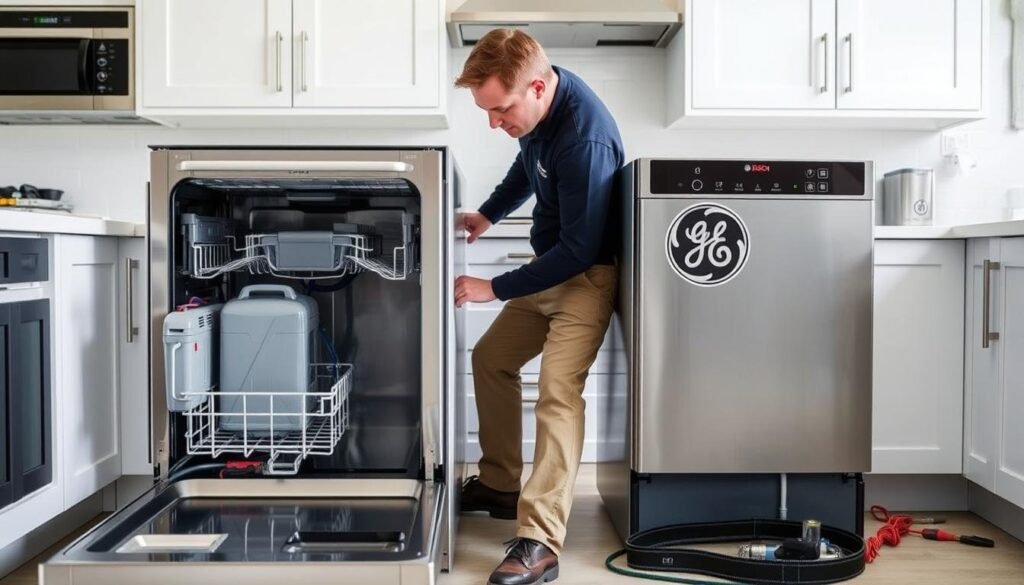
1. Who Is Responsible When a Newly Installed Dishwasher Floods Your Home?
There is no single answer that applies to every dishwasher flooding incident.
Responsibility depends on the actual cause of the leak, the installation agreement, the appliance warranty, the insurance policy, and the applicable consumer protection laws.
In most cases, five parties may become relevant:
- The dishwasher installation company.
- The plumber or independent installer.
- The appliance retailer.
- The dishwasher manufacturer.
- The homeowner’s insurance company.
Each party has a different responsibility.
The installation company
If a professional installation company incorrectly installs the dishwasher and that mistake causes flooding, the company may be legally responsible for the resulting damage.
Examples include:
- Incorrectly connecting the water supply hose.
- Failing to tighten the water inlet connection.
- Incorrectly installing the drain hose.
- Failing to secure the dishwasher properly.
- Damaging a water connection during installation.
- Failing to install required fittings.
- Incorrectly connecting the dishwasher to existing plumbing.
- Failing to perform appropriate leak checks.
If the installation company was negligent, the homeowner may be able to claim compensation for the resulting property damage.
The company’s liability insurance may provide financial protection for qualifying claims arising from its work, subject to its insurance terms.
However, the existence of liability insurance does not automatically establish that the installer is responsible. The homeowner must still establish the relevant facts and applicable legal basis.
The plumber or independent installer
Sometimes a homeowner purchases a dishwasher from one retailer but hires a separate plumber or appliance technician to install it.
In that situation, responsibility may depend on the installation contract and the specific work performed.
For example, imagine that a homeowner purchases a dishwasher from an appliance retailer and hires an independent plumber to connect it.
The plumber installs the water supply line but fails to secure the connection properly.
The homeowner starts the dishwasher, and water escapes from the loose connection, flooding the kitchen.
If the evidence establishes that the plumber’s work caused the leak, the plumber may be responsible for the resulting damage.
The retailer may have no responsibility for the installation if it was not involved in arranging or performing that work.
The appliance retailer
An appliance retailer may become responsible when the dishwasher itself is defective or when installation was included as part of the purchase agreement and performed incorrectly by the retailer or someone acting under its responsibility.
For example, if a customer purchases a dishwasher with delivery and professional installation from the same retailer, the retailer may have contractual or statutory responsibilities concerning both the supplied product and the installation service.
A retailer should not automatically be able to avoid its obligations simply by directing the customer to the manufacturer.
The precise legal position depends on the country, contract, and circumstances.
The dishwasher manufacturer
The manufacturer may become responsible if the flooding resulted from a defect in the dishwasher itself.
Examples include:
- A defective water inlet valve.
- A cracked internal water distribution component.
- A faulty circulation pump housing.
- A defective internal hose.
- A manufacturing defect in the tub.
- A defective water-level control system.
- A faulty door sealing assembly.
If a manufacturing defect causes water to escape during normal operation, the manufacturer may have warranty obligations or potential product liability.
However, not every leaking dishwasher is evidence of a manufacturing defect. Incorrect installation, unsuitable plumbing connections, and improper operation must also be considered.
The homeowner’s insurance company
Homeowners insurance may provide the fastest route to financial assistance when sudden and accidental water damage occurs.
Depending on the policy, the insurer may cover the resulting damage to the home, including:
- Damaged flooring.
- Water-damaged kitchen cabinets.
- Damaged drywall.
- Damaged ceilings.
- Insulation replacement.
- Certain electrical repairs.
- Drying and restoration work.
- Other covered property damage.
The insurer may subsequently investigate whether another party caused the flooding.
If an installer, manufacturer, or retailer is legally responsible, the insurer may pursue recovery from that party or its insurer. This process is commonly called subrogation.
It is therefore possible for your homeowners insurance company to pay for covered damage first and later seek reimbursement from the responsible party.
2. Why Does a Newly Installed Dishwasher Flood a Home?
A dishwasher requires several connections to operate safely. These include a water supply connection, a drain connection, an electrical connection, and, depending on the installation, mounting brackets and other supporting components.
If any of these connections are incorrectly installed, damaged, defective, or incompatible, water may escape during operation.
The fact that the dishwasher is brand-new does not guarantee that the installation is correct or that every component is free from manufacturing defects.
Understanding the most common causes of dishwasher flooding is essential because the cause often determines who pays for the damage.
2.1 Incorrectly installed water supply hose
The water supply hose connects the dishwasher to the household water supply.
If the hose is incorrectly connected, insufficiently tightened, damaged during installation, or fitted with an unsuitable connector, water may escape when the appliance fills.
Possible problems include:
- Loose water inlet connections.
- Incorrectly fitted compression fittings.
- Damaged hose washers.
- Cross-threaded connections.
- Incorrectly installed shut-off valves.
- Incompatible water supply fittings.
A small leak may initially appear harmless, but water can continue escaping whenever the dishwasher fills.
If the installer caused the problem through improper workmanship, the installation company may be responsible for the resulting damage.
If the hose or connector was defective before installation, responsibility may instead involve the manufacturer or supplier of that component.
2.2 Incorrect drain hose installation
The drain hose carries wastewater from the dishwasher into the household drainage system.
Incorrect installation can create leakage, drainage problems, or wastewater escaping into the kitchen.
Common installation mistakes include:
- Poorly secured drain hose connections.
- Incorrect hose routing.
- Damaged drain hose fittings.
- Improperly installed clamps.
- Incorrect connection to the sink drainage system.
- Failure to follow the dishwasher manufacturer’s installation requirements.
A drain hose may also become disconnected when the dishwasher is pushed into its cabinet space.
This is particularly important with built-in dishwashers because the appliance must be carefully positioned without crushing or pulling the hoses.
If the installer fails to route and secure the drain hose correctly, the installer may be liable for the resulting damage.
2.3 Loose or incorrectly fitted water inlet valve connection
The water inlet valve controls the flow of water entering the dishwasher.
A connection that is incorrectly installed or damaged during installation may allow water to escape.
In some situations, the leak may occur immediately when the dishwasher receives water. In others, it may become visible only after several washing cycles.
A technician should inspect the valve, supply hose, connectors, and surrounding fittings to establish where the water originated.
If the valve itself has a manufacturing defect, the manufacturer may become involved. If the valve was damaged or incorrectly connected during installation, the installer may be responsible.
2.4 Defective dishwasher door seal
The door seal prevents water from escaping through the dishwasher door during operation.
A damaged, incorrectly positioned, or defective gasket may allow water to leak onto the kitchen floor.
Possible causes include:
- A defective factory-installed gasket.
- Incorrect door alignment.
- A damaged door seal.
- A twisted gasket.
- Incorrect installation of the dishwasher.
- Excessive movement caused by poor mounting.
A newly installed dishwasher that leaks around the door should be inspected before it is used again.
The technician should determine whether the problem comes from the factory-fitted seal, the appliance’s door assembly, or incorrect installation.
2.5 Damaged internal water hose
Dishwashers contain internal hoses that transport water between different components.
If an internal hose is cracked, incorrectly connected, or damaged during manufacturing or transportation, water may escape when the machine operates.
For example, a hose connecting the circulation pump to another part of the washing system may develop a leak.
If the hose was defective when supplied, the manufacturer or seller may have responsibility.
If the installer damaged the hose while positioning the appliance, the installation company may be responsible.
2.6 Incorrect dishwasher positioning
A built-in dishwasher must be positioned correctly inside the kitchen cabinet opening.
Incorrect positioning can cause several problems.
For example:
- The drain hose may become trapped.
- The water supply hose may become compressed.
- The appliance may not sit level.
- The door may not close properly.
- The dishwasher may move during operation.
- Connections may become strained.
An appliance that is not properly secured can create additional pressure on its water connections.
The installer should follow the manufacturer’s installation instructions and verify that the dishwasher is correctly positioned before completing the job.
2.7 Manufacturing defects
Sometimes the installation is perfectly correct, but the dishwasher itself has a manufacturing defect.
Examples include:
- A cracked internal water connection.
- A defective water inlet valve.
- A faulty circulation pump housing.
- A defective water-level sensor.
- A damaged internal water distribution component.
- A manufacturing defect in the dishwasher tub.
In these situations, the manufacturer may have warranty responsibilities or potential product liability.
The important point is that a new dishwasher flooding a home does not automatically mean the installer made a mistake.
A professional inspection is necessary to establish the actual cause.
3. Does Homeowners Insurance Cover Water Damage From a Newly Installed Dishwasher?
Important distinction
In many circumstances, homeowners insurance can cover sudden and accidental water damage caused by a dishwasher leak, even when the dishwasher was recently installed.
However, the actual coverage depends on the policy wording, the circumstances of the incident, and applicable exclusions.
Most homeowners insurance policies distinguish between damage caused by a sudden accidental water escape and damage caused by a gradual leak, poor maintenance, or an existing defect.
What does homeowners insurance normally cover?
If a newly installed dishwasher suddenly floods your kitchen during its first washing cycle, your home insurance may cover qualifying damage to the insured property.
Depending on the policy, this could include:
- Kitchen flooring.
- Wooden cabinets.
- Kitchen island units.
- Drywall and plasterboard.
- Ceiling materials.
- Insulation.
- Electrical components.
- Carpets and other flooring.
- Personal belongings.
- Necessary water extraction and drying.
- Reasonable restoration expenses.
The Insurance Bureau of Canada explains that standard home insurance typically covers sudden or accidental water damage from household appliances, including dishwashers, although the appliance that caused the problem is not necessarily covered for repair.
Similarly, US insurance guidance identifies a dishwasher that unexpectedly overflows during a washing cycle as an example of sudden accidental water damage that may be covered.
In the UK, this type of incident is commonly considered under the escape-of-water provisions of a home insurance policy.
What may not be covered?
Even when the resulting property damage is covered, the insurer may not pay for:
- The defective dishwasher itself.
- Replacing a faulty water inlet valve.
- Correcting poor installation.
- Replacing a defective drain hose.
- Repairing an improperly fitted connection.
- Gradual water damage.
- Pre-existing deterioration.
- Damage excluded under the specific policy.
For example, suppose a newly installed dishwasher has a defective drain connection.
Water escapes and damages the kitchen floor and cabinets.
Your insurer may cover the resulting property damage while refusing to pay for correcting the defective installation or replacing the dishwasher component.
The installer or retailer may then become responsible for those separate costs.
Sudden water damage versus gradual leakage
This distinction is extremely important.
| Type of incident | Potential insurance treatment |
|---|---|
| Dishwasher suddenly floods during its first cycle | Often covered, subject to policy |
| Water supply hose suddenly disconnects | Potentially covered |
| Internal hose suddenly ruptures | Potentially covered |
| Dishwasher gradually leaks for several weeks | Often excluded or restricted |
| Water slowly escapes from a deteriorating seal | May be excluded |
| Repeated leakage ignored by homeowner | Coverage may be affected |
| Flooding caused by an external river or surface-water event | May require separate flood coverage |
A newly installed dishwasher that causes immediate flooding may present a stronger sudden-and-accidental water damage scenario than an appliance that has leaked unnoticed for months.
However, the fact that the leak occurred immediately does not automatically establish insurance coverage. The insurer still examines the circumstances.
4. Who Pays for the Damaged Kitchen Floor and Cabinets?
This is one of the most important questions for homeowners.
A dishwasher may cost between several hundred and several thousand dollars, depending on its brand and model.
However, the property damage caused by flooding can be considerably more expensive.
Consider a newly installed dishwasher that leaks during its first washing cycle.
Water spreads underneath the kitchen cabinets and damages:
- Laminate or hardwood flooring.
- Kitchen cabinet bases.
- Wooden plinths.
- Floor insulation.
- Drywall.
- Electrical connections.
- Adjacent room flooring.
Who pays for these repairs?
There are generally three possible routes.
Option 1: Your homeowners insurance pays
If the flooding qualifies as an insured event, your insurance company may cover the resulting property damage after applying the deductible or excess.
The insurer may arrange an approved restoration contractor to inspect the property, remove standing water, dry affected materials, and complete repairs.
This can be the most practical option when significant damage has occurred and immediate restoration is necessary.
Option 2: The installer pays
If the installer is found responsible for the flooding, the homeowner may claim compensation from the installation company.
The installer may:
- Pay the repair costs directly.
- Refer the matter to its liability insurer.
- Arrange an independent property inspection.
- Appoint a restoration company.
- Negotiate a settlement.
The homeowner should request written confirmation of any proposed settlement.
Do not assume that an installer offering to repair the dishwasher is also accepting responsibility for the damaged kitchen.
Option 3: The manufacturer or retailer pays
If the dishwasher itself had a manufacturing defect or the retailer breached its legal obligations, the homeowner may have grounds to seek compensation.
This may include the cost of repairing the property, depending on the applicable law and evidence.
For example, if a defective factory-fitted water inlet assembly causes flooding, the manufacturer may face a product liability claim.
If the retailer supplied and installed the appliance under one contract, the retailer may also have responsibilities under the sales and installation agreement.
Can the homeowner claim against both insurance and the responsible company?
A homeowner may notify the insurance company and the potentially responsible business at the same time.
However, the homeowner cannot recover the same loss twice.
If the insurer pays for the property damage, it may acquire recovery rights against the responsible third party through subrogation.
Any uninsured loss, such as an applicable deductible or excluded expense, may remain a separate matter that the homeowner can potentially pursue against the responsible party.
5. What If the Dishwasher Installer Made a Mistake?
If a professional installer caused the flooding through incorrect installation, the installation company may be liable for the damage.
However, the homeowner needs evidence establishing what went wrong.
For example, imagine that a retailer arranges installation of a new dishwasher.
The installation technician connects the water supply hose but fails to tighten the connection correctly.
The technician completes the installation and leaves.
The homeowner starts the dishwasher, and water begins escaping from the loose connection.
The kitchen floor and lower cabinets become flooded.
In this situation, the homeowner may have a claim against the installation company because the damage appears to have resulted from improper workmanship.
What evidence establishes installer negligence?
The following evidence may help:
- A written report from an independent plumber.
- Photographs of the failed connection.
- Video footage showing the leak.
- Installation paperwork.
- The installation invoice.
- The technician’s work order.
- The dishwasher manufacturer’s installation instructions.
- Evidence showing the condition of the connection immediately after installation.
An independent technician may be able to determine whether the connection was improperly fitted, damaged, or unsuitable.
This is particularly important if the installation company disputes responsibility.
Does the installer need liability insurance?
Professional installation companies often maintain public liability or general liability insurance.
Depending on the country and the nature of the business, certain installation contractors may also be subject to specific insurance and licensing requirements.
For example, some US jurisdictions have specific requirements for residential appliance installation contractors.
In Texas, residential appliance installation contractors are required to maintain specified liability insurance, including coverage relating to property damage and completed operations.
However, these requirements are not universal across the United States.
In Canada and the UK, insurance and licensing arrangements also vary depending on the province, territory, nation, and type of work.
Homeowners should request confirmation that the installation company carries appropriate liability insurance.
What if the installer refuses to accept responsibility?
If the installation company refuses to accept responsibility, take the following steps:
- Request its explanation in writing.
- Obtain an independent inspection.
- Preserve the failed fittings and components where possible.
- Collect installation documentation.
- Notify your home insurance company.
- Request the installer’s liability insurance details through the appropriate process.
- Consider formal consumer complaint or legal options.
Avoid accepting an unsupported verbal statement that the flooding was caused by the dishwasher manufacturer.
Ask for technical evidence identifying the actual source of the leak.
6. What If the Dishwasher Itself Is Defective?
Not every newly installed dishwasher flood is caused by incorrect installation.
Sometimes the appliance contains a defective component from the factory.
For example, a new dishwasher may have:
- A cracked water inlet valve housing.
- A defective internal hose.
- A faulty circulation pump.
- A damaged tub.
- A defective water-level control mechanism.
- A poorly manufactured door seal.
If the defect causes water to escape during normal operation, the manufacturer or seller may have legal and warranty responsibilities.
Manufacturer’s warranty
Most new dishwashers come with a manufacturer’s warranty.
The warranty may cover specified defects in materials or workmanship for a defined period.
Depending on its terms, it may provide:
- Replacement components.
- Labour for approved repairs.
- Replacement of a defective appliance.
- Repair through an authorised service technician.
However, manufacturers’ warranties frequently exclude problems caused by incorrect installation.
This is why identifying the source of the leak is so important.
If the manufacturer’s inspection confirms that an internal component was defective from the factory, the homeowner may have a stronger warranty claim.
Can the manufacturer pay for damage to the kitchen?
This depends on the applicable product liability laws, warranty terms, and circumstances.
A manufacturer’s warranty usually focuses on repairing or replacing the defective product.
It does not automatically cover every item of property damaged by the product.
A separate claim for property damage may be possible under applicable product liability law or another legal basis.
For example, a manufacturing defect that causes a dishwasher to flood a kitchen may create a potential claim for the resulting damage, subject to the legal requirements in the relevant country.
The homeowner should distinguish between:
- A warranty claim for the dishwasher.
- A compensation claim for the damaged property.
These are separate legal and financial issues.
7. What If the Retailer Arranged Both Delivery and Installation?
This situation can make responsibility more complicated.
Many appliance retailers offer a combined service that includes:
- Dishwasher purchase.
- Delivery.
- Removal of the old appliance.
- Installation.
- Water supply connection.
- Drain connection.
- Operational testing.
When the customer purchases the appliance and installation as part of one transaction, the retailer may have contractual responsibilities relating to the entire service.
For example, if the retailer arranges an installation subcontractor, the retailer may still have obligations to the customer under the relevant contract and consumer protection law.
This is particularly important in the UK, where consumer legislation addresses incorrect installation when installation forms part of the sales contract and is carried out by the trader or under the trader’s responsibility.
A retailer should therefore investigate a complaint rather than automatically directing the customer to an independent subcontractor.
What should you ask the retailer?
If the dishwasher was purchased with installation, request:
- A copy of the original purchase agreement.
- The installation order.
- The installation company’s details.
- The installation completion report.
- The technician’s name or identification.
- The installation warranty.
- The retailer’s complaint procedure.
- Confirmation of how property damage claims are handled.
Keep all communications in writing.
Can the retailer blame the installation subcontractor?
The answer depends on the applicable law and contractual arrangement.
In some circumstances, the retailer may remain responsible for services supplied through a subcontractor.
In other situations, the homeowner may need to pursue the independent installer directly.
The key question is who contracted to provide the installation and who was responsible for the work.
Do not assume that the retailer has no responsibility simply because another company physically performed the installation.
8. Who Pays in the USA When a Newly Installed Dishwasher Floods a Home?
In the United States, responsibility can involve homeowners insurance, the appliance retailer, the installation contractor, or the manufacturer.
The legal outcome depends on the state, the purchase agreement, the cause of the damage, and the applicable insurance contract.
How American homeowners insurance handles dishwasher flooding
Many US homeowners insurance policies include protection for sudden and accidental water damage.
For example, if a newly installed dishwasher unexpectedly overflows during its first washing cycle, the resulting damage may qualify for coverage under the dwelling or personal property provisions of the policy.
The exact coverage depends on the policy.
The following are examples of potential insurance payments:
| Damage | Potential insurance coverage |
|---|---|
| Damaged kitchen flooring | Dwelling coverage |
| Damaged built-in cabinets | Dwelling coverage |
| Damaged drywall | Dwelling coverage |
| Damaged personal belongings | Personal property coverage |
| Damaged furniture | Personal property coverage |
| Water extraction and drying | Depending on policy |
| Dishwasher replacement | Usually subject to separate warranty or breakdown provisions |
| Correcting faulty installation | Generally not the purpose of homeowners insurance |
What is the difference between dwelling and personal property coverage?
American homeowners policies commonly separate property protection into different coverage categories.
Dwelling coverage: This generally protects the insured home’s structure, including eligible flooring, walls, ceilings, and permanently installed components.
Personal property coverage: This generally protects eligible household belongings, such as furniture, clothing, rugs, and electronics.
Suppose your newly installed dishwasher floods the kitchen.
The water damages the built-in cabinets and hardwood floor, as well as a sofa and television in an adjoining room.
Depending on the policy, the flooring and cabinets may fall under dwelling coverage, while the sofa and television may fall under personal property coverage.
The insurer will assess the damage and apply the relevant limits and exclusions.
Can you claim against the installation company in the USA?
Yes, if the evidence establishes that the installation company caused the damage through negligence or another legally recognised basis for liability.
For example:
- The installer failed to secure the water supply connection.
- The drain hose was incorrectly fitted.
- The installer damaged the dishwasher’s internal hose.
- The installer ignored manufacturer installation instructions.
- The technician failed to identify an obvious installation problem.
The homeowner may pursue compensation from the installation company or its liability insurer.
However, negligence must be established under the applicable state law. The fact that flooding happened immediately after installation is relevant evidence, but it does not automatically prove negligence.
What if the manufacturer is responsible?
If a defective dishwasher component caused the flooding, the manufacturer may face a product liability claim.
Depending on the state, claims may involve defective design, manufacturing defects, failure to provide adequate warnings, or other applicable legal theories.
The homeowner should preserve the dishwasher, failed components, and technical inspection reports.
Do not allow the appliance to be discarded before the cause of the incident has been properly documented.
Does the retailer have responsibility?
The retailer may have contractual responsibilities concerning the supplied appliance and any installation service it arranged.
For example, if the retailer sold the dishwasher and included professional installation in the purchase, the homeowner should initially notify the retailer about both the appliance failure and the installation damage.
The retailer may investigate through its installation contractor or manufacturer.
The homeowner should not be required to guess which company is responsible before reporting the incident.
What if your insurance company pays first?
Your insurer may pay for covered damage and then pursue the responsible installer, retailer, or manufacturer.
This is known as subrogation.
For example:
- Kitchen restoration cost: $12,000.
- Insurance deductible: $1,000.
- Insurer pays: $11,000.
- Homeowner pays: $1,000.
If the insurer successfully recovers the money from the responsible party, the deductible may also be recoverable, depending on the circumstances and policy.
Important US considerations
Homeowners should check:
- State-specific insurance regulations.
- The policy’s sudden water damage provisions.
- The deductible.
- The installer’s licensing requirements.
- The installation company’s liability insurance.
- The manufacturer’s warranty.
- The retailer’s installation agreement.
The legal rules and insurance provisions can differ significantly between states.
9. Who Pays in Canada When a Newly Installed Dishwasher Floods a Home?
Canadian homeowners also need to distinguish between the cost of repairing the dishwasher and the cost of repairing the property damaged by water.
Canadian home insurance policies commonly cover certain types of sudden and accidental water damage caused by household appliances.
However, coverage varies between insurance companies and policy contracts.
Does Canadian home insurance cover dishwasher flooding?
The Insurance Bureau of Canada identifies water damage from malfunctioning household appliances, including dishwashers, as a type of loss typically covered under home insurance.
For example, if a newly installed dishwasher suddenly leaks during a normal washing cycle and damages your kitchen floor, your insurance may cover the resulting property damage.
However, the insurer may not pay for repairing the dishwasher component that caused the leak.
This distinction is important.
Example: Dishwasher floods a home in Ontario
Imagine a homeowner in Ontario purchases a new dishwasher with professional installation.
During the first washing cycle, a water supply connection fails.
Water spreads underneath the kitchen cabinets and damages the flooring.
The homeowner discovers the flooding and immediately shuts off the water supply.
The homeowner then contacts the insurance company.
The insurer may:
- Open a water damage claim.
- Arrange an inspection.
- Determine the extent of the damage.
- Arrange water extraction and drying.
- Assess the cost of restoring the affected property.
- Apply the deductible.
- Investigate whether another party caused the loss.
If the installer is found responsible, the insurer may pursue recovery.
Can Canadian homeowners claim against the installation company?
Potentially, yes.
If the installation company performed defective work or failed to meet its contractual or legal obligations, the homeowner may have grounds to seek compensation.
The homeowner should establish:
- What work the installer agreed to perform.
- Whether the work was performed correctly.
- Whether the incorrect work caused the leak.
- What property damage resulted.
- The reasonable cost of restoring the property.
Consumer protection laws differ between Canadian provinces and territories.
For example, Ontario provides consumer protection rules relating to goods and services, as well as guidance on hiring contractors and documenting agreements.
Homeowners should retain written estimates, invoices, contracts, and details of any subcontractors involved.
What if the dishwasher has a manufacturing defect?
If the flooding resulted from a manufacturing defect, the manufacturer may have warranty or product liability responsibilities.
The homeowner may also have rights against the retailer under applicable provincial law.
The exact legal route depends on the province, the type of defect, the purchase agreement, and the evidence.
What if the retailer used a subcontractor?
Suppose a Canadian appliance retailer sells a dishwasher and arranges a separate installation company to connect it.
The homeowner should establish which business was responsible for the installation service and what the purchase agreement says.
The retailer may have contractual responsibilities, while the installation company may have separate responsibilities for its workmanship.
Do not assume that the retailer is automatically liable for every subcontractor mistake or that it is automatically free from liability.
Important Canadian considerations
Before pursuing a claim, check:
- Your provincial or territorial consumer protection rules.
- Your homeowners insurance water damage provisions.
- The installation company’s contract.
- The installer’s liability insurance.
- The appliance manufacturer’s warranty.
- Any applicable limitation periods.
The rules in Ontario, British Columbia, Alberta, Quebec, and other provinces are not identical.
10. Who Pays in the UK When a Newly Installed Dishwasher Floods Your Home?
The United Kingdom has specific consumer protection rules that can be particularly relevant when a dishwasher floods because of poor installation.
Homeowners generally have two important routes to consider:
- A home insurance claim for covered escape-of-water damage.
- A claim against the retailer, installer, or manufacturer where there is a legal basis for responsibility.
Does UK home insurance cover a newly installed dishwasher leak?
Many UK home insurance policies provide cover for qualifying escape-of-water incidents.
Escape of water generally refers to water accidentally escaping from internal household plumbing, appliances, or water systems.
A newly installed dishwasher that suddenly leaks during its first washing cycle may fall within this type of cover.
Depending on the policy, the insurer may pay for:
- Damaged kitchen flooring.
- Damaged kitchen units.
- Water-damaged walls.
- Ceiling repairs.
- Drying and restoration.
- Certain damaged household belongings.
However, homeowners must check the policy’s exclusions and conditions.
Gradual leakage, poor maintenance, defective workmanship, and certain types of installation-related damage may receive different treatment.
Consumer Rights Act 2015 and incorrect dishwasher installation
In England and Wales, the Consumer Rights Act 2015 provides important protections concerning goods and services.
Section 15 addresses incorrect installation when installation forms part of the contract and is performed by the trader or under the trader’s responsibility.
This means that if you purchase a dishwasher with installation included and the retailer or its installation contractor installs it incorrectly, the goods may be treated as not conforming to the contract.
Section 49 also requires services to be performed with reasonable care and skill.
This is particularly relevant when a professional installer fails to connect the dishwasher correctly.
For example, suppose a retailer sells a dishwasher and includes installation.
Its installation contractor connects the water supply hose incorrectly, causing flooding during the first washing cycle.
The homeowner may have a claim against the retailer under the relevant consumer contract provisions.
The retailer should not automatically avoid its contractual responsibilities simply by referring the homeowner to the subcontractor.
Can you claim compensation for damaged property in the UK?
Yes, depending on the circumstances.
UK consumer protection guidance recognises that a consumer may have a legal right to claim compensation when a defective product causes damage to personal property.
For example, if a newly purchased dishwasher is defective and floods the kitchen, the homeowner may be able to claim compensation for the damaged flooring and other affected belongings.
The applicable legal route depends on whether the claim is against the seller, manufacturer, or installer.
Product liability under the Consumer Protection Act 1987
If the dishwasher has a safety-related defect that causes property damage, the Consumer Protection Act 1987 may provide another potential route.
Under the statutory product liability framework, a qualifying defective product may create liability for the producer or another relevant party.
However, this is not an automatic compensation scheme for every defective appliance.
The claimant must satisfy the legal requirements, including the relevant definition of defect and the type and value of property damage.
For example, the Act has a property damage threshold of more than £275 and other conditions concerning the property and its use.
Does the retailer have to arrange the repairs?
If the retailer supplied and installed the dishwasher under one agreement, the homeowner should initially complain to the retailer.
The consumer should explain that the appliance installation appears to have caused property damage and request an investigation.
The retailer may arrange:
- A technical inspection.
- A replacement dishwasher.
- A repair.
- An investigation by the installation contractor.
- A discussion about compensation.
If the retailer refuses to resolve the complaint, the homeowner can consider available consumer dispute resolution and legal options.
What about Scotland and Northern Ireland?
The UK contains different legal jurisdictions.
Consumer Rights Act provisions have UK-wide application in relevant areas, but court procedures, limitation rules, and certain consumer dispute arrangements can differ.
Homeowners in Scotland and Northern Ireland should seek guidance appropriate to their jurisdiction rather than assuming that every legal procedure is identical to England and Wales.
11. What Happens If the Dishwasher Was Installed by a Subcontractor?
This is one of the most confusing situations for homeowners.
A retailer may sell the dishwasher, collect the installation payment, and then send an independent installation company to complete the work.
The homeowner may not even know the name of the subcontractor.
If the dishwasher floods, the retailer might argue that the installation contractor is responsible.
The installation contractor might argue that the dishwasher itself was defective.
The manufacturer might claim that the appliance was installed incorrectly.
This can create a situation where each party points towards someone else.
Who should you contact first?
If the retailer arranged the installation, contact the retailer first and formally report the incident.
Explain that:
- The dishwasher was purchased from the retailer.
- Installation was included in the transaction.
- Flooding occurred following installation.
- Property damage has resulted.
- You require an investigation into the cause.
- You are requesting details of the installation company and its insurance arrangements.
You should also notify your homeowners insurance company promptly.
Can the retailer be responsible for its subcontractor?
This depends on the applicable law and contractual arrangement.
In some circumstances, a retailer remains responsible for services supplied through its subcontractors.
For example, UK consumer legislation can make the trader responsible where installation forms part of the contract and is carried out by the trader or under its responsibility.
In other countries, the relationship between the retailer and subcontractor may be assessed through contract law, agency principles, negligence, or consumer protection legislation.
The important point is that a retailer cannot necessarily avoid responsibility simply by saying that another company performed the installation.
What if you hired the installer separately?
If you independently hired a plumber or installation technician, your claim may need to be directed against that contractor.
For example:
- You purchase the dishwasher from a retailer.
- You hire an independent plumber.
- The plumber connects the water supply.
- The connection fails because of incorrect installation.
In this situation, the plumber may be the primary party responsible for the installation damage.
The retailer may still have separate responsibilities if the appliance itself was defective.
12. How to Determine Whether the Installer or Manufacturer Caused the Flooding
Determining the actual cause is often the most important part of the entire dispute.
A dishwasher can flood because of a defective appliance, incorrect installation, damaged plumbing, or a combination of factors.
It is therefore important not to assign blame before the source of the leak has been professionally identified.
Examine the location where water escaped
The location of the water leak can provide useful evidence.
| Leak location | Possible cause | Party potentially responsible |
|---|---|---|
| Water supply connection | Loose or incorrectly fitted connection | Installer |
| Drain hose connection | Incorrect hose fitting | Installer |
| Internal drain hose | Defective or damaged component | Manufacturer or installer |
| Water inlet valve | Manufacturing defect or installation damage | Manufacturer or installer |
| Door seal | Defective gasket or incorrect alignment | Manufacturer or installer |
| Dishwasher tub | Manufacturing defect or physical damage | Manufacturer or responsible party |
| Circulation pump housing | Component defect or damage | Manufacturer or installer |
| Sink drainage connection | Incorrect plumbing connection | Plumber or installer |
These are investigative possibilities, not automatic findings of liability.
Request an independent technical inspection
If the damage is substantial, consider obtaining an independent appliance technician or qualified plumber.
The inspection should identify:
- The exact source of the water.
- The failed component.
- Whether the component was installed correctly.
- Whether the failure resulted from a manufacturing defect.
- Whether the installation instructions were followed.
- Whether the damage could have been prevented.
Ask for a written report.
A detailed report can be useful when dealing with an insurance adjuster, retailer, installation company, or manufacturer.
Preserve the failed components
If the water supply hose, connector, valve, or other component has failed, preserve it where reasonably possible.
Do not allow the responsible company to remove and discard the failed part without documenting it.
If a replacement is necessary to prevent further damage, photograph the component and request that the technician retain it for inspection.
Check the installation instructions
The dishwasher manufacturer’s installation instructions can provide important technical information.
They may specify:
- Water supply connection requirements.
- Drain hose positioning.
- Required hose clamps.
- Permitted water pressure.
- Electrical connection requirements.
- Cabinet opening dimensions.
- Mounting arrangements.
- Leak testing procedures.
If the installation does not comply with the manufacturer’s requirements, that information may be relevant when assessing responsibility.
13. What Should You Do Immediately When a Newly Installed Dishwasher Floods Your Home?
The first few hours after a dishwasher flooding incident are extremely important.
Water can travel underneath flooring, enter wall cavities, damage electrical installations, and create conditions for mould growth.
Your priority should be stopping the water, protecting people, limiting further damage, and preserving evidence.
Follow these steps.
Step 1: Stop the dishwasher immediately
If the dishwasher is operating, stop the washing cycle if you can do so safely.
Do not continue using the appliance to determine whether the leak will happen again.
If there is water around electrical sockets, appliances, or wiring, do not touch the dishwasher or its plug.
If it is safe to do so, isolate the electrical supply from an appropriate dry location. Otherwise, contact a qualified electrician.
Step 2: Turn off the water supply
Locate the dishwasher’s water isolation valve.
Turn off the water supply to prevent additional water from entering the appliance.
If you cannot locate the isolation valve, shut off the relevant household water supply if it is safe and practical.
Step 3: Remove standing water
If there is a significant amount of water on the kitchen floor, remove it using suitable equipment.
Depending on the amount of water, you may need:
- Towels.
- A wet-and-dry vacuum suitable for the situation.
- Water extraction equipment.
- Professional water restoration services.
Avoid using ordinary household electrical equipment in wet areas.
If water has entered electrical installations, arrange an appropriate safety inspection before restoring power.
Step 4: Photograph and record the damage
Take photographs and videos of:
- The dishwasher.
- The water supply connection.
- The drain connection.
- The surrounding kitchen floor.
- Damaged cabinets.
- Water entering adjoining rooms.
- Any visible damage to walls or ceilings.
Record the date and approximate time when the flooding occurred.
If the dishwasher was installed that same day, retain proof of the installation date.
Step 5: Contact your homeowners insurance company
Report the incident as soon as possible.
Explain that the dishwasher was recently installed and that water has escaped into your property.
Ask the insurer:
- Whether the incident qualifies as sudden accidental water damage.
- Whether an approved restoration contractor will be appointed.
- Whether an inspection is required.
- Whether you can appoint your own plumber.
- Whether emergency drying costs are covered.
- Whether you should retain failed components.
- Whether you need written approval before major repairs.
Do not delay reporting simply because you believe the installer is responsible.
Step 6: Contact the retailer and installation company
Send written notification to the company that arranged the installation.
Include the installation date, the date of the flooding, photographs, and a brief description of the damage.
Request an investigation and ask for the installation company’s insurance details where appropriate.
If the retailer used a subcontractor, request the subcontractor’s name and contact information.
Step 7: Arrange a professional inspection
A qualified technician or plumber should identify the source of the leak.
If the property damage is extensive, your insurer may appoint its own specialist.
Ask for the findings in writing.
Step 8: Prevent further damage
Do not wait several days for the retailer or installer to respond if water is still affecting your home.
Arrange reasonable emergency mitigation measures to prevent further damage.
Keep all invoices and receipts for necessary emergency work.
Your insurance policy may require you to take reasonable steps to prevent further loss.
However, do not undertake major permanent repairs or discard important evidence before discussing the situation with the insurer and preserving the relevant components.
14. How Much Can a Newly Installed Dishwasher Flooding Incident Cost?
The cost of a dishwasher flooding incident depends on the amount of water released, the duration of the leak, the materials affected, and the extent of the restoration required.
A small leak confined to the area immediately around the appliance may require relatively minor repairs.
A major leak that spreads underneath kitchen cabinets and into adjoining rooms can be significantly more expensive.
The following figures are illustrative budgeting examples in US dollars. They are not fixed repair prices or guaranteed insurance settlement amounts.
| Type of repair | Illustrative cost |
|---|---|
| Emergency water extraction | $200–$600 |
| Professional drying equipment | $300–$1,000 |
| Kitchen flooring replacement | $800–$3,000 |
| Damaged cabinet repairs | $500–$2,500 |
| Cabinet base replacement | $500–$2,000 |
| Drywall and plaster repairs | $300–$1,500 |
| Painting and finishing | $200–$800 |
| Electrical inspection and repairs | $150–$800 |
| Dishwasher replacement | $500–$2,000 |
| Plumbing connection repairs | $100–$500 |
These costs can be considerably higher in larger kitchens, premium properties, and homes requiring extensive restoration.
Example: A newly installed dishwasher floods a kitchen
Imagine a homeowner purchases a dishwasher for $1,000 and pays $150 for professional installation.
During the first washing cycle, an incorrectly fitted water supply connection begins leaking.
Water damages the kitchen flooring, lower cabinets, and part of the adjoining dining room.
The homeowner receives the following repair estimates:
| Expense | Cost |
|---|---|
| Water extraction and drying | $1,000 |
| Kitchen flooring replacement | $2,500 |
| Cabinet repairs | $1,800 |
| Wall repairs and painting | $700 |
| Electrical inspection | $300 |
| Plumbing correction | $200 |
| Total estimated damage | $6,500 |
The dishwasher itself may still be operational once the connection is corrected.
However, the property damage amounts to $6,500.
If the homeowner has insurance with a $1,000 deductible and the full $6,500 is approved, the insurer may pay $5,500.
The insurer may subsequently investigate whether the installation company was responsible and pursue recovery.
This example demonstrates why homeowners should not assume that the installation company’s responsibility is limited to replacing the dishwasher or tightening a water connection.
The potential property damage may be much greater than the appliance’s purchase price.
15. Can the Homeowner Claim the Insurance Deductible From the Installer?
Yes, potentially.
If the homeowner’s insurance company pays for the covered damage, the homeowner may still have an uninsured financial loss because of the deductible.
For example:
- Total approved damage: $8,000.
- Insurance deductible: $1,000.
- Insurance payment: $7,000.
- Homeowner contribution: $1,000.
If an installer is legally responsible for the incident, the homeowner may be able to seek recovery of the $1,000 deductible.
The homeowner may also have other uninsured losses that could potentially be claimed, depending on the circumstances.
These might include:
- Temporary accommodation expenses not covered by insurance.
- Additional cleaning costs.
- Certain damaged belongings.
- Reasonable emergency expenses.
- Other documented losses arising from the incident.
However, compensation depends on legal responsibility, causation, proof of loss, and the applicable policy and legal rules.
Will your insurance company recover the deductible?
Sometimes an insurance company successfully recovers its payment from the responsible third party.
This process is known as subrogation.
When recovery occurs, the insurer may also seek to recover the homeowner’s deductible.
The timing and distribution of any recovered amount depend on the policy, applicable law, and the recovery agreement.
Ask your insurance company how it handles deductible recovery in third-party claims.
16. What If the Installer Says the Homeowner Is Responsible?
Installation companies sometimes argue that the homeowner’s plumbing or existing kitchen connections caused the flooding.
For example, an installer may claim that:
- The existing water valve was defective.
- The household plumbing was already damaged.
- The homeowner supplied an unsuitable connector.
- The water pressure was outside the permitted range.
- The existing drain system was incorrectly installed.
- The homeowner used the dishwasher incorrectly.
Some of these explanations may be legitimate.
However, the installer should provide technical evidence rather than simply blaming the property’s existing plumbing.
What should you do?
Request a written explanation identifying:
- The exact component that failed.
- The reason the component failed.
- Whether the installer inspected the connection before installation.
- Whether the installation complied with manufacturer instructions.
- Whether the existing plumbing was unsuitable.
- Whether the installer informed you of any problems before completing the work.
If necessary, arrange an independent inspection.
What if the existing plumbing was defective?
The homeowner may be responsible for certain pre-existing plumbing problems.
For example, if an old isolation valve was already corroded and failed when the installer attempted to connect the new dishwasher, the legal responsibility may differ from a situation where the installer simply failed to tighten a new connection.
There may also be shared responsibility if both an existing defect and incorrect installation contributed to the flooding.
The final decision should be based on the technical evidence and applicable law.
17. What If You Are Renting the Property?
The situation becomes more complicated when the dishwasher is installed in a rented property.
Responsibility depends on who owns the dishwasher, who arranged the installation, the tenancy agreement, and the cause of the flooding.
If the landlord purchased the dishwasher
If the landlord purchased the appliance and arranged its installation, the landlord will generally be the first person the tenant should notify.
The landlord may need to contact:
- The appliance retailer.
- The installation company.
- The manufacturer’s warranty department.
- The landlord’s insurance company.
The tenant should not assume responsibility for an installation mistake made by a contractor hired by the landlord.
If the tenant purchased the dishwasher
If the tenant independently purchased and arranged installation of the dishwasher, the tenant may have greater responsibility for investigating the installation and any resulting damage.
However, the landlord’s property insurance may still be relevant when the building itself is damaged.
The tenant’s own contents or renters insurance may also provide certain protections, depending on the policy.
Who pays for damaged kitchen cabinets?
Kitchen cabinets and permanent flooring usually form part of the property rather than the tenant’s personal belongings.
The landlord’s buildings insurance may therefore be relevant.
If the tenant or a contractor hired by the tenant caused the damage, the landlord may have a separate claim against the responsible party.
What should tenants do?
Tenants should:
- Notify the landlord immediately.
- Stop the water supply if safe.
- Document the damage.
- Avoid authorising major repairs without permission.
- Keep records of communications.
- Contact their own insurer if personal belongings are damaged.
A tenant should not ignore a leak simply because the dishwasher belongs to the landlord.
Prompt action can prevent additional damage and help protect everyone involved.
18. What If You Are a Landlord Installing a Dishwasher in a Rental Property?
Landlords should pay particular attention to installation responsibilities because they may be exposed to property damage claims from tenants or neighbouring property owners.
For example, a landlord may arrange the installation of a new dishwasher in an apartment.
The installation company incorrectly connects the drain hose, causing water to leak into the kitchen and eventually into the apartment below.
There may now be damage to:
- The landlord’s kitchen.
- The tenant’s belongings.
- The downstairs apartment.
- Shared building structures.
The landlord should notify the relevant insurer and investigate the installation contractor’s responsibility.
Landlord’s insurance
Landlord insurance may cover certain sudden and accidental property damage, depending on the policy.
However, cover for tenants’ belongings, alternative accommodation, and liability to third parties may be governed by separate policy sections.
Contractor liability
If the installation company caused the flooding, the landlord may have grounds to pursue compensation.
The installation company’s liability insurance may become relevant.
Apartment buildings and condominiums
In multi-unit properties, water can spread through ceilings, walls, service shafts, and floor structures.
A dishwasher flooding incident in one apartment may therefore create damage in another unit.
The building’s master insurance policy, the individual unit owner’s insurance, and the responsible contractor’s liability insurance may all become relevant.
The landlord or property manager should report the incident promptly to the building management and insurers.
19. Can You Claim for Mould After a Newly Installed Dishwasher Floods Your Home?
Yes, potentially.
Water trapped underneath flooring, inside kitchen cabinets, or within wall cavities can create conditions that support mould growth.
This is particularly concerning when a dishwasher leak is not discovered immediately.
Mould may develop after water has soaked:
- Wooden cabinet bases.
- MDF panels.
- Carpet underlay.
- Drywall.
- Insulation.
- Timber flooring.
- Other porous materials.
Whether mould remediation is covered depends on the policy and the circumstances.
Some insurance policies cover resulting mould damage when it develops from an otherwise insured sudden water event and the homeowner takes reasonable steps to limit the damage.
Other policies impose specific limitations or exclusions.
What should homeowners do?
If a dishwasher has flooded the kitchen:
- Remove standing water promptly.
- Arrange professional drying where necessary.
- Check underneath cabinets.
- Inspect affected flooring.
- Investigate damp wall cavities.
- Keep records of moisture inspections.
- Obtain professional remediation if mould develops.
Do not simply cover wet flooring with new material.
The affected area should be properly inspected and dried before permanent restoration.
Can the installer be responsible for mould damage?
If the installer caused the original flooding, resulting mould damage may form part of a claim against that party, subject to proof of causation and applicable legal rules.
However, the homeowner’s response to the initial flooding may also be relevant.
For example, if the leak was discovered immediately but the homeowner allowed standing water to remain for several weeks without taking reasonable action, the additional damage may be assessed differently.
Prompt mitigation is therefore important.
20. How to Make a Strong Claim Against the Dishwasher Retailer or Installer
If your newly installed dishwasher floods your home, you should communicate with the retailer and installation company in a structured way.
A well-documented complaint can help avoid confusion and unnecessary delays.
Prepare a complete evidence file
Collect the following documents:
| Document | Why it matters |
|---|---|
| Dishwasher purchase invoice | Establishes the purchase |
| Installation invoice | Establishes who performed the installation |
| Installation agreement | Identifies contractual responsibilities |
| Manufacturer warranty | Establishes product warranty protection |
| Photographs | Shows the damage and leak location |
| Videos | May demonstrate how the leak occurred |
| Technician report | Identifies the technical cause |
| Insurance claim number | Connects the incident to the insurance claim |
| Restoration quotation | Establishes the property repair cost |
| Repair invoices | Documents expenses already incurred |
| Communication records | Shows what each party said and agreed |
Keep digital and physical copies.
Ask for a written investigation
Request that the retailer or installation company investigate the incident.
Ask them to confirm:
- Who performed the installation.
- Whether the installer was authorised.
- Whether the manufacturer’s installation instructions were followed.
- Whether the appliance was tested after installation.
- Whether the failed component was defective.
- Whether the company accepts responsibility.
Do not accept an incomplete settlement
Suppose the installation company offers to replace the dishwasher but refuses to discuss the damaged kitchen flooring.
You should not automatically treat the matter as resolved.
The appliance replacement and the property damage are separate financial issues.
A complete settlement should clearly identify what is being paid for and whether any remaining claims are being released.
Before signing a final settlement or waiver, consider obtaining legal advice if the damage is substantial.
Escalate the complaint if necessary
If the company refuses to investigate or respond appropriately, consider the relevant complaint channels.
Depending on the country, these may include:
- State consumer protection agencies in the USA.
- Provincial consumer protection authorities in Canada.
- Consumer advice and dispute resolution services in the UK.
- Relevant industry or trade dispute resolution schemes.
- Civil courts where appropriate.
The correct process depends on the jurisdiction and value of the claim.
21. How to Prevent a Newly Installed Dishwasher From Flooding Your Home
Although installation-related flooding cannot always be prevented, homeowners can take several precautions before and immediately after installation.
These precautions are particularly important for built-in dishwashers because water connections are often hidden behind kitchen cabinets.
Before installation
1. Hire a qualified installer.
Choose an experienced appliance installation company or qualified plumber who understands dishwasher water supply and drainage connections.
2. Check the company’s insurance.
Ask whether the installation company carries appropriate liability insurance for accidental property damage.
3. Inspect existing plumbing.
Have the installer check the water supply valve, drainage connection, and existing hoses before connecting the new appliance.
4. Read the installation requirements.
Ensure the installer follows the manufacturer’s instructions.
5. Obtain written installation documentation.
Keep the installation invoice, work order, and any inspection or testing records.
During installation
The installer should:
- Check the water supply connection.
- Inspect the drain hose.
- Use suitable connectors and fittings.
- Ensure hoses are not twisted or compressed.
- Position the dishwasher correctly.
- Secure the appliance where required.
- Check the door alignment.
- Test the water supply.
- Inspect the drainage system.
- Perform appropriate leak checks.
After installation
Homeowners should take the following precautions:
- Inspect the floor underneath the dishwasher.
- Check the visible water supply connection.
- Look for signs of moisture around the cabinet.
- Run an initial washing cycle while monitoring the appliance.
- Check the drainage connection after the cycle.
- Investigate unusual sounds or water smells.
- Keep the installation receipt.
If water appears around the appliance, stop using it and investigate the source.
Do not assume that a small amount of water is normal for a newly installed dishwasher.
Frequently Asked Questions (FAQs)
1. Who pays when a newly installed dishwasher floods your home?
The responsible party depends on the cause of the flooding. If the installer incorrectly connects the water supply or drain hose, the installation company may be responsible. If the dishwasher has a manufacturing defect, the manufacturer or retailer may be liable. Your homeowners insurance may also cover sudden and accidental resulting water damage.
2. Does homeowners insurance cover a dishwasher that floods during its first use?
Many homeowners insurance policies cover sudden and accidental water damage caused by a dishwasher overflowing or leaking during normal operation. However, coverage depends on the policy wording, exclusions, and circumstances. The insurer may cover the resulting property damage without paying to repair the defective dishwasher or incorrect installation.
3. Is the dishwasher installer responsible if the water supply hose was incorrectly connected?
Potentially, yes. If the installer failed to connect or secure the water supply hose properly and that mistake caused flooding, the installation company may be liable for the resulting damage, subject to the applicable legal requirements.
4. Can I claim against the retailer if it arranged the installation?
Yes, potentially. If the retailer supplied the dishwasher and arranged installation under the purchase agreement, it may have contractual or statutory responsibilities. The exact position depends on the country, the installation arrangement, and applicable consumer protection laws.
5. What if the dishwasher manufacturer says the installer caused the flooding?
Ask for a written technical explanation. The manufacturer should identify the component that failed and explain why it believes the installation caused the problem. You can obtain an independent inspection if you disagree with the findings.
6. Does a manufacturer’s warranty cover water damage caused by a new dishwasher?
A standard manufacturer’s warranty generally focuses on defects in the appliance itself. It does not automatically cover damage to kitchen flooring, cabinets, or other property. Separate product liability rights or other legal claims may apply if a manufacturing defect caused the damage.
7. Can I claim compensation for damaged kitchen cabinets?
Yes, potentially. If the cabinets were damaged by a sudden insured water event, your homeowners insurance may cover the resulting damage. You may also have a claim against the installer, retailer, or manufacturer if their negligence, breach of contract, or product defect caused the flooding.
8. Who pays if the dishwasher drain hose was incorrectly installed?
If the drain hose was incorrectly fitted by the installation company, that company may be responsible. If the hose itself was defective, the manufacturer or supplier may become involved. A professional inspection should establish the actual cause.
9. What if the dishwasher floods the kitchen and the ceiling below?
This can become a substantial property damage claim. Your insurance company may assess the damage to the kitchen and the ceiling below separately. If the flooding resulted from an installation mistake, the responsible installation company may also face a claim for the resulting damage.
10. Can my insurance company recover the money from the installer?
Yes. If your insurer pays for covered damage and determines that an installer or another third party was responsible, it may pursue recovery through subrogation. This can include seeking recovery of the amount paid under the policy.
11. Can I recover my insurance deductible from the installer?
Potentially. If the installer is legally responsible, you may be able to seek reimbursement for your deductible and other qualifying uninsured losses. Whether you receive payment depends on the evidence, applicable law, and any recovery arrangements between the insurers.
12. What if the dishwasher was installed by a subcontractor?
If the retailer arranged the installation, contact the retailer first and request details of the subcontractor. Depending on the contract and applicable law, the retailer may retain responsibility for the installation service even though another company performed the physical work.
13. Does homeowners insurance cover a dishwasher leak caused by poor installation?
The resulting sudden water damage may be covered under some homeowners policies, but coverage is not guaranteed. Some policies have exclusions or limitations relating to faulty workmanship. The cost of correcting the installation itself is generally treated separately from the resulting water damage.
14. What should I do if a new dishwasher floods my kitchen?
Immediately stop the dishwasher, turn off the water supply, and isolate electricity if safe. Remove standing water where possible, photograph the damage, contact your insurance company, notify the retailer and installer, and arrange a professional inspection.
15. Can I use the dishwasher again after it floods?
No, not until the source of the leak has been identified and the appliance and its connections have been inspected. Operating a leaking dishwasher can cause additional property damage and may create electrical safety risks.
16. What if the installer refuses to pay for the damage?
Request a written explanation, obtain an independent technical report, and notify your insurer. You can also contact the relevant consumer protection authority or seek legal advice. If the installer carries liability insurance, its insurer may need to assess the claim.
17. Does insurance cover mould caused by dishwasher flooding?
It may, if the mould results from an insured sudden water damage incident and the policy provides the relevant protection. However, some policies impose restrictions or exclusions. Prompt water extraction and professional drying are important.
18. Who pays if a landlord’s newly installed dishwasher floods a rental property?
The landlord’s property insurance may cover eligible damage to the building. The installation company may be responsible if its workmanship caused the flooding. The tenant’s insurance may cover eligible damage to personal belongings, depending on the policy.
19. Can I claim against the manufacturer if a defective dishwasher floods my home in the UK?
Potentially. Depending on the circumstances, you may have rights under the Consumer Rights Act 2015 and potentially the Consumer Protection Act 1987. The appropriate legal route depends on whether the claim concerns the retailer’s contractual obligations, incorrect installation, or a defective product causing property damage.
20. Does Canadian home insurance cover flooding caused by a new dishwasher?
Many Canadian home insurance policies cover sudden and accidental water damage caused by household appliances, including dishwashers. However, the defective appliance itself may not be covered, and the policy’s exclusions, limits, and deductible will apply.
21. Does US homeowners insurance cover flooding from a dishwasher installation mistake?
It may cover qualifying resulting water damage, depending on the policy and circumstances. However, damage caused by faulty workmanship can be subject to specific exclusions or limitations. The insurer will investigate the cause and determine which provisions apply.
22. Can a retailer refuse responsibility by blaming the installation company?
Not necessarily. If installation was included in the retailer’s contract, the retailer may have continuing contractual or statutory obligations. The exact position depends on the agreement and applicable consumer protection laws.
23. How long do I have to report dishwasher flooding to my insurance company?
You should report the incident as soon as reasonably possible. Insurance policies contain notification and cooperation requirements, and delays can complicate the investigation or increase the damage. Check your policy rather than assuming that you have a particular number of days.
24. Should I let the installer repair the dishwasher before the insurance inspection?
Contact your insurer first. Emergency measures to stop the leak and prevent additional damage should not be delayed, but major repairs or disposal of failed components should ideally wait until the damage and cause have been properly documented.
25. What if the dishwasher floods immediately after installation but nobody knows why?
Do not assume that the installer or manufacturer is automatically responsible. Arrange a professional inspection, preserve the failed components, document the incident, and notify your insurer and retailer. Technical evidence is essential to establish liability.
Conclusion
When a newly installed dishwasher floods your home, the financial responsibility depends on what caused the water to escape.
If an installation technician incorrectly connects the water supply or drain hose, the installation company may be responsible for the resulting property damage.
If the dishwasher contains a manufacturing defect, the manufacturer or retailer may have warranty, contractual, or product liability responsibilities.
If the flooding is sudden and accidental, your homeowners insurance may cover the resulting damage to your kitchen, flooring, cabinets, walls, and other insured property, subject to the policy terms.
The most important distinction is between the party responsible for causing the flooding and the insurance company responsible for covering the resulting property damage. These can be two different parties.
For homeowners in the USA, UK, and Canada, the best approach is to report the incident immediately, document everything, obtain a professional technical inspection, and notify both the insurance company and the retailer or installation contractor.
Never assume that replacing the dishwasher resolves the entire problem. If water has damaged your kitchen, the cost of restoring the property must also be addressed.
A newly installed dishwasher should be properly connected, tested, and safe to operate. When an installation failure or manufacturing defect floods your home, you should not automatically be left paying for damage caused by someone else’s mistake.