
Choosing between the Bosch 500 and Bosch 800 Series dishwasher can be difficult because both sit in the premium end of the residential dishwasher market. They share several important characteristics, including stainless-steel tubs on many models, quiet operation, automatic wash sensing, flexible rack systems and efficient cleaning technology. Both are designed for households that want dependable daily performance without the noise and inconvenience associated with older dishwashers.
The main differences become clearer when you examine drying technology, specialised cleaning options, noise ratings, rack flexibility and price. The Bosch 500 Series generally represents a balance between premium features and cost. The Bosch 800 Series builds on that foundation with advanced options on selected models, particularly CrystalDry and PowerControl.
Independent laboratory testing has consistently placed Bosch among the stronger dishwasher brands for overall performance. However, it is important to understand that a high-performing brand does not mean every model achieves identical results. Testing scores, specifications and available features can differ between model numbers and generations. Buyers should therefore compare the exact dishwasher they intend to purchase rather than relying entirely on the series name.
This detailed comparison examines both product families, including washing performance, drying results, noise, racks, energy efficiency, maintenance, reliability, pricing and regional considerations for the United States, Canada and the United Kingdom.
The central question is straightforward: Is the Bosch 800 Series worth the extra money, or will the Bosch 500 Series provide everything most households need?
For many families, the 500 Series is the sensible value choice. For households that regularly wash plastic containers, prefer more advanced drying and want selected premium cleaning functions, the 800 Series can justify its higher price.
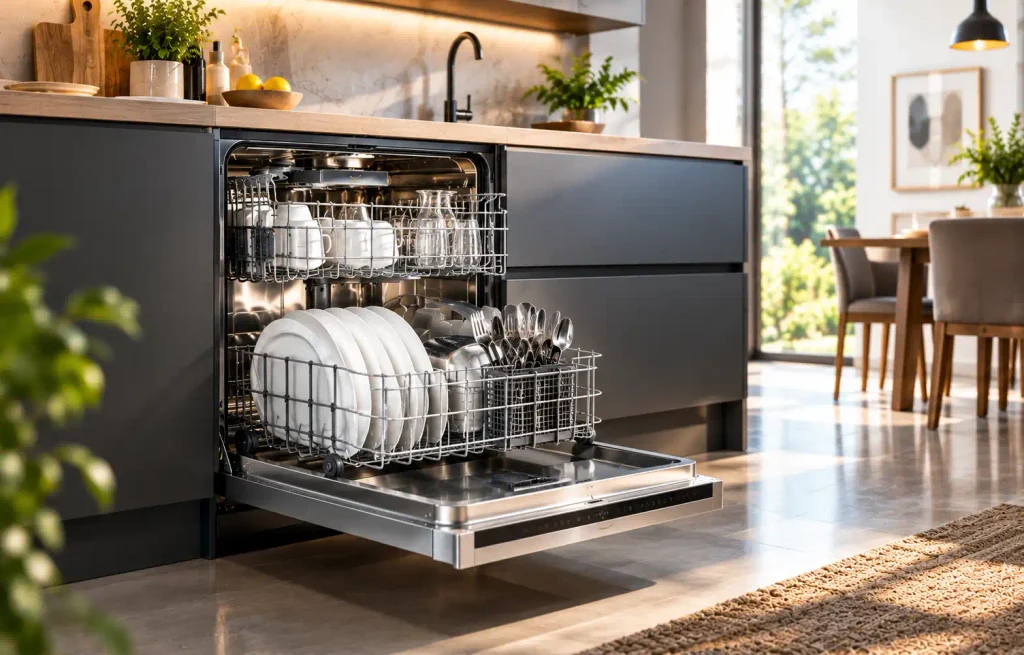
Bosch 500 vs 800: Quick Comparison
| Feature | Bosch 500 Series | Bosch 800 Series |
|---|---|---|
| Product positioning | Premium mid-range | Higher-end premium |
| Typical noise rating | Around 44 dBA on representative models | Around 42 dBA on representative models |
| Standard cleaning technology | PrecisionWash on current models | PrecisionWash on current models |
| Specialised cleaning | Zone Wash on selected newer models | PowerControl on selected models |
| Drying technology | PureDry, with AutoAir on selected models | PureDry or CrystalDry, depending on model |
| Automatic door opening | Available on AutoAir-equipped models | Depends on model and configuration |
| Stainless-steel tub | Available on representative models | Available on representative models |
| Third rack | Available on current models; configuration varies | Available, with more flexible designs on selected models |
| Adjustable middle rack | RackMatic on representative models | RackMatic on representative models |
| Smart connectivity | Available on supported models | Available on supported models |
| Energy efficiency | Many models are highly efficient; check the exact label | Many models are highly efficient; check the exact label |
| Typical purchase cost | Usually lower | Usually higher |
| Best suited to | Value-conscious households wanting premium basics | Buyers prioritising drying and advanced features |
Specifications are representative, not universal. Features can change with model year, market, finish and installation configuration. Check the complete model number before buying.
1. Understanding the Bosch 500 and 800 Series
What is the Bosch 500 Series?
The Bosch 500 Series is positioned for buyers who want a well-equipped dishwasher without paying for every advanced feature available in the brand’s higher tiers.
Many representative 500 Series models include PrecisionWash cleaning technology, a stainless-steel interior, a third rack, an adjustable middle rack, quiet operation and a condensation-based drying system. Selected models also use AutoAir, which automatically opens the door near the end of the drying process to release moisture.
Newer North American 500 Series models have also introduced specialised washing options, including Zone Wash on selected configurations. This means that older descriptions of the 500 Series may not accurately represent every newer model. Some current models offer more advanced features than previous generations, so buyers should look at the model-specific specification sheet.
The principal attraction of the 500 Series is balance. It provides useful everyday functions without requiring buyers to pay for CrystalDry or other advanced features that they may not need.
For a family that runs the dishwasher most evenings, washes ordinary plates, glasses, cookware and cutlery, and is comfortable allowing dishes to air-dry for a little longer, a well-selected 500 Series model can be an excellent purchase.
What is the Bosch 800 Series?
The Bosch 800 Series sits higher in the lineup and offers additional technology on selected models. Its most important distinction is CrystalDry, which uses a mineral-based process involving Zeolite to help convert moisture into heat. This can improve drying results, particularly for plastics, when compared with Bosch’s PureDry system.
Selected 800 Series models also feature PowerControl, a specialised wash system designed to direct more intensive cleaning toward particular areas of the lower rack. It can be useful for cookware and dishes with stubborn, baked-on food.
Other model-dependent advantages can include more flexible third-rack arrangements, premium finish choices and additional controls or convenience options.
However, the 800 Series is not a completely different type of dishwasher. It retains the core Bosch approach to washing, including water circulation, spray arms and automatic sensing. Its value comes from specific improvements rather than a guarantee that every load will be dramatically cleaner than one washed in the 500 Series.
The 800 Series is best viewed as an upgrade for people who can identify a practical benefit from its additional features.
2. Cleaning Performance: Does the 800 Series Wash Better?
Cleaning performance is one of the most important factors in any dishwasher purchase. A machine may look attractive, run quietly and offer impressive technology, but it still needs to remove food residue without requiring dishes to be washed by hand first.
Both the Bosch 500 and 800 Series use Bosch’s sensor-assisted cleaning approach on representative current models. PrecisionWash monitors the wash process and works with the dishwasher’s spray system to distribute water where it is needed. Effective results still depend on loading, detergent, water temperature, cycle selection and maintenance.
Bosch 500 Series cleaning performance
For everyday loads, the 500 Series is designed to clean plates, bowls, cups, cutlery and cookware without requiring extensive pre-rinsing. Normal household food residue should generally be manageable when the correct cycle and detergent are used.
The dishwasher’s spray arms need enough space to rotate, and water must reach the surfaces being cleaned. Large plates placed too close together, nested bowls, obstructed spray arms or utensils packed tightly into the racks can reduce cleaning performance regardless of the series.
Selected newer 500 Series models offer Zone Wash technology. This option concentrates additional water power in a designated part of the lower rack, making it useful when one section contains particularly dirty cookware. Availability depends on the exact model, so buyers should not assume that every 500 Series dishwasher includes it.
For a household that mainly washes normal dinnerware and lightly to moderately soiled cookware, the 500 Series should be more than capable of handling routine work.
Bosch 800 Series cleaning performance
The 800 Series retains the core cleaning system while offering PowerControl on selected models. This feature uses a specialised motorised spray arm to apply different levels of washing intensity to designated areas of the lower rack.
It can be helpful when a load contains a mixture of lightly soiled dishes and cookware with stubborn food residue. Instead of treating every area of the lower rack identically, the system lets users direct more intensive washing where it is most useful.
In one independent laboratory test of a particular 800 Series model, using its heavy PowerControl setting produced dishes that were approximately 5% cleaner than a standard cycle using automatic soil sensing. That result is useful evidence that the feature can make a measurable difference, but it should not be interpreted as a universal 5% improvement for every model, load or wash cycle.
The practical advantage depends on what you wash. If your household regularly cleans roasting trays, saucepans or dishes with dried-on food, a model with PowerControl may offer a useful benefit. If most of your loads contain ordinary plates and cups, the difference may be less noticeable.
Which series cleans better?
The 800 Series has an advantage when comparing a model equipped with PowerControl against a 500 Series model without an equivalent targeted-cleaning feature. Nevertheless, the 500 Series remains a strong option for everyday cleaning.
Cleaning verdict: Choose the 800 Series if its specific advanced wash feature addresses a recurring problem in your kitchen. Do not pay extra merely because the number 800 is higher than 500.
3. Drying Performance: The Biggest Difference
Drying is arguably the most important distinction between these two series. Bosch’s condensation-based approach differs from conventional dishwashers that rely on an exposed heating element to dry the load. The exact result depends on the model’s drying system, the dishes being washed, rinse-aid use and the selected cycle.
Bosch 500 Series: PureDry and AutoAir
Many Bosch dishwashers use PureDry, a closed drying system that allows moisture to be removed as the load cools. The design avoids a conventional exposed heating element at the bottom of the tub, which can be beneficial for households that place suitable plastic items in the lower rack.
However, condensation-based drying has limitations. Water tends to evaporate and drain more readily from smooth glass, porcelain and metal than from lightweight plastic. Plastics often retain droplets because they do not store heat as effectively as heavier materials.
Selected 500 Series models address this limitation with AutoAir. At the end of the drying cycle, the door automatically opens to release humid air and allow fresh air to circulate. This helps moisture escape rather than remaining trapped inside the tub.
AutoAir can improve drying results without requiring the more advanced CrystalDry system. It is particularly useful when users unload the dishwasher after the cycle has finished and can allow some time for the remaining moisture to dissipate.
The trade-off is that the door-opening process depends on the model and its settings. It may not be ideal in every kitchen layout, and it does not eliminate all water droplets from plastic containers.
Bosch 800 Series: CrystalDry
CrystalDry is one of the main reasons buyers consider the 800 Series. It uses Zeolite, a mineral with moisture-absorbing properties, in a system designed to help transform moisture into heat and improve drying performance.
The manufacturer reports that CrystalDry-equipped models achieve up to 60% drier dishes, including plastics, compared with PureDry-equipped models in aggregate average tests involving a mixed household load. This is a manufacturer-reported comparison, not a guarantee that every individual item will be 60% drier in every cycle.
The distinction matters because drying results are affected by the shape of containers, water trapped in recesses, cycle settings and the amount of moisture in the load. Even an advanced drying system cannot completely overcome poor loading or water trapped in the base of an inverted plastic container.
Nevertheless, CrystalDry offers a meaningful advantage for households that frequently wash reusable food-storage containers, lunch boxes, plastic lids and lightweight cups.
It can also help when users want to unload the dishwasher soon after a cycle rather than leaving the door open for an extended period.
Does CrystalDry justify the extra cost?
The answer depends on your daily routine.
Consider a household that washes several plastic containers every day. If those items regularly come out wet and need to be dried with a kitchen towel, CrystalDry may save time and reduce inconvenience.
Now consider a household that mostly washes ceramic plates, stainless-steel cutlery and glassware. These items generally respond well to conventional condensation-based drying, especially when rinse aid is used correctly. In this situation, the extra drying technology may provide a smaller practical benefit.
Drying comparison
| Drying requirement | Better fit |
|---|---|
| Mainly plates, glasses and cutlery | Bosch 500 Series may be sufficient |
| Frequent plastic containers and lids | Bosch 800 Series with CrystalDry |
| Prefer automatic door opening | A 500 Series model with AutoAir, if suitable |
| Want improved drying without paying for CrystalDry | Compare AutoAir-equipped 500 Series models |
| Need consistently convenient unloading | Consider an 800 Series model with CrystalDry |
Drying verdict: The 800 Series has the clearer advantage when the selected model includes CrystalDry. This is the strongest reason to pay more for the higher series.
4. Noise Levels: Is the 800 Series Quieter?
Dishwasher noise matters in open-plan homes, apartments, small kitchens and houses where people work or sleep near the kitchen.
Representative Bosch 500 Series models are rated at around 44 dBA, while representative 800 Series models are rated at around 42 dBA. A lower decibel rating indicates less sound pressure, but decibels use a logarithmic scale, so a two-decibel difference should not be interpreted as a simple percentage reduction in perceived loudness.
Both series are designed to operate quietly. The 500 Series should be suitable for most households, including kitchens that connect to living or dining areas. The 800 Series offers a modest advantage on representative models, but the difference may not be obvious to every listener.
The sound heard in a real kitchen also depends on installation, floor construction, cabinetry, plumbing, loading and the type of food residue being washed away. A poorly installed premium dishwasher can sound louder than a correctly installed lower-priced model.
If quietness is your main priority, compare the exact model’s sound rating rather than assuming every 800 Series unit is quieter than every 500 Series unit. Some configurations and generations differ, and higher-end Bosch ranges may offer still quieter options.
Noise verdict: The 800 Series has a small advantage on representative models, but the 500 Series is already quiet enough for most homes.
5. Rack Design and Loading Flexibility
A dishwasher’s interior design affects how much you can wash in one cycle and whether awkward items fit comfortably. A good rack system can make a greater difference to everyday convenience than an additional wash programme.
Bosch 500 Series racks
Many 500 Series models include a third rack for cutlery and smaller utensils, along with a height-adjustable middle rack. Bosch’s RackMatic system allows the middle rack to move between positions so users can create more space for tall glasses, plates or cookware.
This flexibility helps households accommodate different loads. Tall wine glasses may require additional clearance above the lower rack, while large dinner plates may need extra space below the middle rack.
The third rack can also free up room in the lower cutlery basket, leaving more space for pots, pans and plates.
However, the design and capacity of the third rack vary by model. Some racks are relatively shallow, while others accommodate a broader selection of utensils. Buyers should inspect the actual rack layout rather than relying on photographs from a different generation.
Bosch 800 Series racks
The 800 Series also commonly includes RackMatic and a third rack, with selected models offering a more flexible third-rack design. Depending on the configuration, this may provide additional clearance or better accommodation for larger utensils.
The advantage is most noticeable in households that wash varied loads. People who frequently clean cooking utensils, large serving spoons, mixing bowls and different sizes of glassware may appreciate the extra flexibility.
That said, an 800 Series rack is not automatically superior for every household. If your regular load fits comfortably in the 500 Series, the difference may not justify the price premium.
Capacity and place settings
Capacity should be judged by usable space, not just the advertised place-setting count. A dishwasher may have a high nominal capacity but still be awkward for a household that uses oversized dinner plates, deep bowls or large cookware.
Before buying either series, check:
- Whether your largest plates fit without obstructing the spray arm.
- Whether tall glasses clear the middle rack.
- Whether the third rack accommodates your preferred utensils.
- Whether the cutlery basket or rack suits your loading habits.
- Whether pots and pans can be placed without blocking water circulation.
Rack verdict: Both series provide flexible loading on representative models. The 800 Series may offer refinements, but the exact rack configuration is more important than the series number.
6. Wash Cycles and Special Features
Bosch offers several wash programmes and options, but their availability varies by model. Common functions may include automatic washing, normal washing, intensive washing, quick programmes, sanitising options and delayed start.
The value of these features depends on how they fit your household routine.
An automatic programme is useful when the soil level changes from one load to another. An intensive programme may be appropriate for cookware with heavier residue. A quick programme can be convenient for lightly soiled dishes when the manufacturer’s instructions permit it, although shorter cycles may not deliver the same drying or cleaning results as longer programmes.
Selected models offer specialised wash-zone features. Newer 500 Series configurations may include Zone Wash, while selected 800 Series configurations offer PowerControl. These are not interchangeable features in every respect, and neither should be assumed to be present in every model within its series.
A sanitising option, where included and used according to the instructions, can be helpful for certain household needs. Users should verify the exact programme, temperature and applicable certification rather than assuming all Bosch dishwashers offer identical sanitising performance.
The best buying approach is to identify the three or four programmes you will actually use. Paying extra for features that rarely leave the control panel untouched may not be a good investment.
7. Smart Connectivity and Home Connect
Selected Bosch 500 and 800 Series dishwashers support Home Connect, allowing users to connect the appliance to a compatible home network and use supported app features.
Depending on the model and market, connectivity may provide remote status information, cycle notifications, selected remote controls and other convenience functions. Availability can vary by country, appliance generation, app version and the configuration of the home network.
Smart connectivity is helpful for people who want to check whether a cycle has finished without walking into the kitchen. It may also be useful when the dishwasher is installed in a utility room or another area where its operating status is not immediately visible.
However, an app does not make a dishwasher clean better by itself. The core results still depend on the machine’s wash system, correct detergent, loading and maintenance.
Some users prefer simple controls and may rarely use connected features after the initial setup. Others appreciate notifications and remote status checks.
Connectivity verdict: Treat smart features as a convenience, not a reason on their own to choose the 800 Series. Compare the supported features on the precise model you are buying.
8. Energy Efficiency and Water Consumption
Energy and water use influence both operating costs and environmental impact. Bosch’s premium dishwashers are designed with efficiency in mind, and many models in both series have strong efficiency credentials. However, energy consumption should be checked using the official label or specification sheet for the exact model.
Do not assume that the 800 Series will automatically use less electricity or water than the 500 Series. More advanced drying technology may improve results, but efficiency ratings depend on the complete appliance design and the testing method used.
A dishwasher’s real-world consumption also depends on the programme selected, the number of loads run, incoming water temperature, soil levels and the frequency of optional settings.
Eco programmes are often designed to reduce energy and water use by running for longer at lower temperatures or by adjusting the wash process. A longer cycle does not automatically mean that the machine is wasting energy. In many cases, longer, lower-temperature operation is part of the efficiency strategy.
To keep operating costs under control:
- Run full loads without overcrowding the racks.
- Use the recommended detergent and rinse aid.
- Select an efficient programme when it suits the load.
- Clean the filter regularly.
- Avoid unnecessary repeat cycles caused by poor loading.
- Check the model’s energy label before comparing running costs.
For North American shoppers, look for the applicable energy certification and model-specific consumption figures. In the UK, compare the energy label and the technical data supplied for the precise appliance sold in that market.
9. Reliability and Long-Term Ownership
Reliability is a major consideration because a dishwasher is an appliance that may be used several times each week for years.
Independent owner surveys and product testing have generally placed Bosch among the stronger dishwasher brands for predicted reliability and owner satisfaction. That is a useful starting point, but brand-level results cannot guarantee that a particular machine will be trouble-free.
The 500 and 800 Series share many underlying design principles. Both rely on water circulation, spray arms, sensors, filtration, drainage and electronic controls. Both need correct installation, appropriate detergent and routine care.
The 800 Series includes additional technology on selected models, which may create more potential components to service. That does not establish that the 800 Series is less reliable, nor does it prove that the 500 Series will last longer. A meaningful comparison requires model-specific failure data over a sufficiently long period, and such evidence may not be available for every new model.
What can affect reliability?
Common causes of poor dishwasher performance include blocked filters, obstructed spray arms, unsuitable detergent, poor drainage, hard-water deposits and incorrect loading. Some apparent mechanical problems are actually maintenance or installation issues.
A dishwasher that leaves residue may need its filter cleaned, its spray arms inspected or its detergent and rinse-aid settings adjusted. A machine that fails to drain may have a blocked filter, a hose problem or a fault that requires professional attention.
Electronic components, pumps, valves and seals can eventually fail in any dishwasher. Repair costs depend on the failed part, labour rates, local service availability and whether the appliance remains under warranty.
Is the 800 Series more reliable?
There is not enough reason to assume that the higher series is automatically more reliable. More expensive does not necessarily mean fewer breakdowns. Similarly, choosing the 500 Series simply because it has fewer advanced features does not guarantee a longer service life.
The more practical approach is to compare warranty terms, availability of authorised service, repair costs and the reputation of the specific model. For buyers planning to keep a dishwasher for many years, service access may be just as important as a feature such as CrystalDry.
10. Maintenance Requirements
Both series need routine maintenance to preserve cleaning and drying performance.
Clean the filter
Food particles collect in the filter system. If it becomes clogged, drainage and cleaning performance can deteriorate. Follow the user manual’s instructions for removing, cleaning and reinstalling the filter.
Inspect the spray arms
Check that spray-arm openings are not blocked by food particles or mineral deposits. Make sure the arms can rotate freely after loading. Large pans and plates should not prevent movement.
Use the correct detergent
Use detergent suitable for automatic dishwashers. Handwashing liquid is not an acceptable substitute because it can create excessive foam and cause leaks or operating problems.
Use rinse aid when appropriate
Rinse aid helps water drain from dish surfaces and can improve drying, particularly in areas with challenging water conditions. Adjust the setting according to the manual and your results.
Manage hard water
Hard water can leave mineral deposits on dishes and inside the appliance. Use the water-hardness guidance in the manual and any water-softening features or products supported by the specific model.
Leave the interior clean
If the dishwasher develops persistent odours, inspect the filter, door seals and drainage area. Use only cleaning products and procedures approved for the appliance.
Follow the manual
The precise maintenance schedule, cleaning products and service procedures vary by model. Avoid dismantling pumps, heating components or electrical parts unless qualified to do so.
Neither series should be considered maintenance-free. Regular care can prevent many avoidable performance problems and help users identify faults before they become more serious.
11. Price Comparison: Is the 800 Series Worth Paying More For?
The Bosch 500 Series is generally positioned below the 800 Series in price. The premium paid for an 800 Series model reflects its additional features, finish options and technology, although the exact difference depends on the model and retailer.
Prices change with promotions, seasonal sales, stock levels, installation packages and regional availability. It is therefore better to compare current offers for the precise model numbers than to rely on a fixed price difference.
When comparing costs, include more than the sticker price. Consider installation, delivery, old-appliance removal, accessories, warranty coverage and any modifications required for the kitchen.
A useful way to evaluate the upgrade is to ask what problem the more expensive dishwasher will solve.
If the main frustration with your existing appliance is wet plastic containers, CrystalDry may be valuable. If you regularly wash pans with stubborn residue, PowerControl on a suitable 800 Series model may be worthwhile. If your existing loads mostly contain plates and glasses, the 500 Series may provide similar practical satisfaction for less money.
When the 500 Series offers better value
The 500 Series is particularly attractive if:
- You want a quiet dishwasher with premium everyday performance.
- Most loads contain normal plates, glasses, cups and cutlery.
- You want a third rack and adjustable middle rack.
- You are comfortable with AutoAir or conventional condensation-based drying.
- You prefer to keep the purchase price lower.
- You do not need the specialised features offered by the particular 800 Series model.
When the 800 Series is worth the premium
The 800 Series is a stronger candidate if:
- Your household washes many plastic containers.
- You want CrystalDry and the model you are considering includes it.
- You regularly clean cookware with stubborn food residue and want PowerControl where available.
- You value selected rack refinements or additional finish choices.
- You expect to use the premium features frequently rather than occasionally.
Price verdict: The 500 Series is the better value for many households. The 800 Series is worth the extra money when its additional technology addresses a specific and recurring need.
12. Pros and Cons of the Bosch 500 Series
Advantages
- Usually costs less than a comparable 800 Series model.
- Offers quiet operation, with representative models rated around 44 dBA.
- Provides strong everyday cleaning performance.
- Many models include a stainless-steel tub.
- Third rack and adjustable middle rack improve loading flexibility.
- AutoAir on selected models helps release moisture.
- Selected newer models offer Zone Wash technology.
- A good balance of premium features and purchase cost.
Disadvantages
- AutoAir is not included on every 500 Series model.
- PureDry and AutoAir may not match CrystalDry for difficult plastic loads.
- Selected models may lack the advanced targeted wash system available on certain 800 Series machines.
- Rack configuration and features vary by model year.
- Buyers may need to allow more time for moisture to escape after a cycle, depending on the drying system and load.
13. Pros and Cons of the Bosch 800 Series
Advantages
- CrystalDry on selected models can improve drying, especially for plastics.
- PowerControl on selected models allows more targeted intensive washing.
- Representative models offer very quiet operation at around 42 dBA.
- Many models include a stainless-steel tub and flexible rack systems.
- Premium configurations can provide useful loading and convenience refinements.
- A strong choice for households that want more advanced drying and cleaning options.
Disadvantages
- Usually costs more than the 500 Series.
- Not every 800 Series model includes every premium feature.
- The improvement in cleaning may be modest for ordinary everyday loads.
- Advanced drying technology may be unnecessary for households that mainly wash glass, porcelain and metal.
- More expensive does not automatically mean more reliable.
- Exact features, noise ratings and prices vary by model and market.
14. Which Series Is Better for the USA?
In the United States, buyers can compare a wide range of 500 and 800 Series models, including different handle designs, finishes and control layouts. A good starting point is to identify the precise model number and confirm its sound rating, drying technology, rack layout and available wash options.
For many American households, the 500 Series will be enough. It combines premium everyday cleaning with quiet operation and useful rack flexibility. A model with AutoAir may be especially attractive to buyers who want improved drying without moving to CrystalDry.
The 800 Series is a stronger choice for households that wash a lot of plastic food containers or need the specialised wash options on a particular configuration.
American buyers should also check installation dimensions. A standard-looking dishwasher may have different cutout requirements, door clearances or handle dimensions. Confirm the required water connection, drain connection and electrical arrangement before ordering.
15. Which Series Is Better for Canada?
Canadian shoppers should apply the same feature-based approach while checking the exact model sold in Canada. Model numbers and available configurations can differ from those sold in the United States, even when the series name is the same.
Confirm the product’s Canadian specification sheet, warranty terms, installation requirements and energy information. Do not assume that a US model’s included options, certification or service arrangements automatically apply to the Canadian equivalent.
Water hardness can vary significantly by location. If your home has hard water, correct detergent use, rinse-aid adjustment and filter maintenance can make an important difference to results. Check the manual for any water-softening provisions or recommended settings relevant to the model.
The 500 Series is a sensible option for many Canadian homes, particularly where everyday cleaning and value are priorities. The 800 Series is worth considering when CrystalDry or PowerControl provides a clear benefit.
16. Which Series Is Better for the UK?
Buyers in the United Kingdom should be particularly careful when comparing Bosch’s North American 500 and 800 Series with UK product ranges.
Bosch does not use exactly the same series naming and product lineup in every market. UK dishwashers may be grouped under different series names and may have different dimensions, installation formats, programmes, energy labels and feature combinations.
As a result, a UK buyer should not assume that a product labelled Series 6 or Series 8 is a direct equivalent of a North American 500 or 800 Series dishwasher. The names alone do not establish identical specifications.
Instead, compare the individual UK model’s drying system, noise rating, rack design, energy label, capacity, dimensions and warranty. Look for the features that matter most to your household rather than trying to translate the series number directly.
For example, if improved plastic drying is your priority, verify whether the exact UK model includes the relevant drying technology. If quietness is the main concern, compare the published noise ratings for the specific models available locally.
The best buying decision in the UK is therefore based on the actual appliance specification, not a direct series-name comparison.
17. Common Buying Mistakes to Avoid
Buying by series number alone
A higher series number does not mean every feature is included. Check the model number and full specification sheet.
Assuming all 500 Series models include AutoAir
AutoAir is available on selected models, not every dishwasher carrying the 500 Series name.
Assuming all 800 Series models include PowerControl
PowerControl is available on selected configurations. Verify its presence before paying a premium for it.
Ignoring drying requirements
If plastic containers are a daily frustration, compare drying systems carefully. A better wash result does not automatically mean a drier load.
Expecting a quiet dishwasher to be completely silent
A rating around 42–44 dBA represents quiet operation, but water movement, drainage, installation and the kitchen environment can still be audible.
Comparing old and new models as if they were identical
Feature sets change over time. Older reviews may describe racks, drying systems or wash options that are different from those in newer products.
Ignoring the installation details
Measure the available space and check door clearance, plumbing, electrical requirements and the product’s cutout dimensions before buying.
Assuming a premium price guarantees longer life
Price and series level alone do not establish reliability. Consider warranty, service access and model-specific evidence.
18. Final Verdict: Bosch 500 vs 800 Dishwasher
The Bosch 500 and 800 Series are both strong candidates for households seeking quiet operation, practical loading features and capable everyday cleaning. The best choice depends on which features will make a noticeable difference to your daily routine.
The Bosch 500 Series is the sensible choice for buyers who want a premium dishwasher without paying for every advanced option. It offers a good combination of cleaning performance, rack flexibility and quiet operation. Selected models with AutoAir can also improve drying by releasing humid air at the end of a cycle. For households that mainly wash plates, glasses, cutlery and ordinary cookware, the 500 Series will often provide the better balance of performance and price.
The Bosch 800 Series is the better fit for buyers who need more advanced drying and specialised cleaning features. CrystalDry can be particularly useful for plastic containers and lids, while PowerControl can help with stubborn food residue on selected models. These advantages are real, but their value depends on the exact model and the type of dishes you wash.
Noise should not be the deciding factor for most buyers because representative models in both series are already quiet. Likewise, neither series can be declared universally more reliable based on its position in the product lineup alone.
For most households, the decision comes down to drying and price. If the 500 Series meets your needs, there is little reason to spend more simply to own the higher series. If you regularly struggle with wet plastics or want a model with a targeted intensive wash system, the 800 Series may be a worthwhile upgrade.
Overall recommendation: Choose the Bosch 500 Series for value and everyday performance. Choose the Bosch 800 Series when CrystalDry or a model-specific advanced wash feature will solve a real problem in your kitchen. Before ordering, verify the complete model number, current specification, installation dimensions and warranty for your country.
Frequently Asked Questions
1. Is the Bosch 800 Series better than the 500 Series?
The 800 Series offers additional features on selected models, especially CrystalDry and PowerControl. However, the 500 Series can deliver excellent everyday cleaning and may be the better value for households that do not need those upgrades.
2. Does the Bosch 800 Series clean dishes better?
Selected 800 Series models with PowerControl can improve cleaning in targeted areas of the lower rack. Independent testing found a measurable improvement with a heavy setting on one tested model. The result does not mean every 800 Series dishwasher will outperform every 500 Series model on every load.
3. What is the main difference between Bosch 500 and 800?
The biggest practical difference is drying technology. Selected 500 Series models offer AutoAir, while selected 800 Series models offer CrystalDry. PowerControl is another important feature available on selected 800 Series models.
4. Is Bosch CrystalDry worth the extra money?
CrystalDry is worth considering if your dishwasher frequently washes plastic containers, lunch boxes and lids that remain wet after a cycle. If you mainly wash glass, porcelain and metal, a 500 Series model may be sufficient.
5. Does every Bosch 500 Series dishwasher have AutoAir?
No. AutoAir is available on selected models. Check the specification sheet for the exact model number rather than assuming it is included throughout the series.
6. Does every Bosch 800 Series dishwasher have CrystalDry?
No. Feature availability varies by model and generation. Confirm that the particular 800 Series dishwasher you are considering includes CrystalDry.
7. Does every Bosch 800 Series dishwasher have PowerControl?
No. PowerControl is available on selected models. It should not be treated as a universal feature of every 800 Series dishwasher.
8. Is the Bosch 800 Series quieter than the 500 Series?
Representative 800 Series models are rated around 42 dBA, compared with around 44 dBA for representative 500 Series models. Exact ratings vary, so compare the specific model numbers.
9. Is a 42 dBA dishwasher much quieter than a 44 dBA dishwasher?
The 42 dBA model has a lower sound rating, but the perceived difference depends on the room, installation and type of sound. Both ratings indicate quiet operation for a residential dishwasher.
10. Which Bosch series is better for plastic containers?
An 800 Series model equipped with CrystalDry is generally the stronger choice for households that frequently wash plastics. The exact results depend on the container shape, loading, cycle and model.
11. Which series is better for pots and pans?
Both can clean cookware effectively when loaded correctly and used with an appropriate cycle. A model equipped with PowerControl may be useful for stubborn food residue in the lower rack. Check whether the exact model includes this feature.
12. Do Bosch 500 and 800 Series dishwashers have a third rack?
Many models in both series include a third rack, but the design and flexibility vary. Check the interior layout and the dimensions of the rack before purchasing.
13. Is the Bosch 800 Series more reliable?
A higher series number does not automatically mean greater reliability. Compare model-specific evidence where available, warranty terms, service access and the availability of replacement parts.
14. Does the Bosch 500 Series use less electricity than the 800 Series?
Not necessarily. Energy consumption depends on the exact model, its drying system and its wash programmes. Compare the official energy information for the models you are considering.
15. Are Bosch dishwashers suitable for hard water?
They can be used in hard-water areas, but the correct detergent, rinse aid, cleaning routine and water-hardness settings are important. Follow the model’s instructions and any recommended water-softening guidance.
16. Do Bosch 500 and 800 Series models support smart connectivity?
Selected models in both series support Home Connect. Available functions depend on the model, country, app and network setup. Confirm the features before buying if connectivity is important to you.
17. Is the Bosch 500 Series good for a family?
Yes. A properly selected 500 Series model can be suitable for a family that regularly washes plates, cups, cutlery and cookware. Rack capacity and flexibility should be checked against the family’s actual dishes.
18. Is the Bosch 800 Series worth it for a small household?
It can be, especially if the household regularly washes plastic containers or values the advanced features. However, a small household that mainly washes standard dinnerware may not gain enough practical benefit to justify the extra cost.
19. Are the Bosch 500 and 800 Series the same in the UK and North America?
No. Product ranges and naming conventions vary by market. UK buyers should compare the actual UK model specifications rather than assume that a UK series number directly corresponds to a North American 500 or 800 Series.
20. Should I buy a Bosch 500 or 800 Series dishwasher?
Buy the 500 Series if you want quiet, capable everyday performance at a generally lower cost. Choose the 800 Series if the specific model’s CrystalDry or PowerControl feature will make a meaningful difference to your daily dishwashing routine.
SEO Title: Bosch 500 vs 800 Dishwasher Review: Which Series Is Better?
Meta Description: Compare Bosch 500 vs 800 Series dishwashers for cleaning, drying, noise, reliability, rack design and price. Find the best option for your home.