
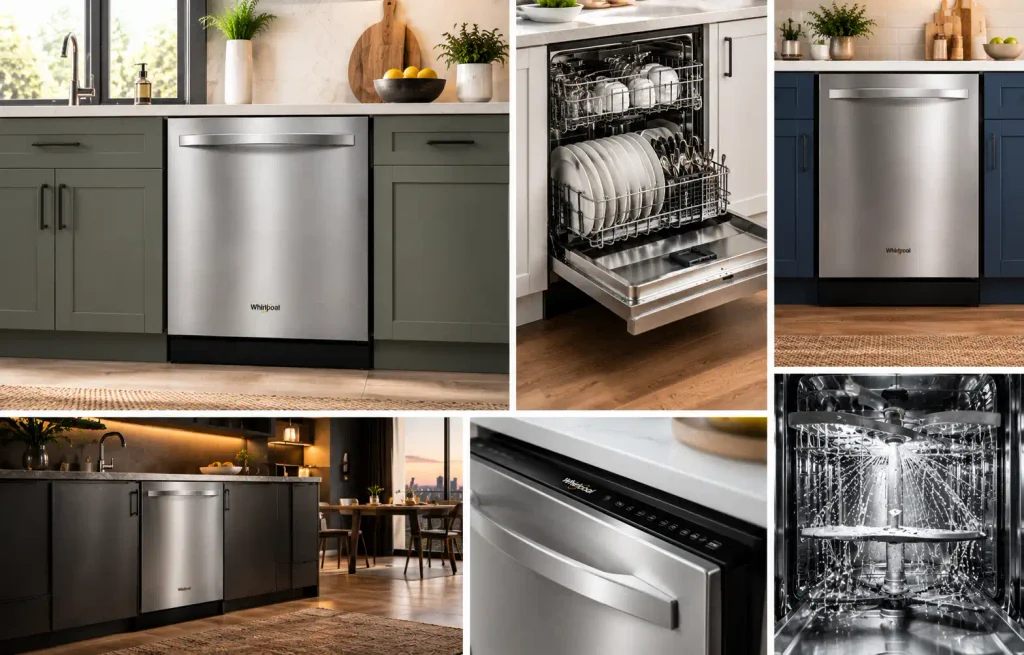
The Whirlpool WDP540HAMZ is a 24-inch built-in dishwasher designed for households that want practical cleaning performance without paying for a long list of premium features. It combines a fingerprint-resistant stainless steel exterior, hidden top-mounted controls, several useful wash cycles, heated drying, and a filtration system intended to manage food particles during washing.
Rather than concentrating on smart-home connectivity, automatic door opening, or elaborate rack adjustments, this model focuses on everyday dishwashing tasks. Its Boost Cycle is intended for tougher food messes, its Extended Soak Cycle helps loosen dried-on residue, and its Quick Wash Cycle provides an option when dishes need to be cleaned sooner. Additional options, including High Temperature Wash, Heated Dry, Extended Dry, and Sani Rinse, give households some flexibility over cleaning and drying results.
However, a dishwasher should not be judged by its feature list alone. Actual performance depends on how effectively it removes food, how well it dries different materials, how much noise it produces, how easily its racks accommodate a normal household load, and how dependable it proves to be over time. The cost of installation, repairs, replacement parts, and ownership also matters.
The WDP540HAMZ has several practical advantages, but there are compromises to consider. Its advertised sound level is 55 dBA, which is not among the quietest levels available in modern dishwashers. Its hybrid interior uses a plastic tub with a stainless steel inner door rather than a completely stainless steel tub. Drying performance may also require some attention to rinse aid, loading practices, and cycle selection.
This detailed review examines the Whirlpool WDP540HAMZ from the perspective of buyers in the United States, Canada, and the United Kingdom. It covers its design, capacity, washing options, filtration, drying, noise, installation, maintenance, potential drawbacks, and long-term value.
1. Whirlpool WDP540HAMZ: Key Specifications
The WDP540HAMZ is a conventional, full-size built-in dishwasher intended for installation beneath a kitchen countertop. Its specification sheet emphasizes practical wash cycles and straightforward controls rather than advanced automation.
| Feature | Whirlpool WDP540HAMZ |
|---|---|
| Appliance type | Built-in dishwasher |
| Nominal width | 24 inches |
| Exterior finish | Fingerprint-resistant stainless steel |
| Control location | Hidden controls on the top edge of the door |
| Advertised sound level | 55 dBA |
| Interior construction | Hybrid interior with a plastic tub and stainless steel inner door |
| Capacity | Listed at approximately 12 place settings in some specifications |
| Main wash cycles | Boost, Quick Wash, Heavy, Normal, Extended Soak |
| Additional options | High Temperature Wash, Heated Dry, Extended Dry, Sani Rinse |
| Filtration | Triple Filtration Wash system |
| Handle design | Pocket-style horizontal handle |
| Cycle status | Indicator light on the exterior |
| Smart connectivity | Not a central feature of this model |
| Best suited to | Buyers seeking a straightforward built-in dishwasher |
Specifications, included accessories, energy labels, and available finishes can vary by country and product revision. Confirm the precise model number on the manufacturer’s documentation before purchasing.
The nominal 24-inch width makes this model a potential replacement for many standard North American built-in dishwashers. However, a nominal width does not guarantee a perfect fit. Cabinet opening height, depth, countertop overhang, water connections, electrical supply, and drain routing all need to be checked.
Important for UK buyers: The WDP540HAMZ is a North American-market model. Do not assume that it can be connected safely or legally to a typical UK domestic electrical installation simply because it fits the cabinet opening. Verify the exact model’s voltage, frequency, installation requirements, warranty coverage, and local availability before importing or buying it.
2. Design and Exterior Appearance
The WDP540HAMZ has a relatively understated design. Its stainless steel exterior is intended to complement common kitchen finishes, including stainless steel ovens, refrigerators, and other built-in appliances. The horizontal pocket handle gives the front a clean appearance without a large protruding handle.
For homeowners updating a kitchen on a budget, this design is useful because it looks more contemporary than many basic white or black appliances. It can blend into a modern kitchen without requiring the buyer to pay for decorative trim or a more elaborate control panel.
Fingerprint-resistant stainless steel
The exterior finish is advertised as fingerprint-resistant. This type of surface treatment can help reduce the appearance of fingerprints, light smudges, and everyday marks compared with some conventional stainless steel finishes.
It should not be interpreted as completely fingerprint-proof. Grease, cooking residue, water marks, and handprints may still appear, particularly in households where the appliance is opened frequently. Cleaning with a soft microfiber cloth and a cleaner approved for the finish is generally preferable to using abrasive pads that may scratch the surface.
The exterior finish is a convenience feature rather than a measure of cleaning performance. It can make the kitchen easier to maintain, but it does not indicate how well the dishwasher cleans plates or dries glasses.
Hidden top controls
The controls are positioned along the top edge of the door. When the door is closed, the front remains relatively uncluttered because the buttons are not prominently displayed.
This layout suits buyers who prefer a simple, integrated appearance. It can also reduce the likelihood of accidentally pressing a control while moving around the kitchen.
There is a trade-off, however. The controls are less visible when the dishwasher is closed, and selecting a different cycle after closing the door may require opening it again. Users who prefer a prominent countdown display or visible cycle-progress information may find this arrangement limiting.
Exterior status indicator
The machine includes a cycle-status indicator light. This provides a basic visual cue that the dishwasher is operating, although it does not replace a detailed remaining-time display.
For a household that mainly wants to know whether a cycle is running, this may be sufficient. People who frequently need to coordinate washing around meals, guests, or work schedules may prefer a dishwasher with a clearer time-remaining indicator.
3. Interior Design and Build Quality
Interior construction is one of the most important differences between the WDP540HAMZ and some higher-priced dishwashers.
This model uses a hybrid construction: a plastic tub combined with a stainless steel inner door. That arrangement is common in value-oriented appliances because it can help control manufacturing costs.
Plastic tub versus stainless steel tub
A plastic tub can be perfectly functional for ordinary dishwashing. It contains the water, supports the racks, and provides the enclosed space required for the wash and rinse cycles. A plastic interior is not, by itself, proof that a dishwasher will clean poorly.
Nevertheless, a full stainless steel tub has advantages that some buyers value. Stainless steel can provide a more premium interior appearance and may behave differently during drying because of its thermal properties. A plastic tub may retain heat differently and can be less effective at helping water evaporate from certain loads.
The long-term durability of a dishwasher depends on more than the tub material. Pumps, seals, electronic controls, wiring, spray arms, rack components, and installation quality also influence service life.
Buyers replacing an older dishwasher with a stainless steel tub should inspect this model’s interior carefully before buying. If the appearance and perceived durability of a full stainless steel tub are priorities, the WDP540HAMZ may not be the right match.
Racks and loading flexibility
The racks are designed for everyday items such as dinner plates, bowls, glasses, mugs, cutlery, and commonly used cookware. That should cover the needs of many small and medium-sized households.
However, rack layout can matter more than a headline place-setting figure. Tall dinner plates, wide bowls, oversized mugs, large mixing bowls, and handled pans can compete for space. A dishwasher that technically accommodates a certain number of place settings may still be awkward for a household that uses unusually large dishes.
Before purchasing, consider the items you wash most often. If your kitchen regularly produces large cooking pots, baking trays, tall reusable bottles, or bulky mugs, inspect the rack spacing and available clearance rather than relying only on the advertised capacity.
The cutlery basket also occupies part of the lower rack. Its practical capacity depends on how it is arranged and how much room is left for plates and pans. A large basket may be convenient for households that use many utensils, but it can reduce flexibility when loading larger items.
Is the interior premium?
No. The WDP540HAMZ is better understood as a functional, value-focused design than a luxury dishwasher. It provides the essential interior space and wash options expected from a full-size appliance, but it does not prioritize premium materials or extensive rack customization.
That is not necessarily a reason to reject it. The important question is whether the interior can accommodate your normal dishes comfortably and whether its construction meets your expectations for the price.
4. Cleaning Performance: How Well Does It Wash Dishes?
Cleaning performance is the main reason to buy a dishwasher, and the WDP540HAMZ offers several cycles for different levels of food residue. Its Triple Filtration Wash system, spray-based washing action, and selectable wash options are intended to help remove everyday food soil without requiring users to scrub every item first.
For normal household use, the most important factors are the condition of the dishes, how they are loaded, the selected cycle, the detergent, and the incoming water temperature. Even a well-designed dishwasher can deliver disappointing results when spray arms are blocked, detergent does not dissolve properly, or dishes prevent water from reaching one another.
Everyday plates and bowls
The Normal Cycle is intended for typical daily loads containing plates, bowls, glasses, cutlery, and other items with ordinary food residue. It is the natural starting point for most households.
For routine meals, the dishwasher should be loaded so that water can reach the surfaces that need cleaning. Plates should not be pressed tightly together, bowls should be angled to avoid collecting pools of water, and items should not obstruct the spray arms.
Scraping off large food scraps before loading is sensible. However, aggressive pre-rinsing is generally unnecessary when the machine, detergent, and selected cycle are suitable for the load. Excessive pre-rinsing also wastes water that could otherwise be saved by using a dishwasher.
Dried-on food and heavier messes
The Boost Cycle is one of this model’s main selling points. It is intended to tackle tougher food residue by using more water, time, and heat than the Normal Cycle while taking less time than the Heavy Cycle.
This makes it a useful middle option. A load containing dried sauce, cooked-on food, or dishes that have sat for a while may benefit from the additional washing effort.
The Boost Cycle should not be treated as a guarantee that every heavily soiled pan will come out spotless. Burnt-on food, thick grease, and food baked onto cookware may still need soaking or light manual cleaning. The result also depends on whether the detergent is suitable and whether the spray arms can reach the affected surfaces.
Heavy Cycle
The Heavy Cycle is designed for more demanding loads. Its longer washing time gives the dishwasher more opportunity to loosen and remove stubborn food residue.
It is particularly relevant after cooking meals that leave sauce, grease, or food particles on plates and cookware. However, cycle length and energy use are important considerations. Using a heavy-duty cycle for every lightly soiled load may be unnecessary.
Choose the cycle according to the load rather than assuming that the most intensive setting always produces the best result. For normal daily dishes, the Normal Cycle may be sufficient; for stubborn residue, Boost or Heavy may be more appropriate.
Quick Wash Cycle
The Quick Wash Cycle is useful when a load needs to be cleaned sooner than usual. It can be convenient after a small meal, when guests are arriving, or when a particular set of plates and glasses is needed again.
A quick cycle is not necessarily the best choice for dried-on food, greasy cookware, or a heavily loaded machine. Shorter cycles have less time available for soaking and washing, so the result may depend more heavily on the condition of the dishes when they are loaded.
The word “Quick” also does not mean that the cycle will finish in just a few minutes. Actual duration depends on the programme, selected options, incoming water temperature, and the appliance’s operating conditions. Check the manual for cycle times applicable to your unit.
Extended Soak Cycle
The Extended Soak Cycle combines a soaking stage with washing. Its purpose is to help loosen food that has dried onto dishes without requiring a separate manual soaking step.
This can be useful when a household does not run the dishwasher immediately after each meal. For example, dishes loaded after breakfast may remain in the machine until later in the day. A soaking-focused programme may help prepare the residue for removal during the wash.
It is not a substitute for removing large scraps or following care instructions for delicate cookware. If food has been burnt onto a pan, a dishwasher soak may not remove every trace. The programme is best understood as a convenience for loosening residue rather than a promise to eliminate every stubborn stain.
Can it clean without pre-rinsing?
The WDP540HAMZ is designed to handle ordinary food soil when used correctly, so routine hand-rinsing should not be necessary for most loads. Scraping off bones, large vegetable scraps, and other substantial food waste is still sensible.
If dishes repeatedly emerge dirty, investigate the cause before assuming the machine is defective. Common possibilities include overloading, blocked spray arms, a clogged filter, unsuitable detergent, incorrect detergent placement, low water temperature, or a cycle that is not intensive enough for the load.
For a fair assessment, test the dishwasher with a typical load of plates, bowls, cups, and cutlery. Use the recommended detergent amount, select the appropriate cycle, and avoid blocking the spray arms. This gives a more realistic indication of performance than testing it only with unusually dirty pans or a poorly arranged load.
5. Triple Filtration Wash System
The WDP540HAMZ uses a Triple Filtration Wash system. Filtration helps manage food particles suspended in the water during a wash cycle and is an important part of maintaining cleaning performance.
Dishwashers recirculate water during washing. Without suitable filtration, loosened food residue could remain in circulation and potentially redeposit on dishes. A functioning filter system helps capture particles and supports effective washing.
Why filtration matters
Filtration is particularly relevant in households that regularly wash plates containing rice, vegetable pieces, sauces, and other food residue. The amount and type of debris entering the machine influence how much maintenance the filtration system requires.
However, filtration does not mean the dishwasher can accept unlimited food waste. Large scraps should be removed before loading. Excessive debris can interfere with cleaning and make maintenance more frequent.
Does triple filtration mean no maintenance?
No. The term describes the filtration system, not a promise that the owner will never need to inspect or clean it.
Follow the owner’s manual for the exact filter arrangement, removal method, cleaning frequency, and reinstallation procedure. Different designs have different maintenance requirements, and forcing a filter component can damage it or prevent it from sealing correctly.
When cleaning the filter, use the method recommended for the appliance. Remove accumulated debris, rinse the components as directed, and make sure everything is securely reinstalled before running the machine.
Signs that the filter needs attention
Possible warning signs include:
- Food particles remaining on plates after a cycle.
- Debris accumulating near the bottom of the tub.
- Unpleasant smells that persist after cleaning.
- Water draining more slowly than normal.
- Cleaning performance declining despite correct loading and detergent use.
These symptoms do not always mean the filter is responsible. Spray-arm blockages, drainage restrictions, detergent problems, or mechanical faults can produce similar results. If cleaning the filter does not improve performance, further inspection may be necessary.
6. Drying Performance: Heated Dry and Extended Dry
Drying is an area where expectations need to be realistic. The WDP540HAMZ offers Heated Dry and Extended Dry options, but neither option guarantees that every item will emerge completely dry under every condition.
Dishwashers must manage different materials with different surface properties. Glass, ceramic, metal, and plastic do not behave identically during drying. The shape of an item also matters because recessed surfaces can hold water even after the cycle has finished.
Heated Dry option
Heated Dry adds heat to assist the drying process. This can be helpful for ordinary plates, bowls, cutlery, and many glass items.
Its effectiveness depends on the selected programme, the type and amount of dishes, how the load is arranged, and the moisture remaining after the final rinse. Items with deep bases or inward-facing surfaces can retain water even when other dishes dry successfully.
For households that want to put dishes away soon after a cycle, the Heated Dry option can be useful. However, it may increase energy consumption compared with relying on less intensive drying methods. The precise difference depends on the programme and operating conditions.
Extended Dry option
Extended Dry lengthens the drying period by approximately 30 minutes, although the added time may vary. This provides additional time for moisture to evaporate from the load.
It is particularly worth trying if the normal drying option leaves cups, bowls, or other items damp. It may improve results, but it cannot eliminate every instance of pooling water.
For example, an upside-down cup with a recessed base may retain a small pool because of its shape and position. The issue may be loading rather than a lack of drying time. Angling items so that water can drain away can make a noticeable difference.
Why plastic items remain wet
Plastic often dries less effectively than glass, ceramic, or metal. It does not retain heat in the same way, so water may evaporate more slowly from its surface.
This is a general limitation of dishwasher drying rather than a problem unique to the WDP540HAMZ. Reusable plastic containers, lids, and lightweight cups may remain damp even when other items are dry.
To improve results, arrange plastic items so that water does not collect in their recesses. Use the appropriate drying option and allow additional time before unloading if necessary.
The role of rinse aid
Rinse aid can improve drying by helping water spread into a thinner film rather than forming large droplets. It can also help reduce water spots on glassware and other surfaces.
If dishes are consistently wet or spotted, check whether rinse aid is being used and whether its dispenser setting is appropriate. Follow the manual’s instructions for filling and adjusting the dispenser.
Hard water can make spotting and mineral deposits more noticeable. In such cases, detergent selection and rinse-aid use become especially important. Rinse aid will not solve every drying problem, but it is a practical first step before concluding that the dishwasher has a mechanical fault.
Drying verdict
The WDP540HAMZ provides useful drying options for a value-oriented dishwasher, but buyers should not expect premium-level drying automation. The Heated Dry and Extended Dry options give users some control over results, while rinse aid and correct loading remain important.
If perfectly dry plastic containers are a top priority, compare drying systems carefully across models before purchasing.
7. Sani Rinse and High Temperature Wash
The WDP540HAMZ includes two options aimed at improving washing conditions for particular loads: High Temperature Wash and Sani Rinse. Although they both involve heat, they serve different purposes.
High Temperature Wash
High Temperature Wash raises the water temperature during the washing process to help remove stubborn grease and food grime.
This option can be useful after cooking oily meals or when plates have a layer of residue that may be difficult to remove with a standard wash. Heat can help soften grease and support detergent performance, provided the machine is operating as intended.
It is not necessary for every load. Everyday dishes with light food residue may clean adequately on the Normal Cycle without additional heating. Using the more intensive option selectively can help avoid unnecessary extra energy use.
Always follow the care instructions for dishes and cookware. Items marked as unsuitable for high-temperature dishwasher cleaning should not be placed in the machine simply because a hotter cycle is available.
Sani Rinse
Sani Rinse is intended to provide a sanitizing final rinse. The manufacturer states that its qualifying dishwasher sanitizing performance is certified to eliminate 99.999% of food-soil bacteria and achieve a final rinse temperature above 150°F (approximately 65.6°C).
That claim relates to the specified test conditions and the applicable sanitizing function. It should not be interpreted as a guarantee that every item in every load is completely sterile, nor should it be confused with medical sterilization.
The option may be useful when users want an additional sanitizing stage for suitable dishwasher-safe items. Follow the appliance manual and the care instructions for the items being washed.
Is Sani Rinse necessary for daily washing?
For most ordinary household loads, a suitable detergent and a correctly selected wash programme should be the starting point. Sani Rinse is an additional option rather than something that must automatically be used for every cycle.
The best choice depends on the type of dishes, the manufacturer’s instructions, the intended use of the items, and any specific hygiene requirements. Users should not assume that every plastic container, delicate glass, or specialty kitchen item can tolerate every sanitizing programme.
8. Noise Level: Is 55 dBA Quiet?
Whirlpool lists the WDP540HAMZ at 55 dBA. This is an important specification because a dishwasher’s sound level can affect how comfortable it is to run during meals, conversations, remote work, or evening relaxation.
Decibels are measured on a logarithmic scale, so differences in dBA do not translate directly into a simple percentage change in perceived loudness. The sound a person hears also depends on the room’s acoustics, the type of cabinetry, installation quality, and whether the machine is operating in a particularly noisy part of its cycle.
What does 55 dBA mean in practice?
A 55 dBA dishwasher is generally better described as moderately audible than exceptionally quiet. It can be suitable for many kitchens, but users should expect to hear some operating noise.
The sound may include water spraying, the movement of water through the system, draining, and normal mechanical operation. The exact character of the noise can be as important as the number on the specification sheet.
In an open-plan kitchen connected directly to a living room, the dishwasher may be more noticeable than it would be in a separate kitchen with a closed door. Buyers who frequently run appliances while watching television or sleeping nearby may prefer a quieter model.
Is it noisy compared with premium dishwashers?
Some higher-priced dishwashers advertise lower sound levels, including models in the low-40 dBA range or below. Against those products, 55 dBA is not especially quiet.
However, a comparison should account for more than sound alone. A lower-priced dishwasher may offer acceptable cleaning and convenience while sacrificing some sound insulation. A premium model may cost more but provide a quieter experience and additional features.
If low noise is a major priority, compare the advertised dBA ratings of the models available in your market. Where possible, listen to a working example in a showroom, bearing in mind that showroom conditions may differ from a real kitchen.
What if the dishwasher sounds unusually loud?
Normal operating noise should be distinguished from sudden grinding, repeated knocking, harsh rattling, or other unusual sounds.
Before assuming the motor has failed, check whether dishes or utensils are touching the spray arms or whether lightweight items are rattling against one another. Confirm that the appliance is level and properly secured. Installation problems can cause vibration that makes an otherwise normal machine sound louder.
If the noise is new, severe, or accompanied by a failure to wash or drain, stop using the appliance if continued operation could cause damage and consult the troubleshooting instructions or a qualified service technician.
Noise verdict: The WDP540HAMZ is a reasonable option if moderate operating noise is acceptable. Buyers who want a particularly quiet dishwasher should investigate quieter alternatives.
9. Energy Efficiency and Water Consumption
Energy and water consumption affect the long-term cost of operating a dishwasher. The WDP540HAMZ’s purchase price is only part of its total cost; the frequency of use, programme selection, local utility rates, and household loading habits all contribute to the overall expense.
A dishwasher that is filled efficiently and used with a suitable cycle can reduce the need for handwashing. However, savings are not automatic. Running small, lightly loaded cycles frequently or relying on extra heating options may increase consumption compared with a more efficient routine.
Does the WDP540HAMZ use a lot of energy?
The actual energy consumption should be assessed using the official energy label or product documentation applicable to the exact model and market. Do not rely on the appliance’s appearance, price, or number of cycles to estimate its efficiency.
The energy used during a wash depends on the programme and options. Higher-temperature washing and heated drying may require additional energy, while cycle length alone is not a reliable measure of total consumption.
For a meaningful comparison, examine the standardized energy figures for competing dishwashers under the same regional rating system. A model that costs more initially may recover some of that difference through lower running costs, depending on how often it is used.
Water consumption
Dishwasher water consumption varies by cycle and load conditions. The most appropriate figure is the one provided in the official documentation for the model and market being considered.
Avoid assuming that a shorter cycle always uses less water or that a longer cycle necessarily wastes it. Wash programmes are designed around different combinations of water, heat, circulation, and time.
The household’s alternative also matters. Handwashing a large number of dishes under a continuously running tap can consume substantial water, while careful handwashing in a filled basin may have a different result. A properly loaded dishwasher can be a practical way to manage water use in many homes.
How to reduce running costs
A few habits can help keep operating costs under control:
- Run reasonably full loads instead of repeatedly washing only a few items.
- Use the Normal Cycle for ordinary food residue when it delivers satisfactory results.
- Reserve Heavy, Boost, and high-temperature options for loads that need them.
- Use detergent according to the manufacturer’s instructions rather than assuming that more is better.
- Clean the filter and maintain the spray arms so that the machine can wash effectively.
- Check the official energy label when comparing this model with alternatives.
These steps are useful regardless of whether the appliance is installed in the United States, Canada, or another market.
Energy Star and regional ratings
Energy labels and efficiency programmes differ across countries. A rating applicable to a US model or a North American configuration should not automatically be transferred to a different regional version.
Before buying, verify whether the exact WDP540HAMZ configuration is listed in the relevant efficiency database and whether its energy figures correspond to the model being sold. If you are comparing products in the UK, use the documentation and rating information applicable to the actual appliance offered there.
10. Capacity and Everyday Loading
The WDP540HAMZ is a full-size, nominally 24-inch dishwasher, making it a potential fit for many kitchens designed around standard North American appliances. Its capacity is intended to cover everyday plates, bowls, cups, glasses, and cutlery.
Nevertheless, the way a dishwasher uses its interior space can matter more than the stated number of place settings.
Is it suitable for families?
For a couple or a small family, the WDP540HAMZ may offer enough space for daily dishwashing, provided the rack layout matches the household’s dishes. Families that prepare most meals at home may need to run it more frequently than households that eat out or use fewer dishes.
Larger households should consider both capacity and loading flexibility. If several people use large plates, mugs, lunch containers, and cooking pans throughout the day, a standard rack layout can fill quickly.
Pots, pans, and baking dishes
Large cookware can be challenging in many dishwashers. A wide pan may block a spray arm, while a tall pot can prevent the upper rack from being used effectively.
Place large items around the perimeter where possible, following the manual’s loading guidance. Avoid stacking cookware so tightly that water cannot reach the surfaces. If you regularly wash baking trays, roasting pans, or unusually tall pots, verify the available clearances before buying.
Not every pan should go in a dishwasher. Non-stick coatings, seasoned cast iron, wooden handles, and specialty finishes may require handwashing. Follow the cookware manufacturer’s care instructions rather than assuming that every item is dishwasher-safe.
Mugs, cups, and glasses
Cups and glasses need enough separation to prevent collisions and allow water to reach their surfaces. Angling items slightly can help water drain rather than collect in the base.
The shape and size of mugs influence how efficiently the upper rack can be filled. Oversized mugs can occupy more space than standard cups, so households that use large drinkware should assess the rack layout before purchasing.
Cutlery and utensils
Arrange cutlery according to the basket’s design and the manual’s safety guidance. Mixing different utensil shapes can help prevent items from nesting together, which may otherwise stop water reaching their surfaces.
Sharp knives require particular care. Follow the manufacturer’s instructions for loading knives and other sharp utensils, and keep blades positioned so that they cannot injure someone when the basket is unloaded.
Loading verdict
The WDP540HAMZ offers conventional full-size capacity rather than an unusually flexible or premium rack system. It should be assessed against your real dishes and cookware, not just the number of place settings stated in a product listing.
11. Installation: What Buyers Should Know
A dishwasher installation involves more than sliding the appliance beneath a countertop. Correct electrical connections, water supply, drainage, levelling, and secure mounting are essential for safe operation.
The WDP540HAMZ is designed as a built-in appliance. Before ordering, measure the cabinet opening and compare it with the current installation requirements in the manual. Check the width, height, depth, door clearance, and space needed for the hoses and electrical connection.
Measure before purchasing
The model is approximately 23.875 inches wide, with a listed product height of around 33.5 inches and depth of approximately 24.5 inches. These figures should be treated as product dimensions, not as a complete specification for the cabinet opening.
The required opening may need additional clearance or a different height range. Countertop overhangs, flooring, plumbing fittings, and the position of the door can all affect installation.
If you are replacing an existing appliance, do not assume that every 24-inch dishwasher uses exactly the same installation dimensions. Compare the new model’s manual with the available space before scheduling delivery.
Water supply and drainage
The dishwasher needs a suitable water connection and a correctly routed drain hose. The drain arrangement must follow the installation instructions and applicable plumbing requirements.
Incorrect drainage can lead to slow draining, water remaining in the tub, odours, or other operational problems. A poorly secured hose or an unsuitable connection may also contribute to leaks.
If the existing water supply or drain arrangement does not match the installation requirements, additional fittings or plumbing work may be needed. Confirm these details in advance to avoid unexpected costs.
Electrical requirements
Electrical requirements are especially important when comparing markets. A North American model should not be assumed compatible with a UK electrical supply, even if an adapter appears to fit the plug or connection.
Voltage, frequency, wiring, protective devices, and local electrical regulations must all be considered. A qualified electrician or appliance installer should confirm compatibility before an imported unit is connected.
Should you install it yourself?
A capable homeowner may be able to install a dishwasher if local rules permit it and the existing connections are suitable. However, an installation error can cause leaks, electrical hazards, drainage problems, or damage to kitchen cabinets.
Professional installation is worth considering if the plumbing needs modification, the electrical connection is unfamiliar, or the appliance is being installed in a new kitchen. Check exactly what is included in the retailer’s installation package because delivery, removal of the old dishwasher, plumbing modifications, and additional fittings may be charged separately.
12. Maintenance and Cleaning
Routine maintenance helps preserve washing performance and may reduce the likelihood of avoidable problems. The WDP540HAMZ does not eliminate the need for care simply because it uses a filtration system.
Clean the filter as directed
Check the manual for instructions on inspecting, removing, cleaning, and reinstalling the filter. The appropriate maintenance interval depends on how frequently the machine is used and how much food residue enters it.
Never run the appliance with a filter component incorrectly installed. A misplaced or damaged component may affect performance or allow debris to enter areas where it should not accumulate.
Inspect the spray arms
Spray arms need to rotate freely and distribute water through their openings. Food particles or mineral deposits can block the small spray holes.
If cleaning performance deteriorates, inspect the arms according to the manual. Remove visible debris using an approved method and ensure that the arms can move without striking plates, cutlery, or pans.
Prevent odours
Food residue, moisture, and deposits can contribute to unpleasant smells. Remove large scraps before loading, maintain the filter, and wipe accessible door seals when needed.
If the dishwasher develops a persistent odour, inspect the filter and drain area and check whether water is being removed properly. A suitable dishwasher-cleaning product may help with accumulated deposits, but it will not correct a blocked drain or a faulty component.
Manage hard water
Hard water contains minerals that can leave spots, film, or deposits on glassware and interior surfaces. If you live in a hard-water area, follow the detergent and rinse-aid recommendations for your water conditions.
The WDP540HAMZ should not be assumed to include a dedicated water-softening system suitable for every region. Check the documentation for the exact configuration. In areas with very hard water, the appropriate detergent and maintenance routine can be particularly important.
Avoid inappropriate cleaning products
Do not use ordinary household dish soap in the dishwasher. Products designed for handwashing can create excessive foam and may cause leaks or operational problems.
Use detergent specifically intended for automatic dishwashers and follow the manufacturer’s dosage instructions. Avoid abrasive cleaners on the exterior finish and use only recommended cleaning methods for the interior components.
13. Reliability and Common Owner Concerns
Reliability deserves careful consideration because a dishwasher can appear attractive and offer useful features but become expensive if major components fail soon after the warranty period.
Public owner feedback for the WDP540HAMZ is mixed. Some owners report good cleaning results, a straightforward control layout, a pleasing exterior, and quieter operation than their previous dishwasher. Other reports describe wet dishes, noise concerns, difficulty with detergent pods, leaks, or pump and control-related failures.
These experiences are useful to consider, but they are not the same as a controlled reliability study. Online reviews often overrepresent people who have had unusually positive or negative experiences. They cannot establish the percentage of all units that will fail, nor can they prove that every reported problem is common to the model.
Pump and motor concerns
Some owners have reported pump or motor problems. These components are important because the machine depends on circulating water effectively during the wash cycle and removing it during drainage.
A dishwasher that fills but does not wash properly, stops mid-cycle, or fails to drain may have a problem involving the pump system, but those symptoms can also arise from other causes. The exact diagnosis requires appropriate troubleshooting.
Before purchasing, review the warranty coverage and the availability of authorized service in your area. Ask about repair labour, parts coverage, and service-call fees rather than assuming that a major brand will cover every problem after the standard warranty expires.
Control panel concerns
Electronic controls are another possible source of service issues in modern appliances. If buttons stop responding, programmes fail to start, or the machine repeatedly stops at the same stage, the cause may involve the control system or another component.
However, a failed cycle is not automatically evidence of a defective control board. Power supply issues, door-latch problems, water-supply restrictions, and other faults may produce similar symptoms.
Record any displayed indicators or fault information and consult the owner’s manual. Avoid replacing parts based on guesswork, especially when electrical components are involved.
Detergent not dissolving
Some users report detergent residue or pods that do not dissolve properly. This problem can have several causes, including unsuitable detergent, a blocked dispenser, low water temperature, overloaded racks, or items obstructing the dispenser door.
For troubleshooting, check that the detergent is intended for automatic dishwashers and is stored correctly. Make sure dishes do not block the dispenser and that the spray arms can rotate freely. If the problem persists with correct loading and an appropriate cycle, the machine may need professional inspection.
Leaks
A leak should be taken seriously because water can damage flooring, cabinetry, and nearby electrical components.
Possible causes include an improperly secured connection, damaged hose, door-seal issue, excessive foam, or an internal fault. Stop using the appliance if a leak continues, and isolate the water and electrical supply only when it is safe to do so. Arrange a qualified inspection rather than continuing to run cycles in the hope that the leak will disappear.
What does this mean for buyers?
The available owner experiences suggest that it is sensible to investigate service arrangements and warranty terms before buying. They do not provide enough evidence to calculate a reliable failure rate for the WDP540HAMZ.
A careful buyer should consider the purchase price alongside the likely cost and convenience of repairs. Local availability of parts and technicians can be just as important as the brand name.
14. Warranty and After-Sales Support
Warranty terms can differ according to country, retailer, purchase date, and the exact model configuration. A warranty offered with a US purchase should not be assumed to apply to a dishwasher imported into Canada or the UK.
Check the official warranty documentation before buying and keep the receipt, model number, serial number, and installation paperwork. Confirm the length of coverage for the complete appliance and whether any individual components have different terms.
Also check whether the warranty requires professional installation or specific maintenance practices. A warranty does not necessarily cover damage caused by incorrect installation, misuse, unauthorised repairs, or unsuitable electrical connections.
Is an extended warranty worth buying?
An extended warranty may be useful if it provides meaningful additional protection at a reasonable cost. Compare the price of the plan with its exclusions, deductible, repair limits, parts coverage, and service arrangements.
Read the terms rather than relying on a salesperson’s verbal summary. If the plan costs a substantial percentage of the dishwasher’s purchase price, consider whether the money would be better kept available for a future repair or replacement.
Why local support matters
The availability of service technicians can vary considerably between cities and regions. A dishwasher that is easy to repair in one area may be more inconvenient to maintain in another if parts are difficult to obtain.
This is especially important for buyers outside the model’s main sales market. Before importing the WDP540HAMZ, confirm whether authorised service providers can work on it and whether the necessary parts can be sourced locally.
15. Price and Overall Value for Money
The Whirlpool WDP540HAMZ is positioned as a practical, budget-conscious dishwasher rather than a premium appliance. Its value depends on the actual selling price, installation costs, local warranty, and the features available from competing models.
A discounted price can make this model appealing to buyers who need a straightforward replacement without paying for smart connectivity, advanced rack systems, or sophisticated drying technology. However, a low purchase price should not be the only consideration.
What are you paying for?
The main attractions are:
- A conventional full-size built-in design.
- Fingerprint-resistant stainless steel exterior.
- Hidden top-mounted controls.
- Several useful wash cycles.
- Heated Dry and Extended Dry options.
- High Temperature Wash and Sani Rinse.
- A filtration system intended to support everyday cleaning.
For a household that primarily washes standard plates, bowls, glasses, and cutlery, these features may cover the essential requirements.
What are you not getting?
The WDP540HAMZ does not emphasize the advanced features found in some higher-priced dishwashers. Buyers looking for exceptionally quiet operation, a fully stainless steel tub, extensive rack adjustments, a remaining-time display, or connected controls may find the specification relatively basic.
The importance of these omissions depends on the household. Someone replacing an old dishwasher in a rental property may care more about price and basic cleaning than app control. A homeowner renovating a premium open-plan kitchen may place greater value on quiet operation, interior materials, and drying performance.
Calculate the total ownership cost
Before choosing this model, consider the following costs:
- Purchase price: Compare the final sale price rather than the advertised list price alone.
- Installation: Include plumbing, electrical work, fittings, delivery, and removal of the old appliance where applicable.
- Operating costs: Check the relevant energy and water consumption figures.
- Maintenance: Budget for dishwasher detergent, rinse aid, and routine cleaning.
- Repairs: Check local labour rates, parts availability, and warranty limitations.
A cheaper dishwasher is not necessarily the least expensive option over five or more years. On the other hand, spending more on premium features does not guarantee that an appliance will last longer. The sensible decision is to balance purchase cost, performance requirements, warranty protection, and repair access.
16. Whirlpool WDP540HAMZ: Pros and Cons
Advantages
- Fingerprint-resistant stainless steel exterior provides a clean, contemporary appearance.
- Hidden controls create a relatively uncluttered front panel.
- Boost and Heavy cycles offer options for tougher food residue.
- Extended Soak can help loosen dried-on food.
- Quick Wash provides an alternative for less demanding loads.
- Heated Dry and Extended Dry give users some control over drying.
- High Temperature Wash and Sani Rinse provide additional options for appropriate loads.
- The full-size format can suit many standard North American kitchens.
- Straightforward controls may appeal to buyers who prefer a conventional dishwasher.
Disadvantages
- The 55 dBA sound rating is not especially quiet compared with quieter premium models.
- The interior uses a plastic tub rather than an entirely stainless steel tub.
- Drying results can vary, particularly with plastic items and dishes that retain water.
- There is no emphasis on advanced smart-home connectivity.
- The hidden control layout may not suit people who prefer visible cycle information.
- Rack flexibility may be limiting for unusually large cookware or oversized drinkware.
- Some owner reports describe reliability, drainage, leaking, and customer-service concerns.
- Buyers should verify local service and warranty support, particularly outside North America.
17. Who Should Buy the Whirlpool WDP540HAMZ?
This model makes the most sense for a buyer who wants a conventional built-in dishwasher and is comfortable with a relatively basic feature set.
A good choice for budget-conscious households
If the WDP540HAMZ is available at a competitive price, it may be worth considering for everyday washing without the cost of a premium model. Its collection of standard cycles covers common household situations, and the stainless steel exterior provides a contemporary finish.
The important condition is that the buyer’s expectations match the machine’s design. It should be evaluated as a value-oriented appliance, not as a premium dishwasher with advanced noise control or specialised rack features.
Potentially suitable for rental properties
Landlords and property managers may prefer a dishwasher with familiar controls and standard built-in dimensions. The WDP540HAMZ could be an option when the priority is providing basic dishwashing functionality at a controlled purchase cost.
However, rental properties make after-sales support particularly important. A failure can inconvenience tenants and require urgent repair arrangements. Compare warranty coverage, local technicians, and expected service costs before choosing a model for a rental unit.
Suitable for everyday household loads
Households that mainly wash dinner plates, bowls, cups, glasses, and cutlery may find its cycle selection sufficient. Users who regularly deal with stubborn residue can choose Boost or Heavy rather than relying on a single programme for everything.
Who should consider another model?
You may want to compare alternatives if you:
- Need a particularly quiet dishwasher for an open-plan home.
- Prefer a fully stainless steel interior.
- Want highly adjustable racks for oversized dishes and cookware.
- Expect very strong drying performance on plastic containers.
- Need a visible remaining-time display or smart connectivity.
- Require local warranty and repair coverage that this model cannot provide.
These are not necessarily defects; they are purchasing considerations that help determine whether this particular design fits your needs.
18. Is the WDP540HAMZ Suitable for the USA, Canada, and UK?
Although this review is intended to help readers in all three markets, the model’s regional compatibility needs careful attention.
United States
The WDP540HAMZ is a North American-market dishwasher. US buyers should verify the cabinet opening, water and drain connections, electrical requirements, delivery conditions, and warranty terms. If replacing an existing 24-inch built-in unit, check the installation documentation rather than assuming that the connections will match automatically.
Compare the exact model’s energy information and final installed price with competing products available locally.
Canada
Canadian buyers should confirm availability through a local retailer, the applicable Canadian product documentation, and the warranty terms for the unit being sold. Installation requirements and service coverage should be verified for the buyer’s province and locality.
Do not assume that a product purchased across the border has the same warranty or service entitlement as one purchased through an authorised Canadian retailer.
United Kingdom
UK buyers need to be particularly cautious. A nominally similar cabinet size does not establish electrical compatibility. North American and UK domestic electrical systems differ, and importing an appliance may create issues involving voltage, frequency, connections, installation compliance, warranty, and spare parts.
Before purchasing, obtain confirmation from the manufacturer or a qualified appliance specialist that the exact unit can be used safely and supported locally. If compatibility and service support cannot be established, choosing a dishwasher specifically sold for the UK market is generally the more practical approach.
19. How to Get Better Results from the Whirlpool WDP540HAMZ
Good loading and maintenance habits can make a meaningful difference to cleaning performance.
First, scrape off large food scraps. Remove bones, substantial food pieces, and other debris before loading. Ordinary residue does not normally require every dish to be thoroughly hand-rinsed.
Second, avoid overcrowding. Plates and bowls need enough separation for water to reach their surfaces. Keep the spray arms free to rotate, and ensure that tall items do not block the detergent dispenser.
Third, select the appropriate cycle. Use Normal for routine loads, Quick Wash when the dishes and time requirements suit it, and Boost or Heavy for tougher food residue. Extended Soak can help with food that has dried onto dishes.
Fourth, use a suitable detergent. Automatic dishwashers require detergent designed for machine washing. Follow the product instructions and the appliance manual. If pods leave residue, check the dispenser, loading arrangement, cycle selection, and water temperature before assuming the pod itself is defective.
Fifth, use rinse aid if needed. Rinse aid can help reduce water spotting and improve drying. If cups and glasses remain wet, check the rinse-aid dispenser and make sure items are positioned so water can drain away.
Sixth, maintain the filter and spray arms. Follow the manual’s cleaning instructions. Remove debris and check for blocked spray holes when performance declines.
Finally, investigate unusual behaviour promptly. Repeated drainage failures, persistent leaks, burning smells, or unusual grinding sounds should not be ignored. Stop using the appliance when continued operation may be unsafe and seek qualified assistance.
20. Final Verdict: Is the Whirlpool WDP540HAMZ Worth Buying?
The Whirlpool WDP540HAMZ is a conventional built-in dishwasher with a practical selection of wash cycles, a fingerprint-resistant stainless steel exterior, hidden controls, and additional options for drying and sanitizing suitable loads. Its Boost Cycle and Extended Soak Cycle are useful features for households that occasionally deal with dried-on food, while Quick Wash provides another option for less demanding loads.
Its main limitations are equally important. A 55 dBA rating means it should not be the first choice for someone seeking exceptionally quiet operation. The hybrid interior has a plastic tub, and drying results may depend on rinse aid, loading, and cycle selection. Owner feedback is mixed, so buyers should also investigate warranty coverage and the availability of local repairs.
For a US or Canadian household seeking a straightforward dishwasher at a competitive price, the WDP540HAMZ may be worth considering if its dimensions, washing performance, and feature set meet the household’s requirements. It is less compelling for buyers who prioritise premium interior materials, advanced drying, extensive rack flexibility, or very low operating noise.
For UK readers, regional compatibility is the decisive issue: confirm that the exact North American model can be installed safely and supported locally before considering an import.
Overall recommendation: Consider the Whirlpool WDP540HAMZ as a practical, value-focused dishwasher rather than a premium appliance. Compare its final installed cost, sound level, interior construction, drying performance, and warranty with alternatives before making a decision.
Frequently Asked Questions
1. Is the Whirlpool WDP540HAMZ a good dishwasher?
It can be a reasonable option for buyers who want a conventional built-in dishwasher with useful everyday wash cycles. Whether it is a good purchase depends on the selling price, cleaning expectations, acceptable noise level, drying requirements, and local warranty support.
2. What is the noise level of the WDP540HAMZ?
The advertised sound level is 55 dBA. It may be acceptable in many kitchens, but it is not among the quietest dishwashers available. Buyers with open-plan kitchens should compare quieter alternatives if operating noise is a major concern.
3. Does the WDP540HAMZ have a stainless steel tub?
No. It uses a hybrid interior with a plastic tub and a stainless steel inner door. Buyers who specifically want a full stainless steel tub should check the construction details of alternative models.
4. What is the Boost Cycle used for?
The Boost Cycle is intended for tougher food residue. It uses more water, time, and heat than the Normal Cycle while taking less time than the Heavy Cycle, according to the manufacturer’s description.
5. Does the WDP540HAMZ have a Quick Wash Cycle?
Yes. Quick Wash is intended for loads that need a faster wash. It is not necessarily the best option for heavily soiled dishes or dried-on food.
6. What is the Extended Soak Cycle?
Extended Soak combines soaking and washing to help loosen food residue that has dried onto dishes. It may be useful when dishes cannot be washed immediately after a meal.
7. Does the WDP540HAMZ dry dishes completely?
Not necessarily. The dishwasher includes Heated Dry and Extended Dry options, but results vary with the material, shape, and arrangement of the dishes. Plastic items and recessed cups may retain moisture. Correct loading and rinse-aid use can help.
8. What does the Sani Rinse option do?
Sani Rinse is designed to provide a sanitizing final rinse under specified operating conditions. The manufacturer’s stated performance is certified to eliminate 99.999% of food-soil bacteria and achieve a final rinse temperature above 150°F. This should not be interpreted as a guarantee of complete sterilization in every load.
9. Does this dishwasher use a filtration system?
Yes. The WDP540HAMZ uses a Triple Filtration Wash system. The filter still needs inspection and maintenance according to the owner’s manual.
10. Can the WDP540HAMZ wash dishes without pre-rinsing?
For ordinary food residue, it is generally reasonable to scrape off large scraps and allow the dishwasher to do the washing. If dishes remain dirty, check loading, detergent, the selected cycle, spray-arm movement, and filter condition.
11. Why might detergent pods fail to dissolve?
Possible causes include an obstructed dispenser, unsuitable detergent, low water temperature, overloaded racks, or dishes preventing the dispenser from opening. Check these factors before assuming that the appliance has a mechanical problem.
12. Is the WDP540HAMZ energy-efficient?
Its efficiency should be assessed using the official energy information for the exact model and market. Consumption varies with cycle selection and options such as high-temperature washing and heated drying. Compare standardized figures rather than relying on assumptions based on the brand or price.
13. Is the Whirlpool WDP540HAMZ suitable for a family?
It may suit a small or medium-sized household that washes ordinary dishes and cookware. Families with large loads or oversized dishes should check the rack layout and usable capacity carefully before buying.
14. Is the WDP540HAMZ easy to install?
It is designed as a built-in dishwasher, but installation still requires suitable cabinet dimensions, water supply, drainage, electrical connections, and secure mounting. Professional installation may be advisable if plumbing or electrical modifications are needed.
15. Is the WDP540HAMZ suitable for a UK home?
Do not assume so. This is a North American-market model, and electrical compatibility, installation compliance, warranty, and local service must be confirmed before importing it. A dishwasher specifically sold for the UK market may be a more practical choice.
16. What should I check before purchasing the WDP540HAMZ?
Check the final price, cabinet dimensions, interior construction, sound rating, drying options, energy information, warranty terms, and availability of local repair services. If possible, examine the racks to make sure they fit the plates, mugs, and cookware you use most often.
17. Is the WDP540HAMZ worth buying at a discount?
It may be worth considering if the discount makes it competitive with similar models and you are comfortable with its plastic tub, 55 dBA sound rating, and conventional feature set. A low price alone should not outweigh installation costs, warranty limitations, or a mismatch with your needs.
18. How long should the Whirlpool WDP540HAMZ last?
A specific lifespan cannot be guaranteed from the model number or a collection of online reviews. Actual service life depends on component quality, usage, water conditions, installation, maintenance, and repair history. Review warranty terms and local service availability rather than assuming a fixed number of years.
19. What should I do if the dishwasher is not draining?
Check the owner’s manual for safe troubleshooting steps and inspect accessible areas only as instructed. A blocked filter, restricted drain hose, or plumbing issue may be responsible, but a pump fault is also possible. If the problem persists, arrange a qualified inspection.
20. What is the biggest drawback of the WDP540HAMZ?
There is no single drawback for every buyer, but the most notable compromises are its 55 dBA noise rating, plastic tub, and potentially variable drying results. Buyers who prioritise quiet operation or premium interior construction should compare alternatives carefully.