
The GE Profile PDT145SSLSS is a compact, built-in dishwasher designed for kitchens where a standard 24-inch dishwasher would take up too much space. Its narrow 18-inch design makes it particularly relevant for apartments, smaller homes, secondary kitchens, and households that need a space-saving appliance without giving up important features.
Unlike many basic compact dishwashers, this GE Profile model offers a stainless-steel interior, a quiet operating specification of 47 dBA, an AutoSense wash cycle, a high-temperature sanitizing option, and a Piranha hard-food disposer. It also has an adjustable upper rack, a countdown display, and optional Wi-Fi connectivity.
There is one important consideration before purchasing: the PDT145SSLSS is listed as no longer being manufactured, although clearance inventory may still be available. Buyers should therefore evaluate the price, warranty, service support, and condition of the specific appliance rather than assuming it is a current-generation model.
This detailed review examines its cleaning performance, drying system, compact capacity, energy consumption, installation requirements, reliability considerations, common problems, and suitability for buyers in the United States, Canada, and the United Kingdom.
1. GE Profile PDT145SSLSS review at a glance
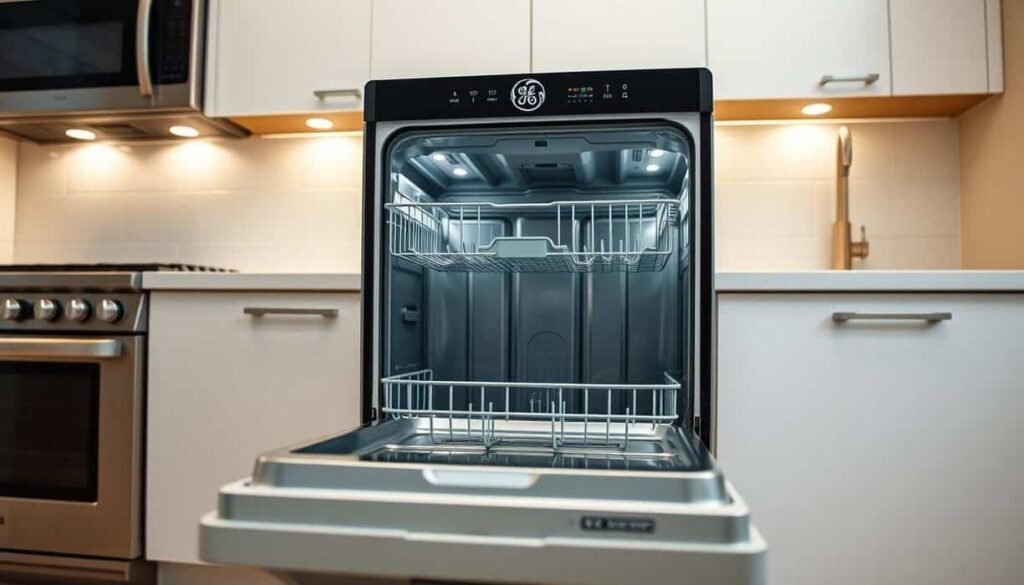
GE Profile PDT145SSLSS
Compact built-in dishwasher · 18-inch width · Stainless-steel interior
Place settings
8
Compact capacity
Noise rating
47 dBA
Quiet operation specification
Annual energy
240 kWh
Manufacturer-listed figure
Width
17.75 in
Approximately 45 cm
Specifications are based on the manufacturer’s product information. Actual energy use, drying results, and operating noise depend on conditions and selected settings.
Main specifications
| Feature | GE Profile PDT145SSLSS |
|---|---|
| Appliance type | Built-in compact dishwasher |
| Nominal width category | 18 inches |
| Exterior finish | Stainless steel |
| Interior tub | Stainless steel |
| Capacity | 8 place settings |
| Noise rating | 47 dBA |
| Wash system | Three-level wash system |
| Main wash cycles | AutoSense, Heavy Wash, Light Wash |
| Sanitizing | NSF-certified Sanitize option |
| Food handling | Piranha hard-food disposer |
| Filtration | Three-stage manual-clean filtration |
| Drying | Calrod heating element |
| Upper rack | Adjustable, with utility shelf and stemware support |
| Controls | Top-mounted electronic controls |
| Display | Three-digit countdown display |
| Energy certification | ENERGY STAR qualified |
| Listed annual electricity use | 240 kWh |
| Electrical specification | 120 V, 60 Hz |
| Wi-Fi | Optional module required |
| Minimum listed height | 32.5 inches |
| Maximum listed height | 34.625 inches |
| Listed depth | 22.5 inches |
| Place of intended use | North American electrical market |
One specification deserves particular attention: this is an 18-inch dishwasher, not a standard 24-inch model. Its compact size can be a significant advantage in a small kitchen, but its eight-place-setting capacity is also a genuine limitation for households that regularly wash large quantities of dishes.
2. Design and exterior quality
The PDT145SSLSS has a clean, contemporary appearance. Its stainless-steel exterior, recessed pocket handle, and top-mounted controls help it blend into modern kitchen cabinetry.
The pocket handle is particularly practical in narrow kitchens. Unlike some prominent projecting handles, a recessed design keeps the front relatively streamlined and can reduce interference with nearby drawers or cabinet doors.
The controls are located along the top edge of the door. This means the main control panel is concealed when the dishwasher is closed, creating a cleaner front appearance than a conventional front-control dishwasher.
A three-digit countdown display provides a useful indication of the remaining cycle time. Indicator lights also help communicate cycle progress and sanitization status.
Is the stainless-steel finish easy to maintain?
Stainless steel can develop fingerprints, water spots, and smudges, especially in kitchens where the appliance is handled frequently. Routine cleaning with a soft cloth and a product approved for the finish can help maintain its appearance.
Avoid abrasive pads and aggressive cleaning products that might scratch or discolor the surface.
The stainless-steel interior is another positive feature. It provides a different interior construction from compact dishwashers that use plastic tubs. However, a stainless-steel tub alone does not guarantee superior cleaning, drying, or reliability. Those outcomes also depend on the wash system, heating components, filtration, loading design, and maintenance.
Does the design suit a small kitchen?
Yes. Its narrow footprint is one of the strongest reasons to consider this model.
An 18-inch dishwasher may fit a kitchen layout where a 24-inch appliance would require extensive cabinet changes. It can be especially useful in small condominiums, apartments, compact homes, and secondary kitchen areas.
However, the available opening must still be measured accurately. An 18-inch product category does not mean the appliance is exactly 18 inches wide; the listed width is 17.75 inches, and the surrounding opening must meet the installation requirements.
Design verdict: The PDT145SSLSS combines a premium-looking stainless-steel exterior with a stainless-steel tub and a compact footprint. Its design is particularly appealing to homeowners who need a narrow dishwasher without choosing an overly basic-looking appliance.
3. Cleaning performance: How well does the PDT145SSLSS wash dishes?
Cleaning performance is the central consideration when buying a dishwasher. A compact appliance needs to remove everyday food residue effectively while distributing water across a smaller loading area.
The PDT145SSLSS uses a three-level wash system, two wash arms plus an upper nozzle, automatic temperature control, an AutoSense cycle, and a Piranha hard-food disposer. These components are designed to deliver cleaning coverage within the machine’s compact interior.
The actual results depend on loading, detergent, incoming water temperature, soil level, and the condition of the spray arms and filtration system.
AutoSense cycle
AutoSense is one of the model’s most useful features because it is designed to adapt the wash process to the load’s cleaning requirements.
Instead of treating every load as equally dirty, an automatic sensing cycle can adjust aspects of the washing process based on detected conditions. This can be convenient for households that alternate between lightly soiled breakfast dishes and more demanding dinner loads.
For everyday use, AutoSense is a sensible starting point when you are unsure which program to select.
However, automatic sensing should not be interpreted as a guarantee that every load will receive the perfect wash. Large food deposits, poorly arranged dishes, blocked spray openings, or unsuitable detergent can still compromise results.
Heavy Wash cycle
Heavy Wash is intended for loads with more substantial food residue, including plates, bowls, and suitable cookware.
It may be useful after preparing meals involving sauces, greasy food, or residue that has dried onto dishes.
For the best results, scrape off large food scraps and arrange items so water can reach their dirty surfaces. Do not position a large pan where it blocks the spray arm or prevents water from reaching nearby plates.
The compact interior means loading strategy is especially important. A large pot may occupy space that could otherwise hold several plates, so households that frequently wash oversized cookware should consider whether the capacity meets their needs.
Light Wash cycle
Light Wash is intended for less heavily soiled loads.
It may be appropriate for cups, glasses, lightly used plates, and dishes that do not have substantial dried food residue. The exact cycle selection should follow the instructions in the owner’s manual.
The advantage of having a light program is that users do not need to run a more intensive cycle for every load. Nevertheless, cycle duration and resource consumption depend on the selected settings and operating conditions.
Three-level washing system
The three-level wash arrangement helps distribute water throughout the interior. The lower and middle wash arms serve different areas, while the upper nozzle provides additional coverage for items placed near the top.
Correct loading remains critical. Deep bowls can trap water, plates placed too close together can shield one another, and large utensils may obstruct the spray pattern.
To improve cleaning:
- Face the dirty surfaces toward the centre of the racks where practical.
- Avoid nesting bowls or cups together.
- Keep the spray arms clear of pans and utensils.
- Do not block the detergent dispenser.
- Use a suitable dishwasher detergent.
- Clean the filter at the intervals recommended in the manual.
Is the cleaning system powerful enough for a family?
For a small household, the wash system should be capable of handling ordinary daily dishes when the appliance is loaded correctly and maintained properly.
However, the eight-place-setting capacity is a more important limitation than the number of wash levels. A family that cooks frequently, uses large plates, or accumulates substantial cookware may need to run multiple loads.
If you regularly wash baking trays, large pots, serving bowls, and a full day’s worth of dishes, compare this model with a standard-width dishwasher before buying.
Cleaning verdict: The PDT145SSLSS offers a useful collection of wash features for a compact appliance. It is best suited to modest daily loads rather than households that need the capacity of a full-size dishwasher.
4. Piranha hard-food disposer and filtration system
The Piranha hard-food disposer is a notable feature in this compact dishwasher.
It is designed to break down suitable food particles so that the wash system can handle them more effectively. This can reduce the need to remove every small piece of residue before loading dishes.
For people who cook at home regularly, the feature can make everyday cleanup more convenient.
However, a food disposer does not make the dishwasher immune to blockages. Large bones, fruit pits, packaging, labels, and other unsuitable objects should not be placed inside the machine.
How does the filtration system work?
The PDT145SSLSS uses a three-stage manual-clean filtration system. Its purpose is to help capture food particles and prevent unwanted debris from repeatedly circulating through the wash water.
The disposer and filter serve complementary functions. The disposer helps break down suitable particles, while filtration captures material that needs to be removed from the system.
Over time, residue can collect in the filter area. If the filter becomes heavily contaminated, the dishwasher may develop unpleasant odours, leave food particles on dishes, or experience reduced cleaning performance.
Does the filter need regular cleaning?
Yes. The exact cleaning frequency depends on usage, the amount of food residue, and the manufacturer’s maintenance instructions.
Households that run frequent loads containing substantial food residue may need to inspect the filter more often than people who wash mostly lightly soiled dishes.
Always follow the manual when removing and reinstalling the filter. Incorrect installation can affect performance, so ensure all components are seated properly before restarting the appliance.
Is a hard-food disposer better than a filter-only system?
Neither arrangement is automatically superior for every household. A disposer can be convenient for handling suitable food particles, while filtration systems require proper maintenance to remain effective.
The important question is how well the overall system performs and how easy it is to maintain.
For the PDT145SSLSS, the combination of a disposer and manual-clean filtration provides useful functionality, but it does mean that owners should not neglect routine maintenance.
5. Drying performance: How effective is the heating element?
The PDT145SSLSS uses a Calrod heating element to support its drying process.
This is a conventional heated-drying approach. After the wash and rinse stages, heat helps moisture evaporate from dishes and the interior of the dishwasher.
The model’s drying performance will depend on the material of the dishes, how items are positioned, the selected program, rinse-aid use, and the conditions inside the appliance at the end of the cycle.
Does it dry plates and glasses well?
Glassware and ceramic plates generally retain heat better than lightweight plastics. This can help moisture evaporate more readily from their surfaces.
For the best results, load glasses securely, avoid overlapping dishes, and position cups so water does not collect around their bases.
The heated drying system is useful for households that prefer dishes to be ready for unloading soon after a cycle finishes.
What about plastic containers?
Plastic is usually more difficult to dry because it does not retain heat as effectively as glass or ceramic.
Water may remain on plastic food containers, lids, lightweight cups, and items with recessed surfaces. This is a common limitation of heated drying rather than proof that the appliance is defective.
To improve results:
- Position plastic containers so water can drain away.
- Avoid nesting lids and bowls.
- Use a compatible rinse aid.
- Allow the full cycle to finish.
- Unload items that collect water before removing dishes underneath them.
Does the stainless-steel tub improve drying?
A stainless-steel tub can influence how moisture behaves inside the dishwasher, but it does not automatically guarantee that every load will emerge completely dry.
Drying performance depends on the overall system, including the heating element, rinse conditions, air circulation, dish materials, and the way items are loaded.
Buyers should not assume that a stainless-steel interior means the appliance has the same drying capabilities as a premium dishwasher with a specialized drying technology.
Is the drying system energy-efficient?
Heating water and air requires energy. The amount consumed depends on the cycle, operating conditions, and whether the appliance needs additional heat to achieve the intended drying result.
If minimizing electricity use is a priority, follow the manufacturer’s recommendations for efficient cycle selection and avoid running unnecessarily intensive programs.
Drying verdict: The Calrod heating element provides a conventional heated-drying system that can work well for everyday plates and glasses. Plastic items may still require a short manual drying step.
6. Sanitizing performance: What does the Sanitize option do?
The GE Profile PDT145SSLSS includes a high-temperature Sanitize option. This is a meaningful addition for buyers who want more than a standard wash cycle.
The sanitizing function uses a high-temperature rinse intended to reduce bacteria on dishes. The model is identified as certified to NSF/ANSI Standard 184, and its manufacturer describes the option as capable of reducing 99.999% of bacteria under the specified test conditions.
This claim should be understood in context. Sanitization is not the same as sterilization, and the performance of a residential dishwasher depends on completing the appropriate cycle under the required conditions.
When is the Sanitize option useful?
It may be useful for:
- Household dishes that need a sanitizing treatment.
- Loads for which a high-temperature rinse is appropriate.
- Users who prefer an additional sanitizing stage for everyday kitchenware.
For routine lightly soiled dishes, the standard wash options may be sufficient. There is generally no need to use the most intensive available setting for every load if a normal program meets the cleaning requirements.
Is it suitable for baby bottles?
The dishwasher may be suitable for dishwasher-safe baby bottles and related items when their manufacturers permit dishwasher cleaning and sanitizing.
However, bottle materials, nipples, valves, and other accessories may have different temperature requirements. Always follow the instructions for the specific items being washed.
For households with particular medical or infection-control requirements, follow relevant professional guidance rather than relying on a dishwasher cycle alone.
Does sanitizing make dishes completely germ-free?
No. The purpose of a sanitizing cycle is to reduce microorganisms to the specified level under the applicable test conditions. It should not be described as sterilization or a guarantee that every item is free from all microorganisms.
Correct loading, suitable detergent, clean filters, and completion of the selected program remain important.
7. Compact capacity: Is eight place settings enough?
The PDT145SSLSS is rated for eight place settings. This is a typical compact-dishwasher capacity and one of the most important differences between this model and a conventional 24-inch dishwasher.
Its narrow interior can be an advantage when kitchen space is limited, but the reduced loading area means that users need to organize dishes carefully.
A place-setting rating is a standardized measurement, not a promise that every household’s daily dishes will fit in one load. Pots, pans, serving bowls, oversized plates, and reusable containers can take up considerable space.
Upper rack
The adjustable upper rack is designed for cups, glasses, bowls, and other suitable items.
Its utility shelf and stem-safe support help organize certain types of glassware and smaller pieces of kitchenware.
Adjustability is useful because it allows users to adapt the available space for different loads. However, the actual adjustment range and the clearance available for taller items should be checked in the manual.
When loading glasses, leave sufficient space between them to reduce the risk of contact during washing. Cups should be positioned so water does not collect in their bases.
Lower rack
The lower rack accommodates plates, bowls, and suitable cookware.
It includes fold-down tines, which can make it easier to accommodate different dish shapes. For example, folding down selected tines may create room for a larger bowl or a pan that would not fit comfortably in the standard arrangement.
The compact width limits how many large items can fit simultaneously. Users who frequently wash large dinner plates should confirm the maximum supported dimensions and available clearance.
Silverware and utensils
A compact dishwasher requires careful organization of cutlery and small utensils. Arrange items so that spoons do not nest together and block water from reaching their surfaces.
Long utensils should not interfere with the spray arms or prevent the detergent dispenser from opening.
Because the available loading space is limited, a household that uses many cooking utensils may find that it needs to wash those separately from plates and glasses.
Is there a third rack?
The PDT145SSLSS does not have a dedicated third rack in the conventional sense. Instead, it uses an upper rack with a utility shelf and a lower rack.
The utility shelf provides some additional organization, but it should not be confused with a full-width third rack designed for flatware and kitchen utensils.
Who will find the capacity sufficient?
The eight-place-setting capacity is most suitable for:
- Singles and couples.
- Small households.
- Apartment residents.
- Secondary kitchens.
- Homes where dishes are washed frequently.
- Households that do not regularly use large cookware.
A family of four may still find it useful, depending on cooking habits and the size of the dishes. However, households that regularly fill a standard-width dishwasher may need multiple loads in this compact model.
Capacity verdict: The PDT145SSLSS is designed to solve a space problem, not to maximize loading capacity. Measure your available space and consider your normal dish load before choosing it.
8. Noise level: Is 47 dBA quiet enough?
One of the strongest features of the PDT145SSLSS is its listed noise level of 47 dBA.
This is a relatively quiet operating specification for a compact dishwasher. It makes the model worth considering for kitchens that are close to living areas, although the actual sound level perceived in a home depends on installation and room acoustics.
What does 47 dBA mean in practical terms?
The dishwasher should produce less noticeable operating noise than a louder model with a rating in the mid-50 dBA range, all else being equal.
You may still hear water circulation, draining, and mechanical activity. A dishwasher does not become completely silent simply because it has a low published noise rating.
Sound can be more noticeable in small kitchens with hard surfaces, limited cabinetry, or a direct connection to a living room.
Is it suitable for apartments?
Yes, its compact size and quiet specification make it a promising option for apartment kitchens.
It can be especially attractive when the dishwasher is installed near a dining area or in a small open-plan space where noise from a louder machine could become distracting.
However, good installation matters. Poor leveling, loose mounting, or contact between the appliance and surrounding cabinetry can create additional vibration or noise.
Is it quieter than a standard GE dishwasher?
That depends on the specific model being compared. The PDT145SSLSS has a listed rating of 47 dBA, but other GE models can have different sound ratings and different sound-insulation packages.
Compare the published noise specifications of the exact models rather than assuming that all dishwashers within a manufacturer’s range sound the same.
Noise verdict: The 47 dBA specification is a genuine advantage for a compact appliance, particularly in small or open-plan homes.
9. Energy efficiency and running costs
The PDT145SSLSS is ENERGY STAR qualified and has a listed annual electricity consumption of 240 kWh.
This figure provides a useful starting point for estimating electricity costs. Actual consumption depends on the selected wash cycle, frequency of use, incoming water temperature, drying conditions, and other factors.
How much does it cost to run?
The following table illustrates estimated annual electricity costs using the listed consumption of 240 kWh.
| Electricity rate | Estimated annual cost |
|---|---|
| $0.10 per kWh | $24 |
| $0.15 per kWh | $36 |
| $0.20 per kWh | $48 |
| $0.30 per kWh | $72 |
| $0.40 per kWh | $96 |
These figures are calculations based on the stated annual consumption, not guaranteed real-world bills. They exclude water, detergent, rinse aid, installation, and repair expenses.
For example, at $0.20 per kWh:
240 kWh × $0.20 = $48 per year.
Your actual electricity costs may differ, particularly if you use heated drying frequently or run more cycles than assumed in the manufacturer’s annual estimate.
Can a compact dishwasher save money?
It can reduce the amount of manual dishwashing required and may use water efficiently when operated with suitable loads.
However, a narrow dishwasher does not automatically have lower total running costs than every standard-width model. If a household needs two compact loads to wash the same dishes that fit into one larger machine, the total resource consumption may be higher.
The right comparison considers the energy and water consumption per cycle, the size of the load, and how often the appliance is used.
What about water consumption?
The exact water consumption should be checked in the model’s official energy documentation for the relevant market. Water usage can vary by cycle and operating conditions, so avoid treating an unsupported single figure as applicable to every load.
For Canadian households, local energy-label information can help compare appliances. In the United States, ENERGY STAR qualification and the manufacturer’s energy documentation are useful starting points.
Is it economical for a two-person household?
It can be, especially when a couple fills the compact dishwasher regularly and avoids unnecessary half-empty cycles.
For a larger household, the calculation is less straightforward. A standard-width dishwasher may be more convenient if it accommodates the same daily load in fewer cycles.
The most economical appliance is not necessarily the one with the smallest physical size. It is the one that matches the household’s normal loading pattern while using resources efficiently.
10. Installation requirements and dimensions
The PDT145SSLSS is designed for a compact built-in installation. Its dimensions are substantially narrower than those of a standard 24-inch dishwasher.
The manufacturer lists the following measurements:
| Dimension | Specification |
|---|---|
| Overall width | 17.75 inches |
| Overall height | 32.5 inches |
| Minimum height with legs retracted | 32.5 inches |
| Maximum adjustable height | 34.625 inches |
| Overall depth | 22.5 inches |
| Cabinet depth reference | 24 inches |
| Cutout width | 18 inches |
| Cutout height | 32.5 inches |
| Cutout depth | 24 inches |
These measurements are essential when planning a replacement installation. Cabinet openings vary, and the available space must meet the model’s actual installation instructions.
What should you measure before buying?
Measure the opening’s width, height, and depth. Check the clearance available for the door, nearby drawers, cabinet frames, plumbing connections, and electrical wiring.
Also confirm that the floor is level enough for correct installation and that the water supply and drain can be connected without kinking hoses or creating leak risks.
Do not rely solely on the nominal 18-inch category. The appliance must fit the opening with the clearances and connections required by the manufacturer.
Electrical requirements
The PDT145SSLSS is specified for 120 V, 60 Hz electrical supply. Its listed electrical requirements are approximately 8.9 amps.
It must be connected in accordance with the installation instructions and applicable electrical codes. A qualified installer should handle any required wiring changes, particularly in kitchens where the existing connection was designed for a different appliance.
Is it suitable for RVs?
The manufacturer identifies the model as RV ready, which may make it relevant to some recreational-vehicle or compact living arrangements.
However, RV readiness does not mean that the dishwasher can be installed in every RV without additional work. Available space, water pressure, drainage, electrical capacity, ventilation, weight, and the particular vehicle’s design must all be checked.
Confirm the complete installation requirements before attempting an RV installation.
Can you install it in the UK?
The model’s electrical specification is designed for the North American market. The United Kingdom generally uses a 230 V, 50 Hz household supply.
Consequently, this is not a straightforward replacement for a UK-market dishwasher. Buyers should normally choose an appliance designed and approved for UK electrical and plumbing requirements.
Using an ordinary voltage converter as a workaround for a permanently installed appliance is not an appropriate default solution.
What about Canada?
Canada generally uses 120 V, 60 Hz household electricity, making the electrical specification more compatible with local supply. Nevertheless, buyers should verify the model’s certification, plumbing requirements, warranty coverage, and access to local service.
An appliance’s electrical compatibility does not by itself establish that it is approved for every installation or that its warranty will apply in every province.
11. Smart features and controls
The PDT145SSLSS has electronic top controls and optional Wi-Fi connectivity.
Its controls are designed to keep the front of the dishwasher uncluttered while providing a countdown display and cycle-status indicators.
Does it have Wi-Fi?
Yes, but Wi-Fi connectivity requires an optional module rather than being included as a fully integrated feature in every configuration.
The connected functionality is designed to provide features such as remote status feedback, alerts, and certain connected services through the manufacturer’s supported ecosystem.
Buyers should confirm that the required module is included or available and that the relevant application and connected services remain supported.
Is the smart functionality essential?
No. The dishwasher can perform its primary washing functions without connected features.
Wi-Fi can be convenient for people who want notifications or remote status information, but it should not be the main reason to purchase a discontinued appliance.
For most buyers, the more important considerations are cleaning performance, capacity, noise, installation fit, parts availability, and warranty support.
Is the countdown display useful?
Yes. A remaining-time display makes it easier to estimate when a load will finish.
This can be particularly useful in small households that plan meal preparation around a dishwasher cycle or want to unload dishes before going to bed.
The display indicates cycle progress, but actual completion time can vary depending on the selected program and operating conditions.
12. Build quality and long-term reliability
The PDT145SSLSS has several features that make it look more premium than a basic compact dishwasher, including a stainless-steel exterior, stainless-steel interior, quiet-operation package, and electronic controls.
However, long-term reliability cannot be determined from its materials or feature list alone.
Dishwashers contain multiple components that can wear or fail over time, including circulation pumps, drain pumps, heating elements, door latches, water valves, sensors, electronic controls, and seals.
Does the stainless-steel interior improve durability?
A stainless-steel tub is a useful construction feature. It differs from plastic interiors and may appeal to buyers who prefer metal construction inside the dishwasher.
However, it does not guarantee that the pump, heating element, electronic controls, or other parts will last longer. Reliability depends on the entire appliance, operating conditions, water quality, and maintenance.
A dishwasher with a stainless-steel tub can still develop leaks, drainage problems, or electrical faults.
Is the model reliable?
It would be misleading to assign a precise reliability rating without sufficiently strong, model-specific long-term failure data.
When assessing this dishwasher, look for repeated reports of the same fault, the age of the appliance when the problem occurred, and whether the repair was covered by warranty.
Individual customer reviews can be useful, but a small number of positive or negative comments should not be treated as conclusive proof of reliability.
Does its compact size affect reliability?
Compact size does not automatically make an appliance more or less reliable. It does, however, affect loading capacity and may influence how the appliance fits into a particular kitchen.
Correct installation remains essential. A poorly secured dishwasher, kinked drain hose, unsuitable electrical connection, or incorrectly installed filter can create problems regardless of the appliance’s dimensions.
How long should it last?
There is no guaranteed service life for an individual PDT145SSLSS. Its lifespan depends on usage, maintenance, water quality, installation, and component condition.
Because this model is no longer being manufactured, replacement-part availability and local repair support deserve particular attention.
Before purchasing clearance or used stock, ask whether common replacement components can still be obtained and whether technicians in your area are familiar with the model.
13. Common problems and troubleshooting
The PDT145SSLSS uses conventional dishwasher components, so many everyday performance problems can be investigated through basic checks.
Always consult the owner’s manual for model-specific instructions. Disconnect power before performing maintenance that requires access to internal components, and leave electrical or major mechanical repairs to a qualified technician.
Problem 1: Dishes are coming out dirty
Possible causes include blocked spray openings, poor loading, a dirty filter, unsuitable detergent, or an inappropriate cycle.
Try the following:
- Check that the spray arms can rotate freely.
- Remove large food scraps before loading.
- Inspect and clean the filter according to the manual.
- Make sure the detergent dispenser is not obstructed.
- Select Heavy Wash for an appropriate heavily soiled load.
- Confirm that the water supply is functioning correctly.
If cleaning remains poor, the circulation system, water-heating system, or another internal component may need professional inspection.
Problem 2: Glasses have spots or a cloudy appearance
Mineral deposits from hard water can leave spots on glasses. Excess detergent, unsuitable detergent, or other water-quality issues can also contribute.
Check that the rinse-aid dispenser is filled and that the detergent is suitable for your water conditions.
If a cloudy film persists, determine whether it is removable mineral residue or permanent glass etching. These are different problems and may require different solutions.
Problem 3: Plastic containers remain wet
Plastic retains less heat than glass and ceramic, which makes water evaporation slower.
Position plastic containers so water drains away, avoid nesting items together, and use the recommended rinse-aid settings.
If the load contains many plastic items, some manual drying may still be necessary.
Problem 4: The dishwasher does not start
Check the household circuit breaker, electrical supply, door latch, and control-lock settings.
Make sure the door closes correctly and that the selected program has been started according to the manual.
If the appliance remains unresponsive, the problem could involve the door switch, control board, wiring, or another electrical component. Do not bypass safety switches or attempt live electrical testing without the required qualifications.
Problem 5: Water remains at the bottom
A small amount of water in the sump area may be normal, but substantial standing water after a completed cycle can indicate a drainage issue.
Check the accessible filter and drain area for obstructions. If the drain hose is safely accessible, inspect it for kinks or improper routing.
Persistent drainage problems may involve the drain pump, plumbing connection, or another component and should be assessed by a technician if basic checks do not resolve them.
Problem 6: The dishwasher is noisier than usual
An unusual increase in noise can be caused by a loose item, an obstructed spray arm, incorrect leveling, or contact between the appliance and surrounding cabinetry.
Check that dishes and utensils are securely positioned and that nothing is interfering with the spray arms.
Grinding, repeated knocking, or other persistent unusual noises may indicate a mechanical issue. Stop using the appliance if the noise is accompanied by a burning smell, leaking, or an electrical problem.
Problem 7: Water is leaking around the door
Possible causes include an obstructed door seal, incorrect loading, excessive detergent foam, poor leveling, or a component fault.
Stop the cycle if the leak is substantial. If safe, isolate the water and electrical supplies before investigating.
Do not assume that a compact dishwasher’s flood-protection features make leaks harmless. Persistent leakage should be repaired rather than managed by repeatedly restarting the machine.
14. Maintenance tips for better performance
Regular maintenance is important for any dishwasher, particularly a model with a manual-clean filtration system.
Clean the filter
Remove accumulated residue according to the owner’s manual. Make sure the filter is correctly reinstalled before operating the dishwasher.
Inspect the spray arms
Check for blocked openings and ensure the arms rotate freely. Remove suitable debris following the manufacturer’s instructions.
Use appropriate detergent and rinse aid
Follow the detergent instructions and maintain the rinse-aid dispenser. Hard-water households may need products suited to their local water conditions.
Inspect the door seal
Wipe away food residue and check for visible damage. Use cleaning products compatible with the seal and surrounding surfaces.
Also inspect the area around the appliance periodically for signs of moisture, unusual odours, loose connections, or changes in operating noise.
Avoid using excessive detergent, which can contribute to foam and rinsing problems. Follow the manufacturer’s cleaning and maintenance schedule rather than relying on harsh chemicals or improvised treatments.
15. Warranty, spare parts, and ownership costs
The US product specifications list a limited one-year warranty covering the appliance’s parts and labor. The written warranty supplied with the particular unit should always be checked for its exact conditions and exclusions.
Because the PDT145SSLSS is listed as no longer being manufactured, warranty and repair considerations are especially important.
What should you check before buying?
Ask the seller to confirm:
- Whether the unit is new, clearance stock, refurbished, open-box, or used.
- Whether the original warranty applies.
- Whether installation and delivery are included.
- Whether replacement parts are available.
- Whether local technicians service the model.
- Whether the seller offers additional warranty coverage.
A product may remain supported after production ends, but the availability of manuals and a support page does not guarantee that every replacement part is in stock.
Is it worth buying as clearance stock?
It may be worthwhile if the discount is substantial, the unit is complete, and the warranty and installation arrangements are satisfactory.
However, the purchase price should not be the only consideration. A low-priced appliance can become expensive if a major component fails and parts are difficult to obtain.
Compare the total installed cost against currently manufactured compact dishwashers with similar capacity and features.
What about buying used?
If buying a used PDT145SSLSS, ask to see it complete a wash and drain cycle. Check the door seal, racks, controls, heating function, and signs of leakage or corrosion.
A used appliance without a meaningful warranty should be priced accordingly. If repair support is limited in your area, a newer model may be a safer long-term purchase.
16. GE Profile PDT145SSLSS pros and cons
Pros
Compact 18-inch footprint
Stainless-steel exterior and tub
Quiet 47 dBA specification
AutoSense wash cycle
High-temperature Sanitize option
Piranha hard-food disposer
Adjustable upper rack
ENERGY STAR qualified
Optional connected features
Cons
Limited eight-place-setting capacity
No dedicated third rack
Only three main wash cycles listed
Plastic items may remain wet
Wi-Fi requires an optional module
Manual-clean filtration requires maintenance
No longer being manufactured
North American electrical specification
17. GE Profile PDT145SSLSS vs. a standard 24-inch dishwasher
The most important buying decision is whether you actually need an 18-inch dishwasher.
The PDT145SSLSS is designed to fit a smaller opening. A standard 24-inch dishwasher generally provides more room for dishes, cookware, and larger loads.
| Feature | GE Profile PDT145SSLSS | Typical 24-inch dishwasher |
|---|---|---|
| Width category | 18 inches | 24 inches |
| Listed capacity | 8 place settings | Often around 12–16 place settings, depending on model |
| Best fit | Small kitchens and compact households | Most standard family kitchens |
| Interior | Stainless steel | Varies by model |
| Noise | 47 dBA | Varies widely |
| Loading flexibility | Compact racks and utility shelf | Often more room for larger items |
| Daily capacity | Modest | Usually greater |
| Installation | Requires an 18-inch opening | Requires a standard-width opening |
| Best reason to choose | Space savings | Larger loads and fewer wash cycles |
These are category-level comparisons; the exact performance and capacity of a 24-inch dishwasher depend on the model.
If your kitchen has an existing 18-inch opening, the PDT145SSLSS may be a practical option. If you have room for a standard-width appliance, compare the additional loading capacity before deciding that a compact dishwasher is the better value.
18. Who should buy the GE Profile PDT145SSLSS?
Apartment residents and small households
The narrow footprint and eight-place-setting capacity can work well for people who do not need to wash large family-sized loads.
Homeowners with limited cabinet space
The 18-inch width is the main reason to choose this model over a standard dishwasher. Measure the available opening before buying.
Certain compact or recreational-vehicle installations
The manufacturer identifies the model as RV ready, but the installation must still meet the electrical, plumbing, space, and structural requirements of the particular vehicle.
Who should avoid it?
You may be better served by another dishwasher if you regularly wash large quantities of dishes, use oversized cookware, or want the convenience of a full-width third rack.
Buyers who prefer the newest connected features, a long remaining production life, or easy access to current-generation parts should also compare newer alternatives.
For UK households, the North American electrical specification is a significant limitation. For US and Canadian buyers, local stock, service availability, and warranty conditions should be checked before purchase.
19. Frequently asked questions
1. Is the GE Profile PDT145SSLSS a good dishwasher?
It is a capable compact dishwasher with a stainless-steel tub, a 47 dBA noise rating, AutoSense washing, a sanitizing option, and a hard-food disposer. It is most attractive for households that need an 18-inch appliance. Its limited capacity and discontinued status are important considerations.
2. How many place settings does the PDT145SSLSS hold?
The model is rated for eight place settings. The practical number of dishes that fit depends on their size and shape, particularly when you include pots, pans, and serving dishes.
3. Is the GE Profile PDT145SSLSS quiet?
Yes, it has a listed noise rating of 47 dBA. This is relatively quiet for a dishwasher, although actual perceived noise depends on the installation and kitchen layout.
4. Does the PDT145SSLSS have a stainless-steel interior?
Yes. Both its exterior and interior tub are stainless steel. This is a useful feature for buyers who prefer a metal washing chamber rather than a plastic interior.
5. Does the GE Profile PDT145SSLSS have a sanitize cycle?
Yes. It includes an NSF-certified Sanitize option that uses a high-temperature rinse to reduce bacteria under the specified operating conditions.
6. Does this dishwasher have a third rack?
No. It has an adjustable upper rack, a utility shelf, and a lower rack. The utility shelf provides additional organization but is not a dedicated full-width third rack.
7. Does the PDT145SSLSS have a hard-food disposer?
Yes. Its Piranha hard-food disposer is designed to break down suitable food particles. The dishwasher also uses a three-stage manual-clean filtration system that needs regular maintenance.
8. Does it have Wi-Fi?
Wi-Fi connectivity is optional and requires the appropriate module. Confirm that the module is included or available before paying extra for connected functionality.
9. How much electricity does it use?
The manufacturer lists annual electricity consumption of 240 kWh. Actual consumption varies with cycle selection, frequency of use, incoming water temperature, and drying requirements.
10. Is the GE Profile PDT145SSLSS ENERGY STAR qualified?
Yes. The model is listed as ENERGY STAR qualified. Compare its documented energy consumption with competing appliances when estimating running costs.
11. Can I install this dishwasher in the UK?
It is not a straightforward choice for a UK home because it is specified for 120 V, 60 Hz electrical supply, while UK domestic electricity is approximately 230 V, 50 Hz. A dishwasher designed and approved for the UK market is generally the better option.
12. Can I use it in Canada?
Its 120 V, 60 Hz electrical specification is compatible with the nominal household supply commonly used in Canada. Buyers should still verify local certification, installation requirements, warranty coverage, and service availability.
13. Is the GE Profile PDT145SSLSS still being manufactured?
The manufacturer lists the model as no longer being manufactured. Clearance inventory may remain available, but availability depends on the retailer and location.
14. What warranty does the PDT145SSLSS have?
The US specifications list a limited one-year parts and labor warranty. Check the written warranty for the exact appliance, particularly if purchasing clearance, refurbished, or used stock.
15. Is the PDT145SSLSS suitable for a family of four?
It may be suitable for a family of four with modest dishwashing needs, but its eight-place-setting capacity can be restrictive. Families that cook frequently or use large cookware may need multiple loads each day.
16. Does the stainless-steel interior guarantee better drying?
No. The stainless-steel tub is a useful construction feature, but drying performance also depends on the heating system, rinse aid, dish materials, loading, and cycle selection. Plastic items may still retain water.
17. Is the PDT145SSLSS good for an RV?
The manufacturer identifies it as RV ready. However, installation depends on available space, electrical capacity, water supply, drainage, and the vehicle’s design. Verify all requirements before installing it in an RV.
18. Is it worth buying used?
It may be worth considering if the appliance has been tested, is in good condition, and can be serviced locally. Since the model is discontinued, confirm parts availability and repair costs before buying.
19. How does it compare with a Bosch compact dishwasher?
The answer depends on the exact Bosch model. Compare capacity, noise ratings, drying technology, rack layout, energy use, price, and local service support. Neither brand should be considered the automatic winner across every compact-dishwasher category.
20. What is the biggest disadvantage of the GE Profile PDT145SSLSS?
Its biggest limitation is its compact capacity. Eight place settings are adequate for many small households, but people who regularly wash large loads may find a standard-width dishwasher more practical. Its discontinued status is the other major consideration.
Final verdict: Should you buy the GE Profile PDT145SSLSS?
The GE Profile PDT145SSLSS is a well-equipped compact dishwasher that offers several useful features in a narrow 18-inch design. Its stainless-steel tub, 47 dBA noise specification, AutoSense wash cycle, Piranha hard-food disposer, and NSF-certified sanitizing option make it an appealing choice for a small kitchen.
Its strengths are practical rather than purely cosmetic. The compact dimensions help it fit into limited spaces, while the quiet-operation specification makes it suitable for many apartments and open-plan kitchens.
Nevertheless, the eight-place-setting capacity limits its usefulness for larger households. Its heated drying system may leave moisture on plastic items, its filtration system needs regular cleaning, and optional Wi-Fi adds complexity without being essential to the appliance’s primary function.
The model is also no longer being manufactured, so buyers should pay particular attention to the price, warranty, replacement-part availability, and local repair support.
My recommendation: The GE Profile PDT145SSLSS is worth considering if you specifically need an 18-inch built-in dishwasher and find a well-priced unit with suitable warranty coverage. It is less compelling if you have room for a standard 24-inch dishwasher or want the reassurance of buying a current-generation model.
For buyers in the United States and Canada, verify local availability and service arrangements. For buyers in the United Kingdom, choose a dishwasher designed for the local electrical supply rather than treating this North American model as a direct replacement.
The bottom line is simple: the PDT145SSLSS is a strong compact-format option on paper, but its value depends on whether its limited capacity and discontinued status are acceptable for your household.