
The Bosch 300 Series is one of the most established premium-midrange dishwasher families in the North American market. It sits above Bosch’s entry-level 100 Series and below the 500 Series, 800 Series and Benchmark ranges. The 300 Series is designed for buyers who want strong cleaning performance, quiet operation, stainless-steel construction, flexible loading and useful modern features without necessarily paying for Bosch’s most advanced drying and premium technologies. Current models include front-control, top-control, recessed-handle, bar-handle, panel-ready and third-rack configurations, depending on the market and exact model.
The current 300 Series is not one single dishwasher. Bosch sells multiple configurations under the 300 Series name, and the differences can be important. Some models have a standard third rack, some have front controls, others use hidden top controls, and selected models offer Home Connect Wi-Fi. Drying systems, rack arrangements, energy certification and handle designs can also vary. As a result, a proper Bosch 300 Series review needs to examine the platform as a family while making clear where individual models differ.
For U.S. and Canadian shoppers, current examples include models such as the SHE43DM5N, SHS43CF5N, SHP53EM5N, SHX53DM5N, SHS53CD5N and other configurations. Many current 300 Series models operate at approximately 48 dBA, use PrecisionWash, have PureDry, include a stainless-steel tub and provide a third rack. Some configurations add Home Connect and additional convenience features.
UK buyers should be aware that Bosch uses a different naming system. There is not a direct North American “300 Series” equivalent sold under that name across the UK market. Bosch’s current UK lineup uses Series 2, Series 4, Series 6 and higher designations. Series 4 is generally the closest broad market-position comparison to the North American 300 Series, although individual features and technologies must be compared model by model.
The most important question is therefore not simply whether the Bosch 300 Series is good. The more useful question is what it does well, where it compromises, which features vary by model, and whether its particular combination of cleaning, noise, drying, capacity and convenience matches the way you use a dishwasher.
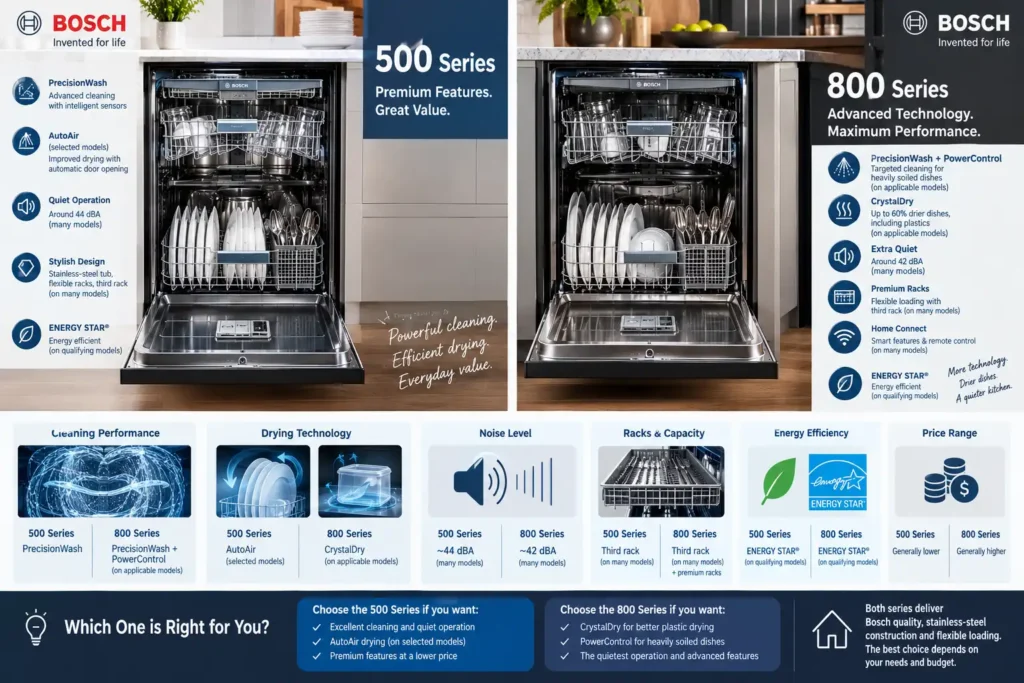
Bosch 300 Series Dishwasher Review at a Glance
The Bosch 300 Series is fundamentally a cleaning-focused dishwasher. Its PrecisionWash system uses sensors to monitor conditions during the wash cycle and adjust the cleaning process, while multiple spray arms direct water throughout the interior. Current independent testing of representative 300 Series models has found very good washing performance on heavily soiled dishes.
Noise is another major strength. Current North American 300 Series models commonly carry a 48 dBA rating. Bosch’s Canadian comparison information places the 300 Series at 44 dBA for certain current top-control configurations, demonstrating that the exact model number matters when comparing noise levels across the range.
Drying is handled primarily through PureDry on current North American 300 Series models. PureDry is a closed-door condensation-based drying system rather than the mineral-based CrystalDry technology used in selected higher-end models. Some models also provide an ExtraDry option for additional drying.
Rack flexibility is another important part of the 300 Series package. Current models commonly provide a standard third rack, adjustable upper rack components and FlexSpace-style adjustable tines. The third rack creates additional space for cutlery and smaller utensils, although its design is not as flexible as the Flexible Third Rack found higher in the Bosch lineup.
Independent testing provides a useful reality check. A current representative Bosch 300 Series model, the SHX53CM5N, received very-good results for washing, energy use and noise in laboratory testing, while its cycle-time performance was rated fair.
That combination gives the 300 Series a fairly clear identity: strong everyday cleaning, relatively quiet operation, useful loading flexibility and efficient operation, with cycle speed and the sophistication of drying being areas where buyers may want to compare higher Bosch series.
What Is the Bosch 300 Series?
The Bosch 300 Series is a family of built-in residential dishwashers positioned in the middle of Bosch’s North American product hierarchy.
The range has historically been designed to deliver several of Bosch’s signature dishwasher technologies without including every feature available in the 800 Series or Benchmark models.
Current Bosch product information identifies PrecisionWash, PureDry, stainless-steel interiors, third racks and AquaStop among the features associated with the 300 Series. Depending on the model, Home Connect connectivity and other convenience features can also be included.
One of the important characteristics of the current range is its variety.
For example, the SHS43CF5N is a 24-inch top-control model with a 48 dBA silence rating, Home Connect, EasyGlide rack technology, PrecisionWash, PureDry and a third rack.
The SHE43DM5N, meanwhile, is a front-control 24-inch model with PrecisionWash, PureDry, AquaStop and an ExtraDry option.
The result is a lineup that can serve different kitchen designs and budgets while retaining the underlying Bosch cleaning platform.
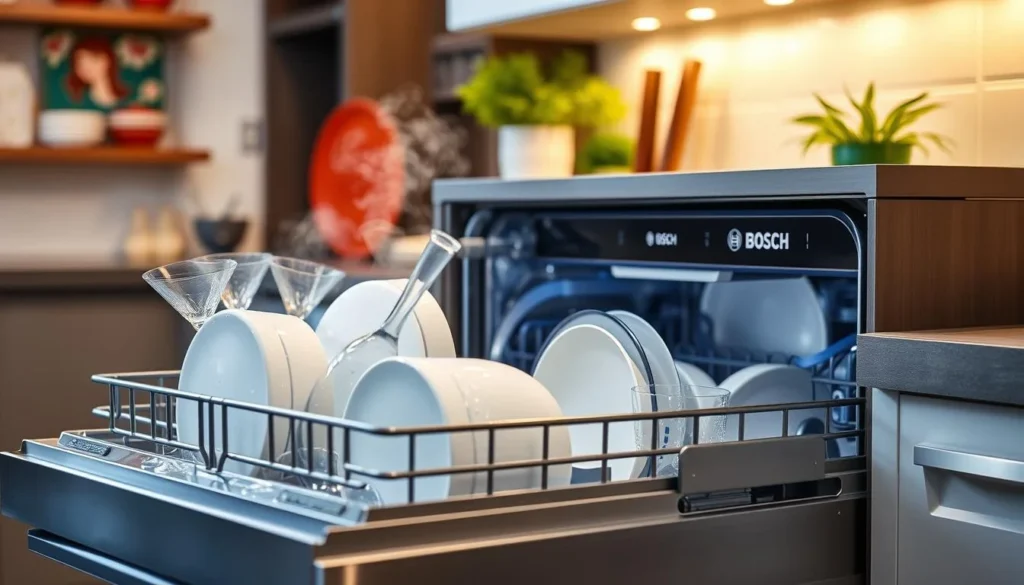
Bosch 300 Series Cleaning Performance
Cleaning is arguably the most important reason to consider the Bosch 300 Series.
The current range uses PrecisionWash technology, which combines sensors and targeted spray action to monitor and clean the load. Bosch describes the system as continually scanning and checking conditions during the cycle so the spray arms can target the dishes being washed.
This is useful because household dishwasher loads are rarely uniform.
One load might contain lightly used glasses, bowls with dried cereal, dinner plates with sauce residue and a casserole dish with baked-on food. A sensor-based system is intended to respond to the load rather than treating every cycle as exactly the same.
Independent testing provides support for the cleaning capability.
Testing of the current SHX53CM5N found very-good washing performance on heavily soiled dishes. Another representative current 300 Series model, the SHS53CD5N, also received a very-good washing result.
This is important because heavily soiled dishes are a demanding test. A dishwasher that performs well with baked-on food has a substantially different practical profile from a machine tested only on lightly soiled plates and glasses.
However, even a strong dishwasher cannot overcome poor loading.
Spray arms need room to rotate, dishes should not block one another, and large cookware should be positioned so water can reach the dirty surfaces. Detergent quality, water temperature and water hardness can also affect the final result.
Bosch PrecisionWash Technology
PrecisionWash is one of the central technologies behind Bosch dishwasher cleaning.
The system uses sensors to monitor the washing conditions and help optimize the cycle. Bosch describes its five-point PrecisionWash system as using intelligent sensors to continually monitor the load while precision spray arms target the dishes.
The benefit is that the dishwasher can respond to changing conditions during a wash rather than simply following a completely fixed pattern.
For everyday household use, that can make the Bosch 300 Series particularly convenient because users do not need to manually determine exactly how aggressively every load should be washed.
The system does not mean that every cycle will be short. In fact, modern sensor-controlled dishwashers can use extended cycle times to achieve cleaning while managing water and energy consumption.
This is one reason why cycle duration should be considered separately from cleaning quality.
Does Bosch 300 Series Clean Baked-On Food?
Yes, the 300 Series is capable of cleaning heavily soiled dishes, although results depend on the cycle, detergent, loading and severity of the residue.
Independent laboratory testing of current representative 300 Series models has found very-good washing performance on heavily soiled dishes.
Older 300 Series models have also demonstrated strong cleaning performance in independent testing, including models that received excellent washing results.
However, baked-on food should not automatically be treated as something that requires no preparation.
Very thick or dried residue can sometimes benefit from scraping off large food particles before loading. The goal is not necessarily to hand-wash every plate but to avoid placing large quantities of food debris into the dishwasher.
Proper rack placement is equally important. A plate covered by another dish cannot receive the same spray coverage as an unobstructed plate.
Bosch 300 Series Drying Performance
Drying is one of the areas where the 300 Series differs from higher Bosch ranges.
Current North American 300 Series models commonly use PureDry. PureDry is a closed-door drying system designed to remove moisture as the dishes cool. Bosch describes the technology as gently whisking moisture away from dishes as they cool.
This approach has several advantages.
It does not require the dishwasher door to automatically open at the end of the cycle, which can make it easier to install in certain kitchens.
It also avoids the need for a more complicated premium drying system.
However, PureDry should not be confused with Bosch’s CrystalDry system.
CrystalDry is available on selected 800 Series and Benchmark models and uses a different mineral-based drying approach. Therefore, shoppers who place an unusually high priority on completely dry plastics should compare the 300 Series with higher Bosch ranges rather than assuming that all Bosch dishwashers dry in the same way.
Does Bosch 300 Series Dry Plastic?
Plastic is difficult for most conventional dishwasher drying systems.
Plastic containers tend to retain water because they do not store heat in the same way that glass, ceramic and metal do.
The Bosch 300 Series uses PureDry, and some models provide an ExtraDry option.
ExtraDry can increase drying performance by using additional heat or extending the drying process, depending on the model and program.
Nevertheless, users should have realistic expectations.
A plastic food-storage container may still have droplets on it after a complete cycle. This is not necessarily a sign that the dishwasher has malfunctioned.
If plastic drying is one of your most important requirements, the 800 Series and its selected CrystalDry models deserve comparison.
Bosch 300 Series ExtraDry
ExtraDry is an important feature on selected current 300 Series models.
The purpose is straightforward: provide additional drying for loads where normal drying does not produce the desired result.
This can be particularly useful when washing plastic containers, reusable food-storage items and other objects that tend to retain water.
The exact implementation varies by model, so shoppers should verify whether their chosen 300 Series dishwasher includes ExtraDry and which cycles support it.
This is another reason why model numbers matter more than the general “300 Series” label.
Bosch 300 Series Noise Level
Noise is one of the strongest characteristics associated with Bosch dishwashers, although the exact rating varies by model and generation.
Current 300 Series examples such as the SHE43DM5N and SHS43CF5N are rated at 48 dBA.
Independent testing of the SHX53CM5N and SHS53CD5N found very-good noise performance.
A dishwasher operating around 48 dBA is generally much quieter than many older machines.
This can be especially useful in homes where the kitchen is close to a living room or dining area.
However, the numerical rating should not be interpreted as absolute silence.
A dishwasher makes different sounds during filling, washing, draining and pumping. Some noises can also be transmitted through cabinets, flooring or plumbing.
Installation quality therefore has an important effect on perceived noise.
Is Bosch 300 Series Quiet Enough for an Open Kitchen?
For many homes, yes.
A 48 dBA Bosch dishwasher can be a practical choice for an open-plan kitchen, particularly compared with older dishwashers that operate at substantially higher sound levels.
However, buyers who are extremely sensitive to dishwasher noise may want to compare the exact model with the quieter 500 and 800 Series configurations.
Bosch’s Canadian comparison information places its current series at different noise levels, with the 300 Series positioned above the 500 and 800 Series in noise output on the models represented in the comparison.
Therefore, the 300 Series is quiet, but it is not necessarily Bosch’s quietest choice.
Bosch 300 Series Third Rack
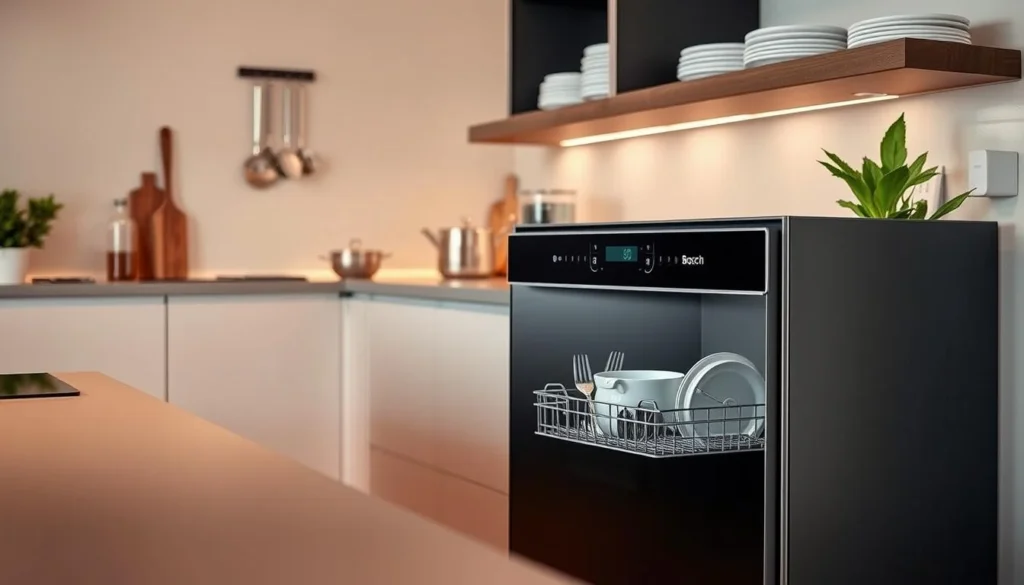
A third rack is one of the most useful features available on many current 300 Series dishwashers.
The third rack provides an additional loading level for cutlery, cooking utensils and small kitchen items.
This can free the lower racks from objects that would otherwise occupy valuable space.
Bosch’s Canadian comparison identifies a standard third rack for the 300 Series, while the 500 Series moves to a Flexible Third Rack and higher models provide still more advanced configurations.
The distinction is important.
The 300 Series third rack is useful, but it is not necessarily as adjustable or versatile as the third rack on higher-end Bosch models.
For a household that uses a lot of cooking utensils, however, even a standard third rack can make a meaningful difference.
Bosch 300 Series Rack Flexibility
The rack system is designed to accommodate different sizes of dishes.
Current 300 Series models provide rack adjustability, adjustable upper racks and adjustable tines.
Adjustable tines are particularly useful because plates, bowls and cookware are not identical.
A household that frequently washes large pots may want to fold down selected tines.
A household that washes many plates can configure the rack differently to maximize capacity.
The flexibility is therefore more important than simply counting the number of place settings.
Bosch EasyGlide Rack System
Selected 300 Series models feature Bosch’s EasyGlide rack system.
The system is designed to make the racks move smoothly, including when loaded with dishes.
Bosch’s product literature identifies redesigned EasyGlide functionality on selected 300 Series models and describes smoother rack movement when the racks are loaded.
This may seem like a small convenience, but rack movement is something users experience every time they load and unload the dishwasher.
A heavily loaded rack that rolls smoothly is easier to manage than one that catches or requires excessive force.
Exact EasyGlide availability varies by model.
Bosch 300 Series Capacity
The North American 300 Series is primarily a 24-inch full-size dishwasher family.
For example, current 24-inch models measure approximately 33 7/8 inches high, 23 9/16 inches wide and 23 3/4 inches deep.
The standard full-size format makes the dishwasher appropriate for most family kitchens.
The actual usable capacity depends heavily on rack configuration.
A dishwasher can have a large theoretical place-setting capacity but feel smaller if its rack design does not accommodate the cookware a household actually uses.
The 300 Series benefits from adjustable tines and a third rack, which can help maximize usable space.
Bosch 300 Series Stainless-Steel Interior
Many current 300 Series models have a stainless-steel interior.
For example, the SHX53CM5N, SHS53CD5N and SHE43DM5N are identified with stainless-steel interiors.
Stainless steel is well suited to the hot and wet environment inside a dishwasher.
It also contributes to the premium appearance of the appliance.
A stainless-steel tub should not, however, be treated as proof of superior cleaning.
Cleaning depends on the complete system: spray arms, water pressure, temperature, sensors, detergent and cycle design.
Bosch 300 Series Energy Efficiency
Energy efficiency is another important strength of the 300 Series.
Independent testing of the SHX53CM5N found very-good energy performance when water and electricity use were combined for a heavily soiled load.
The exact ENERGY STAR status and energy consumption can vary by model, so consumers should check the certification and energy label for the specific dishwasher they intend to purchase.
One current 300 Series model, the SHP53EM5N, is identified as ENERGY STAR certified in independent product information.
This variation is important because Bosch’s current lineup includes several different 300 Series generations and configurations.
Do not assume that one model’s energy specification applies to every 300 Series dishwasher.
Bosch 300 Series Water Consumption
Modern Bosch dishwashers are designed to clean full loads with relatively controlled water use.
The PrecisionWash system and sensor-based operation are intended to optimize the washing process rather than simply running continuous water through the machine.
The exact water consumption depends on the model and selected cycle.
For buyers who want to compare operating costs, the most reliable approach is to examine the official energy label for the exact model rather than estimating water consumption from the Series name.
Water consumption can also change when intensive options or additional functions are selected.
Bosch 300 Series Home Connect
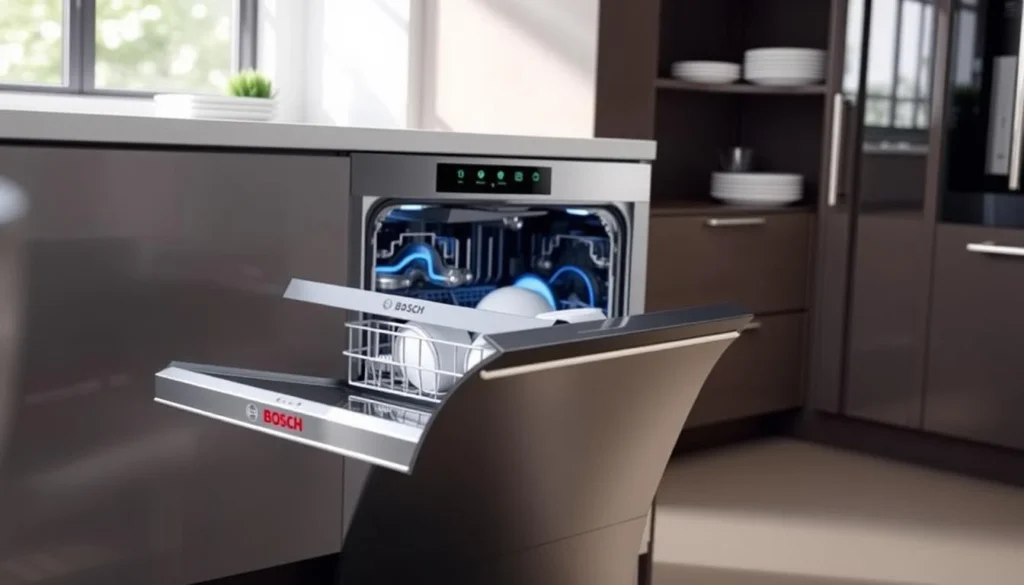
Home Connect is available on selected 300 Series models.
The SHS43CF5N, for example, is identified as Wi-Fi enabled and includes Home Connect functionality.
The newer 2-rack 300 Series introduced in 2024 also includes Home Connect features, including Smart Cycle functionality and hands-free voice-control compatibility.
Smart connectivity can be useful for people who want to monitor cycles, receive notifications or access additional dishwasher functions through a mobile device.
However, Wi-Fi is not essential to the dishwasher’s basic cleaning operation.
A household that starts the dishwasher at night and never needs remote control may get little practical benefit from the smart features.
Bosch 300 Series Smart Features
Home Connect can extend the dishwasher beyond its physical control panel.
Depending on the model and connected-service availability, users can access functions through the app and receive information about the appliance.
Smart Cycle functionality can help recommend or configure a suitable cycle based on load information and desired cleaning conditions.
Voice-control support is also available on selected configurations.
These features are useful conveniences, but they should not be confused with the dishwasher’s core performance.
A dishwasher with excellent spray coverage and good drying remains more important than one with an advanced app if the primary goal is consistently clean dishes.
Bosch 300 Series Controls
Bosch sells both front-control and top-control 300 Series models.
Front-control models place the buttons on the outside of the door, making them easy to see and access.
Top-control models hide the controls along the upper edge of the door when the dishwasher is closed, creating a cleaner appearance.
Current models such as the SHS43CF5N use top controls, while the SHE43DM5N uses front controls.
Neither design is universally better.
Front controls are convenient for people who want to see the controls without opening the door.
Top controls are attractive for modern kitchens where a clean appliance front is preferred.
Bosch InfoLight
InfoLight is another Bosch convenience feature available on applicable models.
Because a quiet dishwasher may not make enough sound to obviously indicate that it is operating, a small projected light can provide a visual indication.
Bosch’s Canadian comparison identifies InfoLight across the relevant dishwasher series.
This can be especially useful with hidden-control models.
Bosch 300 Series AquaStop Leak Protection
Leak protection is important for any dishwasher because the appliance is permanently connected to a water supply.
Current 300 Series models include AquaStop on applicable configurations.
Bosch describes its AquaStop system as using a solid molded base and sensors designed to detect leaks in the base and automatically shut off the water inlet.
This is an important safety feature, but it does not remove the need for correct installation.
Water connections, drainage, electrical supply and dishwasher leveling still need to be handled correctly.
A leak-protection system should be viewed as an additional layer of protection rather than a substitute for proper installation.
Bosch 300 Series Filter
The filter is an important maintenance component.
Independent testing of current 300 Series models identifies a manually cleaned filter rather than a self-cleaning filter.
That means owners need to periodically inspect and clean the filtration system.
A dirty filter can contribute to poor drainage, odors and reduced cleaning performance.
How frequently it needs cleaning depends on the amount of food residue entering the dishwasher and how frequently the machine is used.
Households that scrape plates thoroughly may need less frequent cleaning than households that place substantial food residue into the dishwasher.
Bosch 300 Series Hard Water Performance
Hard water can influence dishwasher performance in the United States, Canada and the UK.
Hard water contains minerals such as calcium and magnesium that can contribute to spotting and mineral deposits.
The North American 300 Series does not universally include an integrated water softener. Bosch’s current Canadian comparison identifies a built-in water softener at the Benchmark level rather than as a standard 300 Series feature.
This matters for households in areas with very hard water.
Appropriate detergent and rinse aid can help manage spotting and mineral residue.
In severe hard-water areas, household water treatment may also be worth considering.
Owners should follow the instructions for the exact dishwasher and local water conditions rather than assuming that every Bosch model handles hard water identically.
Bosch 300 Series Rinse Aid
Rinse aid can improve drying and help reduce water spotting.
This can be particularly useful in hard-water regions where evaporating water leaves mineral residue on glassware.
It can also improve the appearance of dishes after the drying stage.
The correct dosage depends on the dishwasher and water conditions, so users should follow the model-specific instructions.
Rinse aid is not a substitute for cleaning the filter or maintaining the dishwasher.
Bosch 300 Series Cycle Time
Cycle duration is one of the compromises buyers should understand.
Independent testing of the current SHX53CM5N and SHS53CD5N rated cycle-time performance as fair when using a full heavily soiled load and the applicable options.
Other current 300 Series models are listed with cycle times around 150 to 160 minutes in independent product databases, depending on model and test configuration.
This is not necessarily a sign of poor performance.
Modern dishwashers often use longer cycles to achieve effective cleaning while controlling water and energy use.
For households that run the dishwasher overnight, a two-and-a-half-hour cycle may be almost irrelevant.
For households that need to complete several loads in one day, cycle duration becomes much more important.
Does a Long Bosch 300 Series Cycle Mean It Is Inefficient?
No.
Cycle length and energy efficiency are not the same measurement.
A dishwasher can operate for a long time while using relatively little water and energy during portions of the cycle.
Independent testing of current 300 Series models demonstrates this distinction: the SHX53CM5N received a very-good energy result while its cycle-time result was only fair.
Therefore, buyers should evaluate energy consumption separately from cycle duration.
Bosch 300 Series Reliability
Reliability is one of the most difficult dishwasher characteristics to judge from specifications alone.
A dishwasher contains pumps, valves, heating components, sensors, electronics, seals and moving mechanical parts. Any of these components can eventually require service.
Independent testing incorporates owner-survey information and laboratory testing into its broader product evaluation. Current 300 Series listings also provide predicted-reliability information, although detailed scores may require access to the full report.
The most defensible conclusion is that the Bosch 300 Series has demonstrated strong performance in independent laboratory testing, but no individual dishwasher can be guaranteed to remain trouble-free for a specific number of years.
Installation, water conditions, maintenance and usage all influence long-term ownership.
Common Bosch 300 Series Problems
Potential dishwasher problems can involve drainage, water supply, spray performance, door seals, heating, electronics or drying.
However, some things users interpret as problems can be normal dishwasher behavior.
A long cycle, for example, can be expected.
Some plastic containers remaining damp can also be normal with condensation-based drying.
A small amount of water around the filter area can be part of normal operation depending on the design, although unusual standing water elsewhere should be investigated.
If a dishwasher develops persistent drainage problems, unusual leaks, repeated fault codes or major cleaning deterioration, the model-specific troubleshooting instructions should be consulted and professional service considered where appropriate.
Bosch 300 Series Maintenance
Regular maintenance can help preserve dishwasher performance.
The filter should be inspected and cleaned periodically.
Spray arms should also be checked for blocked holes.
The door seal should be kept free of food debris.
The interior should be cleaned when mineral deposits or residue begin to accumulate.
Hard-water households may need more frequent attention to mineral buildup.
The dishwasher should also be operated according to the manufacturer’s recommendations regarding detergent and rinse aid.
Maintenance is particularly important with sensor-controlled dishwashers because accumulated residue can affect the overall washing environment.
Bosch 300 Series Installation
A standard 24-inch Bosch 300 Series dishwasher is designed to fit a conventional full-size dishwasher opening, but measurements should always be verified before purchase.
Current 24-inch models are approximately 33 7/8 inches high, 23 9/16 inches wide and 23 3/4 inches deep.
The installation also requires appropriate water, drainage and electrical connections.
Cabinet clearance is particularly important with top-control models.
The door must open correctly without striking surrounding cabinets.
The dishwasher also needs to be properly leveled to ensure correct door operation and drainage.
If the existing kitchen opening is unusual, installation instructions for the exact model should be reviewed before ordering.
Bosch 300 Series for Families
The 300 Series is well suited to many family kitchens.
A third rack provides additional space for utensils and cutlery.
Adjustable tines make it easier to accommodate a mixture of plates, bowls and cookware.
The 24-inch full-size format provides substantially more capacity than compact dishwashers.
The cleaning system is also designed to handle mixed loads and heavily soiled dishes. Independent testing supports strong cleaning performance on difficult loads.
For families, the main consideration may be drying.
If the household regularly washes large quantities of plastic containers, the limitations of PureDry should be considered.
Bosch 300 Series for Apartments
The Bosch 300 Series can be suitable for apartments where a full-size built-in dishwasher is available.
Its relatively quiet operation is particularly useful when the kitchen is adjacent to a living or sleeping area.
The 24-inch format does require a full-size installation opening, however.
For smaller kitchens, Bosch also sells compact 18-inch models, including 300 Series configurations.
Apartment buyers should therefore check both available width and the dishwasher’s sound rating.
Bosch 300 Series for Open-Plan Kitchens
Open-plan kitchens place greater importance on dishwasher noise.
A 48 dBA model can be a reasonable choice for an open kitchen because it reduces the amount of operational noise compared with older or louder appliances.
Independent testing of representative current 300 Series models found very-good noise performance.
However, if the dishwasher is located directly beside a living room or television seating area, the quieter 500 or 800 Series models may be worth comparing.
Bosch 300 Series vs Bosch 100 Series
The 300 Series is positioned above the 100 Series.
The main differences can include rack configuration, third-rack availability, design options, cleaning features, noise ratings and convenience functions.
Current Bosch listings show the 100 Series and 300 Series as distinct product tiers, with the 300 Series offering a broader set of features and configurations.
The 300 Series is therefore aimed at buyers who want more than a basic dishwasher.
The exact price difference varies by model and retailer, so shoppers should compare the specific machines rather than assuming every 300 Series model provides the same value.
Bosch 300 Series vs Bosch 500 Series
The 500 Series moves the design further toward premium features.
Bosch’s Canadian comparison identifies 44 dBA operation for the 500 Series versus the higher noise level associated with the 300 Series configurations shown in the comparison. The 500 Series also adds a Flexible Third Rack rather than the standard third rack used by the 300 Series.
Selected 500 Series models also include AutoAir, which automatically opens the door to improve drying.
Therefore, the 500 Series becomes more attractive if quiet operation, advanced rack flexibility and improved drying are priorities.
The 300 Series remains focused on delivering core Bosch performance at a lower tier.
Bosch 300 Series vs Bosch 800 Series
The 800 Series sits substantially higher in the Bosch lineup.
The most important difference for many users is drying.
Selected 800 Series models use CrystalDry, which uses a mineral-based drying system designed to improve drying performance, including on plastics.
The 800 Series also offers quieter operation on selected models and additional premium cleaning and loading technologies.
The 300 Series is therefore not intended to compete with the 800 Series on every feature.
Its purpose is to offer strong core performance without including every premium technology.
Bosch 300 Series vs Bosch Benchmark
The Benchmark range sits at the top of Bosch’s North American dishwasher hierarchy.
It adds technologies such as advanced rack configurations, integrated water softening on selected models and very low noise ratings.
Bosch’s Canadian comparison identifies a built-in water softener and MyWay third rack within the Benchmark range, features not generally associated with the 300 Series.
For most households, these features may not be necessary.
For buyers with very hard water, unusually demanding loading requirements or a strong desire for the quietest possible dishwasher, however, Benchmark deserves consideration.
Bosch 300 Series in the United States
The U.S. 300 Series currently includes several 24-inch configurations.
Examples include front-control SHE43 models, top-control SHS and SHX configurations, recessed-handle models and panel-ready designs.
Current Bosch listings show 300 Series products in stainless steel, black, white and custom-panel configurations, depending on the model.
The U.S. lineup also includes both standard third-rack models and selected configurations with Wi-Fi connectivity.
Because Bosch continues to update its product lineup, shoppers should verify the current model number rather than relying on older reviews.
Bosch 300 Series in Canada
The Canadian 300 Series includes models such as the SHE43CM5N and SHE43DM5N, as well as other configurations.
The SHE43CM5N is identified with PrecisionWash, PureDry, ExtraDry and a 48 dBA rating.
The Canadian comparison table also identifies a standard third rack, FlexSpace tines, rack adjustability, InfoLight and AquaStop among the relevant 300 Series features.
Canadian buyers should compare the exact model because specifications and availability can change between generations.
Bosch 300 Series in the UK
The UK market uses different Bosch series names.
Current UK listings include Series 2, Series 4 and Series 6 dishwashers, among others.
For a broad positioning comparison, Series 4 is generally the closest equivalent to the North American 300 Series.
A current UK Series 4 model can provide a 60 cm full-size format, Home Connect on selected configurations and Bosch’s European basket and drying technologies.
However, buyers should not assume that a North American 300 Series specification applies to a UK Series 4 dishwasher.
European models use different energy labels, dimensions, programs and drying technologies.
Higher UK Series 6 models, for example, can use Zeolith drying and heat-exchanger systems.
Bosch 300 Series Energy Labels in the UK and Europe
UK and European dishwashers use the A-to-G energy-label system rather than the North American ENERGY STAR framework.
This means energy figures cannot be directly compared simply by looking at the numbers printed on U.S. and UK specifications.
A UK Bosch dishwasher may report energy consumption per 100 Eco cycles and water consumption per Eco cycle, while a North American dishwasher uses a different standardized framework.
Consumers should therefore compare machines using the energy-label system applicable to their market.
Bosch 300 Series Pros
Strong cleaning performance
Independent testing of current representative models found very-good washing performance on heavily soiled dishes.
Quiet operation
Current 300 Series models commonly operate around 48 dBA, with independent testing also finding very-good noise performance on representative models.
Third rack
Many current models provide a third rack for utensils and cutlery.
Stainless-steel interior
Many current models use a stainless-steel tub, providing a durable interior environment.
PrecisionWash
Sensor-controlled cleaning helps optimize washing conditions throughout the cycle.
PureDry
The closed drying system provides condensation-based drying without requiring automatic door opening.
ExtraDry on selected models
Some models offer an additional drying option for loads requiring more drying.
Home Connect on selected models
Wi-Fi functionality provides additional convenience and smart features on compatible models.
AquaStop
Applicable models provide additional leak protection.
Bosch 300 Series Cons
Drying is not Bosch’s most advanced
PureDry is effective for conventional drying but does not provide the same technology as CrystalDry on selected higher-end models.
Plastic can remain damp
Like many condensation-drying dishwashers, the 300 Series may leave some moisture on plastic items.
Cycle times can be long
Independent testing rates cycle-time performance as fair on current representative models.
Features vary significantly
The 300 Series name covers several configurations, so buyers must compare exact model numbers.
Filters require maintenance
Current tested models use manually cleaned filters.
Not the quietest Bosch series
Higher-end Bosch models can offer lower dBA ratings.
No universal built-in water softener
The 300 Series does not universally provide the integrated water-softening system found at the premium end of the Bosch lineup.
Is the Bosch 300 Series Worth Buying?
The Bosch 300 Series makes the most sense for buyers who value cleaning performance and quiet operation but do not necessarily need Bosch’s most advanced drying system.
Its strongest characteristics are the ones that affect everyday dishwasher use.
PrecisionWash addresses cleaning.
The third rack improves loading flexibility.
Stainless-steel interiors provide a durable premium environment.
PureDry handles normal drying.
AquaStop provides additional leak protection.
Selected models add Home Connect.
Independent laboratory testing reinforces the strongest areas of the design: current representative models have received very-good results for washing, energy use and noise.
The biggest consideration is whether PureDry is sufficient for your household.
If you mostly wash plates, glasses, bowls and stainless-steel cookware, it may be perfectly adequate.
If you wash large quantities of plastic food-storage containers and want them as dry as possible immediately after the cycle, a higher-end Bosch model may be worth considering.
Who Should Buy a Bosch 300 Series Dishwasher?
The 300 Series is particularly suitable for households that want a premium dishwasher without moving into the highest product tiers.
It is a strong match for families that need flexible loading.
It is also suitable for open kitchens where reducing dishwasher noise matters.
People who frequently wash mixed loads can benefit from PrecisionWash and adjustable racks.
People who want a third rack without moving to Bosch’s most expensive models can also find the 300 Series attractive.
The exact model should then be selected based on whether Wi-Fi, front controls, hidden controls, rack configuration and additional drying options are important.
Who Should Not Buy the Bosch 300 Series?
A buyer whose main goal is the lowest possible purchase price may find the 100 Series or another mainstream dishwasher more appropriate.
Someone who wants the strongest possible plastic drying should compare the 800 Series and CrystalDry models.
Someone who wants the quietest Bosch dishwasher should compare 500 Series, 800 Series and Benchmark models with lower dBA ratings.
Someone with very hard water may also want to examine higher Bosch models with integrated water-softening capability.
And if fast cycle times are extremely important, independent testing suggests that the 300 Series deserves careful comparison against other options.
Bosch 300 Series Buying Checklist
Before purchasing a Bosch 300 Series dishwasher, check the following:
- Exact model number — the 300 Series includes several configurations.
- Noise rating — many current models are around 48 dBA.
- Control style — choose between front and top controls.
- Third rack — confirm the exact rack configuration.
- Home Connect — verify whether Wi-Fi is included.
- Drying system — confirm PureDry and whether ExtraDry is available.
- AquaStop — verify the applicable leak-protection system.
- Tub material — check that the model has the desired stainless-steel interior.
- Filter design — expect routine manual filter maintenance.
- Hard-water requirements — consider local water hardness.
- Energy certification — verify the exact model’s energy information.
- Water consumption — compare the official specification.
- Dimensions — measure the opening before ordering.
- Door clearance — make sure the door can open fully.
- Rack configuration — consider your actual cookware and plates.
- Plastic drying — decide whether PureDry is sufficient.
- Cycle time — consider whether long programs fit your routine.
- Service availability — verify local authorized service.
- Warranty — check the warranty applicable to your country.
- Regional model — do not assume U.S., Canadian and UK versions are identical.
Final Bosch 300 Series Dishwasher Review
The Bosch 300 Series is a well-rounded dishwasher family that focuses on strong everyday performance rather than trying to include every premium feature available.
Its biggest strengths are cleaning, noise control, rack flexibility and overall dishwasher design.
Current independent testing of representative 300 Series models has found very-good cleaning performance on heavily soiled dishes, very-good energy performance and very-good noise performance.
PrecisionWash is an important part of the experience because the dishwasher uses sensors to monitor conditions and adjust its cleaning process. This makes the machine well suited to mixed household loads containing different levels of soil.
The third rack is another practical advantage.
It provides an additional location for cutlery, utensils and small objects, while adjustable racks and tines help users configure the interior for different types of dishes.
PureDry is competent but should be understood in context.
It is not the same as Bosch’s more advanced CrystalDry system. Users who regularly wash plastic containers should therefore consider whether conventional condensation drying is sufficient for their needs.
Noise performance is another strong point.
At around 48 dBA on many current 300 Series models, the dishwasher is substantially quieter than many older appliances, although higher Bosch ranges can be quieter still.
The main compromise is cycle duration.
Independent laboratory testing has rated cycle-time performance as fair on representative current 300 Series models. This is not necessarily a problem for households that run the dishwasher overnight, but it matters more for people who need several fast loads during the day.
The other major consideration is model variation.
A Bosch 300 Series dishwasher with front controls, a standard third rack and no Wi-Fi can provide a different ownership experience from a top-control model with Home Connect and additional rack features.
Therefore, buyers should never compare only the Series name.
For U.S. and Canadian shoppers, the Bosch 300 Series can be a strong fit for families, open kitchens, apartments with full-size openings and households that want good cleaning performance without moving to Bosch’s highest-priced ranges.
For UK shoppers, the closest general comparison is Bosch Series 4, but the two markets should not be treated as identical. Current UK Series 4 and Series 6 products use different specifications, energy labels and, on some models, different drying technologies.
Ultimately, the Bosch 300 Series is best understood as a practical premium dishwasher rather than a luxury flagship.
It gives buyers many of the characteristics that make Bosch dishwashers popular—quiet operation, sensor-controlled cleaning, flexible loading, stainless-steel construction and strong overall engineering—while leaving the most advanced drying, quietness and specialized features to the higher series.
Frequently Asked Questions About Bosch 300 Series Dishwashers
Is the Bosch 300 Series a good dishwasher?
Current 300 Series models offer PrecisionWash cleaning, PureDry drying, stainless-steel interiors, adjustable racks and third racks on many configurations. Independent testing of representative models has found very-good washing, energy and noise performance.
How quiet is the Bosch 300 Series?
Many current North American models are rated at 48 dBA, although the exact rating depends on the model.
Is 48 dBA quiet for a dishwasher?
Yes. A 48 dBA dishwasher is relatively quiet and can work well in many open-plan kitchens.
Is Bosch 300 Series quieter than older dishwashers?
Many older dishwashers operate at substantially higher noise levels, so a modern 300 Series model can represent a noticeable improvement in perceived noise.
Does Bosch 300 Series have PrecisionWash?
Yes. PrecisionWash is a core Bosch cleaning technology used throughout the dishwasher lineup, including the 300 Series.
What is PrecisionWash?
PrecisionWash uses sensors to monitor washing conditions and spray arms to target the load during the cycle.
Does Bosch 300 Series clean baked-on food?
Independent testing of current representative 300 Series models found very-good performance on heavily soiled dishes.
Does Bosch 300 Series have a third rack?
Many current 300 Series models have a standard third rack.
Is the Bosch 300 Series third rack adjustable?
The exact design varies by model. The 300 Series uses a standard third rack, while higher series introduce more flexible third-rack configurations.
Does Bosch 300 Series have adjustable racks?
Yes. Current models provide rack adjustability and adjustable tines.
Does Bosch 300 Series have a stainless-steel tub?
Many current 300 Series models have stainless-steel interiors.
Does Bosch 300 Series have PureDry?
Yes. PureDry is the primary drying technology on many current North American 300 Series models.
Does Bosch 300 Series have AutoAir?
AutoAir is primarily associated with selected higher Bosch models rather than being a standard 300 Series feature.
Does Bosch 300 Series have CrystalDry?
CrystalDry is associated with selected 800 Series and Benchmark models rather than being the standard 300 Series drying system.
Does Bosch 300 Series dry plastic well?
It can dry plastic, but some moisture can remain because plastic is difficult to dry using conventional condensation-based systems.
Does Bosch 300 Series have ExtraDry?
Selected current 300 Series models provide an ExtraDry option.
Does Bosch 300 Series have Wi-Fi?
Some current 300 Series models have Home Connect Wi-Fi, while others do not.
What is Home Connect?
Home Connect provides connected dishwasher functions through a compatible mobile application and can add features such as remote monitoring and Smart Cycle functions on supported models.
Does Bosch 300 Series have AquaStop?
Applicable current 300 Series models include AquaStop leak protection.
Does Bosch 300 Series have a self-cleaning filter?
Current representative models use manually cleaned filters.
How often should I clean the Bosch 300 Series filter?
The appropriate frequency depends on use and the amount of food residue entering the dishwasher. Regular inspection is recommended.
Does Bosch 300 Series use a lot of water?
Modern Bosch dishwashers are designed to manage water consumption efficiently, but exact consumption varies by model and cycle.
Is Bosch 300 Series ENERGY STAR certified?
Some current 300 Series models are ENERGY STAR certified, while certification varies by exact model. For example, the SHP53EM5N is identified as ENERGY STAR certified.
Is Bosch 300 Series good for hard water?
It can be used in hard-water areas, but water hardness should be considered when choosing detergent, rinse aid and maintenance procedures.
Does Bosch 300 Series have a water softener?
The 300 Series does not universally include an integrated water softener. Bosch identifies water softening as a premium feature on higher-end configurations.
Should I use rinse aid in Bosch 300 Series?
Rinse aid can improve drying and help reduce water spotting, especially in hard-water areas.
Why does my Bosch 300 Series take so long?
Modern dishwasher cycles can be lengthy because they are designed to clean heavily soiled dishes while managing water and energy consumption. Independent testing has rated cycle-time performance as fair on representative 300 Series models.
Is a long Bosch dishwasher cycle normal?
Yes. A long cycle does not automatically indicate a malfunction.
Can Bosch 300 Series wash pots and pans?
Yes. Proper loading and the appropriate cycle can make the 300 Series effective for cookware and heavily soiled dishes.
Can Bosch 300 Series wash casserole dishes?
Yes. Large casserole dishes can be loaded when rack space and spray-arm clearance permit.
Is Bosch 300 Series good for families?
The full-size format, third rack and adjustable loading components make it suitable for many families.
Is Bosch 300 Series good for apartments?
Yes, provided the kitchen has a compatible full-size opening. Its relatively quiet operation can also be useful in apartments.
Is Bosch 300 Series good for an open kitchen?
Yes. Many current models are rated at 48 dBA and representative models have received very-good noise results in independent testing.
Is Bosch 300 Series better than Bosch 100 Series?
The 300 Series provides a higher level of rack flexibility and features than the entry-level 100 Series, although the exact differences depend on the models being compared.
Is Bosch 300 Series better than Bosch 500 Series?
The two series target different feature levels. The 500 Series generally adds quieter operation, more flexible third-rack designs and selected advanced drying features.
Is Bosch 300 Series better than Bosch 800 Series?
The 800 Series provides more advanced features, including CrystalDry on selected models and lower noise levels on many configurations. The 300 Series is designed as a lower-cost alternative with strong core cleaning performance.
Is Bosch 300 Series worth the money?
Its value depends on how much you prioritize cleaning, quiet operation, third-rack capacity and Bosch’s overall design. Independent testing supports strong washing, energy and noise performance on representative models.
What is the biggest advantage of Bosch 300 Series?
Its combination of strong cleaning performance, relatively quiet operation and useful loading flexibility is one of its main advantages.
What is the biggest disadvantage?
Cycle time and the limitations of the PureDry system compared with Bosch’s more advanced drying technologies are important considerations.
Does Bosch 300 Series have front controls?
Yes. Bosch sells front-control 300 Series models such as the SHE43DM5N.
Does Bosch 300 Series have hidden controls?
Yes. Selected models use top controls hidden along the upper edge of the door.
Does Bosch 300 Series have a time-remaining display?
The availability depends on the model. Some current models do not display remaining time directly on the appliance.
What size opening does Bosch 300 Series need?
Most North American 300 Series full-size models are designed around a 24-inch dishwasher opening, but exact installation dimensions should always be checked against the model specification.
Is Bosch 300 Series available in Canada?
Yes. Multiple current 300 Series models are offered in Canada.
Is Bosch 300 Series available in the UK?
Bosch uses different series names in the UK. Comparable mainstream models are generally found under the Series 4 designation rather than the North American 300 Series name.
What is the UK equivalent of Bosch 300 Series?
There is no exact one-to-one equivalent, but Bosch Series 4 is the closest broad positioning comparison in the current UK range. Individual specifications must be checked.
Does UK Bosch Series 4 use the same technology?
Not necessarily. UK and North American Bosch dishwashers can use different drying systems, energy-label standards, programs and model specifications.
Does Bosch 300 Series have a water softener for hard water?
Not as a universal feature. The integrated water softener is associated with higher-end Bosch configurations.
Can Bosch 300 Series be installed under a counter?
Yes. These are built-in dishwashers designed for standard kitchen installation, subject to the exact model’s dimensions and installation requirements.
Can Bosch 300 Series be installed in an apartment?
Yes, if the apartment has the appropriate dishwasher opening, water connection, drainage and electrical supply.
Does Bosch 300 Series need regular maintenance?
Yes. Filter cleaning, spray-arm inspection, seal cleaning and periodic interior maintenance are important for long-term performance.
How long can a Bosch 300 Series dishwasher last?
There is no guaranteed universal lifespan. Actual service life depends on usage, installation, maintenance, water conditions and component reliability.
Is Bosch 300 Series good for glassware?
Yes. Its controlled washing system and adjustable racks make it suitable for normal household glassware when loaded correctly.
Is Bosch 300 Series good for stainless-steel cookware?
Yes. Stainless-steel cookware that is dishwasher-safe can generally be washed in the machine using the appropriate cycle and loading position.
Should I buy Bosch 300 Series with Wi-Fi?
Wi-Fi is useful if remote monitoring, notifications or connected functions matter to you. It is not necessary for normal dishwasher operation.
Should I buy a Bosch 300 Series with a third rack?
If you frequently wash cutlery, cooking utensils or small kitchen tools, the third rack can provide useful additional capacity.
Should I choose front controls or top controls?
Front controls are easier to see and access while the door is closed. Top controls create a cleaner exterior appearance and are common in modern kitchens.
Is Bosch 300 Series good for a large family?
The 24-inch full-size design and third rack can accommodate substantial household loads, although the actual usable capacity depends on the type and size of dishes being washed.
Is Bosch 300 Series good for small families?
Yes. A smaller household can still benefit from the dishwasher’s cleaning, noise and loading features, although the purchase price may be harder to justify if the appliance is rarely used.
Is Bosch 300 Series good for daily use?
Yes. Its design is intended for regular household dishwasher use, and sensor-controlled cleaning can adapt to different load conditions.
What detergent should I use with Bosch 300 Series?
Use a dishwasher detergent appropriate for your water conditions and follow the instructions for the exact model. Rinse aid can also improve drying and reduce spotting.
Why are my Bosch 300 Series plastic containers wet?
Plastic does not retain heat as effectively as glass or ceramic, so it can remain damp after condensation drying. Selecting additional drying options where available can help.
Why are my Bosch 300 Series glasses spotted?
Water hardness, rinse-aid settings, detergent selection and loading can all contribute to spotting. Hard-water households may need additional attention to rinse aid and water-treatment practices.
Why is my Bosch 300 Series dishwasher noisy?
Some operating sounds are normal, particularly during draining and pumping. Unusual grinding, rattling or persistent loud noises should be investigated.
Why is my Bosch 300 Series not drying?
Check the selected cycle, drying option, rinse-aid level and loading. Plastic items may remain damp even when the dishwasher is operating normally.
Why does Bosch 300 Series leave water in the bottom?
A small amount of water can be normal depending on the design, but significant standing water may indicate a drainage problem, blocked filter, blocked hose or pump issue.
Is Bosch 300 Series a premium dishwasher?
It occupies the premium-midrange portion of Bosch’s North American lineup, above the entry-level range and below the higher 500, 800 and Benchmark tiers.
Final FAQ: Who is Bosch 300 Series best for?
The Bosch 300 Series is best suited to buyers who want a well-engineered full-size dishwasher with strong cleaning performance, relatively quiet operation, a third rack on many models, adjustable loading components and useful modern features without moving into Bosch’s highest-end product tiers. The exact model should be selected according to noise requirements, drying expectations, rack configuration, connectivity needs, water conditions and local installation requirements.