
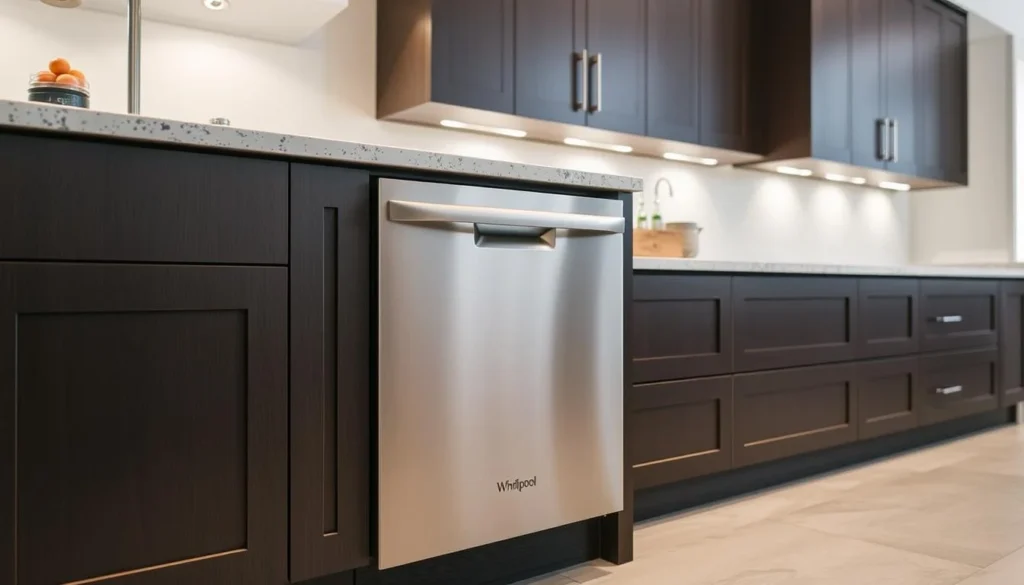
Whirlpool 6th Sense dishwashers are designed around one central idea: the dishwasher should be able to determine how dirty the load is and adjust its washing process rather than forcing the user to select every setting manually. Depending on the model and market, 6th Sense technology uses sensors to monitor soil levels and adjust elements of the wash programme, with the objective of achieving good cleaning results while avoiding unnecessary water, energy and time consumption. Whirlpool has used this technology across different generations of dishwashers, particularly in European and international models, while North American Whirlpool machines use closely related sensor-cycle technology under different product names.
That distinction is important when reading a Whirlpool 6th Sense dishwasher review. A 14-place-setting European 6th Sense model, for example, may have a different energy rating, programme selection, drying system and rack arrangement from a Whirlpool dishwasher sold in the United States or Canada. Therefore, the best way to evaluate 6th Sense is to examine the technology itself and then consider the specific model’s specifications rather than treating every Whirlpool 6th Sense dishwasher as identical.
Whirlpool 6th Sense Dishwasher Review at a Glance
| Category | Whirlpool 6th Sense Dishwasher |
|---|---|
| Main technology | Automatic soil-sensing wash system |
| Primary purpose | Adjust washing according to detected soil |
| Cleaning performance | Generally good when correctly loaded and matched to the soil level |
| Heavy-soil capability | Good on models equipped with PowerClean/PowerClean Pro |
| Water efficiency | Potentially very good because sensor operation can reduce unnecessary washing |
| Energy efficiency | Varies substantially by model and market |
| Drying | Varies by model; heated, residual-heat and NaturalDry-style systems may be used |
| Capacity | Common European models offer around 13–14 place settings |
| Third rack | Available on selected models |
| Noise | Model-dependent; some international models are designed for relatively quiet operation |
| Smart connectivity | Model-dependent |
| Leak protection | Available on many international 6th Sense models |
| Best suited for | Households wanting automatic cycle adjustment and flexible cleaning |
| Main limitation | “6th Sense” alone does not tell you the complete specification |
| Overall value | Strong when the individual model has the desired wash, drying and efficiency features |
The biggest strength of the Whirlpool 6th Sense concept is automation. Whirlpool describes 6th Sense as a sensor-controlled system that detects and monitors soil and adapts cycle parameters accordingly. In practical terms, this means a mixed load containing lightly soiled plates, glasses and more heavily soiled cookware does not necessarily have to be treated exactly like a uniformly dirty load.
However, this does not mean that a 6th Sense dishwasher can ignore loading, detergent, water temperature or maintenance. Sensor technology improves automatic decision-making, but it cannot compensate indefinitely for blocked spray arms, an overloaded rack, inadequate detergent, a dirty filter or unsuitable water conditions. Whirlpool’s own dishwasher guidance continues to emphasize correct loading, detergent selection, rinse aid and maintenance as important factors in cleaning and drying results.
What Is Whirlpool 6th Sense Technology?
Whirlpool’s 6th Sense dishwasher technology is essentially a sensor-based approach to automatic dishwashing. Sensors monitor conditions associated with the load and allow the dishwasher to modify its operation. Depending on the particular generation and model, this can involve changes to programme duration, water use, temperature or wash intensity. The objective is to avoid treating every load as though it contains the maximum possible amount of soil.
This principle is also visible in Whirlpool’s North American Sensor Cycle systems. Current Whirlpool documentation describes sensor operation as using measurements such as soil level, load characteristics and water temperature to determine appropriate wash action. Some models use sensors during prewash and wash stages, while other models may provide additional automatic adjustments.
The practical advantage is convenience. With a conventional fixed cycle, selecting a heavy programme for a lightly soiled load may use more time, water or energy than necessary. A sensor-controlled cycle can instead react to what it detects. This is particularly useful for households where dishwasher loads vary considerably from one day to the next.
The technology should not be confused with artificial intelligence in the modern cloud-computing sense. The term “6th Sense” is Whirlpool’s product technology branding, while current North American products may describe newer sensor systems with terms such as Intelligent Wash. The important engineering principle is automatic sensing and adjustment rather than the marketing terminology.
Whirlpool 6th Sense Cleaning Performance
Cleaning performance is the most important consideration in any dishwasher review, and this is where 6th Sense technology makes the most sense. The dishwasher can modify its operation according to detected soil rather than requiring the user to make a perfect prediction before every wash.
On suitable loads, this can make everyday washing straightforward. Plates, bowls, cups, glasses and ordinary cookware can generally be handled using an automatic or sensor-oriented programme. The machine determines the required treatment rather than making the household select a heavy programme every time.
Whirlpool’s European 6th Sense models have also been paired with PowerClean or PowerClean Pro on selected products. These systems are designed to direct stronger water jets toward difficult soil, particularly on pots, pans and larger cookware. Whirlpool documentation describes PowerClean Pro as using powerful rear jets and intelligent sensing to adapt water pressure to soil conditions.
This is especially useful for people who cook frequently. A dishwasher that can accommodate large cookware while directing additional water pressure toward heavily soiled areas can reduce the amount of manual scrubbing required before loading. It does not mean that every burnt pan will emerge perfectly clean, but the technology is designed specifically to improve treatment of difficult soil.
One advantage of the PowerClean approach is that it can make better use of dishwasher space. Some Whirlpool designs allow pots and pans to be positioned so that targeted jets can reach them. This is more useful than simply increasing the overall wash intensity because the dishwasher can concentrate stronger water action where it is needed.
Does Whirlpool 6th Sense Remove the Need to Pre-Rinse?
For many ordinary loads, modern Whirlpool sensor-controlled dishwashers are designed to reduce the need for extensive pre-rinsing. PowerClean-equipped 6th Sense models specifically promote cleaning without prewashing, soaking or hand scrubbing for appropriate loads.
That does not mean large quantities of food should simply be left on dishes. Removing large pieces of food and bones is still sensible, and heavily baked-on material may require a heavy programme or soaking depending on the specific dishwasher. Whirlpool’s operating guidance recommends removing bulk food before loading.
Whirlpool 6th Sense and Water Consumption
Water efficiency is one of the most interesting aspects of sensor-based dishwashing. A dishwasher does not necessarily need to use the same amount of water for every load. Sensor technology can allow the machine to adjust the cycle according to detected conditions. Whirlpool specifically describes 6th Sense as a system intended to save water and energy while maintaining cleaning performance.
Actual water consumption varies significantly between models and cycles. For example, Whirlpool’s published cycle information for a North American Sensor cycle lists approximately 3.96 gallons, while the Normal cycle in the same guide is listed at approximately 2.48 gallons under specified test conditions. Heavy and extended-soak programmes can consume substantially more.
European 6th Sense models can have very different published figures. One 14-place-setting Whirlpool 6th Sense dishwasher lists water consumption of 9.5 litres per cycle, while a related PowerClean model also lists 9.5 litres. These figures demonstrate why buyers should examine the exact model rather than assuming all 6th Sense machines have the same water consumption.
For American buyers, the ENERGY STAR framework provides a useful benchmark. Current criteria for standard dishwashers require no more than 240 kWh annually and 3.2 gallons per cycle under the applicable testing methodology. Actual household consumption can differ depending on cycle selection, frequency of use, soil level and options.
Whirlpool 6th Sense Energy Efficiency
Energy efficiency is closely connected to water usage because heating water represents an important portion of dishwasher energy consumption. A dishwasher that can reduce unnecessary water heating may potentially reduce energy consumption as well. Whirlpool’s 6th Sense concept is specifically intended to optimize water, energy and time according to the load.
European Whirlpool models historically used the EU energy-label system, while North American models use different certification and labeling systems. A European 6th Sense model listed in Whirlpool documentation may show an A++ or A+++ classification depending on its generation, while those labels cannot simply be translated into today’s U.S. ENERGY STAR ratings.
This is an important point for international buyers. Energy labels have changed over time, especially in Europe, and an older A+++ dishwasher should not automatically be interpreted as equivalent to a current product using a newer labeling framework. Always compare the actual kWh and water-consumption figures for the model and market in which the appliance is being purchased.
Whirlpool 6th Sense Drying Performance
Drying is more complicated because 6th Sense does not define the drying system by itself. Different Whirlpool dishwasher models can use different drying approaches. Some use heated drying, while certain European models have used NaturalDry or automatic door-opening systems designed to improve drying through airflow.
A Whirlpool 6th Sense dishwasher equipped with a modern drying system can provide good results on ceramic plates, glassware and metal cookware. Plastics are more difficult because they retain less heat than heavier materials and tend to hold droplets after the wash. Whirlpool recommends using rinse aid and appropriate drying settings to improve results.
Rinse aid is particularly important for drying and water-spot control. Whirlpool’s guidance states that rinse aid supports the drying process and helps reduce spotting on glassware. This becomes particularly relevant in hard-water areas, where dissolved minerals can remain on surfaces after water evaporates.
Therefore, if drying performance is a major priority, do not buy a dishwasher solely because it carries the 6th Sense name. Check whether the exact model has heated drying, fan assistance, automatic door opening, NaturalDry or another dedicated drying technology.
Whirlpool 6th Sense Noise Levels
Noise performance depends on the individual Whirlpool model. The 6th Sense name itself does not establish a particular decibel rating. European Whirlpool models have been marketed with relatively quiet operating characteristics, and some product documentation lists noise figures such as 46 dB(A).
North American Whirlpool models also vary. Current Whirlpool products can have noise ratings in the high-40-decibel range, while other products may be quieter or louder depending on their design and price category.
For context, a dishwasher around 50 dBA can generally be noticeable during operation, whereas machines in the low-to-mid 40s are more suitable for open-plan kitchens where quiet operation matters. This is a practical interpretation rather than a universal threshold, because kitchen acoustics, cabinetry and installation also influence perceived noise.
Whirlpool’s current dishwasher portfolio demonstrates why shoppers should compare the exact decibel specification rather than relying on the 6th Sense branding.
Whirlpool 6th Sense Capacity and Loading Flexibility
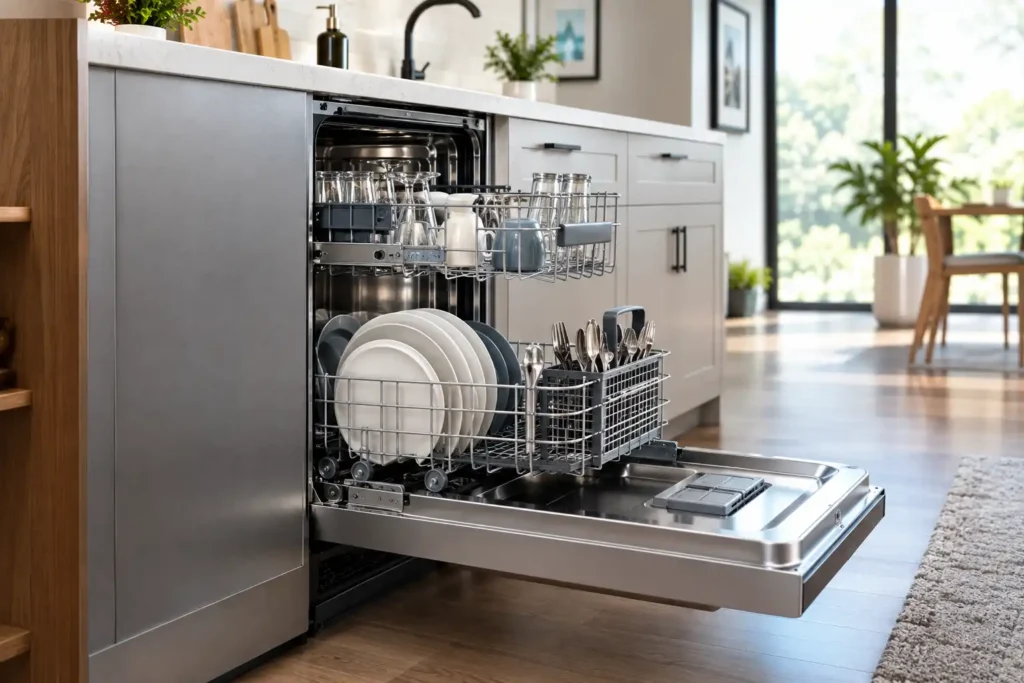
Many European 6th Sense dishwashers use a full-size 60-centimetre format and provide around 13 or 14 place settings. One Whirlpool 6th Sense model, for example, specifies 14 place settings, a stainless-steel tub, an adjustable upper rack and a three-layer sliding cutlery rack.
Capacity is important because a large dishwasher is not necessarily useful if its rack geometry is poor. Flexible racks, adjustable tines and removable or adjustable upper racks can make it easier to accommodate tall glasses, pans, bowls and large plates.
Selected Whirlpool models include third racks or specialized utensil areas. Current North American Whirlpool models demonstrate the brand’s use of third-level racks, adjustable second racks and other flexible-capacity systems.
The best loading configuration depends on the exact dishwasher. Buyers should examine the rack layout rather than judging capacity solely by the number of place settings.
Whirlpool 6th Sense PowerClean and PowerClean Pro
PowerClean is one of the features that can make a 6th Sense dishwasher substantially more interesting for households that regularly wash cookware. Whirlpool describes PowerClean technology as a targeted high-pressure cleaning system intended for difficult soil and large cookware.
PowerClean Pro goes further by combining powerful water jets with sensing technology. The system can detect soil conditions and adapt water pressure, allowing stronger cleaning where the dishwasher determines it is needed.
This is particularly useful for pots and pans. Instead of requiring every item to receive the maximum possible washing intensity, targeted jets can concentrate cleaning action on areas that need it. The result is a more flexible approach to mixed loads.
However, PowerClean should not be interpreted as a guarantee that heavily burned cookware will always become completely clean. Dishwasher performance remains dependent on the type of soil, how long food has dried, the detergent, water temperature, loading position and the exact cycle selected. Whirlpool’s own troubleshooting guidance identifies loading, detergent, temperature and water pressure as important cleaning factors.
Whirlpool 6th Sense Washing Programmes
The number and names of programmes vary considerably. A Whirlpool 6th Sense 14-place-setting model can provide programmes such as 6th Sense, prewash, crystal/glass, rapid wash, eco, daily, intensive and silent.
The 6th Sense cycle is intended to provide automatic adjustment, making it useful for mixed everyday loads. Eco programmes are generally designed around lower resource consumption, while intensive programmes are intended for heavier soil. Rapid programmes prioritize speed and may use different resource levels to achieve faster results.
North American Whirlpool dishwashers use comparable concepts under different cycle names. Current cycle documentation includes Sensor, Normal, Heavy, Quick and other options, with the Sensor cycle automatically adjusting according to soil conditions.
This means the fundamental Whirlpool approach is consistent across markets even though the terminology and exact implementation differ.
Whirlpool 6th Sense Sani Rinse and Hygiene Features
Some Whirlpool 6th Sense models include high-temperature or sanitizing options. These are intended for situations where additional heat is desirable, such as cleaning heavily soiled dishes or certain household items where the manufacturer’s instructions permit dishwasher washing.
Current Whirlpool North American documentation describes Sani Rinse as a cycle or option designed to meet the requirements of NSF/ANSI Standard 184 for residential dishwashers when successfully completed. The documented temperature can rise substantially during the main wash and final rinse.
A sanitizing cycle should not be confused with a claim that every dishwasher cycle sanitizes every load. The certification applies to the designated sanitizing programme under specified test conditions.
Whirlpool 6th Sense Hard Water Performance
Hard water is an important consideration for Whirlpool dishwasher owners in many regions of the United States, Canada and the UK. Minerals in hard water can produce spotting, filming and scale. Whirlpool’s dishwasher documentation recommends rinse aid for spotting and notes that very hard water may require additional water-softening measures.
European Whirlpool dishwashers may also include salt-based water-softening systems depending on the model. The exact configuration should be checked in the owner’s manual before installation or use.
Using the correct dishwasher salt where required is particularly important because ordinary cooking salt is not an appropriate substitute. Whirlpool specifically warns against using cooking salt because its composition can damage dishwasher components.
For hard-water households, the combination of appropriate detergent, rinse aid and correctly configured water softening can have a greater effect on real-world results than the 6th Sense label alone.
Whirlpool 6th Sense Leak Protection
Leak protection varies by model, but several European 6th Sense dishwashers specify multiple levels of water-leak protection. One Whirlpool 6th Sense model lists a three-level water-leakage protection system.
This is a useful feature because dishwasher leaks can damage flooring, cabinets and adjacent structures. However, leak protection should be viewed as a risk-reduction feature rather than a guarantee that a dishwasher can never leak.
Current Whirlpool North American models also offer leak-detection systems on selected products. These systems can detect certain leak conditions, alert the user and initiate draining of water from the tub.
Installation remains critical. A correctly installed drain hose, water connection, dishwasher level and door seal are all important for preventing operational problems.
Whirlpool 6th Sense Reliability
Reliability is more difficult to judge than features because reliability depends on the individual model, production period and ownership conditions. Independent survey data covering thousands of dishwashers places Whirlpool among the mainstream brands evaluated for predicted reliability, while also showing that no dishwasher brand is immune to breakdowns.
Current reliability research uses owner surveys and historical failure information to estimate the likelihood that a dishwasher will develop a problem during its first several years. Such data should not be interpreted as a guarantee for an individual Whirlpool 6th Sense machine.
The most commonly reported dishwasher problems across brands include inadequate cleaning, poor drying and drainage issues. These problems are not unique to Whirlpool or 6th Sense models.
This makes maintenance important. Cleaning filters, maintaining spray arms, using appropriate detergent and rinse aid, avoiding overloading and addressing water-supply problems can all help maintain performance.
Whirlpool 6th Sense Maintenance
A dishwasher with advanced sensors still requires routine maintenance. Food particles can accumulate in filters, spray arms can become blocked and mineral deposits can develop in hard-water environments. Whirlpool’s manuals specifically instruct owners to clean the filtration system at the recommended intervals.
Filters deserve particular attention because a restricted filtration system can interfere with water circulation and cleaning performance. If dishes begin emerging with food particles, the filter and spray arms should be among the first areas inspected.
Rinse aid should also be maintained when the model supports it. Whirlpool recommends rinse aid for drying and to reduce spotting, making it especially useful for glassware and hard-water conditions.
Owners should also avoid using hand dish soap or laundry detergent in the dishwasher. Excessive suds can interfere with normal operation and may contribute to problems.
Whirlpool 6th Sense Dishwasher Pros
Automatic cleaning adjustment
The primary benefit is the ability to adapt washing to the detected load instead of requiring users to make every decision manually. This is convenient for households with mixed soil levels.
Good everyday flexibility
Multiple programmes allow users to choose between automatic, normal, intensive, rapid and other wash approaches depending on the model.
Stronger cookware cleaning on selected models
PowerClean and PowerClean Pro models can provide targeted high-pressure water action for pots, pans and difficult soil.
Potentially efficient operation
The sensor philosophy is designed to avoid unnecessary resource consumption when loads do not require maximum washing intensity.
Good capacity on many European models
Full-size 6th Sense machines commonly provide 13–14 place settings, making them suitable for families and larger households.
Useful options for different households
Depending on the model, buyers can find third racks, adjustable racks, multi-zone washing, delay start, intensive cycles, rapid programmes, sanitizing options and specialized drying systems.
Whirlpool 6th Sense Dishwasher Cons
6th Sense does not describe one specification
This is probably the most important limitation. Two Whirlpool dishwashers carrying 6th Sense branding can have substantially different racks, drying systems, energy consumption, noise levels and programme selections.
Drying performance varies by model
Some models have more sophisticated drying technologies than others. Buyers who care about completely dry plastics should examine the exact drying system instead of relying on 6th Sense branding.
Noise varies
A 6th Sense dishwasher is not automatically quiet. Published decibel ratings vary between models.
Sensor cycles can take longer
Automatic cycles may extend their operation when the dishwasher detects greater soil or needs additional heating. Whirlpool documentation explicitly notes that sensor-controlled operation can change cycle behavior and resource use according to conditions.
Advanced features may increase complexity
PowerClean systems, sensors, electronic controls, drying systems and other features add functionality but also mean there are more components involved than in a basic dishwasher.
Whirlpool 6th Sense Dishwasher for the USA
American buyers should be careful when searching specifically for “Whirlpool 6th Sense dishwasher.” The 6th Sense branding is more strongly associated with certain international and European Whirlpool products, while current U.S. and Canadian products frequently use terms such as Sensor Cycle, soil sensor and Intelligent Wash for comparable automatic-sensing functionality.
For a U.S. buyer, the practical comparison should therefore focus on sensor technology, washing performance, drying system, noise level, energy consumption, capacity and warranty rather than insisting that the appliance carry the literal 6th Sense name.
Current North American Whirlpool products demonstrate this approach clearly. Sensor cycles can use measurements such as soil level, load size and water temperature to automatically determine washing action.
U.S. shoppers should also check ENERGY STAR certification and the EnergyGuide information where applicable. Current ENERGY STAR standards provide an objective benchmark for water and energy performance.
Whirlpool 6th Sense Dishwasher for Canada
Canadian buyers face a similar situation. Whirlpool Canada currently offers sensor-controlled dishwashers using terminology such as Sensor Cycle and Intelligent Wash rather than relying exclusively on 6th Sense branding.
Canadian Whirlpool models also demonstrate features such as third racks, adjustable racks, soil sensing, heated drying, leak detection and delay start. These features can provide a useful comparison point when evaluating the practical capabilities associated with the broader Whirlpool sensor-washing philosophy.
Canadian buyers should also compare the product’s Canadian energy and water information rather than importing figures from a European Whirlpool model.
Whirlpool 6th Sense Dishwasher for the UK
The Whirlpool 6th Sense concept is particularly relevant to European-style dishwasher models. Full-size 60-centimetre Whirlpool machines can provide 14 place settings, dedicated 6th Sense programmes, Eco cycles, intensive programmes, silent modes, multi-zone washing and adjustable rack systems.
European models can also have different electrical, installation and energy-label specifications from North American machines. A UK buyer should therefore purchase a model specifically intended for the UK or the applicable European market rather than assuming that a U.S. model can simply be substituted.
Water-softening capability is another important consideration in the UK because local water hardness varies substantially by region. A model with appropriate salt-based softening can be useful in harder-water areas, provided it is correctly configured and maintained.
Is Whirlpool 6th Sense Worth Buying?
The answer depends more on the specific model than on the 6th Sense name. The technology provides a useful combination of automatic sensing, flexible cleaning and potential resource savings, but the overall ownership experience also depends on drying technology, noise level, rack design, filtration, capacity and reliability.
For someone who wants an uncomplicated everyday dishwasher, the automatic sensing system is useful because it reduces the need to decide whether every load should receive a normal or heavy treatment. For households that regularly wash pots and pans, a model with PowerClean or PowerClean Pro can provide additional value.
For buyers whose top priority is extremely quiet operation, the exact dBA rating should be checked. For buyers who prioritize dry plastics, the exact drying system matters more than the 6th Sense badge. For buyers focused on operating costs, published energy and water figures should be compared directly.
Who Should Consider a Whirlpool 6th Sense Dishwasher?
A Whirlpool 6th Sense dishwasher can make sense for households that have changing dishwasher loads and want automatic adjustment. It is particularly useful for families where one load may contain lightly soiled breakfast dishes while another includes pots, pans and dried-on food.
It can also be attractive to people who want a full-size European dishwasher with flexible loading, automatic sensing and multiple programme choices. Selected models provide 14-place-setting capacity and adjustable rack configurations.
Households that frequently cook with large cookware should investigate models with PowerClean or PowerClean Pro. The targeted jets are designed specifically to improve cleaning of difficult cookware and heavy soil.
Who Should Look at Other Dishwasher Options?
A buyer who considers extremely quiet operation the highest priority should compare the actual decibel rating against other machines rather than choosing solely on the 6th Sense branding.
Likewise, someone who wants exceptional drying of plastics should compare the drying technology of each candidate dishwasher. Automatic soil sensing does not automatically mean exceptional drying. Whirlpool itself offers multiple drying approaches across its dishwasher portfolio.
Finally, anyone purchasing an older 6th Sense model should check the availability of replacement parts, manuals and service support in their market. Whirlpool provides official manuals and service documentation for its products, but model-specific support is important when considering an older dishwasher.
How to Get the Best Results From a Whirlpool 6th Sense Dishwasher
Start by scraping large pieces of food from dishes before loading. Avoid completely pre-rinsing every plate unless the dishwasher’s instructions specifically call for it, because modern dishwasher cycles are designed to work with food soil.
Load plates so that spray water can reach their surfaces and avoid nesting bowls or placing large cookware where it blocks the spray arms. Correct loading is especially important for sensor-controlled machines because sensors can adjust the cycle, but they cannot overcome physical obstructions that prevent water from reaching dishes.
Use dishwasher detergent rather than hand dishwashing liquid. Excess suds can interfere with dishwasher operation. Use the detergent quantity recommended for the specific product and adjust for water conditions where the manufacturer permits.
Keep rinse aid available when the dishwasher supports it, particularly if you experience wet dishes or water spots. Rinse aid is especially helpful for glassware and hard-water conditions.
Clean the filter regularly and inspect spray arms if cleaning performance declines. If the dishwasher suddenly leaves food behind, do not immediately assume that the sensor system has failed. A blocked filter, restricted spray arm, incorrect detergent or inadequate water temperature can produce similar symptoms.
Whirlpool 6th Sense Dishwasher Review: Final Assessment
Whirlpool 6th Sense is a well-established approach to automatic dishwasher control built around sensing soil and adapting the washing process. Its greatest practical advantage is that the dishwasher does not have to treat every load identically. Depending on the model, it can modify cycle behavior to balance cleaning performance with water, energy and time consumption.
The technology becomes more compelling on models that combine 6th Sense with PowerClean or PowerClean Pro. Those machines add targeted high-pressure jets for difficult soil and cookware, potentially reducing the amount of manual scrubbing required.
The main caution is that 6th Sense is not a complete dishwasher specification. It tells you about the sensing technology but does not automatically tell you how quiet the machine will be, how well it will dry plastics, how many racks it has, how much water it uses or how efficient it is. Those characteristics must be checked on the exact model.
Independent reliability data also indicates that Whirlpool belongs in the mainstream dishwasher reliability discussion, but no brand is immune from problems and individual model performance can vary.
For UK buyers, European 6th Sense models can offer a particularly attractive combination of automatic sensing, large capacity, multi-zone washing, PowerClean, flexible racks and European-style energy specifications. For U.S. and Canadian buyers, equivalent Whirlpool sensor technology may appear under different names, so it is more useful to compare the actual specifications than search only for the 6th Sense label.
Overall, Whirlpool 6th Sense is best understood as a sensor-based cleaning technology rather than a single dishwasher model. When paired with good rack design, appropriate drying technology, efficient water use, strong cleaning programmes and adequate service support, it can form the basis of a capable everyday dishwasher. The exact model remains more important than the 6th Sense name itself.
Frequently Asked Questions About Whirlpool 6th Sense Dishwashers
1. What is 6th Sense on a Whirlpool dishwasher?
6th Sense is Whirlpool’s sensor-based dishwasher technology that detects soil conditions and automatically adjusts aspects of the washing cycle. The goal is to provide appropriate cleaning while reducing unnecessary water, energy and time consumption.
2. Are Whirlpool 6th Sense dishwashers good?
They can provide good everyday cleaning, particularly when the dishwasher is correctly loaded and maintained. However, performance varies between models, so the exact washing system, drying technology, rack design and cycle selection should be examined before purchase.
3. Does Whirlpool 6th Sense save water?
The technology is designed to optimize water consumption according to detected soil. Actual consumption varies by model and cycle, so the manufacturer’s published water-use specification should be checked for the particular dishwasher.
4. Does 6th Sense automatically select the wash cycle?
On applicable models, 6th Sense can automatically adjust programme parameters based on sensor measurements. The exact behavior depends on the model and programme.
5. Does Whirlpool 6th Sense remove the need to pre-rinse?
It can reduce the need for extensive pre-rinsing, especially on models equipped with PowerClean technology. Large food particles should still be removed before loading.
6. Does Whirlpool 6th Sense clean pots and pans?
Selected models with PowerClean or PowerClean Pro are specifically designed to improve cleaning of heavily soiled cookware using targeted water jets.
7. Is Whirlpool 6th Sense good for hard water?
It can work well in hard-water areas when the dishwasher’s water-softening system, dishwasher salt, detergent and rinse aid are correctly managed. Hard water can otherwise cause mineral spotting and filming.
8. Does Whirlpool 6th Sense use dishwasher salt?
Some European Whirlpool models use salt-based water softeners, while the requirement varies by model and market. Check the specific owner’s manual before adding salt.
9. Can I use ordinary table salt in a Whirlpool dishwasher?
No. Where the dishwasher requires regeneration salt, use dishwasher salt specified for the appliance. Whirlpool specifically warns against ordinary cooking salt.
10. Does Whirlpool 6th Sense dry dishes well?
Drying performance depends on the individual model. Some Whirlpool dishwashers use heated drying, while selected European models use NaturalDry or other drying systems.
11. Does Whirlpool 6th Sense dry plastic containers?
Plastic is generally harder to dry than ceramic or metal. Using rinse aid and the appropriate drying option can improve results, but the exact drying system should be considered when choosing a model.
12. Is Whirlpool 6th Sense dishwasher quiet?
Some models are relatively quiet, but there is no single noise rating for all 6th Sense dishwashers. Published specifications must be checked for the exact model.
13. How many place settings does a Whirlpool 6th Sense dishwasher hold?
Many full-size European 6th Sense models provide around 13 or 14 place settings. Exact capacity varies by model.
14. Does Whirlpool 6th Sense have a third rack?
Some models do, while others use a conventional cutlery basket or different rack arrangement. Third-rack availability must be checked by model.
15. Does Whirlpool 6th Sense have PowerClean?
Selected 6th Sense dishwashers have PowerClean or PowerClean Pro. It is not a universal feature across every Whirlpool dishwasher carrying the 6th Sense name.
16. What is PowerClean Pro?
PowerClean Pro uses targeted water jets to attack difficult soil, particularly on cookware, while sensing technology can adapt water pressure according to detected soil.
17. Does Whirlpool 6th Sense have a sanitize cycle?
Selected models offer Sani Rinse or comparable high-temperature options. The exact certification and operation depend on the model.
18. Is a Whirlpool 6th Sense dishwasher energy efficient?
Many models are designed around efficient sensor-controlled operation, but actual energy performance varies substantially by model and market. Buyers should compare the published annual energy consumption rather than relying solely on the 6th Sense branding.
19. Are Whirlpool 6th Sense dishwashers reliable?
Independent reliability surveys place Whirlpool among the major dishwasher brands evaluated for reliability, but reliability varies by model and no dishwasher brand is problem-free.
20. How long can a Whirlpool 6th Sense dishwasher last?
There is no guaranteed lifespan for all 6th Sense models. Service life depends on the specific model, usage frequency, water conditions, installation, maintenance and repairs.
21. Why is my Whirlpool 6th Sense dishwasher taking so long?
Sensor-controlled cycles can extend operation when additional heating, washing or rinsing is required. Whirlpool documentation also notes that water temperature can affect cycle duration.
22. Why are my dishes still dirty after a 6th Sense cycle?
Check loading, detergent, filter condition, spray-arm movement, water temperature and water pressure. These factors can affect cleaning independently of the sensor system.
23. Why does my Whirlpool dishwasher leave white spots?
Mineral deposits from hard water are one possible cause. Rinse aid, correct detergent use and appropriate water-softening measures can help reduce spotting and filming.
24. Why are my Whirlpool dishes wet after the cycle?
Possible factors include the selected drying system, rinse-aid level, loading and plastic items retaining moisture. Whirlpool recommends rinse aid to support drying performance.
25. Should I use rinse aid with a Whirlpool 6th Sense dishwasher?
If the model supports rinse aid, using it can improve drying and reduce water spots. It is especially useful in hard-water conditions.
26. How often should I clean the filter?
Follow the maintenance interval specified for your exact Whirlpool model. Filters should also be inspected whenever cleaning performance begins to decline.
27. Is Whirlpool 6th Sense available in the USA?
Whirlpool has used the 6th Sense branding primarily on certain international and European products. Current U.S. and Canadian products often use related terminology such as Sensor Cycle and Intelligent Wash.
28. Is Whirlpool 6th Sense available in Canada?
Whirlpool Canada currently offers sensor-controlled dishwasher technology under names such as Sensor Cycle and Intelligent Wash, while specific 6th Sense-branded products depend on the market and model generation.
29. Is Whirlpool 6th Sense suitable for UK homes?
European Whirlpool 6th Sense dishwashers are designed around the full-size European format and can offer 14 place settings, multiple programmes, multi-zone washing and water-softening-related features depending on the model.
30. What should I check before buying a Whirlpool 6th Sense dishwasher?
Check the exact model’s capacity, noise rating, drying technology, energy consumption, water consumption, rack configuration, PowerClean availability, leak protection, warranty, service support and programme selection. The 6th Sense label alone does not provide enough information to evaluate the complete dishwasher.
Final Buying Checklist
Before purchasing a Whirlpool 6th Sense dishwasher, compare these specifications:
- Exact model number
- Place-setting capacity
- Noise rating in dB
- 6th Sense or equivalent sensor technology
- PowerClean or PowerClean Pro
- Drying technology
- Third-rack availability
- Adjustable upper rack
- Stainless-steel or other tub construction
- Water consumption
- Annual energy consumption
- Energy certification
- Eco programme
- Intensive programme
- Quick programme
- Sanitizing option
- Water-softening system
- Dishwasher salt requirement
- Rinse-aid system
- Leak protection
- Filter design
- Delay-start function
- Smart connectivity, if required
- Local warranty
- Availability of replacement parts and service
The most important conclusion is simple: evaluate the exact Whirlpool model, not just the 6th Sense label. The 6th Sense sensor system is a useful foundation for automatic cleaning, but the dishwasher’s complete specification determines how well it will fit your household’s needs.
For a family that wants automatic cycle adjustment, flexible loading and efficient everyday cleaning, Whirlpool’s 6th Sense technology can be a compelling feature. For heavy cookware users, adding PowerClean or PowerClean Pro can make the platform more useful. For buyers focused on quietness, drying or operating cost, the model-specific specifications should receive greater attention than the marketing name.