
Dishwasher error codes are designed to help identify problems before a minor issue turns into a larger repair. When a dishwasher displays a code, the code itself is usually not the repair. Instead, it is an indication that the electronic control has detected an abnormal condition involving water supply, drainage, temperature, motors, sensors, controls, communication, leakage, or another part of the operating system.
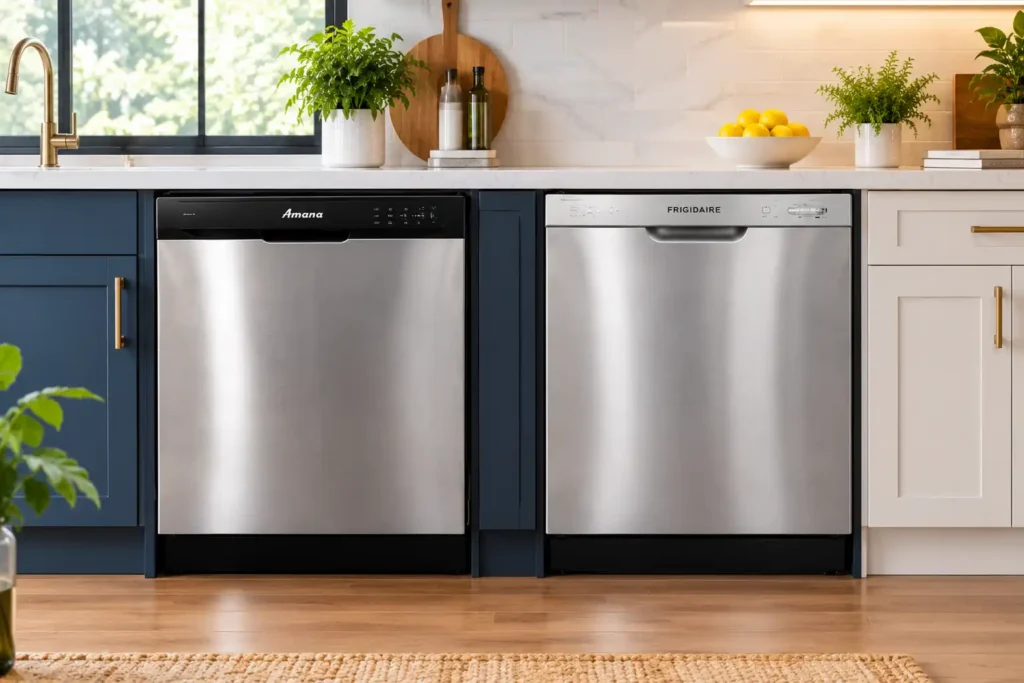
Amana and Frigidaire both use diagnostic codes and warning messages on many of their dishwashers, but their coding systems are considerably different. Current Amana documentation commonly uses F#E# codes, such as F1E1, F2E2, F6E1, F7E2, F8E4, F9E1 and H2O, while Frigidaire uses a mixture of codes and messages such as i20, i40, PF, CL, Cd, Hd and HO, depending on the model.
This difference is important when troubleshooting because an Amana F9E1 code cannot be interpreted using a Frigidaire i20 chart, even though both can point toward a drainage-related condition. Likewise, a Frigidaire PF message should not be interpreted as an Amana F-code because the two manufacturers use different diagnostic conventions.
The purpose of this guide is to explain the major differences between Amana and Frigidaire dishwasher error codes, identify commonly documented codes, explain what they indicate, describe the checks that can safely be performed by a homeowner, and clarify when professional service may be necessary. The information is intended to be useful for dishwasher owners in the United States, Canada and the United Kingdom, while recognizing that exact codes and procedures can vary by model and market.
Amana vs Frigidaire Dishwasher Error Codes at a Glance
| Category | Amana | Frigidaire |
|---|---|---|
| Common code format | F#E# | i-series, PF, CL/Cd, Hd/HO and other model-specific messages |
| Example | F6E1 | i20 |
| Drainage example | F9E1 | i20 |
| Water-supply example | H2O | Model-dependent |
| Control-related example | F1E1 | Model-dependent |
| Communication example | F2E2 | Model-dependent |
| Wash-motor example | F7E2 | Model-dependent |
| Filter/sump example | Model-dependent | i40 |
| Power-related example | Model-dependent | PF |
| Door-related message | Model-dependent | CL/Cd |
| Flashing-light diagnostics | Used on some models | Model-dependent |
| Exact codes universal across all models? | No | No |
| Model-specific manual important? | Yes | Yes |
| Reset may solve some temporary faults | Yes | Yes |
| Persistent fault may require service | Yes | Yes |
The major difference is that Amana’s current dishwasher error-code documentation is organized heavily around function/error combinations, while Frigidaire’s public dishwasher guide combines error codes with status and operating messages. Neither system should be treated as a universal code list for every dishwasher carrying the brand name.
What Is a Dishwasher Error Code?
A dishwasher error code is a diagnostic message generated when the electronic control detects a condition outside the expected operating parameters.
For example, the control may expect the dishwasher to drain within a particular period. If the expected drainage does not occur, the control can register a drainage fault.
Similarly, if the dishwasher does not detect incoming water, the control may generate a water-supply-related code. If communication between electronic components fails, a communication-related code may be generated.
The code therefore helps narrow down the problem, but it does not necessarily identify the exact failed component. A drainage code, for example, could result from a blocked filter, obstructed hose, incorrect installation, debris in the sump, or a failed pump depending on the model and system design.
This is why replacing a component solely because an error code appeared can lead to unnecessary expense. The manufacturer’s troubleshooting procedure should be followed before replacing parts.
How Amana Dishwasher Error Codes Work
Many current Amana dishwasher models use an F#E# format.
The first part identifies the function category, while the second part identifies the particular error condition. Amana’s documentation provides examples including F1E1, F2E2, F6E1, F7E2, F8E4 and F9E1.
On models without a conventional digital display, Amana may communicate the code through a flashing Clean light or another status-light sequence. The flashes occur in two groups separated by a pause. The first group represents the function number and the second group represents the error number.
For example, a sequence of seven flashes, a pause, followed by one flash can correspond to F7E1.
This system is useful because the dishwasher does not necessarily need a large digital display to communicate diagnostic information.
However, owners should count the flashes carefully. A long pause indicates the end of the sequence, while the shorter pause separates the function and error portions. Miscounting the sequence can result in diagnosing the wrong problem.
How Frigidaire Dishwasher Error Codes Work
Frigidaire uses a different approach.
Its current dishwasher error-code guide includes codes such as i20, i40 and PF, along with operating or status messages including CL, Cd, Hd, HO and delay-time displays.
Some Frigidaire displays therefore show something that looks like an error but is actually an operating message.
For example, a display showing the remaining cycle time is not a failure. Likewise, the CL or Cd indication can tell the user that the door has not been successfully closed and latched. Frigidaire explicitly distinguishes some of these messages from actual error conditions.
This means Frigidaire owners should not automatically assume that every letter or number shown on the display represents a mechanical failure.
Amana F1E1 Dishwasher Error Code
The Amana F1E1 code is associated with a control-module condition.
Amana’s troubleshooting instruction for F1E1 is to cycle power to the dishwasher. The control can sometimes recover from a temporary electronic condition after being disconnected from power. If the code remains after resetting, further service may be necessary.
A power cycle should be performed according to the manufacturer’s instructions. Amana’s current documentation describes disconnecting the dishwasher from power for approximately 30 seconds before restoring power.
If F1E1 repeatedly returns, repeatedly resetting the dishwasher should not be treated as a permanent repair. A recurring control-related code indicates that further diagnosis may be required.
Amana F2E2 Dishwasher Error Code
The F2E2 code is associated with a main-control communication error.
Electronic dishwashers depend on communication between the main control system and other electronic components. If communication does not occur as expected, the control can register a communication fault.
Amana’s recommended first troubleshooting step is to cycle power to the control. The manufacturer’s documentation specifies disconnecting power for approximately 30 seconds and then restoring it.
If the code repeatedly returns, the problem may involve electronic controls, connections, wiring or another related component, and professional diagnosis may be appropriate.
Amana F6E1 Dishwasher Error Code
F6E1 is another Amana dishwasher code associated with the user interface and main control.
Amana identifies the potential cause as a user-interface/main-control error and recommends cycling power. If the code remains, the manufacturer directs the user toward service.
This is an important example of why error codes should not automatically be translated into a specific replacement part.
An F6E1 indication does not simply mean “replace the control board.” The control system needs to be diagnosed according to the model-specific service information.
Amana F7E2 Dishwasher Error Code
Amana identifies F7E2 as a wash-motor error in its current dishwasher error-code guide.
The wash motor is responsible for circulating water through the dishwasher’s spray system. Because circulation is essential to cleaning, a motor-related fault can prevent normal washing performance.
If the code returns after a power cycle, professional service is generally appropriate because diagnosing a motor-related problem can involve electrical measurements, wiring inspection, control diagnosis and mechanical inspection.
Owners should avoid disassembling electrical components without the appropriate technical knowledge and safety precautions.
Amana F8E4 Dishwasher Error Code
The F8E4 code indicates that water has been detected in the drip tray on applicable Amana models.
Amana’s troubleshooting information directs attention toward the drip tray, float switch and water connections. The presence of water in the tray can indicate a leak or another water-management problem.
This code should not be ignored.
Even if the dishwasher continues operating, water underneath the appliance can damage flooring, cabinetry and nearby materials. The water source should be investigated before continuing normal operation.
Amana F9E1 Dishwasher Error Code
F9E1 is associated with a long-drain or not-draining condition.
Amana recommends checking the filter, drain hose, sink disposer connection and air gap where applicable. A new garbage-disposal installation should also be checked to ensure that the knockout plug was removed.
This is particularly useful because a drainage error does not necessarily mean that the drain pump has failed.
A blocked filter or hose can produce the same general symptom.
Cleaning the filter and checking the external drainage path should therefore be part of the initial troubleshooting process.
Amana H2O Dishwasher Error Code
The H2O code indicates that the dishwasher is not detecting water.
Amana recommends checking that the water supply is turned on and that the water-supply hose is not kinked. Once the water problem is corrected, the dishwasher can attempt to resume the cycle.
This makes H2O a useful example of an error that may be caused by something outside the dishwasher itself.
A closed shutoff valve or restricted supply line can prevent filling even when the dishwasher’s internal components are functioning correctly.
Amana FAE5 or F10E5
Some Amana dishwashers use FAE5 or F10E5 to identify a diverter leak condition.
The manufacturer’s troubleshooting procedure includes checking underneath the dishwasher for leaks and verifying that water connections are secure. It also recommends cancelling the current cycle and trying another cycle; if the code returns, service should be scheduled.
A diverter-related leak is more significant than a simple status message because water leakage can cause damage beyond the dishwasher itself.
If water is actively leaking, continued operation should be approached cautiously.
Frigidaire i20 Dishwasher Error Code
One of the most important Frigidaire dishwasher codes is i20.
Frigidaire identifies i20 as a condition in which the dishwasher did not drain completely or did not drain properly.
The manufacturer’s troubleshooting list includes several possible causes:
- Blocked drain hose
- Pinched drain hose
- Incorrect drain-hose positioning
- Food soil in the filter
- Food soil in the sump
- Garbage-disposal knockout plug not removed after installation
These possibilities demonstrate why an i20 code should not automatically be interpreted as a failed drain pump.
Frigidaire also specifies a minimum drain-hose height of 32 inches from the floor in its current guidance.
How to Reset Frigidaire i20
Frigidaire provides several ways to reset the i20 condition.
The manufacturer’s guidance includes pressing or holding the cancel control, turning power off at the circuit breaker, or unplugging the dishwasher for approximately three minutes.
However, resetting should not be viewed as a substitute for correcting the drainage problem.
If the dishwasher continues to produce i20 after the filter, sump, drain hose and installation have been checked, further diagnosis may be required.
Frigidaire i40 Dishwasher Error Code
The i40 code is associated with a clogged filter or sump.
Frigidaire explains that i40 can occur when food soils build up in the sump. The recommended initial action is to clean the glass trap and filter and then run the dishwasher again.
This code is particularly useful because it points toward a maintenance-related problem rather than automatically identifying an electronic or motor failure.
Regular filter cleaning can therefore reduce the likelihood of encountering certain drainage and filtration-related problems.
Frigidaire PF Dishwasher Error Code
The PF code indicates a loss of power.
Frigidaire states that the PF error occurs when the dishwasher has experienced a power loss. Pressing Start/Cancel can clear the condition so that a new cycle can be started.
A PF code therefore does not automatically indicate a failed dishwasher control board.
A recent electrical interruption, tripped circuit breaker or other power event can cause the message.
If PF repeatedly appears without an obvious power interruption, the electrical supply and appliance should be investigated.
Frigidaire CL or Cd Dishwasher Message
Frigidaire uses CL or Cd to indicate that the dishwasher door is open or has not successfully latched.
The manufacturer’s guidance says to check that the door is properly closed and latched. If the consumer cannot close the door successfully, service may be required.
This is an important distinction between a status message and a component failure.
A door-related display does not necessarily mean that the electronic control has failed.
The door, latch and surrounding installation should be checked first.
Frigidaire Hd and HO Messages
Frigidaire documentation identifies Hd or HO as heat-delay or heater-on indications rather than necessarily being conventional fault codes.
The dishwasher can temporarily display this type of indication while heating water to the required operating temperature. The manufacturer notes that colder incoming water can increase the time needed to reach the target temperature.
This is particularly useful for homeowners who see a code-like display and assume that the heating system has failed.
A heating-related status indication is not automatically equivalent to a heating-element failure.
Amana vs Frigidaire Drainage Error Codes
Drainage is one of the clearest areas where the two systems can be compared.
Amana commonly uses F9E1 for a long-drain/not-draining condition on applicable models, while Frigidaire uses i20 for a dishwasher that did not drain properly.
Although the codes are different, the troubleshooting philosophy is similar.
Both systems direct attention toward the drainage path before assuming a major component has failed.
Filters, drain hoses, garbage-disposal connections and accumulated food debris can all affect drainage.
This means homeowners should avoid replacing a drain pump simply because a drainage code appears.
Amana vs Frigidaire Water-Supply Error Codes
Amana’s H2O code indicates that the dishwasher is not detecting water.
The manufacturer recommends checking the water supply and supply hose before proceeding to more complicated diagnosis.
Frigidaire’s exact water-fill code depends on the dishwasher model, which illustrates an important limitation when comparing the two brands.
There is no safe universal conversion in which an Amana H2O code can simply be matched to one Frigidaire code across every model.
The correct Frigidaire interpretation must come from the model-specific documentation.
Amana vs Frigidaire Control and Communication Codes
Electronic control problems are another major category.
Amana’s current code documentation includes F1E1 for a control-module condition, F2E2 for a main-control communication error, and F6E1 for a user-interface/main-control error.
These codes demonstrate that Amana’s F/E structure can distinguish between different types of electronic conditions.
Frigidaire also uses electronic diagnostics, but its publicly available dishwasher error-code guide does not provide a single universal control-code table covering every dishwasher generation. Instead, owners are directed toward model-specific documentation when the displayed message is not covered by the general guide.
Therefore, Amana’s publicly documented F/E structure can sometimes make the category of the problem more immediately recognizable, but that does not necessarily mean that repairing an Amana control problem is simpler.
Why Model Number Matters So Much
The same brand can use different electronic controls, displays, sensors and diagnostic systems across different dishwasher generations.
A dishwasher manufactured several years ago may use different codes from a current model.
This is why manufacturer support documentation repeatedly directs users toward the owner’s manual or model-specific information when a code is not covered by a general guide.
Before searching for an error-code meaning, record:
- Brand
- Complete model number
- Serial number when needed
- Exact code
- Whether the code is displayed continuously or intermittently
- What the dishwasher was doing when the code appeared
- Whether water remains inside
- Whether the dishwasher fills
- Whether the dishwasher drains
- Whether the code returns after a reset
These details can dramatically improve diagnostic accuracy.
Amana Flashing-Light Error Codes
Not every Amana dishwasher has a large display.
On certain models, a flashing Clean light communicates an F/E code through a sequence of flashes.
The user must count the first group, wait for the short pause, count the second group, and then wait for the longer pause before the sequence repeats.
This system is especially important for older or simpler dishwasher interfaces.
If the flashing sequence is counted incorrectly, the owner can easily search for the wrong code.
It is therefore advisable to record the sequence on paper or video before beginning troubleshooting.
Are Amana Error Codes Easier to Understand?
Amana’s F/E system can be relatively systematic because the code itself separates a function number from an error number.
For example, F7E2 immediately identifies the function and error portions of the diagnostic code.
However, understanding the code is not the same as repairing the problem.
A code can identify a system category without identifying the failed physical component.
For example, a control-related code can require inspection of wiring, electronic connections, the user interface and the main control rather than simply replacing one part.
Are Frigidaire Error Codes Easier to Understand?
Frigidaire’s system has some codes that are particularly intuitive.
For example, i20 is associated with drainage, i40 with a clogged filter or sump, and PF with power loss.
These codes can provide a relatively direct starting point for troubleshooting.
However, Frigidaire’s use of model-dependent messages means that the general code guide does not replace the owner’s manual.
When a display message is not covered by the general guide, the manufacturer recommends referring to the owner’s manual or contacting support.
Which Brand Gives More Useful Error Information?
The answer depends on what is meant by “useful.”
Amana’s F/E system can provide a structured diagnostic category, particularly when a model supports the documented F/E codes and flashing-light sequence.
Frigidaire’s codes such as i20, i40 and PF can provide very understandable starting points for common drainage, filtration and power conditions.
Neither approach should be considered universally superior because the usefulness of a diagnostic code depends on the model, fault, documentation and available troubleshooting instructions.
Which Error Codes Can Homeowners Usually Check First?
The safest initial troubleshooting usually involves problems that do not require opening electrical compartments.
For drainage codes, inspect the filter, sump area, drain hose and disposal connection as directed by the manufacturer.
For water-supply codes, check that the water valve is open and the supply hose is not kinked.
For door messages, verify that the door is closing and latching correctly.
For power-related messages, confirm that electrical power has been restored and that the appropriate circuit is functioning.
These checks can sometimes resolve the problem without a service visit.
When Should You Stop Troubleshooting?
Homeowners should stop basic troubleshooting when the problem involves electrical components, persistent leaks, burning smells, damaged wiring, repeated control errors, or a fault that returns immediately after the recommended reset.
Amana directs owners toward service when certain control, motor and leak-related codes persist.
Frigidaire likewise directs consumers toward service when certain conditions cannot be resolved through the recommended checks.
A dishwasher contains mains-voltage electrical components and can contain hot water and moving mechanical components, so safety should take priority over attempting an advanced repair.
Resetting an Amana Dishwasher
A power cycle can clear some temporary control conditions.
Amana’s current documentation commonly instructs users to disconnect power for approximately 30 seconds and then restore it for several control-related error codes.
However, a reset should be considered a diagnostic step rather than a repair.
If the same code immediately returns, the underlying condition remains.
Repeatedly resetting a dishwasher without investigating a persistent fault can delay proper diagnosis.
Resetting a Frigidaire Dishwasher
Frigidaire’s reset instructions vary according to the error and model.
For i20, the manufacturer identifies cancelling the cycle, switching off the breaker, or unplugging the dishwasher for approximately three minutes as reset options.
For PF, pressing Start/Cancel can clear the power-loss indication.
Again, clearing the display does not necessarily eliminate the underlying cause.
If the code repeatedly returns, the original condition should be investigated.
Amana vs Frigidaire Error Codes for Drainage
| Problem | Amana | Frigidaire |
|---|---|---|
| Drainage fault example | F9E1 | i20 |
| Filter inspection | Yes | Yes |
| Drain hose inspection | Yes | Yes |
| Sump inspection | Yes | Yes |
| Disposal connection | Yes where applicable | Yes where applicable |
| Knockout plug | Check on new disposal installations | Check on new disposal installations |
| Reset possible | Yes | Yes |
| Persistent fault may require service | Yes | Yes |
Both manufacturers therefore use diagnostic systems that can direct the homeowner toward the drainage system before assuming a pump failure.
Amana vs Frigidaire Error Codes for Water Problems
Water-related errors can originate from either the dishwasher or the household plumbing.
A closed shutoff valve, restricted hose or installation problem can prevent filling.
Amana’s H2O guidance specifically instructs users to check the water supply and hose.
Frigidaire’s model-specific instructions should be used for the exact code displayed because water-fill diagnostics can vary by model.
This is another reason why the model number is essential.
Amana vs Frigidaire Error Codes for Leaks
Leak-related faults deserve particular attention because they can cause property damage.
Amana’s F8E4 can indicate water detected in the drip tray, while FAE5/F10E5 can indicate a diverter leak on applicable models.
Frigidaire’s general error-code guide should be supplemented with model-specific troubleshooting when water leakage or another condition is present.
If significant water is present underneath the dishwasher, continuing to run repeated cycles is not an appropriate substitute for finding the source.
Error Codes Do Not Always Mean a Broken Part
One of the biggest mistakes in dishwasher troubleshooting is assuming that an error code identifies a failed component.
Consider a drainage code.
The control may detect that the dishwasher did not drain, but it may not know whether the cause is:
- Food debris
- A blocked filter
- A blocked hose
- Incorrect hose routing
- A disposal connection problem
- A pump problem
- Wiring
- Control electronics
Frigidaire’s i20 troubleshooting instructions demonstrate this clearly because several different physical causes can produce the same drainage condition.
The same principle applies to Amana drainage and water codes.
Error Codes and Dishwasher Maintenance
Regular maintenance can reduce some of the conditions that trigger dishwasher fault messages.
Filters should be kept clean, spray systems should remain free of debris, and drainage paths should remain unobstructed.
Amana specifically provides filter-maintenance instructions and explains that filter condition affects dishwasher operation.
Frigidaire’s i40 documentation similarly connects the error with food-soil accumulation in the sump and recommends cleaning the filter and glass trap.
Maintenance cannot prevent every electronic or mechanical failure, but it can reduce avoidable problems.
Hard Water and Error Codes
Hard water can contribute to mineral deposits, reduced cleaning performance and restricted components.
Although not every hard-water condition generates a dedicated error code, mineral accumulation can contribute to symptoms that eventually lead owners to investigate a fault.
Regular cleaning and correct detergent usage are therefore important in areas with hard water.
This applies across the United States, Canada and the United Kingdom because water hardness varies substantially between regions rather than being determined by country alone.
Amana vs Frigidaire: Which Has More Error Codes?
It is not meaningful to simply count the number of codes published by each manufacturer and conclude that one dishwasher is more problematic.
Amana’s current general dishwasher page lists a substantial group of F/E codes, including F1E1, F1E2, F2E1, F2E2, F3E2, F4E2, F4E3, F6E1, F6E3, F6E4, F7E2, F8E2, F8E4, F8E5, F9E1, F9E2, FAE4/F10E4, FAE5/F10E5 and H2O.
Frigidaire’s current general guide contains a different set of codes and operating messages, including i20, i40, PF, CL/Cd and Hd/HO.
A larger code list does not mean a dishwasher has more failures.
It can simply mean that the manufacturer has chosen to divide diagnostic conditions into more categories.
Are Error Codes the Same in the USA, Canada and UK?
Not necessarily.
Dishwasher models, electrical configurations, product generations and market-specific documentation can differ.
Amana’s current error-code support pages specifically provide U.S. and Canadian service pathways for many listed dishwasher faults.
For UK owners, the correct model-specific documentation is especially important because the exact appliance version available in the UK may differ from North American versions.
Therefore, owners should never assume that an error-code list found for a North American dishwasher automatically applies to a European-market model.
How to Find the Correct Error Code for Your Dishwasher
The most reliable process is:
Step 1: Record the exact display
Do not write “F6” if the display actually says F6E1.
Do not write “i2” if the display says i20.
A single missing character can completely change the diagnosis.
Step 2: Record the model number
The model number identifies the particular dishwasher platform and documentation.
Step 3: Check whether the display is a code or status message
Frigidaire’s documentation shows that some displays are operating messages rather than faults.
Step 4: Follow the manufacturer’s troubleshooting sequence
Do not skip directly to replacing parts.
Step 5: Reset only when instructed
A reset can clear temporary electronic conditions but does not repair a persistent mechanical problem.
Step 6: Escalate persistent faults
If the same code returns after the recommended troubleshooting, professional diagnosis may be appropriate.
Amana vs Frigidaire Dishwasher Error Codes: Practical Difference
Amana’s system is particularly recognizable for its F/E diagnostic structure and flashing-light sequences.
Frigidaire’s system is recognizable for i-series codes and additional status messages.
For common homeowner troubleshooting, both systems can provide useful information.
The most important difference is not which code format looks simpler. It is whether the code provides a sufficiently narrow starting point for troubleshooting.
In many cases, both brands ultimately require the same practical checks: water supply, filters, drainage, hoses, door closure, electrical supply and, when necessary, professional component diagnosis.
Frequently Asked Questions
1. Are Amana and Frigidaire dishwasher error codes the same?
No. They use different diagnostic systems. Amana commonly uses F/E combinations, while Frigidaire uses codes such as i20, i40 and PF along with model-dependent status messages.
2. What does an Amana F9E1 code mean?
On applicable Amana models, F9E1 indicates a long-drain or not-draining condition. The filter, drain hose, disposer connection and air gap should be checked.
3. What does Frigidaire i20 mean?
Frigidaire i20 indicates that the dishwasher did not drain properly. The manufacturer recommends checking the drain hose, filter, sump and disposer connection.
4. What does Amana H2O mean?
H2O indicates that the dishwasher is not detecting water. The water supply and supply hose should be checked.
5. What does Frigidaire i40 mean?
i40 indicates a clogged filter or sump condition. Cleaning the glass trap and filter is the manufacturer’s initial recommendation.
6. What does Frigidaire PF mean?
PF indicates a loss of power. Pressing Start/Cancel can clear the condition after power has been restored.
7. What does Amana F6E1 mean?
F6E1 is associated with a user-interface/main-control error. Amana recommends cycling power and obtaining service if the error remains.
8. What does Amana F2E2 mean?
F2E2 indicates a main-control communication error on applicable models. A power cycle is the manufacturer’s initial troubleshooting step.
9. What does Amana F1E1 mean?
F1E1 is associated with a control-module condition. Amana recommends cycling power and seeking further assistance if the code remains.
10. What does Amana F7E2 mean?
F7E2 indicates a wash-motor error on applicable Amana models. Persistent occurrences generally require further diagnosis.
11. What does Amana F8E4 mean?
F8E4 indicates that water has been detected in the drip tray on applicable models. The drip tray, float switch and water connections should be checked.
12. What does Amana FAE5 mean?
FAE5 or F10E5 can indicate a diverter leak. Water connections and the area beneath the dishwasher should be inspected, and persistent faults may require service.
13. Is an Amana flashing Clean light an error code?
It can be. On applicable models, the flashing sequence communicates an F/E diagnostic code. The flashes must be counted in two groups.
14. Is every Frigidaire display message an error?
No. Some displays indicate normal operating conditions, door status, delay settings or other functions.
15. Can an error code disappear after resetting?
Yes. Some temporary electronic or operating conditions can clear after a power cycle or cancellation procedure. However, a recurring code requires investigation rather than repeated resetting.
16. Does a drainage code always mean the drain pump is bad?
No. Filters, hoses, food debris, installation and disposer connections can all cause drainage problems.
17. Can a dirty filter trigger an error code?
Yes. Frigidaire specifically associates i40 with filter or sump blockage, and both manufacturers emphasize filter maintenance.
18. Can a kinked hose cause an error code?
Yes. Both water-supply and drainage hoses can contribute to operating problems when restricted or incorrectly installed.
19. Can a garbage disposal cause a dishwasher error?
Yes. A newly installed disposal can cause drainage problems if its dishwasher knockout plug has not been removed.
20. Should I replace a part immediately after seeing an error code?
No. The code should first be interpreted using the exact model’s documentation and the recommended troubleshooting steps should be completed.
21. Are Amana error codes easier to diagnose?
The F/E structure can make the diagnostic category relatively systematic, but actual repair complexity depends on the fault and model.
22. Are Frigidaire error codes easier for homeowners?
Some, such as i20, i40 and PF, provide relatively straightforward starting points, but the complete system remains model-dependent.
23. Does the same Amana code apply to every Amana dishwasher?
No. Error-code availability and meanings can vary by model and generation.
24. Does the same Frigidaire code apply to every Frigidaire dishwasher?
No. Frigidaire’s documentation specifically directs users to the owner’s manual for messages not covered by the general error-code guide.
25. Can I use a North American error-code chart for a UK dishwasher?
Not automatically. Market-specific models and electronics can differ, so the exact model documentation should be used.
26. Can error codes tell me which part to buy?
Usually not with sufficient certainty. A code identifies a detected condition, while component-level diagnosis may require additional testing.
27. Why does my dishwasher show an error after a power outage?
Power interruptions can cause certain electronic controls to display power or control-related messages. Frigidaire’s PF code specifically indicates loss of power.
28. What should I do if my dishwasher stops mid-cycle?
Check whether the cycle was interrupted, whether the dishwasher can drain, whether an error code is displayed, and whether the filter or drain hose is obstructed. Amana specifically recommends these checks for applicable mid-cycle interruptions.
29. Can an error code indicate a leak?
Yes. Some Amana codes specifically identify water detected in the drip tray or a diverter leak.
30. Should I continue running a dishwasher that is leaking?
A significant leak should be investigated rather than repeatedly running cycles. Water can damage flooring, cabinets and electrical components.
31. Does hard water cause dishwasher error codes?
Hard water does not necessarily produce a dedicated error code, but mineral deposits can contribute to performance and maintenance problems that may eventually produce operating symptoms.
32. How do I find my dishwasher’s exact error-code list?
Use the complete model number and the manufacturer’s model-specific owner documentation or support resources.
33. Can I reset an Amana dishwasher by turning off the breaker?
For certain Amana errors, the manufacturer specifically recommends disconnecting power and restoring it after the prescribed period.
34. Can I reset a Frigidaire dishwasher by unplugging it?
For some errors, yes. For example, the i20 troubleshooting procedure allows the dishwasher to be unplugged for approximately three minutes.
35. What if the same error code keeps returning?
A recurring error indicates that the underlying condition may still be present. At that point, model-specific diagnosis or professional service may be necessary.
Final Comparison: Amana Dishwasher Error Codes vs Frigidaire Error Codes
Amana and Frigidaire both provide diagnostic systems that can help homeowners identify dishwasher problems, but they approach error reporting differently.
Amana’s system commonly uses structured F/E codes, including F1E1, F2E2, F6E1, F7E2, F8E4 and F9E1, along with H2O and other model-specific codes. Some models communicate these codes through flashing-light sequences instead of a conventional digital display.
Frigidaire uses a different combination of codes and messages. Its current general dishwasher guide documents conditions such as i20 for incomplete drainage, i40 for clogged filter or sump, PF for loss of power, and CL/Cd for door-related status, while other messages and codes depend on the particular dishwasher.
The two systems nevertheless have an important similarity: an error code is a starting point for diagnosis, not necessarily a direct instruction to replace a part.
A drainage code can be caused by a filter, hose, sump, disposal connection or pump. A water-supply code can result from a closed valve or restricted hose. A control code may require examination of the electronic system rather than immediate control-board replacement.
For homeowners in the United States, Canada and the United Kingdom, the safest and most accurate approach is to identify the exact model, record the exact code, consult the applicable model documentation, perform only the recommended basic checks, and obtain professional service when the problem involves persistent electrical, control, motor or leak-related faults.
The most useful comparison is therefore not simply “Amana has these codes and Frigidaire has those codes.” The more important difference is how each manufacturer communicates detected conditions and guides the owner toward the appropriate troubleshooting path.
For common problems, both systems can provide valuable diagnostic information. For unusual or persistent problems, however, the exact dishwasher model and its technical documentation matter far more than the brand name alone.