
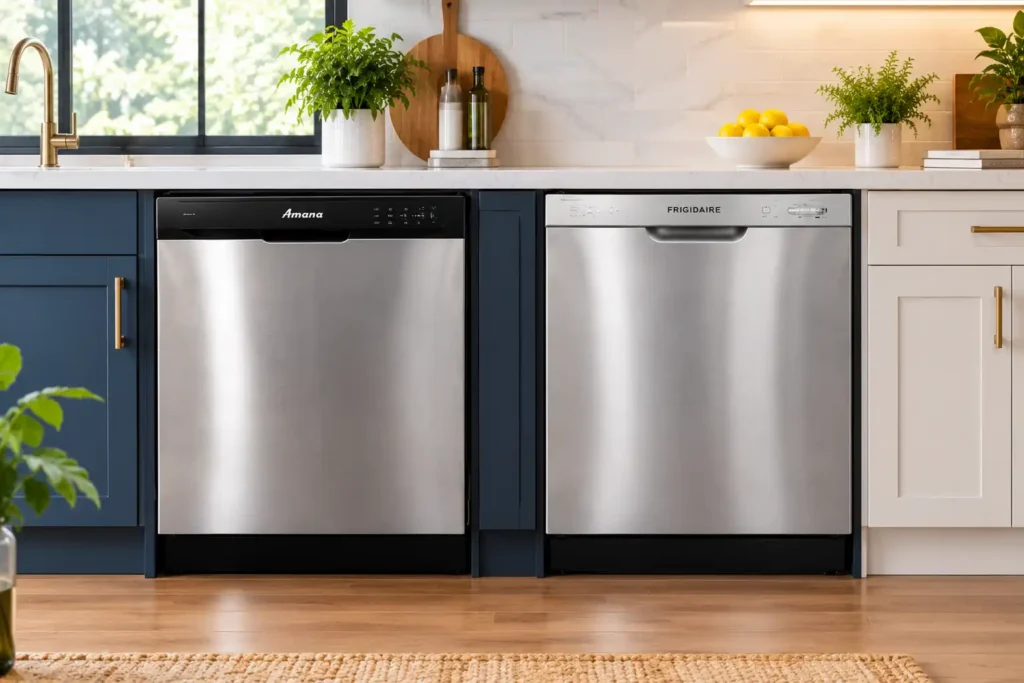
When comparing Amana and Frigidaire dishwashers, washing performance usually gets most of the attention. Buyers look at spray arms, wash cycles, soil sensors, filtration, noise ratings, and cleaning power. Drying performance, however, can be just as important in everyday use.
A dishwasher that cleans plates extremely well but leaves glasses covered in droplets, plastic containers full of water, and silverware damp can become frustrating to use. This is particularly noticeable when dishes need to be put away immediately after a cycle.
Both Amana and Frigidaire offer dishwashers with heated drying systems, but their exact drying technologies vary considerably from model to model. Amana uses heated drying options on many models, with some models also combining heat with a fan or venting system. Frigidaire likewise offers Heat Dry on many models, while selected models add forced-air systems such as Sahara Dry or PowerPlus Dry.
This means that simply asking whether an Amana or Frigidaire dishwasher has “heated dry” does not tell the whole story. The heating element is only one part of the drying system. Rinse aid, airflow, tub material, dish loading, water temperature, cycle selection, and the type of dishes being dried can all affect the final result.
The most useful comparison is therefore to understand how heated drying works, what Amana and Frigidaire actually provide, where their systems overlap, and what shoppers in the United States, Canada, and the United Kingdom should consider before choosing a model.
What Is Heated Dry in a Dishwasher?
Heated dry is a dishwasher drying method that uses heat to accelerate evaporation after the washing and rinsing stages.
Instead of leaving the dishes to dry entirely through ambient air, the dishwasher raises the temperature inside the tub and uses a heating element to help remove moisture.
The basic principle is straightforward. Water remaining on the dishes needs to evaporate. Increasing the temperature can accelerate that evaporation, while airflow can help carry moisture away from the surfaces.
Modern dishwasher drying systems can therefore use one or more of the following approaches:
- Heating elements
- Fans
- Vents
- Heated air circulation
- Automatic door opening
- Condensation-based drying
- Mineral-based drying on selected premium systems
- Air drying without additional heat
Amana and Frigidaire both use heated drying technologies, but the implementation depends on the specific model.
Amana’s documentation states that its Heated Dry option uses an internal heater to remove excess moisture and provide a more complete dry. Some Amana models also combine heat with a fan, while others use venting to help release humid air.
Frigidaire similarly states that its Heat Dry option uses heat to enhance drying performance. Selected Frigidaire models go further by adding forced air to the heated drying process.
This distinction becomes important when comparing two models that are both advertised as having heated dry.
Why Heated Dry Matters
The main reason people choose heated drying is convenience.
Without heated drying, water can remain on dishes for a significant amount of time, particularly on:
- Plastic food containers
- Bowls
- Cups with recessed bottoms
- Mugs
- Glasses
- Stainless-steel cookware
- Silverware
- Items with deep cavities
Heated drying can accelerate evaporation and reduce the amount of moisture remaining at the end of a cycle.
Amana specifically describes heated drying as providing the best drying performance on its compatible models. Frigidaire likewise recommends Heat Dry combined with rinse aid when users want improved drying.
However, neither manufacturer suggests that heated drying will make every item completely dry under every circumstance.
Plastic is particularly difficult because it has a relatively low thermal mass and tends to retain water droplets. Concave objects can also trap water even when the surrounding dishwasher environment is hot.
Amana Heated Dry: How It Works
Amana offers Heated Dry on multiple dishwasher models.
On current Amana models, the Heated Dry option uses an internal heater to accelerate drying by raising the temperature and removing excess moisture.
For example, current Amana dishwasher specifications describe the Heated Dry Option as using an internal heater to remove excess moisture and provide a more complete dry.
This is particularly useful for users who want dishes to be ready for cabinet storage shortly after the dishwasher finishes.
Some Amana models also incorporate airflow into the drying process. Certain models use a fan together with the heating element, while other designs include venting or door-opening functionality to help remove humid air.
The exact mechanism therefore depends on the model.
This is one reason buyers should avoid assuming that every Amana dishwasher has exactly the same drying system.
Amana Heat Dry and Fan-Assisted Drying
Some Amana dishwashers use a combination of heat and airflow.
Amana’s documentation explains that certain ProDry or Extended ProDry systems combine a heating element and fan. The fan circulates hot air around the dishes, helping move moisture away from their surfaces.
This approach has an important advantage over relying on heat alone.
Heat increases evaporation, but airflow helps transport moisture away from the dishes. Combining the two can improve the drying environment inside the dishwasher.
Depending on the model and selected option, the fan can continue operating after the main cycle. Amana notes that on some models the fan may operate for an extended period after the cycle to provide additional air movement and remove heat and moisture.
That means users may sometimes hear a fan after the dishwasher appears to have finished washing.
This is not necessarily a malfunction.
Amana Vented Dry
Some Amana models use a venting approach alongside heated drying.
Vented drying allows humid air to leave the dishwasher rather than remaining trapped inside the tub.
Amana describes Vented Dry as using an open vent to release humid air while the heating element helps evaporate water from dishes.
This can be useful because removing humid air from the dishwasher environment can help maintain a stronger drying gradient.
In simple terms, if the air inside the dishwasher becomes saturated with moisture, evaporation can slow. Venting helps replace moisture-laden air with drier air, allowing additional water to evaporate from dishes.
Amana Door-Opening Drying
Some Amana models use a different approach known as automatic door opening or Door Open Dry.
At the end of the washing process, the door opens slightly, allowing humid air to escape and fresh air to enter.
This can accelerate drying without relying entirely on continuous heating.
Amana explains that its Natural Dry technology on certain models automatically opens the door after the washing phase to release humid air and allow fresh air to circulate.
This is important because it demonstrates that Amana’s current drying technologies are not limited to one method.
A buyer comparing two Amana dishwashers should therefore check whether the model uses:
- Heated Dry
- Fan-assisted drying
- Vented Dry
- Door Open Dry
- ProDry
- Extended ProDry
rather than simply looking for the word “dry.”
Frigidaire Heated Dry: How It Works
Frigidaire uses Heat Dry on many dishwasher models.
According to current manufacturer guidance, the Heat Dry option uses heat to improve drying performance.
Frigidaire recommends combining Heat Dry with rinse aid because rinse aid helps water sheet off the surfaces of dishes rather than remaining as individual droplets.
This is a crucial point.
Heated drying is not simply about making the dishwasher hotter.
The drying system works more effectively when water can leave the surface of the dish efficiently.
Rinse aid reduces surface tension and encourages water to form a thin film that can run or evaporate more easily.
As a result, a dishwasher with heated drying but no rinse aid may produce noticeably different results from the same dishwasher operated with the correct rinse-aid setting.
Frigidaire Sahara Dry
Selected Frigidaire dishwashers use a more advanced drying system called Sahara Dry.
Sahara Dry combines the Heat Dry process with forced air.
The addition of forced air is important because it increases air movement around the dishes.
Frigidaire describes Sahara Dry as adding a forced-air system to Heat Dry and identifies it as an advanced drying system available on selected models.
This means a Frigidaire dishwasher with Sahara Dry should not be considered equivalent to a basic Frigidaire dishwasher that only has Heat Dry.
Both use heat, but the airflow component changes the drying system.
For consumers who frequently wash plastic containers or need dishes dry as soon as possible, this distinction can be significant.
Frigidaire PowerPlus Dry
Selected Frigidaire models also use PowerPlus Dry.
Like Sahara Dry, PowerPlus Dry combines forced air with Heat Dry.
The objective is to move moisture away from the dishes while heat accelerates evaporation.
The exact implementation depends on the dishwasher model, but the basic concept is the same: combine heat and air movement to improve drying.
This gives Frigidaire a range of drying technologies rather than a single system.
A basic model may use Heat Dry, while a more advanced model may add forced airflow.
Amana vs Frigidaire Heated Dry: Basic Comparison
The following comparison provides a useful way to understand the two brands:
| Drying Feature | Amana | Frigidaire |
|---|---|---|
| Basic heated drying | Available on selected models | Available on selected models |
| Internal heating element | Yes on heated-dry models | Yes on Heat Dry models |
| Fan-assisted drying | Available on selected models | Available on selected models |
| Forced-air drying | Available on selected models | Available on selected models |
| Door-opening drying | Available on selected models | Available on selected models depending on model |
| Rinse aid recommended | Yes | Yes |
| Plastic drying limitations | Yes | Yes |
| Concave-item limitations | Yes | Yes |
| Extended drying options | Available on selected models | Model dependent |
| Drying system consistency across range | Varies by model | Varies by model |
The most important point is that there is no single Amana drying system and no single Frigidaire drying system.
Both companies sell different dishwasher configurations.
Amana vs Frigidaire Heated Dry: Heat Alone Is Not the Whole Story
It is tempting to assume that the dishwasher with the hottest drying cycle will produce the driest dishes.
That is not necessarily true.
Drying depends on several physical factors:
- Temperature
- Humidity
- Air movement
- Surface tension
- Dish shape
- Material
- Loading position
- Drainage
- Rinse aid
- Tub construction
- Cycle duration
- Venting
Increasing temperature can accelerate evaporation, but if humid air remains trapped inside the tub, drying can eventually slow.
Similarly, excellent airflow cannot completely eliminate water trapped inside a concave container.
This is why modern dishwashers often combine several drying techniques.
Heated Dry and Rinse Aid
Rinse aid is one of the most important factors in dishwasher drying performance.
Both Amana and Frigidaire recommend rinse aid to improve drying.
Rinse aid changes the behavior of water on the dish surface. Instead of forming large droplets that remain on glass, metal, or ceramic surfaces, water can sheet away more easily.
This has several potential benefits:
- Faster drying
- Fewer water spots
- Less residual moisture
- Better glassware appearance
- Improved drying of metal surfaces
- Reduced pooling
Amana specifically states that heated drying combined with rinse aid provides the best drying performance.
Frigidaire likewise recommends rinse aid when using Heat Dry.
Therefore, comparing heated dry performance without considering rinse aid can produce misleading conclusions.
Why Plastics Are Difficult to Dry
Plastic is one of the biggest challenges for any dishwasher drying system.
Both manufacturers acknowledge that plastic items may retain water after a drying cycle.
There are several reasons.
Plastic does not retain heat in the same way as ceramic or metal. As a result, water on plastic surfaces can remain cooler and evaporate more slowly.
Plastic containers also frequently have:
- Deep recesses
- Ridges
- Lids
- Corners
- Flat surfaces
- Inverted bottoms
These shapes can trap water.
Consequently, even a strong heated-dry system may leave some plastic containers damp.
This is not necessarily a defect in the dishwasher.
Amana vs Frigidaire Heated Dry for Plastic
For plastic, the comparison becomes more complicated.
A basic heated-dry Amana can improve plastic drying compared with air drying, but Amana itself warns that heated drying does not necessarily dry plastic articles completely.
The same applies to Frigidaire.
Frigidaire specifically notes that plastic products and concave surfaces may retain some water even when Heat Dry is used.
Selected Frigidaire models with forced-air drying may provide improved results because moving air can assist evaporation.
Likewise, Amana models with fan-assisted or extended drying can provide additional drying action.
Therefore, if plastic drying is your highest priority, compare the complete drying system rather than choosing a brand solely because it advertises Heat Dry.
Amana vs Frigidaire Heated Dry for Glassware
Glassware generally responds well to heated drying.
Glass surfaces do not usually trap as much water as deep plastic containers, provided the glasses are loaded correctly.
Rinse aid is especially useful because it encourages water to sheet off glass surfaces.
Both brands recommend rinse aid for better drying and fewer spots.
However, water hardness can affect glassware appearance.
Minerals in hard water can leave spots or film even when the glass is technically dry.
This means a dishwasher can successfully dry a glass while still leaving visible mineral deposits.
The problem is then water chemistry rather than simply drying power.
Amana vs Frigidaire Heated Dry for Stainless Steel
Stainless steel generally dries well under heated conditions, but the shape of the item matters.
Flat stainless-steel surfaces can release water relatively easily.
Deep stainless-steel cookware can trap water around:
- Handles
- Rims
- Corners
- Concave bottoms
- Rolled edges
Correct loading can therefore be just as important as the drying technology.
Both Amana and Frigidaire recommend loading dishes so that water does not pool.
Amana vs Frigidaire Heated Dry for Silverware
Silverware is usually relatively easy to dry because most pieces have exposed surfaces.
However, water can remain between utensils if they are nested together.
The dishwasher must be able to expose enough surface area to the heated air.
Amana specifically discusses silverware drying and notes that proper loading, appropriate water temperature, heated drying, and rinse aid can all contribute to better results.
Frigidaire similarly emphasizes proper loading and rinse aid.
The lesson is simple: even the strongest drying system cannot effectively dry surfaces that are shielded from airflow.
Does Heated Dry Use More Electricity?
Yes, heated drying generally requires additional electrical energy compared with a no-heat or air-dry approach.
The heating element must consume electricity to raise the temperature and accelerate evaporation.
This is why energy-efficiency guidance commonly recommends air drying when maximum energy savings are the priority.
ENERGY STAR recommends using rinse aid and selecting no-heat drying when possible because it can provide good drying performance with less energy.
Canadian energy-efficiency guidance similarly recommends air drying as an energy-saving strategy.
Therefore, heated dry represents a trade-off:
More drying assistance in exchange for additional energy consumption.
Is Heated Dry Expensive to Run?
The cost depends on the dishwasher, electricity price, heating system, and duration of the drying cycle.
The additional energy used by heated drying can be relatively modest per cycle, but the cumulative effect depends on how frequently the dishwasher runs.
Frigidaire describes the additional energy cost of Heat Dry as relatively small on its support documentation.
Nevertheless, “small per cycle” does not mean “zero.”
A household running the dishwasher every day may accumulate meaningful additional electricity use over a year.
A household that values completely dry dishes may consider that trade-off worthwhile.
Heated Dry vs Air Dry
The simplest comparison is:
| Characteristic | Heated Dry | Air Dry |
|---|---|---|
| Uses additional heat | Yes | No |
| Uses additional drying energy | Yes | Lower |
| Drying speed | Generally faster | Generally slower |
| Plastic drying | Improved but not perfect | More moisture likely |
| Glass drying | Generally good | Slower |
| Energy consumption | Higher | Lower |
| Moisture removal | Heat-assisted | Ambient air |
| Best for quick unloading | Yes | Less suitable |
| Best for minimum energy | No | Yes |
The choice depends on priorities.
If the goal is maximum drying performance and quick unloading, heated drying has an advantage.
If the goal is minimizing energy consumption and you do not mind leaving dishes inside the dishwasher longer, air drying may be preferable.
Amana Heated Dry vs Frigidaire Heat Dry: Energy Considerations
There is no defensible basis for saying that every Amana heated-dry dishwasher uses less electricity than every Frigidaire heated-dry dishwasher, or the reverse.
Energy consumption depends on the specific model.
Even two dishwashers from the same brand can have different annual energy ratings.
For U.S. consumers, ENERGY STAR certification and the applicable energy information provide better comparison tools.
For Canadian consumers, the EnerGuide label provides model-specific energy information.
Therefore, do not choose between Amana and Frigidaire solely on the basis of the words “Heated Dry.”
Compare the annual energy consumption of the actual models.
Amana Heated Dry and Energy Efficiency
Amana offers ENERGY STAR-certified dishwasher models that include heated drying.
This demonstrates that heated drying does not automatically make a dishwasher inefficient.
Modern efficient dishwashers can incorporate heat-based drying while still meeting applicable efficiency requirements.
The important factor is the complete appliance design.
A dishwasher can reduce water consumption through efficient spray systems and filtration while using controlled heat during drying.
Consequently, buyers should look at the entire energy profile rather than assuming that heated dry automatically means poor efficiency.
Frigidaire Heated Dry and Energy Efficiency
Frigidaire also offers ENERGY STAR-certified dishwasher models with different drying methods.
Current ENERGY STAR listings show that heated dry is used across many certified dishwasher products, demonstrating that the presence of a heated drying system is compatible with modern efficiency requirements.
However, certified status does not mean every heated-dry model consumes the same amount of energy.
Again, the specific model matters.
Heated Dry and Dishwasher Tub Material
Tub material can influence drying behavior.
Stainless-steel interiors can retain heat effectively and may contribute to condensation behavior and overall thermal performance.
Plastic tubs behave differently.
However, tub material should not be treated as an independent guarantee of drying performance.
A dishwasher with a stainless-steel tub and a basic drying system may perform differently from another stainless-steel model with forced-air drying.
Similarly, plastic interiors can still deliver good drying when combined with effective heating and airflow.
Therefore, tub material should be considered together with drying technology.
Why Concave Dishes Stay Wet
Bowls, cups, measuring containers, and other concave objects can retain water even when the dishwasher is operating correctly.
The problem is geometry.
If a surface forms a pocket, water can remain trapped after the washing and drying stages.
Frigidaire specifically advises users to position concave items at an angle to improve drying.
Amana likewise explains that heated drying may not remove all moisture from certain convex or difficult-to-drain surfaces.
This is why loading technique remains critical.
Proper Loading for Better Heated Dry
To maximize drying performance:
1. Angle bowls
Place bowls at an angle so water can drain rather than pool.
2. Avoid nesting
Do not place multiple bowls or cups directly inside one another.
3. Separate silverware
Give water and air access to each utensil.
4. Place plastic items carefully
Use the upper rack when recommended by the manufacturer.
5. Avoid blocking spray arms
Large pans should not prevent the spray arms from rotating.
6. Keep drainage paths clear
Items should not trap large quantities of water.
7. Use rinse aid
This can significantly improve water sheeting and drying.
Amana vs Frigidaire Heated Dry in Hard-Water Areas
Hard water can make drying appear worse than it actually is.
Suppose a glass comes out with white spots.
The glass may actually be dry, but minerals remain on its surface.
That is a water-quality issue rather than necessarily a heating problem.
Rinse aid can help reduce spotting, while appropriate detergent and water-softening strategies may be necessary in areas with significant hardness.
Both Amana and Frigidaire recommend rinse aid for improved drying and reduced spotting.
This is particularly important in parts of the United States, Canada, and the United Kingdom where local water hardness can vary substantially.
Heated Dry and Water Temperature
Incoming water temperature also matters.
The dishwasher uses hot water during the washing and rinsing process, and appropriate water temperature can help overall cleaning and drying performance.
Frigidaire recommends a household water-heater setting of at least 120°F for appropriate dishwasher operation.
Amana similarly indicates that its dishwasher water-heating system relies on an appropriate hot-water supply for best wash and dry performance.
The dishwasher’s internal heating system then provides additional temperature control during the cycle.
Therefore, a dishwasher’s drying performance should not be evaluated completely separately from the household hot-water supply.
Amana vs Frigidaire Heated Dry: Drying Speed
Drying speed depends on the model and the selected option.
A basic Heat Dry cycle may require a significant period after washing.
Extended drying options can add additional time.
Fan-assisted systems may also continue circulating air after the washing cycle has completed.
Amana documentation indicates that some fan systems can operate for an extended period after the main cycle.
Frigidaire’s forced-air drying systems similarly use airflow as an additional mechanism for moisture removal.
Therefore, a longer drying period does not necessarily indicate inferior performance.
It can mean that the dishwasher is deliberately continuing to remove moisture.
Why a Dishwasher May Continue Making Noise After the Cycle
Users sometimes become concerned when they hear a fan or airflow noise after the wash cycle appears complete.
On some Amana models, this is normal.
The drying fan can continue operating to circulate air and remove moisture.
A similar principle applies to forced-air drying systems on selected Frigidaire models.
Therefore, post-cycle fan operation should not automatically be interpreted as a malfunction.
Always consult the specific model’s manual because operating behavior differs.
Amana Heated Dry vs Frigidaire Heated Dry for Everyday Dishes
For everyday plates, cups, glasses, and silverware, both brands can provide good drying when:
- Heated Dry is selected
- Rinse aid is available
- Dishes are loaded correctly
- Water temperature is appropriate
- The filter is clean
- The spray system is unobstructed
- The correct cycle is selected
At this level, the difference between brands may be less important than the difference between individual models.
A more advanced model with forced-air drying can naturally have a different drying experience from a basic heated-dry model.
Amana vs Frigidaire for Plastic Containers
Plastic is where drying technology becomes more important.
If your household regularly washes food-storage containers, baby bottles, plastic cups, reusable lunch containers, or lightweight food containers, a basic heated element may not completely solve moisture retention.
Forced-air systems can provide an additional advantage because moving air helps remove moisture from surfaces.
However, even advanced systems can leave water on concave plastic surfaces.
For plastic-heavy households, compare:
- Heat Dry
- Fan-assisted drying
- Forced-air drying
- Extended drying
- Automatic door opening
- Rack design
- Manufacturer’s plastic-drying guidance
rather than choosing based on brand alone.
Amana vs Frigidaire for Glasses and Cups
Glass and ceramic generally benefit strongly from heated drying.
These materials tend to tolerate higher temperatures than many plastics.
Rinse aid can further improve results by helping water sheet from the surfaces.
For users who primarily wash ceramic plates, glass drinking glasses, and stainless-steel utensils, a conventional heated-dry system may provide all the drying performance they need.
An advanced forced-air system may still provide advantages, but the difference may be less noticeable than it is with plastic.
Amana vs Frigidaire for Delicate Items
Heated drying is not appropriate for every item.
Some products may be damaged by heat.
Potentially sensitive items include certain:
- Plastics
- Wooden utensils
- Insulated containers
- Decorative items
- Adhesive-based products
- Items with heat-sensitive finishes
The dishwasher-safe instructions for the specific item should always take priority.
If an item is marked dishwasher safe but has a heat limitation, air drying may be preferable.
Heated Dry and Dishwasher Safety
Heated drying is a normal operating feature of modern dishwashers, but users should still follow loading instructions.
Items should be placed in the appropriate rack.
Heat-sensitive plastics should generally be positioned according to the manufacturer’s recommendations.
Amana specifically recommends placing plastic items in appropriate upper-rack positions on compatible models.
The reason is straightforward: the lower area of the dishwasher can experience greater heat exposure.
Heated Dry and Sanitization Are Not the Same
Another common misunderstanding is confusing heated drying with sanitization.
They are separate functions.
A sanitation cycle raises water temperature during the wash or final rinse to achieve the specified sanitization conditions.
Heated dry occurs after the washing and rinsing stages and is intended primarily to remove moisture.
Therefore:
Sanitize = primarily a high-temperature washing/rinsing function.
Heated Dry = primarily a moisture-removal function.
A dishwasher can have both features, but they should not be treated as interchangeable.
Can Heated Dry Remove Water Spots?
Heated drying can help reduce residual water, but it does not independently eliminate all spotting.
Rinse aid is more directly associated with reducing water spots because it helps water sheet away from surfaces.
Water hardness can also affect spotting.
Therefore, if glasses remain covered in white marks, the solution may involve:
- Rinse aid
- Water-hardness adjustment
- Detergent selection
- Dishwasher cleaning
- Water softening
rather than simply increasing drying temperature.
Can Heated Dry Prevent Cloudy Glasses?
Not necessarily.
Cloudy glassware can result from mineral deposits or, in some circumstances, permanent glass etching.
Heating alone does not reverse those problems.
If cloudiness is caused by mineral residue, improving rinse-aid use and addressing water hardness may help.
If the glass has been permanently etched, changing the drying setting will not restore the original surface.
Heated Dry and Dishwasher Maintenance
A clean dishwasher generally provides more predictable drying performance.
The filter should be maintained according to the owner’s manual.
Spray arms should remain free from blockages.
The drain system should function correctly.
Rinse-aid levels should be maintained.
The dishwasher should also be cleaned periodically when recommended.
Although these maintenance tasks may seem unrelated to drying, the entire wash process is interconnected.
Poor drainage can leave excess water.
Poor spray performance can leave food residue.
Mineral buildup can affect water distribution.
Incorrect rinse-aid settings can affect spotting and drying.
Therefore, drying performance should be considered as part of the complete dishwasher system.
Common Reasons an Amana Dishwasher Does Not Dry Properly
If an Amana dishwasher is leaving dishes wet, possible causes include:
- Heated Dry was not selected.
- The dishwasher is using an air-dry setting.
- Rinse aid is empty.
- The rinse-aid setting is too low.
- Plastic containers are retaining water.
- Concave dishes are positioned incorrectly.
- Dishes are nested.
- The dishwasher is overloaded.
- The heating element is not operating correctly.
- The selected cycle does not provide the desired drying.
- The filter or drainage system requires attention.
- A fan-assisted or extended drying option is needed.
Amana’s troubleshooting documentation specifically directs users to check the selected dry option, rinse aid, loading, water temperature, and heating element when drying performance is poor.
Common Reasons a Frigidaire Dishwasher Does Not Dry Properly
Frigidaire similarly identifies several causes of poor drying:
- Plastics
- Concave dishes
- Quick cycles
- Lack of rinse aid
- Incorrect settings
- Water temperature
- Installation or drainage issues
Frigidaire specifically notes that Quick Wash and short cycles may not dry dishes completely.
This means users should not necessarily judge the dishwasher’s maximum drying capability based on a short cycle.
Amana vs Frigidaire Heated Dry: Quick-Cycle Considerations
Short cycles often prioritize speed over maximum drying.
This is logical.
A dishwasher that completes washing rapidly has less time available for evaporation.
Therefore, if you use a 30-minute or one-hour cycle and expect every item to be completely dry, you may be disappointed.
For maximum drying, use the cycle and drying option recommended for a full normal load.
Amana vs Frigidaire Heated Dry and Rinse Aid Settings
Using rinse aid is not necessarily a simple on/off decision.
Many dishwashers allow the rinse-aid dosage to be adjusted.
The correct setting depends on water conditions and drying results.
Too little rinse aid can contribute to spotting and residual droplets.
Too much may be unnecessary.
The best approach is to start with the manufacturer’s recommended setting and adjust gradually based on actual results.
Amana vs Frigidaire Heated Dry: Energy Trade-Off
The central trade-off can be summarized as follows:
Heated Dry
- Faster moisture removal
- Better overall drying
- Useful for quick unloading
- Helpful for glass and ceramic
- More energy use than no-heat drying
Air Dry
- Lower energy consumption
- Longer drying
- More residual moisture
- Particularly challenging for plastic
- Useful when dishes can remain inside longer
This is not a question of one technology being universally correct.
The appropriate choice depends on the household.
Heated Dry for Households That Run the Dishwasher Daily
A household that runs a dishwasher once every day may notice the energy difference between heated and air drying over time.
If the dishwasher is usually unloaded immediately in the morning, heated drying may provide significant convenience.
If the dishwasher can remain closed for several hours after completion, air drying may be perfectly acceptable.
The decision therefore depends on both energy priorities and household routine.
Heated Dry for Large Families
Large households often benefit from faster drying because dishes may need to be reused throughout the day.
If one dishwasher load is followed quickly by another, drying speed becomes more important.
Forced-air systems can provide an advantage in this situation.
However, capacity is equally important.
A larger dishwasher that allows the family to wash fewer loads can sometimes be more useful than a smaller machine with a more sophisticated drying system.
Heated Dry for Small Households
Small households may place greater emphasis on energy efficiency.
If dishes can remain inside the dishwasher overnight, air drying may provide adequate results without using additional heating energy.
On the other hand, people who dislike handling damp dishes may prefer heated drying even with a small load.
Again, the choice is about convenience versus energy use.
Amana vs Frigidaire Heated Dry in the USA
In the United States, shoppers should compare the exact model’s energy information and manufacturer specifications.
Look for:
- Drying method
- Annual energy consumption
- ENERGY STAR certification
- Heat Dry availability
- Fan-assisted drying
- Soil sensing
- Water usage
- Noise rating
The U.S. ENERGY STAR database categorizes dishwasher drying methods separately, including heated dry, fan-assisted dry, condensation dry, air dry, mineral dry, and automatic door release.
This is useful because it demonstrates that “drying” is not a single technology category.
Amana vs Frigidaire Heated Dry in Canada
Canadian consumers have access to EnerGuide information for dishwashers.
The Canadian efficiency reporting framework specifically identifies drying options such as:
- Power dry with fan and heat
- Power dry with fan and heat off
- Power dry off
This provides a useful framework for understanding why two dishwashers can have different energy profiles even when both provide some form of drying.
Canadian shoppers should compare the actual EnerGuide information for the models they are considering.
Amana vs Frigidaire Heated Dry in the UK
The UK market uses its own energy-information framework and product availability can differ significantly from North America.
Therefore, shoppers should not assume that a U.S. or Canadian Amana or Frigidaire dishwasher has identical specifications to a model sold in the UK.
The underlying drying principles remain the same, but electrical specifications, product names, model numbers, efficiency labeling, and available cycles can differ.
For UK buyers, the locally supplied model’s energy information and owner’s manual should be treated as authoritative.
Does Heated Dry Make a Dishwasher More Reliable?
Not necessarily.
Heated drying adds a heating component and, on some models, fans or other components.
But the presence of heated drying alone does not establish whether a dishwasher will be reliable over its service life.
Reliability depends on the complete appliance.
Important components include:
- Heating element
- Pump
- Motor
- Control board
- Sensors
- Valves
- Drain system
- Fan
- Wiring
- Door seal
- Racks
A buyer should therefore avoid assuming that a simple air-dry dishwasher will always outlast a heated-dry model.
What Happens If the Heating Element Fails?
If the heating element fails, the dishwasher may still be able to wash dishes, depending on the model and failure.
However, drying performance can be severely affected.
The dishwasher may finish a cycle while dishes remain much wetter than usual.
Some models also use the heating element during wash or sanitization operations, so a heating-element problem can affect more than drying.
Amana provides diagnostic guidance indicating that certain models can use a high-temperature or sanitization cycle as part of checking heating-element operation.
A genuine heating failure should be evaluated according to the model’s service documentation.
What Happens If a Drying Fan Fails?
On models that depend on fan-assisted drying, a fan problem can reduce airflow and therefore reduce drying performance.
Symptoms can include:
- Dishes remaining wetter than normal
- Longer drying time
- Reduced moisture removal
- Different post-cycle sounds
- Fan not operating when expected
Not every dishwasher has a drying fan, so diagnosis depends on the exact model.
Amana vs Frigidaire Heated Dry: What Matters Most?
For most buyers, the following order of consideration is useful:
1. Exact drying technology
Determine whether the model uses basic Heat Dry, fan-assisted drying, forced air, door opening, or another method.
2. Rinse-aid system
A good rinse-aid system can substantially improve drying.
3. Plastic performance
If you wash many plastics, pay particular attention to drying technology.
4. Energy consumption
Compare annual energy figures rather than assuming heated drying is inherently inefficient.
5. Cycle choices
Make sure the dishwasher has the cycles you actually use.
6. Loading design
Rack geometry affects how effectively water drains.
7. Tub construction
Consider the complete tub and drying system together.
8. Maintenance
A dishwasher with poor maintenance can perform badly regardless of drying technology.
Amana vs Frigidaire Heated Dry: Advantages of Amana
Amana’s heated-dry systems offer several useful characteristics.
Depending on the model, buyers can find:
- Internal heated drying
- Fan-assisted drying
- Extended drying
- Vented drying
- Door-opening drying
- Rinse-aid systems
- Heated drying integrated with normal cycles
Amana’s current product range demonstrates that the company is not relying on one universal drying method.
For buyers who want a straightforward heated drying system, basic Amana models can provide that functionality.
For buyers who want more advanced airflow or venting, selected models provide additional options.
Amana vs Frigidaire Heated Dry: Advantages of Frigidaire
Frigidaire also offers a range of drying technologies.
Depending on the model, buyers can find:
- Heat Dry
- Air Dry
- Forced-air drying
- Sahara Dry
- PowerPlus Dry
- Rinse-aid-assisted drying
The major advantage of the broader range is that buyers can choose a dishwasher based on their preferred drying performance.
A basic model may provide Heat Dry, while a higher-level model can add forced airflow.
Which Is Better for Plastic: Amana or Frigidaire?
There is no universal brand-level answer.
A Frigidaire model equipped with forced-air drying may have a different plastic-drying performance from a basic Amana Heat Dry model.
Likewise, an Amana model with fan-assisted or extended drying may perform differently from a basic Frigidaire model.
Therefore, the correct comparison is:
Amana model A vs Frigidaire model B
rather than:
Amana vs Frigidaire as brands.
Which Is Better for Glassware?
Both brands can provide strong glassware drying when heated dry and rinse aid are used correctly.
For ordinary glasses, ceramic dishes, and stainless-steel utensils, a standard heated-dry system may be sufficient.
The difference becomes more important when the household expects extremely dry plastics or difficult-to-drain containers.
Which Is Better for Energy Savings?
If the objective is minimizing electricity consumption specifically during drying, neither brand has an inherent advantage simply because it uses heated drying.
The key distinction is between heated and no-heat drying.
Air drying generally uses less energy.
For model-level comparison, use the official annual energy figures rather than assuming that one manufacturer’s heated-dry system consumes less electricity.
Should You Always Use Heated Dry?
No.
Heated drying is useful when you want:
- Faster drying
- Drier dishes
- Faster unloading
- Better drying of glass and ceramic
- Less residual moisture
You may prefer air drying when:
- Energy consumption is a major concern
- Dishes can remain inside for several hours
- You do not mind residual moisture
- You primarily wash items that dry easily
The best choice depends on your household.
Best Practices for Maximum Amana Heated-Dry Performance
For the best results:
- Fill the rinse-aid dispenser.
- Use the manufacturer’s recommended rinse-aid setting.
- Load bowls at an angle.
- Avoid nesting cups.
- Separate silverware.
- Place plastics appropriately.
- Avoid blocking the spray arms.
- Select Heated Dry.
- Use Extended or ProDry when available and needed.
- Clean the filter regularly.
- Keep spray arms clear.
- Use an appropriate wash cycle.
- Ensure adequate incoming water temperature.
- Do not overload the racks.
- Follow the owner’s manual.
These steps can make a significant difference without changing the dishwasher itself.
Best Practices for Maximum Frigidaire Heated-Dry Performance
For Frigidaire:
- Use rinse aid.
- Select Heat Dry.
- Use Sahara Dry or PowerPlus Dry when available.
- Angle concave dishes.
- Avoid nesting.
- Position plastic correctly.
- Use the appropriate cycle.
- Clean filters.
- Keep spray arms unobstructed.
- Ensure appropriate incoming water temperature.
- Avoid overloading.
- Allow airflow around dishes.
- Use the drying option recommended for the load.
- Follow the model-specific manual.
Amana vs Frigidaire Heated Dry: Final Comparison
Amana and Frigidaire both offer heated drying, but neither brand can be judged accurately by the phrase “heated dry” alone.
Amana’s current heated-dry systems range from internal heating to more advanced combinations involving fans, venting, or door opening. Frigidaire likewise offers basic Heat Dry and selected advanced forced-air systems such as Sahara Dry and PowerPlus Dry.
The fundamental purpose is the same: accelerate moisture removal after washing.
The most important differences appear at the model level.
For basic everyday dishes, both brands can provide effective heated drying.
For households that wash large quantities of plastic, a model with forced airflow or another advanced drying mechanism may be more appropriate.
For households primarily washing glass, ceramic, and stainless steel, a conventional heated-dry system combined with rinse aid may already provide very good results.
For energy-conscious households, air drying generally consumes less energy than heated drying, so the question is not simply which brand has better heated dry. The more relevant question is whether the additional drying performance is worth the additional energy consumption for your household.
For Canadian shoppers, the EnerGuide information provides useful model-level energy information. For U.S. shoppers, official energy information and ENERGY STAR data allow models to be compared. UK shoppers should rely on the energy information and specifications for the exact locally available model.
Ultimately, Amana and Frigidaire are both capable of providing effective heated drying, but the specific drying technology matters more than the brand name.
If you are comparing two particular dishwashers, identify the exact model numbers and compare their drying method, energy consumption, rinse-aid system, tub material, fan/airflow technology, and cycle options. That will give you a much more meaningful answer than simply comparing Amana and Frigidaire at the brand level.
Frequently Asked Questions
1. Does Amana have heated dry?
Yes. Selected Amana dishwashers have a Heated Dry option that uses an internal heater to accelerate moisture removal.
2. Does Frigidaire have heated dry?
Yes. Selected Frigidaire dishwashers have a Heat Dry option that uses heat to improve drying performance.
3. Is Amana Heated Dry better than Frigidaire Heat Dry?
Neither can be universally considered better. The actual drying performance depends on the specific model and whether it uses basic heat, fan-assisted drying, forced air, venting, or another technology.
4. Which dries plastic better?
Advanced forced-air systems may provide better drying of plastics than basic heated drying, but plastic can still retain water because of its material and shape.
5. Does Amana use a fan for drying?
Some Amana models use a fan in combination with heat. Other models use different drying approaches, including venting or door opening.
6. Does Frigidaire use a fan for drying?
Selected Frigidaire models use forced-air systems. Sahara Dry and PowerPlus Dry add forced air to the Heat Dry process.
7. Does heated dry use more electricity?
Yes. Heated drying requires energy to produce heat, so it generally consumes more energy than no-heat air drying.
8. Does rinse aid improve heated drying?
Yes. Both manufacturers recommend rinse aid to improve drying. Rinse aid helps water sheet off surfaces and can reduce residual droplets and spotting.
9. Why are my dishes still wet after heated dry?
Possible reasons include plastic materials, concave surfaces, poor loading, lack of rinse aid, an unsuitable cycle, inadequate airflow, drainage problems, or a heating-system issue.
10. Why are plastic containers wet after a dishwasher cycle?
Plastic often retains moisture because it does not retain heat in the same way as ceramic or metal. Concave plastic containers can also trap water.
11. Does heated dry eliminate water spots?
Not necessarily. Water spots can be caused by mineral deposits or hard water. Rinse aid and appropriate water-hardness management are important.
12. Does heated dry sanitize dishes?
No. Heated drying and sanitization are different functions. Sanitization generally depends on high-temperature washing or rinsing, while heated dry removes moisture.
13. Is air dry better for energy savings?
Generally, yes. Air drying avoids the additional energy required to heat the dishwasher during the drying phase.
14. Should I use heated dry every time?
Not necessarily. Use it when you want better and faster drying. Air drying can be appropriate when energy savings are more important than immediate dryness.
15. Is heated dry safe for plastic?
It depends on the plastic and the dishwasher’s loading instructions. Heat-sensitive items should be placed according to the manufacturer’s recommendations or air dried if appropriate.
16. Why do bowls stay wet?
The concave shape can trap water. Positioning bowls at an angle can allow water to drain more effectively.
17. Can a dirty filter affect drying?
It can affect overall dishwasher performance and water circulation, which may indirectly affect the drying result. Regular filter maintenance is important.
18. Can a failed heating element cause wet dishes?
Yes. If the dishwasher’s heating element is not operating correctly, heated drying can be substantially reduced. On some models, the heating element also contributes to other temperature-related functions.
19. Is a fan-assisted dishwasher better than a basic heated-dry dishwasher?
A fan can improve airflow and moisture removal, but the complete dishwasher design matters. It should be evaluated alongside heat, venting, rinse aid, loading, and cycle design.
20. Does a stainless-steel tub guarantee better drying?
No. Tub material is only one component of drying performance. Heating, airflow, condensation, rinse aid, and dish geometry also matter.
21. Which is better for a large family?
A dishwasher with strong drying and sufficient capacity can be particularly convenient for a large family. Advanced forced-air or extended drying may be useful when dishes need to be unloaded quickly.
22. Which is better for a small household?
Either can work well. A small household may prefer air drying to reduce energy use or heated drying when convenience is more important.
23. Is Amana or Frigidaire more energy efficient when heated dry is used?
There is no universal brand-level answer. Compare the annual energy consumption of the exact models.
24. Does Frigidaire Sahara Dry use heat?
Yes. Sahara Dry adds a forced-air system to the Heat Dry process on selected models.
25. Does Amana have an alternative to heated dry?
Selected Amana models provide alternatives such as air drying, venting, door-opening drying, and other drying configurations depending on the model.
26. Can I leave the dishwasher closed after an air-dry cycle?
You can, but drying may take longer. Opening the door after completion can help release humid air on models where the manufacturer recommends doing so.
27. Why does my dishwasher fan continue after the cycle?
Some dishwashers deliberately continue operating a fan after the main wash cycle to move air, remove moisture, and improve drying. This can be normal depending on the model.
28. Does heated dry increase dishwasher cycle time?
It can. Drying options can add time to the overall cycle, particularly when extended drying or fan-assisted drying is selected.
29. Does heated dry damage glassware?
Dishwasher-safe glassware is generally designed to tolerate dishwasher conditions, but always follow the item’s care instructions. Extremely delicate or decorative glassware may require different handling.
30. What should I compare when choosing between an Amana and Frigidaire dishwasher?
Compare the exact models’ drying technology, Heat Dry availability, fan or forced-air system, rinse-aid system, energy consumption, tub material, rack design, capacity, noise, wash cycles, filtration, warranty, and price.
31. Is heated drying worth it?
It can be worthwhile if you value faster, more complete drying and frequently unload the dishwasher soon after the cycle. If minimizing energy use is more important and dishes can remain inside longer, air drying may be preferable.
32. What is the most important factor in Amana vs Frigidaire heated dry?
The exact drying system is more important than the brand name. A model with forced air, heat, appropriate venting, and good rinse-aid performance can behave very differently from a basic heated-dry model.
Conclusion
Amana and Frigidaire both provide heated-dry dishwasher options, but their product ranges include several different approaches to drying.
Amana offers internal heated drying, with selected models adding fans, venting, door-opening functionality, or extended drying. Frigidaire offers Heat Dry, while selected models add forced-air systems such as Sahara Dry and PowerPlus Dry.
Both manufacturers emphasize the importance of rinse aid, proper loading, and realistic expectations for plastics and concave dishes.
The key takeaway is that heated dry should not be evaluated as an isolated feature. The best drying results come from the interaction between heat, airflow, humidity removal, rinse aid, dish positioning, tub design, and cycle programming.
For buyers in the USA, Canada, and UK, the most reliable approach is to compare the exact model specifications and energy information rather than assuming one brand automatically has superior heated drying.
If your priority is completely dry dishes with minimal waiting, look for a model that combines heat with effective airflow or moisture removal. If your priority is reducing energy consumption, consider air drying and use rinse aid to improve the results.
Ultimately, the right Amana or Frigidaire dishwasher is the one whose specific drying technology matches the types of dishes you wash, how quickly you need them dry, and how much energy you are willing to use for additional drying performance.