
When comparing Amana vs Frigidaire dishwashers, reliability is only one part of the ownership experience. Even a dishwasher that performs well overall can eventually develop problems involving cleaning, draining, drying, leaks, odors, controls, water filling, detergent dispensing, racks, or unusual noises. The type and frequency of a problem can also vary considerably between individual models, installation conditions, water quality, usage patterns, and maintenance habits.
Large-scale dishwasher ownership data shows that cleaning and drying problems are among the most frequently reported issues, followed by drainage problems. This is important because many dishwasher complaints do not necessarily mean that a major component has failed. A clogged filter, blocked spray arm, incorrect loading, poor detergent usage, restricted drain hose, or insufficient rinse aid can create symptoms that appear to be mechanical failures.
Amana and Frigidaire both provide troubleshooting information covering many of these same categories. Their official troubleshooting materials address problems such as dishes not getting clean, dishes remaining wet, water remaining in the tub, leaks, odors, detergent-dispenser problems, startup failures, and abnormal operation. That overlap means that many of the most common problems are not exclusive to one brand.
The purpose of this guide is therefore not simply to declare one brand problematic and the other problem-free. Instead, it examines the common problems associated with Amana and Frigidaire dishwashers, explains what can cause them, identifies where the two brands have similar symptoms, and shows what owners should check before deciding that a dishwasher needs an expensive repair.

Amana vs Frigidaire Dishwasher Common Problems at a Glance
The most useful way to compare common dishwasher problems is by looking at the actual symptom rather than assuming the brand itself is responsible. Cleaning performance, drying, drainage, leaks, odors, startup issues, and dispenser problems can occur with either Amana or Frigidaire machines.
| Common Problem | Amana | Frigidaire | Typical Areas to Check |
|---|---|---|---|
| Dishes not cleaning properly | Possible | Possible | Filters, spray arms, loading, detergent |
| Dishwasher not draining | Possible | Possible | Filter, sump, drain hose, disposal connection |
| Dishes not drying | Possible | Possible | Rinse aid, cycle, loading, heater |
| Water leaking | Possible | Possible | Door gasket, hoses, leveling, excess suds |
| Bad odors | Possible | Possible | Filter, standing water, food debris |
| Dishwasher won’t start | Possible | Possible | Door latch, power, water supply, controls |
| Detergent dispenser problems | Possible | Possible | Blocked dispenser, residue, loading |
| Noisy operation | Possible | Possible | Spray arms, pumps, valves, loose items |
| Water not filling correctly | Possible | Possible | Water supply, inlet valve, hose |
| Error or flashing lights | Model-dependent | Model-dependent | Model-specific diagnostics |
| Rack or loading problems | Model-dependent | Model-dependent | Rack hardware, loading pattern |
| Long cycles | Possible | Possible | Cycle selection, water temperature, sensors |
These categories are consistent with manufacturer troubleshooting documentation and broader dishwasher ownership research.
1. Amana Dishwasher Common Problems
Amana’s troubleshooting information covers a broad range of dishwasher complaints, including failure to operate, cleaning problems, drying problems, door and dispenser issues, leaks, and other performance concerns. This does not mean that every Amana model experiences all of these issues. Dishwasher designs differ significantly by model and production year.
1.1 Amana Dishwasher Not Cleaning Properly
One of the most noticeable Amana dishwasher complaints is dishes that remain dirty after a complete cycle. Dirty dishes can result from several different causes, and replacing a component immediately is often unnecessary.
The filter is one of the first areas to inspect. Food particles accumulate during washing, and a dirty or restricted filter can interfere with water circulation. Spray arms also need to remain unobstructed so that water can reach dishes throughout the racks. Loading dishes too closely together can prevent water jets from reaching surfaces that need cleaning.
Detergent is another major factor. Too little detergent may leave grease and food residue behind, while excessive detergent can contribute to filming and residue depending on the water conditions. Hard water can make the situation more noticeable because minerals can accumulate on internal and dish surfaces.
Water temperature can also affect results. Dishwashers depend on sufficiently hot incoming water to dissolve detergent and improve cleaning. Running the kitchen faucet until hot water reaches the line before starting the dishwasher can reduce the amount of cold water initially entering the machine.
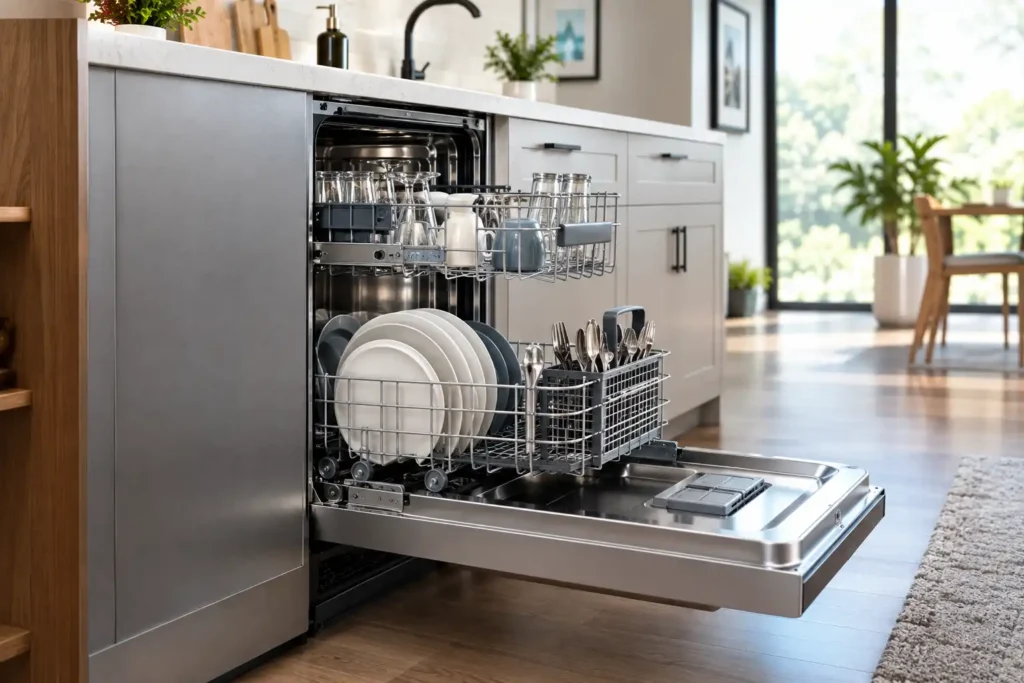
What to check on an Amana dishwasher
Before assuming that the wash motor has failed, check:
- Filter cleanliness
- Spray-arm openings
- Loading arrangement
- Detergent quantity
- Detergent type
- Incoming water temperature
- Rinse-aid level
- Hard-water buildup
- Cycle selection
- Water supply
A dishwasher that suddenly begins producing dirty dishes may therefore have a maintenance or loading problem rather than a major mechanical failure.
2. Frigidaire Dishwasher Common Problems
Frigidaire’s official troubleshooting information similarly identifies cleaning, draining, drying, leaking, odors, starting, filling, detergent, and control-related problems among dishwasher service concerns.
2.1 Frigidaire Dishwasher Not Cleaning Properly
A Frigidaire dishwasher may leave food or grease on dishes when the wrong cycle is selected, dishes are incorrectly loaded, detergent is unsuitable or incorrectly dosed, or the filter, glass trap, or spray arms become restricted.
Quick and short cycles are particularly important to understand. A short cycle may be appropriate for lightly soiled dishes but may not provide the same cleaning performance as a heavier cycle for baked-on or heavily soiled food.
Frigidaire also specifically advises checking the filter, glass trap, and spray arms when cleaning performance deteriorates. These components can collect food debris and become restricted over time.
Therefore, a Frigidaire dishwasher that is not cleaning properly should not automatically be classified as unreliable. The first diagnostic step should be to determine whether the problem is related to water circulation, loading, detergent, temperature, or maintenance.
3. Amana vs Frigidaire: Which Has More Cleaning Problems?
Cleaning performance is one of the most important dishwasher complaints across brands. Large-scale ownership research has found that failure to clean properly is one of the most frequently reported dishwasher problems.
Both Amana and Frigidaire provide troubleshooting instructions emphasizing filters, spray arms, loading, detergent, and water conditions. This indicates that cleaning problems in either brand can have multiple causes rather than being attributable to one defective component.
A practical comparison should therefore focus on the specific model. Two dishwashers carrying the same brand name can have different filtration systems, spray-arm configurations, wash motors, cycle selections, drying systems, and interior designs.
For consumers comparing an Amana and a Frigidaire dishwasher, it is therefore more useful to compare the exact model numbers than to assume that every dishwasher from either brand behaves identically.
4. Amana Dishwasher Not Draining
Water remaining in the bottom of a dishwasher is another common problem.
Amana’s troubleshooting information identifies several potential causes, including a dirty filter, debris in the sump, a restricted drain hose, problems at the sink or disposal connection, and possible drain-pump problems. Older or model-specific designs can also involve other components affecting the drain sequence.
A dishwasher drain system depends on several components working together. The pump must move wastewater out of the machine, while the hose must allow unrestricted flow toward the sink drain, disposal, or other approved connection. Improper hose routing can also contribute to drainage problems or wastewater returning toward the dishwasher.
A recently installed dishwasher deserves special attention because installation-related problems can mimic appliance failure. A kinked hose or an improperly prepared disposal connection can prevent normal drainage even when the dishwasher itself is operating correctly.
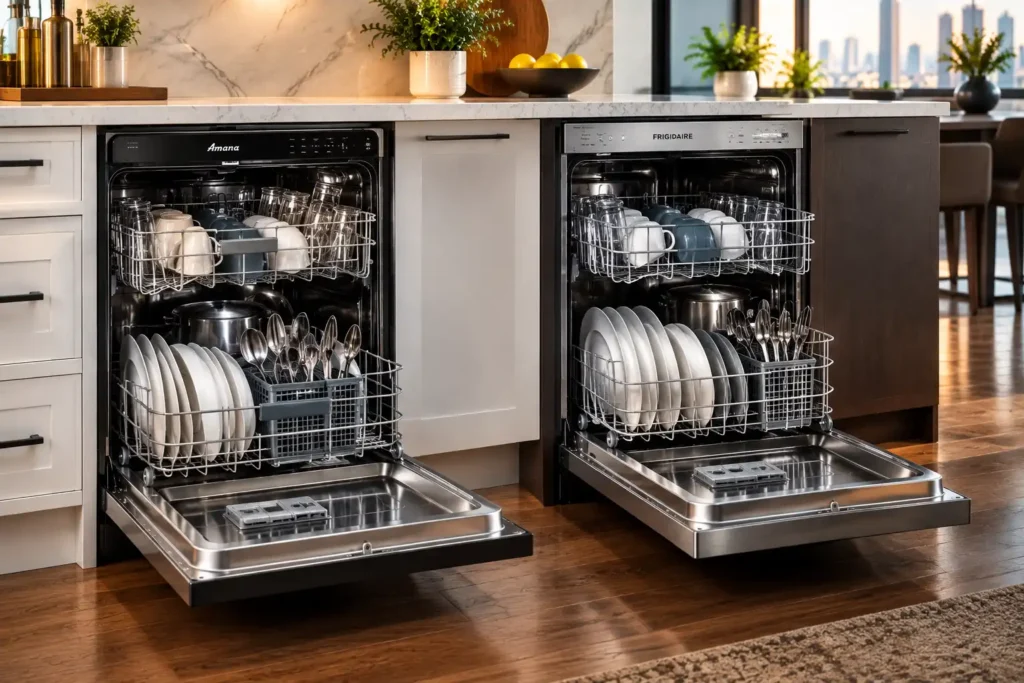
Amana draining checklist
Check:
- Filter
- Sump area
- Drain hose
- Hose routing
- Sink connection
- Garbage-disposal connection
- Disposal knockout plug where applicable
- Air gap where installed
- Drain pump operation
- Error codes or fault indicators
If cleaning the filter and checking the drain path does not resolve the issue, professional diagnosis may be necessary.
5. Frigidaire Dishwasher Not Draining
Frigidaire also identifies drainage as an important dishwasher troubleshooting category. Its guidance recommends checking the drain hose for kinks, maintaining the filter and glass trap, and verifying the disposal connection.
A new installation can produce a particularly common drainage problem when the knockout plug inside a newly installed garbage disposal has not been removed. In that situation, the dishwasher may be functioning normally while wastewater has nowhere to travel through the intended connection.
Frigidaire also explains that a clogged filter or glass trap can contribute to drainage problems. Cleaning these components should therefore be one of the first maintenance steps before assuming the drain pump has failed.
6. Amana vs Frigidaire Dishwasher Drainage Problems
There is considerable overlap between Amana and Frigidaire when it comes to drainage troubleshooting.
Both brands direct owners toward checking:
- Filters
- Drain hoses
- Sink connections
- Garbage disposals
- Blockages
- Installation-related hose problems
This similarity is logical because dishwashers use fundamentally similar drainage principles.
Large-scale dishwasher reliability research also identifies failure to drain as one of the common dishwasher problems reported by owners.
The important distinction is between a maintenance blockage and an actual component failure. A clogged filter or hose is usually a very different repair situation from a failed pump or control system.
7. Amana Dishwasher Not Drying Properly
Drying is another frequent source of dishwasher complaints.
Amana’s troubleshooting guidance identifies rinse aid, loading, water temperature, dry-cycle selection, and the heating element among the factors that influence drying performance.
Rinse aid is particularly important because it helps water run off dish surfaces rather than remaining in droplets. This can be especially noticeable with glassware, stainless steel, and other smooth surfaces.
Plastic items are more difficult to dry because their surfaces tend to retain water droplets. Therefore, finding water on plastic containers does not automatically indicate a failed heating element.
Some Amana models use door-opening or natural-drying approaches in addition to heated drying. When available, these systems can allow humid air to escape after washing and can improve drying performance.
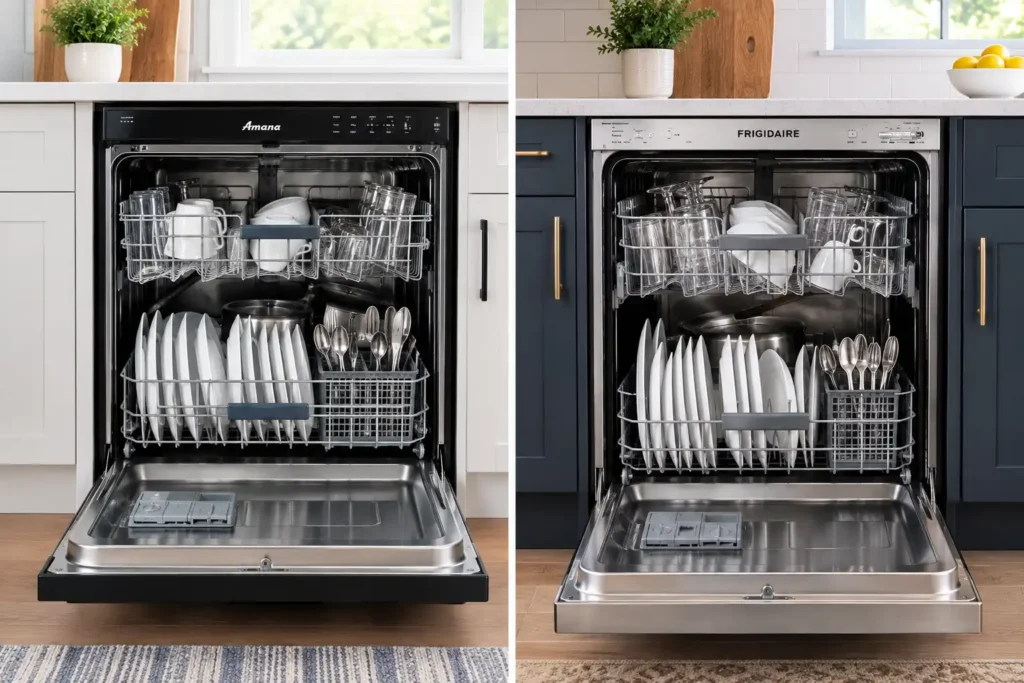
8. Frigidaire Dishwasher Not Drying Properly
Frigidaire also identifies several reasons dishes may remain wet.
Plastics, bowls, and other concave items may retain water even when the dishwasher’s drying system is functioning correctly. Short cycles may also provide less drying performance than cycles designed for more extensive drying.
Rinse aid can improve drying by helping water sheet away from dish surfaces. Certain Frigidaire models also use forced-air drying systems, while other models rely on different drying approaches depending on their design.
Water temperature is another factor. Frigidaire recommends appropriate hot-water conditions and notes that running the kitchen faucet until the water becomes hot can help optimize dishwasher performance.
9. Amana vs Frigidaire Drying Problems
Drying problems are particularly interesting because consumers sometimes interpret wet dishes as a reliability failure when the dishwasher may actually be operating normally.
Consumer ownership data identifies drying as one of the leading dishwasher complaints across the market.
For both Amana and Frigidaire, the first checks should be rinse aid, cycle selection, loading, water temperature, and the type of dishes remaining wet.
If plates and stainless-steel cookware are consistently wet while the interior remains unusually cold at the end of a cycle designed for heated drying, then investigation of the heating system becomes more relevant.
10. Amana Dishwasher Leaking
Water leaks can range from simple installation or detergent issues to component failures.
Amana identifies several possible sources, including door seals, leveling, excessive detergent, water-supply connections, and drain-line problems.
A dishwasher that is not level may not seal correctly around the door. Similarly, an object caught between the door and seal can create a path for water to escape.
Using ordinary hand-washing detergent is another potential cause. These products can produce excessive suds, which can push water toward areas that were not designed to handle large amounts of foam.
Underneath-the-dishwasher leaks can also originate from water-supply or drain connections. Therefore, the location of the water is an important diagnostic clue.
11. Frigidaire Dishwasher Leaking
Frigidaire’s troubleshooting guidance similarly identifies several potential causes of leakage.
Incorrect drain-hose installation, a blocked drain path, an improperly closed door, loose water-supply connections, a clogged filter, and excessive sudsing can all contribute to water appearing where it should not.
Frigidaire specifically warns against using ordinary dish soap in the dishwasher. Excessive sudsing can contribute to leaks, and spilled rinse aid can also create foam if it is not cleaned up.
The correct diagnostic approach is therefore to determine where the water originates before replacing parts.

12. Amana vs Frigidaire Dishwasher Leak Problems
Leakage is one area where installation quality matters almost as much as the dishwasher itself.
A leaking dishwasher can involve:
- Door gasket
- Door alignment
- Leveling
- Water inlet connection
- Drain hose
- Pump or sump seals
- Excessive suds
- Clogged drainage
- Improper installation
Both manufacturers’ troubleshooting information emphasizes these types of checks.
If water is actively leaking near electrical connections, underneath cabinetry, or from an unidentified internal component, the dishwasher should not simply be repeatedly operated to see whether the problem disappears. Water and electricity create a safety concern, and persistent leaks should be professionally assessed.
13. Bad Odor Problems
Dishwasher odors can occur with either Amana or Frigidaire.
Food particles can remain in the tub, filter, sump, spray-arm areas, or other hard-to-reach locations. Standing water caused by poor drainage can also contribute to unpleasant smells.
Frigidaire recommends periodic dishwasher cleaning and specifically connects standing water and drainage problems with odor development.
Amana similarly recommends inspecting the tub and removing food soils from areas where debris can accumulate.
A bad smell therefore does not automatically indicate a failed dishwasher. In many cases, the odor is an indication that the filter, tub, drain path, or surrounding plumbing needs attention.
14. Dishwasher Won’t Start
An Amana or Frigidaire dishwasher that refuses to start can create the impression of an electrical failure, but several simple causes should be eliminated first.
Frigidaire’s troubleshooting guidance recommends checking power, the circuit breaker, the door latch, water supply, delayed start settings, and drain-hose installation.
The door must be properly closed because the dishwasher is designed not to operate when the door is unsecured.
Some models may also display flashing lights or fault indicators when the machine detects a condition that prevents normal operation.
Amana’s troubleshooting system similarly separates startup problems from cleaning, drying, door, dispenser, and leak problems, demonstrating why diagnosing the exact symptom is more useful than simply labeling a machine as “not working.”
15. Detergent Dispenser Problems
A detergent dispenser that does not open can lead to dirty dishes even though the dishwasher appears to complete its cycle normally.
Amana explains that dishes, utensils, or rack components can physically block the dispenser door. Cleaning and maintaining the dispenser can also help maintain proper operation.
This is an excellent example of why loading matters. A large plate or utensil positioned incorrectly can interfere with the dispenser and prevent detergent from being released correctly.
Frigidaire also includes detergent-dissolving and dispenser issues among its dishwasher troubleshooting categories.

16. Water Not Filling Properly
A dishwasher requires a reliable water supply to operate correctly.
Frigidaire’s startup troubleshooting indicates that the dishwasher needs water entering the unit and recommends checking whether the household water supply is turned on.
Amana’s fault-code information also identifies situations in which the dishwasher does not detect incoming water and recommends checking the water supply and hose for restrictions.
Possible causes can include:
- Closed water valve
- Kinked supply hose
- Restricted inlet
- Inlet-valve problem
- Water-pressure issue
- Float or water-level problem
- Control-related fault
Not all of these require replacing the dishwasher.
17. Unusual Noises
Noise does not always mean something is broken.
A dishwasher naturally produces several sounds during operation. Frigidaire’s noise guidance identifies sounds associated with the water valve, wash pump, drain pump, detergent dispenser, ball valve, and spray arms.
For example, a spray arm can make a noticeable sound if it strikes a tall dish or utensil. A humming noise can also be associated with normal pump operation.
However, a new grinding, rattling, scraping, or continuously abnormal noise deserves attention, especially if it is accompanied by poor washing, poor drainage, or leakage.
The same principle applies to Amana. Before assuming a motor has failed, determine whether the sound occurs during filling, washing, draining, or drying.
18. Error Codes and Flashing Lights
Modern dishwashers increasingly use electronic controls to identify problems.
Amana’s current fault-code information includes conditions involving water detection, wash-motor faults, drainage problems, user-interface/control issues, and water-supply detection.
Frigidaire likewise provides troubleshooting information for flashing lights and model-specific fault indications. Some flashing patterns can relate to power interruption, an unclosed door, or control/keypad problems.
Because error codes vary by model, the exact model number is important. A code from one generation should not automatically be interpreted using the code list for another model.
19. Long Dishwasher Cycles
Long cycle times are another common source of complaints.
A long dishwasher cycle does not necessarily indicate a malfunction. Modern machines can use longer wash and drying periods to improve cleaning or reduce water and energy consumption.
Cycle duration can also change according to the selected program, water temperature, soil level, drying option, sensor decisions, and other model-specific operating conditions.
For this reason, owners should compare the observed cycle with the normal duration listed in the user manual rather than assuming that any long cycle is a defect.

20. Hard Water and Mineral Buildup
Hard water can make dishwasher problems more noticeable in all three major markets covered by this article.
Minerals can contribute to spots, filming, deposits, spray-arm restrictions, and reduced cleaning or drying performance. Amana specifically identifies rinse aid as useful for controlling hard-water deposits and improving drying.
Hard water can also affect the appearance of dishes even when the dishwasher is operating correctly. Increasing detergent indefinitely is not necessarily the solution because excessive detergent can introduce other problems.
A better approach is to understand local water hardness, maintain the dishwasher correctly, use suitable detergent and rinse aid, and follow the model’s instructions for water conditions.
21. Filter Maintenance Is One of the Most Important Preventive Steps
A dishwasher filter is one of the easiest components for an owner to overlook.
Food debris can accumulate in the filter and surrounding areas. As restrictions develop, cleaning performance and drainage can deteriorate. Both Amana and Frigidaire troubleshooting documentation repeatedly directs owners toward filters when addressing cleaning and drainage problems.
Frigidaire recommends periodic cleaning of the filter and glass trap, while Amana documentation also emphasizes filter maintenance as part of dishwasher care.
For households that run the dishwasher frequently, regular filter inspection is particularly important.
22. Loading Problems Can Look Like Mechanical Problems
Incorrect loading is one of the most underestimated causes of dishwasher complaints.
A dishwasher depends on water jets reaching the dishes. Plates stacked too tightly, bowls positioned incorrectly, tall utensils blocking spray arms, or objects obstructing the detergent dispenser can produce poor results even when every mechanical component is working properly.
Loading also affects drying. Concave dishes can hold water, while plastics may retain droplets even after a complete heated cycle.
This means that a dishwasher should be evaluated using a consistent loading pattern before deciding that it has a performance defect.
23. Amana vs Frigidaire: Which Problems Are Usually Easier to Fix?
Many dishwasher problems are relatively simple maintenance or installation issues rather than major mechanical failures.
Examples include:
- Dirty filters
- Blocked spray arms
- Kinked drain hoses
- Improper loading
- Excess detergent
- Incorrect cycle selection
- Lack of rinse aid
- Disposal connection problems
- Door obstruction
- Incorrectly positioned dishes
These issues can occur in both Amana and Frigidaire machines.
More complicated problems include failed pumps, inlet valves, heating components, electronic controls, wiring, sensors, or internal seals. Diagnosis of these components may require electrical testing or disassembly and is generally better handled by a qualified appliance technician.
24. Problems That Should Not Be Ignored
Some symptoms deserve more attention than ordinary cleaning or drying complaints.
These include:
- Persistent water leakage
- Electrical burning smell
- Repeated circuit-breaker trips
- Visible damaged wiring
- Water reaching electrical components
- Severe grinding or burning noises
- Repeated failure to drain
- Continuous overfilling
- Cracked internal components
- A heating system that appears to malfunction
- Repeated fault codes after basic troubleshooting
A dishwasher should not be repeatedly operated when there is an unresolved electrical or significant water-leak problem.
25. Amana vs Frigidaire Dishwasher Common Problems: Reliability Perspective
It is important to distinguish common problems from overall reliability.
A brand can have several common complaints while still producing many dishwashers that operate satisfactorily for years. Conversely, a dishwasher can be generally reliable while an individual unit develops a problem early in its ownership.
Consumer Reports’ large dishwasher survey shows that approximately 21% of surveyed dishwashers had broken down or stopped working as well as they should, with cleaning, drying, and drainage among the leading problems.
This reinforces an important point: dishwasher problems are not unique to one brand. The useful question is not simply “Does Amana have problems?” or “Does Frigidaire have problems?” Almost every dishwasher brand has some percentage of units that develop problems.
The more meaningful comparison involves the specific model, generation, design, warranty, repair availability, parts availability, and ownership history.

26. Amana vs Frigidaire: Common Problems by Category
When comparing the two brands, the following pattern is useful:
Cleaning
Both can experience poor cleaning due to filters, loading, detergent, spray arms, water temperature, or hard-water conditions.
Draining
Both can develop drainage problems involving filters, hoses, sink connections, disposal connections, or pumps.
Drying
Both can leave plastics and concave items wet. Rinse aid, loading, cycle selection, water temperature, and the drying system influence results.
Leaks
Both can experience leaks related to seals, hoses, leveling, drainage, installation, or excessive suds.
Odors
Both can develop odors when food debris accumulates or water remains standing.
Startup
Both may fail to start because of power, door, water-supply, control, or installation conditions.
Controls
Both have model-specific diagnostic systems, although the exact fault codes and flashing-light patterns vary considerably.
27. USA, Canada, and UK Considerations
Dishwasher problems can look similar across countries, but installation conditions can differ.
In the United States and Canada, dishwashers commonly connect to household hot-water plumbing and an electrical supply, while specific installation requirements vary by model and local code.
Canada also uses an energy-labeling system for appliances, making efficiency information available to consumers when comparing qualifying products.
In the UK, appliance efficiency information is presented through the applicable energy-label system, allowing consumers to compare efficiency characteristics when purchasing appliances.
Regardless of country, installation instructions should take precedence over generic troubleshooting advice. Drain-hose routing, electrical requirements, plumbing connections, water pressure, and local installation requirements can vary.
28. How to Prevent Common Amana Dishwasher Problems
Preventive maintenance can reduce many of the problems discussed above.
Start with the filter. Inspect and clean it according to the manufacturer’s instructions. A clean filter helps maintain water circulation and drainage.
Keep spray arms unobstructed. Check that holes are not blocked by food particles or mineral deposits and make sure tall items cannot interfere with their movement.
Use the correct dishwasher detergent. Avoid ordinary hand dishwashing liquid because excessive sudsing can contribute to leakage and operating problems.
Use rinse aid when appropriate. It can improve drying and reduce water spots, particularly in hard-water conditions.
Finally, periodically inspect the drain hose and the area beneath the sink. A dishwasher can develop drainage problems after plumbing work if the hose becomes kinked or the connection is disturbed.
29. How to Prevent Common Frigidaire Dishwasher Problems
Frigidaire owners can use a similar preventive approach.
Clean the filter and glass trap periodically, keep the spray arms clear, use appropriate detergent, and select the cycle according to the soil level of the dishes.
Pay attention to drainage. Standing water can contribute to odors and may indicate a restricted drain path.
Use rinse aid where appropriate to improve drying, especially when water hardness or plastic-heavy loads create persistent moisture.
Finally, avoid overloading the dishwasher. A dishwasher cannot compensate for water jets being physically blocked by tightly packed dishes.

30. Should You Repair or Replace an Amana or Frigidaire Dishwasher?
The decision depends on the age, condition, repair cost, model, and nature of the failure.
A dishwasher with a dirty filter, blocked hose, damaged gasket, or minor installation problem may be worth repairing because the underlying appliance may otherwise be functioning correctly.
A much older dishwasher with repeated pump, control, heating, leakage, and drainage problems presents a different economic calculation.
Manufacturer guidance itself recognizes that older dishwashers may eventually reach the point where replacement becomes more appropriate than continued repair.
The cost of the replacement part is only one factor. Labor, service-call charges, future repair risk, energy and water consumption, warranty coverage, and the overall condition of the appliance should also be considered.
31. What Is the Most Common Amana Dishwasher Problem?
There is no single problem that applies to every Amana model.
However, the most important categories to investigate are poor cleaning, poor drying, drainage, leaks, odors, startup issues, and dispenser problems. These categories appear repeatedly in Amana’s own troubleshooting materials.
If an Amana dishwasher is performing poorly, begin with the simplest explanations: filter, loading, detergent, spray arms, water supply, drain hose, and rinse aid.
32. What Is the Most Common Frigidaire Dishwasher Problem?
Frigidaire’s support information similarly covers cleaning, draining, drying, odors, leaks, starting, filling, detergent, and control problems.
Therefore, it would be misleading to identify one universal Frigidaire failure without specifying a model and symptom.
For owners, the most useful approach is symptom-based troubleshooting rather than brand-based assumptions.
33. Amana vs Frigidaire Dishwasher Common Problems: Overall Comparison
Amana and Frigidaire share many of the same fundamental dishwasher problems because both use similar categories of components: filters, spray arms, pumps, heating systems, water valves, drain hoses, electronic controls, door seals, detergent dispensers, and drying systems.
The biggest differences generally emerge at the model level rather than simply from the brand name.
A particular Amana model may have a different filtration or drying system from another Amana model. The same is true of Frigidaire.
Therefore, someone choosing between the brands should examine the exact model’s:
- Filter design
- Tub material
- Wash system
- Drying system
- Noise level
- Rack configuration
- Control design
- Warranty
- Replacement-part availability
- Service availability
- Energy and water specifications
- Historical owner feedback
Large-scale reliability research also cautions that reliability can change between brands and over time as designs and manufacturing change.

Frequently Asked Questions
Is Amana or Frigidaire more likely to have dishwasher problems?
Both brands can experience common dishwasher problems, including poor cleaning, poor drying, drainage issues, leaks, odors, and startup problems. Large-scale dishwasher research shows that these problems occur across the industry rather than being exclusive to one brand.
Do Amana dishwashers have a lot of problems?
Amana dishwashers can experience problems like any other dishwasher. Common troubleshooting categories include cleaning, drying, drainage, leaks, door operation, dispenser issues, and startup problems.
The exact experience depends heavily on the model, age, installation, water conditions, and maintenance.
Do Frigidaire dishwashers have a lot of problems?
Frigidaire dishwashers can also develop cleaning, drainage, drying, odor, leakage, startup, filling, and control-related problems.
A specific model should be evaluated rather than assuming every Frigidaire dishwasher has the same reliability characteristics.
Why does my Amana dishwasher leave dishes dirty?
Check the filter, spray arms, loading pattern, detergent, cycle selection, water temperature, and hard-water conditions. These are all recognized factors affecting cleaning performance.
Why does my Frigidaire dishwasher leave food on dishes?
Check the cycle selection, loading, detergent, filter, glass trap, and spray arms. Frigidaire specifically identifies these areas when troubleshooting poor cleaning.
Why does my Amana dishwasher have water in the bottom?
Possible causes include a clogged filter, debris in the sump, restricted drain hose, sink or disposal connection problems, or a drain-pump issue.
Why does my Frigidaire dishwasher not drain?
Check the filter and glass trap, drain hose, hose routing, disposal connection, and disposal knockout plug where applicable.
Why is my Amana dishwasher not drying?
Check rinse aid, loading, water temperature, drying-cycle selection, and the heating system. Plastics may remain wet even when the drying system is functioning normally.
Why is my Frigidaire dishwasher not drying?
Rinse aid, cycle selection, loading, water temperature, and the dishwasher’s particular drying system can all affect results. Plastic and concave dishes commonly retain water.
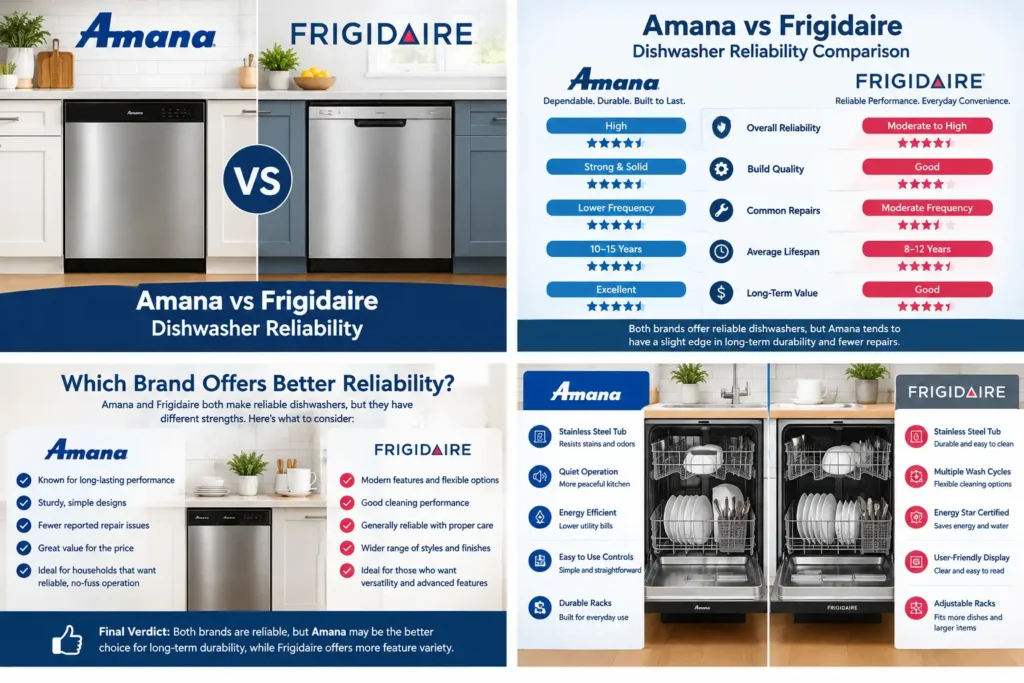
Why is my Amana dishwasher leaking from the door?
Possible causes include a damaged or contaminated gasket, improper leveling, an obstruction preventing the door from closing correctly, or excessive sudsing from incorrect detergent.
Why is my Frigidaire dishwasher leaking?
Check the door closure, drain hose, water-supply connection, filter, spray arms, and detergent type and quantity. Excessive sudsing can also cause leakage.
Why does my dishwasher smell bad?
Food debris, dirty filters, standing water, and drainage problems are common causes. Periodic cleaning and proper drainage can reduce odor problems.
Can hard water cause dishwasher problems?
Yes. Hard-water minerals can contribute to spots, filming, deposits, and reduced cleaning or drying performance. Rinse aid can help water drain from dishes and reduce mineral-related spotting.
Are dishwasher problems usually expensive to repair?
Not necessarily. Some problems are caused by filters, loading, hoses, detergent, rinse aid, or installation and may require little or no replacement of major components. More serious problems involving pumps, heating components, valves, controls, or internal seals can be more expensive.
Should I repair an old Amana dishwasher?
Consider the dishwasher’s age, repair cost, condition, previous repair history, and availability of parts and service. A minor repair may make sense, while repeated major failures can make replacement more practical. Manufacturer troubleshooting guidance also notes that older units may eventually be candidates for replacement.
Should I repair an old Frigidaire dishwasher?
Use the same approach: consider the repair cost against the appliance’s age, condition, previous repairs, and replacement cost. A simple hose, filter, seal, or other minor repair is very different from a major control, pump, or heating-system failure.
Is an Amana dishwasher or Frigidaire dishwasher easier to troubleshoot?
Both manufacturers provide extensive troubleshooting information. The exact difficulty depends on the model and problem. Basic maintenance problems such as filters, loading, hoses, and detergent are generally easier to investigate than internal electrical or mechanical failures.
Final Thoughts: Amana vs Frigidaire Dishwasher Common Problems
Amana and Frigidaire dishwashers can both experience the common problems found across the dishwasher industry: dishes that do not come clean, dishes that remain wet, water left in the tub, leaks, odors, startup failures, detergent-dispenser problems, unusual noises, and control or fault-code issues.
The important point is that a common problem is not automatically evidence of poor overall reliability. Many dishwasher problems are caused by maintenance, loading, detergent, water conditions, drainage installation, or other factors that can affect almost any dishwasher.
For Amana, filter maintenance, spray-arm cleanliness, rinse aid, correct loading, proper detergent, and drainage checks are particularly useful first steps.
For Frigidaire, the same fundamentals apply, with particular attention to the filter and glass trap, drain hose, disposal connection, detergent, rinse aid, loading, and drying-cycle selection.
The best way to compare Amana vs Frigidaire dishwasher problems is therefore to move beyond the brand name and investigate the specific model, exact symptom, age, installation, maintenance history, and component involved.
If a dishwasher is not cleaning, first investigate loading, detergent, filters, spray arms, and water temperature. If it is not draining, inspect the filter, sump, drain hose, and sink or disposal connection. If it is not drying, check rinse aid, loading, cycle selection, and heating performance. If it is leaking, identify the exact source before continuing to operate the appliance.
This symptom-based approach can prevent unnecessary part replacements and can also help owners determine when a simple maintenance correction is enough and when professional service is warranted.
Ultimately, neither Amana nor Frigidaire should be judged solely by the existence of common problems. Dishwasher ownership is strongly influenced by the individual model, installation quality, household water conditions, usage frequency, maintenance, and the way the appliance is loaded and operated. Large-scale owner research confirms that cleaning, drying, and drainage issues are among the most common dishwasher complaints generally, making these areas more useful to examine when comparing the two brands.