
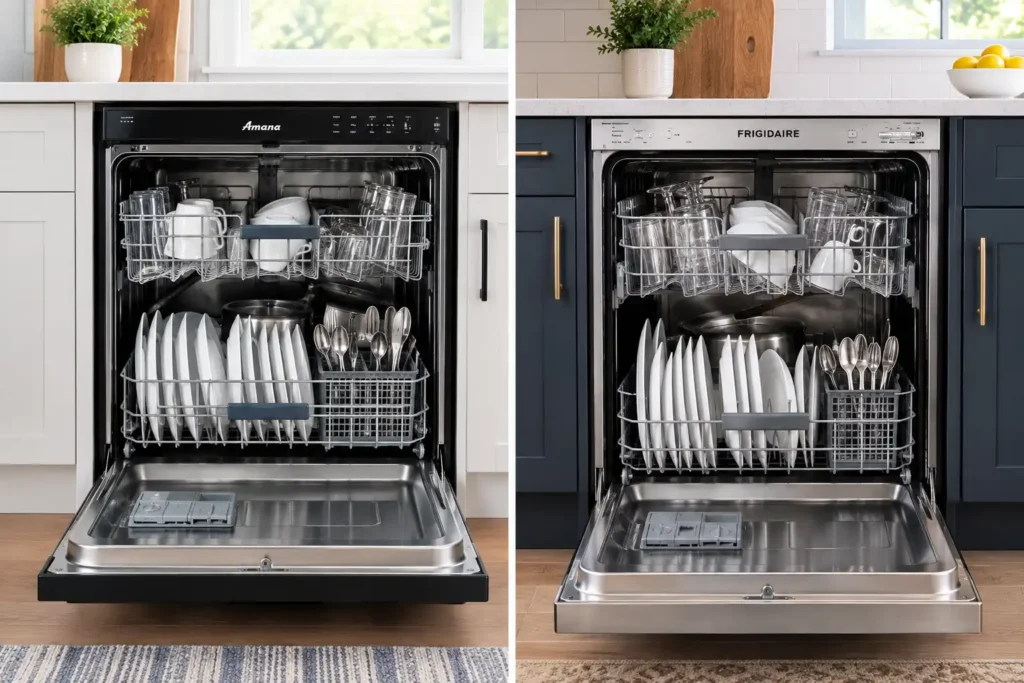
When comparing Amana vs Frigidaire dishwasher washing performance, the most important question is not simply which brand sells more dishwashers or which one has the lower price. The more useful question is how specific models perform when they are tested with heavily soiled dishes, how effectively they clean the upper and lower racks, how their wash systems distribute water, how sensors respond to soil levels, and how consistently the dishwasher can deliver good results under normal household conditions.
Consumer Reports evaluates dishwasher washing performance separately from other characteristics such as drying, noise, energy use and ease of use. Its dishwasher testing specifically considers how clean dishes come out after washing, including performance on heavily soiled loads. It also separates lower-rack and upper-rack washing performance because water distribution can differ substantially between the two racks.
The available testing provides interesting results for both Amana and Frigidaire. Several Amana dishwashers have achieved very good or excellent washing results in independent laboratory testing. Several Frigidaire models have also achieved very good or excellent results, including current-generation models. This means that neither brand can accurately be described simply as having “good” or “poor” washing performance across its entire product range.
For shoppers in the United States, Canada and the UK, there is another important consideration: dishwasher models and specifications can vary by market. A model sold in one country may not have the same programme structure, capacity, wash options or efficiency label as a similarly named model in another country. The exact model number should therefore be checked before applying test results to a purchase decision.
Amana vs Frigidaire Dishwasher Washing Performance at a Glance
| Washing-performance factor | Amana | Frigidaire |
|---|---|---|
| Heavily soiled dish testing | Several models tested very good to excellent | Several models tested very good to excellent |
| Lower-rack washing | Model dependent | Model dependent |
| Upper-rack washing | Model dependent | Model dependent |
| Soil sensing | Available on some models | Available on many current models |
| Multiple spray arms | Model dependent | Available on selected current models |
| Filtration | Model dependent | Model dependent |
| Hard-food cleaning | Model dependent | Model dependent |
| Quick-cycle cleaning | Depends heavily on model and soil level | Depends heavily on model and soil level |
| Sanitization option | Available on selected models | Available on selected models |
| Loading flexibility | Generally varies by model | Generally varies by model |
| Best comparison method | Exact model number | Exact model number |
This comparison is intentionally model-specific. Consumer Reports’ published testing shows that different models from the same brand can receive different washing results, so a brand name alone is not enough to predict cleaning performance.

What Consumer Reports Means by Washing Performance
Consumer Reports’ dishwasher testing does not simply determine whether a dishwasher can remove ordinary food residue. Its washing test includes heavily soiled dishes, providing a more demanding test of the machine’s ability to remove baked-on or dried food.
The testing also distinguishes between the lower and upper racks. A high lower-wash result indicates that dishes placed on the lower rack come out cleaner, including dishes with baked-on food. Upper-wash performance similarly evaluates cleaning on the upper rack.
This distinction is important because dishwasher cleaning is fundamentally a water-distribution problem. The machine has to deliver sufficient water and detergent to different areas of the tub while dishes, pans, glasses and utensils can partially block spray patterns. A dishwasher that performs well on the lower rack may not necessarily deliver identical results on the upper rack.
Consumer Reports also evaluates energy use separately. Its energy test combines water and energy use for a fully soiled load, meaning washing performance and efficiency are related but remain separate aspects of dishwasher performance.
Amana Dishwasher Washing Performance
Amana has produced several dishwashers that have performed well in independent washing tests.
One useful example is the Amana ADB1500ADS. Consumer Reports reports that this model performed excellent in its wash test of heavily soiled dishes. The same model also received an excellent result for its combined water-and-energy test.
Another example is the Amana ADB1400AGW. Consumer Reports reports that it performed very good in its wash test of heavily soiled dishes. This is significant because it shows that a relatively straightforward Amana dishwasher can achieve strong cleaning results even without the extensive feature package associated with more expensive machines.
The older Amana ADB1100AWW also achieved a very good washing result in Consumer Reports testing of heavily soiled dishes. This gives additional evidence that strong cleaning has not been limited to one isolated Amana model.
However, these results should not be interpreted as a universal rating for every Amana dishwasher. The current Amana ADFS2524RB, for example, has a different configuration, including a sensor that monitors conditions during the cycle and adjusts settings for cleaning. Its feature package also differs from the older models used in earlier testing.
This distinction is particularly important when publishing or reading an Amana-versus-Frigidaire comparison. A strong result from an older model demonstrates that Amana has produced effective cleaning systems, but it does not automatically establish the exact same result for every current model.
Frigidaire Dishwasher Washing Performance
Frigidaire also has a substantial history of strong washing results in independent testing.
The Frigidaire FDSP4401AS is one of the clearest examples. Consumer Reports reports that this model performed excellent in its wash test of heavily soiled dishes. Its energy-use result was also very good.
The Frigidaire FDPH4316AS provides another current-generation example. Consumer Reports reports that it performed very good in its heavily soiled dishwashing test. Its energy-use and noise results were also very good under the laboratory conditions used for testing.
The Frigidaire GDSH4715AF also received an excellent washing result for heavily soiled dishes, together with very good energy and noise results.
Other Frigidaire models have similarly achieved very good or excellent washing results. The FFCD2418US, for example, is reported as very good in the heavily soiled washing test.
This range of results demonstrates that Frigidaire’s washing performance also depends heavily on the model’s wash-system design rather than simply the Frigidaire name.

Amana vs Frigidaire on Heavily Soiled Dishes
Heavily soiled dishes are among the most useful tests when comparing dishwasher cleaning performance because they expose weaknesses that may not be obvious during an ordinary lightly soiled load.
Consumer Reports reports an excellent heavily soiled washing result for the Amana ADB1500ADS and very good results for models such as the ADB1400AGW and ADB1100AWW.
Frigidaire’s results are similarly varied but include multiple excellent and very good performers. The FDSP4401AS and GDSH4715AF achieved excellent results, while the FDPH4316AS, FFCD2418US and several other models achieved very good results.
The practical conclusion is that both brands have demonstrated the ability to clean heavily soiled dishes effectively. The specific wash system, programme, loading arrangement and model generation matter more than assuming that one entire brand uses a universally superior cleaning system.
How Dishwasher Spray Arms Affect Washing Performance
Spray-arm design is one of the fundamental components of dishwasher cleaning.
Water has to reach different parts of the rack while dishes are positioned at different angles. Spray arms use strategically positioned openings to distribute water throughout the tub. The effectiveness of this arrangement depends on water pressure, spray pattern, rotation, rack configuration and how heavily the dishwasher is loaded.
Current Frigidaire models illustrate how manufacturers continue to develop spray coverage. The FDPH4316AB, for example, is specified with three spray arms intended to provide greater water coverage during the cleaning cycle.
Other current Frigidaire models use specialized rotating spray systems. One current model uses a rotating wash arm with multidirectional spray patterns designed to increase coverage without requiring additional water.
Amana models also use multiple spray and filtration components, although the exact arrangement varies by model. Current Amana documentation emphasizes proper filter maintenance because food debris can accumulate in the filtration system and interfere with dishwasher performance.
This means that comparing spray-arm count alone is not enough. The geometry, spray pattern, water delivery and rack layout all contribute to actual cleaning.
Soil Sensors and Cleaning Performance
Modern dishwasher sensors can change how a dishwasher approaches a load.
A soil sensor monitors characteristics of the wash water or other operating conditions and allows the dishwasher to modify portions of the programme based on the detected condition of the load.
The current Amana ADFS2524RB is described as having a sensor that monitors conditions during the cycle and automatically adjusts settings for more efficient cleaning.
Frigidaire similarly uses DishSense sensor technology on current models. The manufacturer describes the system as adjusting cleaning performance according to the soil level of the dishes.
Sensor technology does not mean that the dishwasher can compensate for every loading mistake. If a plate blocks the spray arm or a large pan prevents water from reaching dishes behind it, a sensor cannot physically move the item or change the geometry of the load.
Good sensor technology therefore works best when combined with proper loading.

Does a Soil Sensor Make Amana or Frigidaire Clean Better?
Not necessarily.
A sensor can help a dishwasher respond to the conditions it detects, but cleaning performance still depends on water distribution, detergent concentration, temperature, filtration, cycle programming and loading.
This is why Consumer Reports’ laboratory washing result is more informative than simply counting the number of sensors listed on a specification sheet.
The testing of individual models demonstrates that strong washing results can be achieved by machines with different combinations of features.
Lower-Rack Cleaning: Amana vs Frigidaire
The lower rack is normally where heavily soiled plates, cookware and larger food-contact items are placed.
Consumer Reports specifically identifies lower-wash performance as a separate criterion. A high result indicates that dishes on the lower rack come out cleaner even when they contain baked-on food.
This makes lower-rack performance particularly relevant for households that wash casserole dishes, dinner plates, baking dishes and pots.
Amana’s ADB1500ADS achieved an excellent overall washing result for heavily soiled dishes, demonstrating that its wash system was capable of handling demanding loads under the test conditions.
Frigidaire’s FDSP4401AS and GDSH4715AF also achieved excellent heavily soiled washing results, indicating strong cleaning capability in their respective tests.
Because the published summaries do not expose every numerical subscore without membership access, it would be inappropriate to invent an exact lower-rack numerical comparison between brands.
Upper-Rack Cleaning: Why It Matters
The upper rack presents a different challenge.
Glasses, cups, bowls and smaller objects are often placed there, and they may be positioned farther from the main lower spray area.
Consumer Reports therefore evaluates upper-wash performance separately. This is useful because a dishwasher can have strong overall cleaning while still having differences between rack positions.
When comparing Amana and Frigidaire, consumers should therefore look for model-specific upper-rack washing information rather than relying on a single overall washing description.
This is especially important for households that put large numbers of glasses, bowls and cups into the dishwasher every day.
Baked-On Food and Dried Food
Baked-on food is among the hardest cleaning challenges for a dishwasher.
Once food has dried and bonded to a surface, the dishwasher has to combine water temperature, detergent chemistry, mechanical spray action and sufficient programme time to remove it.
Consumer Reports specifically incorporates heavily soiled dishes into its washing tests, which makes its results more useful than a simple claim that a dishwasher “cleans dishes.”
Both Amana and Frigidaire have models that have demonstrated strong performance under these demanding conditions. However, users should remember that laboratory results represent standardized loads and do not mean every possible type of baked-on food will disappear without preparation.
Quick Wash Cycles and Washing Performance
Quick cycles are useful for lightly or moderately soiled dishes, but they are not necessarily intended to replace the longest heavy-duty programme for badly baked-on food.
Frigidaire’s own support documentation warns that Quick Wash and 30-minute cycles may not clean heavily soiled dishes. It also notes that loading, detergent, filter condition and spray-arm condition can affect cleaning quality.
This is an important point when comparing Amana and Frigidaire.
A dishwasher may produce excellent results during a standard or heavy cycle but provide less effective results when the user consistently chooses the fastest available programme for heavily soiled cookware.
Detergent and Amana vs Frigidaire Cleaning Performance
Dishwasher detergent is part of the cleaning system.
The dishwasher provides water pressure, heat, mechanical action and programme control, while the detergent supplies the chemistry needed to break down grease, proteins, starches and other food residues.
Using too little detergent can leave food behind. Using too much can also create problems, particularly under certain water conditions.
Frigidaire’s support documentation recommends following detergent instructions and warns that detergent can remain in the dispenser if something blocks the dispenser.
Therefore, if an Amana or Frigidaire dishwasher appears to clean poorly, changing the detergent or checking loading and dispenser operation may be more appropriate than immediately assuming the wash motor is defective.
Water Temperature and Cleaning
Temperature is another important component of dishwasher cleaning.
Hotter water helps detergent work effectively and assists with removing grease and food residue. Dishwasher programmes manage water temperature as part of the overall cleaning sequence.
Sanitization programmes can use higher temperatures and specific programme conditions, but a sanitation programme should not be confused with ordinary washing performance.
Current Amana documentation notes that only designated sanitizing cycles are designed to meet the applicable residential sanitation performance standard; it specifically cautions that not every cycle on a certified dishwasher is designed to meet that same soil-removal and sanitization performance standard.
This distinction is important for consumers who see a “sanitize” button and assume that every cycle provides the same level of performance.
Sanitization vs Cleaning Performance
Cleaning and sanitization are related but different.
Cleaning removes food residue and visible soil.
Sanitization is concerned with reducing microorganisms to specified levels under defined test conditions.
A dishwasher can therefore be very good at cleaning while a particular cycle is not intended to provide the same sanitation performance as a certified sanitizing cycle.
Current residential dishwasher documentation identifies NSF/ANSI 184 as the relevant performance standard for designated sanitizing cycles.
Consumers should therefore select the appropriate cycle according to the load and desired result instead of assuming that the sanitize option is necessary for ordinary dishwashing.

Filtration and Washing Performance
The filtration system is another major part of dishwasher cleaning.
During a cycle, food particles are removed from dishes and suspended in the wash water. The dishwasher’s filtration system helps prevent those particles from continually interfering with the wash process.
Amana’s current dishwasher maintenance documentation recommends removing and cleaning filters periodically for best performance and warns against operating the dishwasher with loose or missing filters.
Frigidaire’s support documentation similarly explains that debris can become trapped in the filter, glass trap and spray arms and that these components should be cleaned when a dishwasher is not cleaning properly.
This demonstrates that filtration is not merely a technical feature. It is part of the dishwasher’s ongoing cleaning performance.
Does a Self-Cleaning Filter Mean Better Washing?
Not necessarily.
A self-cleaning filter can reduce the amount of manual maintenance required, but filter design by itself does not determine the dishwasher’s total washing performance.
Consumer Reports lists both Amana and Frigidaire models with manually cleaned and self-cleaning filter arrangements. The washing results of these models vary, showing why filter type should not be treated as a direct substitute for laboratory cleaning results.
A manually cleaned filter can work very effectively if it is maintained properly.
Hard Water and Amana vs Frigidaire Washing Performance
Hard water can complicate dishwasher cleaning.
Calcium and magnesium minerals can contribute to deposits on dishes, dishwasher surfaces and components. Over time, mineral accumulation can interfere with spray openings and other components.
The underlying dishwasher brand does not eliminate the effect of hard water.
Users with hard water should follow the manufacturer’s detergent and maintenance instructions and pay particular attention to rinse aid, filter condition and periodic cleaning.
The same principle applies to Amana and Frigidaire: a dishwasher operating in a hard-water environment may require more maintenance than an identical machine operating with softer water.

Loading Has a Major Effect on Cleaning
Dishwasher loading is one of the easiest factors to overlook.
The strongest wash system cannot clean a surface that water cannot reach.
Large plates can block smaller dishes. Pots can obstruct spray patterns. Cutting boards can prevent water from reaching the rack behind them. Bowls positioned incorrectly can hold dirty water.
Frigidaire’s official support information specifically identifies improper loading as a potential cause of poor cleaning and recommends checking how dishes are positioned.
The same physical principle applies to Amana.
Therefore, differences between two brands can sometimes appear larger or smaller depending on how the user loads each machine.
Rack Flexibility and Cleaning Results
Rack design indirectly affects washing performance because it determines how freely water can reach the dishes.
An adjustable rack can create additional clearance for large plates or cookware. Adjustable tines can change the orientation of dishes and allow more effective water access.
The Amana ADFS2524RB, for example, is listed without an adjustable upper rack or adjustable tines.
Some Frigidaire models offer more rack flexibility. The FDSP4401AS, for example, has an adjustable upper rack, although it does not have adjustable tines.
This does not automatically make one dishwasher a better cleaner. It can, however, make it easier for the user to create a load configuration in which water reaches more surfaces.
Three Spray Arms vs Two: Does More Mean Better?
Not automatically.
A greater number of spray arms can potentially provide additional water coverage, but the effectiveness depends on spray pattern, water pressure, arm geometry and programme design.
The current Frigidaire FDPH4316AB uses three spray arms and describes them as providing more effective water coverage.
However, a dishwasher with fewer spray components can still produce strong cleaning results if its water distribution is well designed.
Consumer Reports’ model-level testing is therefore more meaningful than simply counting spray arms.

Cycle Length and Cleaning Performance
Longer cycles are not automatically better, but heavy soil often requires more time for the combined effects of heat, detergent and mechanical washing.
Consumer Reports reports poor cycle-time results for several models that nevertheless produced very good or excellent washing performance. For example, the Frigidaire FDPH4316AS achieved very good washing performance despite receiving a poor cycle-time assessment under the test conditions.
The same pattern appears in other models.
This demonstrates that a long cycle can coexist with strong cleaning performance. Consumers who prioritize speed should therefore examine cycle time separately from washing performance.
Eco Cycles and Washing Performance
Modern dishwashers increasingly use longer, lower-resource eco programmes.
In the UK, household dishwashers are required to provide an eco programme, and the applicable regulations establish both energy-efficiency and cleaning-performance requirements. The regulations specify a minimum cleaning-performance index as part of the requirements for household dishwashers.
This is important because efficiency does not simply mean reducing water until dishes stop becoming clean.
Modern dishwasher engineering attempts to balance water consumption, energy use and cleaning effectiveness through spray patterns, sensors, filtration and programme control.
Amana vs Frigidaire for Everyday Food Residue
For normal food residue such as sauces, rice, vegetables, cereal, pasta and light grease, both brands offer models capable of effective automatic cleaning.
The difference becomes more significant when the load contains heavily baked-on food, blocked rack positions, large cookware or dried residue.
Consumer Reports’ tests of heavily soiled dishes show that individual models from both Amana and Frigidaire can perform strongly.
Therefore, the exact model and cycle selection should be considered before drawing conclusions about everyday performance.

Amana vs Frigidaire for Pots and Pans
Pots and pans can be among the hardest items to clean because they have larger surfaces, deeper shapes and more stubborn food residue.
The lower rack is generally intended to accommodate these larger items, but loading them incorrectly can block water from reaching other dishes.
A strong dishwasher can still struggle if a large pan is positioned so that it shields several plates from the spray.
For households that frequently wash pots and pans, rack flexibility, lower-rack layout and heavy-cycle performance deserve particular attention.
Amana vs Frigidaire for Glasses and Cups
Glasses and cups are usually placed on the upper rack.
Their cleaning depends heavily on water reaching the inside surfaces.
If cups are positioned at an angle that allows dirty water to pool, cleaning and rinsing can suffer regardless of the brand.
This is one reason Consumer Reports separates upper-rack washing performance from lower-rack performance.
Amana vs Frigidaire for Plates
Plates are normally positioned vertically on the lower rack.
Spacing matters because closely packed plates can block water from reaching their surfaces.
Adjustable tines can sometimes make it easier to alter spacing and accommodate different plate sizes.
Because rack arrangements differ between models, consumers should examine the actual rack design rather than assuming that every 24-inch dishwasher has the same usable capacity.
Washing Performance and Energy Efficiency
Cleaning performance and energy efficiency can sometimes pull in different directions.
Using more water and heat can potentially increase cleaning power, but modern dishwasher engineering seeks to obtain strong cleaning results with controlled resource use.
Current efficiency programmes therefore rely on technologies such as improved spray patterns, better motors, soil sensing and reduced unnecessary water use.
The challenge is to reduce water and energy without compromising cleaning. Technical research on efficient dishwasher design specifically identifies soil sensors, improved motors and spray-pattern improvements as important technologies while noting that excessive water reduction can negatively affect cleaning performance.
This is one reason a good dishwasher comparison should consider both washing performance and efficiency.
Washing Performance in the United States
U.S. consumers can use independent testing, manufacturer specifications and efficiency labeling together.
The exact model number should be used when comparing Amana and Frigidaire because different models can have different sensors, spray systems, filtration arrangements and racks.
A dishwasher marketed as a value model can still have strong washing performance, as demonstrated by several Amana and Frigidaire models tested by Consumer Reports.

Washing Performance in Canada
Canadian consumers should also verify the exact Canadian model.
Canadian regulations classify household dishwashers by capacity and establish efficiency and water-consumption requirements. Canadian labeling requirements also provide consumers with standardized product information.
Cleaning performance should still be evaluated separately from energy consumption. A low-energy dishwasher is not automatically a better cleaner, and a higher-energy model is not automatically a stronger cleaner.
Washing Performance in the UK
UK consumers need to pay particular attention to the actual UK model and its eco programme.
Current UK rules require household dishwashers to provide an eco programme and include minimum cleaning-performance requirements as part of the regulatory framework.
UK energy labels also provide standardized information such as eco-programme capacity, energy consumption per 100 cycles, water consumption per cycle and programme duration.
Consequently, a UK buyer should compare the UK energy label and product information for the exact Amana or Frigidaire model available in that market.
Why Consumer Reports Model Testing Matters
Consumer Reports testing is particularly useful because it allows consumers to move beyond manufacturer claims.
For example, a manufacturer can describe a dishwasher as having powerful cleaning, but independent laboratory testing provides a separate measurement of how that model actually performed against a standardized heavily soiled load.
Amana models such as the ADB1500ADS and ADB1400AGW have produced excellent or very good washing results, while Frigidaire models such as the FDSP4401AS, FDPH4316AS and GDSH4715AF have also produced excellent or very good results.
This makes model-level testing particularly useful for consumers who are deciding between similarly priced dishwashers.

Why One Consumer Reports Result Should Not Be Generalized
A dishwasher model can change during its production life.
Manufacturers can introduce new motors, control boards, spray arms, racks, sensors and filtration systems.
Consumer Reports itself identifies the importance of model-specific testing and provides separate pages for individual dishwasher models. Its current research also uses owner survey information covering a large population of dishwasher purchases.
Therefore, an older Amana model’s excellent washing result should not automatically be transferred to a newer Amana model.
The same applies to Frigidaire.
Amana vs Frigidaire Washing Performance: What the Evidence Shows
The available evidence provides several useful observations.
Amana has produced models with very strong washing performance. The ADB1500ADS achieved an excellent heavily soiled washing result, while the ADB1400AGW and ADB1100AWW achieved very good results.
Frigidaire has also produced multiple models with strong washing results. The FDSP4401AS and GDSH4715AF achieved excellent results, while the FDPH4316AS, FFCD2418US and other models achieved very good results.
The evidence therefore supports a model-by-model approach.
The exact wash system, rack design, spray coverage, sensor technology, filtration, programme options and loading flexibility can make a meaningful difference.
How to Improve Washing Performance on an Amana Dishwasher
Even a well-performing dishwasher needs proper use.
Start by checking that the spray arms can rotate freely. Large pans, utensils or tall plates should not obstruct their movement.
Clean the dishwasher filter according to the manufacturer’s instructions. Current Amana documentation recommends periodic filter removal and cleaning for best performance.
Use an appropriate dishwasher detergent and avoid exceeding the recommended amount.
Load plates so that water can reach their surfaces.
Avoid stacking bowls or nesting spoons.
Do not place large cutting boards or baking trays where they completely block water from reaching the rack behind them.
Finally, use the appropriate cycle for the soil level.
How to Improve Washing Performance on a Frigidaire Dishwasher
The same basic principles apply to Frigidaire.
Frigidaire’s support documentation specifically recommends checking the selected cycle, loading arrangement, detergent and maintenance condition when dishes are not being cleaned properly.
Filters, spray arms and the glass trap should be checked for accumulated debris.
Quick cycles should not be treated as a replacement for heavy-duty programmes when dishes contain significant baked-on food.
Sensor-equipped models can adjust cleaning according to soil conditions, but correct loading remains essential.

Amana vs Frigidaire Washing Performance: Common Mistakes
Mistake 1: Comparing Only Brand Names
Amana and Frigidaire each sell multiple dishwasher configurations.
Mistake 2: Assuming More Spray Arms Always Means Better Cleaning
Water distribution depends on much more than spray-arm count.
Mistake 3: Ignoring the Upper Rack
A dishwasher can clean the lower rack very well while producing different results on the upper rack.
Mistake 4: Using Quick Wash for Everything
Short cycles may not be appropriate for heavily soiled dishes.
Mistake 5: Overloading the Dishwasher
Overloading can prevent water from reaching food-covered surfaces.
Mistake 6: Forgetting the Filter
A blocked or dirty filter can interfere with cleaning performance.
Mistake 7: Ignoring Water Hardness
Mineral deposits can affect long-term dishwasher performance.
Mistake 8: Comparing an Old Model to a New Model
A new generation may use a completely different wash system.
Frequently Asked Questions
Is Amana or Frigidaire better at washing dishes?
Consumer Reports testing shows strong washing performance from specific models of both brands. Several Amana models have achieved very good or excellent heavily soiled washing results, while several Frigidaire models have also achieved very good or excellent results. The evidence is therefore best interpreted at the model level rather than as a universal brand comparison.
Which Amana dishwasher has strong washing performance?
The Amana ADB1500ADS is one documented example, receiving an excellent result in Consumer Reports’ heavily soiled washing test. The ADB1400AGW and ADB1100AWW received very good washing results.
Which Frigidaire dishwasher has strong washing performance?
Several Frigidaire models have performed strongly. The FDSP4401AS and GDSH4715AF received excellent heavily soiled washing results, while the FDPH4316AS received a very good result.
Does Frigidaire clean better than Amana?
The available model-level testing does not justify treating the entire Frigidaire range as uniformly better or worse than the entire Amana range. Individual models from both brands have achieved strong washing results.
Does Amana have good dishwasher cleaning performance?
Yes, several Amana models have demonstrated very good or excellent cleaning performance in independent testing of heavily soiled dishes.
Does Frigidaire have good dishwasher cleaning performance?
Several Frigidaire models have achieved very good or excellent results in heavily soiled dishwashing tests.
Does a soil sensor improve dishwasher cleaning?
A soil sensor can help a dishwasher adjust portions of its cleaning programme according to detected conditions. Current Amana and Frigidaire models use sensor technology for this purpose. However, sensors do not eliminate the importance of detergent, loading, water distribution or filtration.
Does having three spray arms make a Frigidaire dishwasher clean better?
Three spray arms can increase water coverage, and current Frigidaire models describe this as an advantage. However, spray-arm count alone cannot establish total cleaning performance. Spray pattern, water pressure, rack arrangement, programme design and loading also matter.
Can an Amana dishwasher remove baked-on food?
Some Amana models have performed very well or excellently when tested with heavily soiled dishes, including the ADB1500ADS. Actual household results depend on the model, cycle, loading and preparation of the dishes.
Can a Frigidaire dishwasher remove baked-on food?
Several Frigidaire models have achieved excellent or very good results in heavily soiled dishwashing tests.
Why are my dishes still dirty after using an Amana dishwasher?
Possible causes include incorrect loading, blocked spray arms, a dirty filter, unsuitable detergent, insufficient detergent, inappropriate cycle selection or water-quality problems. Current manufacturer documentation specifically identifies filter, spray-arm, loading and detergent issues as potential causes of poor cleaning.
Why are my dishes still dirty after using a Frigidaire dishwasher?
Check the cycle selected, loading arrangement, detergent, filter, glass trap and spray arms. Manufacturer support information identifies each of these as potential contributors to poor cleaning.
Does a longer dishwasher cycle clean better?
Not automatically, but longer cycles can provide additional time for heating, detergent action and mechanical cleaning. Consumer Reports has documented models with strong washing performance but relatively long cycle times, demonstrating that cycle duration and cleaning performance are separate characteristics.
Should I pre-rinse dishes before putting them in the dishwasher?
Modern dishwashers are designed to handle food residues without requiring extensive hand washing beforehand. However, large pieces of food should generally be removed, and the dishwasher should be loaded so that spray water can reach the surfaces.
Is a dishwasher sensor more important than the spray arms?
Neither feature can be considered independently decisive. Sensors help adjust programme operation, while spray systems physically deliver water to the dishes. Effective cleaning depends on the interaction of sensors, spray distribution, temperature, detergent, filtration and loading.
Is washing performance different between the USA, Canada and UK?
The underlying cleaning principles are the same, but exact models and programmes can vary by market. UK regulations establish specific eco-programme and cleaning-performance requirements, while Canadian regulations and labeling apply their own framework. Consumers should therefore compare the exact model sold in their country.
Does hard water make one brand clean better than the other?
Hard water can affect dishwasher performance regardless of brand. Mineral deposits can accumulate on components and dishes, making proper detergent use, rinse-aid use and maintenance important.
Does a stainless-steel tub improve washing?
A stainless-steel tub can have advantages related to construction and heat retention, but tub material alone does not determine washing performance. Independent testing of the complete dishwasher is more useful.
Does a self-cleaning filter improve cleaning?
A self-cleaning filter can reduce maintenance requirements, but it does not automatically mean the dishwasher will clean better. Models with different filter systems have demonstrated different washing results.
What should I compare when buying an Amana or Frigidaire dishwasher?
Compare the exact model number, heavily soiled washing performance, lower-rack washing, upper-rack washing, rack flexibility, spray system, filtration, sensor technology, cycle options, detergent requirements, water use, energy use, noise, drying, warranty and service availability.
Final Conclusion: Amana vs Frigidaire Dishwasher Washing Performance
The available independent testing shows that both Amana and Frigidaire have produced dishwashers capable of strong washing performance.
Amana’s documented results include very good washing performance from the ADB1100AWW and ADB1400AGW and excellent heavily soiled washing performance from the ADB1500ADS.
Frigidaire has also produced several strong performers. The FDSP4401AS and GDSH4715AF achieved excellent heavily soiled washing results, while the FDPH4316AS and several other models achieved very good results.
The important lesson is that dishwasher washing performance should be evaluated by model rather than by brand alone.
The wash motor, spray arms, water distribution, soil sensor, filtration system, rack configuration, detergent, water temperature and programme duration all work together to determine how clean the dishes become.
A dishwasher with sophisticated features can still perform poorly if it is overloaded or maintained incorrectly. Conversely, a relatively straightforward dishwasher can deliver strong results when its wash system is properly designed and the machine is correctly loaded.
For U.S. consumers, independent laboratory testing and model specifications provide useful comparison information. For Canadian buyers, the exact Canadian model and its regulatory labeling should be checked. For UK buyers, the actual UK model, eco programme and energy information should be examined because market-specific specifications can differ.
Ultimately, the most useful comparison is not simply “Amana vs Frigidaire.” It is Amana model X vs Frigidaire model Y, using the same criteria: heavily soiled washing, lower-rack cleaning, upper-rack cleaning, loading flexibility, spray coverage, filtration, sensor technology, cycle options and real-world maintenance requirements.
That approach gives consumers a much clearer understanding of what their dishwasher is actually capable of cleaning and avoids assuming that every dishwasher carrying the same brand name performs identically.