
Choosing between an Amana dishwasher and a Frigidaire dishwasher can be surprisingly difficult. Both brands sell relatively affordable dishwashers, both offer standard 24-inch built-in models, and both have models that appear in independent dishwasher testing. However, the differences become more important when you look beyond the purchase price and examine reliability, washing performance, drying, noise, energy use, convenience features, owner satisfaction, and the way Consumer Reports evaluates individual models.
Consumer Reports does not treat every dishwasher from a brand as identical. Its dishwasher evaluations combine laboratory testing of individual models with owner-survey information and brand-level reliability and satisfaction data. Its current dishwasher coverage includes more than 100 models, while its recent reliability research has incorporated survey information from tens of thousands of dishwasher owners.
That distinction is particularly important when comparing Amana and Frigidaire. A brand can have several different dishwasher platforms, and one model may have a different wash system, rack design, drying system, filtration arrangement, tub material, noise rating, or sensor package from another model sold under the same brand. Consumer Reports itself notes that quality and reliability can change over time as manufacturers change designs and production.
For that reason, an Amana-versus-Frigidaire comparison should not simply ask, “Which brand is better?” A more useful approach is to ask how specific Amana and Frigidaire models perform in the categories that matter to you.
Amana vs Frigidaire Dishwasher: Consumer Reports at a Glance
| Category | Amana | Frigidaire |
|---|---|---|
| Consumer Reports coverage | Multiple tested models | Multiple tested models |
| Reliability evaluation | Available through CR’s owner-survey methodology | Available through CR’s owner-survey methodology |
| Owner satisfaction | Included in CR evaluation | Included in CR evaluation |
| Washing performance | Model dependent | Model dependent |
| Drying performance | Model dependent | Model dependent |
| Energy performance | Several efficient models | Several efficient models |
| Water efficiency | Model dependent | Model dependent |
| Sensors | Available on some models | Available on many current models |
| Stainless-steel interiors | Model dependent | Available on selected models |
| Plastic interiors | Common on entry-level models | Common on entry-level models |
| Adjustable racks | Model dependent | More common on feature-rich models |
| Self-cleaning filtration | Model dependent | Available on selected models |
| Typical positioning | Value-oriented | Value to mid-range |
| Best comparison method | Compare exact model | Compare exact model |
The table should not be interpreted as a brand ranking. Consumer Reports evaluates specific products and uses survey data to establish brand-level reliability and owner-satisfaction measures. The publicly visible pages for individual models do not expose every numerical score without membership access, so it would be misleading to manufacture a numerical Amana-versus-Frigidaire score from incomplete information.
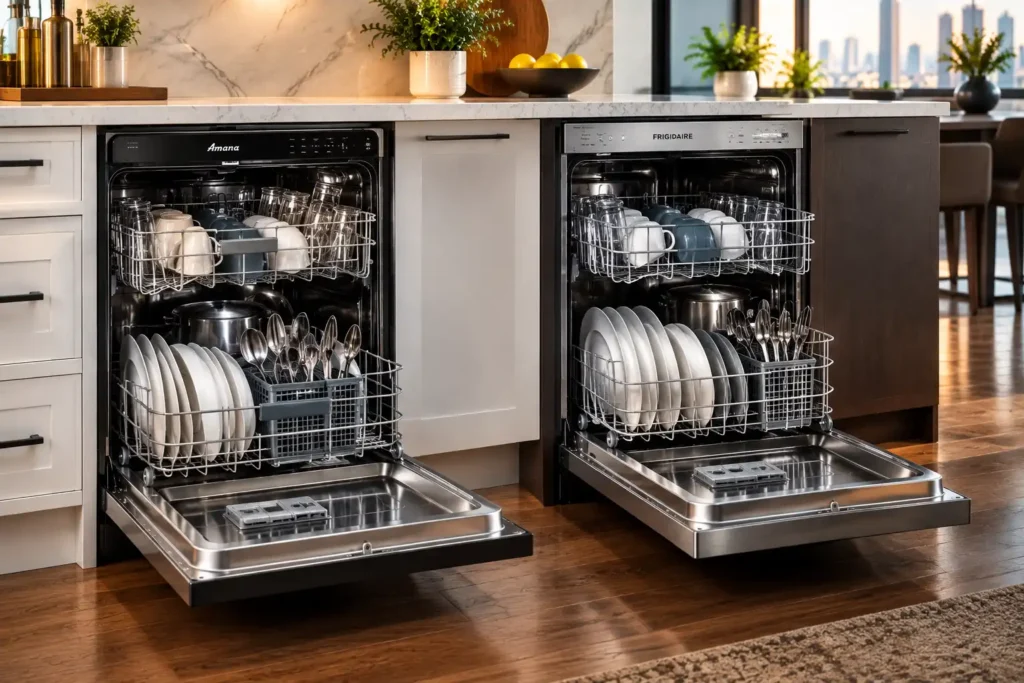
What Consumer Reports Actually Measures
Consumer Reports uses a broader evaluation system than simply checking whether dishes come out clean. Its dishwasher testing can include lower-rack washing, upper-rack washing, ease of use, drying, energy use, noise, water efficiency, washing performance, convenience, annual usage cost, and cycle time. Owner surveys also contribute information about reliability and satisfaction.
This matters because a dishwasher can perform extremely well in one category while being average in another. For example, a machine can clean heavily soiled dishes very effectively but use more energy or have a longer cycle. Another machine might be quieter and more efficient but require better loading practices for difficult baked-on food.
Consumer Reports also separates predicted reliability from laboratory cleaning performance. Predicted reliability is intended to estimate how likely newly purchased machines are to experience a problem by the end of the fifth year of ownership, using owner-survey information and adjustments for factors such as service contracts and product usage.
Therefore, a good Consumer Reports comparison should never equate “excellent washing performance” with “excellent long-term reliability.” These are different measurements.
Consumer Reports and Amana Dishwashers
Consumer Reports has tested multiple Amana dishwasher models over time. Current and recent examples include the Amana ADFS2524RB as well as earlier models such as the ADB1500 series and ADB1400 series. This gives consumers more than just manufacturer specifications to consider.
The Amana ADFS2524RB is a particularly useful example of the brand’s current value-oriented dishwasher design. The tested model has a plastic interior, a sensor that monitors conditions during the cycle and adjusts settings, front controls, Energy Star certification, and a one-year warranty. Consumer Reports includes it in its dishwasher test program.
Older Amana models show that performance can vary substantially from one generation to another. For example, the Amana ADB1500ADS received an excellent result in Consumer Reports’ energy-use test and an excellent result for washing heavily soiled dishes, while its noise result was described as mediocre and its cycle-time result as fair.
Another Amana model, the ADB1400AGW, also received an excellent energy-use result, while its noise performance was described as fair and its cycle time as poor under the test conditions.
These examples illustrate an important point about Amana. A lower-priced dishwasher should not automatically be assumed to have poor cleaning or energy performance. Some Amana models have demonstrated strong results in individual Consumer Reports laboratory categories, even though the overall feature package may be simpler than that of more expensive machines.
Consumer Reports and Frigidaire Dishwashers
Frigidaire has a larger and broader range of dishwasher models represented in Consumer Reports testing, including basic models, mid-range models, Gallery models, and higher-feature configurations. Examples include the FFCD2413US, FDPH4316AS, FDSP4401AS, FGID2468UF and other models.
The Frigidaire FDPH4316AS is particularly relevant because it represents a current-generation design. Consumer Reports reports very good washing performance on heavily soiled dishes, very good energy performance, and very good noise performance for this tested model. The model also has a sensor system, hidden controls and Energy Star certification.
The Frigidaire FDSP4401AS is another current model tested by Consumer Reports. Its available testing information reports excellent washing performance and very good energy performance under Consumer Reports’ laboratory conditions.
At the other end of the range, the older Frigidaire FGID2468UF demonstrates why model-level research matters. Consumer Reports reported excellent washing performance and very good noise performance for that model, but its energy-use performance was described as mediocre and its cycle time as poor under the specified test conditions.
Consequently, it would be inaccurate to describe every Frigidaire dishwasher as having the same performance profile. The brand has models with different washing systems, filtration systems, drying technologies, rack designs, tub materials and control arrangements.
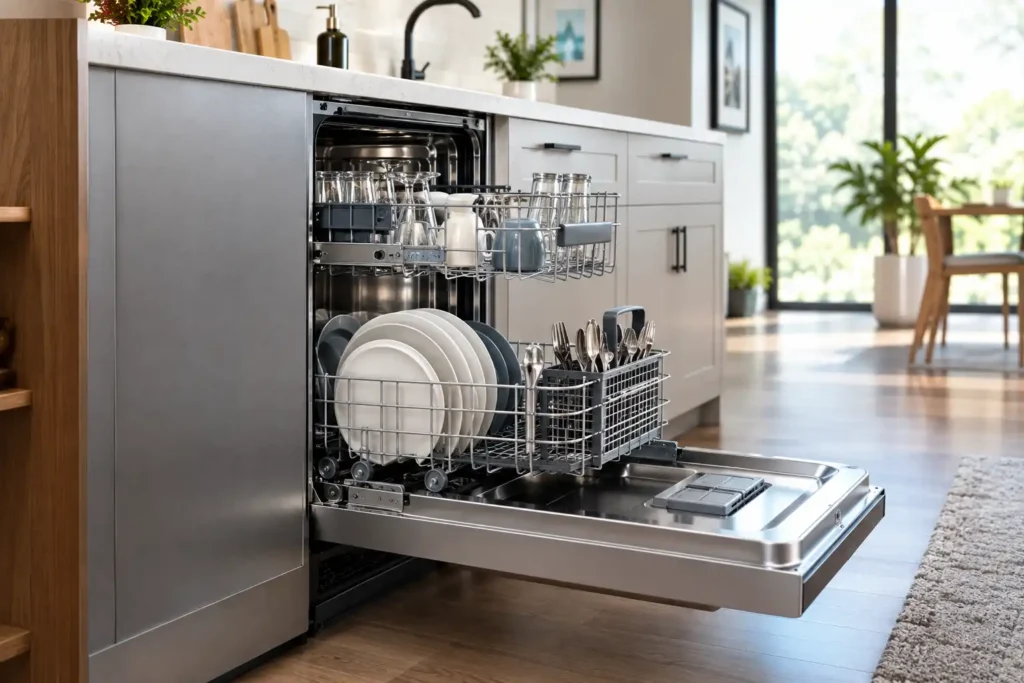
Amana vs Frigidaire Reliability
Reliability is probably the most important reason consumers search for “Amana dishwasher vs Frigidaire Consumer Reports.”
Consumer Reports’ predicted reliability methodology is based on owner-survey data. Its recent dishwasher research surveyed members who purchased 77,011 new dishwashers from 2015 through 2025. The reliability measurement estimates the likelihood that a newly purchased dishwasher will experience a problem by the end of the fifth year of ownership.
This is different from a traditional product review. A laboratory can test cleaning performance in a controlled environment, but long-term reliability requires information from owners who have used the machines over time.
Consumer Reports also warns that reliability can change as manufacturers modify designs and production. This is one reason older owner experiences should not automatically be transferred to a newly released model.
For Amana, the existence of multiple tested models means that reliability should be evaluated using the exact model number whenever possible. An older Amana dishwasher and a current Amana dishwasher may share a brand name but have substantially different components and controls.
The same principle applies to Frigidaire. A basic Frigidaire dishwasher with a simple mechanical configuration should not automatically be considered equivalent to a feature-rich Frigidaire model with sensors, advanced filtration, hidden controls and additional electronic components.
Why Reliability Ratings Need Context
A reliability rating is not a guarantee that a dishwasher will last five years without a repair. It is a statistical prediction based on observed owner experiences.
The result can also be affected by how frequently a dishwasher is used, whether the machine is properly installed, water quality, detergent choice, loading practices, maintenance and the availability of qualified service.
This is particularly important in areas with hard water. Mineral deposits can affect spray arms, filters, heating components and water-flow components over time. Proper maintenance can therefore influence real-world ownership experience regardless of brand.
Amana vs Frigidaire Washing Performance
Washing performance is another area where Consumer Reports’ model-specific testing is useful.
Consumer Reports tests dishwashers using heavily soiled dishes and separately assesses washing on the lower and upper racks. This is important because a dishwasher may clean the lower rack differently from the upper rack depending on spray-arm design, water distribution, loading flexibility and detergent distribution.
Some Amana models have performed strongly in Consumer Reports washing tests. The ADB1500ADS, for example, received an excellent washing result for heavily soiled dishes.
Frigidaire has also produced models with strong washing results. The FDPH4316AS received a very good result, while the FDSP4401AS received an excellent result for washing heavily soiled dishes.
This demonstrates why price alone cannot be used as a proxy for washing quality.
Cleaning Heavily Soiled Dishes
If you regularly wash casserole dishes, dried sauces, baked-on cheese or greasy cookware, pay close attention to the model’s washing system rather than just its brand.
A dishwasher’s result depends on spray pressure, water distribution, temperature, filtration, detergent chemistry, cycle programming and loading.
Modern sensor-controlled dishwashers can also alter portions of the cycle based on detected conditions. The current Amana ADFS2524RB, for example, has a sensor that monitors conditions during the cycle and adjusts settings.
Several current Frigidaire models similarly use sensing technology. The FDPH4316AS is documented as having a sensor that monitors conditions and automatically adjusts settings.
Amana vs Frigidaire Drying Performance
Drying can be just as important as washing.
A dishwasher that cleans perfectly but leaves plastics covered in water may be frustrating for everyday use. Drying performance depends on heating, air movement, tub construction, rinse-aid use, cycle selection and the physical properties of the dishes.
Consumer Reports includes drying as a separate dishwasher evaluation category rather than treating it as part of washing performance.
Amana’s more affordable models frequently use relatively straightforward drying systems. Depending on the exact model, this may involve heated drying or other conventional approaches.
Frigidaire offers a broader range of drying arrangements. Some models use heated drying, while other configurations include fan-assisted drying or other approaches.
The exact model specification is therefore much more useful than the brand name when comparing drying performance.
Plastics Are Especially Important
Plastic containers are often the hardest items to dry because plastic does not retain heat like glass or metal.
Even a dishwasher with excellent overall drying can leave some plastic items damp. Users who frequently wash plastic storage containers should pay particular attention to the drying system and whether rinse aid is recommended.
A model with more advanced drying technology may offer practical advantages for households that unload the dishwasher immediately after a cycle.
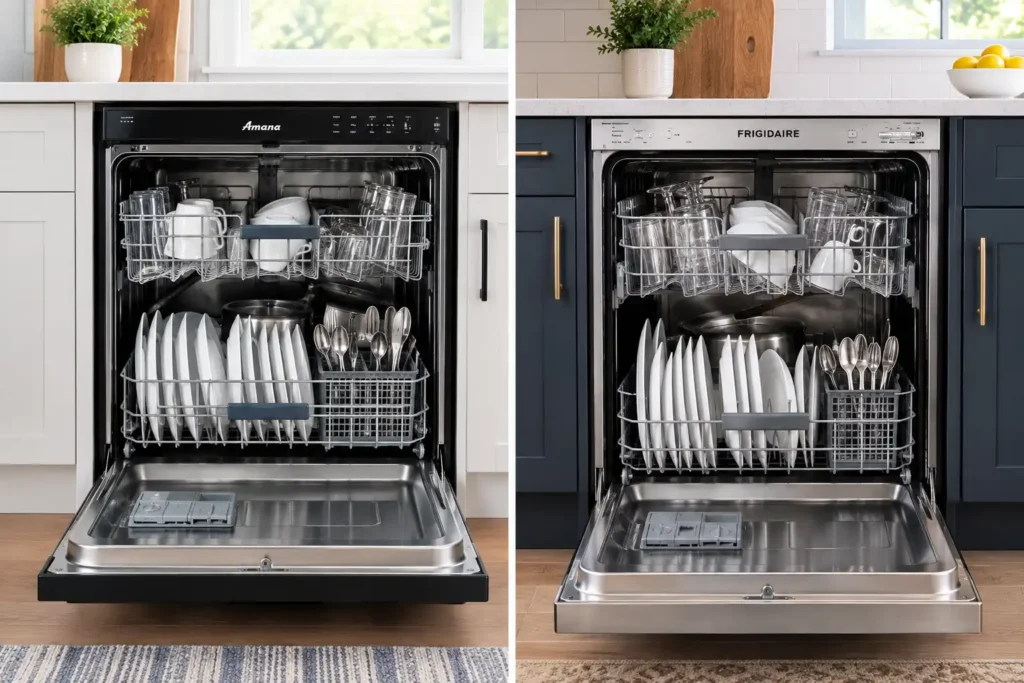
Amana vs Frigidaire Noise
Noise is another category where Consumer Reports provides useful model-level information.
Consumer Reports’ noise evaluation combines measured sound levels with listener judgments. That means a dishwasher’s published decibel figure does not necessarily tell the entire story about how the machine sounds in a kitchen.
Some Amana models have produced only fair or mediocre noise results in Consumer Reports testing. For example, the ADB1400AGW received a fair noise result, while the ADB1500ADS was described as mediocre for noise.
Frigidaire has models with stronger noise results. The FDPH4316AS received a very good noise result, while the older FGID2468UF also received a very good noise result.
However, this should not be generalized to every Amana or every Frigidaire dishwasher.
If your kitchen is open to a living room, dining room or home office, noise may deserve more weight in your purchasing decision than an extra wash cycle or decorative finish.
Amana vs Frigidaire Energy Efficiency
Energy efficiency has become increasingly important because dishwashers consume electricity not only to operate pumps and controls but also to heat water and, depending on the drying system, dry dishes.
Current U.S. efficiency criteria for a standard qualifying dishwasher set a maximum of 240 kWh per year and 3.2 gallons per cycle. The testing procedure also accounts for standby energy and uses a standardized annual-use assumption.
Several current Amana and Frigidaire models meet modern efficiency requirements.
For example, current specifications for the Amana ADFS2524R family list Energy Star certification, while current Frigidaire models such as the FDPH4316AS are also Energy Star certified.
The important lesson is that an Energy Star label should not be interpreted as meaning that every qualifying model consumes exactly the same amount of energy in actual household use. The label and standardized test procedure allow consumers to make structured comparisons, but household behavior affects real consumption.
Amana vs Frigidaire Water Efficiency
Water efficiency is closely connected to energy efficiency because heating water requires energy.
Modern dishwashers generally use much less water per load than many people assume. Sensors, filtration systems, improved spray patterns and cycle programming can reduce unnecessary water use.
Consumer Reports includes water efficiency among the criteria it uses for dishwasher evaluations where applicable.
In Canada, dishwasher efficiency is also regulated and models must carry an EnerGuide label. Canadian requirements establish maximum annual energy and water-consumption levels for standard and compact dishwashers.
For Canadian consumers, the EnerGuide annual energy figure can be particularly useful because it allows direct comparison between models in the same class.
Amana vs Frigidaire Features
Feature availability is one area where the differences between individual models can be substantial.
Basic Amana models generally focus on straightforward controls and essential dishwasher functions. Some models include sensors and modern cycle programming, but many value-oriented configurations do not have the rack flexibility or electronic conveniences found on higher-priced dishwashers.
The Amana ADFS2524RB, for example, has front controls and a plastic interior. Consumer Reports lists no adjustable upper rack, no adjustable tines, no self-cleaning filter and no Wi-Fi on that model.
Frigidaire offers models with a wider variety of convenience features. The FGID2468UF, for example, has an adjustable upper rack, adjustable tines, ample flatware slots, a self-cleaning filter and a remaining-time display.
That does not necessarily mean every Frigidaire dishwasher has these features. Entry-level models can be much simpler.
Rack Design and Loading Flexibility
Rack design can have a major impact on everyday satisfaction.
An adjustable upper rack can create additional clearance for tall glasses or large items. Adjustable tines can make it easier to accommodate pots, pans, plates and unusual-shaped cookware.
Consumer Reports specifically includes ease of use and loading-related features in its dishwasher evaluations.
For households that regularly wash large cookware, rack flexibility may be more valuable than a decorative stainless-steel finish.
Filtration and Food Particles
Dishwasher filtration is another important consideration.
A filter captures food particles and prevents them from continually circulating through the wash system. Some models require periodic manual cleaning, while others use different filtration arrangements.
Consumer Reports identifies self-cleaning filtration as a feature on some Frigidaire models, while several Amana models in its database do not list a self-cleaning filter.
Consumers should not assume that “self-cleaning filter” means the dishwasher never requires maintenance. Filters, spray arms, seals and the dishwasher interior can still require periodic inspection and cleaning.

Plastic Tub vs Stainless-Steel Tub
Tub construction is another difference between individual Amana and Frigidaire models.
The Amana ADFS2524RB has a plastic interior.
Frigidaire also sells plastic-tub models, but its lineup includes stainless-steel interiors. For example, the Frigidaire GDSH4715AF has a stainless-steel interior.
Stainless steel can provide a different appearance and can influence how the dishwasher retains heat and handles the interior environment. However, tub material alone does not determine cleaning quality or reliability.
A well-designed plastic-tub dishwasher can clean effectively, while an expensive stainless-steel dishwasher can still have problems if components or installation are poor.
Amana vs Frigidaire Price
Price is one reason these two brands are frequently compared.
Both brands offer models aimed at consumers who want a dishwasher without moving into the premium price category.
Current Consumer Reports listings show that tested Amana and Frigidaire models can span different price points. For example, a current Amana ADFS2524RB listing has appeared around the mid-$300 range, while Frigidaire offers models both below and above that level depending on features. Prices can change by retailer, promotion and model year.
The most important point is that the least expensive dishwasher is not necessarily the lowest-cost dishwasher to own.
A slightly more expensive machine may offer better rack flexibility, quieter operation, improved drying or more convenient filtration. Conversely, paying substantially more for features you will never use may not make financial sense.
Warranty and Service Considerations
Warranty coverage is another factor that should be considered separately from Consumer Reports laboratory results.
Many mainstream dishwasher models carry one-year limited warranty coverage, although exact terms vary by model and market.
For example, the Amana ADFS2524RB is listed with a one-year warranty, while the Frigidaire FDPH4316AS specification page lists one year of labor and one year of parts warranty.
Warranty length should not be confused with predicted reliability. A warranty tells you what the manufacturer promises to cover under specified conditions; reliability data attempts to estimate how frequently problems occur.
Local service availability also matters. A dishwasher that is easy to service in your area may be less frustrating to own than one for which qualified technicians or replacement components are difficult to obtain.
Amana vs Frigidaire for Hard Water
Hard water can create a different ownership experience from the laboratory environment.
Calcium and magnesium minerals can accumulate on dishwasher interiors, heating components, spray openings and glassware.
Users in hard-water regions should pay attention to detergent dosage, rinse-aid use, filter cleaning and manufacturer maintenance recommendations.
If a home has extremely hard water, the condition of the home’s water supply can sometimes have a greater effect on dishwasher performance than the difference between two mainstream brands.
A dishwasher should therefore be evaluated as part of the entire installation rather than as an isolated appliance.
Amana vs Frigidaire for Families
Families that run a dishwasher once or twice every day may benefit from prioritizing capacity, rack flexibility, filtration and reliability over cosmetic features.
A machine that accommodates more dishes per load can reduce the number of cycles required.
The practical capacity difference can also matter. Some current Frigidaire models are configured for larger place-setting capacities, while Amana’s value-oriented models may use simpler rack arrangements.
The correct choice depends on how the household loads the machine rather than simply on the advertised place-setting number.
Amana vs Frigidaire for Apartments
Apartment residents may have different priorities.
Noise becomes more important when the kitchen is near bedrooms or living spaces. Cycle duration can also matter for people who need to run the dishwasher during limited periods.
A compact kitchen may also require careful measurement of the dishwasher opening, door clearance and adjacent cabinets.
Before purchasing either brand, measure width, height, depth, water connection location, electrical connection and drain configuration.
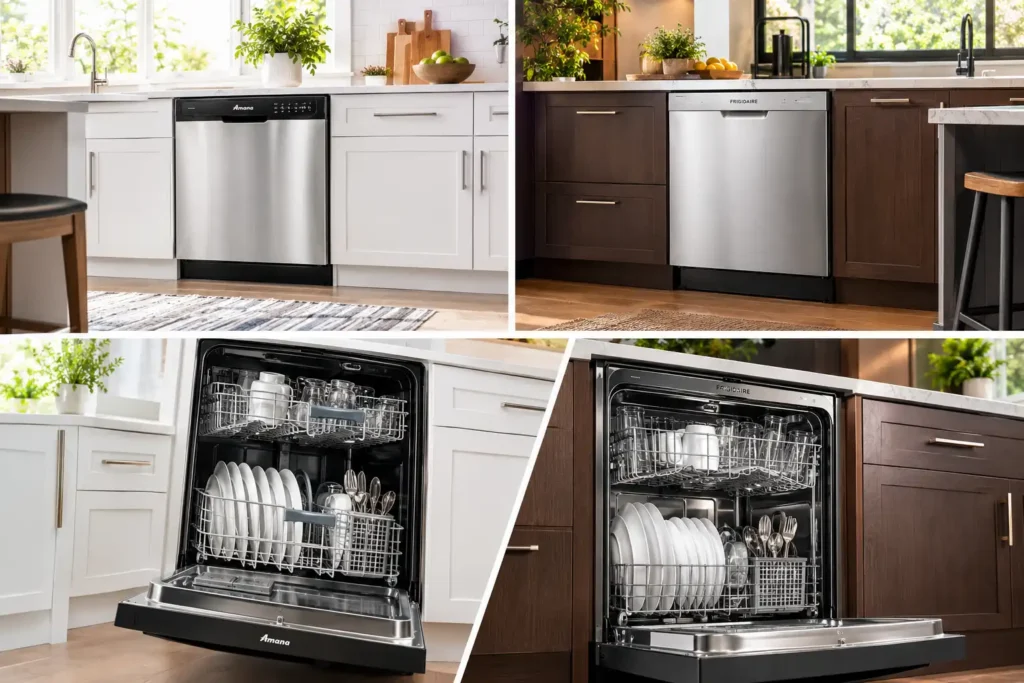
Amana vs Frigidaire for Large Households
Large households often benefit from flexible racks, strong filtration and effective drying.
If the dishwasher is run every day, a small convenience feature becomes a repeated convenience. An adjustable rack can make a difference every day rather than once a month.
For this type of household, compare the exact model’s capacity and rack configuration instead of assuming all 24-inch dishwashers offer the same usable space.
U.S. Consumer Considerations
In the United States, the EnergyGuide label and efficiency certification information can help consumers compare annual energy use.
Current efficiency criteria for qualifying standard dishwashers use standardized annual energy and water metrics. The annual figure is based on a defined testing methodology rather than an individual household’s exact electricity bill.
The U.S. buyer should therefore examine the model’s annual energy figure, water use, drying option, capacity and cycle options rather than relying solely on the brand.
Canadian Consumer Considerations
Canadian consumers should pay particular attention to the EnerGuide label.
The Canadian label provides annual energy consumption and places the model in context against comparable models in its class. The label also identifies the model number and capacity information.
Canadian dishwasher regulations establish maximum annual energy and water-consumption levels. Standard dishwashers have a maximum annual energy consumption of 307 kWh and a maximum water consumption of 18.93 litres per cycle under the applicable regulatory framework.
Because Canadian and U.S. labeling systems are similar but not identical, Canadian buyers should use the Canadian label when comparing models sold in Canada rather than directly transferring U.S. cost estimates.
UK Consumer Considerations
The UK market requires a different approach.
Dishwashers sold within the relevant UK energy-information framework must provide an energy label and product information sheet. The information must be made available at the point of sale, including online sales.
UK dishwasher rules also establish requirements around the eco programme and energy efficiency. Current legislation includes specific energy-efficiency-index requirements, with additional requirements applying to dishwashers with rated capacity of at least 10 place settings from March 2024.
Therefore, consumers in Great Britain should compare the actual UK model and its UK energy label rather than assuming that a U.S. model with the same marketing name has identical specifications.
Consumer Reports vs Manufacturer Specifications
One of the most common mistakes when comparing Amana and Frigidaire is relying exclusively on manufacturer specifications.
Manufacturer specifications are valuable because they provide model-specific information such as dimensions, capacity, sound level, energy consumption, warranty and available features.
Independent testing adds another layer because it can evaluate actual performance under standardized conditions.
Consumer Reports also adds owner-survey information, which is particularly relevant to predicted reliability and satisfaction.
The strongest buying research combines all three:
- Manufacturer specifications.
- Independent laboratory testing.
- Long-term owner-survey information.

What Consumer Reports Cannot Tell You
Consumer Reports cannot predict exactly how your individual dishwasher will perform in your kitchen.
A test laboratory cannot reproduce every household’s water pressure, water hardness, detergent, loading habits, installation quality and electrical conditions.
Likewise, an owner survey represents experiences across a population. It does not guarantee that a particular machine will or will not fail.
This is why a Consumer Reports rating should be treated as one component of a purchase decision rather than a guarantee.
How to Read an Amana or Frigidaire Consumer Reports Listing
When researching an individual model, look for the following categories:
1. Predicted Reliability
This provides information about the expected likelihood of problems during the specified ownership period.
2. Owner Satisfaction
This reflects whether surveyed owners would recommend their dishwasher to others.
3. Washing Performance
Look separately at lower-rack and upper-rack performance where available.
4. Drying
Consider this especially if you frequently wash plastic containers.
5. Noise
This becomes more important in open-plan kitchens.
6. Energy Use
Consider both standardized energy use and your local electricity price.
7. Water Efficiency
Important in regions where water costs or conservation requirements are significant.
8. Ease of Use
Rack flexibility, controls and loading convenience can influence daily satisfaction.
9. Cycle Time
Long cycles may not matter to everyone, but they can be important in households running several loads per day.
10. Annual Usage Cost
This provides a standardized way of thinking about energy expenses.
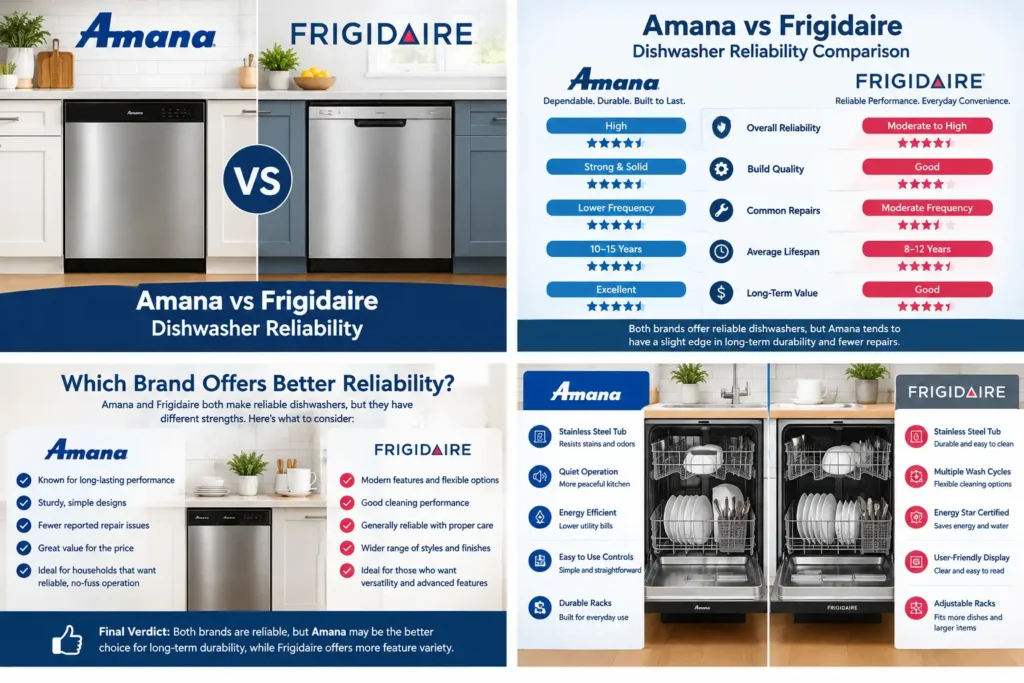
Common Mistakes When Comparing Amana and Frigidaire
Mistake 1: Assuming the Brand Determines Reliability
Brand-level reliability is useful, but individual models matter.
Mistake 2: Comparing Different Generations
A dishwasher released several years ago may use substantially different components from a current model.
Mistake 3: Looking Only at Price
The cheapest dishwasher may have fewer convenience features, a simpler rack system or different drying technology.
Mistake 4: Looking Only at Decibels
Sound measurements do not always describe the entire perceived noise experience.
Mistake 5: Ignoring Installation
A poorly installed dishwasher can develop problems regardless of brand.
Mistake 6: Ignoring Water Quality
Hard water can create maintenance problems that have little to do with the underlying brand.
Mistake 7: Assuming Energy Star Means Identical Efficiency
Certified models meet defined requirements, but their exact tested consumption can still differ.
Mistake 8: Treating Consumer Reports Scores as Guarantees
Reliability and performance ratings are based on standardized methods and survey populations, not guarantees for individual households.
Which Amana and Frigidaire Models Deserve Closer Attention?
For Amana, current buyers may encounter models such as the ADFS2524RB. Consumer Reports identifies this model as part of its dishwasher testing program and reports a sensor system, Energy Star certification, front controls and a plastic interior.
For Frigidaire, models such as the FDPH4316AS and FDSP4401AS provide useful examples of current-generation designs that have undergone independent testing. The FDPH4316AS received very good results in washing, energy use and noise testing, while the FDSP4401AS received excellent washing and very good energy results.
These examples should not be interpreted as universal brand scores. They demonstrate the importance of comparing the actual model.
Amana vs Frigidaire Consumer Reports: Long-Term Ownership
The long-term ownership question involves more than the first purchase.
A dishwasher’s total cost can include:
- Purchase price
- Installation
- Electricity
- Water
- Detergent
- Rinse aid
- Filters and maintenance
- Repairs
- Replacement parts
- Service calls
- Potential replacement after a premature failure
A machine that costs less initially may be attractive, but a slightly higher purchase price can sometimes be offset by lower operating costs or useful features.
On the other hand, expensive features do not automatically produce greater reliability.
Consumer Reports’ broader appliance reliability research specifically notes that price and reliability do not always move together.
Should You Choose Amana or Frigidaire?
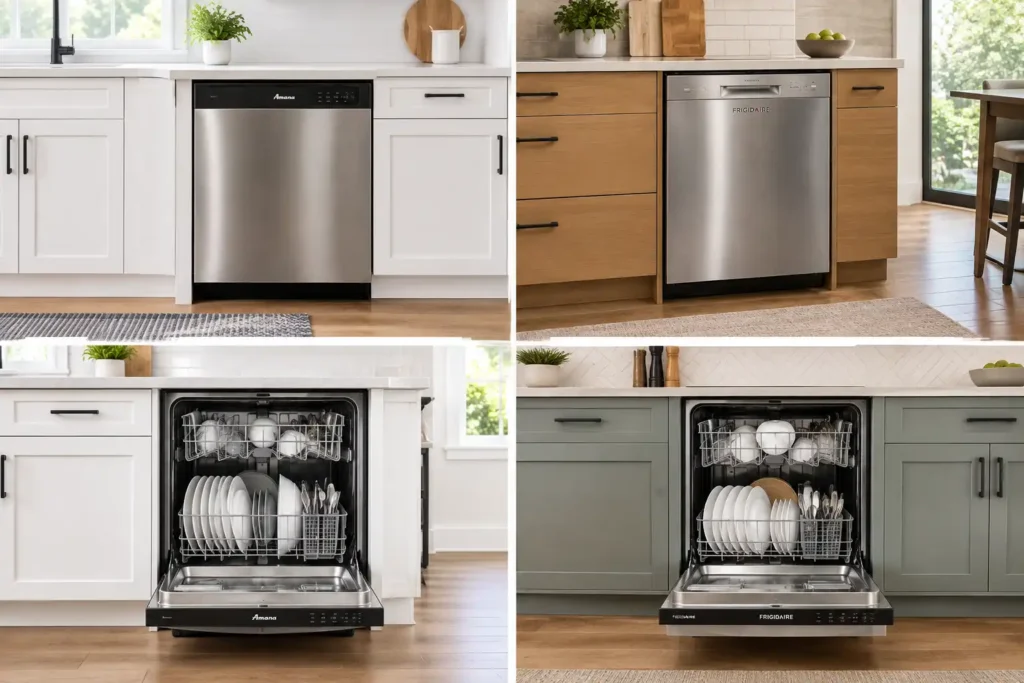
The available evidence supports a model-by-model comparison rather than a blanket brand judgment.
Amana has tested models that have demonstrated strong cleaning and energy performance in specific Consumer Reports laboratory tests. At the same time, some tested Amana models have shown weaker results in categories such as noise or cycle time.
Frigidaire also has a wide range of results. Some tested models have demonstrated very good or excellent washing and energy performance, while other models have produced more mixed results in areas such as energy use or cycle time.
The evidence therefore does not support treating every dishwasher sold under either brand as equivalent.
The more precise approach is to identify the exact Amana and Frigidaire model numbers, then compare Consumer Reports testing, predicted reliability information, owner satisfaction, energy consumption, noise, drying, rack design, filtration, warranty and current price.
Final Buying Checklist
Before buying an Amana or Frigidaire dishwasher, check:
- Exact model number
- Consumer Reports test status
- Predicted reliability information where available
- Owner satisfaction information where available
- Lower-rack washing
- Upper-rack washing
- Drying performance
- Noise performance
- Energy consumption
- Water consumption
- Capacity
- Rack adjustability
- Filter design
- Tub material
- Sensor availability
- Drying technology
- Cycle duration
- Warranty
- Local service availability
- Replacement-parts availability
- Installation requirements
- Your local water hardness
- Your local electricity cost
- Current retailer price
Frequently Asked Questions
Is Amana or Frigidaire more reliable according to Consumer Reports?
Consumer Reports evaluates reliability using owner-survey data and provides model and brand-level reliability information. However, current numerical brand scores are not completely visible without membership access, so it would be misleading to assign an exact numerical winner using incomplete publicly available information. The important point is that reliability should be evaluated using the specific model and the applicable survey period.
Does Consumer Reports recommend Amana dishwashers?
Consumer Reports tests Amana dishwashers and incorporates laboratory results, reliability information and owner satisfaction into its evaluations. Whether a particular model is appropriate depends on its individual test results and the features important to the buyer.

Does Consumer Reports recommend Frigidaire dishwashers?
Consumer Reports tests numerous Frigidaire dishwasher models. Individual models have produced different results, so the exact model number should be checked rather than assuming the entire brand performs identically.
Which brand has better washing performance?
Consumer Reports testing shows strong washing results from individual models of both brands. For example, some Amana models have achieved excellent washing results, while current Frigidaire models such as the FDPH4316AS and FDSP4401AS have achieved very good or excellent results.
Which is quieter, Amana or Frigidaire?
Noise varies by model. Some Amana models have received fair or mediocre noise results in Consumer Reports testing, while several Frigidaire models have received very good results. This does not establish a universal brand-wide result because different models use different pumps, insulation and cabinet designs.
Which dries dishes better?
Drying performance depends heavily on the individual dishwasher’s drying system. Both brands sell models with different drying configurations, so the exact model should be compared rather than relying on the brand name.
Are Amana dishwashers energy efficient?
Some Amana dishwashers are Energy Star certified. The current ADFS2524RB, for example, is identified as Energy Star certified.
Are Frigidaire dishwashers energy efficient?
Many Frigidaire models are Energy Star certified. The FDPH4316AS, for example, is identified as Energy Star certified and has a published annual energy figure of 240 kWh.
Does a stainless-steel tub make a dishwasher better?
Not necessarily. Stainless steel can provide certain durability, appearance and thermal characteristics, but tub material alone does not determine cleaning, drying or reliability. Compare the entire dishwasher system.
Is a plastic dishwasher tub bad?
No. Plastic tubs are widely used in mainstream dishwashers. Consumer Reports has tested plastic-tub models from both Amana and Frigidaire.
Which brand is better for hard water?
Neither brand should automatically be considered the universal solution for hard water. Water hardness, detergent, rinse aid, filtration and maintenance all influence performance. Check the manufacturer’s instructions for your exact model and local water conditions.
Should I buy an Energy Star Amana or Frigidaire dishwasher?
Energy Star certification provides a useful efficiency benchmark, but it should be considered alongside washing, drying, noise, rack design, reliability information, price and warranty. Current qualifying standard dishwashers must meet defined energy and water criteria.
Are Consumer Reports dishwasher ratings reliable?
Consumer Reports combines laboratory testing with owner-survey information. Its reliability estimates are based on large survey populations, but no statistical rating can guarantee the performance of an individual dishwasher.
How many dishwashers were included in the recent Consumer Reports reliability survey?
Recent Consumer Reports dishwasher model pages state that its surveys covered 77,011 new dishwashers purchased from 2015 through 2025. The survey information contributes to reliability and owner-satisfaction measurements.
Does a higher price mean a more reliable dishwasher?
Not necessarily. Consumer Reports’ broader reliability research indicates that higher price does not automatically correspond to higher reliability. Individual model design and manufacturing history remain important.
Should I compare Amana and Frigidaire by brand or model?
Model is the better starting point. Compare the exact model numbers because washing performance, drying, noise, filtration, rack design, tub construction and sensors can differ significantly within the same brand.

Is the Consumer Reports Overall Score the same as reliability?
No. Consumer Reports’ Overall Score incorporates multiple elements, including laboratory testing as well as brand reliability and owner satisfaction information. Reliability is a separate component rather than the entire score.
Conclusion
The Consumer Reports evidence shows why an Amana-versus-Frigidaire dishwasher comparison needs to go deeper than brand reputation.
Amana has tested dishwasher models that have delivered strong washing and energy-use results, although some models have shown weaker results in areas such as noise or cycle time. Frigidaire has a broader selection of tested models, with current examples demonstrating very good or excellent results in washing, energy use and noise, while other models have produced more mixed results.
Reliability should also be considered separately from cleaning performance. Consumer Reports uses large owner surveys to estimate predicted reliability and owner satisfaction, while its laboratory tests examine the actual performance of individual dishwasher models.
For buyers in the United States, Canada and the UK, energy labeling provides another important comparison tool, although the labeling systems and regulatory requirements differ between markets.
The most useful strategy is therefore to compare the exact Amana model against the exact Frigidaire model you are considering. Check reliability information, washing, drying, noise, energy use, water consumption, rack flexibility, filtration, warranty and service availability. This approach provides a much more meaningful picture of ownership than treating either brand as a single uniform product line.