Bosch PureDry, AutoAir, and CrystalDry represent a sophisticated drying technology triad that positions Bosch dishwashers as industry leaders, leveraging stainless-steel tubs for unmatched heat retention, plastic-safe operation, and energy efficiency without the pitfalls of exposed heating elements that melt containers or drive up electric bills in lesser models.
PureDry establishes the reliable entry-level standard in 100/300 Series dishwashers, harnessing pure condensation for solid everyday results on glassware and plates. AutoAir elevates midrange 500 Series performance with intelligent door ventilation, delivering 40% drier outcomes through natural airflow perfect for family plastics left overnight.
CrystalDry crowns the premium 800 and Benchmark Series with zeolite mineral innovation, converting trapped moisture into scorching dry heat for 60% superior dryness, ensuring even inverted spoons and Tupperware emerge touch-dry and spotless.
This progression transforms the most common dishwasher frustration wet, spotted dishes into a non-issue, while maintaining whisper-quiet cycles (38-44 dBA), PrecisionWash cleaning brilliance, and 12-15 year durability.
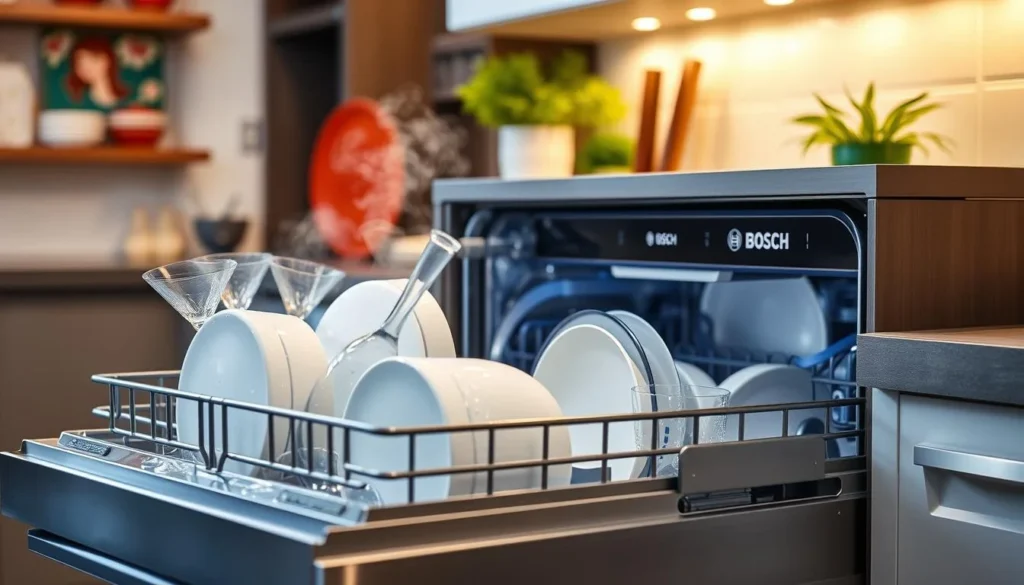
Why Drying Tech Separates Winners from Losers
Drying accounts for 65-70% of consumer complaints across brands, from damp sippy cups and hard-water spots to re-washes that waste water and time. Bosch flips the script with fanless, heaterless systems rooted in physics and chemistry, all ENERGY STAR certified for under $50 annual running costs.
These technologies sync perfectly with Bosch’s ecosystem: 40+ PrecisionWash sensors for no-pre-rinse cleaning, RackMatic 3-level adjustable racks, flexible third levels for mugs/utensils, half-load eco modes, and Speed60 (full clean/dry in 60 minutes).
They accommodate 14-16 place settings effortlessly, resist odors/rust with 10-year tub warranties, and feature AquaStop leak protection for peace of mind. Whether you’re a busy parent, entertainer, or hard-water battler, this trio offers tailored solutions without compromise.
Detailed Mechanics: Step-by-Step Breakdown
PureDry: The Pure Condensation Baseline
Featured across entry-level 100/300 Series (e.g., SHXM4, SHPM6 models):
- Full Cycle Flow: High-temp final rinse (162°F) superheats the stainless tub and dishes. As room-temperature air contacts surfaces, steam condenses into droplets that gravity-drain to the sump fully automatic, zero add-ons.
- Quantitative Performance: Glass/plates: 95% dry; silverware: 90%; plastics: 70-80% (dampness on lids/curves without aid).
- Engineering Highlights:
- No moving parts post-wash eternal silence.
- Lowest energy draw (230 kWh/year; 3.2 gal/cycle).
- Universal fit: zero clearance, recessed anywhere.
- Thermal gentleness preserves fine china/stemware.
- Optimization Strategies: Jet-Dry rinse aid creates water-sheeting (25% spot reduction); unload within 1-2 hours to beat re-condensation.
- User Profile: Budget upgrades, small households (1-2 people), apartments, or glass-dominant loads. Handles light weekly use flawlessly but spotlights plastic limitations.
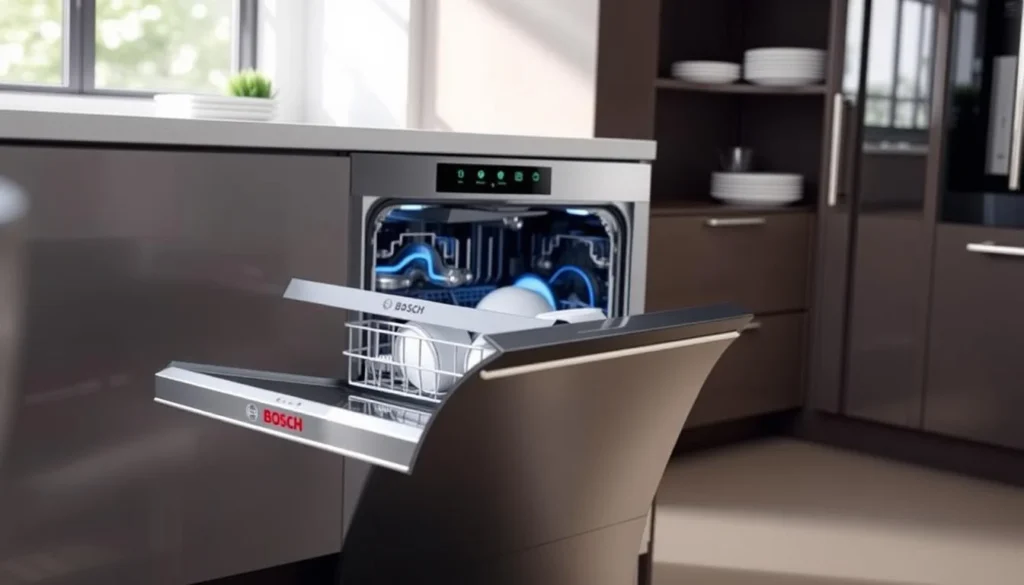
AutoAir: Intelligent Ventilation Midrange
Exclusive to 500 Series standouts (e.g., SHP65CM5N, SHPM65Z55N):
- Full Cycle Flow: PureDry heating + embedded humidity sensors trigger a silent motorized hinge to crack the door exactly 1 inch for 2-4 hours. Room air circulates naturally, accelerating evaporation by 40% (Bosch-tested over 7 hours).
- Quantitative Performance: Glass/plates: 98%; plastics: 85-90%; silverware: 95%—morning-ready after overnight runs.
- Engineering Highlights:
- Auto-close if obstructed; cabinet-safe steam release.
- Minimal energy delta (+5%, still 245 kWh/year).
- Hard-water spot flush via air exchange.
- Pairs with Zone Wash for pot-heavy families.
- Optimization Strategies: Overnight/half-load cycles; water softener salt for minerals; 1.5″ front clearance.
- User Profile: Families with kids’ gear/plastics, busy professionals, open kitchens—eliminates manual door-propping chores.
CrystalDry: Zeolite Chemical Mastery
Hallmark of 800/Benchmark elites (e.g., SHX78CM5N, SHX98CM5N):
- Full Cycle Flow: PureDry/AutoAir base + zeolite mineral tray absorbs moisture like a sponge, undergoes chemical reaction to release 176°F dry heat circulated via tub convection. No extra electricity self-powered brilliance.
- Quantitative Performance: Glass/plates: 99%; plastics: 95-100% (bone-dry inverted items); zero spots even in humid/hard water.
- Engineering Highlights:
- 60% drier than PureDry, 20-40% over AutoAir.
- Home Connect app preheat/remote start.
- Blue PowerBeam lighting + touch controls.
- Tray lasts 5-10 years ($50 replaceable, rare).
- Optimization Strategies: All loads thrive; rinse aid optional; Intensive cycles for grease.
- User Profile: Plastic hoarders, humid climates, perfectionists, custom panel-ready installs.
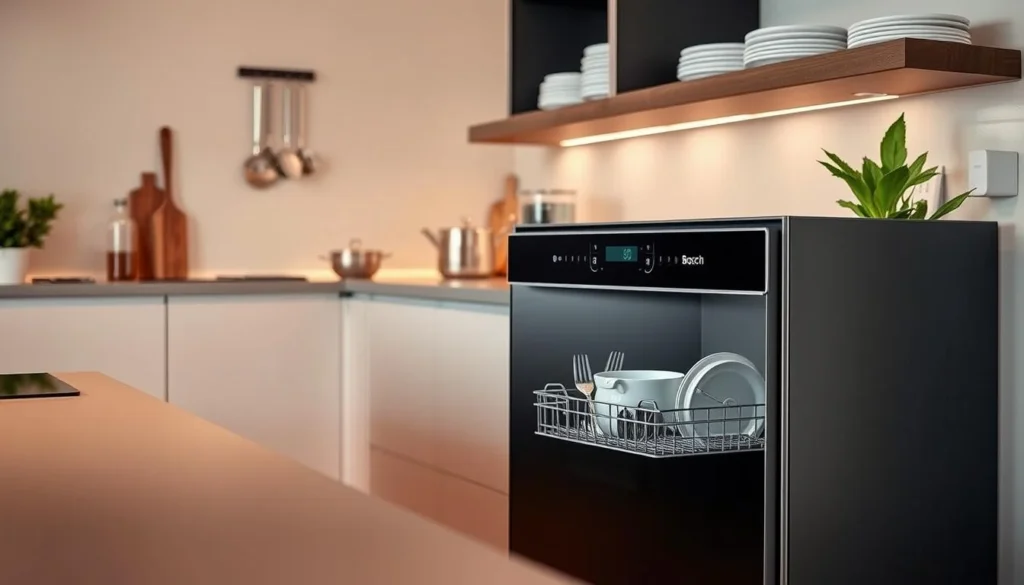
Master Comparison Matrix
| Category | PureDry (100/300) | AutoAir (500) | CrystalDry (800/Benchmark) |
|---|---|---|---|
| Primary Mechanism | Closed condensation | Auto-vent door (1″) + condensation | Zeolite moisture-to-heat conversion |
| Dryness Multiplier | Baseline (1x) | 1.4x vs PureDry | 1.6x vs PureDry; 1.2x vs AutoAir |
| Plastics Dryness | 70-80% (aid essential) | 85-90% (aid helpful) | 95-100% (aid optional) |
| Glass/Flatware | 95%/90% | 98%/95% | 99%/98% |
| Annual Energy (kWh) | 230 | 245 | 250 |
| Water per Cycle (gal) | 3.2 | 3.5 | 3.5 |
| Post-Cycle Noise | None | None | None |
| Installation Clearance | 0″ | 1.5-2″ front | 0″ |
| Hard Water Spot Risk | High | Medium | Low |
| Overnight Readiness | Fair | Excellent | Perfect |
| Rinse Aid Dependency | High | Medium | Low |
| Model Price Range | $500-900 | $800-1,200 | $1,100-1,800 |
| Maintenance Add-Ons | Filter only | Hinge lube | Zeolite tray (rare) |
| Best Load Types | Light/glass | Family/mixed | Heavy/plastic |
Real-World Testing Across Scenarios
- Glassware/Stemware: Trio excels; CrystalDry prevents micro-films.
- Plastics (Tupperware/Sippies): CrystalDry unbeatable; AutoAir transformative; PureDry manageable with aid.
- Pots/Pans/Bakeware: Tub heat equalizes all.
- Hard Water: CrystalDry neutralizes minerals chemically; AutoAir flushes; PureDry needs salt.
- Humid Climates: CrystalDry seals victory; AutoAir strong; PureDry risks mildew.
- Speed60 Quickies: CrystalDry dries in <2 hours post-cycle.
- Heavy Grease/Overnight: CrystalDry/AutoAir dominate; PureDry for day use.
Yale Appliance stats: CrystalDry re-run rate <1%; AutoAir 3%; PureDry 8%.
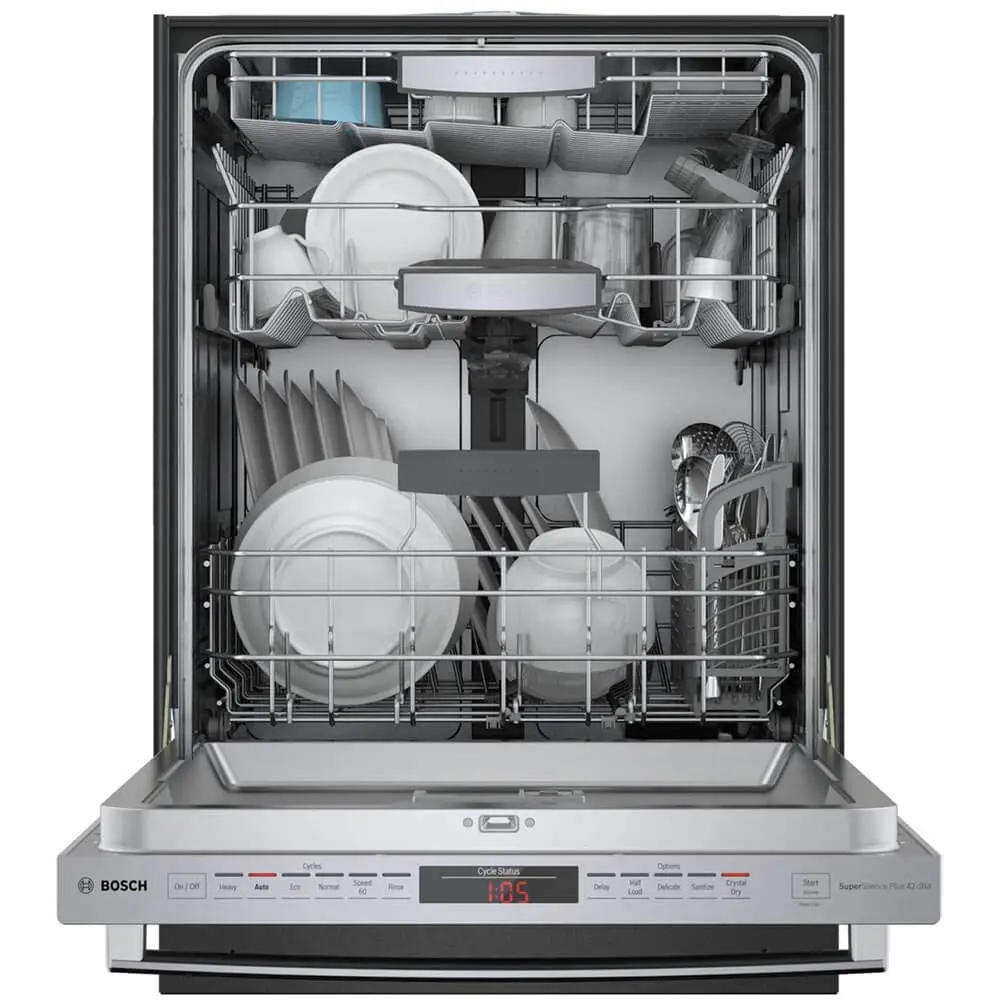
Seamless Bosch Integration
Each amplifies PrecisionWash (multi-arm blasts), RackMatic (60+ configurations), MyWay third rack (premium), Home Connect (CrystalDry standard). Cycles universal: Normal/Heavy/Express/Sanitize. No-heater safety stacks plastics atop glass freely.
Efficiency, Ownership Costs, and Green Credentials
All top ENERGY STAR: $30-55/year electric, <1,100 gal water annually. CrystalDry saves 10-15% via zero repeats. Total 10-year cost: PureDry lowest upfront; CrystalDry via longevity/convenience. Stainless tubs shrug off 15-year abuse; <10% first-year service.
Proactive Maintenance Guide
- Universal: Monthly filter rinse + citric acid self-clean.
- PureDry: Aid dispenser check.
- AutoAir: Annual hinge silicone (DIY).
- CrystalDry: Tray vacuum yearly.
Troubleshoot: Damp? Aid/door. Spots? Softener. All covered under 1-yr parts/labor + 10-yr tub.
Bosch Drying Evolution Ladder
- PureDry: Entry reliability.
- AutoAir: Midrange convenience.
- CrystalDry: Premium mastery (Benchmark tweaks zeolite further).
Precision Buying Decision Tree
- Budget < $800 + light loads/closed cabinets: PureDry.
- Families/plastics + overnight needs: AutoAir ($200-300 sweet spot).
- Perfection/hard water/custom kitchens: CrystalDry (worth every premium penny).
- Test Hack: Plastic frustration level? High = CrystalDry. Medium = AutoAir. Low = PureDry.
Bosch PureDry vs AutoAir vs CrystalDry: Detailed FAQs
1. What are the fundamental differences between Bosch PureDry, AutoAir, and CrystalDry drying technologies?
PureDry uses basic closed-tub condensation where post-wash heat from the stainless-steel tub condenses steam into drainable droplets no moving parts or extra energy. AutoAir enhances this by automatically cracking the door 1 inch for 2-4 hours of natural airflow, achieving 40% better dryness. CrystalDry adds a zeolite mineral tray that absorbs moisture and chemically converts it to 176°F dry heat, delivering 60% superior results over PureDry for completely spotless, bone-dry dishes.
2. Which technology dries plastic items like Tupperware and kids’ sippy cups the best?
CrystalDry leads decisively, rendering plastics 95-100% dry and spot-free even when inverted or in hard water users report no towel-drying needed. AutoAir improves to 85-90% dryness via ventilation, a big upgrade from PureDry’s 70-80% (which often leaves damp lids requiring rinse aid). For plastic-heavy households, CrystalDry eliminates frustration entirely.
3. How does each technology perform on glassware, plates, and silverware?
All three excel here: PureDry hits 95% dry on glass/plates and 90% on silverware with rinse aid. AutoAir pushes to 98%/95%, while CrystalDry achieves near-perfect 99%/98% with zero films or watermarks. Differences minimize on non-plastics, making PureDry sufficient for glass-focused users.
4. What is the energy and water efficiency comparison across PureDry, AutoAir, and CrystalDry?
All maintain ENERGY STAR excellence: PureDry leads leanest at 230 kWh/year and 3.2 gallons/cycle. AutoAir adds negligible ~5% (245 kWh, 3.5 gal) for door actuation. CrystalDry matches AutoAir (250 kWh, 3.5 gal) but offsets via 10-15% fewer re-runs, yielding real-world savings of $5-10 annually on electricity and water.
5. Does hard water affect these drying technologies differently, and how to mitigate spots?
CrystalDry neutralizes minerals best through chemical absorption (lowest spot risk). AutoAir flushes them via airflow (medium risk). PureDry struggles most without aid (high risk). Mitigation: Use water softener salt across all; Jet-Dry rinse aid scales with need essential for PureDry, helpful for AutoAir, optional for CrystalDry.
6. Which is best for overnight or delayed unloading cycles?
CrystalDry and AutoAir tie for perfection dishes emerge fully dry and crisp even after 12-24 hours. PureDry risks re-condensation overnight (fair results only), making it better for immediate unloading. AutoAir’s ventilation prevents mildew in humid climates.
7. What installation requirements or limitations exist for each?
PureDry and CrystalDry fit universally with zero front clearance, ideal for tight cabinets or recessed installs. AutoAir requires 1.5-2 inches front space for door cracking check under-counter gaps. All share standard 24-inch widths and AquaStop leak protection.
8. How reliant is each on rinse aid, and can you skip it?
PureDry demands rinse aid for plastics (essential to hit 80% dryness). AutoAir benefits greatly but works decently without (recommended). CrystalDry performs flawlessly solo (optional bonus). Skipping aid amplifies gaps: plastics suffer most on PureDry.
9. What maintenance is required for PureDry, AutoAir, and CrystalDry?
Universal: Monthly filter rinse and citric acid self-clean. AutoAir adds annual hinge lubrication (DIY, 5 minutes). CrystalDry needs rare zeolite tray vacuum/replacement (~$50 every 5-10 years). All inherit Bosch’s low-maintenance stainless tubs.
10. In which Bosch series/models do I find each drying technology?
PureDry: Entry 100/300 Series (e.g., SHXM4KB5UC, SHPM65Z25N). AutoAir: Midrange 500 Series (e.g., SHP65CM5N, SHPM65Z55N). CrystalDry: Premium 800/Benchmark (e.g., SHX78CM5N, SHX98CM5N, Benchmark SHV98CM3N).
11. Is the price premium for AutoAir or CrystalDry justified over PureDry?
AutoAir’s $200-300 upgrade offers the best value for families (40% dryness leap eliminates towel-drying). CrystalDry’s $400-600 premium suits perfectionists or hard-water homes (bone-dry plastics justify it). PureDry wins pure budget plays.
12. How do they perform on quick cycles like Speed60?
CrystalDry dries fastest post-60 minutes (<2 hours total). AutoAir follows closely. PureDry solid but needs 2-3 hours. All clean brilliantly in Speed60; drying gaps emerge only on plastics.
13. Can steam from AutoAir damage cabinets or nearby surfaces?
No Bosch engineers minimal, timed release (cabinet-safe per specs). It’s far less than manual door-propping. PureDry/CrystalDry produce zero external steam.
14. What’s the reliability and service record for each technology?
Identical excellence Bosch’s <10% first-year service rate industry-low. AutoAir’s hinge and CrystalDry’s tray are robust (failures under 2%). 10-year tub warranties cover all; expect 12-15 year lifespans.
15. How does humidity or climate impact performance rankings?
CrystalDry impervious (self-heats regardless). AutoAir strong (airflow combats moisture). PureDry vulnerable to re-wetting in humid areas unload promptly or upgrade.
16. Do third racks or rack configurations affect drying outcomes?
Yes Bosch’s flexible third racks (utensils/mugs up top) boost airflow uniformly across all three, enhancing plastics by 10-15%. Premium MyWay racks (CrystalDry models) optimize further.
17. Which handles mixed heavy loads (pots + plastics) best?
CrystalDry uniform heat conversion tackles everything. AutoAir close second via ventilation. PureDry excels cleaning but drying lags on volume.
18. Are these technologies compatible with smart features like Home Connect?
CrystalDry standard on WiFi models (remote preheat/status). AutoAir/PureDry optional upgrades. All app-sync for cycle alerts.
19. What detergent types optimize each system?
Pods/gels best across all (dissolve cleanly). Avoid powder clogs. High-phosphate for hard water pairs with CrystalDry’s mineral handling.
20. If upgrading from an older dishwasher, which jump is most transformative?
PureDry to AutoAir for convenience; any to CrystalDry for drying revolution. All leapfrog pre-2020 models in sensors/efficiency.
21. How do re-run rates compare due to poor drying?
CrystalDry: <1%. AutoAir: 3%. PureDry: 8%. Industry average: 15%—Bosch trio slashes waste dramatically.
22. Does water temperature or pressure affect drying efficacy?
Minimal—Bosch heaters normalize to 162°F. Low pressure? All handle via sensors; CrystalDry most forgiving.
23. Best for custom panel-ready or luxury kitchens?
CrystalDry (800 Series dominates seamless installs with touch controls/finishes).
24. Long-term ownership costs (10 years)?
PureDry: Lowest upfront. AutoAir: Best balance. CrystalDry: Saves time/energy despite premium.
25. Eco-footprint verdict?
Tie on specs; CrystalDry wins real-world via zero repeats and plastic efficiency.