
Choosing between washing dishes by hand and using a dishwasher may seem like a simple household decision, but the difference can affect your water consumption, electricity bills, cleaning results, hygiene, time, and long-term household expenses.
The answer is not quite as straightforward as saying that one method is always better. A modern, energy-efficient dishwasher used with full loads can often use considerably less water than washing the same dishes by hand. However, the result depends on the dishwasher’s efficiency, how many dishes you wash, your washing habits, local utility prices, and whether you leave the tap running.
This guide compares both methods across the USA, UK, and Canada, including water and energy use, cleaning performance, hygiene, environmental impact, costs, convenience, and situations where handwashing may still be the better option.
1. The Main Difference Between Dishwashing and Handwashing
A dishwasher cleans dishes by spraying heated water mixed with detergent through rotating spray arms. The machine circulates and filters the wash water during the cycle, then drains it and uses fresh water for rinsing. Depending on the model, it may also use soil sensors, temperature controls, specialised wash programmes, and heated or fan-assisted drying.
Handwashing relies on the person doing the cleaning. You fill a sink or washing-up bowl, apply detergent, scrub each item, rinse it, and leave it to dry or dry it with a towel. The amount of water and energy used depends heavily on whether you use a bowl, keep the tap running, use hot water, and how many dishes you wash at once.
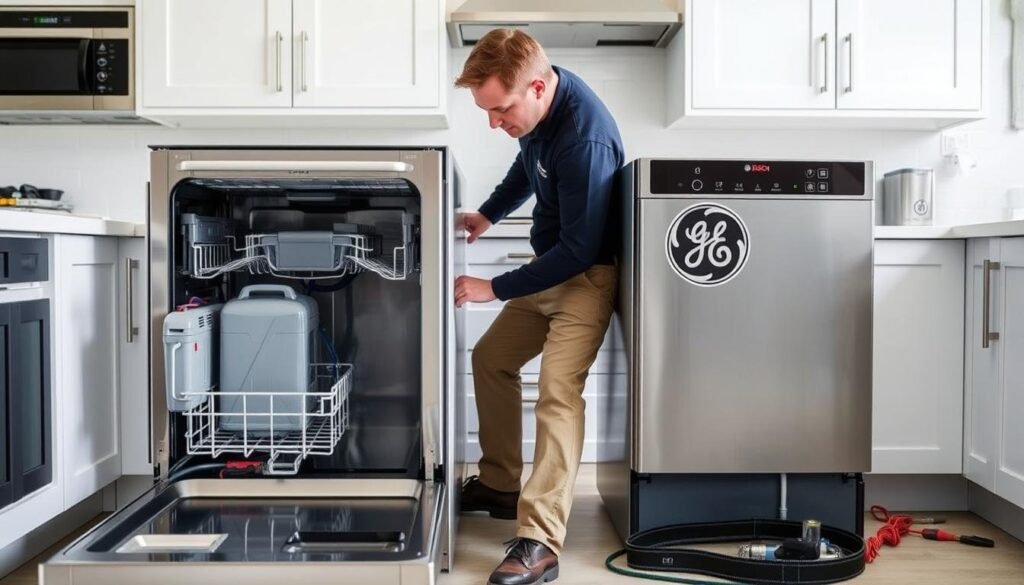
The important distinction is that a dishwasher can clean a large number of dishes using a controlled quantity of water. Handwashing can be economical when only a few items need cleaning, but washing a full family’s worth of dishes under a running tap can use substantially more water.
A comparison of dishwashing habits found that washing a full dishwasher-sized load by hand used an average of 49 litres of water and 1.7 kWh of energy, while the dishwasher used approximately 13 litres of water and 1.3 kWh for the same quantity of dishes. The study also found that participants spent about 60 minutes washing the load by hand, compared with approximately nine minutes loading and unloading the dishwasher. These figures are from a particular study, not guaranteed results for every household or appliance.
2. Which Uses More Water: Dishwasher or Handwashing?
Water consumption is one of the biggest differences between the two methods. Modern dishwashers are designed to wash a substantial number of dishes with relatively little water. Handwashing can use much more, particularly when the tap remains open throughout the washing and rinsing process.
An efficient standard-size dishwasher can use approximately 3.2 US gallons (12.1 litres) or less per cycle under the current ENERGY STAR qualification limit. Actual consumption varies by model, cycle, load, and soil level. Some machines use more water on intensive programmes, while suitable eco programmes may use less.
Handwashing has no fixed water-consumption limit. A person washing dishes in a filled bowl may use a modest amount, but someone who continuously runs hot water can use many litres in a short period. The difference becomes particularly important when cleaning plates, bowls, glasses, cutlery, pots, and pans from several meals.
Example: Water Used for a Full Load
The following comparison illustrates how much water may be required to clean approximately 14 place settings.
| Washing method | Illustrative water consumption |
|---|---|
| Handwashing in a washing-up bowl | 63 litres |
| Dishwasher on a standard programme | 13 litres |
| Dishwasher on an eco programme | 10 litres |
In this example, the dishwasher uses approximately 80% less water than handwashing on a standard programme and around 84% less on eco mode. These figures come from a particular comparison using a sample of tested machines and an estimated bowl-based handwashing method. They should not be treated as universal figures.
The actual difference in your kitchen may be larger or smaller. A person who uses two washing-up bowls, avoids unnecessary rinsing, and changes the water only when needed may use considerably less water than someone who leaves the tap running. Similarly, an older dishwasher may consume more water than a modern efficient model.
3. Which Is Cheaper: Using a Dishwasher or Washing by Hand?
The cheaper option depends on how many dishes you wash, the efficiency of your dishwasher, the price of electricity and water, and the energy source used to heat your hot water.
Handwashing has one obvious financial advantage: you do not need to purchase a dishwasher. You also avoid installation expenses, dishwasher detergent tablets, rinse aid, dishwasher salt where required, and future appliance repairs. If you live alone and wash only a few plates and glasses each day, buying and operating a dishwasher may not make financial sense.
However, the calculation changes when you wash a large quantity of dishes every day. A dishwasher has a relatively predictable operating cost per cycle. Handwashing costs depend on the quantity of hot water used, the time spent washing, and the amount of washing-up liquid required.
The cost of using a dishwasher
The main operating expenses of a dishwasher include:
- Electricity consumed by the wash cycle, water heating, controls, pumps, and drying system.
- Water supplied to the appliance.
- Dishwasher detergent or tablets.
- Rinse aid.
- Dishwasher salt for models and water conditions that require it.
- Maintenance and occasional repairs.
The electricity consumption printed on an appliance’s energy label or stated in its product specifications is a useful starting point. For example, an ENERGY STAR-qualified standard-size dishwasher must meet a maximum annual energy consumption of 240 kWh under the current qualification criteria. This is a testing and qualification limit, not a promise that every household will use exactly that amount.
The actual electricity cost can be estimated with this formula:
Electricity cost per cycle = kWh consumed per cycle × electricity price per kWh
For example, assume a dishwasher uses 1 kWh for a particular cycle and your electricity rate is $0.20 per kWh. The electricity cost for that cycle would be $0.20. If the same cycle uses 0.7 kWh, the electricity cost would be $0.14.
You must add water and detergent expenses to calculate the complete operating cost.
The cost of handwashing
Handwashing may appear almost free because you do not see an appliance operating or an electricity meter changing. However, hot water requires energy, and that energy has a cost.
The cost of handwashing depends on:
- How many litres of water you use.
- Whether you use hot or cold water.
- Whether your water is heated by electricity, natural gas, or another source.
- Whether you use a washing-up bowl or leave the tap running.
- How often you replace the washing water.
- How much detergent you use.
- Whether you wash dishes after every meal or combine them into one washing session.
Consider a simple example. If a tap delivers nine litres of water per minute, leaving it running for five minutes uses approximately 45 litres. If you wash and rinse dishes under the tap for ten minutes, the consumption could reach approximately 90 litres, depending on the actual flow rate.
That water also needs to be heated if you use hot water. Heating a large quantity of water can make handwashing considerably more expensive than expected.
Illustrative cost comparison
The following example shows how the two methods can differ when cleaning a large quantity of dishes. These are hypothetical figures for explaining the calculation, not fixed utility prices or universal operating costs.
| Expense | Dishwasher | Handwashing |
|---|---|---|
| Water used | 13 litres | 49 litres |
| Electricity or water-heating energy | 1.0 kWh | 1.7 kWh |
| Energy price assumption | $0.20/kWh | $0.20/kWh |
| Energy cost | $0.20 | $0.34 |
| Water price assumption | $0.005/litre | $0.005/litre |
| Water cost | $0.065 | $0.245 |
| Detergent | $0.25 | $0.10 |
| Illustrative total | $0.515 | $0.685 |
In this particular example, the dishwasher costs approximately 17 cents less to operate for the same quantity of dishes. The calculation excludes the dishwasher’s purchase price, installation, maintenance, and repairs. It also assumes that the handwashing energy figure represents the energy required to heat the water.
The detergent cost is an assumption and will vary with the product and dosage. Some households use cheaper washing-up liquid, while others purchase premium dishwasher tablets.
The important lesson is that the cheapest method cannot be determined by comparing the price of a dishwasher tablet with a small amount of washing-up liquid. Water and water-heating energy must also be included.
4. Electricity Consumption: Which Method Uses Less Energy?
Electricity consumption is another important consideration, particularly in households where hot water is produced using an electric water heater.
A dishwasher uses electricity to operate its circulation pump, drain pump, electronic controls, sensors, and other components. It also needs energy to heat water, unless it receives sufficiently hot water from the household plumbing. Some models use additional electricity for heated drying.
Handwashing does not require a dishwasher motor or electronic controls, but it can require substantial energy to heat water. The amount depends on the temperature you choose, the volume of water used, and the efficiency of your water heater.
Why dishwashers can use less energy
Modern dishwashers are designed to control water consumption and temperature. Rather than continuously supplying fresh water, many machines circulate wash water through a filtration system during the washing stage. They use spray arms to distribute water around the dishes and adjust parts of the wash process according to the programme and, where fitted, soil-sensing technology.
This controlled approach can reduce the amount of water that needs heating.
Handwashing can be less efficient when a person repeatedly fills a sink, replaces the water, or leaves hot water running while scrubbing and rinsing. Every additional litre of hot water requires energy to heat it.
The importance of your water heater
The energy source used to heat water can change the comparison significantly.
Electric water heating: If your home uses an electric storage water heater or immersion heater, heating water for handwashing can be a noticeable part of your electricity consumption. A dishwasher may have an advantage when it uses a carefully controlled amount of water.
Natural gas water heating: If your home uses natural gas, the cost of heating handwashing water may be lower than with some electric systems. However, the final comparison depends on gas prices, heater efficiency, and water consumption.
Heat-pump water heating: A heat-pump water heater can use less electricity than conventional electric resistance heating. This can reduce the energy cost of hot water used for handwashing and may also influence the overall comparison.
Solar water heating: Households with solar hot water may have a lower marginal cost for heating water during periods of sufficient solar production. However, the dishwasher still uses electricity for its pumps, controls, and any additional heating or drying.
Does the dishwasher’s drying function increase energy consumption?
Yes. Some dishwashers use heated drying systems that consume additional electricity. Depending on the model, drying may involve a heating element, fan, or other drying technology.
If your dishwasher has an air-dry, energy-saving, or automatic-door-opening option, using it may reduce electricity consumption. Opening the door after the wash cycle has completed can also help release moisture, provided the manufacturer permits this practice and there is no risk from escaping steam.
Plastic containers often retain water because they do not hold heat as effectively as ceramic or glass. This does not necessarily mean the wash cycle has failed. It is partly a drying characteristic of the material.
For households looking to reduce energy use, the most practical approach is to compare the complete cycle consumption rather than judging the dishwasher by its wash-stage electricity alone.
5. Which Cleans Dishes Better?
Cleaning performance depends on the temperature, detergent, mechanical action, water quality, food residue, and washing technique.
A dishwasher is designed to clean multiple items consistently. Its spray arms distribute detergent-containing water across the load, while filters help collect food particles. The programme controls the washing and rinsing stages, allowing the appliance to maintain specific conditions throughout the cycle.
Handwashing gives you direct control over every item. You can concentrate on a greasy pan, scrub a stained plate, or clean a glass immediately. However, the result depends on the person washing the dishes.
Dishwasher cleaning advantages
A dishwasher offers several cleaning benefits:
Consistent water distribution: Spray arms distribute water throughout the machine. Correct loading is essential because large plates, pans, or utensils can block the spray arms and prevent water from reaching other items.
Controlled temperature: Dishwashers can heat water to temperatures that may be uncomfortable or unsafe for prolonged contact with bare hands. This helps detergents work effectively and can improve the removal of grease and food residue.
Specialised programmes: Many models include normal, intensive, eco, quick, glass, and automatic programmes. These settings allow the machine to adapt to different loads.
Reduced manual contact: You do not need to scrub every item individually. This is useful when cleaning a large quantity of dishes or dealing with greasy cookware.
Repeatable results: When the dishwasher is loaded correctly and maintained, it can produce relatively consistent results from one cycle to another.
Handwashing cleaning advantages
Handwashing also has important strengths.
Immediate attention to stains: You can directly scrub a stubborn food stain or remove burnt residue from a suitable pan.
Better control over delicate items: Some fragile glasses, decorative plates, wooden utensils, and special cookware require gentle handling.
Flexible cleaning: You can wash one item without waiting for a full dishwasher load.
No loading restrictions: Oversized pots, unusually shaped utensils, and some kitchen accessories can be cleaned without worrying about rack dimensions.
Visible inspection: You can examine an item while washing it and repeat the cleaning process immediately if necessary.
Which method removes grease more effectively?
Both methods can remove grease when the correct detergent, water temperature, and cleaning action are used.
Dishwasher detergents are formulated for machine washing and work with the appliance’s controlled cycle. Handwashing liquids are formulated for manual use, where a person applies detergent directly and physically scrubs the surface.
For greasy plates and cookware, hot water and an appropriate detergent are important. A dishwasher’s intensive programme may be useful for suitable heavily soiled items. With handwashing, using a clean sponge or brush and changing dirty water when necessary can improve results.
Neither method guarantees perfect cleaning if dishes are overloaded, detergent is unsuitable, spray arms are blocked, or washing water is heavily contaminated.
6. Which Is More Hygienic?
Hygiene is an important part of the dishwasher-versus-handwashing discussion, particularly when cleaning items used for raw meat, poultry, fish, eggs, and other potentially contaminated foods.
A dishwasher can offer an advantage because it controls water temperature and the duration of the cleaning process. Some models also include a sanitising programme or a high-temperature final rinse. However, not every dishwasher has a certified sanitising cycle, and a normal wash should not automatically be described as sterilisation.
Handwashing can also clean dishes safely when it is performed correctly. The key is to remove food residue, use suitable detergent, rinse thoroughly, and prevent cleaned items from being contaminated again.
How dishwasher temperature affects hygiene
Dishwashers commonly operate at temperatures higher than those comfortable for direct hand contact. The exact temperature depends on the selected programme and model.
A sanitising cycle is designed to provide an additional level of hygiene under specified conditions. If you need this feature for a particular reason, check the manufacturer’s instructions and the programme’s sanitisation certification rather than assuming that every high-temperature cycle provides the same result.
The appliance must also be clean. A dirty filter, accumulated food debris, blocked spray arms, or poorly maintained interior can affect washing performance.
Hygiene considerations when handwashing
Handwashing requires attention to the condition of the sink, washing-up bowl, sponge, brush, and dishcloth.
A sponge that remains damp and contains food particles can become a place where microorganisms survive and multiply. Reusing dirty washing water can also spread residue from one item to another.
For better hygiene:
- Remove visible food particles before washing.
- Use clean, hot, soapy water.
- Wash items thoroughly, including handles and areas where food may collect.
- Rinse away detergent and loosened food residue.
- Allow dishes to air-dry on a clean rack where practical.
- Clean and replace sponges, brushes, and dishcloths regularly.
- Wash your hands after handling raw meat, poultry, fish, or contaminated kitchen equipment.
Health guidance also emphasises avoiding cross-contamination. Cutting boards and utensils used for raw meat should be cleaned thoroughly before being used for other foods. A dishwasher-safe item can be washed in the machine according to its care instructions.
Is a dishwasher better for families with young children?
A dishwasher with an appropriate sanitising programme can be useful for households that need additional hygiene control for suitable feeding items and utensils. However, not every baby bottle, feeding accessory, or plastic item is dishwasher-safe.
Always check the product’s care instructions. Some items require a separate sterilising process, and a normal dishwasher cycle should not be assumed to replace that process.
For families with young children, the best approach is to combine proper cleaning, suitable sanitising where required, and safe storage of clean items.
7. Which Method Is Better for the Environment?
The environmental impact of dishwashing involves more than the amount of water used. It includes electricity or fuel consumption, water heating, detergent production, wastewater treatment, appliance manufacturing, transportation, maintenance, and eventual disposal.
A modern efficient dishwasher can have an environmental advantage when it is used correctly and regularly with reasonably full loads. It can reduce the amount of water required to clean a large number of dishes, which can also reduce the energy required to heat that water.
However, a dishwasher is a manufactured appliance with an environmental footprint. Producing its steel, plastic, electronic components, pump, motor, and control systems requires raw materials and energy. Transporting and disposing of the appliance also have environmental consequences.
Water conservation
Water conservation is one of the strongest arguments for using an efficient dishwasher.
In areas experiencing drought, water restrictions, or pressure on freshwater supplies, reducing unnecessary water use is important. A full dishwasher load can clean many items using a controlled quantity of water.
Handwashing can also be environmentally responsible if you use a bowl, avoid continuous running water, and rinse efficiently. The environmental difference becomes smaller when handwashing is performed carefully.
Energy and greenhouse gas emissions
The electricity source matters.
In a region where electricity is generated mainly from fossil fuels, electricity-intensive washing and drying can contribute more greenhouse gas emissions. In a region with a cleaner electricity supply, the same dishwasher may have a lower operational carbon footprint.
Water heating also matters. If handwashing requires large quantities of electrically heated water, its energy impact can be substantial. If the water is heated efficiently using a lower-carbon energy source, the difference may be reduced.
Detergent and chemical use
Both methods require cleaning products. Dishwasher detergents are generally more concentrated and formulated for machine operation. Handwashing liquids are designed to create foam and work with direct manual cleaning.
The environmental impact depends on the product’s ingredients, packaging, quantity used, manufacturing process, and wastewater treatment. Using more detergent than necessary does not automatically improve cleaning and can increase chemical discharge.
Choose products suitable for your appliance and local water conditions, and follow the dosage instructions.
Should you replace an old dishwasher to save the environment?
Not automatically.
A newer dishwasher may use less water and electricity than an older appliance, but manufacturing a replacement also has an environmental cost. If your current dishwasher works properly and is reasonably efficient, continuing to use it may be a sensible choice.
If the machine is extremely inefficient, frequently leaking, or experiencing major failures, replacement may become more reasonable. Compare the expected savings with the cost and environmental impact of purchasing a new appliance.
8. Which Is Better for a Large Family?
For a large family, a dishwasher is usually more practical and can be more economical when used efficiently.
A household with four, five, or six people can generate a substantial number of plates, bowls, glasses, cups, utensils, and cooking accessories every day. Washing all of these items by hand can consume considerable time and water.
A standard-size dishwasher can handle a large load in one cycle. Instead of washing every plate individually, family members can scrape food from the dishes and place suitable items in the racks.
Benefits for larger households
- Less time spent washing dishes after meals.
- More predictable water consumption.
- Reduced repeated use of hot water.
- Less physical work for the person responsible for kitchen cleaning.
- Easier management of dishes from breakfast, lunch, and dinner.
- More consistent cleaning when the machine is loaded correctly.
A dishwasher can be particularly useful for families who cook at home regularly. Cooking several meals each day often creates a mixture of greasy pans, plates, serving bowls, and utensils.
What about households with only one or two people?
Smaller households need to think differently.
If one person uses only a few dishes each day, running a full-size dishwasher after every meal may waste energy and detergent. Handwashing a small number of items in a filled bowl can be more economical.
However, a dishwasher can still make sense if the household accumulates enough dishwasher-safe items to run a reasonably full load every day or every few days.
The important question is not simply how many people live in the home. It is how many dishes are generated and how efficiently they can be washed together.
9. Which Is More Convenient?
Convenience is one of the main reasons people purchase dishwashers.
Handwashing requires direct participation. You need to stand at the sink, apply detergent, scrub, rinse, and arrange the dishes to dry. A large washing session can take considerable time, particularly after cooking or entertaining guests.
A dishwasher automates much of this process. You scrape food from the dishes, arrange them in the racks, add detergent, select a programme, and start the machine.
The dishwasher still requires loading and unloading, but it reduces the amount of active washing work.
Time required for handwashing
The time needed depends on the number of dishes and how dirty they are. Washing a few cups may take only a couple of minutes. Cleaning a full family’s dishes, cookware, and cutlery can take much longer.
Handwashing also involves additional tasks, such as changing the water, cleaning the sink, rinsing the items, and drying them.
Time required for a dishwasher
Dishwasher programmes can take one to several hours, especially on eco settings. This does not mean the user must spend that entire period working.
Most of the process is automatic. The user’s active time is generally concentrated around loading, unloading, and occasionally cleaning the filter or interior.
This difference is important: cycle duration and human effort are not the same thing.
Which method is better after a large meal?
After a family gathering or dinner party, a dishwasher can be extremely useful. It can handle a large number of compatible dishes while allowing you to focus on other tasks.
Handwashing may be necessary for oversized serving dishes, delicate glassware, and items that are not dishwasher-safe. A combination of both methods is often the most practical approach.
10. Which Is Better for Different Types of Kitchenware?
Not every kitchen item should be washed in a dishwasher. Some products are designed for machine washing, while others may be damaged by heat, detergent, water pressure, or repeated cycles.
The care instructions provided by the manufacturer should always take priority.
| Kitchen item | Recommended method | Important consideration |
|---|---|---|
| Everyday ceramic plates | Dishwasher if labelled safe | Place securely in racks |
| Stainless steel cutlery | Dishwasher if labelled safe | Avoid unsuitable mixed-metal contact |
| Drinking glasses | Dishwasher if labelled safe | Use a suitable glass programme |
| Fine crystal | Usually handwash unless specifically approved | Heat and detergent may cause damage |
| Wooden spoons | Usually handwash | Repeated heat and moisture can damage wood |
| Cast-iron cookware | Handwash according to care instructions | Dishwashers can remove protective seasoning |
| Non-stick cookware | Follow manufacturer instructions | Some coatings are unsuitable for machine washing |
| Sharp kitchen knives | Usually handwash | Protect cutting edges and handles |
| Plastic containers | Only if labelled dishwasher-safe | Use the recommended rack and programme |
| Insulated travel mugs | Follow manufacturer instructions | Heat may damage insulation or seals |
| Aluminium cookware | Check care instructions | Some aluminium may discolour |
| Large baking trays | Either method, depending on size and care label | Handwashing may be more practical |
Why some items need handwashing
Wood can absorb moisture and may crack, warp, or split under repeated exposure to hot water and drying conditions. Certain non-stick coatings can deteriorate if exposed to unsuitable detergents or high temperatures.
Fine crystal and delicate glassware may be vulnerable to heat, detergent, and contact with other items. Sharp knives may become blunt or suffer damage if repeatedly washed in a dishwasher.
For these items, careful handwashing is often the safer option.
11. Is It Better to Wash Pots and Pans by Hand?
Pots and pans are among the most challenging kitchen items because they may contain burnt food, grease, oil, or stubborn residue.
Many modern dishwashers include an intensive programme designed for heavily soiled cookware. Suitable stainless steel pots and some dishwasher-safe pans can be cleaned effectively in these cycles.
However, not all cookware is suitable for machine washing. Cast iron, some aluminium pans, wooden-handled cookware, and certain non-stick products require special care.
When a dishwasher is suitable
Use the dishwasher when:
- The cookware is marked dishwasher-safe.
- The item fits properly without blocking spray arms.
- The selected programme is suitable for the level of soil.
- The detergent is appropriate for the cookware material.
When handwashing is better
Handwashing is often preferable for:
- Cast-iron pans that require preservation of their seasoning.
- Delicate non-stick cookware.
- Oversized pots that do not fit properly.
- Cookware with wooden handles.
- Items with manufacturer instructions prohibiting dishwasher use.
For heavily burnt food, soaking and using an appropriate non-abrasive cleaning method may be more effective than placing the pan directly into a normal dishwasher cycle.
12. Does Handwashing Damage Your Hands More Than Using a Dishwasher?
Frequent handwashing exposes your skin to water, detergents, and repeated contact with cleaning products.
People who wash dishes several times a day may experience dry skin, irritation, or discomfort, particularly if they have sensitive skin. Hot water and prolonged exposure to detergents can make the problem worse.
A dishwasher reduces the need for direct contact with dishwashing chemicals and hot water. This can make kitchen cleaning more comfortable for people who dislike prolonged sink work.
However, loading and unloading the appliance still involves handling dirty and clean dishes. A dishwasher also requires occasional contact with detergent, rinse aid, filters, and the interior during maintenance.
How to protect your hands when handwashing
- Avoid unnecessarily hot water.
- Use a suitable dishwashing liquid.
- Wear waterproof cleaning gloves if your skin is sensitive.
- Avoid prolonged exposure to detergent solutions.
- Rinse detergent from dishes thoroughly.
- Dry your hands after washing.
- Apply moisturiser if your skin becomes dry.
For people with persistent irritation, a suitable cleaning product and protective gloves may help reduce exposure. Severe or continuing skin problems should be assessed by an appropriate healthcare professional.
13. Dishwasher vs. Handwashing in the USA
In the United States, the choice between a dishwasher and handwashing depends on electricity rates, water and sewer charges, household size, and the type of water heater installed.
Many American households have standard-size built-in dishwashers, and modern models may include soil sensors, eco settings, heated drying, and sanitising options.
ENERGY STAR-qualified standard-size dishwashers are required to meet specific energy and water-use criteria. The current standard qualification limit is 240 kWh per year and 3.2 US gallons per cycle.
American households and water consumption
Water costs vary significantly between cities and utility providers. Some households pay separate water and wastewater charges, while others have different billing arrangements.
In places where water is expensive or supplies are under pressure, using an efficient dishwasher with full loads can help reduce household water consumption.
Electricity and water heating
The cost comparison depends on whether the household uses electric resistance heating, a heat-pump water heater, or natural gas.
If handwashing involves repeatedly running electrically heated hot water, a dishwasher may be cheaper for a large load. If only a few items are washed in a bowl, handwashing may cost less.
Practical recommendation for US households
For medium and large households, a modern efficient dishwasher is generally a sensible choice for everyday dishes. Choose an appliance with a good energy rating, use full loads, and avoid unnecessary pre-rinsing.
For a single person or a couple with very few dishes, handwashing may remain economical.
14. Dishwasher vs. Handwashing in the UK
In the United Kingdom, water and energy costs are important considerations because households may pay for water through a meter or through other billing arrangements, depending on the property and region.
Dishwashers sold in the UK carry energy labels that provide information about energy efficiency, energy consumption, and water use. These labels help consumers compare appliances before purchasing.
Modern efficient dishwashers can use relatively small quantities of water per cycle. A recent comparison of tested machines found that a full dishwasher load could use substantially less water than washing an equivalent quantity of dishes by hand.
Why UK households should consider a washing-up bowl
Handwashing does not have to mean leaving the tap running.
Using a washing-up bowl can reduce water consumption considerably. A separate rinsing bowl can also help prevent the waste associated with rinsing every item under a continuously running tap.
A running tap can use approximately nine litres of water per minute, although the actual rate depends on the tap and water pressure. This means a relatively short period of unnecessary running can use more water than expected.
Is a dishwasher cheaper in the UK?
The answer depends on the electricity tariff, the method of heating hot water, and the quantity of dishes.
A dishwasher may be cheaper for a large load, while washing a few items in a bowl may cost less. Dishwasher detergent tablets can also be more expensive per wash than washing-up liquid, so the complete cost should be considered.
For UK households, the most useful comparison is between the energy and water figures on the dishwasher label and the household’s actual handwashing habits.
15. Dishwasher vs. Handwashing in Canada
Canadian households face similar considerations, although local water and electricity prices differ considerably between provinces and municipalities.
The cost of electricity in a region with relatively low electricity prices may make operating a dishwasher more affordable. In areas with higher utility costs, households may need to pay closer attention to cycle selection and water-heating methods.
EnerGuide and ENERGY STAR labels
Canadian consumers can use the EnerGuide label to compare the energy consumption of dishwashers. ENERGY STAR certification provides another way to identify appliances that meet specified efficiency requirements.
An efficient dishwasher can reduce the amount of water used for a full load compared with many common handwashing practices.
Cold winters and hot water costs
In colder parts of Canada, the incoming water temperature can be lower during winter. This can affect the amount of energy required to heat water.
Households using electric water heaters may therefore benefit from reducing unnecessary hot-water use. A dishwasher’s controlled water consumption can be useful when washing a large quantity of dishes.
Practical recommendation for Canadian households
Choose a dishwasher with a favourable EnerGuide consumption figure and an appropriate capacity for your household. Use full loads, scrape rather than pre-rinse, and select the eco programme when suitable.
If you have only a few dishes, a washing-up bowl can still be a practical and economical alternative.
16. How to Save Money When Using a Dishwasher
Owning a dishwasher does not automatically guarantee lower household expenses. The way you use it has a major influence on operating costs.
A poorly loaded dishwasher, unnecessary pre-rinsing, excessive detergent, and frequent half-empty cycles can reduce the benefits of an efficient appliance.
The following practices can help reduce costs.
1. Run full loads
Dishwashers use a relatively similar amount of water and energy for a cycle regardless of how many dishes are inside, although sensor-controlled models may adjust consumption.
Running a full load makes better use of the resources required for each cycle. Do not overload the racks, however, because water must be able to reach every item.
2. Avoid unnecessary pre-rinsing
Scrape leftover food into the bin or food-waste container before loading dishes.
Most modern dishwasher detergents and machines are designed to handle ordinary food residue. Pre-rinsing under a running tap can waste water and hot-water energy.
If dishes are going to remain in the machine for an extended period, use the manufacturer’s recommended rinse or hold function if available.
3. Use the eco programme
Eco programmes are designed to reduce resource consumption. They may take longer than normal programmes because they use a different combination of temperature, soaking, and washing time.
A longer cycle does not necessarily mean higher energy consumption. Check the energy-use information for your model.
4. Use the correct detergent quantity
Follow the manufacturer’s detergent instructions and adjust for water hardness where necessary.
Using too much detergent can leave residue, increase chemical consumption, and potentially affect cleaning performance.
5. Use air drying when practical
If your dishwasher has an air-dry or energy-saving drying option, consider using it. Avoid unnecessary extra-dry settings when the dishes do not require them.
6. Keep filters clean
Food debris can collect in the filter and affect water circulation and drainage. Clean the filter according to the manufacturer’s instructions.
7. Maintain the spray arms
Blocked spray-arm holes can reduce water distribution. Inspect and clean the spray arms as recommended by the manufacturer.
8. Choose a programme suited to the load
Do not automatically use an intensive programme for lightly soiled plates. Select the programme according to the type and level of soil.
9. Avoid unnecessary dishwasher cycles
Wait until there are enough dishes for a suitable load. If you need to clean only one or two items, handwashing may be more sensible.
10. Compare energy labels before buying
Do not choose a dishwasher based only on its purchase price or brand. Compare energy consumption, water consumption, capacity, noise, and programme options.
An inexpensive appliance with high operating costs may become more expensive over time than a reasonably priced efficient model.
17. How to Save Water and Energy When Handwashing
If you prefer washing dishes by hand, you can still reduce your water and energy consumption.
The biggest improvement is usually to stop relying on a continuously running tap.
Use a washing-up bowl
Fill a suitable bowl with enough water to wash the dishes. Avoid filling it more than necessary.
Use a separate rinsing bowl
If you have two sinks, use one for washing and another for rinsing. This avoids running water continuously over every item.
Wash similar items together
Start with relatively clean items such as glasses and cups, then move to plates and cutlery, followed by greasier cookware. This can help keep the washing water usable for longer.
Do not replace water unnecessarily
Replace the water when it becomes too dirty or cold to clean effectively. There is little benefit in continuing to wash dishes in heavily contaminated water.
Use detergent sparingly
Follow the detergent instructions. Excessive washing-up liquid can require more rinsing and therefore more water.
Avoid excessive hot water
Use a comfortable temperature that allows effective cleaning without unnecessarily heating large quantities of water.
Air-dry dishes
Place clean dishes on a suitable rack and allow them to dry. This reduces the need to use a towel on every item.
Clean as you go
If you are cooking, clean utensils and equipment between preparation stages where appropriate. This can prevent food residue from drying and becoming harder to remove later.
18. Common Mistakes That Make Dishwashing More Expensive
Whether you use a dishwasher or wash by hand, certain habits can increase household expenses.
Running the dishwasher half-empty: Frequent small loads increase the cost per dish because each cycle consumes resources even when the racks are not full.
Pre-rinsing every plate: Rinsing under running hot water can add significant water and energy consumption before the dishwasher even starts.
Using the wrong programme: An intensive programme for lightly soiled dishes may consume more energy than necessary.
Leaving the handwashing tap running: This is one of the easiest ways to waste water and hot-water energy.
Using too much detergent: More detergent does not necessarily produce cleaner dishes.
Ignoring maintenance: A blocked filter, dirty interior, or obstructed spray arm can affect dishwasher performance.
Washing unsuitable items in the machine: Damaged cookware, broken glassware, or deteriorating coatings can create replacement expenses.
Drying everything with a heated cycle: Extra drying may not be necessary for every load.
Washing dishes repeatedly throughout the day: Multiple small handwashing sessions can use more water than one carefully managed washing session.
19. Is Buying a Dishwasher Worth It If You Already Wash Dishes by Hand?
A dishwasher can be a worthwhile investment, but it is not automatically the right choice for every home.
Before purchasing one, consider the cost of the appliance, installation, available kitchen space, household size, water and electricity rates, and how frequently you cook.
When buying a dishwasher makes sense
A dishwasher is more likely to be worthwhile when:
- You have a medium or large household.
- You cook at home frequently.
- You generate a large quantity of dishes every day.
- You spend considerable time washing dishes.
- Your current handwashing habits involve running hot water.
- You want a more convenient cleaning routine.
- You have sufficient kitchen space and suitable plumbing.
When handwashing may be more sensible
Handwashing may be the better option when:
- You live alone and use very few dishes.
- You rarely cook at home.
- You have limited kitchen space.
- You cannot install a dishwasher without expensive modifications.
- You already wash dishes efficiently in a bowl.
- You prefer not to take on the purchase and maintenance costs of another appliance.
Consider the full ownership cost
The financial decision should include more than the dishwasher’s purchase price.
You should account for:
- Appliance purchase.
- Delivery and installation.
- Electricity.
- Water and wastewater charges.
- Dishwasher detergent.
- Rinse aid and salt where required.
- Maintenance and repairs.
- Possible replacement during the appliance’s service life.
Compare those costs with the amount you currently spend on water, hot-water energy, washing-up liquid, and any other relevant expenses.
Also consider your time. A dishwasher may not always save money on the utility bill, but reducing the time spent washing dishes can be a meaningful benefit.
20. Can You Combine Dishwashing and Handwashing?
Yes. In fact, a combination of both methods is often the most practical approach.
A dishwasher does not need to replace handwashing entirely. Some items should be washed by hand because they are delicate, oversized, or unsuitable for machine cleaning.
A sensible household routine could look like this:
- Scrape leftover food from everyday plates and place dishwasher-safe items in the machine.
- Wash suitable glasses, cups, cutlery, and cookware in the dishwasher.
- Handwash delicate glassware, wooden utensils, cast iron, and items with specific care instructions.
- Avoid pre-rinsing dishwasher-safe items unless the manufacturer recommends it.
- Run the dishwasher when the load is sufficiently full.
- Allow clean dishes to air-dry where practical.
This approach takes advantage of the dishwasher’s water and time efficiency while protecting kitchenware that needs more careful treatment.
21. Frequently Asked Questions
1. Is using a dishwasher better than washing dishes by hand?
For a large quantity of everyday dishes, a modern, efficient dishwasher is often better because it can use less water and energy than many common handwashing methods. It also saves active cleaning time. For a few dishes, handwashing may be more economical.
2. Does a dishwasher use less water than handwashing?
Generally, yes, particularly when it is fully loaded. An efficient dishwasher may use around 10–15 litres per cycle, while handwashing an equivalent quantity can require considerably more. Actual consumption depends on the appliance and washing habits.
3. Is handwashing cheaper than using a dishwasher?
It can be cheaper when you have only a few dishes. However, washing a large quantity by hand may cost more because of the water and energy needed to heat it. Dishwasher purchase, maintenance, and detergent expenses must also be considered.
4. Does a dishwasher use more electricity than handwashing?
A dishwasher consumes electricity for its pumps, controls, water heating, and sometimes drying. Handwashing can also consume considerable energy through the hot-water system. For a large load, an efficient dishwasher may use less energy overall.
5. Is washing dishes by hand more hygienic?
Not necessarily. Both methods can clean dishes safely when performed correctly. A dishwasher with an appropriate sanitising programme can provide controlled high-temperature cleaning. Handwashing requires clean water, detergent, thorough rinsing, and good hygiene practices.
6. Can a dishwasher kill bacteria?
A dishwasher can reduce microorganisms through cleaning and, where the programme is designed for it, sanitising. However, ordinary washing is not the same as sterilisation. Check whether your appliance has a sanitising cycle and follow its instructions.
7. Does handwashing use more hot water?
It often does when people leave the tap running or repeatedly refill the sink. Using a washing-up bowl can reduce hot-water consumption considerably.
8. Is a dishwasher environmentally friendly?
An efficient dishwasher can reduce water consumption and the energy required to heat water when washing a full load. Its environmental impact also includes manufacturing, electricity generation, detergent, maintenance, and disposal.
9. Should I rinse dishes before putting them in the dishwasher?
Usually, no. Scrape off leftover food and load the dishes. Modern machines and detergents are designed to handle ordinary food residue. Excessive pre-rinsing wastes water and energy.
10. Is it cheaper to wash dishes in cold water?
Cold-water handwashing avoids the energy required to heat water, but it may not remove grease as effectively as warm water. Use an appropriate detergent and cleaning method. Cold water should not be treated as a substitute for proper cleaning and sanitising when those are required.
11. Is it better to use a dishwasher every day?
It depends on how many dishes your household generates. Running a reasonably full load when needed is generally more efficient than operating several small loads. Some households may need a daily cycle, while smaller households may need one only every few days.
12. Do dishwashers save time?
Yes. A dishwasher automates the washing and rinsing process. You still need to scrape, load, and unload dishes, but you do not need to scrub every item individually.
13. Is a dishwasher worth buying for one person?
Not always. A single person who uses only a few dishes may find handwashing cheaper. However, a compact dishwasher or an efficient standard-size model may be useful if dishes accumulate and the machine can be run with suitable loads.
14. Is handwashing better for delicate glassware?
Often, yes. Fine crystal, delicate decorative glasses, and certain special glassware may be damaged by dishwasher temperatures, detergents, or contact with other items. Follow the manufacturer’s care instructions.
15. Can I wash cast-iron pans in a dishwasher?
Generally, no. Dishwasher detergents and prolonged exposure to water can damage the seasoning and encourage rust. Follow the cookware manufacturer’s cleaning instructions.
16. Are dishwasher tablets more expensive than washing-up liquid?
Usually, the cost of a dishwasher tablet per wash is higher than the cost of a small amount of washing-up liquid. However, the complete comparison must include water and hot-water energy, not just detergent prices.
17. Does an eco dishwasher programme really save energy?
Eco programmes are designed to reduce resource consumption. They may take longer because they use a different combination of temperature, soaking, and washing time. Check your appliance’s programme information for actual consumption figures.
18. Is it better to air-dry dishes?
Air-drying can reduce the electricity required by heated drying systems. Use a clean drying rack and allow dishes to dry thoroughly before storing them.
19. Can I put all kitchen utensils in a dishwasher?
No. Wooden utensils, certain knives, delicate glassware, cast iron, and some non-stick cookware may require handwashing. Check the manufacturer’s instructions for each item.
20. Does a dishwasher save money on water bills?
It can, especially if you previously washed large quantities of dishes under a running tap. Savings depend on local water charges, sewerage costs, appliance efficiency, and household washing habits.
21. Is handwashing better for the environment if I use very little water?
It can be competitive when you wash a small quantity of dishes in a filled bowl and avoid unnecessary hot water. However, a full efficient dishwasher load can still be more resource-efficient for a large quantity of dishes.
22. Does a dishwasher clean greasy plates better?
A dishwasher can clean greasy plates effectively using suitable detergent, water temperature, and a programme designed for the soil level. Handwashing can also remove grease effectively with warm water, detergent, and proper scrubbing.
23. How often should I clean my dishwasher?
Clean the filter and inspect the spray arms according to the manufacturer’s maintenance instructions. The frequency depends on usage and how much food residue enters the machine. Regular maintenance helps preserve cleaning performance.
24. Should I wash dishes immediately after eating?
You do not necessarily need to wash every item immediately. You can scrape dishes and load them into the dishwasher. If they will remain there for an extended period, use a suitable rinse or hold function if your appliance provides one.
25. Is a dishwasher better for a family of four?
Usually, yes. A family of four can generate enough dishes to make a standard-size dishwasher practical. Running full loads can reduce the water and energy required per dish while saving considerable time.
26. Can handwashing damage non-stick cookware less than a dishwasher?
Yes, depending on the cookware. Some non-stick coatings are not designed for dishwasher detergents or repeated high-temperature cycles. Gentle handwashing may help preserve the coating, but always follow the manufacturer’s instructions.
27. Does a dishwasher use water throughout the entire cycle?
A dishwasher does not continuously consume fresh water throughout the entire cycle. Many models circulate and filter water during washing before draining and using fresh water for rinsing. The exact operation depends on the model and programme.
28. Can I save money by turning off the dishwasher’s heated drying function?
Yes, if your appliance offers a suitable air-dry or energy-saving option. Avoiding heated drying can reduce electricity consumption, although drying performance and cycle design vary between models.
29. Is a dishwasher better during water shortages?
An efficient dishwasher used with full loads can help reduce water consumption compared with many handwashing methods. During water restrictions, follow local guidance and use water responsibly regardless of the washing method.
30. Which method is best overall?
For large quantities of everyday dishes, a modern efficient dishwasher is generally the better choice for water conservation, convenience, and often energy efficiency. For a small number of items or delicate kitchenware, handwashing remains useful.
Final Verdict: Dishwasher vs. Handwashing
When comparing dishwashers with handwashing, the most important factors are the quantity of dishes, water consumption, energy use, cleaning performance, and household habits.
For most medium and large households, a modern energy-efficient dishwasher is a practical choice. It can clean a full load using considerably less water than many traditional handwashing methods. It also reduces the time and physical effort required to clean dishes after meals.
Handwashing still has its place. It can be cheaper for a few plates, cups, and utensils, and it is often necessary for delicate glassware, wooden utensils, cast-iron cookware, and items that cannot safely go into a dishwasher.
The biggest mistake is assuming that handwashing is automatically cheaper simply because it does not require an appliance. Hot water, electricity, and water consumption all contribute to the actual cost. Likewise, owning a dishwasher does not guarantee savings if you operate it with very small loads, use unnecessary intensive programmes, or pre-rinse every dish under a running tap.
The best overall approach is to use an efficient dishwasher for full loads of everyday dishwasher-safe items and handwash only the items that require special care or are too few to justify a machine cycle. This combination offers a sensible balance between household expenses, water conservation, cleaning performance, and convenience.