
When buying a dishwasher, most people compare the price tags of different models and choose one that fits their budget. A dishwasher advertised for $500 may appear to be a better deal than a premium model costing $900. However, the purchase price tells only part of the story.
Over the next ten years, you will also pay for electricity, water, detergent, rinse aid, maintenance, replacement parts and occasional repairs. Depending on the model, household usage and local utility rates, these ongoing expenses can make a cheaper dishwasher more expensive to own than a more efficient model.
There are also costs that buyers often overlook. Delivery and installation may require additional spending. An integrated dishwasher might need cabinet adjustments. A leaking hose can damage flooring or kitchen cabinets. A control-board failure may require an expensive repair, while an older dishwasher may eventually need replacement before the ten-year period ends.
The true cost of owning a dishwasher is therefore its total cost of ownership (TCO): the combined amount spent to purchase, install, operate, maintain, repair and eventually dispose of the appliance.
This guide examines those expenses over a ten-year period and explains how to calculate them realistically. It covers households in the United States, United Kingdom and Canada, including differences in electricity prices, water charges, energy labels, repair costs and consumer protection.
The purpose is not to suggest that every dishwasher will cost the same amount to operate. Instead, it is to show you how to calculate the cost of your own appliance, compare different models and avoid choosing a dishwasher that looks inexpensive at the checkout but becomes costly over time.
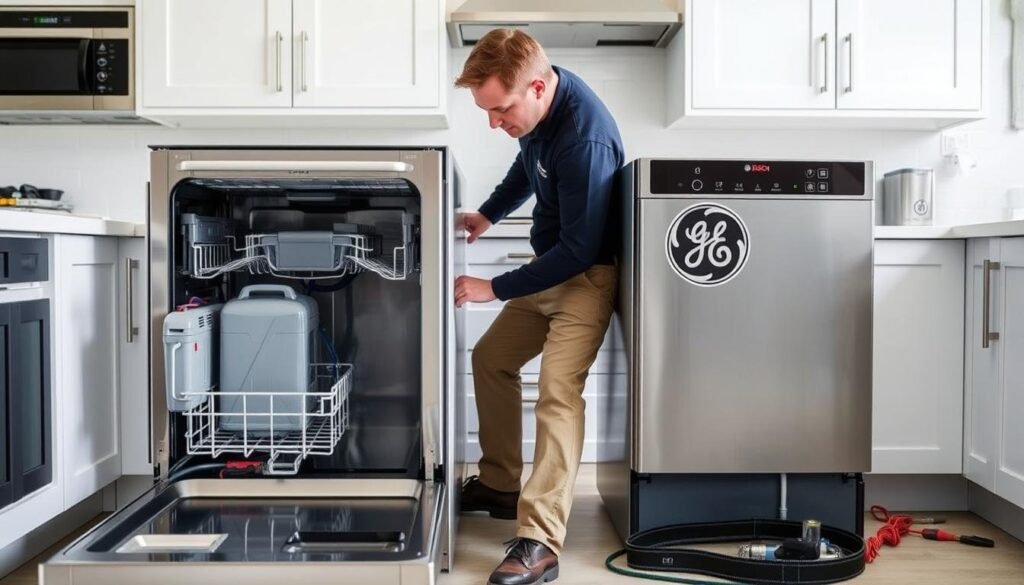
1. What Does the True 10-Year Cost of a Dishwasher Include?
A dishwasher’s purchase price is only the first expense. To understand what the appliance will actually cost, you need to consider everything required to own and operate it for a decade.
Some expenses occur once, such as purchasing and installing the appliance. Others happen every time you run a wash cycle. A third group consists of unpredictable costs, such as pump failures, replacement hoses and electronic repairs.
The main ownership expenses include:
| Cost category | What it includes | How often it occurs |
|---|---|---|
| Purchase price | Cost of the dishwasher | Once |
| Delivery | Transport and delivery charges | Usually once |
| Installation | Plumbing, electrical connections and fitting | Usually once |
| Electricity | Power for washing, heating and drying | Every cycle |
| Water | Water consumed during washing and rinsing | Every cycle |
| Detergent | Tablets, powder or gel | Regularly |
| Rinse aid | Drying and rinsing assistance | Regularly, if used |
| Dishwasher salt | Water-softener regeneration, where required | Periodically |
| Maintenance | Cleaning products, filters and routine care | Periodically |
| Repairs | Pumps, valves, heating systems, controls and other components | Occasionally |
| Replacement parts | Racks, baskets, spray arms, hoses and seals | Occasionally |
| Insurance or protection | Optional appliance cover | Monthly or annually |
| Disposal | Removal, recycling or collection at the end of ownership | Usually once |
Not every household will incur every expense. For example, a dishwasher without an integrated water softener may not require dishwasher salt. A household with a reliable appliance may spend very little on repairs, while another may experience several component failures.
The important point is to avoid comparing appliances using purchase price alone.
The total cost of ownership formula
A useful starting formula is:
\[ \begin{aligned} \text{10-Year Cost} ={}& \text{Purchase Price}\\ &+\text{Delivery and Installation}\\ &+\text{Electricity}\\ &+\text{Water}\\ &+\text{Detergent and Rinse Aid}\\ &+\text{Maintenance}\\ &+\text{Repairs}\\ &+\text{Protection Costs}\\ &+\text{Disposal} \end{aligned} \]
If you replace the dishwasher during the ten-year period, you should also include the second appliance’s purchase and installation costs.
This calculation gives you a more complete picture of what owning the dishwasher actually costs.
2. The Initial Purchase Price: Your First Major Expense
The initial purchase price is usually the most visible part of dishwasher ownership. Prices vary considerably depending on capacity, brand, construction, design, noise levels and available features.
A basic freestanding dishwasher may cost considerably less than a premium integrated model with advanced drying technology, adjustable racks, smart connectivity and specialised wash programmes.
However, paying more does not automatically mean that the dishwasher will last longer or cost less to operate.
What determines the purchase price?
Dishwasher type
Freestanding dishwashers are often straightforward to install and can be suitable for kitchens with standard appliance spaces. Built-in and integrated models may cost more because of their design, finishes and installation requirements.
Compact and countertop dishwashers may have lower purchase prices, but they generally have smaller capacities. If you need to run several loads to wash the same quantity of dishes, the apparent saving may be reduced.
Capacity
A standard full-size dishwasher is generally more suitable for households that produce substantial quantities of dishes. Compact machines may be appropriate for smaller households, apartments or kitchens with limited space.
Capacity should be considered alongside the number of wash cycles you expect to run. A machine that is too small for your household may require more frequent operation.
Wash and drying technology
Different dishwashers use different washing and drying systems. Some have advanced sensors, improved filtration, automatic programmes, fan-assisted drying or specialised drying technologies.
These features may improve convenience or performance, but you should consider whether they provide practical benefits that justify the additional purchase price.
Noise level
Quiet dishwashers are particularly attractive in open-plan kitchens, apartments and homes where the kitchen is close to living or sleeping areas.
A quieter model may cost more, but the difference may be worthwhile if the dishwasher operates during evenings or overnight.
Smart features
Wi-Fi connectivity, mobile applications, remote monitoring and downloadable programmes can increase convenience. However, these features do not necessarily reduce the ten-year ownership cost.
Consider whether you will actually use them before paying extra.
Example: Two dishwashers with different purchase prices
Imagine you are comparing two standard-size dishwashers:
| Expense | Dishwasher A | Dishwasher B |
|---|---|---|
| Purchase price | $500 | $850 |
| Delivery and installation | $150 | $150 |
| Initial total | $650 | $1,000 |
Dishwasher A is $350 cheaper initially. However, that does not establish which appliance is the better investment.
If Dishwasher B consumes less electricity and water, needs fewer repairs or lasts longer, some of the additional purchase cost may be recovered over time.
On the other hand, if both models have similar operating costs and reliability, the more expensive model may never recover its higher initial price.
The lesson: Purchase price should be evaluated together with expected running costs, reliability, repairability and warranty coverage.
3. Electricity Consumption: One of the Biggest Ongoing Costs
Every dishwasher cycle requires electricity. The appliance uses energy to operate its circulation pump, control system, sensors, drainage pump and other components. It may also use electricity to heat water and dry dishes.
The amount consumed depends on the model, selected programme, incoming water temperature, load size, drying method and frequency of use.
An older dishwasher may use more energy than a modern efficient model, although this is not true of every comparison. Some older appliances are relatively efficient, while a poorly selected new model may not provide a meaningful reduction in running costs.
How much electricity does a dishwasher use?
In the United States, current ENERGY STAR criteria for a standard-size qualifying dishwasher set a maximum annual energy consumption of 240 kWh under the relevant test procedure. Compact qualifying models have a separate limit.
These figures are useful when comparing certified models, but they are not a guarantee that every household will consume exactly that amount. Actual usage depends on the number of cycles, programme selection and operating conditions.
In Canada, dishwasher energy consumption is measured and presented through the country’s appliance energy-rating system. Product information allows consumers to compare annual electricity consumption between similar models.
In the UK, the energy label for dishwashers displays electricity consumption per 100 cycles. This helps buyers compare models using a standardised measurement.
How to calculate your annual electricity cost
Use this formula:
\[ \text{Annual Electricity Cost} = \text{Annual kWh}\times\text{Electricity Rate} \]
For example, assume a dishwasher consumes 240 kWh annually and your electricity rate is $0.20 per kWh.
\[ 240\times \$0.20=\$48 \]
The estimated electricity cost would be $48 annually.
Over ten years, assuming the same consumption and electricity price:
\[ \$48\times10=\$480 \]
This is a simplified calculation. Electricity prices can change, and the actual consumption of your dishwasher may be different from its rated figure.
How usage frequency changes electricity costs
A household running a dishwasher once every two days will generally use less energy than a household running it twice daily, although the relationship is not always perfectly proportional because modern machines can adjust water and energy consumption according to load conditions.
Consider this illustration:
| Usage pattern | Approximate cycles per year |
|---|---|
| Three cycles per week | 156 |
| Five cycles per week | 260 |
| Seven cycles per week | 364 |
| Ten cycles per week | 520 |
| Fourteen cycles per week | 728 |
A household running ten cycles each week uses the appliance much more frequently than one running three cycles.
This is why annual energy figures should be interpreted carefully. The testing assumptions used to produce a label may not match your household’s actual usage.
Does the Eco programme really save money?
Eco programmes are designed to use resources efficiently. They may take longer than intensive or rapid programmes because they can reduce water temperature or adjust the washing process to use less energy.
A longer cycle does not automatically mean higher electricity consumption.
For many households, the Eco programme is a good choice for normally soiled dishes when the manufacturer recommends it. However, the best programme depends on the load, soil level and appliance design.
Heated drying can increase the electricity bill
Some dishwashers use additional energy for heated drying. Other models use condensation drying, air movement or alternative drying technologies.
If your dishwasher has an air-dry or energy-saving drying option, check whether it can reduce electricity consumption without compromising the results you need.
You should also consider whether the machine needs to provide perfectly dry dishes immediately. Allowing dishes to air-dry naturally may reduce the need for energy-intensive drying features.
The ten-year electricity calculation
If your dishwasher consumes 240 kWh annually:
| Electricity rate | Annual cost | Ten-year cost |
|---|---|---|
| $0.12/kWh | $28.80 | $288 |
| $0.16/kWh | $38.40 | $384 |
| $0.20/kWh | $48.00 | $480 |
| $0.25/kWh | $60.00 | $600 |
| $0.30/kWh | $72.00 | $720 |
These are illustrative calculations, not guaranteed utility costs for any particular household or country.
The same dishwasher can have significantly different ownership costs depending on local electricity prices.
4. Water Consumption: The Cost That Many Dishwasher Owners Forget
Electricity is not the only utility expense. Every wash cycle also consumes water, and the cost can be more significant in households with metered water charges or high wastewater rates.
Dishwasher water consumption varies according to model, capacity, wash programme, soil level and sensor technology. A modern efficient dishwasher may use substantially less water than an older model, but the difference should be established using the actual product specifications.
For a standard-size dishwasher meeting current ENERGY STAR qualification criteria in the United States, water consumption is limited to 3.2 gallons per cycle. This is approximately 12.1 litres.
Canadian efficiency standards and product information provide water-consumption figures in litres per cycle. In the UK, the energy label also displays water consumption per cycle, making comparisons between models easier.
How much water does a dishwasher use in ten years?
Consider a dishwasher using 12 litres of water per cycle.
If your household runs five cycles per week:
\[ 5\times52=260\text{ cycles per year} \]
Annual water consumption:
\[ 260\times12=3,120\text{ litres} \]
Ten-year water consumption:
\[ 3,120\times10=31,200\text{ litres} \]
Illustrative calculation using 12 litres per cycle and five cycles per week. Actual water consumption depends on the appliance and selected programmes.
Now compare a less efficient dishwasher using 18 litres per cycle.
| Measurement | Efficient model | Less efficient model |
|---|---|---|
| Water per cycle | 12 litres | 18 litres |
| Weekly cycles | 5 | 5 |
| Annual water consumption | 3,120 litres | 4,680 litres |
| Ten-year water consumption | 31,200 litres | 46,800 litres |
| Difference over ten years | — | 15,600 litres more |
The difference is 15,600 litres over ten years.
That is a substantial amount of water, but whether it creates a significant financial saving depends on local water and wastewater charges.
How to calculate the water cost
Use this formula:
\[ \text{Annual Water Cost} = \frac{\text{Annual Litres}}{1,000} \times\text{Cost per 1,000 Litres} \]
For example, assume your dishwasher uses 3,120 litres annually and the combined water and wastewater charge is $5 per 1,000 litres.
\[ 3.12\times \$5=\$15.60 \]
Your estimated annual water cost would be $15.60.
Over ten years:
\[ \$15.60\times10=\$156 \]
This example is deliberately simple. Some water providers use different billing structures, and wastewater charges may not be calculated directly from household water consumption.
Water heating is another hidden cost
The water used by the dishwasher must be heated either by the appliance or by the home’s hot-water system, depending on the model and installation.
When comparing electricity costs, make sure you understand what the appliance’s rated energy figure includes. Standardised energy testing may account for the energy associated with heating incoming water, so you should not add the same heating expense twice.
If you are calculating your own actual energy usage from a meter, consider whether the dishwasher is connected to hot or cold water and how the home’s water heater supplies it.
Does handwashing use less water?
Not necessarily.
Washing dishes under a continuously running tap can use substantial quantities of water. An efficient dishwasher can use considerably less water than some handwashing practices, especially when it is loaded properly.
However, the comparison depends on the number of dishes, the handwashing method, whether the sink is filled, and whether water is left running during rinsing.
A dishwasher is most efficient when it is used with reasonably full loads and appropriate programmes rather than being run repeatedly for a few items.
5. Dishwasher Detergent: A Small Expense That Adds Up Over Ten Years
Detergent is one of the most consistent recurring costs of dishwasher ownership.
Unlike the purchase price or installation charge, detergent expenses continue for as long as you use the appliance. A household that runs the dishwasher daily can spend considerably more on detergent than one that uses it three times a week.
The cost depends on the detergent format, brand, dosage, water hardness and number of cycles.
Different types of dishwasher detergent
Dishwasher tablets
Tablets are convenient because they provide a pre-measured dose. Some products combine detergent, rinse-aid ingredients and other cleaning functions.
However, premium tablets can cost more per wash than basic powder or gel.
Dishwasher powder
Powder allows the owner to adjust the quantity according to the load and programme. This can be economical when used correctly.
However, excessive dosing can waste detergent and leave residue.
Dishwasher gel
Gel detergent is easy to measure and may be suitable for certain machines and programmes. The cost per wash varies according to the product and quantity used.
Specialty detergents
Some households use specialised products for glassware, hard-water conditions or particular cleaning requirements. These can increase the overall cost.
How much can detergent cost over ten years?
Suppose your household spends an average of $0.20 per dishwasher cycle on detergent.
At five cycles per week:
\[ 5\times52=260\text{ cycles per year} \]
Annual detergent cost:
\[ 260\times \$0.20=\$52 \]
Ten-year detergent cost:
\[ \$52\times10=\$520 \]
Now compare different detergent costs:
| Detergent cost per cycle | Annual cost at 5 cycles/week | Ten-year cost |
|---|---|---|
| $0.10 | $26 | $260 |
| $0.15 | $39 | $390 |
| $0.20 | $52 | $520 |
| $0.25 | $65 | $650 |
| $0.30 | $78 | $780 |
| $0.40 | $104 | $1,040 |
This table demonstrates how a small difference in the price per wash can become significant over ten years.
Should you buy premium dishwasher tablets?
Not automatically.
A more expensive detergent may provide better results in certain conditions, but the difference is not guaranteed to justify the additional cost for every household.
Consider the cleaning results, water hardness, programme selected and the amount of detergent required. If an inexpensive detergent cleans your dishes properly without leaving residue, there may be little reason to pay more.
On the other hand, repeatedly buying an ineffective product can waste money through rewashing and additional cycles.
Avoid using too much detergent
More detergent does not necessarily mean cleaner dishes.
Excess detergent may leave residue, contribute to poor rinsing and increase household expenses. Follow the product instructions and the dishwasher manual.
The goal is to use the smallest appropriate quantity that provides satisfactory cleaning under your water conditions.
6. Rinse Aid and Dishwasher Salt: Small Recurring Expenses
Rinse aid and dishwasher salt are two additional costs that are easy to overlook when calculating dishwasher ownership.
Not every household needs both products. Their use depends on the appliance’s design, water conditions and washing requirements.
Rinse aid costs
Rinse aid helps water drain from dish surfaces and can reduce water marks and improve drying performance.
Some dishwashers have adjustable rinse-aid dispensers. The correct setting depends on the product, water conditions and drying results.
If your dishwasher requires rinse aid, you will need to refill it periodically. The annual cost depends on how frequently you use the appliance and how much product the dispenser releases.
For illustration, if rinse aid costs $20 annually:
\[ \$20\times10=\$200 \]
Over ten years, this adds $200 to ownership costs.
If your dishwasher uses very little rinse aid or your water conditions do not require regular use, the actual cost may be lower.
Dishwasher salt costs
Some dishwashers include an integrated water-softening system. These models may require special dishwasher salt to regenerate the softener.
Dishwasher salt is not the same as ordinary table salt. Use only the product specified by the manufacturer.
Salt consumption depends on water hardness and the dishwasher’s settings. Households in hard-water areas may need to refill the reservoir more frequently.
Suppose your annual dishwasher-salt expense is $25.
\[ \$25\times10=\$250 \]
Over ten years, the expense becomes $250.
However, a model without a built-in water softener may not require dishwasher salt at all.
Combined ten-year example
| Product | Illustrative annual cost | Ten-year cost |
|---|---|---|
| Rinse aid | $20 | $200 |
| Dishwasher salt | $25 | $250 |
| Total | $45 | $450 |
These are sample budgeting figures, not standard market prices. Your actual spending will depend on local prices, usage and whether your model requires these products.
7. Maintenance Costs: What Does It Take to Keep a Dishwasher Working?
Dishwashers do not usually require extensive maintenance, but they are not completely maintenance-free.
Filters collect food debris, spray arms can become blocked, door seals can accumulate residue, and drainage areas may need occasional cleaning.
Routine maintenance can help preserve washing performance and reduce the risk of preventable problems.
Cleaning the filter
The dishwasher filter traps food particles and debris. If it becomes blocked, water circulation and drainage may be affected.
Many manufacturers recommend regular inspection and cleaning according to the owner’s manual.
Some households may need to clean the filter weekly, while others may require less frequent cleaning depending on usage and food residue.
Cleaning the filter is usually an owner-maintenance task and does not necessarily require buying replacement parts.
Cleaning the spray arms
Spray arms distribute water throughout the dishwasher. Their openings can become blocked by food particles or mineral deposits.
Inspect and clean removable spray arms according to the instructions for your model. Avoid damaging the openings with sharp tools.
Cleaning the door gasket
The door gasket helps prevent water from escaping during a wash cycle. Food residue and detergent deposits can accumulate around the seal.
Regular cleaning helps keep the sealing surface in good condition. If the gasket becomes cracked or distorted, it may need replacement.
Cleaning the dishwasher interior
Grease, mineral deposits and odours can develop inside a dishwasher over time.
Some manufacturers recommend a dishwasher-cleaning product or a dedicated cleaning programme. Follow the manual and use only suitable products.
Avoid experimenting with harsh household chemicals because they may damage seals or internal components.
Maintenance products over ten years
A household might budget for:
| Maintenance item | Illustrative annual allowance |
|---|---|
| Dishwasher cleaner | $15 |
| Filter and interior cleaning supplies | $5 |
| Other minor maintenance supplies | $10 |
| Total | $30 |
At $30 annually, the ten-year allowance would be $300.
This is a budgeting example rather than a requirement to spend $30 every year. Some owners may spend less, particularly if routine cleaning requires only water and basic care.
Is professional maintenance necessary every year?
Not necessarily.
Many residential dishwashers do not require an annual professional service if they are operating correctly and the manufacturer does not specify one.
However, if you notice unusual noises, repeated drainage problems, leaks, poor heating or recurring fault codes, a professional inspection may prevent a small problem from becoming a more expensive one.
The best maintenance schedule is the one specified by the manufacturer for your exact model.
8. Repairs and Replacement Parts: The Biggest Unpredictable Ownership Expense
Repairs are one of the most difficult parts of a ten-year dishwasher cost calculation because you cannot know in advance which component will fail or when it will happen.
A dishwasher may operate reliably for many years with only routine maintenance. Another machine may require a replacement pump, inlet valve, control board or heating assembly much earlier.
Repair costs also vary between countries and regions. Labour rates, part availability, brand, model complexity and the technician’s service charges all affect the final bill.
Common dishwasher repairs
| Component or problem | What may happen | Cost considerations |
|---|---|---|
| Drain pump | Dishwasher fails to drain | Part price and access to the pump |
| Circulation pump | Weak washing or unusual noise | May involve an expensive assembly |
| Water inlet valve | Dishwasher fails to fill correctly | Part and plumbing diagnosis |
| Heating system | Poor heating or drying | Model-specific repair costs |
| Door latch | Dishwasher will not start | Usually depends on door design |
| Door gasket | Water leaks around the door | Replacement and fitting costs |
| Electronic control board | Interrupted cycles or control faults | Can be expensive |
| Drain hose | Leaking or drainage problems | Access and installation costs |
| Spray arm | Poor water distribution | May be a relatively simple replacement |
What might repairs cost?
Repair prices vary substantially, so avoid using one country’s repair estimate as a universal figure.
For example, recent UK repair-price surveys have reported indicative prices for common dishwasher work such as replacing pumps, motors and heating elements. The final cost may be higher depending on the appliance, location, VAT and whether additional diagnosis is required.
In the United States and Canada, repair costs also vary according to the local labour market, service call charges and replacement-part availability.
For a realistic estimate, obtain a written quote from a technician familiar with your dishwasher brand and model.
The repair reserve method
One practical way to estimate the ten-year cost is to create an annual repair reserve.
For example, suppose you budget $50 each year for possible repairs.
\[ \$50\times10=\$500 \]
This does not mean you will definitely spend $500. It simply creates a planning allowance for occasional service and replacement parts.
A different household might budget $30 annually, while an older or more complex appliance may justify a larger reserve.
Why the dishwasher’s age matters
The likelihood of a repair generally changes as an appliance ages. Seals, pumps, heating components, racks and electronic systems experience repeated use.
However, there is no universal rule that a dishwasher will fail at a particular age.
A well-maintained appliance may remain reliable for longer than expected, while another may develop a major fault after only a few years.
For a ten-year ownership calculation, it is sensible to consider at least three possibilities:
- Low-repair scenario: The dishwasher needs little more than routine maintenance.
- Moderate-repair scenario: One or two components need replacement during the ownership period.
- High-repair scenario: Several faults occur, potentially making replacement necessary.
The cost difference between these scenarios can be substantial.
Should you replace the dishwasher after a major repair?
Not always.
A repair involving a pump or heating component may be worthwhile if the machine is otherwise in good condition.
However, if the appliance is approaching the end of its useful life and the repair costs a large proportion of the price of a new dishwasher, replacement deserves serious consideration.
The decision should include the dishwasher’s previous repair history, parts availability and the expected cost of future ownership.
9. Installation, Delivery and Removal: Expenses That Are Not Always Included in the Price
A dishwasher advertised at a particular price may not include everything required to make it operational.
Installation costs depend on whether the appliance is freestanding, built-in or fully integrated, and whether the existing kitchen connections are compatible with the new model.
If you are replacing an existing dishwasher with a similar model, installation may be relatively straightforward. However, changing appliance dimensions, relocating connections or modifying cabinetry can increase the total expense.
Delivery costs
Delivery may be included in the advertised price, charged separately or offered as part of a promotional package.
Before purchasing, check whether the delivery service includes:
- Transport to the property.
- Delivery to the kitchen rather than the entrance.
- Removal of packaging.
- Carrying the appliance upstairs.
- Collection of the old dishwasher.
If you live in an apartment or a property with restricted access, additional delivery charges may apply.
Installation costs
Installation may involve connecting the water supply, drain hose and electrical connection, levelling the appliance and securing it correctly.
Built-in dishwashers may require additional work to fit cabinet panels and mounting brackets. Integrated models can be particularly expensive to replace if the kitchen has custom cabinetry.
Electrical and plumbing work should meet the applicable local requirements. Depending on the installation and country, a suitably qualified professional may be necessary.
Old dishwasher removal
Some retailers provide old-appliance collection when delivering a replacement. Others charge separately or require you to arrange recycling.
Do not assume that removal is included simply because delivery is free.
Ten-year impact of installation costs
Installation is generally a one-time expense, but it can become relevant again if the dishwasher needs replacement during the ten-year period.
For example:
| Initial expense | Illustrative cost |
|---|---|
| Dishwasher | $750 |
| Delivery | $50 |
| Installation | $120 |
| Old appliance removal | $30 |
| Total initial cost | $950 |
The dishwasher’s actual purchase price is $750, but the household spends $950 to have it delivered, installed and the old appliance removed.
That $200 difference should be included in the ownership calculation.
10. Dishwasher Insurance and Extended Warranty: Are They Worth the Money?
Some retailers and manufacturers offer extended warranties or appliance protection plans. Home insurance policies may also provide certain types of appliance-related protection, although the scope differs considerably.
These products can increase the ten-year cost of owning a dishwasher. Whether they are worthwhile depends on the price of the plan, what it covers, the exclusions and the likely cost of repairs.
Manufacturer’s standard warranty
The manufacturer’s standard warranty generally covers specified defects in materials or workmanship during a defined period.
Some models have separate coverage periods for selected components. For example, a pump, motor, tub or electronic component may have different coverage from the rest of the appliance.
However, a longer parts warranty does not necessarily include labour or service charges.
Extended warranty
An extended warranty may provide additional coverage after the standard manufacturer’s warranty expires.
Before purchasing, check:
- The length of additional coverage.
- Whether parts and labour are included.
- Whether service visits are included.
- Whether accidental damage is covered.
- Whether there is an excess or deductible.
- Whether the plan covers leaks.
- Whether replacement is offered when repair is uneconomical.
- Whether the plan has an annual claim limit.
- Whether pre-existing faults are excluded.
Do not purchase an extended warranty simply because the salesperson says that dishwasher repairs are expensive. Compare the plan’s total cost with the likely cost of the repairs it actually covers.
Appliance insurance
Appliance insurance may cover breakdowns, accidental damage or other specified incidents. Some policies cover multiple household appliances under one contract.
However, insurance policies often contain exclusions relating to age, existing damage, poor maintenance, incorrect installation and cosmetic deterioration.
A policy that appears comprehensive may not cover the particular failure you experience.
A ten-year protection-plan example
Suppose a protection plan costs $8 per month.
\[ \$8\times12=\$96\text{ per year} \]
Over ten years:
\[ \$96\times10=\$960 \]
You would spend $960 on the plan over ten years, assuming the monthly charge remains unchanged.
That amount may exceed the price of some replacement dishwashers.
This does not mean protection plans are always poor value. A plan may be useful if it covers several expensive appliances or provides valuable protection against particular risks. But buying a plan without reading the exclusions can result in paying for protection that does not meet your needs.
Country-specific considerations
United States: Check the manufacturer’s limited warranty, retailer protection plan and any applicable credit-card purchase benefits. Understand whether the plan is a service contract or insurance and what its claims process requires.
United Kingdom: Compare the extended guarantee with your existing statutory rights against the retailer. A paid guarantee does not replace consumer rights, and you should check whether your home insurance or bank account already provides relevant protection.
Canada: Review the written coverage and provincial or territorial requirements applicable to the product or service contract. Confirm the claim limits, exclusions and responsibility for labour and parts.
The key lesson: Treat extended warranties and appliance insurance as optional expenses. Calculate their total ten-year price and compare it with the protection they actually provide.
11. Hidden Costs: Leaks, Kitchen Damage and Appliance Downtime
Some dishwasher ownership expenses are not part of the normal operating budget. They occur when something goes wrong.
A leaking dishwasher can cause damage to flooring, cabinets, skirting boards and nearby electrical components. The repair of the dishwasher itself may be relatively inexpensive, but restoring the surrounding kitchen can cost considerably more.
Water damage
A damaged hose, loose connection, faulty seal or internal leak can allow water to escape.
The consequences depend on how quickly the problem is noticed, the amount of water released and the construction of the surrounding kitchen.
A small leak discovered immediately may require little more than a repair and cleaning. A slow leak hidden behind cabinetry may cause swelling, mould or damage to flooring.
Check the appliance periodically for visible moisture around the door, beneath the machine and near accessible water connections.
Flooring and cabinet repairs
Dishwasher leaks can affect materials such as:
- Laminate flooring.
- Hardwood flooring.
- Kitchen cabinet bases.
- Cabinet side panels.
- Skirting boards.
- Plasterboard and adjoining walls.
These repairs are separate from the cost of repairing the dishwasher.
Whether home insurance covers the resulting damage depends on the policy, the cause of the leak and the circumstances. Some policies distinguish between sudden accidental water escape and damage caused by gradual leakage or poor maintenance.
Appliance downtime
A broken dishwasher can also create inconvenience.
If your household depends on the appliance, you may need to wash dishes by hand while waiting for a technician or replacement part. This takes time and may increase water and energy consumption depending on your handwashing method.
For a household with several occupants, a dishwasher that remains out of service for weeks may be more inconvenient than it would be for someone living alone.
How to reduce these hidden costs
- Check visible water connections periodically.
- Inspect the door gasket for damage.
- Clean the filter according to the manual.
- Investigate unusual noises and repeated fault codes.
- Avoid operating a dishwasher that is actively leaking.
- Shut off the water supply if necessary and safe.
- Consider an appropriate leak-protection feature when purchasing a new appliance.
- Check whether your home insurance covers sudden escape of water.
Leak protection is a useful feature, but it does not eliminate every possible water-damage risk. Correct installation and maintenance remain important.
12. The True 10-Year Cost: A Worked Example
Now let’s combine the main expenses into one calculation.
The following example represents a household in the United States purchasing a standard-size dishwasher. The figures are illustrative and are intended to demonstrate the calculation method rather than represent a universal market average.
Assumptions
- Purchase price: $750.
- Delivery: $50.
- Installation: $120.
- Removal of old appliance: $30.
- Annual electricity consumption: 240 kWh.
- Electricity rate: $0.20 per kWh.
- Usage: Five cycles per week.
- Water consumption: 12 litres per cycle.
- Water and wastewater cost: $5 per 1,000 litres.
- Detergent: $0.20 per cycle.
- Rinse aid: $20 annually.
- Dishwasher salt: $25 annually.
- Maintenance supplies: $30 annually.
- Repair reserve: $50 annually.
- Protection plan: Not purchased.
- Disposal at the end of ten years: $30.
Initial purchase and installation
| Expense | Cost |
|---|---|
| Dishwasher | $750 |
| Delivery | $50 |
| Installation | $120 |
| Old appliance removal | $30 |
| Initial total | $950 |
Electricity over ten years
Annual electricity consumption:
\[ 240\text{ kWh} \]
Annual electricity cost:
\[ 240\times \$0.20=\$48 \]
Ten-year electricity cost:
\[ \$48\times10=\$480 \]
Water over ten years
Annual cycles:
\[ 5\times52=260 \]
Annual water consumption:
\[ 260\times12=3,120\text{ litres} \]
Annual water cost:
\[ 3.12\times \$5=\$15.60 \]
Ten-year water cost:
\[ \$15.60\times10=\$156 \]
Detergent over ten years
Annual detergent expense:
\[ 260\times \$0.20=\$52 \]
Ten-year detergent expense:
\[ \$52\times10=\$520 \]
Rinse aid and salt over ten years
| Product | Annual cost | Ten-year cost |
|---|---|---|
| Rinse aid | $20 | $200 |
| Dishwasher salt | $25 | $250 |
| Total | $45 | $450 |
Maintenance and repairs
| Expense | Annual allowance | Ten-year allowance |
|---|---|---|
| Maintenance supplies | $30 | $300 |
| Repair reserve | $50 | $500 |
| Total | $80 | $800 |
End-of-life disposal
The example includes a $30 allowance for disposal or recycling at the end of the ownership period.
Complete ten-year cost calculation
Illustrative 10-year ownership cost
$3,336
Example household budget, not a market average or guaranteed expense
Purchase, delivery and installation
$950
Electricity
$480
Water
$156
Detergent
$520
Rinse aid and salt
$450
Maintenance and repairs
$800
End-of-life disposal
$30
Total ten-year cost
$3,336
Average annual cost
$333.60
Average monthly cost
$27.80
This example shows why the purchase price is not the same as the cost of ownership. The dishwasher costs $750 to buy, but the modelled ten-year budget is $3,336 after including installation, utilities, detergent, maintenance, repairs and disposal.
The repair reserve is a budgeting allowance, not a prediction that $500 of repairs will definitely occur. If the dishwasher needs no repairs, the actual cost will be lower. If it experiences a major breakdown, the cost could be higher.
The calculation also assumes that the appliance remains in service for the full ten years. It does not include inflation, financing interest, changes in energy tariffs or a complete replacement during the period.
13. How the Ten-Year Cost Changes in the UK
The same dishwasher can have a different ownership cost in the United Kingdom because electricity tariffs, water charges, detergent prices, installation costs and repair labour rates differ from those in North America.
The UK energy label makes it possible to compare dishwashers using electricity consumption per 100 cycles and water consumption per cycle.
This is useful because buyers can compare models without relying on broad claims such as “energy-saving” or “low-cost to run.”
Understanding the UK energy label
The current energy-rating system uses an A-to-G scale, with A representing the most efficient category.
For dishwashers, the label includes information such as:
- Energy consumption per 100 cycles.
- Water consumption per cycle.
- Capacity in place settings.
- Eco programme duration.
- Noise emission information.
The energy figure is based on standardised testing, so it should be used as a comparison tool rather than a promise of your household’s actual consumption.
UK electricity cost calculation
Suppose a dishwasher uses 90 kWh per 100 cycles.
If the household runs five cycles per week:
\[ 5\times52=260\text{ cycles annually} \]
Annual electricity consumption:
\[ 90\times2.6=234\text{ kWh} \]
If electricity costs 25 pence per kWh:
\[ 234\times£0.25=£58.50 \]
Annual electricity cost would be £58.50.
Ten-year electricity cost, assuming an unchanged tariff:
\[ £58.50\times10=£585 \]
The tariff is an illustrative assumption. Your actual rate depends on your energy contract, region and tariff structure.
Water charges in the UK
Water bills vary by water company and location. Some households pay according to a water meter, while others have unmetered charges.
If you have a water meter, using a dishwasher with lower water consumption may help reduce water and wastewater expenses. If your bill is not metered, the direct financial benefit may be less noticeable.
UK repair and installation costs
Dishwasher repair costs vary according to the part and the technician’s location. Recent UK repair-price surveys have published indicative prices for replacing pumps, motors and heating elements, but these should not be treated as guaranteed quotes.
London and the South East may have higher labour prices than other areas.
When comparing ownership costs, include VAT where applicable and ask whether the quoted price includes parts, labour and any call-out fee.
UK ten-year budgeting priorities
For UK households, pay particular attention to:
- The energy consumption per 100 cycles.
- Water consumption per cycle.
- Your electricity tariff.
- Whether your water supply is metered.
- Detergent and rinse-aid spending.
- Repair costs and availability of parts.
- Installation and removal charges.
- The length and conditions of the manufacturer’s guarantee.
Do not assume that a dishwasher with a better energy rating will always be cheaper overall. The difference in purchase price and the cost of repairs must also be considered.
14. How the Ten-Year Cost Changes in Canada
Canadian dishwasher owners should pay attention to electricity consumption, water use and the energy information provided for individual models.
The Canadian EnerGuide system provides information that helps consumers compare the annual energy consumption of appliances. The label identifies the model and gives an indication of how its consumption compares with similar products.
Canada also has minimum energy-efficiency requirements for residential dishwashers. These requirements help establish a baseline for the energy performance of appliances sold in the market.
Calculate annual electricity costs in Canada
Suppose a dishwasher consumes 240 kWh annually.
If your electricity rate is CAD $0.15 per kWh:
\[ 240\times CAD\$0.15=CAD\$36 \]
The annual electricity expense would be CAD $36.
Over ten years:
\[ CAD\$36\times10=CAD\$360 \]
This example assumes an unchanged rate and annual consumption.
Electricity prices vary considerably across Canadian provinces and territories. A household’s actual cost can therefore differ significantly from this example.
Water costs across Canadian regions
Water and wastewater charges are determined by local municipalities and utilities. Some households face metered charges, while others pay through different billing arrangements.
A dishwasher using less water may provide financial benefits in a metered household, particularly where water and wastewater charges are substantial.
However, the exact saving depends on the local billing system.
Canadian repair costs
Repair expenses depend on the city, availability of technicians and replacement parts.
In larger urban areas, consumers may have access to more repair providers, while some rural locations may face higher travel or service charges.
For older or less common dishwasher models, parts may need to be ordered from another province or imported. This can increase repair time and total cost.
Canadian ten-year budgeting priorities
Canadian households should compare:
- Annual energy consumption.
- Water consumption per cycle.
- Local electricity prices.
- Local water and wastewater rates.
- Detergent and maintenance expenses.
- Availability of replacement parts.
- Repair labour and service-call charges.
- Manufacturer warranty and provincial consumer protections.
The most efficient dishwasher is not necessarily the least expensive to own if its purchase price is substantially higher or its repairs are unusually costly.
15. Compare Three Dishwasher Ownership Scenarios Over Ten Years
To understand how much ownership costs can vary, consider three different household situations.
These examples use US dollars for consistency. They are illustrative budgets, not claims about the average cost of dishwashers in every market.
Scenario A: Budget dishwasher with higher running costs
A household purchases an inexpensive dishwasher but chooses a model with relatively high energy and water consumption.
| Expense | Ten-year cost |
|---|---|
| Purchase, delivery and installation | $650 |
| Electricity | $650 |
| Water | $220 |
| Detergent | $650 |
| Rinse aid and salt | $350 |
| Maintenance | $300 |
| Repairs | $700 |
| Disposal | $30 |
| Total | $3,550 |
The initial purchase price is attractive, but the higher operating and repair allowances increase the total cost.
Scenario B: Mid-range efficient dishwasher
A household purchases a more efficient dishwasher with reasonable operating costs and moderate maintenance requirements.
| Expense | Ten-year cost |
|---|---|
| Purchase, delivery and installation | $950 |
| Electricity | $480 |
| Water | $156 |
| Detergent | $520 |
| Rinse aid and salt | $450 |
| Maintenance | $300 |
| Repairs | $500 |
| Disposal | $30 |
| Total | $3,386 |
Although the initial investment is higher, the modelled total cost is lower than Scenario A.
Scenario C: Premium dishwasher with a high purchase price
A household chooses a premium dishwasher with advanced features, quiet operation and a higher initial price.
| Expense | Ten-year cost |
|---|---|
| Purchase, delivery and installation | $1,450 |
| Electricity | $420 |
| Water | $130 |
| Detergent | $520 |
| Rinse aid and salt | $450 |
| Maintenance | $300 |
| Repairs | $350 |
| Disposal | $30 |
| Total | $3,650 |
This model has lower estimated running and repair expenses, but its high purchase price means that it still costs more over the ten-year period.
What do these scenarios demonstrate?
| Scenario | Initial investment | Ten-year ownership cost |
|---|---|---|
| Budget model | $650 | $3,550 |
| Mid-range model | $950 | $3,386 |
| Premium model | $1,450 | $3,650 |
The mid-range model is the least expensive in these particular examples.
However, these figures should not be interpreted as a universal ranking of budget, mid-range and premium dishwashers. Actual costs depend on the models selected, household usage, utility prices and repair experience.
The important lesson is that the cheapest dishwasher to buy is not necessarily the cheapest dishwasher to own.
16. How to Reduce the Ten-Year Cost of Owning a Dishwasher
You do not need to purchase an expensive premium dishwasher to achieve reasonable ownership costs. Many savings come from choosing an appropriate model and operating it correctly.
1. Choose the correct dishwasher capacity
A dishwasher that is too small may require additional cycles, while an unnecessarily large appliance may cost more than you need to spend.
Consider the number of people in your household, your cooking habits and the quantity of dishes produced daily.
A standard-size dishwasher is often suitable for a family, while a compact model may be appropriate for a smaller household.
2. Compare energy consumption before purchasing
Use the official energy information available in your country.
In the United States, compare the EnergyGuide information and relevant efficiency certification.
In the UK, compare electricity consumption per 100 cycles and water use per cycle.
In Canada, use the EnerGuide information and applicable efficiency listings.
Compare similar capacities and operating conditions.
3. Run full loads when practical
Running several small loads generally means using more cycles than combining suitable dishwasher-safe items into fewer loads.
Wait until you have a reasonably full load, provided the dishes are arranged correctly and water can circulate freely.
Do not overload the racks because poor loading can interfere with cleaning.
4. Use the Eco programme
For normally soiled dishes, the Eco programme can reduce resource consumption.
It may take longer, but the longer duration does not necessarily mean greater energy use.
Follow the manufacturer’s guidance on when to use Eco, Auto or intensive programmes.
5. Avoid unnecessary pre-rinsing
Scrape large food particles into the waste bin before loading the dishwasher.
Modern dishwashers often use filtration and soil sensors to manage normal food residue. Excessive pre-rinsing can waste water and increase the household’s overall resource consumption.
Follow the instructions for your particular model.
6. Use detergent correctly
Measure powder or gel according to the instructions. If you use tablets, choose a suitable product and avoid adding unnecessary detergent.
Buying detergent in larger packs may reduce the price per wash, but compare the actual cost per cycle rather than the package price.
7. Maintain the filter
A clean filter helps maintain drainage and washing performance.
Inspect it regularly and clean it according to the manual. This simple task may help prevent avoidable drainage problems.
8. Keep spray arms clean
Check that spray arms can rotate freely and that their openings are not blocked.
Avoid using sharp metal objects that can damage the openings.
9. Check water hardness
If your dishwasher includes a water-softening system, configure it according to the local water hardness.
Use dishwasher salt where required. Incorrect settings can affect washing results and mineral-deposit management.
10. Do not ignore early warning signs
Unusual noises, repeated fault codes, poor drainage, leaks and inconsistent heating should be investigated.
Ignoring a small problem may allow it to become more expensive.
11. Avoid unnecessary extended warranties
Compare the total price of an extended warranty with the repairs it actually covers.
If the protection plan costs nearly as much as a replacement dishwasher, it deserves careful consideration.
12. Choose a model with accessible replacement parts
Before buying, investigate whether filters, racks, spray arms, pumps, valves and other common components are available.
A dishwasher with good parts support may be easier and less expensive to maintain.
17. Is It Better to Buy a Cheap Dishwasher or an Expensive One?
This is one of the most common questions when comparing the long-term cost of ownership.
There is no automatic advantage to either option.
A cheaper dishwasher may offer excellent value if it has suitable capacity, reasonable energy consumption, good cleaning performance and accessible replacement parts.
An expensive dishwasher may justify its price if it offers meaningful benefits such as lower running costs, better construction, quieter operation or a more useful design.
However, a premium model with complicated electronics and expensive replacement assemblies may also have higher repair costs.
When a cheaper dishwasher makes sense
A budget dishwasher may be a sensible choice when:
- You have a limited initial budget.
- Your household has relatively modest washing requirements.
- The model has acceptable energy and water consumption.
- Replacement parts are available.
- You do not need advanced features.
- The warranty provides reasonable protection.
When a premium dishwasher makes sense
A premium model may be worth considering when:
- You need quieter operation.
- You want more flexible racks.
- Your kitchen has an integrated design.
- You regularly wash large or difficult loads.
- You value specialised drying performance.
- The model offers measurable efficiency improvements.
- Local service and replacement parts are readily available.
Look beyond the brand name
A familiar brand name does not guarantee that every model has the same reliability or ownership cost.
Compare individual models, not just manufacturers. Two dishwashers from the same company may have different pumps, control systems, drying arrangements and component warranties.
The best buying decision is based on the appliance’s specifications, performance, service support and expected ownership cost.
18. Does the Dishwasher’s Lifespan Change the Ten-Year Cost?
Yes. The expected lifespan is one of the most important factors in the total cost calculation.
A dishwasher that lasts ten years spreads its initial purchase and installation expenses over a decade. A dishwasher that fails after six years may require an additional purchase, installation and disposal expense.
Many household dishwashers are expected to provide around a decade or more of service, although research and consumer surveys show that actual lifespan varies. Some appliances fail much earlier, while others remain usable beyond twelve or fifteen years.
What if your dishwasher lasts only seven years?
Suppose your initial purchase and installation cost is $950.
If the appliance lasts seven years, its initial cost per year is:
\[ \$950\div7=\$135.71 \]
If it lasts ten years:
\[ \$950\div10=\$95 \]
If it lasts twelve years:
\[ \$950\div12=\$79.17 \]
The longer-lasting dishwasher spreads its initial cost over more years.
However, this calculation excludes electricity, water, detergent and repairs. It also assumes that the appliance remains useful and performs satisfactorily throughout its life.
What if you need to replace the dishwasher during the ten-year period?
Suppose a dishwasher costs $750 and needs replacement after six years.
A replacement machine costs another $750, and the household spends $150 on delivery and installation.
The additional purchase and installation expense is $900.
The ten-year cost would therefore include:
- The original purchase and installation.
- Six years of operating expenses.
- The replacement dishwasher.
- The second installation.
- Four years of operating expenses for the replacement.
- Any repairs and disposal costs.
This is why lifespan and reliability should be considered when comparing two appliances with different purchase prices.
19. Frequently Asked Questions About the True 10-Year Cost of Owning a Dishwasher
1. How much does it cost to own a dishwasher for ten years?
There is no universal amount because the total depends on the purchase price, electricity consumption, water rates, detergent, repairs, maintenance and installation. A dishwasher purchased for $750 could cost several thousand dollars over ten years once all running and ownership expenses are included. Calculate each category using your local prices.
2. What is the biggest expense when owning a dishwasher?
The purchase price is usually the largest single initial expense. Over the full ownership period, however, detergent, repairs, electricity and installation can also contribute significantly. The largest ongoing expense varies by household and dishwasher model.
3. How much electricity does a dishwasher use in ten years?
It depends on annual energy consumption and the number of cycles. A dishwasher using 240 kWh annually would consume approximately 2,400 kWh over ten years if usage remained unchanged. Multiply that figure by your electricity tariff to estimate the cost.
4. How much water does a dishwasher use over ten years?
A dishwasher using 12 litres per cycle and running five cycles weekly would use approximately 31,200 litres over ten years. A model using more water per cycle or operating more frequently will consume more.
5. Is a dishwasher expensive to run?
Not necessarily. Modern efficient dishwashers can have relatively modest electricity and water costs. However, detergent and other consumables add to the total, and frequent operation can increase annual expenses.
6. How much should I budget annually for dishwasher maintenance?
There is no fixed amount. Many dishwashers require little routine spending beyond cleaning supplies and basic care. A separate repair reserve can help households prepare for unexpected component failures, particularly as the appliance ages.
7. How much does dishwasher detergent cost over ten years?
The amount depends on detergent price and usage. If a household runs 260 cycles annually and spends $0.20 per cycle, its ten-year detergent expense would be approximately $520.
8. Do dishwasher tablets cost more than powder?
They can, depending on the brand and product. Tablets offer convenience and pre-measured dosing, while powder may provide greater control over the amount used. Compare the price per wash rather than the total package price.
9. Does rinse aid increase the cost of dishwasher ownership?
Yes, if you regularly use it. Rinse aid is an additional recurring expense, although it may improve drying and reduce water marks. The amount required depends on the dishwasher and local water conditions.
10. Is dishwasher salt necessary?
Not for every dishwasher. Salt is required by some models with integrated water-softening systems. Check the owner’s manual before purchasing it.
11. Does a more energy-efficient dishwasher save money?
It can, especially when compared with a substantially less efficient model that is used frequently. However, the savings must be compared with the difference in purchase price. A more efficient dishwasher does not automatically have the lowest total ownership cost.
12. Is it cheaper to use a dishwasher or wash dishes by hand?
An efficient dishwasher can use less water than some handwashing methods, particularly when the tap is left running. The financial comparison depends on water heating, local water charges, detergent and the way dishes are washed by hand.
13. How much does it cost to repair a dishwasher?
Repair costs depend on the failed component, labour charges, location and availability of parts. A minor hose or latch repair may be relatively inexpensive, while a control-board, circulation-pump or heating-system repair can be considerably more costly.
14. How long should a dishwasher last?
A reasonable planning estimate is approximately 9–12 years, but actual lifespan varies by model, usage, installation and maintenance. Some machines last longer, while others require replacement earlier.
15. Should I buy an extended warranty for my dishwasher?
Only after comparing the price, coverage period, exclusions, claim limits and repair benefits. A protection plan can be useful, but it may not be worthwhile if the premium is close to the cost of a future repair or replacement.
16. Does a dishwasher warranty cover labour?
Some warranties cover both parts and labour for eligible faults, while others provide parts-only coverage or different periods for individual components. Always check the exact warranty document.
17. Are built-in dishwashers more expensive to own?
They can be more expensive to install or replace because of cabinet panels, mounting arrangements and plumbing access. However, their operating costs may be similar to those of comparable freestanding models.
18. Is a compact dishwasher cheaper over ten years?
Not automatically. A compact dishwasher may have lower purchase and per-cycle costs, but its smaller capacity could require more frequent cycles. Compare the amount of dishwashing your household actually needs.
19. What is the cheapest dishwasher to own?
The cheapest dishwasher to own is not necessarily the least expensive to buy. Look for a suitable capacity, low energy and water consumption, reasonable detergent requirements, good repairability and a competitive purchase price.
20. How do I calculate the ten-year cost of my dishwasher?
Add the purchase price, delivery, installation, electricity, water, detergent, rinse aid, salt, maintenance, repairs, insurance or protection plans and disposal. Multiply recurring annual expenses by ten, adjusting for any expected price increases or changes in usage.
21. Does running a dishwasher every day cost a lot?
Daily operation increases electricity, water and detergent consumption compared with using the dishwasher several times a week. However, a full daily load may still be more efficient than washing the same quantity of dishes by hand, depending on your method and appliance.
22. Does the Eco programme reduce the cost of owning a dishwasher?
It can reduce energy or water consumption for suitable loads. Savings depend on the model and selected programme. Eco cycles may take longer, but their longer duration does not automatically mean higher operating costs.
23. Does hard water increase dishwasher ownership costs?
It can. Hard water may increase the need for dishwasher salt, cleaning and maintenance. It can also contribute to mineral deposits if the water-softening system is not configured correctly.
24. Are dishwasher repairs more expensive in the UK, USA or Canada?
There is no universal ranking. Labour costs, parts availability, location, service charges and local taxes vary significantly. Compare actual quotes in your area rather than using repair prices from another country.
25. Should I replace an older dishwasher to save electricity?
Only if the expected operating savings and other benefits justify the replacement expense. Compare the existing appliance’s consumption with that of a suitable new model, then calculate the potential payback period.
26. Can a dishwasher increase my water bill significantly?
It depends on how frequently it operates, its water consumption and your local billing arrangement. A more efficient dishwasher can reduce consumption, particularly in households with metered water charges.
27. What happens if my dishwasher breaks before ten years?
Check the manufacturer’s warranty, retailer guarantee, extended protection and applicable consumer rights. If the fault is not covered, obtain a repair estimate and compare it with replacement cost.
28. Should I include the cost of electricity used to heat water separately?
Only if it is not already included in the energy figure you are using. Standardised dishwasher energy measurements may account for water-heating energy. Adding it again could double-count the expense. If calculating from actual household meter readings, consider how the appliance is connected and how water is heated.
29. Does dishwasher insurance reduce the ten-year ownership cost?
Not necessarily. Insurance adds a recurring premium. It may reduce the financial impact of certain covered failures, but the total cost depends on premiums, excesses, exclusions and claims limits.
30. Is a dishwasher worth buying if I live alone?
It can be, particularly if you value convenience and wash enough dishes to justify the cycles. A compact or appropriately sized model may be more suitable. Compare capacity, usage frequency and the cost of running the appliance against your handwashing routine.
Final Verdict: What Is the True Cost of Owning a Dishwasher for Ten Years?
The true ten-year cost of a dishwasher is much higher than its advertised purchase price. Electricity, water, detergent, rinse aid, dishwasher salt, maintenance, repairs, installation and disposal all contribute to the final amount.
A dishwasher that costs $500 to purchase may eventually cost several thousand dollars to own over a decade. A more expensive model may provide better value if it uses fewer resources, needs fewer repairs and remains reliable for longer. However, paying a premium does not automatically guarantee lower ownership costs.
For households in the USA, UK and Canada, the most important step is to calculate running expenses using local electricity and water prices. Use the official energy information for the country where you are purchasing the appliance, compare similar capacities, and estimate detergent and repair expenses based on your household’s usage.
Here are the five most important principles to remember:
- Compare total ownership cost, not just purchase price. Include installation, utilities, detergent, repairs and disposal.
- Check electricity and water consumption. Small differences per cycle can accumulate over thousands of cycles.
- Consider detergent and maintenance expenses. These recurring costs can become substantial over ten years.
- Do not ignore repairability. Accessible replacement parts and reliable local service can make a meaningful difference.
- Choose the right size and capacity. A dishwasher that suits your household can reduce unnecessary cycles and resource consumption.
Ultimately, the best dishwasher is not necessarily the cheapest, the most expensive or the one with the longest feature list. It is the appliance that delivers dependable cleaning performance at a reasonable purchase price, manageable running cost and sustainable repair expense throughout its useful life.
Before buying your next dishwasher, calculate what it will cost you over ten years. That is a much better measure of value than the price printed on the box.