
Choosing between KitchenAid and Whirlpool dishwashers can be challenging because both brands offer practical cleaning technology, multiple wash cycles, adjustable racks, stainless steel finishes, and models designed for different household needs. However, they approach the dishwasher market differently, particularly when it comes to premium features, drying performance, rack design, noise levels, and price.
KitchenAid is generally the better choice for buyers who prioritise advanced rack systems, specialised cleaning features, quieter operation, and a more premium kitchen experience. Whirlpool is often the more practical choice for households seeking dependable everyday dishwashing, convenient cycles, flexible loading, and value for money. The best choice ultimately depends on the specific models being compared rather than the brand name alone.
Both brands offer dishwashers for different household requirements. KitchenAid places considerable emphasis on premium features, including specialised third racks, advanced drying systems, and targeted spray technology. Whirlpool focuses on accessible everyday convenience, with features such as sensor-based washing, quick cycles, adjustable racks, and selected models with automatic door-opening drying.
This comprehensive comparison examines cleaning performance, drying, noise, reliability, energy and water consumption, loading flexibility, pricing, maintenance, and ownership costs. It is intended for readers in the United States, Canada, and the United Kingdom, with regional differences explained where relevant.
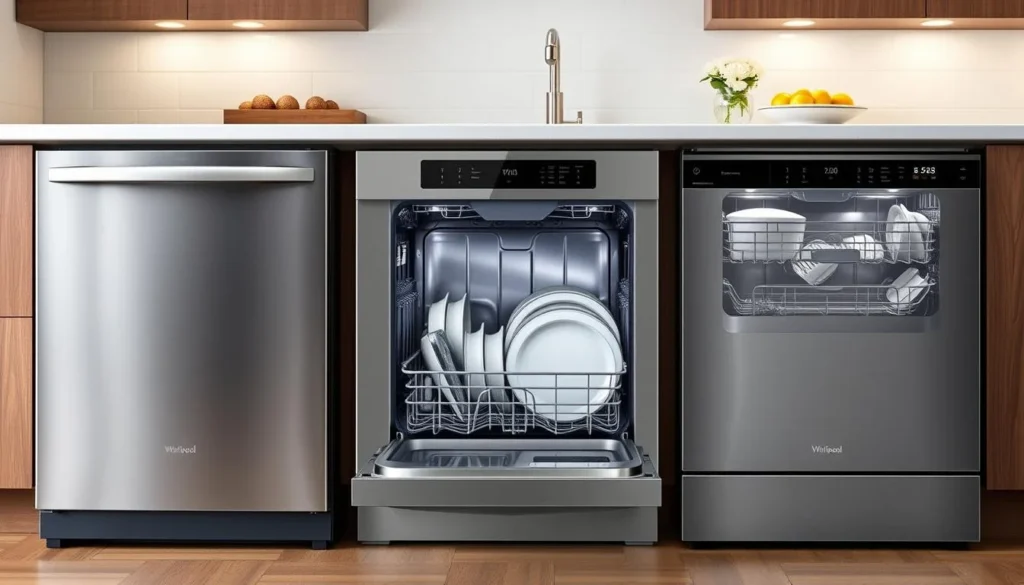
1. KitchenAid vs Whirlpool: Brand Overview
Before comparing individual features, it is important to understand the positioning of the two brands. Both manufacture residential dishwashers, but their product lines cater to somewhat different priorities.
KitchenAid Dishwasher Overview
KitchenAid is positioned toward the premium end of the household appliance market. Its dishwashers are particularly appealing to homeowners who cook frequently, use a wide variety of cookware, entertain guests, and want more flexibility when loading dishes.
Depending on the model, KitchenAid dishwashers may offer:
- Three-rack configurations, including deeper third racks for cups and small bowls.
- Specialised spray jets for cleaning items in the upper rack.
- ProWash cycle technology that adjusts washing according to detected soil levels.
- Advanced drying systems combining heat, fans, or natural ventilation.
- Stainless steel interiors on selected models.
- Quiet operation, with certain models rated at approximately 39–44 dBA.
- Premium finishes, integrated controls, and panel-ready designs.
These features are not available on every KitchenAid dishwasher. Entry-level and older models may have simpler rack arrangements, different drying systems, and fewer wash options. Buyers should therefore compare the precise model specifications rather than assume every KitchenAid dishwasher includes the latest technology.
KitchenAid is particularly attractive to people who want their dishwasher to handle more than ordinary plates and cutlery. Large mixing bowls, spatulas, tall glasses, casserole dishes, and awkwardly shaped cooking utensils can benefit from a thoughtfully designed rack system.
Its main disadvantage is that premium features can increase the purchase price. If you usually wash a small number of lightly soiled dishes and do not need specialised loading options, some of the more expensive features may not deliver enough practical value to justify their cost.
Whirlpool Dishwasher Overview
Whirlpool focuses strongly on practical household convenience. Its dishwasher range includes straightforward models for everyday washing as well as more advanced machines featuring third racks, sensor-based cycles, adjustable loading arrangements, and enhanced drying options.
Depending on the model, Whirlpool dishwashers may include:
- Sensor Cycle technology.
- Quick Wash or one-hour washing options.
- Adjustable upper racks for taller items.
- Third-level utensil racks on selected machines.
- Soil-sensing technology that adjusts washing conditions.
- Heated drying or automatic door-opening drying on selected models.
- Stainless steel interiors and exterior finishes on selected models.
- Different control layouts and installation styles.
Whirlpool can be an excellent choice for families, couples, rental properties, and households that want a capable dishwasher without paying for features they rarely use.
However, the Whirlpool name alone does not guarantee that a particular model is inexpensive, quiet, or basic. Higher-specification models can overlap with KitchenAid in both price and functionality.
2. KitchenAid vs Whirlpool Dishwasher Comparison Table
The following table summarises the general differences buyers should investigate when comparing similar models. These are broad brand tendencies, not guarantees that every model will perform identically.
| Feature | KitchenAid | Whirlpool |
|---|---|---|
| Overall positioning | Premium-oriented | Broad mainstream range |
| Cleaning technology | Advanced targeted cleaning on selected models | Practical sensor-based and targeted cleaning on selected models |
| Third rack | Common on premium models | Available on selected models |
| Upper-rack washing | Specialised third-rack jets on certain models | Available on selected models |
| Drying technology | Advanced drying systems on selected models | Heated, extended, or automatic door-opening options on selected models |
| Noise levels | Certain models are approximately 39–44 dBA | Varies substantially by model |
| Rack flexibility | Strong selling point on higher-end models | Good flexibility on models with adjustable racks |
| Stainless steel interior | Available on selected models | Available on selected models |
| Design choices | Premium finishes and panel-ready options on selected models | Practical finishes and different control and handle configurations |
| Everyday washing | Available | Available |
| Purchase cost | Often higher for feature-rich models | Often attractive for value-focused buyers |
| Energy efficiency | Must be checked by model | Must be checked by model |
| Reliability | Model-specific | Model-specific |
| Best suited to | Feature-focused households and frequent cooks | Budget-conscious households and everyday family use |
The most important distinction is not that one brand can wash dishes and the other cannot. Both are capable of handling normal household dishwashing. The difference is how much additional convenience, flexibility, drying performance, and refinement you receive for the money.
3. Cleaning Performance: Which Dishwasher Cleans Better?
Cleaning performance is arguably the most important consideration when buying a dishwasher. A machine should remove dried food, grease, sauces, starch, and other residue without requiring you to wash everything by hand first.
KitchenAid and Whirlpool both offer sensor-based washing systems, but their implementation and available spray features vary by model.
KitchenAid Cleaning Performance
KitchenAid uses features such as ProWash and, on selected models, multiple spray arms and specialised jets to distribute water throughout the dishwasher.
The ProWash cycle uses soil-sensing technology to adjust factors such as washing time and water temperature according to the detected load conditions. This helps the dishwasher respond differently to heavily soiled cookware and lighter loads.
Higher-end models may also provide additional spray coverage on the third rack. Some configurations use dedicated jets to wash the interiors of mugs and small bowls positioned on that rack. These features are useful when ordinary spray coverage would not adequately reach items loaded in the topmost section.
For a household that cooks frequently, the combination of targeted water delivery and flexible loading can be valuable. You can arrange utensils and suitable cups on the third rack while leaving the main racks available for dinner plates, pots, and pans.
Nevertheless, more jets do not automatically guarantee cleaner dishes. Cleaning results also depend on detergent, water hardness, loading technique, spray-arm movement, filter condition, and the selected cycle.
A heavily loaded dishwasher can still produce disappointing results if plates block one another or tall cookware prevents the spray arms from rotating.
Whirlpool Cleaning Performance
Whirlpool also offers sensor-based washing technology. Depending on the model, its sensors assess conditions such as soil level, temperature, and load characteristics to help determine suitable wash settings.
Some machines also offer cycles for quick washing or loosening stuck-on food. These options are practical for everyday family routines, particularly when dishes need to be cleaned between meals or when cooking utensils have dried food residue.
Whirlpool’s strength is that many households do not need an elaborate washing system to obtain good results. A well-designed model with an effective normal cycle, suitable spray coverage, and a functional filtration system may be sufficient for most plates, glasses, and cutlery.
Its more advanced models can also have third-rack washing features, so it would be inaccurate to assume Whirlpool dishwashers always have less sophisticated cleaning technology.
Which Brand Wins on Cleaning?
KitchenAid has an advantage for buyers who specifically want specialised third-rack cleaning and advanced spray coverage. Whirlpool remains a strong contender for everyday cleaning, especially when the chosen model offers effective sensors, appropriate wash cycles, and a suitable rack arrangement.
There is no reliable universal winner without comparing specific models under similar conditions. A well-equipped Whirlpool may outperform a more basic KitchenAid in a particular household if its loading configuration, cycle options, and drying method better match the dishes being washed.
For the best results with either brand:
- Scrape large food particles into the bin rather than placing heavily soiled scraps in the machine.
- Load dishes so that water can reach the surfaces that need cleaning.
- Keep tall items from obstructing spray arms.
- Use detergent appropriate for your local water conditions.
- Clean the filter if the owner’s manual requires it.
- Choose a suitable cycle for heavily soiled pots and pans.
A dishwasher’s cleaning technology works best when the loading arrangement and wash programme allow it to operate as intended.
4. Drying Performance: KitchenAid vs Whirlpool
Drying performance is a major difference worth investigating, especially if you dislike unloading wet dishes or wiping water from glasses and plastic containers.
A dishwasher can clean dishes effectively but still leave water droplets on cups, utensils, and the tops of bowls. Drying depends on the machine’s heating or ventilation system, the materials being washed, rinse-aid use, the cycle selected, and how the load is arranged.
KitchenAid Drying Technology
KitchenAid offers several drying systems across its product range. Depending on the model, these can include ProDry, Advanced ProDry, and automatic door-opening drying.
Some Advanced ProDry configurations combine a heating element, fans, and natural ventilation. The aim is to remove residual moisture more effectively and leave dishes ready to put away. Other models use different combinations of heating and ventilation, so the exact drying system should be confirmed before purchase.
KitchenAid may be especially attractive if you regularly wash large loads of dishes, glasses, and utensils and want to minimise the time spent drying items by hand.
However, drying performance should not be judged by the feature name alone. A system’s effectiveness depends on the specific model and the types of items in the load.
Whirlpool Drying Technology
Whirlpool also offers several drying arrangements. Depending on the model, these may include heated drying, Extended Dry, or Auto Open Air Dry.
Automatic door-opening systems release moisture from the dishwasher near the end of a cycle, allowing fresh air to circulate. Extended drying options provide additional drying time when the load needs it. These features are not available on every Whirlpool dishwasher.
For households that mainly wash ceramic plates, stainless steel cutlery, and glassware, a suitable Whirlpool drying system may be entirely adequate.
Plastic containers can be more difficult to dry because they retain less heat than many ceramic or metal items. Even a premium dishwasher may leave some water on plastic surfaces, depending on the design and drying method.
Which Dishwasher Dries Dishes Better?
KitchenAid is worth considering if drying performance is a high priority and the model under consideration has an advanced drying system. Whirlpool can also perform well, particularly when comparing models with similar drying technology.
Before purchasing either brand, check whether the dishwasher uses heated drying, fan-assisted drying, automatic door opening, or a combination of methods. Also look for the available drying options and whether they can be used with the cycles you normally select.
For both brands, using rinse aid where appropriate, avoiding tightly nested bowls, and allowing moisture to escape at the end of the cycle can improve results.
Verdict: KitchenAid has a compelling premium drying offering, but the actual winner depends on the two model specifications rather than the brand name alone.
5. Noise Levels: Which Brand Is Quieter?
Noise is an important consideration if your kitchen opens into a living room, you work from home, or you prefer running the dishwasher overnight.
Dishwasher noise is measured in decibels, commonly abbreviated as dBA. Lower numbers generally indicate quieter operation, although the perceived sound also depends on the frequency of the noise, the installation, and the surrounding room.
KitchenAid Noise Performance
KitchenAid offers several quiet dishwashers. Some models are rated as low as 39 dBA, while other current models operate around 41–44 dBA. These ratings are model-specific rather than representative of the entire brand.
A dishwasher operating at a low noise rating can be a worthwhile investment in an open-plan kitchen. It can allow you to run a load during dinner or while watching television without the appliance becoming a major distraction.
Noise levels also depend on what the dishwasher is doing. Water entering the machine, draining, and spraying against dishes may produce different sounds throughout the cycle.
Whirlpool Noise Performance
Whirlpool also sells quiet dishwashers, but its range includes models at different price points and noise ratings. You should check the published dBA figure for the exact model you are considering.
Do not assume that a Whirlpool dishwasher is loud simply because it may be less expensive than a KitchenAid model. A well-specified Whirlpool can be quiet enough for many homes.
Installation also matters. A dishwasher that is not level, has incorrectly secured mounting brackets, or has plumbing that vibrates against cabinetry can sound louder than expected.
Noise Comparison
| Your Priority | What to Look For |
|---|---|
| Very quiet operation | A model rated around 39–42 dBA |
| Open-plan kitchen | A low published dBA rating and good installation |
| Running the dishwasher at night | Quiet operation plus a suitable delay-start function |
| Value-focused purchase | Compare actual dBA ratings rather than paying for a brand name |
| Replacing an older, noisy machine | Compare the new model’s rating with the old machine’s specifications |
Verdict: KitchenAid has several particularly quiet models, making it a strong option for noise-sensitive buyers. Whirlpool remains competitive when you select a model with a similarly low noise rating.
6. Rack Design and Loading Capacity
Rack design affects daily convenience more than many buyers realise. A dishwasher may have a large advertised capacity but still be frustrating if plates do not fit properly, the cutlery basket occupies too much room, or the upper rack cannot accommodate tall glasses.
KitchenAid Rack Systems
KitchenAid offers a range of rack configurations, including models with a third-level utensil rack and deeper third racks designed for suitable cups and small bowls.
Its more advanced third racks can provide dedicated water jets for items placed on that level. Certain configurations also feature removable utensil caddies, adjustable middle racks, stemware holders, and fold-down tines. These additions help accommodate different types of cookware and tableware.
Consider a household that prepares meals from scratch. The dishwasher may need to accommodate spatulas, ladles, measuring spoons, coffee mugs, cereal bowls, dinner plates, and cooking pots in the same load.
A well-designed third rack can free up space in the lower racks and improve the arrangement of smaller items. The result may be fewer loads over time, provided the extra rack genuinely increases usable capacity for your household.
However, a third rack is not automatically beneficial to everyone. If you mostly wash large plates and pots, the rack’s shape and the available height beneath it may matter more than the additional storage area.
Whirlpool Rack Systems
Whirlpool also offers adjustable racks and third-level utensil racks on selected models.
An adjustable second rack is especially useful when you regularly wash tall glasses, water bottles, pitchers, or large cookware. Raising or lowering the rack can create room where you need it without requiring you to change the entire load arrangement.
Some Whirlpool models also include flexible silverware baskets that can be repositioned to free up space for larger items.
For everyday family use, these practical adjustments can be more valuable than a specialised rack with extra spray jets.
Which Brand Has Better Racks?
KitchenAid is particularly appealing if you want a feature-rich third rack and specialised cleaning for cups, bowls, and utensils placed on it.
Whirlpool is a strong alternative if your priority is straightforward flexibility, adjustable rack height, and enough room for ordinary household dishes.
Before buying, measure the height of your largest plates, baking dishes, and glasses. Then check the internal rack dimensions and adjustment options. Published place-setting capacity is useful, but it does not always reflect how easily your own dishes will fit.
7. Build Quality, Interior Materials and Design
A dishwasher is a long-term appliance, so its construction and design should be evaluated alongside its washing performance.
KitchenAid Construction and Appearance
KitchenAid offers stainless steel interiors on selected models, along with finishes and handle styles designed to complement premium kitchens.
Its product range includes pocket handles, integrated controls, and panel-ready configurations on certain models. Panel-ready machines can be fitted with a compatible cabinet panel, helping the appliance blend into the kitchen design.
A stainless steel interior can retain heat and help with drying. It also offers a different appearance and feel from a plastic tub. However, the presence of stainless steel does not guarantee that every component is more durable or that the machine will require fewer repairs.
The racks, hinges, seals, pump, control electronics, and installation quality all contribute to the overall ownership experience.
Whirlpool Construction and Appearance
Whirlpool offers a range of designs, including stainless steel finishes and selected models with stainless steel interiors. The available handle styles, control positions, and internal materials depend on the model.
Its design approach can suit practical kitchens where ease of use and cost matter more than elaborate styling.
For a rental property, a family kitchen, or a straightforward renovation, a well-chosen Whirlpool model may provide the necessary functions without paying extra for premium design details.
Which Brand Is Better Built?
Neither brand should automatically be considered more durable solely because of its price or appearance.
A stainless steel tub is worth considering, but you should also inspect rack construction, door movement, the warranty, available replacement parts, and local repair support.
If you are renovating a kitchen, confirm the appliance’s dimensions and installation requirements before ordering cabinetry. This is especially important for panel-ready models and built-in installations where door clearance and alignment affect the final appearance.
Verdict: KitchenAid has a stronger premium design appeal in parts of its range. Whirlpool offers practical designs that can be an excellent fit for functional kitchens. Construction quality must be assessed at model level.
8. Reliability and Expected Lifespan
Reliability is one of the most common concerns when comparing dishwasher brands. Buyers want a machine that cleans effectively for years without repeated service visits or expensive component replacements.
However, it is important to distinguish between a brand’s reputation, the performance of a particular model, and the reliability of an individual appliance.
Are KitchenAid Dishwashers Reliable?
KitchenAid’s advanced models provide useful features, but additional technology does not automatically mean greater reliability.
A dishwasher may contain pumps, sensors, spray assemblies, heaters, fans, electronic controls, and door mechanisms. The precise components vary by design. If a part fails, the cost and availability of replacement components can influence the total repair expense.
A premium dishwasher may still be a good long-term purchase if its performance and convenience justify the initial price. Nevertheless, buyers should not assume that spending more guarantees fewer breakdowns.
Are Whirlpool Dishwashers Reliable?
Whirlpool also offers models with a wide range of complexity. Simpler machines may have fewer specialised features, but that alone does not prove they will last longer.
Reliability depends on manufacturing quality, component design, usage, installation, water conditions, maintenance, and access to service. A heavily used dishwasher in a large household will also experience a different workload from a machine used only a few times each week.
For either brand, practical maintenance can reduce avoidable problems. Keep the filter clean where required, inspect the spray arms, use the correct detergent, and respond promptly to leaks or unusual noises.
What Matters More Than the Brand?
When assessing reliability, investigate the following:
- Model-specific owner reviews, with attention to recurring problems rather than isolated complaints.
- Warranty terms and what they cover.
- Local availability of authorised repair services.
- Replacement-part availability and typical labour charges.
- Whether the machine has a documented service history if purchasing used.
- Whether the appliance is suitable for your water conditions and household workload.
A long warranty on a particular component does not necessarily cover the labour required to replace it. Always read the complete warranty terms.
KitchenAid vs Whirlpool: Reliability Verdict
There is not enough evidence in general product specifications alone to declare one brand universally more reliable than the other.
KitchenAid may justify a higher price through additional features, but buyers should examine the likely cost of maintaining those features. Whirlpool may appeal to those seeking a simpler, practical appliance, but an inexpensive purchase can become poor value if the selected model has recurring faults or weak local service support.
The best reliability decision is to compare the exact models, warranty coverage, service network, and repair costs in your country.
9. Energy Efficiency and Water Consumption
Energy and water consumption matter both environmentally and financially. Since dishwashers may run several times per week, even small differences in consumption can accumulate over the appliance’s useful life.
Neither KitchenAid nor Whirlpool is automatically the more efficient brand. Both offer multiple models with different capacities, cycles, and drying methods.
Energy Efficiency
Look for the model’s official energy label or energy guide rather than relying on broad brand claims.
In the United States and Canada, ENERGY STAR certification is a useful starting point for comparing eligible models. In the United Kingdom, compare the applicable energy label and the manufacturer’s product information for the model sold in that market.
Do not assume that a dishwasher carrying a similar name in another country has identical specifications.
A model with a more efficient normal cycle may reduce running costs, but the actual saving depends on how often you use it, which cycles you select, local electricity and water rates, and the way the appliance is loaded.
Water Consumption
Sensor-based cycles can adjust washing conditions according to the detected load, helping the dishwasher avoid treating every load in exactly the same way.
KitchenAid and Whirlpool both offer sensor-controlled washing on selected models. The existence of a sensor does not, by itself, establish which machine uses less water.
Compare the published water-use figures for the exact models and consider whether their capacity suits your household. A larger dishwasher can be efficient when fully loaded, but running it repeatedly with only a few dishes may undermine the benefits.
Which Brand Is Cheaper to Run?
The answer depends on the model’s measured or published consumption, the cycles you use, and your local utility prices.
| Factor | What to Compare |
|---|---|
| Electricity | Annual kWh or the applicable energy-label figure |
| Water | Litres per cycle or the relevant official consumption figure |
| Capacity | Place settings and usable rack space |
| Drying | Whether the selected drying system uses additional electricity |
| Usage | Number of cycles per week |
| Local prices | Electricity and water tariffs in your area |
If one machine costs more upfront but uses less energy, the difference may or may not offset the initial premium. Calculate the potential savings using your expected usage rather than assuming that a higher-priced dishwasher is more efficient.
Verdict: Compare the energy and water specifications of individual KitchenAid and Whirlpool models. Brand-level assumptions are not a reliable way to estimate running costs.
10. Price and Overall Value for Money
Price is one of the biggest reasons buyers consider Whirlpool instead of KitchenAid. However, the comparison should include what you receive for the additional money, not just the purchase price.
KitchenAid Dishwasher Pricing
KitchenAid’s premium-oriented models may cost more because they offer specialised rack designs, enhanced drying systems, additional spray coverage, quieter operation, and more refined finishes.
For someone who cooks every day, the extra investment could make sense. A deeper third rack, adjustable middle rack, or more capable drying system may save time during loading and unloading.
However, if you mainly wash dinner plates, mugs, and cutlery, you might not benefit enough from the advanced features to justify paying a substantial premium.
Whirlpool Dishwasher Pricing
Whirlpool’s broad product range makes it worth considering for shoppers with a defined budget. You can look for a model that provides the essentials without paying for every premium feature.
Depending on the model and sale price, useful features such as a sensor cycle, adjustable rack, and third-level utensil rack may be available at a more accessible price.
Nevertheless, do not assume Whirlpool will always be cheaper. A high-specification Whirlpool may overlap with an entry-level or discounted KitchenAid in price.
How to Calculate Value
Use the following formula to compare the true cost of ownership:
Total ownership cost = purchase price + installation + estimated running costs + expected maintenance and repairs.
For example, suppose a KitchenAid model costs $300 more than a comparable Whirlpool. If you value the KitchenAid’s quieter operation and drying performance, that difference may be worthwhile. If the extra features do not improve your daily experience, the Whirlpool may be the more sensible purchase.
The figures should come from actual local prices and product specifications. The example is illustrative rather than a statement about current retail pricing.
Remember to include delivery, installation accessories, disposal of your old appliance, and any plumbing or electrical work.
11. Installation and Maintenance
A dishwasher’s performance depends partly on correct installation and routine care. Even an expensive appliance can produce disappointing results if it is installed incorrectly or maintained poorly.
Installation Requirements
Before buying either brand, confirm the following:
- Available width, height, and depth.
- Door clearance and access to adjacent cabinets.
- Water-supply and drain connections.
- Electrical requirements.
- Compatibility with the kitchen’s plumbing and electrical arrangement.
- Required clearances and installation instructions.
- Whether the chosen model needs a separate cabinet panel or special handle arrangement.
Standard built-in dishwashers are commonly designed around a nominal 24-inch width in North America, but actual dimensions and installation clearances vary. UK kitchens may use different cabinet arrangements and appliance dimensions, so verify the exact model’s installation guide rather than relying on a general measurement.
Panel-ready machines require additional attention because the cabinet panel must be compatible with the appliance’s mounting and door requirements.
Maintenance for KitchenAid and Whirlpool
Follow the owner’s manual for the specific model. General maintenance practices include:
- Clean the filter when required. Some models have filters that require regular manual cleaning, while selected KitchenAid machines feature self-cleaning filtration systems.
- Inspect the spray arms. Remove debris from blocked jets according to the manufacturer’s instructions.
- Use suitable detergent. Select a detergent designed for automatic dishwashers and appropriate for local water conditions.
- Check the door seal. Remove residue and look for signs of damage.
- Keep the exterior clean. Use products suitable for the finish, especially on fingerprint-resistant stainless steel.
- Investigate leaks promptly. Water around the appliance should not be ignored.
- Follow descaling instructions where applicable. Hard-water deposits can affect performance, and the correct treatment depends on the machine and local water conditions.
Maintenance requirements can differ considerably between models. A self-cleaning filtration system may reduce filter-cleaning work, but it does not eliminate the need for all routine maintenance.
12. Hard Water: Which Brand Is Better?
Water hardness can influence detergent performance, spotting, mineral deposits, and the appearance of glassware. This makes it an important consideration for buyers in parts of the United States, Canada, and the United Kingdom.
Hard water contains higher concentrations of minerals, particularly calcium and magnesium. These minerals can leave deposits on dishes and inside appliances.
KitchenAid in Hard-Water Areas
KitchenAid’s sensor-based cycles and filtration features can help with washing performance, but they do not make every model immune to mineral buildup.
Use detergent suitable for your water conditions and follow the manual’s recommendations for rinse aid and cleaning. If your model supports particular water-hardness settings, configure them as instructed.
Whirlpool in Hard-Water Areas
The same principles apply to Whirlpool. A suitable cycle and detergent can help, but mineral deposits may still appear if the detergent dosage, rinse aid, or water treatment is inappropriate.
Some households may benefit from a properly maintained domestic water-softening system, depending on the local water supply and the appliance’s requirements.
Which Is Best for Hard Water?
There is no universal winner. Look at the model’s filtration design, cleaning instructions, available water-softening settings, and the support available for your local water conditions.
If you live in a particularly hard-water area, consider the cost and maintenance of any additional water treatment before choosing the appliance.
13. Warranty, Repairs and After-Sales Service
Warranty coverage is essential when comparing appliances that may be used for many years.
KitchenAid and Whirlpool have official support channels, but warranty conditions vary by model, country, purchase date, and the terms applicable to the sale.
Before ordering, verify:
- The length of the parts and labour warranty.
- Whether particular components receive longer coverage.
- Whether the warranty covers call-out fees, diagnosis, and labour.
- The availability of authorised service centres.
- The expected waiting time for replacement parts.
- Whether the warranty applies to the country where the machine will be installed.
Buying in the United States
Check the model’s US warranty, authorised service coverage, and installation requirements. Confirm whether delivery and installation are included in the retailer’s price.
Buying in Canada
Check the Canadian model number, local warranty, and availability of service in your province or territory. Product variants and support arrangements may differ from those in the United States.
Buying in the United Kingdom
Confirm that the exact model is intended for the UK market. Do not assume a North American model will have the correct electrical specification, plumbing connections, installation dimensions, or warranty coverage.
Verdict: Local repair support and warranty terms can matter more than the difference between the two brand names. Check them before making a final decision.
14. KitchenAid vs Whirlpool in the USA, UK and Canada
Although both brands are associated with the North American appliance market, availability and specifications are not necessarily the same across all three countries.
| Market | What Buyers Should Prioritise |
|---|---|
| United States | Model-specific energy information, installation requirements, current retailer pricing and warranty terms |
| Canada | Canadian model availability, energy certification where applicable, local service coverage and warranty |
| United Kingdom | UK-market availability, applicable energy labels, exact dimensions, electrical compatibility and local service support |
United States
US shoppers may find a wide range of built-in models, finishes, rack configurations, and control layouts. Compare current local prices and check whether a sale model includes the features you actually need.
Canada
Canadian shoppers should confirm the precise model number rather than assuming a similarly named US model has identical specifications. Warranty and service arrangements should be checked for the location where the appliance will be used.
United Kingdom
UK shoppers should verify that the specific KitchenAid or Whirlpool dishwasher is officially available for their market. A model listed on a North American product page may not be sold in the UK, and a similarly named model may have different dimensions or features.
If you are considering an imported appliance, confirm electrical compatibility, installation requirements, and warranty support before purchasing.
15. Pros and Cons of KitchenAid Dishwashers
Advantages
- Premium-oriented features on selected models.
- Specialised third-rack washing on certain machines.
- Flexible rack layouts for different types of cookware.
- Advanced drying systems on selected models.
- A range of quiet dishwashers.
- Premium finishes and panel-ready designs on certain models.
- Suitable options for people who cook frequently and wash varied loads.
Disadvantages
- Feature-rich models can cost more.
- Not every model includes the newest rack or drying technology.
- Advanced features may be unnecessary for some households.
- Repair costs and parts availability need to be assessed locally.
- Premium pricing does not guarantee greater reliability.
KitchenAid is most attractive when its specific features solve problems you experience regularly. If you rarely use the third rack or have little need for advanced drying, a less expensive model could provide better value.
16. Pros and Cons of Whirlpool Dishwashers
Advantages
- A broad range of everyday dishwasher options.
- Useful sensor-based washing features on selected models.
- Quick washing options on certain machines.
- Adjustable racks and third-rack configurations on selected models.
- Practical designs for family kitchens.
- Potentially strong value when the model’s price and features align with your needs.
Disadvantages
- Features vary considerably between models.
- Entry-level machines may lack premium drying or specialised rack features.
- Noise levels should be checked for each model.
- Some models may not offer the capacity or flexibility needed by larger households.
- Reliability and repair costs cannot be determined by brand name alone.
Whirlpool is particularly appealing to buyers who want a capable appliance without spending more for features that will rarely be used. However, the cheapest model is not necessarily the best value if it lacks the capacity, noise performance, or drying options your household requires.
17. Which Brand Should Different Households Choose?
The best dishwasher is the one that matches your daily routine, not necessarily the one with the longest feature list.
Choose KitchenAid if You Cook Frequently
If you regularly wash roasting pans, mixing bowls, serving utensils, and large quantities of tableware, a KitchenAid model with flexible racks and specialised third-rack cleaning may be worth the investment.
Choose Whirlpool if Value Is Your Priority
If you want a dependable everyday cleaning routine and do not need every premium feature, a well-equipped Whirlpool may provide the right balance of convenience and cost.
Compare Both if Noise Is Important
For open-plan kitchens, compare actual dBA ratings. A quiet Whirlpool may be a better purchase than a louder KitchenAid, even if KitchenAid offers more features.
Check Rack Dimensions if You Wash Large Cookware
A third rack is useful only if the full interior still accommodates your largest plates, pots, and pans. Review the rack layout and adjustable height before deciding.
18. Final Verdict: KitchenAid vs Whirlpool Dishwasher
KitchenAid and Whirlpool both offer dishwashers capable of handling everyday household cleaning. The better choice depends on whether you value advanced features or straightforward practicality more highly.
KitchenAid stands out for its premium-oriented features, including specialised third-rack cleaning, advanced drying options, flexible loading arrangements, and quiet models. These advantages are particularly relevant to people who cook regularly and want their dishwasher to handle a broad range of dishes and utensils.
Whirlpool offers a practical alternative for households seeking convenient washing cycles, flexible loading, and a wide range of options. Selected Whirlpool models also provide third racks, sensor-based washing, and enhanced drying, so it is worth comparing the specifications rather than assuming that all Whirlpool dishwashers are basic.
My recommendation is to shortlist two models within your budget, then compare cleaning features, drying method, noise rating, energy consumption, interior capacity, warranty, and local repair support. A well-chosen Whirlpool can be better value than an expensive KitchenAid, while a feature-rich KitchenAid may be worth paying more for if its advantages make a meaningful difference to your routine.
For most buyers, the smartest purchase is not automatically the cheapest dishwasher or the most expensive one. It is the model that delivers the right combination of cleaning performance, convenience, operating cost, and long-term support.
Frequently Asked Questions
1. Is KitchenAid better than Whirlpool for dishwashers?
KitchenAid is often the stronger choice for buyers seeking premium features, specialised third-rack washing, advanced drying options, and quiet operation. Whirlpool is often attractive for everyday practicality and value. The better option depends on the exact models being compared.
2. Are KitchenAid dishwashers more reliable than Whirlpool?
Neither brand can be declared universally more reliable based on brand positioning alone. Reliability varies by model, component quality, maintenance, installation, and usage. Compare model-specific reviews, warranty coverage, and local service availability.
3. Do KitchenAid dishwashers clean better than Whirlpool?
Some KitchenAid models provide specialised spray jets and additional wash coverage, particularly on the third rack. Whirlpool also offers effective sensor-based washing and advanced features on selected models. Actual results depend on the machine, detergent, loading, and cycle.
4. Which brand dries dishes better?
KitchenAid offers advanced drying systems on selected models, while Whirlpool offers heated drying, Extended Dry, and automatic door-opening options on certain machines. Compare the specific drying technology rather than relying on the brand name.
5. Which dishwasher is quieter, KitchenAid or Whirlpool?
Certain KitchenAid models are rated as low as approximately 39 dBA. Whirlpool noise levels vary across its range. Check the published rating of each model, because a quiet Whirlpool may be quieter than a particular KitchenAid.
6. Are Whirlpool dishwashers good for families?
Yes. A suitable Whirlpool model can work well for families, particularly when it has sufficient capacity, adjustable racks, a practical wash programme, and appropriate drying options. Larger households should examine usable rack space carefully.
7. Are KitchenAid dishwashers worth the extra money?
They can be worthwhile if you regularly use their advanced rack arrangements, specialised cleaning features, quiet operation, or drying technology. If you mainly wash ordinary plates and cutlery, a less expensive dishwasher may meet your needs just as well.
8. Do both brands offer third-rack dishwashers?
Yes. Both brands offer third-rack configurations on selected models. KitchenAid has specialised third racks with dedicated jets on certain machines, while Whirlpool’s third racks can provide additional space for utensils and other small items.
9. Which brand uses less electricity?
There is no universal winner. Electricity consumption varies by model, capacity, wash programme, and drying system. Compare the official energy information for the exact machines available in your country.
10. Which dishwasher uses less water?
Water use is model-specific. Both brands offer sensor-based cycles on selected machines. Check the published consumption figures and consider how frequently you run the dishwasher.
11. Are KitchenAid and Whirlpool owned by the same company?
Yes. Both are brands within the Whirlpool Corporation brand portfolio. Their products nevertheless have distinct design priorities, specifications, and positioning.
12. Which brand is better for hard water?
Neither brand is universally better for hard water. Choose a model suitable for your local conditions, follow the detergent and rinse-aid instructions, and maintain the appliance according to the owner’s manual.
13. Which is better for a small kitchen?
Compare the actual dimensions and installation requirements of the available models. Neither brand should automatically be considered better for small kitchens. Check width, depth, door clearance, and the internal rack layout.
14. Which brand is better for the UK, USA and Canada?
Both can be suitable where the specific model is available and supported. Buyers should confirm regional model numbers, energy information, electrical compatibility, warranty coverage, and authorised repair services before purchasing.
15. Should I buy KitchenAid or Whirlpool on sale?
Compare the final installed price and specifications rather than focusing on the discount percentage. A discounted KitchenAid can offer excellent value if you want its premium features, while a Whirlpool may remain the better purchase if it meets your needs for less money.
16. Do KitchenAid dishwashers have self-cleaning filters?
Selected KitchenAid models have a self-cleaning filtration system that reduces the need for manual filter cleaning. This feature is not available across every model, so confirm the specification before purchasing.
17. Is a stainless steel tub worth paying extra for?
A stainless steel tub can retain heat and support drying performance, while also offering a different interior finish from plastic. Whether the additional cost is worthwhile depends on the model, your priorities, and the price difference.
18. What should I check before buying either brand?
Compare cleaning cycles, drying technology, noise level, rack flexibility, usable capacity, energy and water consumption, dimensions, warranty coverage, and local service availability. These details provide a more reliable basis for choosing a dishwasher than brand reputation alone.