
The Bosch SHP878ZD5N 800 Series dishwasher is a premium 24-inch built-in dishwasher from an older generation of Bosch’s 800 Series lineup. It combines a stainless-steel interior, a flexible third rack, RackMatic upper-rack adjustment, PrecisionWash cleaning technology, CrystalDry drying, a 42 dBA operating rating, 16-place-setting capacity, AquaStop leak protection, and multiple specialized wash options. Although the model is no longer listed as an active product for sale in the United States, Bosch continues to maintain support documentation and service information for several SHP878ZD5N production variants.
That makes this model particularly interesting for people researching an existing SHP878ZD5N, buying one as old stock, or considering a used or refurbished unit. It should not be evaluated exactly like a current 800 Series dishwasher because Bosch has introduced newer cleaning, drying, connectivity, and control technologies since this model was produced. At the same time, the SHP878ZD5N still has a specification package that was positioned toward the premium end of the residential dishwasher market.
This review looks at the dishwasher from several angles: washing performance, drying performance, noise, loading flexibility, rack design, energy and water consumption, installation, reliability considerations, maintenance, leak protection, controls, regional compatibility, and whether its older technology still makes sense today. The goal is to distinguish what the exact SHP878ZD5N actually includes from features that appeared on newer Bosch models.
Bosch SHP878ZD5N at a Glance
| Feature | Bosch SHP878ZD5N |
|---|---|
| Series | Bosch 800 Series DLX |
| Model | SHP878ZD5N |
| Type | 24-inch built-in dishwasher |
| Finish | Stainless steel |
| Handle | Pocket handle |
| Capacity | 16 place settings |
| Wash programs | 6 |
| Options | 6 |
| Noise rating | 42 dBA |
| Drying technology | CrystalDry option |
| Third rack | Flexible 3rd Rack |
| Upper-rack adjustment | RackMatic |
| Tub | Stainless steel |
| Wash system | Five-level wash |
| Cleaning technology | PrecisionWash |
| Leak protection | 24/7 AquaStop |
| Sanitize option | Yes |
| ExtraScrub | Yes |
| Speed60 | Yes |
| Delay start | 24 hours |
| InfoLight | Yes |
| Water softener | No |
| ChildLock | No |
| Annual energy figure | 269 kWh |
| Water use | 3.5 gallons/cycle |
| Electrical supply | 120 V, 60 Hz |
| Rated current | 12 A |
| Overall dimensions | 33 7/8 × 23 9/16 × 23 3/4 inches |
| Required cutout | 33 7/8 × 23 5/8 × 24 inches |
| Current U.S. availability | No longer available |
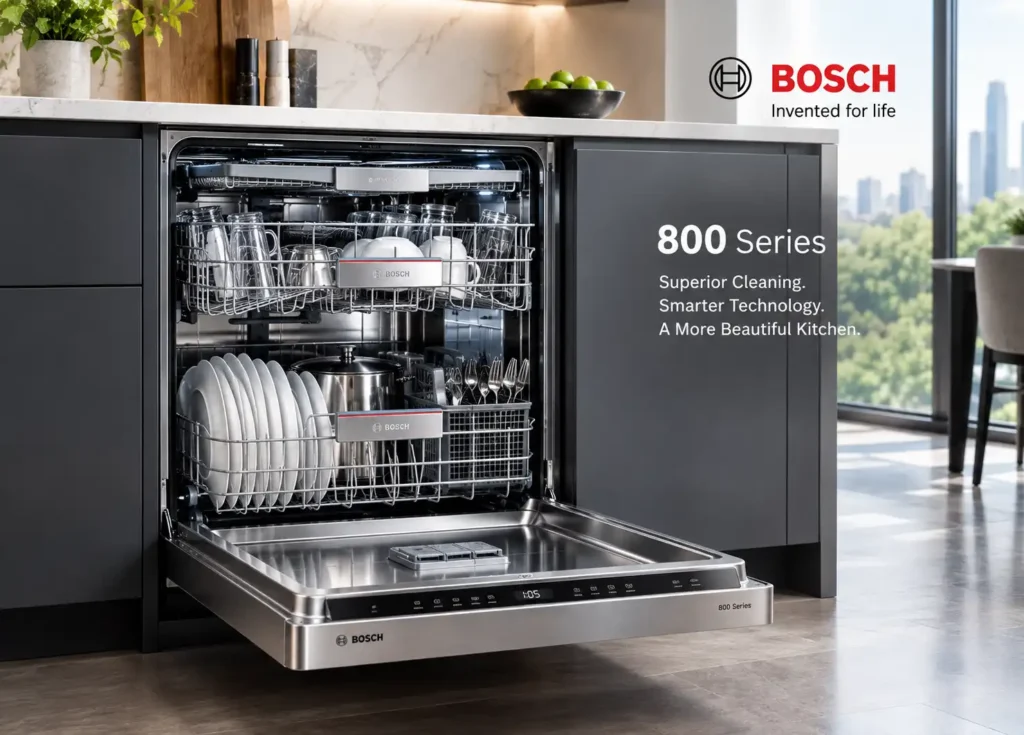
These specifications come from Bosch documentation for the exact model rather than from specifications for a similar-looking Bosch 800 Series dishwasher.
What Is the Bosch SHP878ZD5N?
The SHP878ZD5N was part of Bosch’s 800 Series DLX range and used a pocket-handle design with a stainless-steel exterior and stainless-steel wash tub. It was designed as a full-size 24-inch built-in dishwasher rather than a compact or portable machine. Bosch documentation specifies a capacity of 16 place settings, placing it among the larger-capacity residential machines in this class.
The DLX designation is important because Bosch offered several different 800 Series configurations. The SHP878ZD5N was the pocket-handle version, while other models in the same generation used different exterior designs or installation configurations. Historical Bosch product literature identifies the SHP878ZD5N alongside other 800 Series models, confirming that it was positioned within the company’s premium dishwasher range rather than its entry-level lines.
The model was also sold in related finishes. Bosch documentation identifies the stainless-steel SHP878ZD5N and corresponding white and black variants. This means buyers should pay attention to the complete model number when looking for replacement parts, manuals, or used units because visually similar models can have different specifications.
Design and Exterior
The SHP878ZD5N uses a relatively understated pocket-handle design. Instead of a large protruding bar handle, the handle is integrated into the upper portion of the door. This creates a cleaner front appearance and can work particularly well with modern kitchen cabinetry. The controls are located at the top of the door, so the exterior remains visually simple when the dishwasher is closed. Bosch specifies touch controls for this model.
The stainless-steel construction also gives the machine a substantial feel. More importantly, the stainless-steel tub is useful from a functional standpoint because it is designed to withstand the combination of hot water, detergent, moisture and repeated heating cycles that dishwashers experience. The SHP878ZD5N also uses a concealed heating element, keeping the heating component away from direct contact with dishes and cookware.
One of the exterior conveniences is InfoLight. Instead of requiring the user to open the door to determine whether the dishwasher is operating, a light beam is projected onto the floor. This is particularly useful because the machine is quiet enough that you may not always hear it operating from another room.
16-Place-Setting Capacity
Capacity is one of the strongest practical characteristics of the SHP878ZD5N. Bosch rates it for 16 place settings, giving it enough room for substantial household loads. The combination of three racks and adjustable upper-rack positioning also means that capacity is not simply a matter of physical volume; the rack configuration can be changed depending on the type of dishes being washed.
A 16-place-setting rating can be useful for large families, households that cook frequently, or people who prefer to run fewer but fuller dishwasher cycles. However, maximum place-setting capacity does not mean that every combination of plates, pans, glasses and oversized cookware will fit simultaneously. The way the racks are adjusted matters considerably.
The third rack is particularly important here. Bosch says the flexible third rack adds approximately 30% more loading area compared with a Bosch dishwasher with two racks. That extra area is primarily useful for utensils, smaller items and shallow pieces that otherwise compete for space in the silverware basket or upper rack.
Flexible Third Rack
The flexible third rack is one of the defining features of the SHP878ZD5N. Its fold-down sides make it more adaptable than a simple flat utensil tray. Instead of treating the third rack purely as a silverware shelf, users can adjust it to accommodate different types of small cookware and serving pieces.
This design is especially useful for long cooking utensils. Spatulas, serving spoons, whisks and similar objects can occupy a significant amount of space in a traditional silverware basket. Moving them to the third rack can free the lower portions of the dishwasher for plates, bowls and cookware.
There is also a practical trade-off. A third rack does not automatically mean that every dishwasher load becomes easier. Tall glasses and unusually large items can require careful positioning because upper-rack height affects the available clearance below it. The advantage of the SHP878ZD5N is that Bosch gives the user significant rack adjustment rather than locking the machine into one configuration.
RackMatic Upper Rack
Bosch’s RackMatic system gives the upper rack three height adjustments and up to nine possible rack positions. This is one of the most useful features for households that frequently alternate between normal dish loads and large cookware.
For example, when the lower rack contains a large stockpot or tall pan, raising the upper rack can provide additional clearance. When the lower rack contains mostly standard plates, the upper rack can be positioned differently to make better use of the vertical space.
The benefit becomes more apparent when the dishwasher is loaded regularly rather than occasionally. A fixed rack arrangement can force users to place certain dishes in inefficient positions, whereas adjustable racks allow the interior to be adapted to the current load. That flexibility is one reason the SHP878ZD5N’s interior remains useful even though the model itself is older.
FlexSpace Tines and Lower-Rack Loading
The lower rack includes FlexSpace tines that can be folded to accommodate larger pots and pans. This matters because large cookware is often where dishwasher loading becomes difficult. Fixed rows of tines can create wasted spaces around curved cookware, while folding sections allow the user to create wider areas.
The lower rack can therefore be configured differently depending on whether the load contains mostly dinner plates or a mixture of cookware. A household that frequently washes casserole dishes, mixing bowls and pans may benefit more from this flexibility than a household that primarily washes plates and glasses.
The silverware basket is also designed for flexibility. Bosch documentation says the basket can be split into two pieces and positioned in different locations. That gives users another way to create space when the lower rack contains larger cookware.
Washing Performance
The SHP878ZD5N uses Bosch’s PrecisionWash cleaning approach. Bosch describes PrecisionWash as a sensor-based system designed to monitor washing conditions and adjust the cleaning process. The exact SHP878ZD5N is also documented as having a five-level wash system and a load-size sensor that automates wash temperature.
The significance of sensor-based washing is that the dishwasher does not have to treat every load as though it contains the same amount of soil. Sensor information can help determine how the wash should proceed. This is particularly useful for mixed household loads where some plates may be lightly soiled while cookware contains more substantial residue.
Good dishwasher performance still depends on loading. Spray arms need unobstructed access to dishes, detergent needs to dissolve properly, and heavily soiled cookware should be positioned so that the wash jets can reach the affected surfaces. Even advanced sensing cannot compensate for dishes blocking one another or for cookware being positioned incorrectly.
Six Wash Programs
The SHP878ZD5N has six wash programs and six options. This gives it a considerable degree of flexibility for different household situations. Bosch’s documentation identifies Speed60 among the programs/features and separately identifies specialized options such as Sanitize, Extra Dry and ExtraScrub.
A normal everyday program is suitable for typical mixed loads, while heavier washing can be used when cookware has more difficult food residue. A delicate-oriented program can be more appropriate for fragile items. The exact program names and availability can vary by documentation version, so owners should use the manual corresponding to their model suffix rather than assuming that every Bosch dishwasher with six programs uses exactly the same program structure.
The presence of multiple options is arguably more useful than having a very large number of programs. Options allow the user to modify a wash for a particular need, such as stronger cleaning or improved drying, without requiring a completely different everyday routine.
Speed60: When You Need a Faster Cycle
The SHP878ZD5N includes Speed60, which Bosch describes as getting dishes from dirty to dry in about an hour under the appropriate conditions. This is useful when clean dishes are needed quickly rather than several hours later.
A short cycle should not automatically be treated as a replacement for the most intensive program. Fast programs generally make compromises in some combination of wash intensity, load conditions, temperature, drying or other parameters to achieve their shorter operating time. For heavily baked-on food, the more intensive program is usually the more appropriate choice.
Speed60 is therefore best viewed as a convenience feature. It can be particularly useful after breakfast, before guests arrive, or when the household needs a second load of dishes during the same day.
ExtraScrub Option
The ExtraScrub option is designed for harder-to-remove food stains. Bosch documentation says it increases pressure and temperature throughout the lower rack. This makes it particularly relevant for cookware, casserole dishes and plates with more persistent residue.
The important point is that ExtraScrub is targeted rather than something that necessarily needs to be used on every load. Using the stronger setting selectively can make more sense because everyday dishes often do not require the same level of treatment as heavily soiled cookware.
For households that frequently cook from scratch, this option can be more useful than it initially appears. The lower rack is where many heavily soiled items are placed, and additional cleaning intensity in that area can help when normal washing is insufficient.
CrystalDry Performance
One of the biggest reasons the SHP878ZD5N belongs to the higher end of Bosch’s older lineup is CrystalDry. The official specification identifies CrystalDry as the dishwasher’s drying option, while Bosch’s documentation describes the technology as using a mineral-based process that transforms moisture into heat. Bosch states that its aggregate testing showed dishes, including plastics, became substantially drier than with its PureDry system, although actual drying varies by dish type.
Plastic is where drying systems are often tested most severely. Glass and ceramic surfaces generally release water more readily, while plastic can retain droplets because it behaves differently thermally. CrystalDry was specifically designed to improve drying performance across mixed household loads, including plastic items.
That does not mean every plastic container will emerge perfectly dry after every cycle. Dishwasher loading, shape, material, water temperature, rinse aid use and cycle selection can affect results. Bosch itself notes that drying performance varies by dish type.
CrystalDry vs Older Drying Systems
The SHP878ZD5N should not be confused with Bosch models that use only earlier PureDry technology. CrystalDry represents a different drying approach and is one of the principal reasons the SHP878ZD5N can still be attractive when compared with older Bosch dishwashers.
At the same time, newer Bosch generations have introduced additional refinements to drying and wash control. Therefore, the SHP878ZD5N’s CrystalDry system should be evaluated as a strong feature of its own generation rather than assumed to be identical to the newest 800 Series drying systems.
Sanitize Option
The SHP878ZD5N specification identifies an NSF-certified Sanitize option. Bosch documentation states that this option eliminates bacteria and enhances drying results, and the specification identifies the certification as being to NSF/ANSI Standard 184 for residential dishwashers.
This option can be useful when users want an elevated-temperature sanitation cycle for appropriate dishwasher-safe items. However, it should not be interpreted as meaning that every load automatically receives sanitation-level treatment. The user needs to select the appropriate option and follow the dishwasher’s instructions.
Sanitize is particularly relevant for households that regularly wash baby-related items, food-preparation equipment or heavily soiled cookware, provided those items are dishwasher-safe and compatible with the selected cycle.
Noise Level: Is the SHP878ZD5N Quiet?
At 42 dBA, the SHP878ZD5N is a quiet dishwasher. Bosch’s product documentation specifically identifies 42 dBA as its operating noise level.
A 42 dBA dishwasher can be much less intrusive in an open-plan kitchen than older dishwashers with significantly higher sound levels. This is particularly valuable when the dishwasher runs during dinner, when people are watching television nearby, or when the kitchen is adjacent to living areas.
Bosch’s historical marketing materials also used a “quietest dishwasher brand” claim around this generation. That claim should be understood as a historical manufacturer claim based on the comparison methodology and market sample at the time, not as a statement about the quietest dishwasher available in 2026.
Stainless-Steel Tub
The stainless-steel tub is another premium characteristic of the SHP878ZD5N. Stainless steel provides a durable interior surface and works well with the heat and moisture conditions inside a dishwasher.
The concealed heating element is positioned away from direct exposure to dishes. This can be useful when loading plastic containers or lightweight items because there is no exposed heating element sitting directly underneath the lower rack.
The stainless interior also contributes to the dishwasher’s overall premium construction. Nevertheless, stainless steel does not eliminate the need for maintenance. Filters, spray arms, door seals and detergent-related residue still need periodic attention.
AquaStop Leak Protection
Leak protection is one of the most significant safety features in this model. Bosch specifies 24/7 AquaStop leak protection for the SHP878ZD5N. The documented system is designed to detect and contain leaks, shut down operation and pump out water when a leak condition occurs.
This is particularly valuable for built-in dishwashers because a water leak can cause damage to cabinetry, flooring and surrounding materials. Leak protection cannot guarantee that every plumbing-related failure outside the dishwasher will be prevented, but it adds a dedicated layer of protection within the appliance.
Installation remains important. Water connections should be correctly fitted, hoses should not be kinked, and plumbing should follow local requirements. A sophisticated leak-protection system should never be considered a substitute for correct installation.
Water Softener: Does the SHP878ZD5N Have One?
No. Bosch’s exact specification identifies the water softener as “No.”
This matters particularly in hard-water regions. Hard water can contribute to mineral deposits on glassware, dishwasher components and internal surfaces. The absence of an integrated water-softening system means users in hard-water areas need to pay closer attention to detergent selection, rinse aid and maintenance.
This issue can be relevant in parts of the United States and Canada as well as many areas of the UK and other countries. Water hardness varies considerably by local supply, so there is no single recommendation that applies equally to every household.
Energy and Water Consumption
The SHP878ZD5N’s published figures require careful interpretation because Bosch documentation changed between specification versions. A later Bosch specification lists 269 kWh per year and 3.5 gallons per cycle, while an earlier Bosch specification also listed 269 kWh annually but identified the machine as ENERGY STAR qualified.
The current ENERGY STAR specification for standard residential dishwashers is stricter, with a maximum of 240 kWh/year and 3.2 gallons per cycle, effective July 19, 2023. Therefore, the SHP878ZD5N’s published 269 kWh and 3.5-gallon figures should not be presented as meeting today’s ENERGY STAR thresholds.
This does not mean the dishwasher was incorrectly described historically. Appliance efficiency standards and certification specifications change over time. A model can have carried an ENERGY STAR designation under the applicable specification when it was marketed and later no longer satisfy a newer threshold. The safest way to describe the SHP878ZD5N today is that older Bosch documentation identified it as ENERGY STAR qualified, while later documentation lists it as not ENERGY STAR certified under the newer specification context.
For actual household costs, the published annual figure is more useful as a standardized comparison number than as a guarantee of a household’s electricity bill. Actual consumption depends on cycle selection, frequency of use, water temperature, household loading patterns and other factors. The federal energy-testing framework uses standardized assumptions to produce annualized figures.
Is 3.5 Gallons per Cycle Good?
A published water consumption figure of 3.5 gallons per cycle is reasonably efficient in the broader historical dishwasher context, but it does not meet the current ENERGY STAR maximum of 3.2 gallons per cycle.
This distinction is important for anyone comparing the SHP878ZD5N with a current dishwasher. A newer machine may have a lower rated water and energy consumption even if the older Bosch remains competitive in areas such as drying, noise and rack flexibility.
Users should also avoid judging water efficiency solely by gallons per cycle. The more meaningful household question is how much water and energy are consumed for the number of dishes actually cleaned. Running a properly loaded dishwasher rather than repeatedly washing small loads can change the practical resource use considerably.
Does the SHP878ZD5N Have Home Connect or Wi-Fi?
The exact SHP878ZD5N should not be assumed to have Wi-Fi or Home Connect. The exact model’s official documentation does not list connected functionality as one of its core specifications, and regional support information for this exact model identifies Home Connect as unavailable.
This is an important distinction because newer Bosch 800 Series dishwashers can include connected features, while older 800 Series models do not necessarily have them. The fact that Bosch’s general product pages contain links to Home Connect does not establish that every older model supports it.
Therefore, buyers of used or old-stock SHP878ZD5N units should not pay a premium expecting smartphone control unless the exact appliance documentation confirms otherwise.
Touch Controls and User Interface
The dishwasher uses touch controls rather than conventional mechanical buttons. This contributes to the clean appearance of the pocket-handle design and keeps the control area relatively unobtrusive when the door is closed.
The model also includes an LED remaining-time display, which is useful because many dishwasher programs are long enough that users may want to know approximately when the cycle will finish. InfoLight provides another visual status indicator from outside the machine.
A 24-hour delay-start function is also included. This allows users to schedule a cycle for a later time rather than starting it immediately.
ChildLock Limitation
One notable specification is that Bosch lists ChildLock as “No.”
This does not mean the dishwasher lacks safety mechanisms. AquaStop provides water-leak protection, while the dishwasher’s door and controls are designed as part of normal appliance operation. However, consumers who specifically want a dedicated child-control function should not assume that this model has one.
Families with young children should therefore review the owner’s manual and installation instructions for appropriate safety practices rather than relying on a ChildLock function.
Installation Requirements
The SHP878ZD5N is designed around a standard 24-inch dishwasher opening, but the precise dimensions matter. Bosch specifies overall dimensions of 33 7/8 inches high, 23 9/16 inches wide and 23 3/4 inches deep. The required cutout is listed as 33 7/8 × 23 5/8 × 24 inches.
These measurements mean homeowners should not simply assume that any existing 24-inch dishwasher opening will automatically work. Cabinet height, opening width, depth, flooring, countertop clearance and connection locations all need to be checked before installation.
Bosch also specifies adjustable feet, allowing the dishwasher to be leveled from the front. Proper leveling is important for door operation, rack movement and water drainage.
Electrical Requirements
The SHP878ZD5N is a North American electrical design. Bosch specifies 120 volts, 60 Hz and 12 amps, with a rated power requirement of 1,440 watts.
This is particularly important for international readers. The exact SHP878ZD5N should be treated as a 120-volt North American appliance, not as a generic international dishwasher. A UK household normally operates on a different domestic electrical supply, so the model should not simply be connected using an adapter or ordinary plug conversion.
For the United States and Canada, installation should still follow local electrical codes and the exact instructions associated with the model suffix. Bosch provides installation documentation and support for several SHP878ZD5N variants.
Water Pressure and Drain Requirements
Bosch specifies a minimum water pressure of 14 psi for this model. The documented drain hose length is approximately 79 inches, and Bosch provides an optional approved drain-hose extension kit for installations requiring additional length.
Drain routing is not something to improvise. Bosch’s installation documentation specifies that part of the drain hose needs to be raised to an appropriate height above the cabinet floor and that local plumbing requirements should be followed. This helps reduce the risk of drainage problems and improper wastewater flow.
Because plumbing configurations vary between kitchens, professional installation can be worthwhile, especially when replacing a dishwasher in an older kitchen or modifying an existing installation.
Maintenance Requirements
The SHP878ZD5N is not a maintenance-free appliance. Regular cleaning of the filter and inspection of spray arms can help maintain washing performance. Food particles and mineral deposits can interfere with water circulation if allowed to accumulate.
The filter is particularly important because modern dishwashers recirculate wash water through the cleaning system. A heavily obstructed filter can affect water flow and cleaning performance. The user manual should be followed for the correct procedure and frequency.
Rinse aid can also play an important role in drying and reducing water spots. This is especially relevant to a dishwasher without an integrated water softener when used in a hard-water area.
Hard Water and the SHP878ZD5N
Hard water can be a significant consideration for SHP878ZD5N owners because the model does not contain an integrated water softener. Mineral deposits may become visible on glassware or accumulate in areas where water evaporates repeatedly.
The correct response depends on the hardness of the local water supply. Users should avoid automatically adding excessive detergent because more detergent is not always the solution to mineral deposits. Proper rinse-aid use, appropriate detergent selection and periodic cleaning are generally more useful starting points.
For severe hard-water conditions, users should consult the appliance manual and local water-treatment guidance before introducing any treatment system or chemical product.
Reliability Considerations
A dishwasher’s reliability cannot be determined from specifications alone. The SHP878ZD5N contains numerous mechanical, electrical, heating, pumping and sensing components, so long-term reliability depends on usage, water quality, installation, maintenance and component condition.
One positive factor for owners of this particular older model is that Bosch continues to provide model-specific support pages containing manuals, documentation and replacement-part information for multiple production variants. That does not guarantee that every part will remain available indefinitely, but it is useful when maintaining an older machine.
Because the SHP878ZD5N is no longer an active product in the current U.S. lineup, buyers of used units should pay particular attention to the machine’s age and condition. A low purchase price does not necessarily represent good value if expensive components are near the end of their service life.
Common Problems to Watch For on an Older SHP878ZD5N
Potential issues on an aging dishwasher can include drainage problems, clogged filters, spray-arm obstruction, worn door seals, water inlet problems, pump issues, heating problems and electronic-control faults. These are not claims that every SHP878ZD5N experiences these failures; they are the categories that should be checked when inspecting any older built-in dishwasher.
A used SHP878ZD5N should ideally be tested through a complete wash cycle before purchase. Check whether it fills correctly, washes without unusual mechanical noise, drains completely, heats the water, dries the dishes and shows any warning indicators.
The condition of the racks should also be inspected. Rack wheels, tine assemblies and plastic components can wear independently of the main dishwasher electronics. A machine with a healthy pump and control system may still require rack-component replacement.
Parts and Service Support
Bosch’s current support infrastructure remains one of the more useful aspects of owning an older model. Model-specific support pages for SHP878ZD5N variants provide access to user manuals, short instructions, installation instructions, specification documents, energy information and replacement-part resources.
The exact suffix matters. Bosch lists variants such as SHP878ZD5N/01, SHP878ZD5N/18 and SHP878ZD5N/22 in its support system. When ordering parts or looking up technical information, owners should use the complete model number from the dishwasher’s rating plate rather than relying only on “SHP878ZD5N.”
This is particularly important for older appliances because running-production changes can result in different parts or installation details.
Warranty Considerations
Warranty terms depend on the market, purchase date and applicable Bosch warranty documentation. Since the SHP878ZD5N is no longer a current U.S. product, buyers of used machines should not assume that an original warranty is still active.
The best approach is to verify warranty status using the complete appliance model and serial number and to distinguish between the manufacturer’s original warranty and any warranty offered by a retailer or refurbisher.
For a used dishwasher, warranty status can materially affect the financial risk of the purchase, particularly because the machine contains multiple electronic and mechanical components.
SHP878ZD5N vs Newer Bosch 800 Series Dishwashers
One of the biggest mistakes when researching this dishwasher is assuming that every feature advertised for a modern Bosch 800 Series dishwasher also applies to the SHP878ZD5N.
Newer models can include updated versions of CrystalDry, PrecisionWash, PowerControl, Home Connect, newer rack designs and other refinements. For example, current Bosch 800 Series models advertise Wi-Fi-enabled Home Connect alongside CrystalDry and PrecisionWash.
The SHP878ZD5N already has CrystalDry, PrecisionWash, a flexible third rack, RackMatic, AquaStop and a 42 dBA rating, so it is not technologically basic. However, it belongs to an earlier generation, and its feature list should be evaluated from its own documentation rather than from current 800 Series advertising.
This distinction is especially important when purchasing used or refurbished equipment. A seller may describe an SHP878ZD5N simply as an “800 Series Bosch” and unintentionally imply that it has every feature of a current 800 Series model.
Bosch SHP878ZD5N for Large Families
The 16-place-setting capacity, third rack and flexible lower-rack configuration make the SHP878ZD5N particularly suited to households that generate large dishwasher loads.
The third rack can handle utensils and smaller pieces while the adjustable upper rack can be repositioned to accommodate taller items. This allows the dishwasher to handle mixed loads more efficiently than a basic two-rack machine.
For large families, the 42 dBA rating is also useful because frequent dishwasher operation is less disruptive to an open kitchen or adjacent living area.
SHP878ZD5N for Small Households
A small household can also use this dishwasher effectively, but the large 16-place-setting capacity may be more than necessary if only a few dishes are generated each day.
The advantage is that users can accumulate dishes and run a fuller load rather than running the machine repeatedly. Energy and water consumption are influenced by how frequently the dishwasher operates, so household loading habits are important.
The flexible racks can also help small households wash unusual cookware without wasting an excessive amount of space.
SHP878ZD5N for Hard-Cooking Households
For people who frequently cook meals involving pots, pans, sauces and baked-on food, the SHP878ZD5N has several useful features. FlexSpace tines, ExtraScrub, adjustable upper-rack positioning and the intensive cleaning capabilities give the user more flexibility than a basic dishwasher.
However, heavily soiled cookware still benefits from good loading practices. Large pans should not block spray paths, and food should not be allowed to dry into an extremely difficult residue unnecessarily.
The dishwasher can provide strong mechanical cleaning, but loading remains part of the cleaning system.
Is the Bosch SHP878ZD5N Good for Plastics?
One of its more interesting strengths is CrystalDry. Bosch specifically developed this technology to improve drying performance across different dish materials, including plastics. Bosch’s documentation states that aggregate testing showed substantially greater drying performance compared with PureDry, although actual results vary by dish type.
Plastic containers can still retain some moisture because their physical characteristics differ from glass, ceramic and stainless steel. Nevertheless, CrystalDry gives this older 800 Series model an important advantage over Bosch machines that relied only on earlier drying technology.
Is the SHP878ZD5N Quiet Enough for an Open Kitchen?
At 42 dBA, yes, the model is designed for quiet operation.
Noise perception will vary depending on the kitchen layout, flooring, cabinetry and surrounding room acoustics. A dishwasher installed in an open-plan kitchen can sound different from the same appliance installed in a closed utility room.
Still, 42 dBA places the SHP878ZD5N in the quiet category for residential dishwashers, which is one of its strongest practical characteristics.
USA, Canada and UK Considerations
United States
The SHP878ZD5N is fundamentally a North American model with a 120-volt, 60 Hz electrical specification. Bosch’s current U.S. product page identifies it as no longer available, but model-specific support documentation remains accessible.
For a U.S. buyer considering an existing or refurbished unit, the most important considerations are physical condition, installation compatibility, service history, availability of replacement parts and confirmation of the exact model suffix.
Canada
The appliance’s 120-volt, 60 Hz electrical architecture is consistent with the North American electrical environment, but availability and warranty arrangements can differ by market. Buyers should confirm local service and parts support rather than assuming U.S. warranty terms apply in Canada.
United Kingdom
The situation is different for UK readers. Although the exact SHP878ZD5N appears in Bosch’s UK support database, its North American specification is 120 V/60 Hz. The UK model should therefore not be treated as a normal plug-and-play UK dishwasher. The existence of a UK support record does not change the electrical specification of the appliance.
For UK consumers, the useful comparison is therefore the dishwasher’s technology—CrystalDry, rack flexibility, noise and cleaning features—rather than importing the exact North American appliance.
Bosch SHP878ZD5N Dimensions
The appliance measures approximately:
- Height: 33 7/8 inches
- Width: 23 9/16 inches
- Depth: 23 3/4 inches
- Required cutout width: 23 5/8 inches
- Required cutout depth: 24 inches
- Required cutout height: 33 7/8 inches
Bosch also specifies adjustable feet and a 102-pound net weight in its later specification documentation.
Because dishwasher dimensions can be affected by flooring and cabinet construction, measurements should be taken from the actual installation opening before purchasing an older unit.
Main Advantages of the Bosch SHP878ZD5N
The first major advantage is its 42 dBA noise rating. This remains a strong specification for households that value quiet operation.
The second is CrystalDry. Unlike basic drying systems, this technology was specifically designed to improve drying across different materials, including plastics.
The third is the 16-place-setting capacity combined with a flexible third rack. This provides substantial usable loading capacity for large household loads.
The fourth is RackMatic, which provides three height adjustments and up to nine rack positions. This is especially useful when alternating between normal dish loads and oversized cookware.
The fifth is AquaStop leak protection, which adds a significant safety feature for a built-in dishwasher.
Limitations of the Bosch SHP878ZD5N
The most obvious limitation in 2026 is availability. Bosch’s current U.S. product page says the model is no longer available.
The second limitation is that the model is not equipped like every current 800 Series dishwasher. Buyers should not assume it has newer features such as Home Connect simply because current 800 Series machines advertise connected functionality.
The third limitation is the absence of an integrated water softener. That can matter in hard-water locations.
The fourth is the energy and water specification relative to today’s standards. The published 269 kWh/year and 3.5 gallons/cycle figures are above the current ENERGY STAR limits of 240 kWh/year and 3.2 gallons/cycle.
Finally, ChildLock is listed as unavailable, which may matter to families specifically looking for that feature.
Who Should Consider the Bosch SHP878ZD5N?
The SHP878ZD5N makes the most sense for someone who specifically wants an older premium Bosch dishwasher with CrystalDry, 42 dBA operation, a third rack, flexible loading, stainless construction and AquaStop protection.
It can also make sense for an existing owner deciding whether to maintain the machine rather than replace it. Bosch still provides model-specific manuals and support documentation for several variants, which is useful when diagnosing problems or identifying replacement parts.
A used-unit buyer, however, should evaluate condition carefully. Age, service history and parts availability become increasingly important once a model has been discontinued.
Who Should Look at a Newer Model?
Someone who specifically wants modern connected controls, current-generation efficiency, the newest rack configurations or the latest Bosch cleaning technology should compare the SHP878ZD5N with current models rather than assuming the older 800 Series provides identical capabilities.
Current Bosch 800 Series examples demonstrate how the product family has evolved, including Wi-Fi-enabled Home Connect on some current models and other newer features.
That does not make the SHP878ZD5N obsolete. It simply means buyers need to decide whether the older model’s strengths—particularly CrystalDry, quiet operation and rack flexibility—matter more than newer-generation features.
Bosch SHP878ZD5N Review: Overall Assessment
The Bosch SHP878ZD5N is a premium older-generation dishwasher that still has a strong feature set. Its 42 dBA noise level, CrystalDry system, 16-place-setting capacity, flexible third rack, RackMatic upper rack, stainless-steel tub, PrecisionWash cleaning technology and AquaStop protection give it a specification package that remains relevant for many households.
Its biggest strengths are not necessarily its newest technologies but the way several mature technologies work together. The third rack improves usable capacity, RackMatic makes that capacity easier to manage, PrecisionWash provides sensor-based cleaning, ExtraScrub addresses tougher soil, and CrystalDry addresses one of the most persistent dishwasher complaints: wet dishes, especially plastics.
The main concerns are its discontinued status, lack of a water softener, lack of documented Home Connect functionality, absence of ChildLock, and energy/water specifications that do not meet today’s ENERGY STAR thresholds.
For an existing owner, those limitations do not automatically make the dishwasher unsuitable. For a used buyer, they mean the purchase should be based heavily on condition, price, service history and replacement-part availability.
For a new purchase in 2026, the SHP878ZD5N should be treated as an older premium Bosch option rather than a current-generation 800 Series dishwasher. Its strongest features remain genuinely useful, but current Bosch models have moved forward in connectivity, efficiency and other technologies.
Frequently Asked Questions About Bosch SHP878ZD5N
1. Is the Bosch SHP878ZD5N an 800 Series dishwasher?
Yes. Bosch identifies the SHP878ZD5N as an 800 Series DLX dishwasher.
2. Is the SHP878ZD5N still available?
Bosch’s current U.S. product page identifies the SHP878ZD5N as no longer available.
3. How quiet is the SHP878ZD5N?
It has a rated sound level of 42 dBA.
4. Does the SHP878ZD5N have CrystalDry?
Yes. CrystalDry is specified as the drying option on the SHP878ZD5N.
5. Does CrystalDry dry plastic dishes?
It is specifically designed to improve drying performance on mixed loads that include plastics, although actual results can vary according to the dish and load.
6. How many place settings does it hold?
The dishwasher is rated for 16 place settings.
7. Does it have a third rack?
Yes. It has a Flexible 3rd Rack with fold-down sides.
8. Does the third rack increase capacity?
Bosch states that the flexible third rack adds approximately 30% more loading area compared with a Bosch dishwasher with two racks.
9. Does it have RackMatic?
Yes. RackMatic provides three upper-rack height adjustments and up to nine rack positions.
10. Does it have AquaStop?
Yes. Bosch specifies 24/7 AquaStop leak protection.
11. Does it have a stainless-steel tub?
Yes. The exact model specification identifies the tub as stainless steel.
12. Does it have a concealed heating element?
Yes.
13. Does it have a sanitize cycle?
The Bosch specification identifies an NSF-certified Sanitize option.
14. Does it have ExtraScrub?
Yes. ExtraScrub increases pressure and temperature in the lower rack for difficult food residue.
15. Does it have Speed60?
Yes. Bosch documentation identifies Speed60 as a rapid washing option designed to get dishes from dirty to dry in about an hour under the specified conditions.
16. Does it have a delay-start function?
Yes. It has a 24-hour delay-start timer.
17. Does it have InfoLight?
Yes. InfoLight projects a light onto the floor to indicate that the dishwasher is operating.
18. Does it have ChildLock?
No. Bosch lists ChildLock as unavailable for this model.
19. Does it have a built-in water softener?
No.
20. Does the SHP878ZD5N have Wi-Fi?
The exact model should not be assumed to have Wi-Fi. Regional documentation for the exact model identifies Home Connect as unavailable.
21. Does it work with Home Connect?
The exact SHP878ZD5N should not be treated as a Home Connect model. Newer Bosch 800 Series machines can have Home Connect, but that feature should not be transferred to this older model.
22. How much water does it use?
The later Bosch specification lists 3.5 gallons per cycle and approximately 623.5 gallons annually under its standardized calculation.
23. How much electricity does it use?
The published annual energy figure is 269 kWh.
24. Is the SHP878ZD5N ENERGY STAR certified?
The answer depends on the historical specification being referenced. An earlier Bosch specification listed the model as ENERGY STAR qualified, while later Bosch documentation lists ENERGY STAR as “No.” The current ENERGY STAR dishwasher threshold is 240 kWh/year and 3.2 gallons/cycle, which is below the model’s published 269 kWh and 3.5-gallon figures.
25. Is the SHP878ZD5N energy efficient?
It was designed as an efficient dishwasher for its generation, but its published energy and water figures should be compared with current standards rather than described as meeting today’s ENERGY STAR threshold.
26. What voltage does it use?
It is specified for 120 volts and 60 Hz.
27. How many amps does it require?
Bosch specifies 12 amps.
28. Can you install the SHP878ZD5N in the UK?
The exact appliance is a North American 120 V/60 Hz design, so it should not be treated as a normal UK electrical installation. A UK reader should choose a dishwasher designed and certified for the local electrical and installation environment.
29. Can it be used in Canada?
Its 120 V/60 Hz electrical design is appropriate to the North American electrical environment, but Canadian buyers should confirm local availability, warranty and service arrangements before purchasing an older unit.
30. What are its dimensions?
It measures approximately 33 7/8 inches high × 23 9/16 inches wide × 23 3/4 inches deep.
31. What size cabinet opening does it need?
The Bosch specification lists a required cutout of 33 7/8 × 23 5/8 × 24 inches.
32. Does it have adjustable feet?
Yes. Bosch specifies adjustable feet.
33. How much does the dishwasher weigh?
The later specification lists a net weight of approximately 102 pounds.
34. Does it have a stainless-steel exterior?
The SHP878ZD5N is the stainless-steel version of the model family. Bosch also documented white and black variants separately.
35. Does it have a pocket handle?
Yes. It is a 24-inch pocket-handle dishwasher.
36. Does it have touch controls?
Yes.
37. Does it display remaining time?
Bosch documentation identifies an LED remaining-time display.
38. Does it have six cycles?
Yes. It has six wash programs.
39. Does it have six options?
Yes. Bosch specifies six options.
40. Is the SHP878ZD5N suitable for large families?
Its 16-place-setting capacity and flexible three-rack layout make it well suited to large loads.
41. Is it good for pots and pans?
The FlexSpace tines and ExtraScrub option make it well equipped for larger and more heavily soiled cookware.
42. Is it good for hard water?
It can be used in hard-water areas, but it does not have an integrated water softener. Owners in hard-water regions should therefore pay particular attention to detergent, rinse aid and mineral-deposit maintenance.
43. Does it have a self-cleaning filter?
The exact Bosch specification reviewed here does not establish a specific “self-cleaning filter” feature, so that terminology should not be assumed.
44. Does it have a heating element?
Yes, it has a concealed water-heating element.
45. Is the heating element exposed?
No. Bosch specifies a concealed heating element.
46. Does CrystalDry use heat?
Bosch describes CrystalDry as transforming moisture into heat as part of its drying process.
47. Is CrystalDry the same as PureDry?
No. Bosch documents CrystalDry as a different drying technology and compares its aggregate drying performance against PureDry.
48. Is the SHP878ZD5N still a premium dishwasher?
It was positioned as an 800 Series DLX premium dishwasher, although it is now an older discontinued model.
49. Is it better to buy a new dishwasher instead?
That depends on the buyer’s priorities, price and condition. The SHP878ZD5N has several premium features, but newer models can offer updated efficiency and connectivity features.
50. Should you buy a used SHP878ZD5N?
A used unit should be evaluated based on condition, service history, complete model number, installation compatibility and expected parts availability rather than simply its original 800 Series designation.
51. Is 42 dBA quiet?
Yes. A 42 dBA specification represents quiet operation for a residential dishwasher, although perceived noise varies with room acoustics and installation.
52. Does it have leak protection?
Yes. AquaStop provides the model’s documented leak-protection system.
53. Can AquaStop prevent every water leak?
No protection system should be interpreted as eliminating every possible plumbing or household water-damage risk. Correct installation and maintenance remain important.
54. Does it have a third rack for silverware?
Yes. The Flexible 3rd Rack is designed for utensils and other small items.
55. Can the third rack accommodate more than silverware?
Yes. Its flexible design and fold-down sides make it useful for utensils and other relatively shallow items.
56. Does RackMatic adjust the upper rack?
Yes. It provides three height adjustments and up to nine possible rack positions.
57. Does the dishwasher have a delay timer?
Yes, up to 24 hours.
58. Does it have a sanitation option?
Yes. Bosch identifies an NSF-certified sanitize option.
59. Does it have an Extra Dry option?
Yes. The specification lists Extra Dry as an available option in the model documentation.
60. Does it have PrecisionWash?
Yes. Bosch identifies PrecisionWash as one of the model’s cleaning technologies.
61. Does it have a load-size sensor?
Yes. Bosch’s specification identifies a load-size sensor that automates wash temperature.
62. Is the SHP878ZD5N a current model?
No. Bosch’s current U.S. product page says the product is no longer available.
63. Can Bosch still provide support for it?
Bosch continues to host model-specific support pages with manuals, specifications and replacement-part resources for several production variants.
64. Why are there different SHP878ZD5N suffixes?
Bosch’s support system contains variants such as /01, /18 and /22. Production revisions can have different documentation or parts, which is why the complete model number is important when ordering components or following installation instructions.
65. Does the SHP878ZD5N have a water softener?
No.
66. Is the dishwasher suitable for open-plan kitchens?
Its 42 dBA rating makes it particularly suitable for kitchens where minimizing operating noise is important.
67. Is it suitable for plastic containers?
Yes. CrystalDry was specifically developed to improve drying performance across different dish materials, including plastics.
68. Does it dry every plastic item completely?
No dishwasher can guarantee identical drying results for every plastic item. Bosch notes that drying performance varies by dish type.
69. Does it have a stainless-steel interior?
Yes.
70. What is the biggest strength of the SHP878ZD5N?
Its combination of quiet 42 dBA operation, CrystalDry, flexible three-rack loading, 16-place capacity, adjustable RackMatic system and AquaStop protection makes it a particularly feature-rich older dishwasher.
71. What is the biggest limitation?
Its discontinued status is the most obvious limitation for someone shopping for one today.
72. Does it still make sense to own one?
Yes, particularly if the machine is already installed and functioning properly. Its premium construction and feature set remain useful, although owners should maintain it properly and understand that it belongs to an older generation.
73. Should a buyer confuse it with a newer Bosch 800 Series?
No. Current 800 Series models can contain newer features, including connected functionality, so the exact model number should always be checked before assuming a feature is present.
74. Is the SHP878ZD5N energy efficient by today’s standards?
Its published 269 kWh/year and 3.5 gallons/cycle figures do not meet the current ENERGY STAR limits of 240 kWh/year and 3.2 gallons/cycle.
75. What should you check before buying a used SHP878ZD5N?
Check the complete model and serial number, operating noise, water filling, washing, heating, drainage, drying, racks, door seals, AquaStop-related plumbing, controls and availability of appropriate replacement parts.
Final Verdict
The Bosch SHP878ZD5N 800 Series dishwasher remains a highly capable older premium dishwasher, particularly because of its 42 dBA operation, CrystalDry drying, flexible third rack, RackMatic adjustment, 16-place capacity, PrecisionWash, ExtraScrub and AquaStop protection.
Its age, however, matters. The model is no longer available as a current U.S. product, and newer Bosch 800 Series machines have introduced additional features and updated efficiency standards. The SHP878ZD5N also lacks an integrated water softener and should not be assumed to support Home Connect.
The energy information deserves particular attention. Bosch’s older documentation contains conflicting historical ENERGY STAR labeling, while the later specification lists the model as not ENERGY STAR certified and gives 269 kWh/year and 3.5 gallons/cycle. Current ENERGY STAR criteria are stricter at 240 kWh/year and 3.2 gallons/cycle.
For someone who already owns an SHP878ZD5N, its feature set is still substantial enough that proper maintenance can make continued ownership worthwhile. For someone buying one used or as old stock, the decision should focus on the machine’s actual condition, price, service history, model suffix, installation requirements and parts support rather than simply the fact that it carries an 800 Series label.
For UK readers, the technology can be useful as a point of comparison, but the exact SHP878ZD5N is a 120 V/60 Hz North American appliance, so it should not be treated as a standard UK installation. For U.S. and Canadian readers, the electrical specification is much more appropriate, but local service, warranty and parts availability should still be confirmed before purchasing an older unit.
Overall, the SHP878ZD5N is best understood as a feature-rich previous-generation Bosch 800 Series dishwasher whose strongest qualities are quiet operation, drying performance, flexible loading and premium construction, rather than as a current 2026 model. Its specifications still make it interesting, but its discontinued status and newer-generation alternatives are important parts of the purchasing decision.