
A dishwasher cleans plates, glasses, cookware, and cutlery every day, but the dishwasher itself also needs regular cleaning. Food particles, grease, detergent residue, mineral deposits, and stagnant water can accumulate inside the tub, filter, spray arms, door seals, drain area, and other components. Over time, this buildup can contribute to unpleasant odors, poor cleaning performance, cloudy dishes, drainage problems, and reduced water circulation. Manufacturer maintenance guidance consistently emphasizes cleaning the filter, spray arms, interior surfaces, and other components as part of routine dishwasher care.
Cleaning the inside of a dishwasher does not usually require complicated equipment. In most cases, the process involves removing the racks, inspecting and cleaning the filter, checking the spray arms, wiping the tub and door seals, removing visible debris, and then running an appropriate cleaning cycle. Depending on the dishwasher and the type of buildup, a manufacturer-approved dishwasher cleaner, vinegar, or another appropriate descaling approach may be used. The exact procedure varies by model, so the owner’s manual should always take priority over generic cleaning instructions.
An important distinction is that cleaning a dishwasher is not the same thing as sanitizing dishes. A dishwasher’s cleaning cycle is intended to remove food and soil, while sanitization involves achieving a defined reduction in microorganisms under specified conditions. Some residential dishwashers are certified to a sanitation standard, but that performance applies under the specified sanitizing cycle and operating conditions.
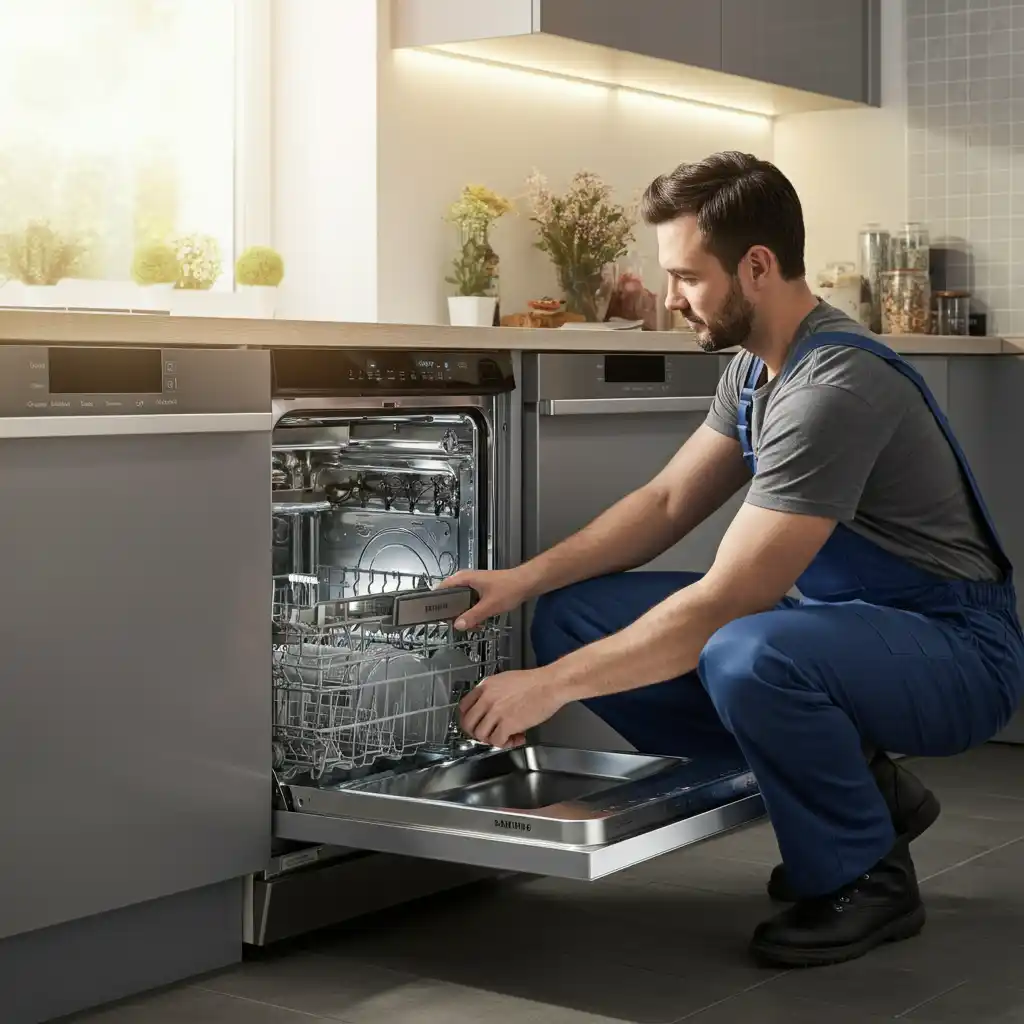
This guide explains how to clean the inside of a dishwasher thoroughly, how often different components should be cleaned, what to do about odors and limescale, which cleaning methods require caution, and how the process applies to households in the United States, Canada, and the United Kingdom.
Why Should You Clean the Inside of a Dishwasher?
A dishwasher is constantly exposed to food residue and dirty wash water. Although the machine is designed to remove soil from dishes, some material is captured by the filter rather than disappearing immediately through the drain.
The dishwasher filter is particularly important because it catches food particles, protects the pump from debris, and helps prevent removed soil from being redistributed onto dishes. When the filter becomes clogged, dishwasher performance can deteriorate and odors can develop.
Spray arms also require attention. Their small openings distribute wash water throughout the tub. Food particles, mineral deposits, and other debris can block these openings, reducing water flow and interfering with proper cleaning. Manufacturers recommend inspecting the spray-arm openings and cleaning them when necessary.
The interior walls can accumulate grease, detergent residue, hard-water deposits, and other material. Mineral deposits are particularly noticeable in areas with hard water because dissolved minerals can form deposits on surfaces exposed to heated water. Regular cleaning can help keep these deposits under control.
Cleaning also helps address odors. Food residue trapped in filters, spray arms, drain areas, seals, and other locations can contribute to unpleasant smells. Cleaning the areas where debris accumulates is generally more useful than simply attempting to mask the odor with fragrance.
How Often Should You Clean a Dishwasher?
There is no single cleaning schedule that applies perfectly to every dishwasher.
A heavily used dishwasher in a large household may require more frequent filter cleaning than a lightly used dishwasher. Hard water can also increase the need for mineral-deposit maintenance. Models with removable filters generally make routine cleaning easier. Manufacturer recommendations should therefore be used as the primary schedule.

A practical maintenance schedule can look like this:
| Dishwasher Component | Suggested Attention |
|---|---|
| Filter | Inspect regularly and clean when debris accumulates |
| Spray arms | Inspect regularly; clean blocked openings |
| Door seal | Wipe periodically |
| Interior walls | Wipe when residue or buildup appears |
| Drain area | Inspect during filter cleaning |
| Detergent dispenser | Clean when residue accumulates |
| Racks | Clean when food or mineral residue appears |
| Deep interior cleaning | Periodically, according to use and manufacturer instructions |
| Hard-water descaling | When mineral deposits become visible or performance declines |
| Exterior/controls | Wipe regularly |
Some manufacturers recommend dedicated cleaning cycles at intervals such as monthly or after a certain number of cycles, while others recommend cleaning based on visible buildup and usage. Follow your model’s instructions rather than treating any single interval as mandatory for every dishwasher.
What You Need to Clean a Dishwasher Inside
For normal cleaning, you may need:
- Soft microfiber cloth
- Soft sponge
- Soft toothbrush or small cleaning brush
- Mild dishwashing detergent for manual component cleaning where permitted
- Warm running water
- Dishwasher-safe container
- Manufacturer-approved dishwasher cleaner
- Distilled white vinegar where the manufacturer’s instructions permit it
- Gloves if preferred for handling dirty components
- Paper towel or clean cloth
Avoid abrasive scouring pads, harsh chemicals, metal tools, and improvised objects that could damage plastic, rubber, stainless steel, filters, or spray-arm openings.
A soft brush is particularly useful for filters and spray arms because it can remove deposits without unnecessarily damaging delicate mesh or small openings. Manufacturer instructions commonly recommend running water and a soft brush for filter cleaning.
Before You Start Cleaning
Before cleaning the dishwasher interior, remove all dishes, glasses, cookware, detergent containers, and loose objects.
If the dishwasher has recently completed a hot cycle, allow it to cool before reaching inside. Hot water and internal components can cause burns.
If you intend to remove the filter, spray arms, or other components, check the owner’s manual first. Different dishwasher designs use different locking mechanisms. A component that twists out on one model may require a different procedure on another.
Do not force a filter, spray arm, cover, or other component. If it does not release according to the manufacturer’s instructions, stop and check the manual.
Step 1: Remove the Dishwasher Racks
Start by removing the lower rack.
Depending on the dishwasher design, you may also be able to remove the upper rack. Removing the racks gives you much better access to the filter, spray arms, tub floor, and side walls.
Inspect the rack wheels, clips, tines, and other components while they are outside the dishwasher.
Look for:
- Food particles
- Grease
- Detergent residue
- Mineral deposits
- Rust or corrosion
- Broken wheels
- Damaged coating
- Objects caught between rack components
Wash removable racks with warm water and a suitable mild cleaning solution if permitted by the manufacturer.
Allow heavily soiled racks to soak if necessary, but avoid using aggressive chemicals that could damage the rack coating or metal.
Step 2: Remove Visible Food Debris
Before using any cleaning cycle, remove large pieces of food or debris from the dishwasher.
Check:
- Bottom of the tub
- Around the filter
- Drain opening
- Corners
- Door area
- Beneath the lower spray arm
- Around the door seal
Do not push debris deeper into the drain opening.
Use a paper towel or soft cloth to pick up larger pieces and dispose of them normally.
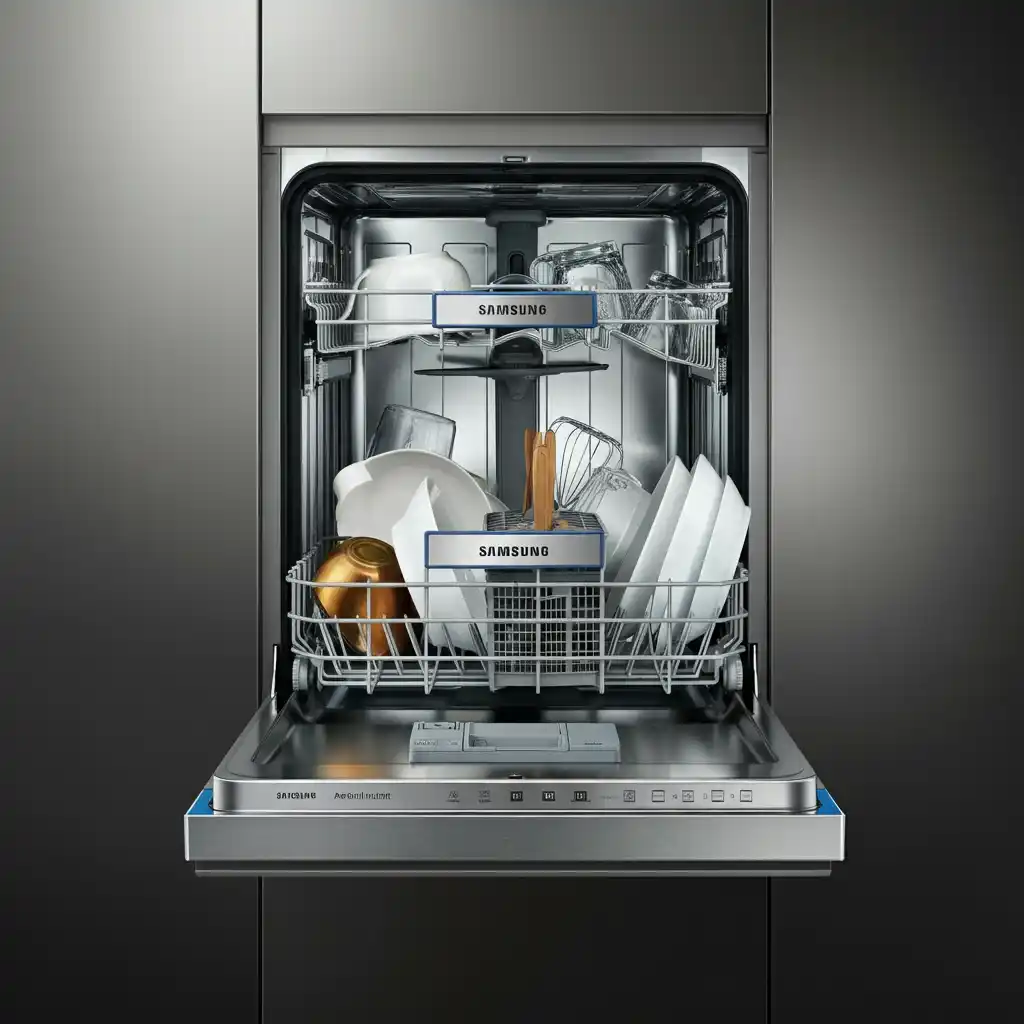
This preliminary cleaning matters because a dishwasher cleaner cannot substitute for physically removing large pieces of food.
Modern dishwashers and detergents are designed to handle food residue, and routine pre-rinsing of every dish is generally unnecessary. However, large scraps should still be scraped from dishes before loading.
Step 3: Clean the Dishwasher Filter
The filter is one of the most important parts of the dishwasher to clean.
It is usually located at the bottom of the tub, although its exact configuration varies.
The filter’s job is to capture food particles and other debris so that they do not repeatedly circulate through the dishwasher or interfere with the drain and pump system.
How to clean the filter
- Remove the lower rack.
- Locate the filter.
- Follow the manufacturer’s instructions for unlocking it.
- Lift or twist the filter out.
- Rinse it under running water.
- Use a soft brush to remove trapped debris.
- Inspect the mesh carefully.
- Clean any surrounding filter area.
- Reinstall the filter correctly.
- Make sure it is locked securely.
Some filters contain multiple sections, such as a cylindrical filter and a flat mesh screen. If your model has multiple pieces, clean each according to the manual.
Do not operate a dishwasher with a removable filter incorrectly installed. A poorly installed filter can interfere with proper operation and may allow debris into areas where it does not belong.
Why a Dirty Filter Causes Bad Smells
A filter filled with food particles is an obvious source of odor.
Food trapped in a damp environment can become unpleasant over time. Because the filter sits directly in the dishwasher’s water-management system, residue can be repeatedly exposed to moisture during wash cycles.
Cleaning the filter removes this accumulated material rather than simply attempting to cover the smell.
If the odor remains after cleaning the filter, inspect the spray arms, drain area, door seal, tub, and drainage system. Persistent odors can sometimes originate outside the dishwasher itself, such as from a drainage problem.
Step 4: Clean the Spray Arms
Spray arms are another critical part of dishwasher maintenance.
The small holes in the arms distribute water across the dishes. If those holes become blocked, water cannot spray properly.
Remove the spray arms only if your model’s instructions allow it.
Then:
- Rinse the spray arm under running water.
- Inspect each spray opening.
- Remove visible debris.
- Use a small soft brush if necessary.
- Rinse thoroughly.
- Make sure water can pass through the openings.
- Reinstall the arm.
- Rotate it manually to confirm that it moves freely.
Manufacturers specifically warn that blocked spray-arm openings can reduce water distribution and cleaning performance.
What Can Block Dishwasher Spray Arms?
Common obstructions include:
- Food particles
- Seeds
- Eggshell fragments
- Small pieces of paper
- Mineral deposits
- Detergent residue
Hard-water scale can be especially troublesome because it can accumulate around small openings.
Do not enlarge spray-arm openings with sharp metal objects. The openings are engineered to produce particular water-flow characteristics, so damaging them can change how the dishwasher operates.
A soft brush or the cleaning method specified by the manufacturer is preferable.
Step 5: Clean the Dishwasher Door
The inside of the dishwasher door can collect detergent residue, grease, food particles, and moisture.
Open the door fully and inspect:
- Inner door panel
- Lower edge
- Door corners
- Detergent dispenser
- Rinse-aid dispenser
- Door hinges
- Gasket area
Use a soft damp cloth to wipe accessible surfaces.
Pay particular attention to the area around the detergent dispenser. Dried detergent can accumulate around the dispenser door and interfere with proper opening or dispensing.
Do not flood the control panel with water. Use only the cleaning method recommended for the specific appliance.
Step 6: Clean the Door Gasket
The door gasket creates a seal between the door and the dishwasher tub.
Food particles, grease, detergent residue, and moisture can accumulate along the gasket.
Wipe the gasket gently with a damp cloth.
Inspect the folds and corners carefully.
Look for:
- Food debris
- Black or discolored deposits
- Grease
- Mineral residue
- Cracks
- Tears
- Deformation
Do not pull aggressively on the gasket.
If the gasket is damaged, cleaning alone will not restore its sealing ability. A damaged gasket may require replacement according to the manufacturer’s service instructions.
Step 7: Clean the Dishwasher Tub
Once the filter and spray arms have been cleaned, inspect the tub itself.
Look at:
- Side walls
- Rear wall
- Bottom
- Corners
- Door area
- Around the filter
- Around the spray-arm mounting area
A soft cloth or sponge can remove loose residue.
For stubborn deposits, use a dishwasher cleaner or other product specifically intended for dishwasher use, following its label and the dishwasher manufacturer’s instructions.
Some manufacturers recommend a dedicated dishwasher cleaner for grease, limescale, mineral deposits, and odors.
Step 8: Clean the Dishwasher Drain Area
The drain area is especially important because dirty water passes through it.
After removing the filter, inspect the exposed area for:
- Food particles
- Broken glass
- Labels
- Plastic fragments
- Seeds
- Grease
- Other foreign objects
Use caution when checking this area. Broken glass can be extremely difficult to see.
Do not place your hand blindly into the drain or pump area.
If an object is lodged where you cannot safely remove it, follow the manufacturer’s service procedure.
A clogged filter or drain area can contribute to poor drainage and poor cleaning performance.
Step 9: Clean the Detergent Dispenser
The detergent dispenser should release detergent during the wash cycle.
If detergent residue builds up around the dispenser, it can interfere with the dispenser door or leave old detergent deposits inside the compartment.
Use a damp cloth and soft brush to clean accessible residue.
Do not force the dispenser door.
If the dispenser is damaged or remains blocked after cleaning, it may require repair or replacement.
Step 10: Clean Mineral Deposits and Limescale
Hard water is a common reason dishwashers develop white or chalky deposits.
Water hardness is primarily associated with dissolved calcium and magnesium. When water is heated and evaporates, mineral deposits can accumulate on appliance surfaces.
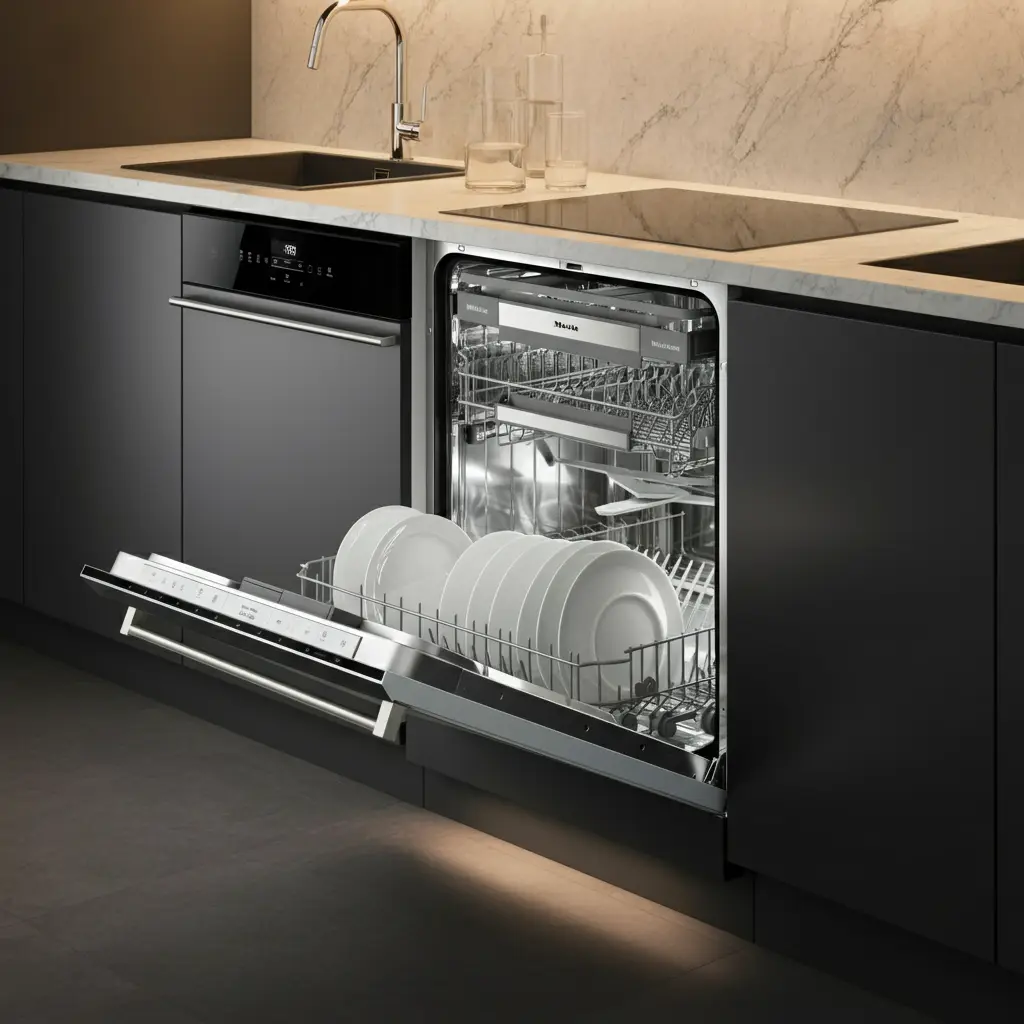
You may notice:
- White film
- Chalky deposits
- Cloudy surfaces
- Deposits around spray holes
- Mineral buildup near the tub floor
- Reduced spray performance
The appropriate treatment depends on the dishwasher and the severity of the deposits.
Some manufacturers recommend dishwasher cleaners or specific descaling procedures. Others provide instructions for using vinegar or citric acid under particular circumstances. Follow your appliance’s instructions rather than assuming that one descaling method is suitable for every model.
Step 11: Run a Dishwasher Cleaning Cycle
After manually cleaning the filter, spray arms, drain area, and visible surfaces, you can run an empty cleaning cycle if the manufacturer recommends it.
A dedicated Self Clean, Machine Clean, or similar program is generally the preferred option when the dishwasher has one.
Some manufacturers instruct users to run a dedicated cleaning cycle with the dishwasher empty, while other models can use an appropriate normal or hot cycle with a dishwasher cleaning product.
Always check whether detergent, dishwasher cleaner, vinegar, or another cleaning product is required for the specific cycle.
Should You Run a Dishwasher Empty to Clean It?
Yes, an empty cycle can be an appropriate way to clean the dishwasher interior.
In fact, some dishwasher manufacturers specifically instruct users to run self-cleaning or cleaning cycles with the dishwasher empty.
The purpose is to allow the cleaning solution and wash water to contact the dishwasher’s interior rather than being consumed by dishes.
An empty cycle is especially useful after manually cleaning the filter and spray arms because it addresses interior surfaces that cannot easily be wiped by hand.
How to Use Dishwasher Cleaner
A dishwasher cleaner specifically designed for automatic dishwashers can be useful for:
- Grease
- Mineral deposits
- Odors
- Residue
- Interior buildup
Follow the product label exactly.
Some cleaners are placed in the detergent compartment, while others are placed directly inside the dishwasher. The required cycle can also vary.
Do not assume that a household bathroom, toilet, oven, or floor cleaner is suitable for dishwasher interiors.
Dishwasher interiors are exposed to food-contact items, heated water, detergents, seals, pumps, filters, and other components. Using an inappropriate chemical can damage the appliance or leave unwanted residues.
Can You Clean a Dishwasher With White Vinegar?
In some dishwasher models, yes.
Several manufacturers provide vinegar-based cleaning instructions, but the concentration and method vary.
One manufacturer’s guidance, for example, instructs users to place approximately two cups of white vinegar in a dishwasher-safe measuring container on the bottom rack and run a complete cycle without detergent, while warning that vinegar is acidic and excessive use could damage the dishwasher.
Another current manufacturer’s cleaning guidance instructs users to place an approximately 8-ounce cup of distilled white vinegar upright in the lower basket and run an appropriate sanitizing cycle on supported models.
These differences demonstrate why generic vinegar recipes should not automatically be applied to every dishwasher.
If your manufacturer prohibits vinegar or provides a different procedure, follow that guidance.
Can Vinegar Remove Limescale?
Vinegar’s acidity can help dissolve some mineral deposits, which is why it is sometimes recommended for dishwasher cleaning.
However, vinegar is not automatically the best choice for every dishwasher or every type of buildup.
For significant mineral accumulation, a purpose-designed dishwasher cleaner or descaler may be more appropriate.
Current appliance guidance also describes vinegar as useful for mineral deposits in certain cleaning procedures, while warning against excessive use.
Can You Use Citric Acid to Clean a Dishwasher?
Some dishwasher manufacturers provide citric-acid cleaning instructions.
Citric acid can help address mineral deposits and certain types of residue.
However, concentration and placement matter. A manufacturer’s troubleshooting guidance may recommend a particular quantity of citric acid when vinegar does not resolve mineral buildup.
Do not assume that more citric acid produces better results. Excessive or inappropriate concentrations can potentially damage components or finishes.
Can You Use Baking Soda to Clean a Dishwasher?
Baking soda is sometimes used as a household cleaning material, but its use in a dishwasher should be guided by the manufacturer’s instructions.
Baking soda is alkaline rather than acidic, so it is not a direct substitute for an acidic descaler.

If your dishwasher manufacturer recommends a specific baking-soda cleaning procedure, follow it. Otherwise, a dishwasher cleaner specifically designed for the appliance is a more predictable option.
Can You Use Bleach to Clean a Dishwasher?
This requires particular caution.
Many modern dishwashers have stainless-steel interiors, and some manufacturers explicitly warn against using bleach in such models because it can damage or discolor the interior.
Bleach should therefore not be treated as a universal dishwasher-cleaning solution.
Never add bleach to a dishwasher unless the manufacturer specifically permits it for your exact model and provides appropriate instructions.
Never Mix Bleach and Vinegar
This is one of the most important safety rules.
Bleach should never be mixed with vinegar or other acidic cleaning products. The combination can produce chlorine gas, which can be dangerous to breathe.
More generally, do not mix different cleaning chemicals unless the product instructions explicitly say the combination is safe.
This means you should not experiment by combining:
- Bleach and vinegar
- Bleach and dishwasher cleaner
- Bleach and descaler
- Different commercial cleaners
- Bleach and ammonia-containing products
Government safety guidance specifically recommends never mixing cleaning products because dangerous vapors or chemical reactions can result.
Never Use Hand Dish Soap Inside a Dishwasher
Hand dishwashing liquid is designed to produce foam.
An automatic dishwasher is not.
Using hand dish soap inside an automatic dishwasher can create excessive foam and cause a major mess. Automatic dishwasher detergents are formulated differently and should be used according to the appliance manufacturer’s instructions.
If you accidentally use hand dish soap, stop the dishwasher and follow the manufacturer’s procedure for removing excess suds rather than continuing the cycle.
How to Clean a Smelly Dishwasher
If your dishwasher smells bad, start with the source rather than simply adding fragrance.
Use this sequence:
- Empty the dishwasher.
- Remove and clean the filter.
- Inspect the drain area.
- Clean the spray arms.
- Wipe the door seal.
- Clean the interior.
- Inspect the detergent dispenser.
- Check for standing water.
- Run an appropriate cleaning cycle.
- Check the drain hose and sink connection if the smell persists.
Food debris, filters, spray arms, stagnant water, and drainage problems are among the areas manufacturers identify when troubleshooting dishwasher odors.
What If the Dishwasher Still Smells After Cleaning?
If the smell remains, investigate the drainage system.
A dishwasher may develop an odor if wastewater is not draining correctly.
Check for:
- Standing water
- Blocked filters
- Drain hose problems
- Sink drain problems
- Garbage-disposal connection problems where applicable
- Air-gap issues where applicable
- Food debris near the drain
- Improper drain installation
If the dishwasher repeatedly retains water after cycles, professional diagnosis may be necessary.
Persistent odor is not always an interior-cleaning problem.
How to Clean a Dishwasher That Has Standing Water
Standing water at the bottom of a dishwasher requires more than simply running another cleaning cycle.
First determine whether a small amount of water is normal for your specific dishwasher. Some designs retain a small amount of water in areas associated with the sump and pump.
If there is an unusually large amount of water:
- Remove standing water according to the manufacturer’s instructions.
- Clean the filter.
- Inspect the drain area.
- Check the drain hose.
- Check the sink connection.
- Check the air gap if the installation uses one.
- Run an appropriate test cycle.
If the dishwasher still does not drain, service may be required.
How to Clean a Dishwasher With Hard Water
Hard water can create a different cleaning challenge.
If you see persistent white deposits despite cleaning the filter and spray arms, the problem may be mineral buildup rather than food residue.
A long-term strategy can include:
- Testing household water hardness
- Using dishwasher salt where the model supports it
- Adjusting the dishwasher’s water-hardness setting
- Using rinse aid
- Periodically descaling
- Using an appropriate dishwasher cleaner
- Following local water-softening recommendations
Some dishwasher models have integrated water-softening systems and require a specific salt product. The correct setting depends on the hardness of the incoming water and the appliance.
How to Clean the Dishwasher if You Have Very Hard Water
Very hard water may require more frequent mineral-deposit maintenance.
Whirlpool guidance, for example, identifies extremely hard water as a situation where a water softener can be strongly recommended.
If your glasses repeatedly develop white spots, the spray-arm holes become restricted, or the dishwasher develops visible mineral scale, investigate water hardness rather than repeatedly increasing detergent.
Excessive detergent is not a substitute for correcting a hard-water problem.
How to Clean a Dishwasher With Grease Buildup
Grease can accumulate inside the tub, filter, spray arms, and drainage system.
Begin with manual cleaning:
- Remove the racks.
- Clean the filter.
- Wipe visible grease.
- Clean the spray arms.
- Clean the door and gasket.
- Run a suitable dishwasher-cleaning cycle.
A purpose-designed dishwasher cleaner can help remove grease and residue from internal areas that are difficult to reach manually.
For severe grease buildup, repeat the approved cleaning procedure rather than using increasingly aggressive household chemicals.
How to Clean a Dishwasher With Mold or Mildew-Like Growth
Dark or slimy material around seals and damp areas can be concerning.
Start by physically removing visible residue and addressing the moisture source.
Do not assume that simply killing mold is enough. General indoor-environment guidance emphasizes that visible mold and moisture problems should be addressed together, because residual material can remain even after microorganisms are killed.
If significant mold growth is present, the gasket is damaged, or the problem repeatedly returns, professional assessment may be appropriate.
Do not introduce bleach into a stainless-steel dishwasher simply because mold-like material is present.
How to Clean the Dishwasher Filter Without Damaging It
The filter should be handled carefully.
Do not:
- Scrub aggressively with metal tools
- Bend the mesh
- Cut blocked openings
- Use sharp objects
- Force the locking mechanism
- Operate the dishwasher with a damaged filter
Manufacturer instructions commonly recommend rinsing filters under running water and using a soft brush for stubborn debris.
A damaged filter may fail to perform its intended function, so replacement may be necessary.
How to Clean Dishwasher Spray Arms Without Damaging Them
Spray arms contain precision openings.
Avoid drilling, cutting, or enlarging the holes.
Instead:
- Remove the arm according to the manual.
- Rinse under running water.
- Use a soft brush.
- Remove visible debris.
- Check each opening.
- Ensure the arm rotates correctly after installation.
Manufacturer guidance specifically recommends clearing blocked nozzles and verifying that spray arms can distribute water properly.
How to Clean the Inside of a Stainless-Steel Dishwasher
Stainless-steel interiors should be treated carefully.
Use soft materials and products approved for dishwasher interiors.
Avoid:
- Steel wool
- Aggressive abrasive cleaners
- Chlorine bleach unless explicitly approved
- Strong acids used outside manufacturer instructions
- Metal scraping tools
Some manufacturers specifically warn against bleach in stainless-steel interiors.
A stainless-steel tub is durable, but that does not mean it is resistant to every chemical.
How to Clean the Bottom of a Dishwasher
The bottom receives a large amount of food residue and dirty water.
Clean it by:
- Removing the lower rack.
- Removing the filter according to the manual.
- Removing visible debris.
- Cleaning the filter.
- Inspecting the drain area.
- Wiping the tub floor.
- Cleaning the lower spray arm.
- Reinstalling all components correctly.
- Running an approved cleaning cycle.
Do not pour large quantities of household cleaner directly into the sump or drain opening.
How to Clean the Dishwasher Door Seal
The door seal should be wiped rather than aggressively scrubbed.
Use:
- Damp microfiber cloth
- Soft sponge
- Mild cleaning solution if permitted
Work carefully around corners.
If you see cracks, tears, flattening, or other damage, replace the gasket according to the manufacturer’s procedure.
A clean gasket can also make it easier to identify whether the seal itself is deteriorating.
How to Clean a Dishwasher After Washing Dirty Dishes
You do not need to deep-clean the dishwasher after every load.
After normal use:
- Scrape large food debris from dishes.
- Check the filter periodically.
- Wipe obvious residue.
- Leave the dishwasher interior able to dry.
- Run the appropriate maintenance cycle when necessary.
Modern dishwashers are designed to clean dishes without requiring users to rinse every plate beforehand. Excessive pre-rinsing can waste water and energy.
The goal is not to disinfect the machine after every load. The goal is to maintain the components that handle soil and water.
Should You Leave the Dishwasher Door Open After Cleaning?
Leaving the door slightly open after a cleaning cycle can help the interior dry, provided this is safe in your household and does not create a hazard.
Some manufacturer cleaning instructions specifically recommend leaving the door slightly open after cleaning to help reduce lingering moisture and odors.
Do not leave the door open if it creates a tripping hazard or is accessible to small children or pets.
How to Clean a Dishwasher Before Long-Term Storage
If a dishwasher will not be used for an extended period, clean it before storage.
Recommended preparation includes:
- Empty the dishwasher.
- Clean the filter.
- Clean the spray arms.
- Wipe the interior.
- Clean the gasket.
- Remove food residue.
- Ensure the interior is dry.
- Follow the manufacturer’s storage instructions.
The objective is to avoid leaving food residue and moisture trapped inside the appliance.
How to Clean a New Dishwasher
A new dishwasher may have manufacturing or packaging odors.
The exact first-use procedure varies.
Some manufacturers state that temporary odors from new materials can occur and may dissipate after several cycles.
If the manufacturer recommends an initial cleaning cycle, follow it.
Do not automatically add vinegar, bleach, baking soda, or another chemical to a brand-new dishwasher unless the instructions permit it.
Does Cleaning the Dishwasher Improve Cleaning Performance?
It can.
A clogged filter can affect soil removal and water circulation, while blocked spray-arm openings can restrict water distribution.
Cleaning these components restores the conditions the dishwasher needs to operate as designed.
However, poor cleaning can also be caused by:
- Incorrect loading
- Blocked spray arms
- Insufficient water
- Incorrect detergent
- Hard water
- Low water temperature
- Mechanical faults
- Damaged components
Cleaning the interior is therefore an important maintenance step but not a universal solution for every dishwasher problem.
Dishwasher Cleaning and Sanitization
Cleaning and sanitization should not be confused.
Cleaning removes visible soil and organic material.
Sanitization is a more specific performance claim.
Residential dishwashers certified to NSF/ANSI 184 can demonstrate a minimum 5-log, or 99.999%, reduction in bacteria when operated on the qualifying sanitizing cycle under the standard’s test conditions. The standard also includes performance requirements related to cleaning effectiveness.
This does not mean that manually cleaning the empty dishwasher automatically sanitizes it.
Nor does it mean that every dishwasher cycle provides the same sanitizing performance.
If sanitation is important, use the designated sanitizing cycle and follow the manufacturer’s instructions.
How Often Should You Deep Clean a Dishwasher?
A reasonable deep-cleaning frequency depends on usage.
A household that runs the dishwasher several times every day may need more frequent maintenance than a household that runs it a few times per week.
Factors that increase the need for cleaning include:
- Heavy use
- Large amounts of food residue
- Hard water
- Frequent low-temperature cycles
- Persistent odors
- Visible mineral deposits
- Dirty filter
- Poor cleaning results
- Standing water
Some manufacturers recommend cleaning programs monthly or after a specified number of cycles, while others provide maintenance intervals based on model design.
A Simple Monthly Dishwasher Cleaning Routine
For many households, a monthly inspection is a useful starting point.
Week or month check
1. Inspect the filter
Remove and rinse it if necessary.
2. Inspect the spray arms
Check that the openings are clear.
3. Wipe the gasket
Remove food and residue.
4. Check the bottom
Remove visible debris.
5. Inspect the door
Clean detergent and grease residue.
6. Check for odors
If there is an odor, identify its source.
7. Run a cleaning cycle
Use the manufacturer’s recommended cleaner and cycle when needed.
This routine can be adjusted according to actual dishwasher usage.
How to Clean a Dishwasher in the USA
For U.S. households, follow the dishwasher manufacturer’s instructions first.
If the appliance has a dedicated cleaning cycle, use it according to the instructions.
If you use a commercial cleaning product, follow the product label.
For chemical safety, U.S. government guidance emphasizes reading labels, following directions, using appropriate ventilation, and never mixing incompatible cleaning products.
U.S. households should also distinguish ordinary cleaning from sanitation claims. If a dishwasher is certified to a residential sanitation standard, the certification applies under the specified cycle and conditions.
How to Clean a Dishwasher in Canada
Canadian households can follow the same fundamental maintenance process:
- Clean the filter.
- Inspect spray arms.
- Remove food debris.
- Clean the door seal.
- Clean the tub.
- Address hard-water deposits.
- Run the manufacturer’s recommended cleaning cycle.
Canadian water conditions vary considerably by location, so hard-water problems may be more important in some areas than others.
If mineral deposits are persistent, determine the household water hardness and use the dishwasher’s water-softening or descaling features where available.
The same chemical safety principle applies: do not mix cleaning products and always follow the product label and appliance instructions.
How to Clean a Dishwasher in the UK
The fundamental process is also the same in the UK.
Clean the filter and spray arms regularly, remove food residue, inspect the door seal, and use an appropriate dishwasher cleaner or descaling procedure when necessary.
UK households should also consider local water hardness because hard water can contribute to limescale formation.
The specific cleaning product should be compatible with the appliance and used according to its label.
If your dishwasher has a dedicated cleaning or maintenance cycle, use that program according to the manufacturer’s instructions.
Common Dishwasher Cleaning Mistakes
Mistake 1: Only Cleaning the Tub
A shiny tub does not necessarily mean a clean dishwasher.
The filter and spray arms can remain dirty even when the visible stainless-steel surfaces look clean.
Mistake 2: Ignoring the Filter
The filter is one of the most important maintenance components.
Mistake 3: Using Too Much Cleaner
More chemical does not automatically mean better cleaning.
Follow the product instructions.
Mistake 4: Using Bleach Automatically
Bleach can damage some dishwasher interiors, particularly stainless-steel interiors.
Mistake 5: Mixing Vinegar and Bleach
This can create dangerous chlorine gas.
Mistake 6: Using Hand Dish Soap
Hand dishwashing liquid can create excessive foam inside an automatic dishwasher.
Mistake 7: Scrubbing Stainless Steel With Abrasive Materials
This can scratch or damage the surface.
Mistake 8: Ignoring Hard Water
Repeated mineral buildup may require water-hardness management rather than repeated surface cleaning.
Mistake 9: Forgetting the Spray Arms
Blocked nozzles can reduce water distribution.
Mistake 10: Cleaning Without Reading the Manual
Different dishwasher designs use different filters, spray arms, cleaners, and maintenance cycles.
A Complete Dishwasher Interior Cleaning Checklist
Use this checklist whenever you perform a deep clean:
Before cleaning
- Empty dishwasher
- Allow hot components to cool
- Check owner’s manual
- Gather cleaning supplies
Interior
- Remove lower rack
- Remove upper rack if appropriate
- Remove visible debris
- Clean filter
- Inspect drain
- Clean spray arms
- Wipe tub
- Clean door
- Clean gasket
- Clean detergent dispenser
- Check rinse-aid area
Deep cleaning
- Check for mineral deposits
- Select approved dishwasher cleaner
- Run recommended empty cycle
- Use vinegar only if permitted
- Avoid bleach unless specifically approved
- Never mix cleaning chemicals
After cleaning
- Reinstall filter correctly
- Reinstall spray arms
- Reinstall racks
- Confirm spray arms rotate freely
- Check drainage
- Allow interior to dry
Dishwasher Cleaning Troubleshooting Table
| Problem | Likely Area to Check | Recommended Action |
|---|---|---|
| Bad smell | Filter, drain, spray arms, gasket | Clean components and check drainage |
| White deposits | Tub, spray arms, heater area | Address hard water and descale appropriately |
| Poor cleaning | Filter, spray arms, loading | Clean and inspect circulation |
| Dirty glasses | Spray arms, filter, detergent, water hardness | Inspect all relevant areas |
| Standing water | Filter, drain, hose | Clean and inspect drainage |
| Detergent remaining | Dispenser, water circulation | Clean dispenser and spray system |
| Greasy interior | Filter, tub | Deep-clean with approved cleaner |
| Blocked spray | Spray-arm openings | Remove debris and mineral deposits |
| Black residue | Gasket, damp areas | Clean and investigate recurring moisture |
| Cloudy interior | Mineral deposits | Use appropriate descaling procedure |
50 Frequently Asked Questions About Cleaning a Dishwasher Inside
1. How often should I clean my dishwasher inside?
Inspect the filter and other components regularly and perform a deeper cleaning according to the manufacturer’s maintenance schedule, household usage, water hardness, and visible buildup.
2. What is the most important part to clean?
The filter is one of the most important components because it captures food debris and protects the dishwasher’s water-management system.
3. Should I clean the dishwasher filter every week?
Not necessarily. The appropriate frequency depends on use and the manufacturer’s recommendations. Inspect it regularly and clean it when debris accumulates.
4. Can I run my dishwasher empty to clean it?
Yes. Many manufacturers provide empty self-cleaning or maintenance-cycle instructions.
5. Can I use vinegar to clean my dishwasher?
Some manufacturers permit vinegar cleaning, while others may recommend dedicated cleaners. Follow the instructions for your model.
6. How much vinegar should I use?
There is no universal amount. Manufacturer instructions vary, with some specifying approximately two cups and others approximately eight ounces for particular procedures.
7. Can vinegar damage a dishwasher?
Frequent or inappropriate use can potentially damage components because vinegar is acidic. Some manufacturers specifically warn against excessive use.
8. Can I use baking soda?
Only use it if your dishwasher manufacturer permits the procedure. It should not automatically be treated as a universal dishwasher cleaner.
9. Can I use citric acid?
Some manufacturers recommend citric acid for mineral buildup under specified conditions. Follow the model-specific quantity and procedure.
10. Can I use bleach?
Do not use bleach unless your dishwasher manufacturer specifically permits it. Some stainless-steel interiors can be damaged or discolored by bleach.
11. Can I mix bleach and vinegar?
Absolutely not. The combination can release dangerous chlorine gas.
12. Can I use hand dishwashing liquid?
No. It can create excessive suds in an automatic dishwasher.
13. Why does my dishwasher smell bad?
Common areas to investigate include the filter, spray arms, drain, gasket, tub, and drainage system.
14. Why does my dishwasher have a white film?
Hard-water minerals are one possible cause.
15. How do I remove limescale?
Use the descaling procedure recommended for your dishwasher and address the underlying water-hardness problem where appropriate.
16. Why are my spray arms blocked?
Food debris and mineral deposits can accumulate in the small spray openings.
17. Can I use a toothpick to clean spray-arm holes?
Some manufacturers recommend small non-damaging tools for removing debris, but follow your model’s instructions.
18. Can I use a metal needle?
It is better to avoid modifying the spray openings. Use the manufacturer’s recommended cleaning method.
19. Should I remove the spray arms?
Only if your model is designed for removal and the manual provides instructions.
20. Why is there food at the bottom of my dishwasher?
The filter may need cleaning, or the drain system may have a problem.
21. Why is my filter dirty?
The filter is designed to collect food particles, so some accumulation is normal.
22. Should I clean the filter with soap?
Some manufacturer instructions permit mild soap and a soft brush; others may specify water only. Follow the model instructions.
23. Can I put the dishwasher filter in the sink?
Yes, if it is removable. Clean it separately using the manufacturer’s recommended method.
24. How do I clean the dishwasher gasket?
Wipe it gently with a damp soft cloth and remove food particles and residue from the folds.
25. How do I clean the dishwasher door?
Use a soft damp cloth and clean the inner panel, dispenser area, corners, and gasket.
26. How do I clean the dishwasher drain?
Start by cleaning the filter and inspecting the accessible drain area. Do not put your hand blindly into the pump area.
27. Why does my dishwasher have standing water?
Possible causes include a clogged filter, blocked drain, drain-hose issue, or plumbing problem.
28. Can dishwasher cleaner remove odors?
A suitable dishwasher cleaner can help remove grease, residue, mineral deposits, and odor sources.
29. Should I clean my dishwasher every month?
Monthly inspection is a useful routine for many households, but the actual cleaning frequency should be adjusted according to usage and manufacturer guidance.
30. Can hard water damage a dishwasher?
Mineral deposits from hard water can contribute to scale and interfere with dishwasher performance.
31. Does rinse aid clean the dishwasher?
Rinse aid primarily assists the dishwashing and drying process; it is not a substitute for cleaning the dishwasher interior.
32. Should I run a hot cycle when cleaning?
Use the cycle recommended by the dishwasher cleaner and manufacturer. A dedicated cleaning or sanitizing cycle may be appropriate on supported models.
33. Does a sanitize cycle clean the dishwasher?
A sanitize cycle is primarily intended for sanitization performance under specified conditions. It does not eliminate the need to clean filters, spray arms, and other components.
34. Is cleaning the dishwasher the same as sanitizing it?
No. Cleaning removes soil; sanitization is a specific reduction of microorganisms under defined conditions.
35. Can an NSF-certified dishwasher sanitize dishes?
A dishwasher certified to NSF/ANSI 184 can meet the standard’s specified sanitization performance when operated on its qualifying sanitizing cycle.
36. Can I use bathroom cleaner inside my dishwasher?
No, unless the product is specifically approved for that application and the dishwasher manufacturer permits it.
37. Can I use oven cleaner?
Do not use oven cleaner inside a dishwasher unless the manufacturer explicitly approves it.
38. Can I use chlorine tablets?
Do not use chlorine products unless specifically approved for the dishwasher.
39. How do I remove grease from a dishwasher?
Clean the filter and visible residue, then use a dishwasher cleaner designed to remove grease if recommended for the appliance.
40. Why does my dishwasher smell even after cleaning?
Check the drain system, filter, gasket, standing water, and sink connection. Persistent odors may originate from drainage problems rather than the tub itself.
41. Should I leave the dishwasher door open?
Leaving it slightly open after cleaning can help the interior dry, provided doing so is safe in your household and does not create a hazard.
42. Can I clean the dishwasher while it is connected to power?
For normal wipe-down cleaning, follow the manufacturer’s safety instructions. For service, disassembly, or work near electrical components, power should be handled according to the manufacturer’s instructions and applicable electrical-safety requirements.
43. Should I wear gloves?
Gloves can be useful when handling dirty filters or cleaning chemicals, particularly if the product label recommends protective equipment.
44. Why does my dishwasher leave dirty dishes after cleaning?
Possible causes include clogged filters, blocked spray arms, incorrect loading, insufficient water, detergent problems, hard water, or mechanical faults.
45. Does cleaning the filter improve dishwasher performance?
It can. A clogged filter can interfere with proper cleaning and water management.
46. Can I clean a dishwasher without a commercial cleaner?
In some models, yes. Manual cleaning and manufacturer-approved household methods may be sufficient. However, dedicated dishwasher cleaners can be useful for specific buildup.
47. What is the best dishwasher cleaner?
The best choice is one specifically intended for automatic dishwashers and compatible with your model. Follow the manufacturer’s instructions and the cleaner’s label.
48. Can I clean the dishwasher with only water?
Water can remove loose debris, but it may not adequately remove grease or mineral buildup.
49. Should I clean the filter before running dishwasher cleaner?
Yes, it is generally sensible to remove major debris first so the cleaning cycle is not being asked to process a heavily contaminated filter.
50. What is the easiest way to keep a dishwasher clean?
Regularly scrape large food debris from dishes, keep the filter clean, inspect the spray arms, clean the gasket, and periodically run the manufacturer’s recommended maintenance cycle.
Final Thoughts
Cleaning the inside of a dishwasher is primarily about maintaining the components that handle dirty water, food particles, grease, minerals, and moisture.
The most important areas are the filter, spray arms, drain area, dishwasher tub, door gasket, detergent dispenser, and interior door. Cleaning these areas regularly helps maintain water circulation and can reduce the buildup that contributes to odors and poor cleaning performance.
A good deep-cleaning process starts with manually removing debris rather than immediately adding chemicals. Clean the filter, inspect the drain area, clear the spray arms, wipe the gasket and tub, and then use an appropriate dishwasher-cleaning cycle if necessary.
For mineral buildup, consider the underlying water hardness instead of repeatedly treating the symptoms. Hard water can contribute to scale, and some dishwashers provide built-in water-softening systems or hardness settings that should be configured according to the manufacturer’s instructions.
When using cleaning chemicals, safety is critical. Never mix bleach with vinegar or other incompatible cleaners, and never assume that a bathroom, oven, floor, or general-purpose cleaner is appropriate for a dishwasher. Government safety guidance emphasizes following labels and avoiding chemical combinations that can produce dangerous vapors.
Finally, remember that cleaning a dishwasher and sanitizing dishes are different processes. A clean dishwasher is maintained by removing soil and deposits from its components, while sanitation performance depends on the specific appliance, cycle, temperature, and applicable certification requirements.
For households in the USA, UK, and Canada, the basic maintenance principles are essentially the same, but the exact cleaning products, appliance instructions, water conditions, and applicable safety requirements can differ. The safest approach is therefore to combine general dishwasher-maintenance principles with the manufacturer’s instructions for the exact model.
A clean filter, unobstructed spray arms, clean gasket, clear drain area, controlled mineral buildup, and regular maintenance cycle can go a long way toward keeping a dishwasher operating efficiently and delivering consistent cleaning results.