
An ADA dishwasher is a dishwasher designed to provide easier access and operation for people with disabilities or physical limitations. In the United States, the term generally refers to a dishwasher designed to meet accessibility requirements associated with the Americans with Disabilities Act (ADA), particularly requirements concerning accessible appliance controls, reach ranges, clear floor space, and the positioning of the dishwasher within an accessible kitchen. The dishwasher itself is not simply a smaller version of a conventional appliance; accessibility also depends on how the appliance is installed and whether the surrounding kitchen provides sufficient space for a person to approach and operate it.
The most recognizable characteristic of many ADA-height dishwashers is their reduced overall height. Conventional built-in dishwashers are commonly designed around standard kitchen cabinet and countertop dimensions, while ADA-height models are generally shorter so that they can fit beneath lower countertops or into kitchens designed around wheelchair accessibility. Some manufacturers describe their ADA-height models as approximately 32 inches high rather than the roughly 34-inch height common to many standard installations.
However, the phrase “ADA dishwasher” should not be interpreted as meaning that every dishwasher with a short cabinet is automatically suitable for every disabled user. Accessibility is a combination of product dimensions, controls, door operation, clear floor space, rack arrangement, countertop height, surrounding cabinetry, and installation. A dishwasher may have an ADA designation from its manufacturer but still be inconvenient for a particular person if the surrounding kitchen does not provide an appropriate approach or if the racks and controls are difficult for that individual to use.
This distinction is especially important when comparing products in the USA with products in Canada or the UK. The ADA is a U.S. accessibility framework. Canada and the UK have their own accessibility standards, building regulations, and design guidance. Therefore, an “ADA dishwasher” sold in the USA can be a useful description of an accessible appliance, but the term should not be treated as a universal legal certification for kitchens in every country. Canadian accessibility work commonly references CSA/ASC B651, while England has Approved Document M for access and use of buildings.

What Does ADA Mean?
ADA stands for the Americans with Disabilities Act, a U.S. federal civil-rights law intended to address discrimination against people with disabilities. The ADA Standards for Accessible Design establish technical accessibility requirements for covered buildings and facilities, including requirements concerning accessible routes, reach ranges, controls, and kitchen appliances in covered situations.
The ADA Standards do not create a special appliance category in which every dishwasher must have a particular brand, wash technology, rack system, or cleaning performance. Instead, accessibility requirements focus on whether the relevant appliance and its operating parts can be approached and used by people with disabilities. For kitchens, the standards address clear floor or ground space at appliances, accessible controls, and specific dishwasher-door considerations.
This is why an ADA dishwasher can look very similar to an ordinary dishwasher. The major differences may be its height, control placement, installation flexibility, and accessibility-related design rather than the fundamental washing technology.
What Makes a Dishwasher ADA Compliant?
Several characteristics can contribute to an accessible dishwasher installation.
1. Lower Overall Height
The lower height is one of the most noticeable differences. Many ADA-height dishwashers are designed around a cabinet height of approximately 32 inches. This can be important in kitchens where the countertop or work surface has been lowered to improve access for someone using a wheelchair.
A standard dishwasher may be too tall for a kitchen designed around a lower countertop. Installing a shorter appliance can allow the countertop to remain at an accessible height while preserving the dishwasher position beneath it.
This does not mean that every wheelchair user needs a 32-inch dishwasher. Individual wheelchair dimensions, seated reach, transfer ability, preferred working height, and kitchen layout vary considerably. The appropriate appliance should therefore be selected together with the overall kitchen design.
2. Accessible Controls
Controls are another important consideration. The 2010 accessibility requirements establish reach ranges for accessible operable parts and generally require controls to be usable without tight grasping, pinching, or twisting. For an unobstructed forward or side reach, the standard maximum high reach is generally 48 inches and the minimum low reach is 15 inches.
For a dishwasher, this means that control placement matters. A control panel located on the front of the dishwasher can be easier to reach than controls positioned at a height or location that requires excessive bending or reaching.
Front controls can also be useful for people with limited mobility who have difficulty standing for extended periods. Nevertheless, control accessibility should be assessed together with the height of the dishwasher, the opening mechanism, and the user’s individual reach.
3. Adequate Clear Floor Space
An accessible appliance needs enough space around it for a person to approach and operate it. The ADA kitchen requirements call for clear floor or ground space at each kitchen appliance. For a dishwasher specifically, the clear space should be positioned adjacent to the dishwasher door. When the dishwasher door is open, it must not obstruct the required clear floor space for the dishwasher or sink.
This is an important point that is sometimes overlooked when purchasing an ADA dishwasher.
A dishwasher may be technically suitable in terms of its dimensions, but if a cabinet, island, wall, or sink prevents a wheelchair user from approaching the appliance, the overall installation may still be difficult to use.
4. Easier Door Operation
Dishwasher doors can be surprisingly important from an accessibility perspective. A user may need to pull the door open, lower it, load dishes, unload racks, and close the door.
The ADA rules recognize that bottom-hinged appliance doors present different accessibility considerations when open. For dishwashers, the critical requirement is maintaining the necessary clear floor space adjacent to the appliance and preventing the open door from blocking required access.
In practical terms, look for a dishwasher door that opens smoothly and does not require excessive force. A person with limited hand strength may find a stiff latch or heavy door difficult even when the appliance otherwise meets dimensional requirements.
5. Appropriate Installation Height
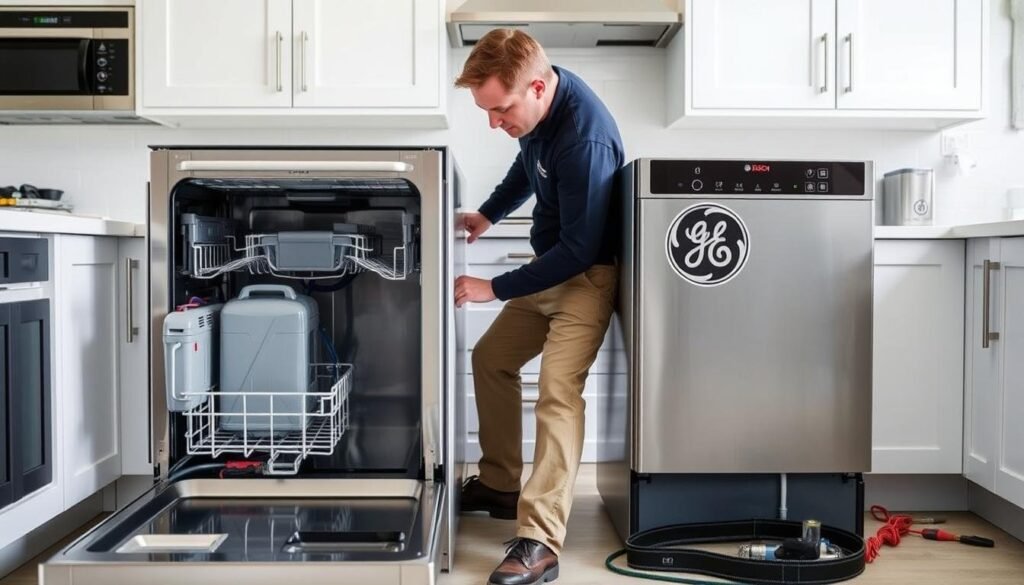
A dishwasher’s accessibility depends heavily on installation. An ADA-height appliance installed incorrectly may become harder to use.
Some manufacturers specifically design their shorter dishwashers so that they can be installed beneath countertops while accommodating different kitchen configurations. Certain models can also be incorporated into kitchen layouts where floor or cabinet dimensions differ from conventional installations.
The installer therefore needs to consider the final floor level, countertop height, cabinet opening, toe-kick, plumbing connections, electrical connection, door swing, and adjacent appliances.
ADA Dishwasher vs Standard Dishwasher
The easiest way to understand the difference is to compare the typical design priorities.
| Feature | ADA-Height Dishwasher | Standard Dishwasher |
|---|---|---|
| Overall height | Usually around 32 inches on many models | Often around 34 inches |
| Main purpose | Accessibility and lower installation height | Conventional kitchen installation |
| Controls | Designed with accessibility considerations | Varies by model |
| Countertop compatibility | Useful for lower accessible countertops | Designed around standard counters |
| Clear floor space | Particularly important | Important for normal operation |
| Door accessibility | Important | Important |
| Width | Commonly available in 18-inch and 24-inch formats | Commonly 24 inches |
| Cleaning performance | Can be comparable to standard models | Varies by model |
| Energy efficiency | Depends on model | Depends on model |
| Noise | Depends on model | Depends on model |
| Smart features | Available on some models | Widely available |
| Accessibility | Designed around accessibility requirements | Not necessarily designed around accessibility |
Manufacturers currently offer both 18-inch and 24-inch ADA-height dishwashers, demonstrating that accessibility does not necessarily require a particular width. Some 24-inch models maintain a conventional width while reducing the vertical height, while 18-inch versions can be useful where both accessible height and limited kitchen space are considerations.
How Tall Is an ADA Dishwasher?
There is no single universal dishwasher height that should be assumed simply because a product is described as ADA compliant.
Many U.S. ADA-height models are approximately 32 inches tall, compared with standard-height models that are commonly around 34 inches. Manufacturer specifications should always be checked because actual dimensions can vary by model and installation configuration.
The difference of approximately two inches can be significant in an accessible kitchen.
For example, imagine a kitchen designed around a lower countertop. A conventional 34-inch dishwasher may leave insufficient space beneath the countertop. A 32-inch model may provide the required clearance while allowing the countertop to remain at the intended height.
The important point is that the height should be evaluated as part of the complete kitchen rather than as an isolated dishwasher specification.
Are ADA Dishwashers Only for Wheelchair Users?
No.
An ADA dishwasher can be useful for many people who experience difficulty bending, reaching, gripping, standing, or manipulating conventional appliance controls.
Potential users can include:
- People who use wheelchairs
- People with limited lower-body mobility
- People with reduced hand strength
- People with arthritis
- People recovering from surgery or injury
- Older adults with mobility limitations
- People who have difficulty bending repeatedly
- People with limited reach
- People who prefer front-accessible controls
- People designing an accessible or adaptable kitchen
Accessibility is not limited to one type of disability. Modern accessibility standards increasingly consider a broad range of physical, sensory, and cognitive needs. Canada’s current accessibility framework, for example, addresses physical, sensory, and cognitive disabilities and includes considerations involving controls and the design of built environments.
Are ADA Dishwashers Shorter Than Normal Dishwashers?
Usually, yes.
A lower cabinet height is one of the defining characteristics of many ADA-height dishwashers. A manufacturer may produce the same general dishwasher platform in both standard and ADA-height versions, with the accessible model designed to fit beneath a lower countertop.
For example, current product information describes 24-inch ADA-height dishwashers at approximately 32 inches high, compared with standard models around 34 inches.
However, shorter does not automatically mean accessible. The control location, door operation, approach space, rack accessibility, and installation must also be considered.
Why Is Dishwasher Height Important for Wheelchair Users?
A wheelchair user generally operates a dishwasher from a seated position. A conventional kitchen designed primarily for standing users may place work surfaces, appliances, switches, and storage at heights that are inconvenient or unreachable from a wheelchair.
A lower dishwasher can help maintain a more accessible relationship between the appliance, countertop, and user.
The ADA’s reach requirements establish maximum and minimum reach dimensions for accessible operable parts. An unobstructed forward or side reach generally falls between 15 and 48 inches above the finished floor.
But reach range alone does not solve every accessibility issue.
A person might be able to reach the controls but still have difficulty leaning forward far enough to load the bottom rack. Another person may have sufficient reach but difficulty gripping the door handle.
Therefore, dishwasher accessibility should be evaluated as a complete movement sequence:
- Approach the dishwasher.
- Reach the controls.
- Open the door.
- Pull out the rack.
- Reach into the rack.
- Load or remove dishes.
- Push the rack back.
- Close the door.
- Start or modify the cycle.
Every stage matters.
ADA Dishwasher Controls: What Should You Look For?
Control design deserves particular attention.
An accessible dishwasher should have controls that can be operated without unnecessary force, awkward wrist movement, or excessive reaching. Accessibility requirements generally address the operation of controls, including the ability to operate them with one hand without tight grasping, pinching, or twisting.
Useful features can include:
- Front-mounted controls
- Large buttons
- Clearly labeled buttons
- High-contrast displays
- Easy-to-read indicators
- Simple cycle selection
- Tactile feedback
- Controls requiring modest activation force
- Clear cycle-status indicators
- Automatic door-opening or drying features where appropriate
- Smart controls that reduce the need to physically operate the panel
However, touchscreen controls should not automatically be considered more accessible. A touchscreen may be excellent for one person but difficult for another person with limited dexterity or visual limitations.
Are Front-Control Dishwashers Better for Accessibility?
A front-control dishwasher can be advantageous because the controls are located on the front face and may be easier to reach.
But “front control” and “ADA compliant” are not interchangeable terms.
A front-control dishwasher could have controls positioned at an inconvenient height or have other design characteristics that do not meet a particular accessibility requirement.
Conversely, accessibility-focused dishwashers may use a variety of control arrangements depending on the manufacturer and model.
The safest approach is to check the manufacturer’s accessibility designation and the actual installation dimensions rather than relying solely on the phrase “front control.”
Can an ADA Dishwasher Have a Top Control Panel?
Some accessible dishwasher designs can use controls that are not immediately obvious from the front, but control accessibility must be evaluated according to the final installed height and reach requirements.
For a wheelchair user, a control panel located on the top edge of the door can potentially be harder to see or reach depending on the person’s seated position.
This is one reason front controls are often considered when planning an accessible kitchen. The appropriate configuration depends on the user and the complete kitchen layout.
Are ADA Dishwashers Smaller Inside?
Not necessarily.
An ADA dishwasher is shorter externally, but manufacturers can use different internal rack configurations to maintain useful capacity.
Current ADA-height products are available in both 18-inch and 24-inch widths, and some 24-inch models offer substantial household capacity.
The usable interior capacity depends on:
- Width
- Height
- Rack design
- Rack adjustability
- Third rack
- Tine configuration
- Door thickness
- Tub geometry
- Dish size
- Stemware space
Therefore, shoppers should not assume that every ADA dishwasher has a small interior.
18-Inch vs 24-Inch ADA Dishwashers
Both sizes have legitimate uses.
18-Inch ADA Dishwasher
An 18-inch dishwasher can be useful for:
- Small accessible kitchens
- Apartments
- Condos
- Guest kitchens
- Smaller households
- Kitchens with limited cabinet space
Manufacturers currently offer ADA-height dishwashers in this width.
The primary disadvantage is reduced capacity compared with many 24-inch models.
24-Inch ADA Dishwasher
A 24-inch ADA dishwasher is closer to the width of a conventional full-size built-in dishwasher.
It can be preferable for:
- Families
- Larger households
- Frequent dishwasher users
- Accessible residential kitchens
- Users who want a larger loading area
Some manufacturers specifically offer 24-inch ADA-height models at approximately 32 inches high.
ADA Dishwasher Installation Requirements
Buying the correct appliance is only part of the job.
Before installation, measure:
- Opening width
- Opening height
- Opening depth
- Finished floor height
- Countertop height
- Door clearance
- Toe-kick clearance
- Water connection
- Drain connection
- Electrical connection
- Adjacent cabinet position
- Sink location
- Available wheelchair approach space
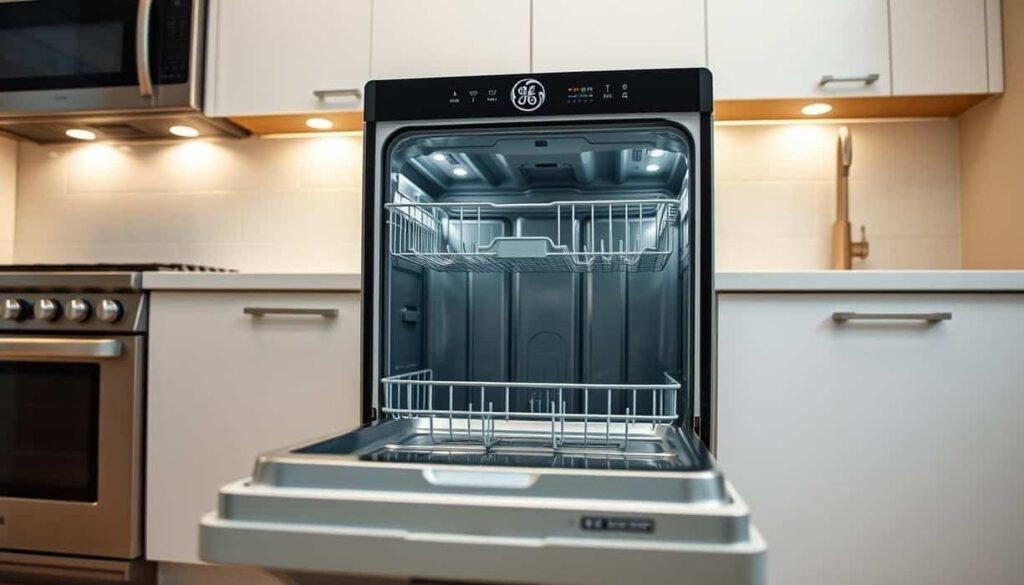
The dishwasher door must be considered in both the closed and open positions.
Under the ADA kitchen provisions, clear floor space should be positioned adjacent to the dishwasher door, and the open door must not obstruct the required clear floor space for the dishwasher or sink.
This is particularly important in compact kitchens.
Should an ADA Dishwasher Be Raised Off the Floor?
Sometimes homeowners consider raising a conventional dishwasher to make loading easier.
This should not be treated as a substitute for selecting an appropriately designed accessible appliance.
Raising a dishwasher can affect:
- Countertop height
- Door alignment
- Cabinet structure
- Drain routing
- Water connections
- Electrical connections
- Appliance stability
- Manufacturer installation requirements
- Accessible clearances
If an accessible kitchen is being designed from scratch, choosing a dishwasher specifically intended for the required height is generally a more predictable approach than improvising an elevated installation.
Can an ADA Dishwasher Be Installed Under a Standard Countertop?
Yes, depending on the model and the kitchen configuration.
A shorter dishwasher can be installed beneath a conventional-height countertop, potentially leaving additional space around the appliance or allowing a customized toe-kick arrangement.
Some manufacturers specifically describe installation flexibility for their ADA-height models, including installations beneath standard countertop heights.
However, the exact installation method must follow the manufacturer’s instructions.
ADA Dishwasher and Countertop Height
The dishwasher and countertop should be designed together.
An accessible kitchen may use a lower work surface to improve seated access. A standard dishwasher may be too tall to fit below that work surface.
An ADA-height dishwasher can solve this dimensional conflict.
UK accessible kitchen guidance similarly recognizes the importance of kitchen layouts that accommodate wheelchair users, including appropriate work surfaces and appliance positioning.
The exact dimensions vary according to the applicable building regulations and the individual kitchen design.
ADA Dishwasher and Wheelchair Clearance
Clearance is one of the most important parts of an accessible installation.
The user needs enough space to approach the dishwasher, position the wheelchair, open the door, and access the racks.
The ADA standards require clear floor or ground space at kitchen appliances and specifically address the relationship between the dishwasher door and the required clear space.
A designer should therefore avoid placing a dishwasher where the open door blocks the only route through the kitchen.
Are ADA Dishwashers More Expensive?
They can be.
The price depends on:
- Brand
- Width
- Noise rating
- Wash technology
- Drying system
- Rack configuration
- Smart features
- Stainless-steel construction
- Energy efficiency
- Accessibility design
- Installation requirements
An ADA dishwasher is not automatically more expensive because of the ADA designation alone. However, the selection of accessible-height models is smaller than the overall dishwasher market, and some manufacturers position their accessible models within higher equipment ranges.
The important comparison is the total value of the appliance rather than simply the purchase price.
Do ADA Dishwashers Clean as Well as Regular Dishwashers?
Yes, an ADA-height dishwasher can provide cleaning performance comparable to a conventional dishwasher.
The lower height primarily relates to physical dimensions and accessibility rather than an inherently different washing process.
Cleaning performance depends on factors such as:
- Spray-arm design
- Water pressure
- Filtration
- Wash temperature
- Cycle design
- Soil sensing
- Detergent
- Water hardness
- Rack loading
- Drying technology
For example, current accessible models can include multiple spray arms, filtration systems, sensors, heated or automatic drying, and other modern dishwasher technologies.
Are ADA Dishwashers Energy Efficient?
Accessibility and energy efficiency are separate characteristics.
An ADA dishwasher is not automatically more or less energy efficient simply because it is ADA-height.
Energy performance should be evaluated using the appliance’s energy label and certification information.
Current U.S. efficiency criteria evaluate both energy consumption and water consumption, with separate thresholds for standard and compact dishwashers.

The same principle applies in Canada and the UK: look at the applicable energy information and model specifications rather than assuming that accessibility determines efficiency.
Are ADA Dishwashers Quiet?
Some are.
Quiet operation is not itself an ADA requirement.
However, accessible dishwasher models can include modern sound-reduction technologies, and some manufacturers specifically promote quiet operation on their ADA-height products.
If the dishwasher is being installed in an open-plan kitchen, noise may be an important consideration regardless of accessibility.
Check the manufacturer’s stated decibel rating rather than assuming an ADA dishwasher is automatically quiet.
ADA Dishwashers for Older Adults
An ADA-height dishwasher can also be useful for older adults who experience difficulty bending or reaching.
Repeatedly bending to load a dishwasher can be uncomfortable for some people. A carefully designed kitchen can reduce unnecessary bending by positioning appliances, work surfaces, and storage within convenient reach.
The same accessibility principles apply: the user should be able to approach the dishwasher safely, operate its controls, open the door, and reach the racks without excessive physical effort.
Accessibility should therefore be considered as part of the entire kitchen rather than treating the dishwasher as an isolated appliance.
ADA Dishwasher for People With Arthritis
People with arthritis may particularly benefit from controls and handles that require less force.
When selecting an appliance, examine:
- Door-latch resistance
- Handle shape
- Button size
- Button activation force
- Touchscreen usability
- Rack movement
- Rack handle design
- Detergent dispenser operation
Accessibility standards place importance on operating controls without tight grasping, pinching, or twisting of the wrist.
For someone with significant hand limitations, physically testing the controls before purchase can be more useful than relying solely on a product description.
Smart Features and ADA Dishwashers
Smart technology can sometimes improve accessibility.
A connected dishwasher may allow a user to:
- Start a cycle
- Monitor progress
- Receive notifications
- Check cycle status
- Receive maintenance alerts
Some accessible models currently offer smartphone connectivity.
However, smart features should complement rather than replace accessible physical controls.
If the internet connection fails, the dishwasher should still be usable through its normal controls.
Are ADA Dishwashers Only for Commercial Buildings?
No.
ADA accessibility requirements are relevant in covered public and commercial environments, but ADA-height dishwashers are also sold for residential kitchens.
Manufacturers market accessible-height residential dishwashers specifically for people with physical limitations and kitchens with special height requirements.
For private residential projects, the legal requirements can differ from those applicable to public accommodations or other covered facilities. Homeowners should therefore distinguish between buying an ADA-height appliance for convenience and meeting a specific legal accessibility requirement.
ADA Dishwasher Requirements in the USA
In the United States, the ADA standards are particularly important when an appliance is part of a covered accessible facility.
The standards specify that kitchen appliances must have appropriate clear floor or ground space and that appliance controls must comply with applicable accessibility requirements. The dishwasher provision specifically addresses the position of clear floor space and the open dishwasher door.
Reach ranges are also important. For unobstructed forward and side reaches, the 2010 standards generally establish a maximum high reach of 48 inches and a minimum low reach of 15 inches.
The exact legal obligations depend on the building, its use, whether it is new construction or an alteration, and which ADA provisions apply.
ADA Dishwashers in Canada
Canada does not simply use the U.S. ADA framework as its national accessibility standard.
Canadian accessibility design can involve CSA/ASC B651, provincial or territorial requirements, building codes, and other applicable standards. The current CSA/ASC B651 framework addresses accessible design for people with physical, sensory, and cognitive disabilities and is referenced in the National Building Code and other legislation.
For a Canadian accessible kitchen, therefore, the term “ADA dishwasher” should be treated as a product description rather than proof that the complete installation meets Canadian accessibility requirements.
The better approach is to check the applicable provincial or territorial rules and design the entire kitchen around the user’s needs.
ADA Dishwashers in the UK
The UK does not use the ADA as its accessibility framework.
In England, Approved Document M provides guidance relating to access and use of buildings. It includes accessibility considerations for dwellings and other buildings.
Accessible kitchen layouts can include provisions for wheelchair users, including the relationship between work surfaces and appliances. UK guidance illustrates wheelchair-accessible kitchen layouts that include a dishwasher as part of the overall arrangement.
Therefore, a dishwasher marketed in the United States as “ADA compliant” may still be a useful choice for an accessible UK kitchen, but the entire installation should be evaluated against the applicable UK requirements.
ADA Dishwasher vs Accessible Dishwasher
These terms are related but not identical.
ADA dishwasher generally refers to a dishwasher marketed or designed to meet U.S. accessibility requirements or dimensions.
Accessible dishwasher is a broader term describing a dishwasher that is easier for people with disabilities or mobility limitations to use.
An accessible dishwasher might be appropriate for a particular user even when it is not specifically marketed using the ADA label.
For example, a person might prioritize:
- A low loading height
- Easy door operation
- Front controls
- Large buttons
- Easy-gliding racks
- Automatic door opening
- Smartphone controls
The best appliance depends on the individual’s actual needs.
How to Choose an ADA Dishwasher
Use the following checklist before buying.
1. Measure the cabinet opening
Measure height, width, and depth accurately.
2. Check finished floor height
Do not measure only from the subfloor. Finished flooring can change the final appliance height.
3. Check countertop height
Confirm that the ADA-height dishwasher fits beneath the intended countertop.
4. Examine the controls
Make sure they can be reached and operated comfortably.
5. Test the door
Open and close the door several times.
6. Pull out the racks
Check whether the racks can be pulled out without excessive force.
7. Check loading reach
Try reaching the bottom and upper racks from the user’s normal position.
8. Check the open-door position
Make sure the open door does not create a dangerous obstruction.
9. Consider width
Choose 18 inches if space is limited or 24 inches if higher capacity is needed.
10. Check energy efficiency
Use the applicable energy information rather than assuming accessibility determines efficiency.
11. Check noise
Consider the sound rating if the kitchen is close to living or sleeping areas.
12. Verify installation requirements
Confirm plumbing, electrical, drain, and mounting requirements.
Common Mistakes When Buying an ADA Dishwasher
Mistake 1: Assuming Every Short Dishwasher Is ADA Compliant
A short appliance may simply be a compact model.
Always check the manufacturer’s accessibility information.
Mistake 2: Ignoring the Kitchen Layout
An accessible appliance cannot compensate for a kitchen with insufficient approach space.
Mistake 3: Measuring the Cabinet Incorrectly
A difference of even an inch can make installation impossible.
Mistake 4: Forgetting the Open Door
The dishwasher occupies substantially more space when the door is open.
Mistake 5: Choosing Controls Without Testing Them
A control panel may look attractive but be difficult for someone with limited dexterity.
Mistake 6: Assuming ADA Means 32 Inches Exactly
Many accessible models are around 32 inches, but actual dimensions vary.
Mistake 7: Ignoring the User
Accessibility is personal. A configuration that works well for one wheelchair user may not work equally well for another.
Mistake 8: Assuming ADA Means Energy Efficient
Accessibility and energy efficiency are separate specifications.
Mistake 9: Assuming ADA Means Quiet
Check the actual noise rating.
Mistake 10: Treating the U.S. ADA Label as a UK or Canadian Legal Certification
The USA, Canada, and UK use different accessibility frameworks.
Can You Put an ADA Dishwasher in Any Kitchen?
Technically, an ADA-height dishwasher can potentially be installed in many kitchens if the cabinet opening, plumbing, electrical connection, and countertop dimensions are compatible.
But whether it is a good accessibility solution depends on the layout.
A kitchen should ideally provide:
- A practical approach route
- Adequate space beside the dishwasher
- Convenient control access
- Safe door operation
- Appropriate countertop height
- Sufficient rack access
- Safe drainage and plumbing
- Appropriate electrical installation
The ADA standards specifically emphasize clear floor space at appliances, demonstrating why appliance selection and kitchen layout need to be considered together.
Can a Standard Dishwasher Be Made ADA Accessible?
This is complicated.
Some accessibility can be improved through kitchen layout modifications, but a standard-height dishwasher cannot automatically be transformed into an ADA-compliant appliance simply by changing its controls or lowering a countertop.
The appliance’s dimensions, door configuration, control position, and installation all matter.
If the goal is to create a kitchen that meets a specific accessibility requirement, the appliance should be selected as part of the accessibility design rather than modified afterward without professional review.
ADA Dishwasher Maintenance
Maintenance requirements are generally similar to those of other dishwashers.
An accessible dishwasher should still have:
- Clean filters
- Clear spray arms
- Proper detergent
- Adequate rinse aid where appropriate
- Correct water temperature
- Clean door seals
- Proper drainage
- Regular inspection
Accessibility does not change the basic principles of dishwasher maintenance.
However, maintenance should also be considered from an accessibility perspective. If a filter is difficult to reach, a user with limited mobility may need assistance. When designing an accessible kitchen, maintenance tasks should be considered alongside daily operation.
Are ADA Dishwashers Worth It?
For a person who needs the accessibility characteristics, an ADA-height dishwasher can solve an important kitchen-design problem.
The biggest benefit is not necessarily better washing performance. The primary benefit is easier physical access.
An appropriate model can help coordinate:
- Dishwasher height
- Countertop height
- Reach range
- Door clearance
- Control accessibility
- Wheelchair approach
- Kitchen workflow
For someone who does not need a lower dishwasher, a standard-height model may provide more choices. For someone designing an accessible kitchen, however, the shorter dimensions and accessibility-focused design can be extremely important.
ADA Dishwasher Buying Checklist
Before purchasing, ask these questions:
- Is the dishwasher officially identified by the manufacturer as ADA compliant or ADA height?
- What is its exact height?
- What is its exact width?
- What is the required cabinet opening?
- Are the controls within an appropriate reach?
- Can the controls be operated with limited hand strength?
- Is the door easy to open?
- Can the racks be reached comfortably?
- Does the open door block a route?
- Is there sufficient clear floor space?
- Does it fit below the countertop?
- Is the drain connection accessible?
- Is the electrical connection suitable?
- Is the dishwasher ENERGY STAR qualified or otherwise energy efficient?
- What is its noise rating?
- Does it have smart controls?
- Does the user’s wheelchair fit comfortably beside the appliance?
- Does the entire kitchen meet the applicable accessibility requirements?
ADA Dishwasher FAQs
1. What is an ADA dishwasher?
An ADA dishwasher is a dishwasher designed with accessibility in mind, particularly for users with disabilities or physical limitations. In the U.S., the term commonly refers to models designed around ADA accessibility requirements, including considerations for appliance height, controls, reach, and clear floor space.
2. How tall is an ADA dishwasher?
Many ADA-height dishwashers are approximately 32 inches tall, although the exact height varies by model. Always check the manufacturer’s specifications.
3. How tall is a standard dishwasher?
Many standard built-in dishwashers are approximately 34 inches tall, although actual dimensions vary by manufacturer and model.
4. Why are ADA dishwashers shorter?
The shorter height allows them to fit into kitchen designs with lower countertops and can make the appliance easier to access from a seated position.
5. Are ADA dishwashers only for wheelchair users?
No. They can also help people with limited mobility, limited reach, reduced hand strength, or difficulty bending.
6. Are ADA dishwashers smaller?
They are shorter, but not necessarily smaller in width. Both 18-inch and 24-inch ADA-height models are available.
7. Do ADA dishwashers clean normally?
Yes. Accessibility design primarily concerns physical access and operation rather than washing technology.
8. Do ADA dishwashers use less water?
Not necessarily. Water consumption depends on the individual model and its efficiency rating.
9. Are ADA dishwashers energy efficient?
Some are highly efficient, but ADA status itself does not guarantee energy efficiency.
10. Are ADA dishwashers more expensive?
Some are, but prices vary considerably according to brand, features, capacity, and construction.
11. Can an ADA dishwasher have a stainless-steel tub?
Yes. Accessibility does not determine tub material.
12. Can an ADA dishwasher have a third rack?
Some models can offer advanced rack configurations, although availability varies by model.
13. Can an ADA dishwasher be 24 inches wide?
Yes. Several manufacturers offer 24-inch ADA-height models.
14. Can an ADA dishwasher be 18 inches wide?
Yes. 18-inch ADA-height models are available for smaller kitchens.
15. Are ADA dishwashers available with front controls?
Yes. Accessible models can be available with front-control configurations.
16. Are front controls automatically ADA compliant?
No. Control position is only one part of accessibility.
17. Does ADA mean wheelchair accessible?
An ADA designation relates to applicable accessibility requirements, but the entire installation must be considered for wheelchair accessibility.
18. Can I install an ADA dishwasher under a normal countertop?
Many ADA-height models are designed for installation under conventional countertops, but exact dimensions must be verified.
19. Can I raise a standard dishwasher to make it accessible?
It may be physically possible in some installations, but raising an appliance does not automatically make the complete installation ADA compliant.
20. Does an ADA dishwasher require special plumbing?
Usually, the plumbing principles are similar to other built-in dishwashers, but the exact installation requirements depend on the model.
21. Does an ADA dishwasher require special electrical wiring?
Not necessarily. Electrical requirements depend on the specific model and local electrical requirements.
22. Can ADA dishwashers be used in normal homes?
Yes. They are widely available for residential kitchens.
23. Can an ADA dishwasher be installed in an apartment?
Potentially, provided the building, cabinetry, plumbing, electrical system, and lease or building rules permit the installation.
24. Are ADA dishwashers good for elderly people?
They can be useful for people who have difficulty bending, reaching, standing, or operating conventional controls.
25. Are ADA dishwashers good for people with arthritis?
They can be, particularly when the controls, handle, racks, and door require relatively little force.
26. What should I look for if I use a wheelchair?
Pay particular attention to approach space, door clearance, control height, dishwasher height, rack accessibility, countertop height, and the ability to reach the interior comfortably.
27. What is the ADA reach range for controls?
For unobstructed forward or side reach under the 2010 ADA Standards, the general high reach is 48 inches maximum and low reach is 15 inches minimum above the finished floor.
28. Can dishwasher controls be difficult for people with limited dexterity?
Yes. Small buttons, stiff controls, awkward touchscreens, and controls requiring excessive force can create accessibility problems.
29. Are touchscreens accessible?
They can be, but accessibility depends on the design, size, feedback, contrast, and the user’s abilities.
30. Are ADA dishwashers quieter?
Not necessarily. Quietness is a separate product characteristic.
31. Do ADA dishwashers have smart features?
Some modern ADA-height models offer smartphone connectivity and other smart features.
32. Are ADA dishwashers available with automatic drying?
Some models are available with advanced drying systems, including automatic or heated drying.
33. Are ADA dishwashers available in stainless steel?
Yes.
34. Can an ADA dishwasher have a panel-ready design?
Yes. Some manufacturers offer ADA-height built-in and custom-panel-ready configurations.
35. Can an ADA dishwasher fit beneath a lower countertop?
That is one of the main reasons ADA-height models exist.
36. Does an ADA dishwasher have to be exactly 32 inches high?
No. The exact dimensions depend on the model and installation.
37. Is ADA the same as accessible?
Not exactly. ADA is a U.S. legal accessibility framework, while accessible is a broader descriptive term.
38. Does Canada use ADA standards?
Canada has its own accessibility frameworks and standards, including CSA/ASC B651.
39. Does the UK use ADA standards?
No. The UK uses its own accessibility and building regulations. In England, Approved Document M addresses access and use of buildings.
40. Can I use an ADA dishwasher in Canada?
Yes, an ADA-height dishwasher can be used in Canada, but the installation should be evaluated against the applicable Canadian accessibility and building requirements.
41. Can I use an ADA dishwasher in the UK?
Yes, an ADA-height dishwasher can be installed in the UK if it meets the applicable product and installation requirements, but the U.S. ADA designation should not be treated as a UK legal certification.
42. Is an ADA dishwasher better than a standard dishwasher?
The answer depends on the user’s needs. Its main advantage is accessibility rather than inherently superior cleaning.
43. Does an ADA dishwasher have less capacity?
Not necessarily. Capacity depends heavily on width and rack design.
44. Are 24-inch ADA dishwashers suitable for families?
They can be, particularly where a full-width dishwasher is needed while maintaining a lower accessible height.
45. Are 18-inch ADA dishwashers good for small kitchens?
They can be particularly useful when cabinet space is limited.
46. Can a dishwasher door block wheelchair access?
Yes. This is why the relationship between the dishwasher door and clear floor space is an important part of accessible kitchen design.
47. Should I test an ADA dishwasher before buying?
If possible, yes. Testing the controls, door, racks, and loading reach can reveal problems that dimensions alone cannot show.
48. Can ADA dishwashers be used by people without disabilities?
Yes. There is no requirement that an ADA-height residential dishwasher be used only by someone with a disability.
49. Do ADA dishwashers require special detergent?
No. They generally use dishwasher detergent in the same way as comparable conventional dishwashers.
50. Do ADA dishwashers need special maintenance?
Generally no. Routine maintenance is similar to other dishwashers.
51. Are ADA dishwashers available from major manufacturers?
Yes. Major manufacturers currently offer ADA-height dishwasher models.
52. What is the biggest advantage of an ADA dishwasher?
For an accessible kitchen, the major advantage is the ability to integrate a dishwasher into a lower and more accessible kitchen layout.
53. What is the biggest mistake when choosing one?
Choosing the dishwasher without considering the surrounding kitchen layout and the individual user’s abilities.
54. Does an ADA dishwasher guarantee that my kitchen is ADA compliant?
No. Appliance compliance and overall kitchen accessibility are separate issues.
55. Can an accessible kitchen use a standard dishwasher?
Potentially, depending on the user’s needs and the overall layout, but a standard-height dishwasher may not work in a kitchen designed around lower accessible countertops.
56. Can an ADA dishwasher be installed beside an accessible sink?
Yes, and the relationship between the dishwasher and sink can be important because both are frequently used together during loading and unloading.
57. Why is dishwasher door clearance important?
The open door can occupy a substantial portion of the user’s maneuvering area, so it should not interfere with required clear floor space.
58. Are ADA dishwashers useful for people who cannot bend easily?
Yes. Their lower installation height can reduce the amount of bending required, although individual suitability depends on the user.
59. Can smart controls make an ADA dishwasher more accessible?
They can provide additional ways to monitor or control the appliance, but they should not be considered a substitute for accessible physical controls.
60. What should I check first when buying an ADA dishwasher?
Start with the user’s needs and the kitchen measurements. Then compare appliance height, control accessibility, door clearance, rack access, width, capacity, efficiency, and installation requirements.
Final Thoughts
An ADA dishwasher is more than a short dishwasher. Its purpose is to make dishwasher operation more accessible by combining appropriate appliance dimensions with accessible controls, door operation, reach, and installation space.
For many U.S. accessibility applications, the key considerations include clear floor space beside the dishwasher, accessible controls, appropriate reach ranges, and an open-door configuration that does not obstruct the required access space.
The approximately 32-inch height found on many ADA-height models is particularly useful when a kitchen has been designed around a lower countertop. Manufacturers currently offer both 18-inch and 24-inch accessible-height models, meaning that accessibility does not necessarily require sacrificing either a narrow-kitchen configuration or full-width dishwasher capacity.
For Canada, the important consideration is that accessibility should be evaluated using the applicable Canadian standards and local requirements rather than assuming that the U.S. ADA label alone establishes compliance. CSA/ASC B651 provides a major Canadian accessibility reference for the built environment.
For the UK, the equivalent approach is to consider the applicable national and local building requirements, including accessibility guidance such as Approved Document M in England. Accessible kitchen planning should consider the dishwasher as one component of the overall kitchen rather than as an isolated product.
Ultimately, the best ADA or accessible dishwasher is the one that works with the person, kitchen, countertop, wheelchair or mobility equipment, reach range, door clearance, rack arrangement, and installation conditions. Measuring the kitchen and evaluating the user’s actual movements before purchasing is much more reliable than choosing a dishwasher solely because the product description contains the words “ADA compliant.”