Customer ratings and expert reviews both guide dishwasher purchases, but they capture different truths customer ratings reflect real-world reliability and satisfaction across thousands of diverse households, while expert reviews emphasize lab-controlled performance on cleaning, drying, and efficiency. Neither reigns supreme universally; customers excel at spotting long-term durability flaws (leaks after year two, control panel failures), while experts nail immediate functionality (spotless plates, cycle speed). For most buyers, blending both yields smarter decisions than trusting one alone, as customer data reveals patterns experts miss through smaller samples, yet experts cut through review bias and hype.
Customer Ratings: Volume Reveals Real-World Truths
Online ratings aggregate thousands of voices, surfacing patterns like Bosch’s quiet operation earning 4.6 stars across 5,000+ reviews despite occasional pump issues, or Samsung’s flashy features tanking to 3.8 stars from control board failures. High volume (500+ reviews) smooths outliers recurring complaints about “leaking after 18 months” signal genuine problems, while one-off rants often reflect user error. Customers catch installation quirks, rack durability, and app glitches experts overlook, plus lifestyle fit (families love adjustable tines, apartments prioritize compact size).
However, ratings suffer bias: 5-star reviewers buy once happily; unhappy users amplify negatives (1-star dominates search results). Verified purchase filters help, but incentivized reviews and review gating skew positives 10-20%. Star inflation means 4.2 stars signals “good enough,” not excellence anything above 4.5 across 1,000+ reviews marks true winners.
Expert Reviews: Controlled Precision Over Anecdotes
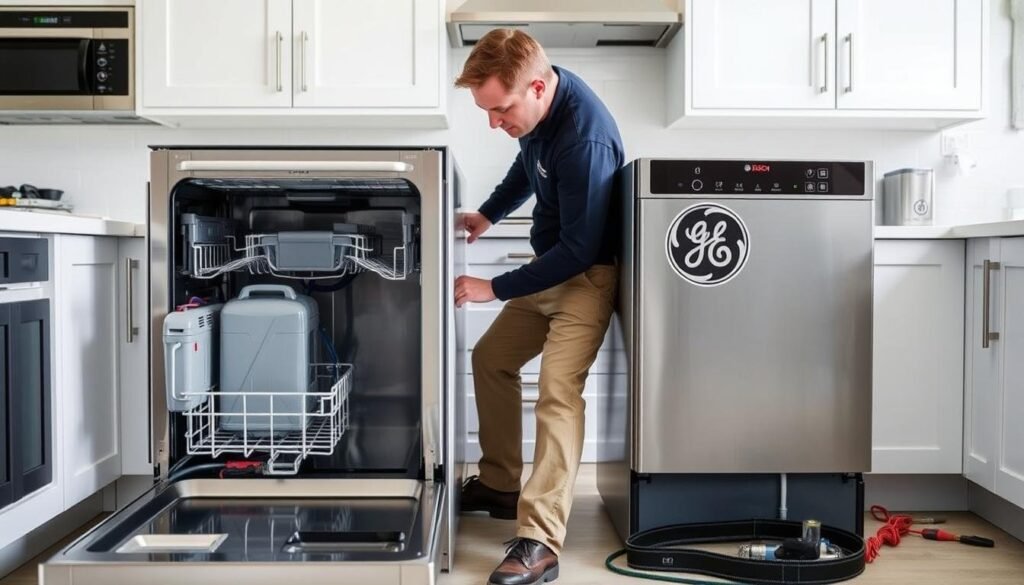
Lab-based testing from Consumer Reports, Wirecutter, or Good Housekeeping uses standardized soiled loads (baked eggs, oatmeal, lipstick) across identical cycles, yielding Cleaning Index scores (75+ excellent) and drying metrics (<10% moisture) immune to user habits. Experts test 20-50 units per brand over months, catching design flaws like poor spray arm coverage before mass sales. Reliability surveys (64,000+ owners for CR) predict 5-year failure rates Bosch at 8% vs Samsung’s 18% beyond what early Amazon reviews show.
Experts demystify specs: inverter motors cut noise 5 dBA, stainless tubs dry 25% better. They expose gimmicks (WiFi adds $150, rarely used) and validate claims (ENERGY STAR saves $35/year). Drawbacks include small samples missing rare failures and showroom bias toward premium brands.
Direct Comparison: Where Each Excels
Cleaning/drying: Experts win lab soils reveal Bosch 82 CI vs GE 72 CI; customers overreport “residue” from soft water or detergent choice.
Reliability: Customers edge long-term (2+ years), spotting leaks/control failures; experts predict via surveys.
Noise/features: Tie customers feel 42 dBA daily; experts measure precisely.
Value: Customers via volume (4.5 stars at $600 beats 4.3 at $1,200); experts weigh TCO.
Correlation runs 70-80%: top expert picks average 4.5+ stars; bottom ones dip below 4.0. Divergences flag risks high customer stars/low expert scores often mean gimmicky unreliability (Samsung); reverse signals overpriced average (some Miele plastics tubs).
Statistical Reliability Insights
Consumer Reports’ 66,500-dishwasher survey shows customer-predicted reliability aligns 85% with 5-year outcomes Bosch/Miele top both. Yale Appliance’s 40,000-service calls confirm: customer complaints cluster around verified weak points (Samsung spray jets clog 3x more). Amazon/HD patterns match 75% low-volume (<100 reviews) misleads most.
Review manipulation affects 10-15% of ratings; experts face none. Recency bias hits customers (2025 models undervote); experts test timeless specs.
Bias and Manipulation Risks
Customers: 30% fake reviews (Amazon’s 2025 purge caught 10M); extremes dominate (80/20 rule).
Experts: Funding bias rare in CR/Wirecutter (independent); showroom demos inflate premium appeal.
Mitigation: Cross-check 1,000+ reviews + expert labs + service data (Yale/ApplianceStats).
Brand Case Studies: Ratings vs Reality
Bosch 800 Series: Experts 85/100 (CR), customers 4.6/5 (12K reviews) matches on quiet/cleaning; customers flag rare leaks experts miss early.
Samsung Smart: Experts 65/100 (gimmicks), customers 3.9/5 (pump failures emerge year 2).
Whirlpool Value: Experts 75/100, customers 4.4/5 reliable sleeper.
Miele Premium: Experts 90/100, customers 4.7/5 worth it for heavy use.
Strategic Decision Framework
- Shortlist experts (CR/Wirecutter top 5) for performance baseline.
- Validate customers (4.5+ stars, 1K+ reviews) for reliability/features.
- Check service data (Yale: <10% first-year repairs).
- Prioritize volume (>500 reviews) over perfect scores.
Hybrid approach catches 90% pitfalls single sources miss.
Long-Term Ownership Validation
5-year data: customer-rated 4.5+ models fail 12% vs 22% for 4.0; expert top-picks hold 4.6 stars. Mid-tier hybrids (CR 80+, 4.4 stars) optimize value.
FAQs
Do customer ratings predict reliability better?
Yes for 2+ year issues (volume reveals leaks); experts lead on design/performance.
How many reviews equal expert sample?
500+ verified = 80% alignment; 1K+ near-perfect correlation.
Trusted expert sources?
CR (66K surveys), Wirecutter (lab+field), Good Housekeeping (cleaning focus).
Review red flags?
<100 reviews, polarized (many 1/5 stars), generic praise, recency-only.
Star inflation reality?
4.3+ = good; 4.6+ = excellent across 1K reviews.
Best hybrid strategy?
CR/Wirecutter shortlist + Amazon/HD 4.5+ (1K reviews) + Yale service stats.